
Field Crickets: Identification, Habits, Entry Points, and Control
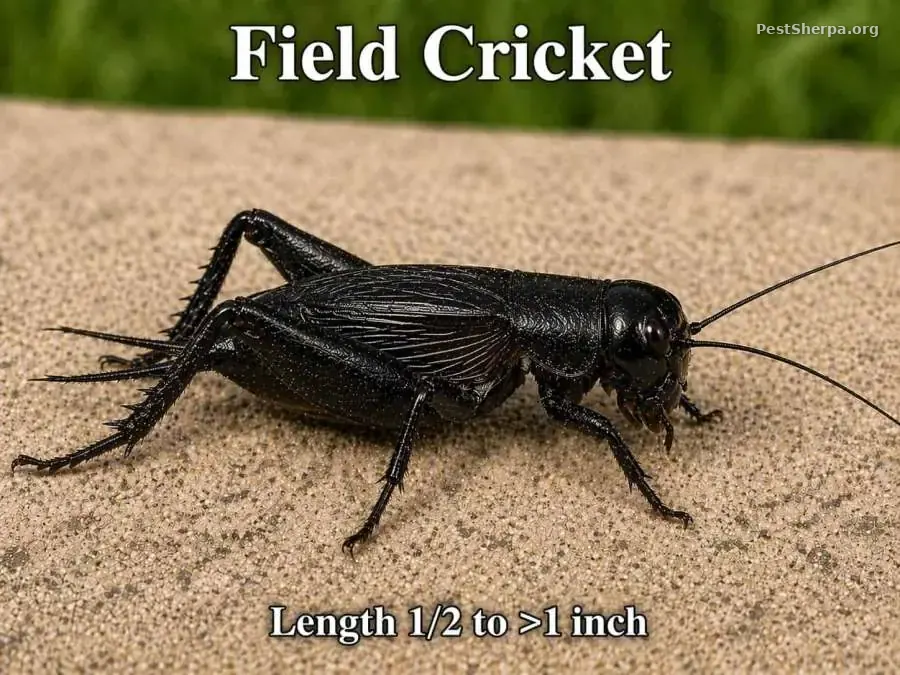
Field crickets are outdoor insects that often become noticeable around homes and commercial properties in late summer and fall. They are usually recognized by dark brown to black bodies, very long antennae, strong jumping legs, and the loud chirping produced by males. In pest management, field crickets are occasional invaders: they usually develop outdoors, then move indoors through gaps under doors, foundation cracks, damaged screens, garage openings, utility penetrations, and other small entry points.
Indoors, field crickets are usually a nuisance rather than a structural pest. Heavy activity can create nighttime noise, dead insect buildup, unpleasant odor, and occasional chewing damage to fabrics, paper, or stored materials. The most effective plan starts with identification, then focuses on outdoor sources, light attraction, entry points, and sanitation instead of treating only the crickets seen inside.
A good control plan begins with accurate identification. Field crickets, house crickets, camel crickets, and mole crickets should not be managed as if they are the same pest.
Quick Summary
| Question | Quick Answer |
|---|---|
| Are field crickets dangerous? | No. They do not sting, are not known as a disease-spreading household pest, and do not damage structures. |
| Why are they coming inside? | They are usually entering from nearby outdoor habitat, especially near lights, doors, garages, cracks, and foundation gaps. |
| Do they reproduce indoors? | Usually not in typical homes. Most problems begin outdoors, though house crickets are more likely than field crickets to live indoors. |
| What is the best first step? | Inspect outside: lights, vegetation, mulch, debris, door sweeps, screens, and foundation openings. |
| Do pesticides always solve it? | No. Habitat reduction, exclusion, lighting changes, and cleanup are often more important than spraying. |
Quick Navigation
- Identification of Field Crickets
- Field Cricket Lookalikes
- Habitat and Seasonal Activity
- Life Cycle and Feeding Habits
- Signs of a Field Cricket Problem
- Why Field Crickets Suddenly Appear
- Inspection Checklist
- Prevention and Control
- What Does Not Work Well
- Pesticide Safety Notes
- When Professional Help May Be Worth Considering
- Frequently Asked Questions
- References
Identification of Field Crickets
Field crickets belong to the order Orthoptera and the family Gryllidae. Many common field crickets are placed in the genus Gryllus. Adults are usually dark brown to black and commonly measure about 1/2 to a little over 1 inch long, depending on species and location. Compared with house crickets, field crickets are generally darker, sturdier, and less yellow in appearance.
Key field cricket features include long, threadlike antennae, enlarged hind legs for jumping, two slender cerci at the rear of the abdomen, and forewings that lie flat over the back. Females also have a long, straight ovipositor between the cerci. This structure is used to place eggs into soil or protected material. Males lack an ovipositor and make sound by rubbing specialized wing surfaces together.
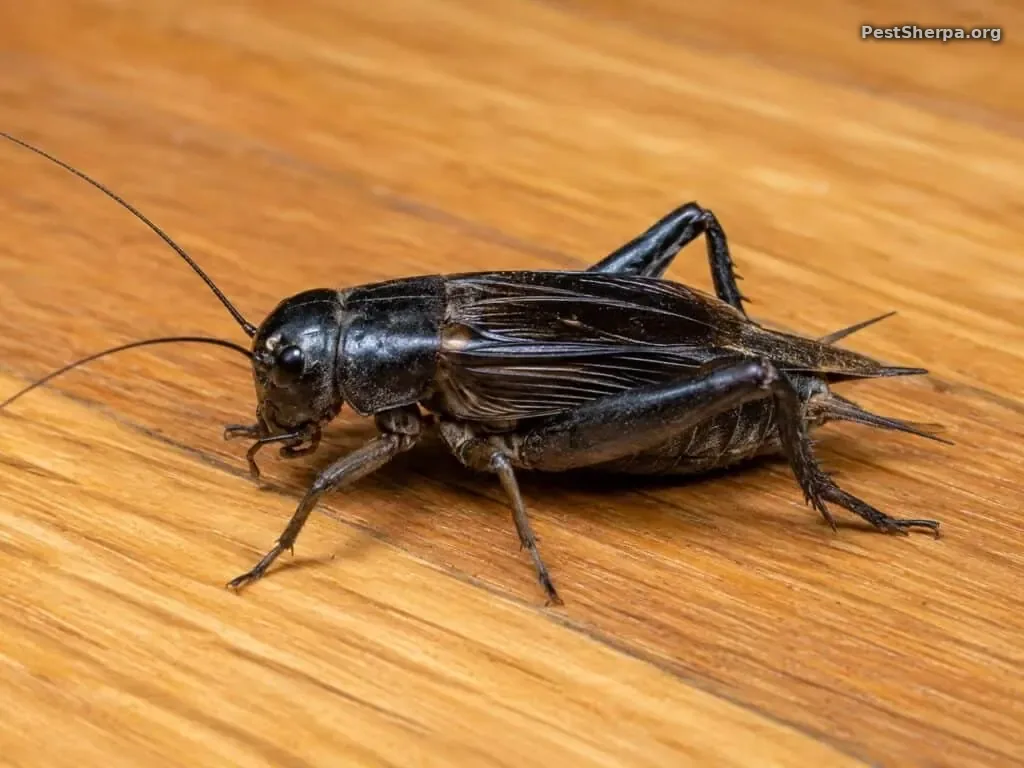
IAdult field cricket showing dark body, long antennae, jumping legs, cerci, and wings.
Field Cricket Lookalikes
Several cricket-like insects can show up around structures. Correct identification matters because the source conditions can differ.
| Pest | How It Differs | Most Likely Clue |
|---|---|---|
| Field cricket | Dark brown to black, sturdy body, long antennae, strong hind legs | Often outdoors in lawns, fields, mulch, debris, and near lights |
| House cricket | Usually yellowish brown or tan, often with darker head markings | More likely than field crickets to persist in warm indoor areas |
| Camel cricket | Humpbacked, wingless, very long legs, no chirping | Often in damp basements, crawl spaces, garages, and other moist areas |
| Mole cricket | Thick body with enlarged front legs adapted for digging | Usually associated with soil and turf rather than indoor chirping |
| Ground beetle | Hard-winged beetle, not a cricket; may run quickly and may be dark | Often attracted to lights and found near doors, windows, and foundations |
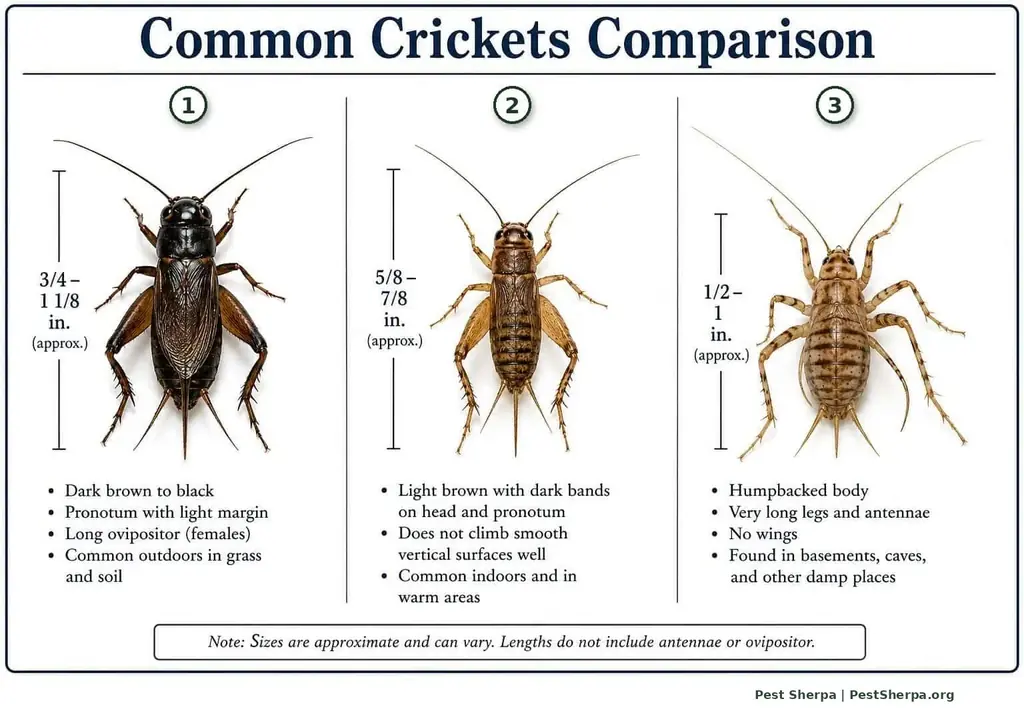
Which one did you find? Match the number:
- Field cricket: dark brown to black, 3/4 to 1 1/8 inch. Common outdoors in grass and soil.
- House cricket: light brown with dark bands on the head and the shield behind it, 5/8 to 7/8 inch.
- Camel cricket: humpbacked and wingless with very long legs and antennae, 1/2 to 1 inch. Found in basements and other damp places.
Habitat and Seasonal Activity
Field crickets are widely distributed in the United States and are associated with fields, lawns, pastures, roadsides, gardens, landscaped areas, open ground, and weedy lots. Outdoors, they hide under stones, boards, leaf litter, mulch, dense vegetation, soil cracks, and other debris.
Around buildings, field crickets often gather near foundations, doorways, garage doors, patios, sidewalks, loading docks, service entrances, trash areas, and exterior lights. Light attraction is one of the main reasons they become a building problem. Bright lights can draw crickets from nearby turf, mulch, and weedy areas to walls and entry points.
In many areas, adult activity becomes most noticeable in late summer and fall. Large numbers may appear during favorable years, especially where outdoor lights, warm weather, nearby vegetation, and accessible entry points overlap.
Life Cycle and Feeding Habits
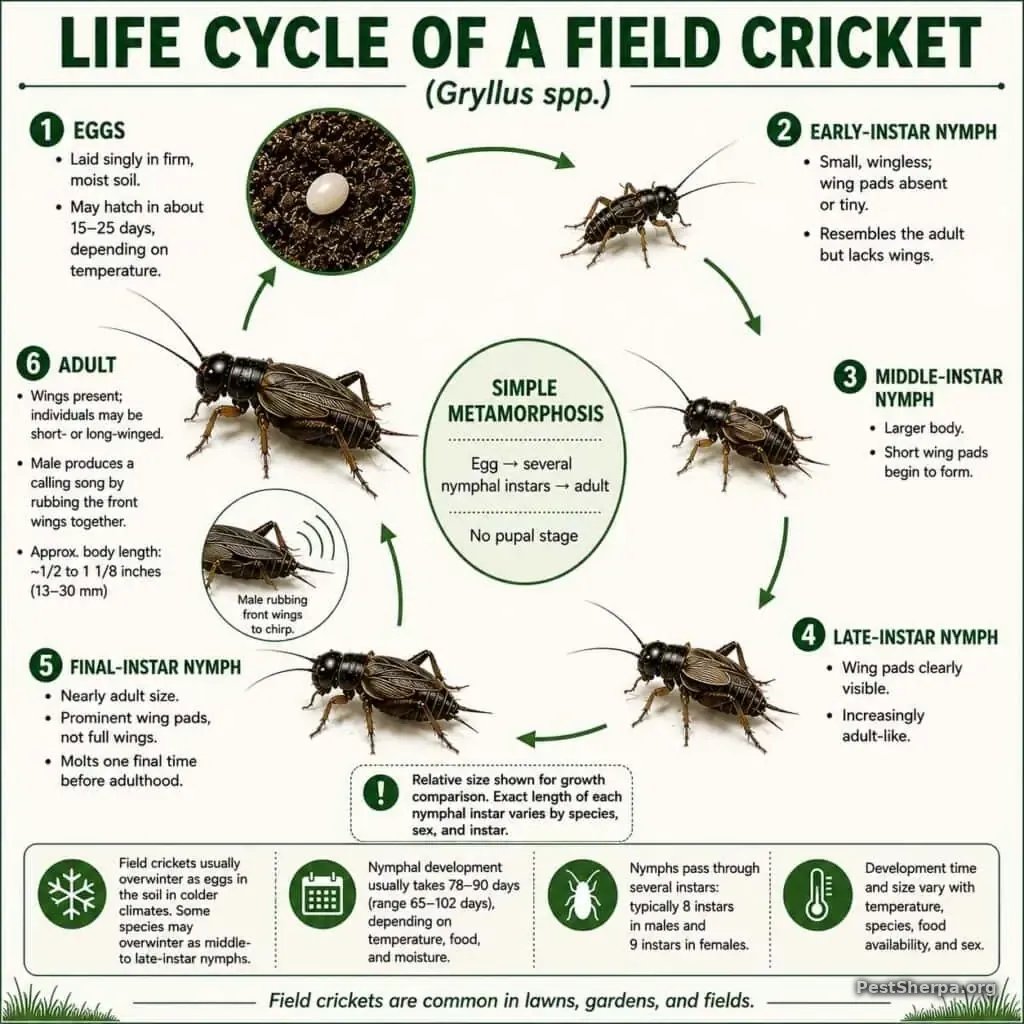
Field crickets develop by incomplete metamorphosis, which includes egg, nymph, and adult stages. Young crickets hatch as nymphs that resemble small adults, then grow through a series of molts before reaching maturity. Females deposit eggs in soil or similar protected sites. Overwintering stage and timing vary by species and climate; some field crickets overwinter as eggs, while others may overwinter as nymphs.
Field crickets are omnivorous scavengers. Outdoors, they may feed on grasses, weeds, seeds, fruits, seedlings, dead insects, living insects, and decaying organic matter. In gardens, large populations may injure seedlings or tender plants, but around buildings they are more often a nuisance than a major plant pest.
Indoors, field crickets may feed on crumbs, organic debris, pet food residues, paper, and soiled fabrics. Cotton, wool, silk, linen, fur, and synthetic blends may be chewed when they contain perspiration, food stains, or other organic residues. Field crickets are not true fabric pests like clothes moths or carpet beetles, but their feeding can still leave irregular holes or surface damage. Dead crickets can also attract scavenging insects, so removal is part of good sanitation.
Signs of a Field Cricket Problem
The most obvious sign is loud chirping at night. Other signs include live crickets jumping indoors, dead crickets near doors or windows, insects gathering beneath exterior lights, dark fecal specks near hiding places, and damaged fabrics or papers. In commercial buildings, activity may appear near loading docks, service doors, storage areas, utility rooms, and trash-handling zones.
| What You Notice | What It Often Means | Where to Check First |
|---|---|---|
| One cricket indoors | Accidental entry | Nearby door, window, garage, or utility opening |
| Nighttime chirping | Male cricket hidden indoors or nearby | Baseboards, storage areas, furnace rooms, garages, and exterior walls |
| Many crickets near lights | Outdoor attraction problem | Exterior fixtures, entry lights, loading docks, wall lights, sidewalks |
| Dead crickets along walls | Repeated entry or outdoor accumulation | Door thresholds, foundation edges, window wells, garages |
| Fabric or paper chewing | Crickets feeding on soiled materials | Laundry, storage boxes, closets, pet food areas, paper storage |
Because field crickets often originate outside, the inspection should not stop indoors. A complete inspection checks the building exterior, nearby vegetation, mulch depth, lighting, door seals, screen condition, foundation gaps, and storage practices.
Why Field Crickets Suddenly Appear
Field crickets may seem to appear all at once because many adults become active during the same late-summer or fall period. Weather patterns, outdoor lights, and surrounding habitat can concentrate crickets around buildings.
- Late-season adult activity: adults are often most noticeable when males begin chirping and moving around.
- Exterior lighting: bright lights can draw crickets toward doors, walls, windows, patios, and loading docks.
- Nearby shelter: tall grass, weeds, leaf litter, boards, stones, stored items, and heavy mulch provide hiding places.
- Easy entry points: gaps under doors, damaged weather stripping, open garage doors, cracked foundations, and torn screens allow movement inside.
- Commercial pressure points: loading dock lights, propped-open doors, trash-handling areas, and service entrances can support recurring activity.
Field Cricket Inspection Checklist
Use the cricket location as a clue. Indoor crickets are often only the visible part of an outdoor problem.
Step 1: Start Where Crickets Are Seen or Heard
Check baseboards, closets, storage rooms, furnace rooms, garages, door thresholds, window wells, utility rooms, and cluttered corners. At night, listen for chirping and narrow the search area before moving objects.
Step 2: Check Entry Points
- Door sweeps and thresholds
- Garage door seals
- Damaged weather stripping
- Foundation cracks
- Gaps around pipes, wires, conduits, and utility penetrations
- Torn screens and poorly fitted window frames
- Loading dock and service door gaps in commercial buildings
Step 3: Inspect Outdoor Habitat
Look for tall grass, weeds, leaf litter, excess mulch, boards, stones, stored materials, firewood, dense groundcover, trash areas, and damp debris near the structure. These areas provide shelter and can support cricket activity close to entry points.
Step 4: Review Exterior Lighting
Check lights above doors, beside garage openings, along patios, near trash zones, and around loading docks. If crickets are collecting below a fixture, lighting changes may reduce the number reaching the building.
Prevention and Control
Long-term field cricket control depends on habitat reduction, exclusion, lighting changes, sanitation, and targeted treatment only when needed.
Reduce Outdoor Shelter
Start by mowing tall grass and weeds near the building. Remove leaf litter, boards, stones, unused materials, and excess debris. Keep firewood and stored items away from exterior walls. Reduce heavy mulch against foundations and maintain a clear border where practical.
Seal Entry Points
Install tight-fitting door sweeps, repair damaged weather stripping, seal foundation cracks, close openings around pipes and utility lines, repair screens, and keep garage and loading dock doors closed when not in use. These steps reduce access for field crickets and many other occasional invaders.
Adjust Exterior Lighting
Lighting adjustments can reduce cricket pressure at entrances. Turn off exterior lights when they are not needed. Where lighting must remain on, reposition fixtures away from doors, direct light away from entry points, or use less attractive yellow-toned lighting when appropriate for safety and security needs.
Clean Up Indoor Activity
Vacuum live and dead crickets when practical. Empty the vacuum outdoors or into a sealed trash bag. Remove dead insects from window wells, door tracks, basements, garages, storage rooms, and lighted entry areas. Store pet food, paper goods, fabrics, and seasonal items in closed containers where cricket activity has been recurring.
What Does Not Work Well
- Treating only indoors: this may reduce visible crickets briefly but does not correct outdoor sources or entry points.
- Ignoring lights: bright exterior lights can keep attracting crickets to the structure.
- Leaving door gaps unsealed: crickets can keep entering even after cleanup.
- Relying only on sticky traps: traps can monitor activity, but they do not remove outdoor habitat or seal entry points.
- Using indoor foggers as a first response: foggers do not solve outdoor attraction and may create unnecessary pesticide exposure when exclusion and cleanup would be safer first steps.
Pesticide Safety Notes
Pesticides are not always necessary for field crickets. When products are used, read and follow the label, use only products labeled for the site and pest situation, and avoid applying pesticides to food-contact surfaces, pet items, children’s toys, drains, vents, or areas where the label does not allow use. Keep children and pets away from treated areas until the label directions say it is safe to return.
Exterior perimeter treatments or crack-and-crevice applications may be appropriate in some situations, especially when crickets are entering repeatedly from the outside. These approaches work best when paired with habitat reduction, exclusion, sanitation, and lighting changes.
When Professional Help May Be Worth Considering
Professional help may be worth considering when cricket activity is large, recurring, difficult to locate, or affecting a commercial property. A careful inspection can confirm the pest, locate outdoor sources, identify entry points, and recommend a plan that combines physical correction with targeted treatment only where appropriate.
- Crickets are appearing in large numbers every night.
- Activity is concentrated around commercial doors, loading docks, or food-handling areas.
- There is repeated indoor chirping that cannot be located.
- Exterior lights and entry points are drawing heavy activity.
- Crickets are causing odor, dead insect buildup, or recurring fabric/paper damage.
Frequently Asked Questions
Do field crickets bite?
Field crickets are not considered a biting or stinging household pest. They are mainly a nuisance indoors because of chirping, jumping, dead insect buildup, and occasional chewing on soiled fabrics or paper.
Why do I hear chirping but cannot find the cricket?
Male crickets often hide in cracks, storage areas, wall edges, garages, closets, or cluttered spaces. Sound can also reflect off hard surfaces, making the cricket seem like it is in a different location. Listening at night and narrowing the sound to one room or wall line can help.
Are field crickets the same as house crickets?
No. Field crickets are usually darker and more associated with outdoor areas. House crickets are usually yellowish brown and are more likely to live in warm indoor conditions when food and moisture are available.
Why are crickets gathering by my front door or garage?
Exterior lights, vegetation, mulch, clutter, and small gaps can combine to attract crickets and then let them enter. Check the light fixture, door sweep, threshold, garage seal, and nearby landscaping.
Will field crickets damage my house?
Field crickets do not damage structural wood or building materials. Heavy indoor activity can occasionally damage fabrics, paper, or stored materials, especially when those items contain food stains, perspiration, or other organic residues.
How can I reduce crickets without spraying indoors?
Vacuum visible crickets, remove dead insects, reduce clutter, store vulnerable fabrics and paper goods in closed containers, seal entry points, adjust exterior lights, and reduce outdoor shelter near the foundation.
Conclusion
Field crickets are common outdoor insects that may become disruptive around structures during late summer and fall. Their dark bodies, long antennae, powerful hind legs, and loud male chirping make them easy to notice. They do not damage buildings, but they can create noise, odor, dead insect buildup, and occasional damage to fabrics or stored materials.
Effective management starts with correct identification and a careful inspection. Reducing outdoor shelter, sealing entry points, adjusting lights, cleaning up dead insects, and using targeted help when needed can greatly reduce field cricket problems. Because most activity begins outdoors, prevention around the building exterior is more effective than treating only the crickets seen inside.
References
- University of Florida IFAS Extension: Field Crickets, Gryllus spp. (Insecta: Orthoptera: Gryllidae)
- University of Minnesota Extension: Crickets
- Oklahoma State University Extension: Field Crickets, Gryllus sp.
- Iowa State University Extension and Outreach: Field Cricket
- University of Missouri Extension: House-Invading Crickets
- Texas A&M AgriLife Extension: Cricket Control in the Fall
- Clemson Cooperative Extension: House and Field Crickets
- NC State Extension Publications: Camel Crickets
This article was written by Greg Baumann, founder of Pest Sherpa, and reflects more than 40 years of professional pest management experience.
About the Author

Greg Baumann | Pest Control Expert
Greg Baumann is the founder of Pest Sherpa and a Pest Control Expert with more than 40 years of professional pest management experience. His articles combine decades of field experience, technical expertise, and science-based guidance to help homeowners identify pests correctly, understand real-world risks, and make informed pest management decisions.
Mission: Identify the pest. Understand the risk. Stop the problem. Prevent the comeback. Know when it’s time to call a professional.