
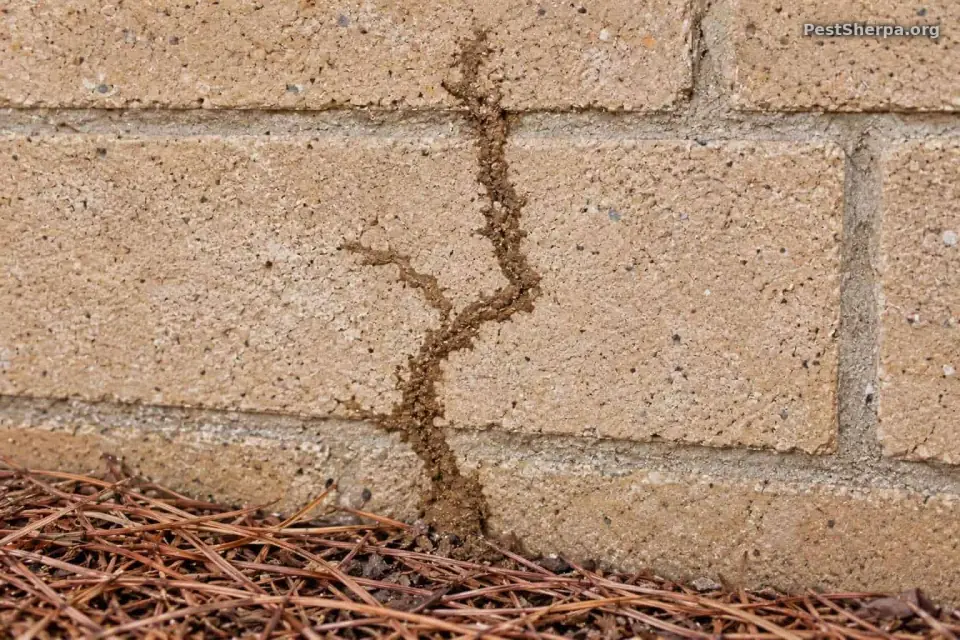
Termite control is a complex system of pest management. It is important because it is structural protection. While many household pests can be controlled in a single step, sometimes as easy as sweeping up ladybugs and releasing them outside, termite control must be done carefully or serious structural and even cosmetic damage can occur over time. This hub owns inspection quality, treatment options (bait vs liquid applied to soil vs liquid applied to wood vs fumigation), prevention, DIY limits, termiticide safety, warranties, and cost drivers. Species ID and comparison charts live in the Termite Guide. General household methods live on the companion Pest Control hub. We will use the term wood destroying insects (WDI) and also mention Wood Destroying Organism (WDO). WDO is all wood destroying insects plus decay fungus. Some states include WDO in inspection. Most termite control companies will treat for insects and fungus if needed. We will focus on the termite portion of WDI/WDO in this section.
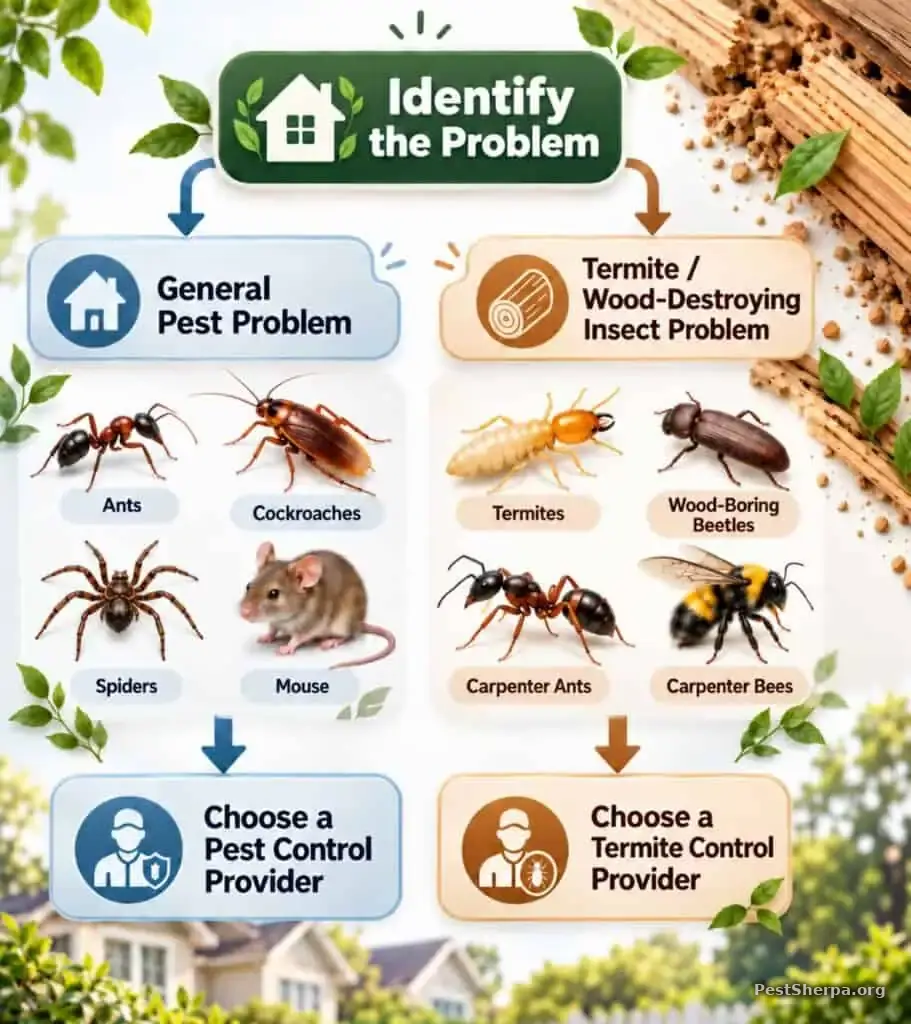
Note: Many companies provide both general and wood destroying insect services
On this page
- Found tubes / frass / wings / soft wood? Do this today
- Why termite management is a separate path and service
- Types that matter to homeowners
- Signs of activity vs damage vs lookalikes
- What a good inspection includes
- Inspection theater vs real inspection
- Treatment systems compared
- Liquid soil vs bait systems in plain English
- Prevention that actually helps
- DIY limits
- Safety around termiticides
- Warranties, retreatments, monitoring
- Cost framing (no fake prices)
- Myths
- FAQ
- Pre-treatment and post-treatment homeowner checklist
- Real estate and refinance moments
- Building a termite-aware maintenance calendar
- References
- Related guides and Q&A
Found tubes / frass / wings / soft wood? Do this today
If you just found something that looks like termite evidence, start here. Stay calm, document what you see, and get a real inspection. Deep ID and lookalikes live on the Termite Guide. This page covers inspection quality, treatment systems, warranties, and cost drivers.
- Photograph what you found (mud tubes, frass piles, discarded wings, soft or hollow wood). Do not scrape mud tubes or vacuum frass before an inspector sees them.
- Leave evidence in place when it is safe to do so. Note where and when you saw it (room, crawlspace, attic, exterior wall, date).
- Open the matching Termite Guide card for ID and lookalikes: Termite Guide.
- Book a real inspection (crawlspace, attic, and soil contact as needed), not porch sales theater. On this page, see what a good inspection includes and inspection theater vs real inspection.
- Skip DIY colony treatments for soil barriers, fumigation, and whole-structure work. Conducive conditions and documentation are the homeowner lane. Details: DIY limits and Can a homeowner perform termite control?
- Next: skim bait vs liquid, warranties, and cost drivers below, or use Ask the Sherpa / the hiring guide.
Why termite management is a separate path and service
General pest control for ants, cockroaches, rodents, and mosquitoes is mostly about sanitation, exclusion, and targeted products and tools. Termite control is structural protection. Termite biology, habits, and control generally require different knowledge and tools. A calculation I did in 2006, as technical director at the National Pest Management Association, put U.S. termite damage at about $5 billion a year. NPMA adjusted that to about $6.8 billion for inflation in 2022, and inflation alone takes it to about $8.4 billion today. When I reran my own 2006 calculation for 2026, using what construction materials and construction labor and benefits cost now (U.S. Bureau of Labor Statistics) and about 17% more homes (U.S. Census Bureau), it came to a modeled estimate of about $11 billion a year in termite damage repair costs. I trace every estimate and its source in my termite damage costs and statistics guide.
| General household pests | Termites |
|---|---|
| Often nuisance, food contamination, or bite risk | Wood-destroying; hidden structural loss |
| Many problems respond to DIY IPM | Active infestations usually need licensed or credentialed termite control companies |
| Wrong spray wastes money | Wrong or incomplete treatment can leave colonies feeding for years |
| Evidence is often visible insects | Evidence is often tubes, frass, wings, or soft wood, not marching armies |
That is why Pest Sherpa keeps:
- Pest Guides for ID (Termite Guide and species pages)
- Pest Control for general methods and safety
- Termite Control hub (this page) for treatment systems and structural decisions
Important: most homeowner insurance excludes control and damage repair due to termites because termite damage is not sudden and accidental, the standard of insurers. Inspection and correct treatment type matter more than panic spraying.
For general household IPM, DIY product classes, and pesticide safety, use the companion Pest Control hub.
Types that matter to homeowners
Most U.S. home questions start with type, not a Latin name. In layman terms, types of termites include subterranean, the most damaging, drywood, and dampwood. Use the Termite Guide for full comparison tables and charts. Here is the control-relevant summary.
Subterranean termites (including Formosan Termites)
- Nest in or near soil; need moisture; reach wood through mud / shelter tubes, cracks, and gaps. Colonies can prosper above soil if there is adequate moisture.
- Subterranean termites can infest houses in much of the country. Naturally occurring subterranean termites can be found even in some parts of Canada and are found in most states except Alaska and far northern states. These termites are often cited in national consumer summaries; confirm local risk with your inspector or state university.
- Formosan subterranean termites are an invasive subterranean type with very large colonies where established (Southeast, Gulf, Hawaii, limited other footholds). They are not a “drywood” pest. While not found everywhere, Formosan termites are considered of most concern and most damaging due to colony size.
Species guides (verified):
More species guides: Asian subterranean, native subterranean overview, dark southeastern subterranean, light southeastern subterranean, conehead. Range context: drywood termite range map.
Drywood termites
- Live inside dry wood; no soil contact required.
- Classic homeowner clue: hard fecal pellets (frass) under tiny kick-out holes. Frass is wood color and is ridged about the size of a coriander seed.
- Strongest pressure in warm coastal / southern belts; furniture can move them outside native range and some researchers observe that because they can be moved with furniture to cold climates, any home is a potential home for drywood termites.
Species guide (verified): Drywood termites
Dampwood termites
- Tied to wet, decaying wood and chronic moisture. Generally considered a minor pest and rarely requires control.
- Often a moisture-and-rot story as much as a “surprise structural colony” story.
- Fixing moisture is non-negotiable.
Species guide (verified): Dampwood termites
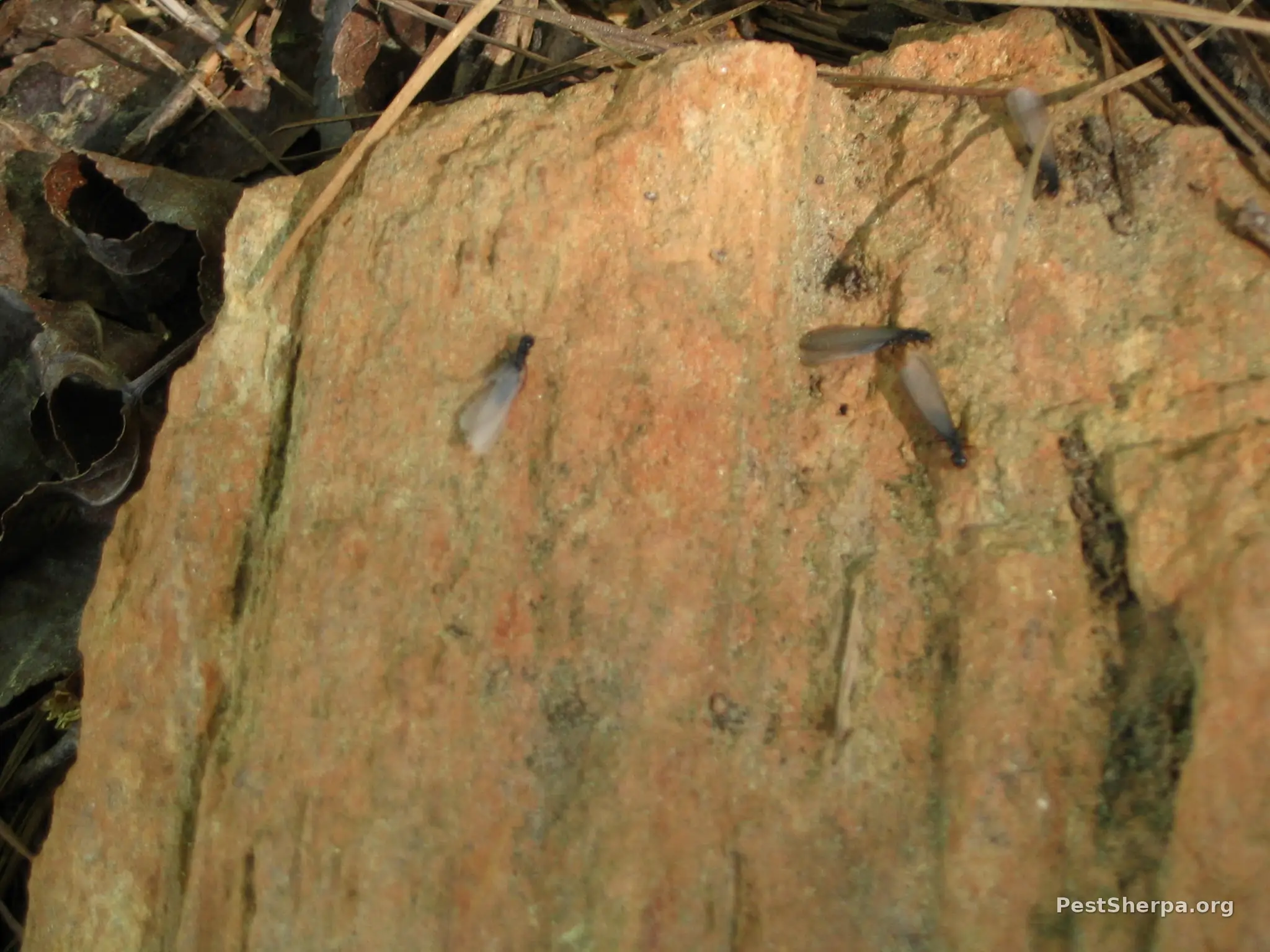
Control implication: Soil liquid barriers and in-ground baits are subterranean tools. Drywood problems often need localized wood treatments or whole-structure fumigation. Dampwood work without moisture correction fails.
Signs of activity vs damage vs lookalikes
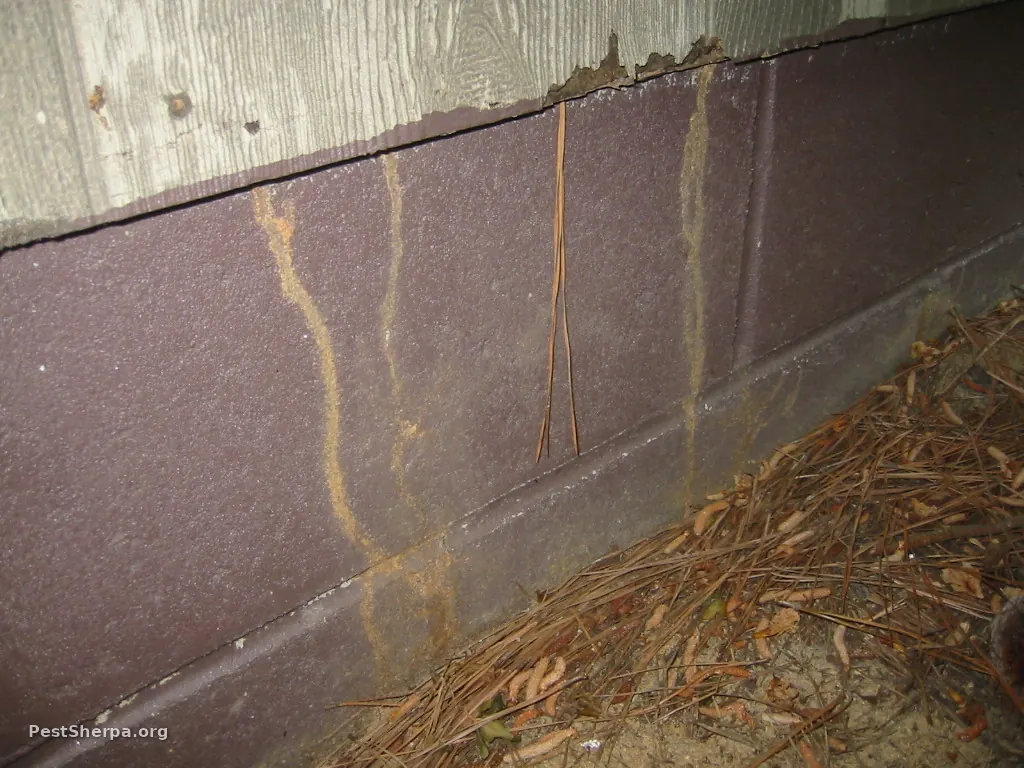
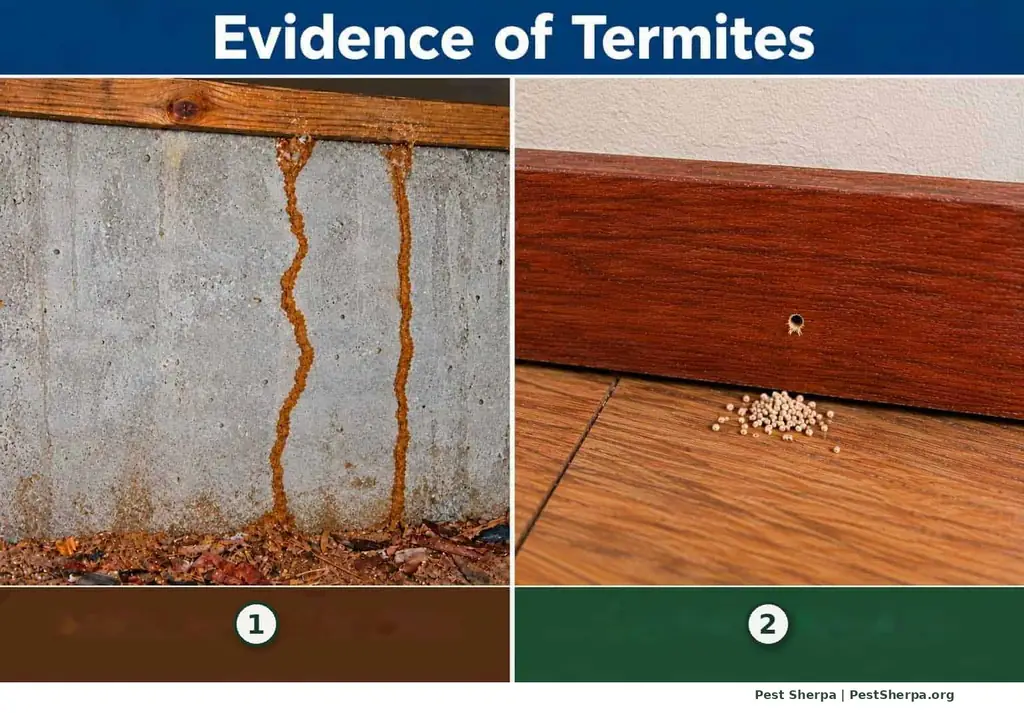
Which one did you find? Match the number:
- Subterranean termites: mud tubes made of soil, running up foundations or walls from the ground.
- Drywood termites: small, hard pellets (frass) piled below a tiny kick-out hole in wood. No mud tubes.
Either one is a reason to call a licensed termite pro for an inspection.
Strong signs of possible activity
| Sign | Often points toward | Homeowner action |
|---|---|---|
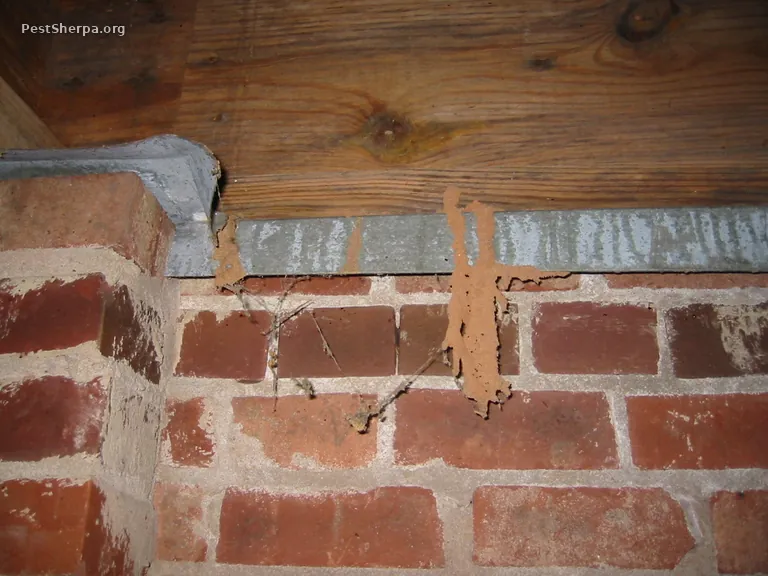
| Mud / shelter tubes on foundation, piers, crawl walls | Subterranean | Photograph; do not scrape as “treatment”; schedule inspection |
| Hard six-sided pellets under kick-out holes | Drywood | Photograph; clean a small area and watch for new pellets; inspect |
| Indoor swarmers or piles of equal-length wings | Termites (confirm vs ants) | Collect a sample if safe; inspect the structure |
| Soft, blistered, hollow wood near soil or moisture | Subterranean and/or moisture and/or other wood destroying insects | Do not dismantle structural wood; get a WDO / termite inspection |
| Sponge shaped dried wood (carton) material in voids (region-dependent) | Formosan / subterranean moisture nests | Pro inspection |
Damage without clear activity
Old damage can remain after a colony is gone or after prior treatment. Fresh frass, live insects, rebuilt tubes, or recurring swarmers raise concern for current activity. Inspectors separate old from active when they can. Do not pay for a whole-house treatment based on a single old exit hole unless you wish to have a preventative treatment.
Lookalikes that change the entire plan
| What you might have | Why it matters | Start here |
|---|---|---|
| Flying ants / carpenter ants | Ants excavate or swarm; different treatment | Ant Guide (carpenter ants especially) |
| Powderpost / old house borers | Flour-like frass or oval holes in softwood | Wood-boring beetles |
| Wood decay / water damage | Soft wood without insects | Moisture correction + qualified building advice |
| Drywood frass vs beetle frass | Texture and hole shape differ | Drywood guide + beetle hub |
Swarmers vs flying ants (quick cues) (detail and charts on the Termite Guide):
- Antennae: termites straighter; ants elbowed
- Waist: termites thick; ants narrow appearing pinched
- Wings: termites equal length; ants front longer than hind
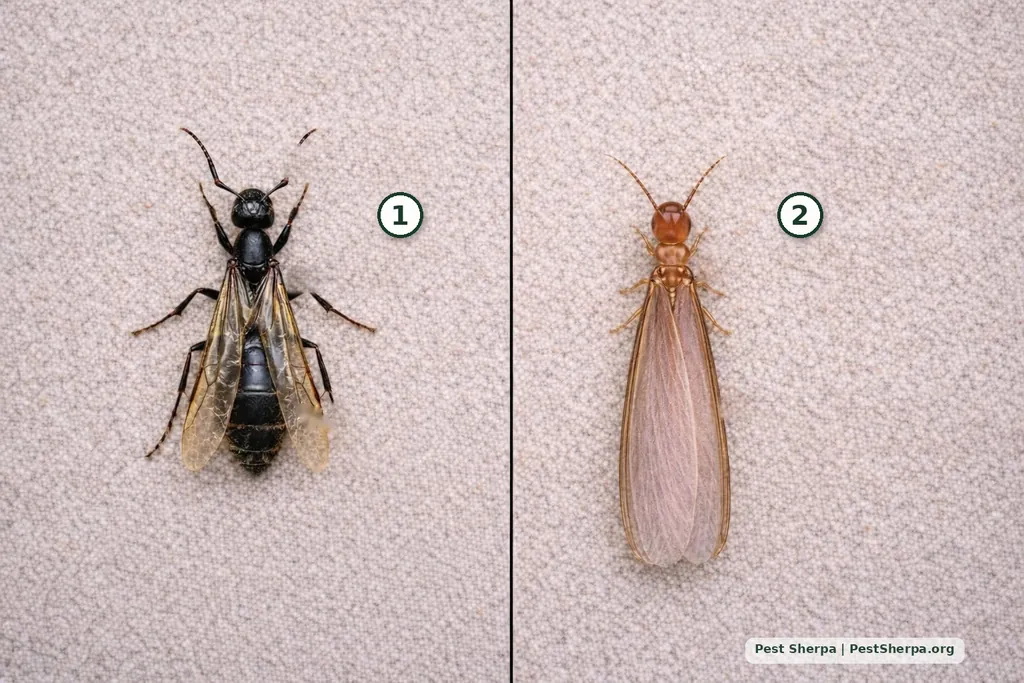
Which one did you find? Match the number:
- Winged ant: pinched, wasp-like waist and bent (elbowed) antennae. Front wings are longer than the back pair.
- Winged termite (swarmer): thick waist with no pinch, straight beaded antennae, and four wings of equal length that run well past the body.
Seeing number 2 indoors, especially near windows or piles of shed wings? Call a licensed termite pro for an inspection.
Equal-length wings and a thick waist point to termites. Elbowed antennae and a pinched waist point to ants.
Related Q&A: Do termites bite? | Swarming is not the only sign | When do termites become active?
What a good inspection includes
A quality termite inspection is not a two-minute glance at the porch. There are three main types of inspections for WDI or WDO.
- Real estate transfer inspection. This is an inspection commonly required by the mortgage company for a property sale. Depending on the state regulations, it can be ordered by the buyer or seller. This inspection usually takes an estimated hour but depends on the size and construction type. Findings are reported formally using the state mandated WDI or WDO form. It reports the scope of the inspection, findings, and damage on a state mandated form.
- Annual inspection for houses under a termite contract with a pest control company. This is an annual inspection for houses that have been treated by a company and for an annual fee, the company inspects for signs of termites. If termites are found, the company will retreat at no additional cost. Some companies offer a damage warranty as well so that not only is treatment provided but damage is repaired as well. Adding a warranty at treatment is the option of the homeowner and whether the company wishes to accept the house under warranty. This is usually the fastest inspection and will usually take less than an hour but can vary with construction and findings.
- Routine inspection is requested because the owner suspects termites, or if a homeowner merely wants to have an inspection just to assess in case there is an unknown issue. A routine inspection should be as thorough as a real estate transfer inspection. In this case proper records similar to a real estate transfer should be provided to the homeowner but generally does not use a real estate transfer report.
Access and scope
- Exterior foundation walk, grade, mulch areas for signs although termites in mulch DOES NOT mean that the house is infested or needs a treatment. Inspectors will also report on wood-soil contact, expansion joints, porch steps, fence attachments
- Interior: plumbing penetrations, slab joints, bath traps where accessible, window/door frames, unfinished areas
- Crawlspace or basement: piers, sill plates, joists, moisture, debris, tubes
- Attic especially in areas where drywood termites are common.
- Clear statement of areas not inspected (blocked crawl, locked rooms, clutter or stored items preventing full view, finished walls)
Tools and methods (vary by company and construction)
- Visual exam and sounding / probing of accessible wood
- Moisture meter where useful
- Graph, diagram, or description of findings
- Photos of evidence
- Optional: borescope, infrared, acoustic tools (helpful in certain situations)
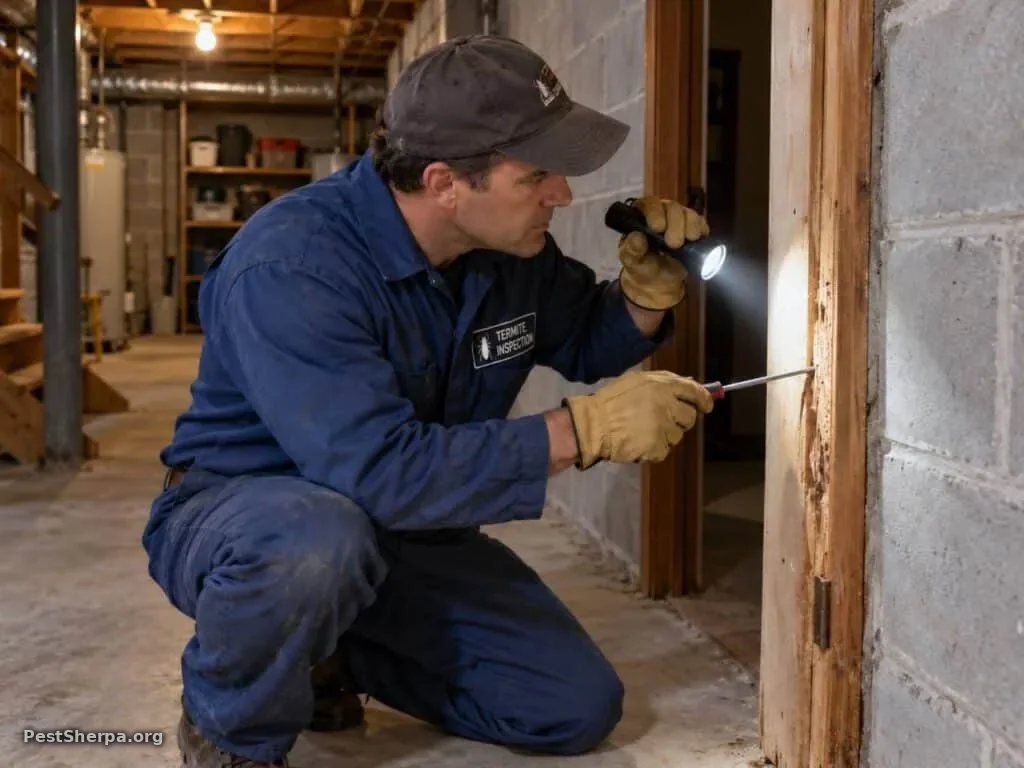
Real inspections thoroughly probe and carefully consider observations and takes time and effort
What you should receive in writing
- For real estate transfer inspection, a copy of the state required WDI/WDO report and attachments.
- For annual and routine inspections:
- Pest(s) found or evidence type (live, tubes, frass, damage only)
- Locations mapped
- Conducive conditions (moisture, wood-soil contact, cellulose debris)
- Recommended treatment type tied to termite type and extent
- What is included / excluded (repairs vs treatment, monitoring term, retreat rules)
- License information for the company (verify): How to hire a licensed pest control company
- When a treatment is completed, further documentation will be provided to the homeowner depending on the state requirements.
Do this / don’t do this before the inspector arrives
- Do clear access to crawl openings, attic hatches, and utility rooms. Move any boxes or stored items to allow a clear view of all walls
- Do photograph tubes and wings. Leave in place for inspection.
- Don’t scrape all mud tubes away “so it looks better.”
- Don’t destroy any evidence of termites. Since you’ve already decided to engage the services of a professional, don’t apply termite control measures.
Inspection interval guidance differs by source (examples include roughly every 3 to 5 years in some university consumer tips vs annual recommendations in some industry consumer materials). Pick a schedule with local termite risk and your inspector in mind. Do not invent one national rule. Also, do not be pushed into making a treatment decision the same day after a routine or annual inspection. Termites do consume wood but carefully weighing options including second or third opinions is smart. Do not panic. A few days or longer won’t affect the amount of damage or safety. Real estate transfer action will be handled with realtors or lenders.
Inspection theater vs real inspection
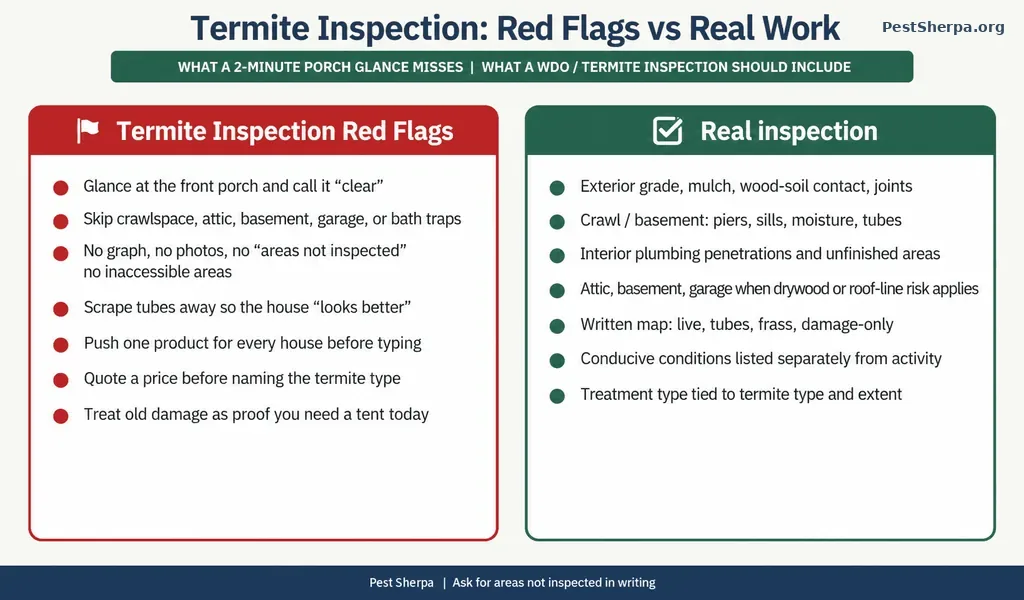
What inspection theater looks like
- Someone walks the front elevation, nods, and calls the house “clear.”
- Crawlspace, attic, or bath traps are skipped without writing “not inspected.”
- Mud tubes are scraped away so the property “looks better” before photos.
- One product is pitched before the termite type is named.
- Old damage is sold as proof you need whole-structure treatment today.
- While many credible companies employ door to door sales staff, do not be pressured into signing on site. Do not let work start on the day of the inspection or you may lose your three day cancellation option.
- Some companies might have a technician knock on your door and state that they just found or treated termites up the street and your house is at risk. Your house is not at risk for termites up the street.
What real inspection feels like in a house
- The inspector asks for access, lights, and time in the crawl or basement.
- Findings are mapped: live insects, tubes, frass, damage-only, conducive conditions.
- You hear the difference between activity (current feeding / fresh evidence) and historic or old damage.
- The recommended system is tied to subterranean vs drywood vs dampwood and to construction features.
- You are provided with a written graph or detailed descriptions, photos, and clear expectations as to what you can expect if you agree to a treatment.
Do this / don’t do this before the tech arrives
- Do clear stored boxes from crawl openings and utility rooms. Any clutter such as treadmills blocking access to walls.
- Do leave tubes and wings in place until photographed. Leave in place if possible; if not retain for the inspector.
- Don’t pretreat with store “termite” sprays that contaminate bait programs or confuse evidence.
- Don’t accept a same-day pressure sale with work starting that very day. Panic leads to poor buying decisions.
Treatment systems compared
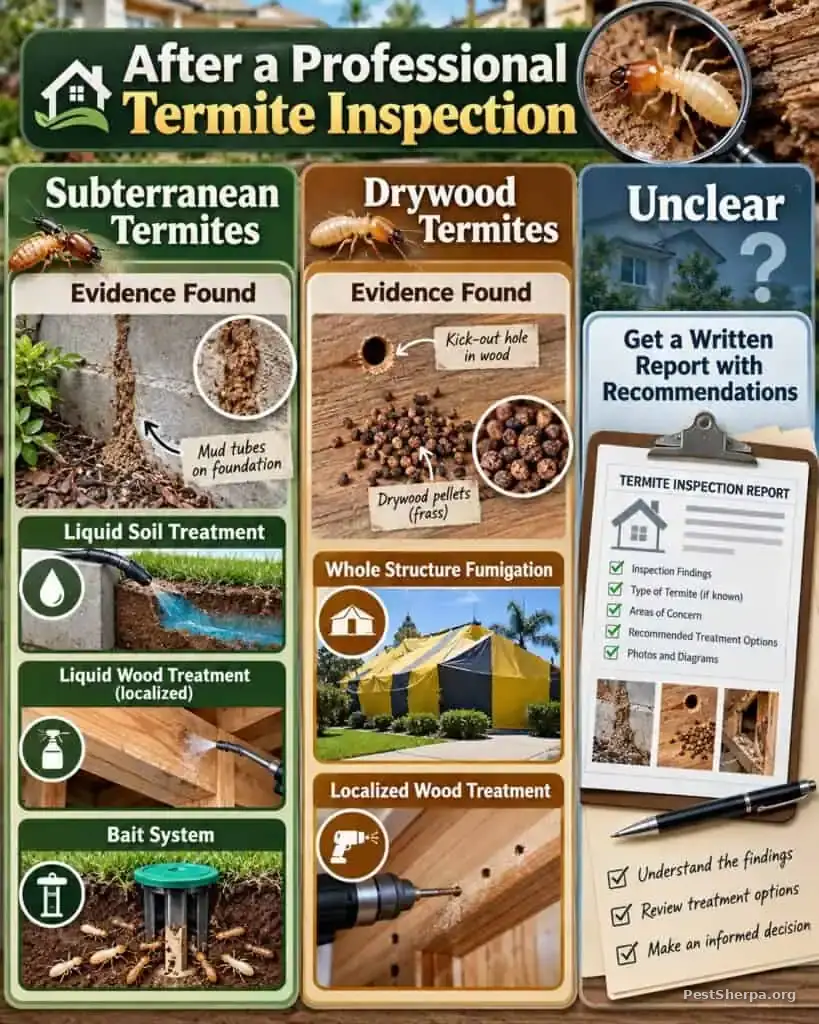
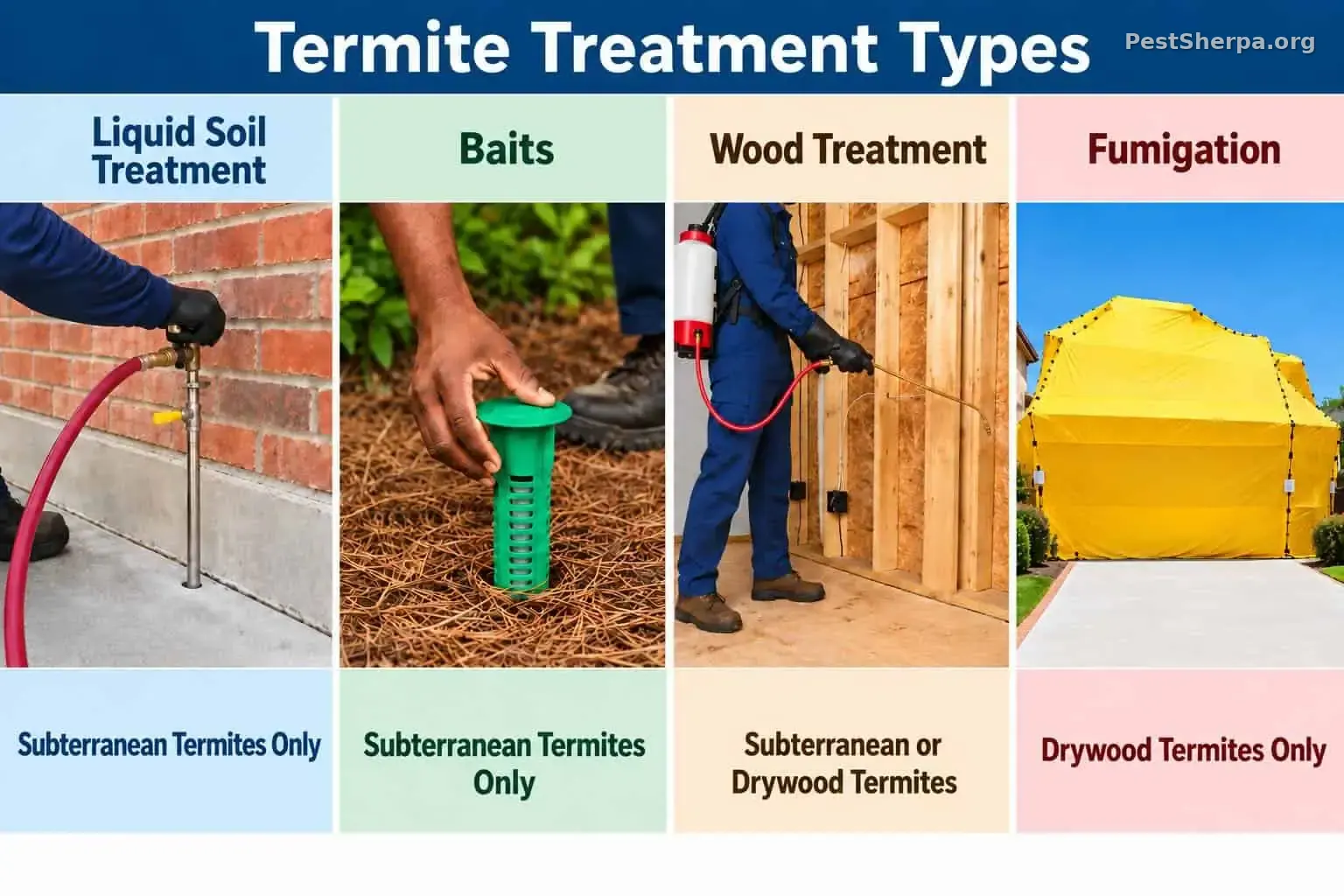
Honest framing: the “best” system is the one that matches termite type, construction, extent, accessibility, and the owner’s preference. Sales scripts that push one product for every house are a red flag.
1. Soil treatments / liquid soil termiticides (subterranean)
What it is: Creating a treated soil zone (and sometimes treating voids) so foraging subterranean termites contacting treated soil are killed or spread the treatment to the rest of the colony greatly reducing population and thus reducing activity. Some termiticides are “repellent” with the theory that this will prevent termite entry, but more modern termiticides are “non-repellent” which is unknowingly encountered by the termite and carried back to the colony.
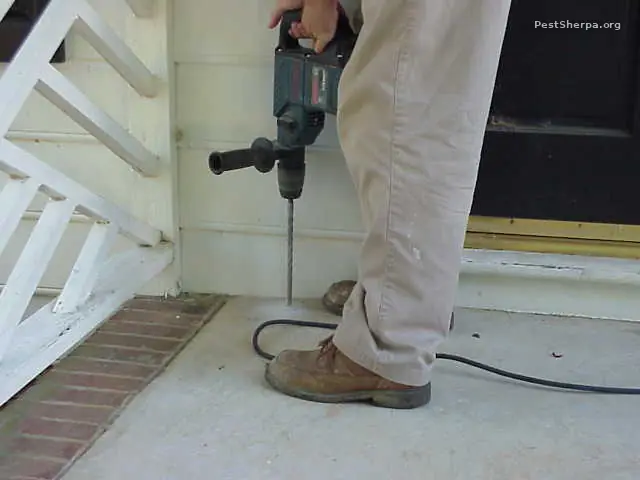
How it is done (high level): Trenching and/or rodding into the trenched soil along foundations; drilling slabs, expansion joints, and voids as needed; applying labeled termiticide at labeled rates. This is professional equipment and calculation work. Many states have specific regulations dictating how a soil treatment must be done.
Pros
- Can provide a continuous treated area or zone when applied correctly around the structure
- Often paired with correcting conditions favorable to subterranean termites
- Familiar warranty structures in many markets
- If you decide against the warranty or cancel the warranty, the house is still protected by the treatment
Cons / limits
- Incomplete drilling or missed construction features leave untreated areas which can be accessed by termites.
- Soil disturbance later (landscaping, pooling) can disrupt treated zones
- Not the tool for drywood colonies living only in attic wood
- Many effective products are professional-use; DIY barriers are unreliable
2. Bait systems (primarily subterranean)
What it is: Stations in soil (sometimes other placements) that termites feed on, sharing an active ingredient through the colony.
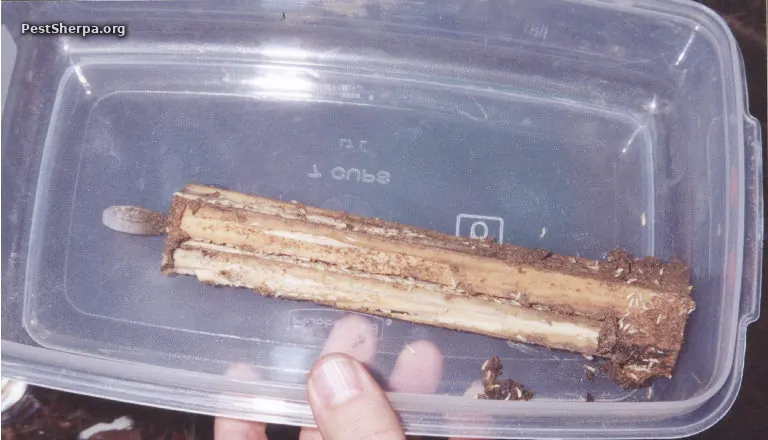
Pros
- Can impact colonies with less structural drilling in some designs
- Useful for monitoring plus suppression
- Attractive where continuous liquid barriers are hard to install perfectly
- Less disruptive to property and takes less time to install
Cons / limits
- Works on colony timelines, not “gone by Friday” expectations
- Requires ongoing monitoring and station maintenance; systems today can go as long as one year between visits
- Not a drywood pellet-pile solution in attic trim
- Homeowner misunderstanding of “why attract termites” is common; baits do not bring termites to the house
- If you cancel the contract, the bait stations are removed and house has no protection whatsoever
Related Q&A: Why use termite bait?
3. Wood treatments and localized injections (often drywood; some subterranean supplemental)
What it is: Treating known galleries in exposed wood; surface or foam applications where labeled; sometimes replacing severely damaged members.
Pros
- Can solve a truly localized, well-mapped subterranean and drywood infestation
- Less disruption than whole-structure fumigation against drywood termites when scope is small and certain
- Leaves residual protection after treatment; does not degrade
Cons / limits
- Missed infested areas might allow infestation to continue
- Multiple pellet sites or attic/structural spread often exceed spot-treatment confidence
- Accessibility through wall coverings is limited unless drywall removed
4. Fumigation (whole-structure; classic for widespread drywood)
What it is: Sealing the structure and introducing a fumigant gas under professional protocol so hidden drywood colonies in wood are reached.
Pros
- Reach into inaccessible wood that spot treatments may miss
- Appropriate when extent cannot be confidently mapped for localized work
Cons / limits
- Home must be vacated; prep is significant
- Does not provide residual prevention against future drywood reinfestation by itself
- Not a subterranean soil-foraging solution
- The gas used is highly toxic. Professionals know how to properly vent for safety after treatment so do not worry about gas exposure.
- Leaves no residual protection.
5. Heat and other non-fumigation whole-area options
What it is: Raising wood temperatures (or other specialized methods) to lethal levels for drywood termites in the treated volume.
Pros
- Can avoid fumigant chemicals in some programs
- Useful in the right assemblies when penetration is complete
Cons / limits
- Large beams, layered construction, and cool spots can reduce reliability
- Still professional equipment and protocols
- Not a casual DIY heater project
Matching type to system
Match termite type to treatment system
| Situation | Systems often discussed | Usually wrong first move |
|---|---|---|
| Subterranean tubes on foundation | Liquid soil treatment, baits, or combination | Spraying visible workers on the tube |
| Formosan with large colony / carton concerns | Aggressive professional subterranean soil programs | Consumer foam-everything |
| One drywood frass site, easy access | Localized treatment after mapping | Immediate tent without inspection map |
| Drywood frass in multiple rooms / attic | Fumigation or other whole-structure options after inspection | Endless incomplete spot jobs |
| Dampwood in wet wood | Moisture correction + targeted treatment | Soil barrier alone without drying |
Liquid soil vs bait systems in plain English
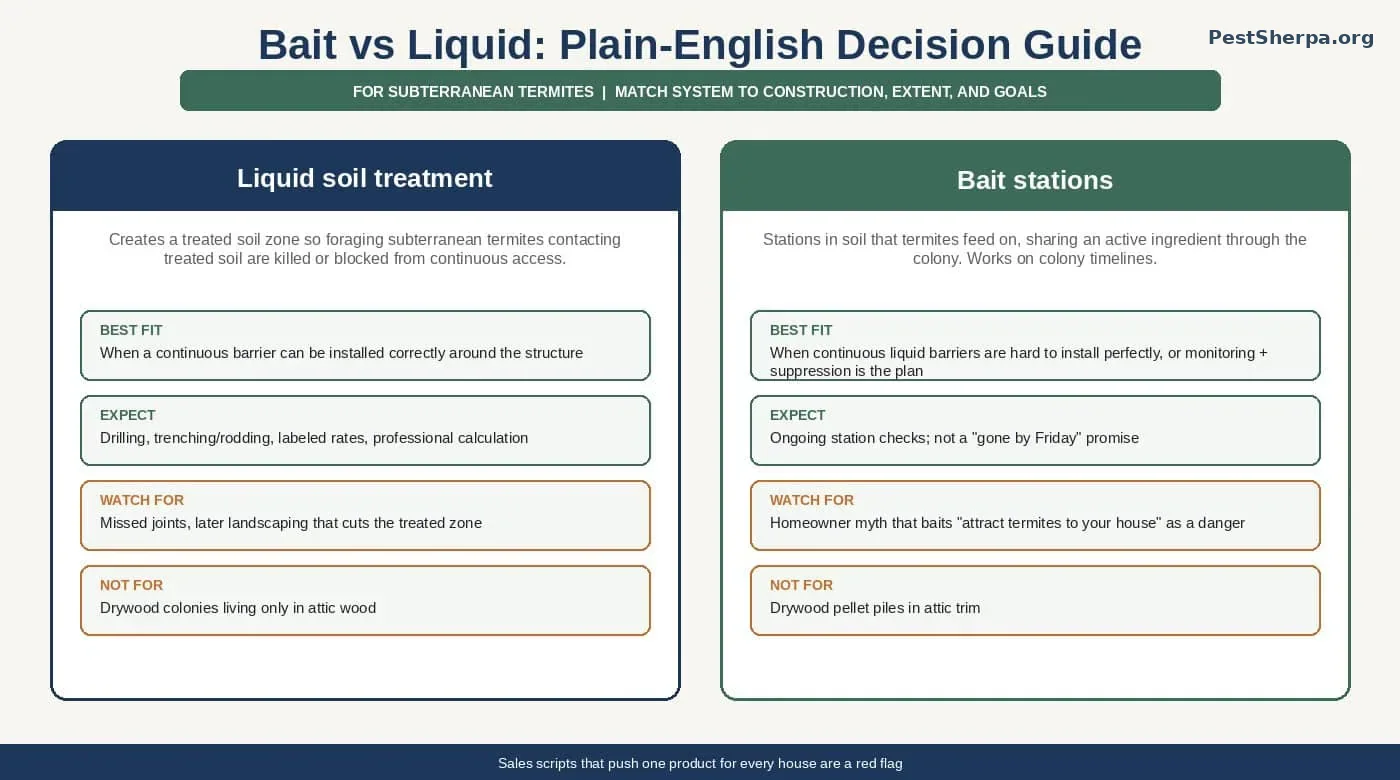
Homeowners hear sales language. Here is the field version for subterranean termites.
| Question | Liquid soil treatment | Bait stations |
|---|---|---|
| What is the job? | Treated soil zone that foraging termites contact | Stations foragers feed on; toxicant shared in the colony |
| Speed expectation | Barrier installed on treatment day; colony impact still takes judgment and follow-up | Colony timelines; not “gone by Friday” |
| Disruption | Drilling, trenching/rodding, dust, temporary access limits | Less structural drilling in many designs; ongoing monitoring visits |
| Weak spot | Missed joints, later landscaping that cuts the treated zone | Skipped station service; impatience that switches products mid-stream; no protection if cancelled |
| Wrong use | Drywood pellets in attic trim | Drywood pellets in attic trim |
Bait vs liquid decision cues
- Can a continuous barrier actually be installed on this foundation and slab layout? If not, bait (or a combination) often makes more sense than a partial liquid story.
- Is the homeowner ready for multi-visit monitoring? If not, a bait-only pitch without that honesty is a bad fit.
- Is the finding drywood or dampwood? Stop comparing soil tools. Change the system family.
- Did two companies recommend different systems? Compare written scope and termite type, not logos. Follow your logic.
Related Q&A: Why use termite bait?
Prevention that actually helps
Prevention reduces risk. It does not replace inspection in termite country.
The prevention that actually moves risk (Sherpa note)
In real houses, the two conditions I see matter more than almost any gadget:
- Chronic moisture against wood and in crawls (leaks, bad grade, clogged gutters, wet insulation).
- Wood-soil contact and cellulose debris that give subterranean foragers a highway.
Mulch against siding can introduce additional moisture. Buried scrap lumber and stair stringers in dirt are not “curb appeal details.” They are conducive conditions. Fix them whether you treat or not. Treatment without moisture correction is how dampwood and subterranean pressure come back into the conversation next season. Also, just because some lumber is pressure treated does not mean it protects the wood permanently so don’t skip focus on those areas as well.
Moisture
- Fix plumbing, roof, and HVAC condensate leaks
- Grade soil away from the foundation; extend downspouts
- Ventilate or condition crawlspaces; consider vapor barriers and dehumidification where appropriate
- Reduce chronic dampness that supports subterranean foraging and dampwood / decay
- Do not over irrigate near foundation
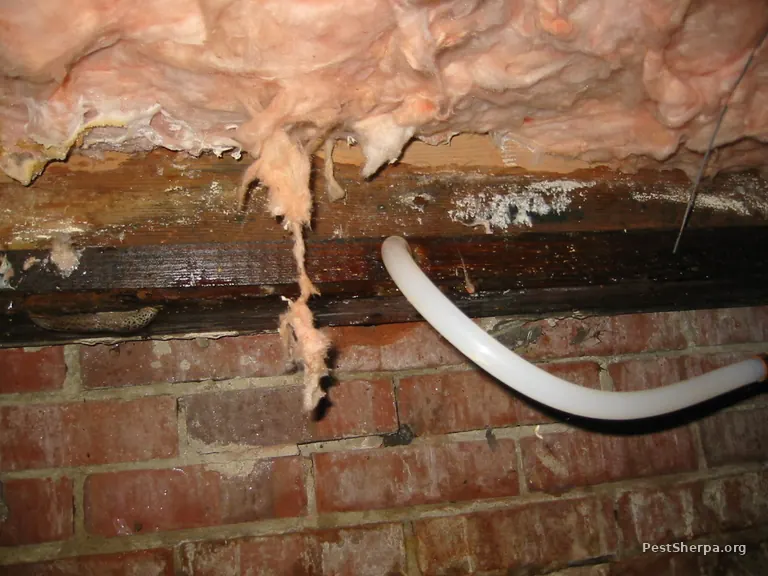
Wood-soil contact and grading
- Keep siding, posts, lattice, and stair stringers off soil
- Maintain visible inspection gaps where construction allows
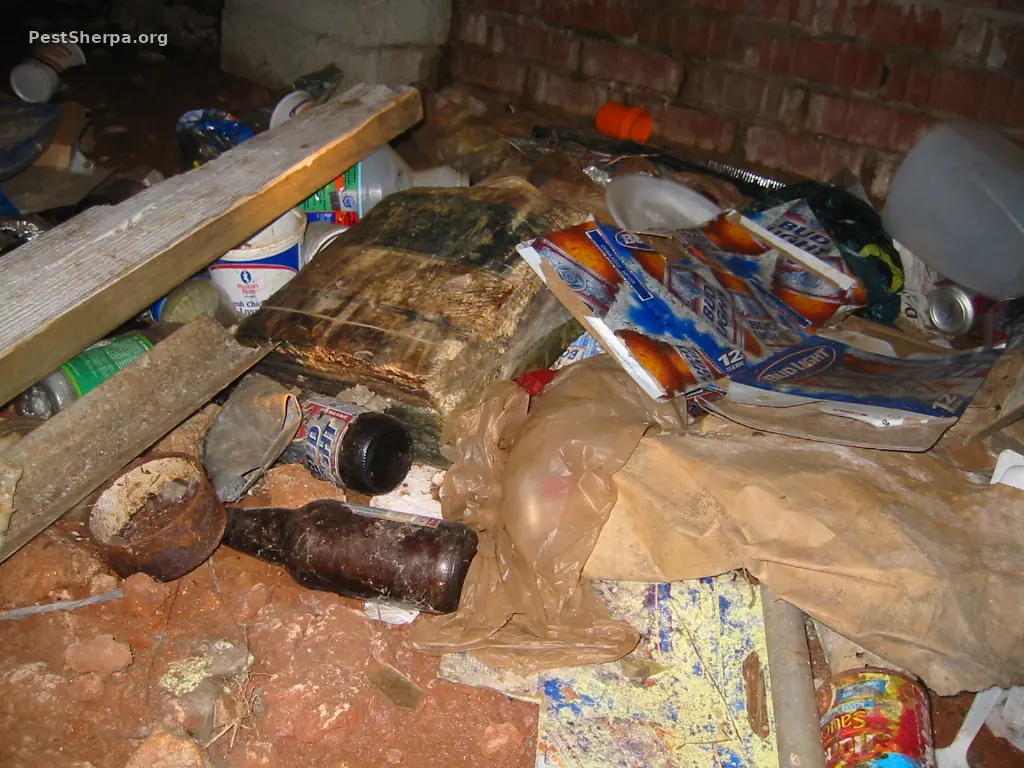
- Remove form boards, buried scrap lumber, and cellulose debris near foundations
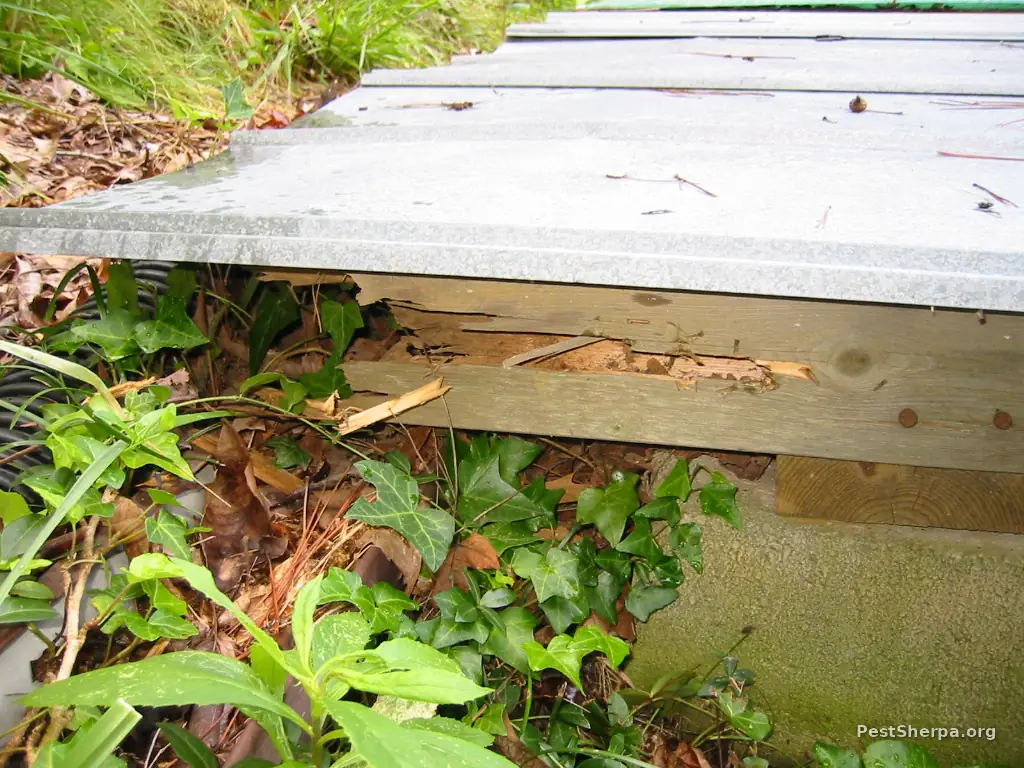
Wood touching soil is a subterranean invitation. Keep a visible inspection gap where construction allows.
Mulch, plantings, and expansion joints
- Pull heavy mulch back from siding; keep a drier buffer
- Avoid stacking firewood against the house; elevate and separate wood piles
- Understand that slab cracks, plumbing penetrations, and expansion joints are subterranean highways
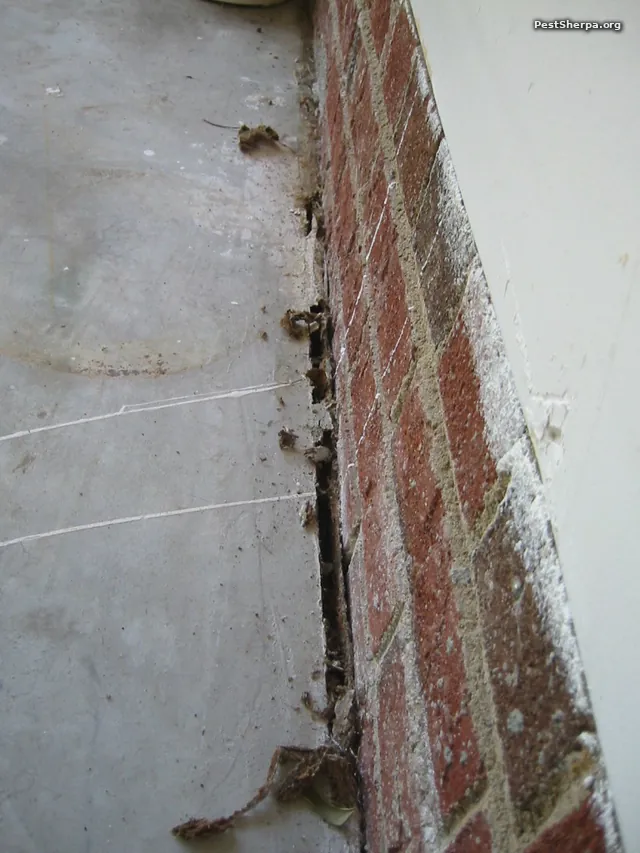
Crawlspaces and attics
- Clear debris so inspectors can see
- Correct condensation on ducts in humid crawls
- For drywood regions, maintain exterior wood finishes and seal exposed end grain where practical; inspect used furniture before bringing it indoors
Neighbor treatments do not “push termites into your house” as a simple rule. Risk is about your structure’s conducive conditions and local population pressure. Related: Neighbor treated for termites in Texas.
DIY limits
Full Q&A: Can a homeowner perform termite control?
What homeowners can usefully do
- Inspect visually for tubes, wings, frass, and soft wood
- Photograph and document
- Correct conducive conditions (moisture, wood-soil contact, debris, mulch)
- Improve access for professionals
- Use monitoring stations as monitors, not as guaranteed colony elimination
- Follow through on warranty inspections after professional treatment
- Work in partnership with the professional
DIY termite liquids: why they fail in the field
A can labeled for termites on a mud tube treats what you can see. Subterranean colonies forage through soil and hidden treatment gaps. Incomplete trenches, wrong dilution, and missed expansion joints leave highways open. Breaking the tube and spraying the scar feels decisive. It is not colony control. University and EPA consumer guidance steer active structural treatment to licensed professionals for a reason.
What homeowners should not treat as DIY termite control
- Soil trenching and professional liquid barrier installation
- Whole-structure fumigation (homeowners are prohibited from using gas fumigants for this purpose)
- Assuming consumer foams or sprays eliminate Formosan or large subterranean colonies
- Breaking tubes and declaring victory
- Drilling finished structural members without a mapped plan
University and EPA consumer guidance consistently steer active structural termite treatment toward trained, state-licensed professionals. OTC products may be legal for limited uses and still fail to finish a colony.
Decision tree: suspect termites
- Suspect termites? → Confirm type (tubes vs frass vs ants vs beetles).
- Conducive conditions? → Fix them either way.
- Active infestation likely? → Licensed termite inspection.
- Treatment choice? → Driven by type + extent + construction, in writing.
- After treatment? → Keep monitoring and warranty visits.
Safety around termiticides
Termiticides are pesticides. The same rules as the Pest Control hub apply, with higher stakes around soil, drilling dust, and fumigation prep.
- Label is law. See Labels & Law.
- Ask what product will be used, where, and what prep you must do (pets, people, food, plants).
- For fumigation: follow the company’s written prep list exactly; understand re-entry clearance procedures.
- Keep children and pets away from trenches, drill holes, and wet treated soil until the company says the area is safe per label.
- Do not “help” by adding store chemicals on top of a professional bait or liquid program.
- Dispose of old consumer termite products through local government hazardous waste channels if you decide not to use them. Related disposal guidance: old pest control products in the garage.
Post-treatment: expect some disruption (drilling dust, temporary access limits). Ask for ventilation and cleanup expectations in writing. Report unexpected odors, spills, or illness through the company and, if needed, your state pesticide regulatory agency.
Warranties, retreatments, monitoring
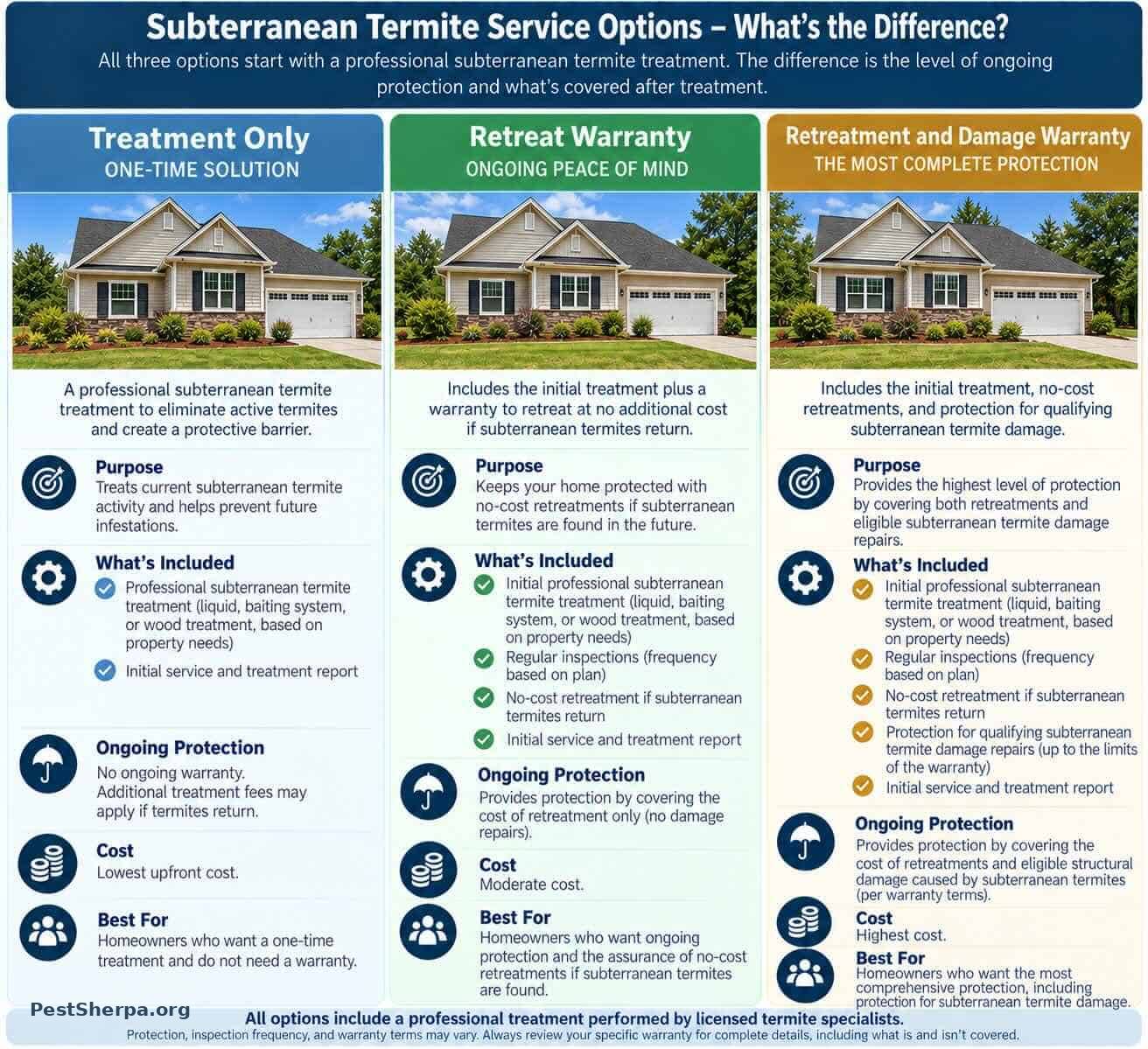
A warranty is only as good as the written terms.
Warranty gotchas I flag for homeowners
- Retreatment-only is not a repair check. If wood is already soft, ask who pays for carpentry.
- Annual inspection fees often keep the warranty active. Miss them and coverage can lapse quietly.
- Denied access (locked crawl, aggressive landscaping over stations) is a classic void.
- Additions and decks built after treatment may be excluded until brought into the graph.
- Transfer to a buyer is valuable at sale. Ask in writing; do not assume.
- “Lifetime” in an ad is not the contract. The typed exclusions are.
If two warranties look identical in the brochure, compare the exclusions page side by side.
Questions to ask
- Is this a repair warranty, a retreatment-only warranty, or something else?
- How many years? What renews it (annual inspection fees)?
- What voids coverage (denied access, home modifications, missed payments, new construction features)?
- Are additions, porches, and detached structures included?
- If termites return, is retreatment free? Are damage repairs included or excluded?
- Is the warranty transferable to a buyer?
Ongoing monitoring
Bait programs and many liquid programs expect periodic inspections. Keep vegetation and storage from blocking stations and foundation lines. Save graphs and service tickets with your home records.
Real estate timing
Buyer inspections and seller repairs have deadlines. Rush jobs without clear scope create disputes. Get type and treatment method in writing before closing pressure forces a bad fit.
Cost framing (no fake prices)
National blog “average prices” are often wrong for your city, construction, and termite type. Instead, understand what drives cost:
| Cost driver | Why it matters |
|---|---|
| Termite type | Drywood fumigation vs subterranean soil/bait are different jobs |
| Size and complexity of structure | Linear feet of foundation, slabs, multiple levels, additions |
| Access | Finished basements, shared walls, obstructed crawls increase labor |
| Extent of infestation | Localized vs whole-structure |
| Construction features | Wells, rubble foundations, plenums, foam forms, stone veneers |
| Monitoring term and warranty | Multi-year bait monitoring is not a one-visit price |
| Repairs | Treatment ≠ rebuilding damaged wood |
Get two written quotes on the same pest, same areas, and same visit/monitoring assumptions. Compare scope, not logos. Hiring guidance: licensed pest control company. If you want a reality check on the national numbers, my termite damage and treatment cost guide lays out sourced ranges and why they rarely match your quote.
Myths
- “If I did not see a swarm, I do not have termites.” False. Many infestations are found by tubes, damage, or inspections without a homeowner-witnessed swarm. See swarming Q&A.
- “Breaking mud tubes solves it.” Tubes are evidence and travel paths. Removing them without a treatment plan can make inspection harder and does not eliminate the colony.
- “Store spray kills the nest.” Visible workers are a tiny fraction of subterranean colonies.
- “Baits attract termites to my house on purpose, so they are dangerous.” Baits are designed around foraging behavior to impact colonies. Ask your pro how monitoring works. See baiting Q&A.
- “Fumigation prevents termites forever.” It targets existing drywood colonies present at treatment. It is not a permanent protection.
- “All wood pests are termites.” Beetles and carpenter ants need different plans. See wood-boring beetles and ants.
- “My neighbor’s treatment puts my house at risk.” False. Manage your own conducive conditions and inspections. See neighbor treatment Q&A.
- “DIY is just as good if I buy enough product.” For structural termites, incomplete treatment is expensive false security.
FAQ
How is this page different from the Termite Guide?
The Termite Guide is the ID and biology router with species cards and charts. This Termite Control hub is the treatment, inspection, prevention, warranty, and DIY-limits pillar.
Should I treat preventively with no evidence?
In many high termite-pressure markets, builders and homeowners use “pretreatment” or preventative treatments when a house is built. In these areas it is common for a house to be under the optional warranty (sometimes using slang “bond”). That is a local risk and budget decision with a licensed company, not a federal law. Inspection still matters.
Can I tent only one room?
Fumigation is typically a whole-structure process for a reason: drywood colonies hide beyond one room’s walls. Localized options exist when mapping supports them.
Do ultrasonic or magnetic gadgets control termites?
No reliable substitute for inspection and appropriate treatment. For general gadget myths, see ultrasonic Q&A on the broader pest-control side.
What if I only find frass once?
Clean, mark, and monitor. Recurring piles raise urgency. Either way, a professional inspection is smarter than guessing between spot treatment and fumigation.
Where do I ask a case-specific question?
Bait or liquid soil or wood liquid for subterranean termites?
Neither is universally “best.” Liquid soil treatments create a treated zone foraging termites contact. Bait stations rely on colony feeding and monitoring over time. Wood treatments work for localized accessible infestation. Choose based on construction, access, monitoring willingness, and written scope matching subterranean (not drywood) findings. See Bait vs liquid in plain English.
How often should I get a termite inspection?
There is no single national rule. Extension and industry consumer tips range from roughly every 3 to 5 years in some regions to annual checks in higher-pressure markets. Match the schedule to local risk, prior treatment/warranty terms, and what your inspector can access. Do not invent one nationwide interval.
Pre-treatment and post-treatment homeowner checklist
Before treatment day
- [ ] Written scope matches the termite type found (subterranean vs drywood vs dampwood)
- [ ] Product class explained in plain language (liquid, bait, localized, fumigation, other)
- [ ] Prep list received (pets, people, plants, food, access)
- [ ] License verified for your state (hiring guide)
- [ ] Warranty draft reviewed (retreatment vs repair; renewals; exclusions)
- [ ] Conducive conditions you can fix are scheduled (leaks, wood-soil contact, debris)
After treatment
- [ ] Keep drill ports / stations accessible as instructed
- [ ] Do not landscape-trench through a fresh soil treatment without asking the company
- [ ] Save the graph, invoice, and warranty packet with home records
- [ ] Complete scheduled monitoring / annual inspections
- [ ] Report new tubes, frass, wings, or soft wood promptly
- [ ] Finish moisture and wood-soil corrections that were listed as conducive conditions
Real estate and refinance moments
WDI reports (slang “letters”) and WDO reports show up at sale and sometimes at refinance. Practical advice:
- Ask whether findings are active infestation, old damage, or conducive conditions only. Those are different decisions and should be clearly listed on the report.
- Match treatment type to the finding. A drywood frass note is not certainly a subterranean soil bid.
- Get timelines in writing. Rush closing pressure creates mismatched treatments. If you are rushed have your real estate professional intervene.
- Keep transferable warranty paperwork ready for buyers when you have it.
If you need a second opinion on a report, Ask the Sherpa or hire another licensed inspector rather than guessing from a photo alone.
Building a termite-aware maintenance calendar
| Cadence | Action |
|---|---|
| After heavy rain / seasonal swarm months | Quick check for wings on sills and tubes on foundation |
| Quarterly | Exterior wood-soil and mulch check; gutter function |
| Annually (or per your local risk plan) | Professional inspection discussion; attic/crawl glance if accessible |
| Anytime you remodel | Tell your termite company if under warranty before cutting foundations, adding slabs, or attaching decks |
| When buying used furniture (drywood regions) | Inspect for pellets and kick-out holes before it enters the home |
This calendar supports prevention. It does not replace treatment when activity is confirmed.
References
Authoritative sources behind the control principles on this page. Product labels and state rules still control what you may apply.
- U.S. EPA: Integrated Pest Management (IPM) Principles
- U.S. EPA: Introduction to Pesticide Labels (label is the law framing)
- U.S. EPA: Citizen’s Guide to Pest Control and Pesticide Safety
- National Pesticide Information Center: Termites
- National Pesticide Information Center: Read the Label
- Mississippi State University Extension: Methods of Termite Control
- Mississippi State University Extension: Termites hub
- NC State Extension: Termite Baiting Systems
- Texas A&M AgriLife: FAQ: Subterranean Termite Control (bait vs liquid)
- Texas A&M AgriLife: Termite factsheets
- Purdue Extension: Termite Control (E-4)
- UF/IFAS EDIS: Subterranean Termites
- UF/IFAS EDIS: termite-related extension publication
- National Pest Management Association (NPMA)
- U.S. Bureau of Labor Statistics: Consumer Price Index for All Urban Consumers, all items, U.S. city average (CUUR0000SA0); data via FRED (CPIAUCNS)
- U.S. Bureau of Labor Statistics: Producer Price Index, Inputs to residential construction, goods (WPUIP2311001); data via FRED (WPUIP2311001)
- U.S. Bureau of Labor Statistics: Employment Cost Index, total compensation, private industry construction (CIU2012300000000I); data via FRED (CIU2012300000000I)
- U.S. Census Bureau: Housing Vacancies and Homeownership, Housing Inventory Estimate, Total Housing Units; data via FRED (ETOTALUSQ176N)
- Pest Control Technology: A-maze-ing journey: where did the $5 billion termite damage number come from? (Nagro, 2015)
- National Pest Management Association: Prime Termite Season is Here: Are You Prepared to Protect Your Home? (2022)
Related guides and Q&A
Guides
- Termite Guide (category)
- Eastern subterranean
- Western subterranean
- Formosan subterranean
- Drywood
- Dampwood
- Wood-boring beetles
- Ant Guide (carpenter ants lookalike path)
- Pest Guides index
Q&A and lab
- Can a homeowner perform termite control?
- Do termites bite?
- When do termites become active?
- Why bait termites?
- Swarming is not the only sign
- Neighbor treated
- Hire a licensed company
Companion hub
- Pest Control hub for general IPM, DIY product classes, and pesticide safety
This article was written by Greg Baumann, founder of Pest Sherpa, and reflects more than 40 years of professional pest management experience.
About the Author

Greg Baumann | Pest Control Expert
Greg Baumann is the founder of Pest Sherpa and a Pest Control Expert with more than 40 years of professional pest management experience. His articles combine decades of field experience, technical expertise, and science-based guidance to help homeowners identify pests correctly, understand real-world risks, and make informed pest management decisions.
Mission: Identify the pest. Understand the risk. Stop the problem. Prevent the comeback. Know when it’s time to call a professional.