
Drywood Termite Range Map
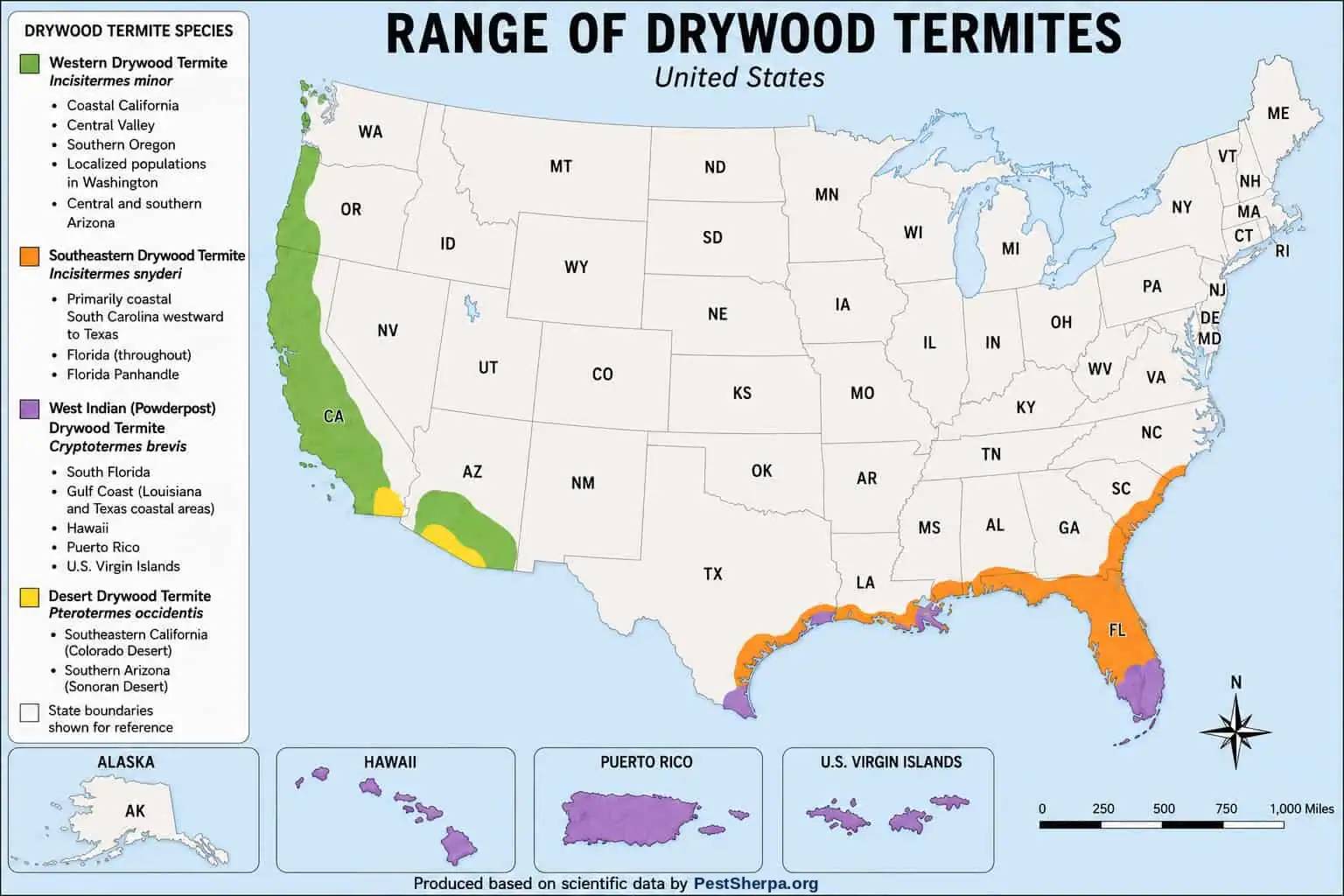
This page is the home for Greg Baumann’s drywood termite range map: a geographic overview of where drywood termites matter as structural pests in the United States. Full identification, frass, damage, and control stay on the drywood termite guide.
The map
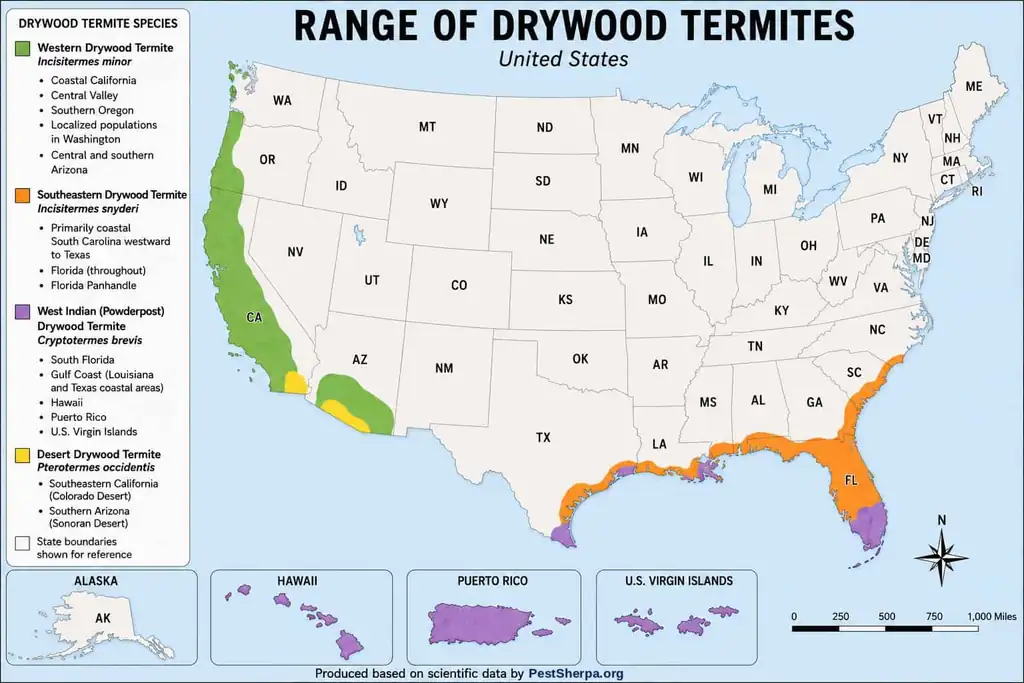
If you reuse the figure, keep the caption and credit Greg Baumann / Pest Sherpa with a link back to this page.
What this map shows
Use it as a range overview for drywood termites (Kalotermitidae as a group) in the continental U.S. and related coastal context shown on the graphic. Drywoods nest in wood without needing soil contact. The figure is meant to give a clearer geographic story than a vague “somewhere warm and coastal” cartoon.
- Where drywood termites are a realistic structural concern based on established regional range and known pressure
- A shareable teaching figure for homeowners, training, and articles (with credit)
- A starting point before species ID and a local inspection
What this map does not show
- A guarantee that a given house is or is not infested
- Every hitchhiking find in furniture, boats, or lumber far outside the main established range
- County-by-county legal, lending, or treatment requirements
- A substitute for identifying which drywood species (or which termite type) you actually have
How to read it
If you live in a highlighted drywood region, take swarmers, sand-like fecal pellets (frass), and unexplained attic or furniture damage seriously, and get a competent local inspection. If you live well outside the main range, drywood is less common as an established outdoor pest, but moved wood can still create one-off structural problems. Species matter: western drywood (Incisitermes minor), West Indian drywood (Cryptotermes brevis), and other drywoods do not share one identical story nationwide.
How range maps are validated (methods)
The best drywood distribution maps are specimen-backed occurrence records, not climate cartoons alone. Florida’s University of Florida / IFAS program is the clearest U.S. model. Estimated distributions for Florida’s established termite species rest on decades of sampling (more than 6,500 samples), species identification by UF labs, vouchering in the University of Florida Termite Collection, and a public interactive map updated regularly since 2016 (UF/IFAS IN1360). UF’s map page states the limits plainly: each point is an approximate collection location (privacy-shifted about 100 m), it marks detection in an area (not proof of a current infestation on a labeled structure), and the map is incomplete (FLREC Termite Distribution in Florida).
Species monographs add the transport story. Western drywood termite (Incisitermes minor) has a West Coast and Southwest-centered native range, with isolated structural finds elsewhere (including Florida) tied to human movement of infested wood (UF/IFAS IN526). West Indian drywood (Cryptotermes brevis) distribution figures dated 2017 on the UF page use University of Florida Termite Collection locality data for the U.S. and Florida/Caribbean picture (UF EDIS IN236). California extension language places western drywood along the Pacific coast into the Central Valley and Southern California deserts (UC IPM Drywood Termites, updated 08/2014). Texas Extension describes drywoods throughout Texas with highest concentrations along the Gulf Coast, and names three common species that need soldier or swarmer ID (Texas A&M E-366, Dec. 2005).
Older national Forest Service prose still gets copied as if it were a modern pixel map. USDA Forest Service Home and Garden Bulletin 64 (revised October 2006) places drywoods along Atlantic coastal states south of Virginia, all of Florida, the Gulf Coast, along the Mexican border, and the Pacific Coast to just north of San Francisco. That bulletin then focuses on subterranean termites. Its relative-hazard figure is for subterraneans, not drywoods. Use the 2006 drywood prose as dated national language, not as HG-64 Fig. 1 relabeled (USDA FS HG-64 PDF). Industry plain-language guides describe similar southern-tier and coastal patterns, including West Coast, Florida, and Hawaii framing (NPMA PestWorld drywood guide; NPMA Termites 101).
This methods discussion reflects extension and agency practice as reviewed in September 2026. Greg’s map figure is a teaching overview informed by that literature and field judgment. It is not a claim that every county was field-checked on a single date, and it is not a climate-envelope model with invented isotherms.
Limits worth remembering
- Maps lag introductions. Furniture, lumber, and boats move colonies faster than survey maps update.
- Local outliers exist far from endemic ranges. A historical collection point is not today’s active infestation.
- Absence of a map mark is not proof the species is absent (undersampling is common).
- Wrong species ID can drive the wrong treatment. Get drywoods identified before you choose a method (IN1360; UC IPM).
Related reading
- Pest Pressure Maps (this section)
- Drywood termites guide (ID, frass, damage, control)
This article was written by Greg Baumann, founder of Pest Sherpa, and reflects more than 40 years of professional pest management experience.
About the Author

Greg Baumann | Pest Control Expert
Greg Baumann is the founder of Pest Sherpa and a Pest Control Expert with more than 40 years of professional pest management experience. His articles combine decades of field experience, technical expertise, and science-based guidance to help homeowners identify pests correctly, understand real-world risks, and make informed pest management decisions.
Mission: Identify the pest. Understand the risk. Stop the problem. Prevent the comeback. Know when it’s time to call a professional.