
Vinegar Flies (Fruit Flies): Identification, Prevention, and Control
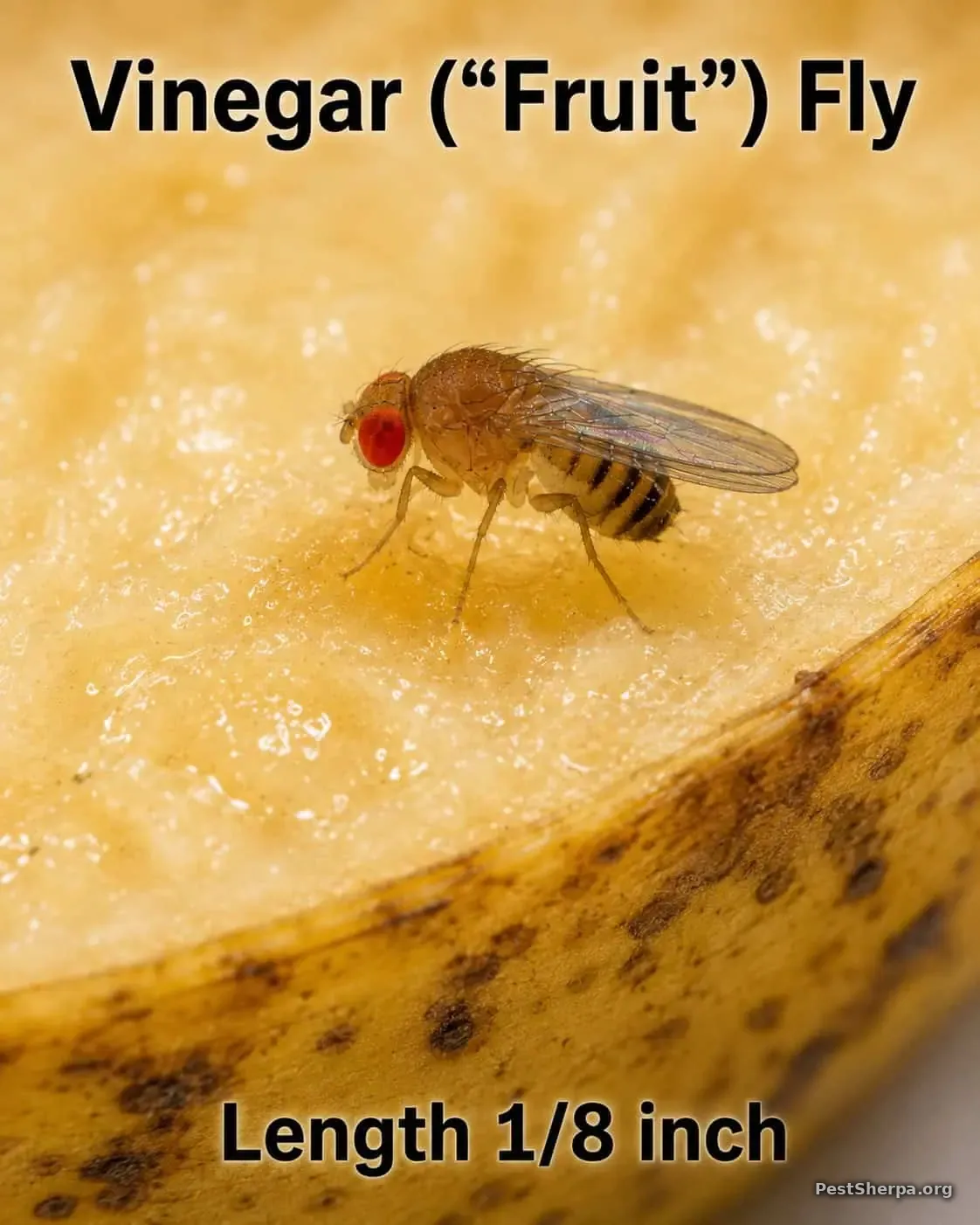
Vinegar flies, often called fruit flies, are tiny nuisance flies that develop anywhere fermenting organic material supports yeast growth. They are often found around overripe fruit, sugary beverages, drains, garbage containers, recycling bins, breweries, bars, restaurants, and commercial food-processing facilities. Vinegar flies are not considered major disease vectors (carriers). Still, they breed so fast that populations can explode in only a week or two if breeding sources are left alone.
Successfully eliminating vinegar flies requires much more than spraying the adults you see flying around your kitchen or business. The key is identifying and eliminating the hidden breeding source where eggs, larvae, and pupae continue developing. Once those breeding sites are removed, infestations usually collapse quickly.
Quick Answer
What causes vinegar flies?
Vinegar flies develop in moist, fermenting organic material where yeasts naturally grow. Common breeding sites include overripe fruit, spilled soft drinks, beer residue, and wine. Others are dirty recycling bins, garbage cans, floor drains, sink drains, garbage disposals, mop buckets, and food debris under equipment. Killing adult flies provides only temporary relief unless these breeding sources are eliminated.
On This Page
- What Are Vinegar Flies?
- Identification
- Life Cycle
- Breeding Sites
- Risk Assessment
- How to Get Rid of Vinegar Flies
- Commercial Prevention
- Frequently Asked Questions
- References
What Are Vinegar Flies?
Vinegar flies belong mainly to the genus Drosophila and are often referred to as fruit flies. Despite the common name, they are not the agricultural fruit flies in the family Tephritidae. Many of those are serious crop pests. The vinegar flies found inside homes and commercial buildings feed mainly on yeasts and microbes growing on fermenting organic material. They do not feed on healthy fruit itself.
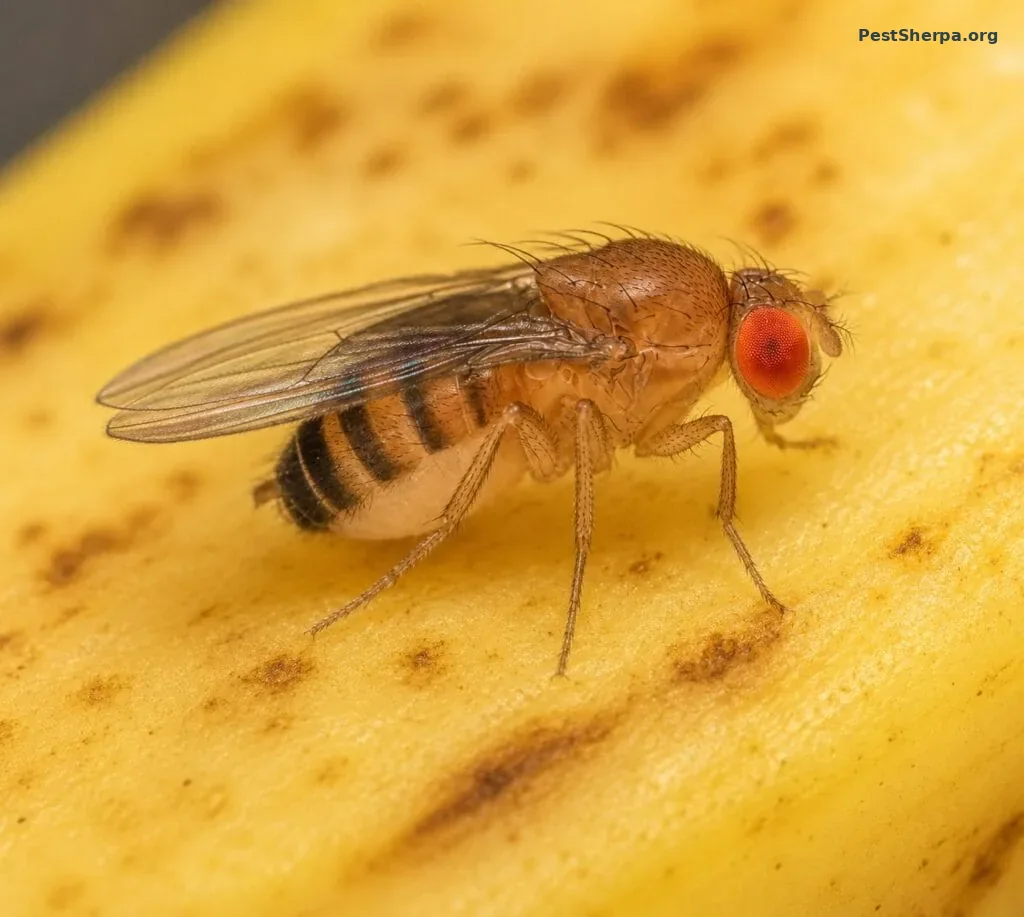
Adult vinegar flies are only about 1/8 inch long but can produce hundreds of offspring in just a few weeks under ideal indoor conditions.
The two species most often found indoors are Drosophila melanogaster, the familiar laboratory fruit fly, and Drosophila repleta. The second species is often tied to drains, garbage, and built-up organic residues in commercial facilities. Yeast grows naturally as fruits, vegetables, beverages, and other organic materials begin to ferment. That is why kitchens, bars, breweries, grocery stores, restaurants, and food-processing facilities make ideal habitats for vinegar flies.
Pest Lab Insight
One of the biggest misconceptions about vinegar flies is that they are attracted to fruit itself.
In reality, they are attracted primarily to the yeast growing on fermenting organic material. Even a few ounces of spilled juice beneath a refrigerator or a thin layer of organic slime inside a floor drain can produce hundreds of new flies every week.
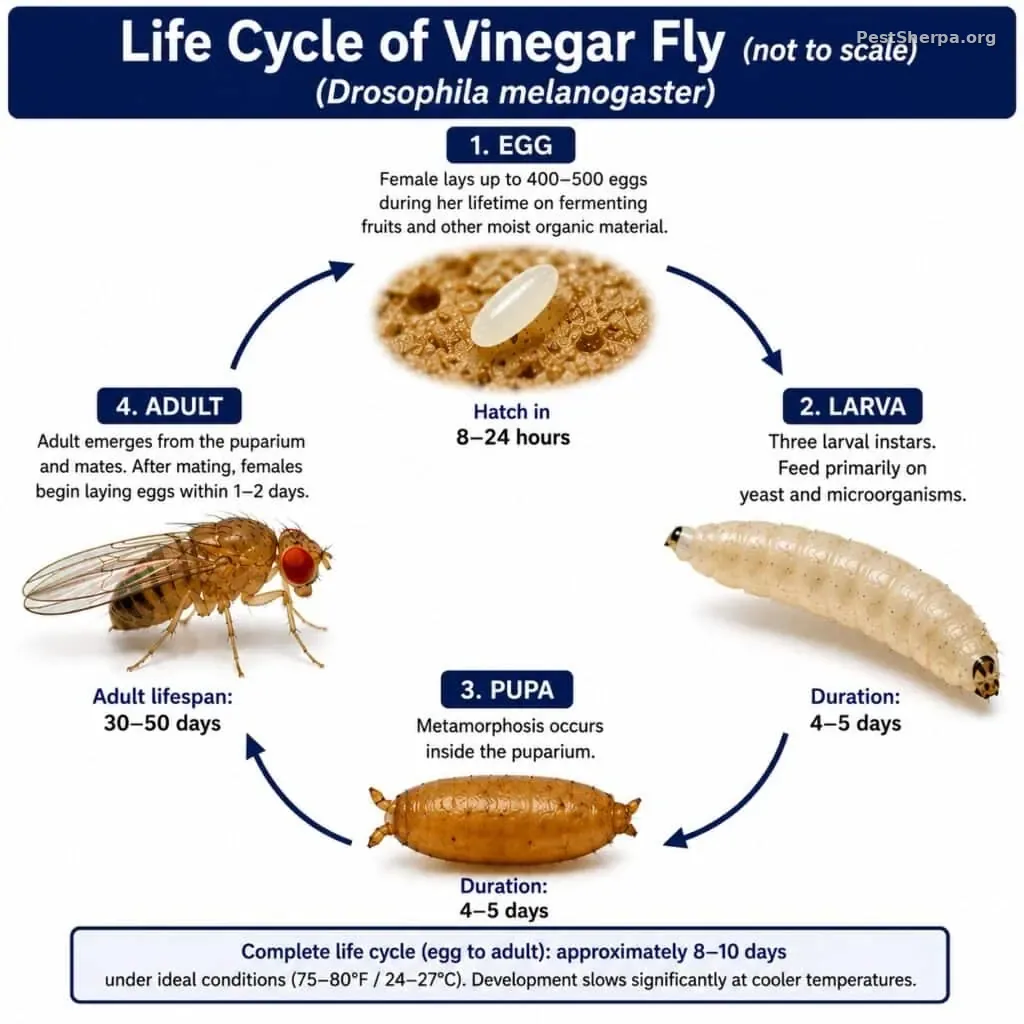
Under warm indoor conditions the complete life cycle may be completed in as little as one to two weeks, allowing populations to increase very rapidly.
How to Identify Vinegar Flies
Correct identification is essential because vinegar flies are often confused with drain flies and fungus gnats. While all three are small nuisance flies found indoors, each develops in different habitats and requires a different control strategy.
Size
Adults measure about 1/8 inch (3 to 4 mm) in length.
Body Color
Most vinegar flies are tan to yellowish-brown with darker abdominal bands that become visible under magnification.
Eyes
Most common species have distinctive bright red compound eyes, one of the easiest identification characteristics.
Wings and Flight
Vinegar flies have clear wings that rest flat over the body when at rest. Their flight is weak, hovering, and erratic, often occurring around fruit bowls, beverage stations, garbage containers, or drains.
Antennae
The short antennae contain specialized sensory structures that detect the volatile compounds produced during fermentation. These odors help vinegar flies locate suitable breeding sites from surprising distances.
Behavior
House flies often land on walls and ceilings. Vinegar flies spend much of their time near breeding sites, where adults feed, mate, and lay eggs. Their presence often indicates an active source of fermenting organic material nearby.
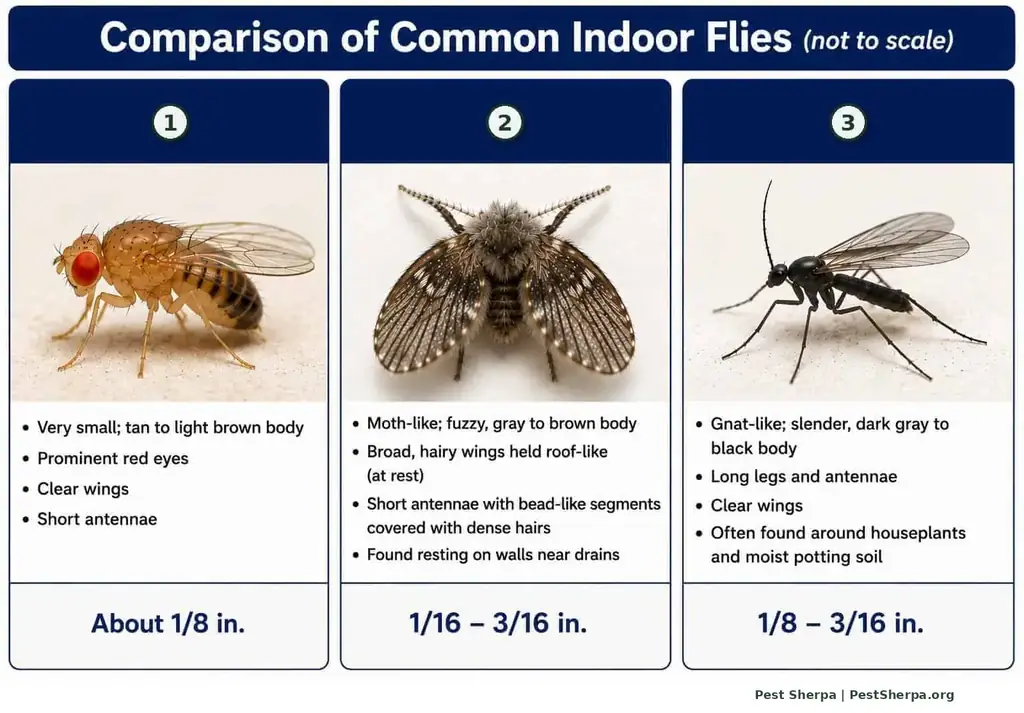
Which one do you see? Match the number:
- Vinegar fly (fruit fly): about 1/8 inch, tan to light brown body, prominent red eyes and clear wings. Breeds in fermenting fruit and organic film.
- Drain fly (moth fly): fuzzy and gray to brown, with broad hairy wings held roof-like at rest. Rests on walls near drains.
- Fungus gnat: slender, dark gray to black, with long legs and antennae. Found around houseplants and moist potting soil.
Although these insects are often confused with one another, their biology, breeding sites, and control methods are quite different.
Comparison of Common Indoor Flies
| Characteristic | Vinegar Fly | Drain Fly | Fungus Gnat |
|---|---|---|---|
| Body Color | Tan to light brown | Gray, fuzzy | Dark gray to black |
| Eyes | Bright red | Dark | Dark |
| Wings | Clear | Hairy, moth-like | Clear |
| Breeding Site | Fermenting organic matter | Drain biofilm | Moist potting soil |
| Common Location | Fruit, beverages, garbage | Floor drains, sinks | Houseplants |
| Primary Food Source | Sugars (adults) and Yeasts | Organic slime | Fungi |
Life Cycle
Like all true flies, vinegar flies undergo complete metamorphosis consisting of four developmental stages:
- Egg
- Larva
- Pupa
- Adult
Females deposit eggs directly onto fermenting organic materials where microscopic yeasts are actively growing. The larvae hatch quickly and feed almost exclusively on these microorganisms rather than the fruit or organic material itself.
During warm indoor conditions, development from egg to adult may require as little as seven to fourteen days. This rapid life cycle explains why seemingly minor infestations can become severe in only a short period of time.
A single female may lay several hundred eggs during her lifetime. If breeding sites remain available, multiple overlapping generations can develop continuously indoors throughout the year.
Common Vinegar Fly Breeding Sites
Locating the breeding source is almost always the most difficult, and most important, part of a successful vinegar fly control program. Adult flies are highly visible, but the larvae often develop in hidden accumulations of moist organic material that receive little attention during normal cleaning.
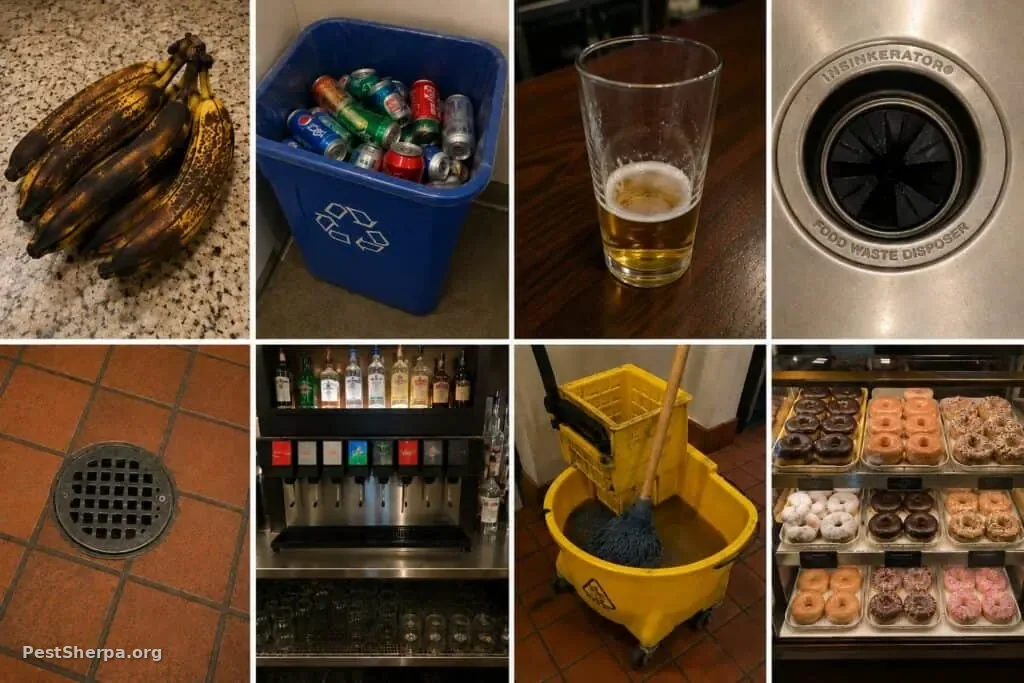
Even very small accumulations of fermenting organic material can support large vinegar fly populations.
Common breeding sites include:
- Overripe fruits and vegetables
- Fermenting produce stored on countertops
- Beer, wine, soda, and juice spills
- Recycling containers holding beverage bottles and cans
- Garbage containers with food residue
- Garbage disposals
- Floor drains
- Sink drains
- Organic residue beneath kitchen equipment
- Mop buckets and wet cleaning tools
- Food-processing equipment
- Commercial beverage stations
One overlooked breeding site can sustain hundreds or even thousands of adult flies. Eliminating these hidden sources is far more effective than repeated insecticide applications directed only at the adults.
Why Drains Become Breeding Sites
Many recurring vinegar fly infestations originate inside sink drains, floor drains, and garbage disposals. These locations often develop a layer of sticky organic biofilm composed of food particles, bacteria, fungi, and yeast. This biofilm provides both food and moisture for developing larvae.
Pouring hot water or bleach into a drain rarely removes this biofilm (the slimy film of microbes and residue). Much of the organic residue clings to the sides of the pipe above the water line. Mechanical cleaning or foaming microbial drain products are generally much more effective because they physically remove or digest the breeding material.
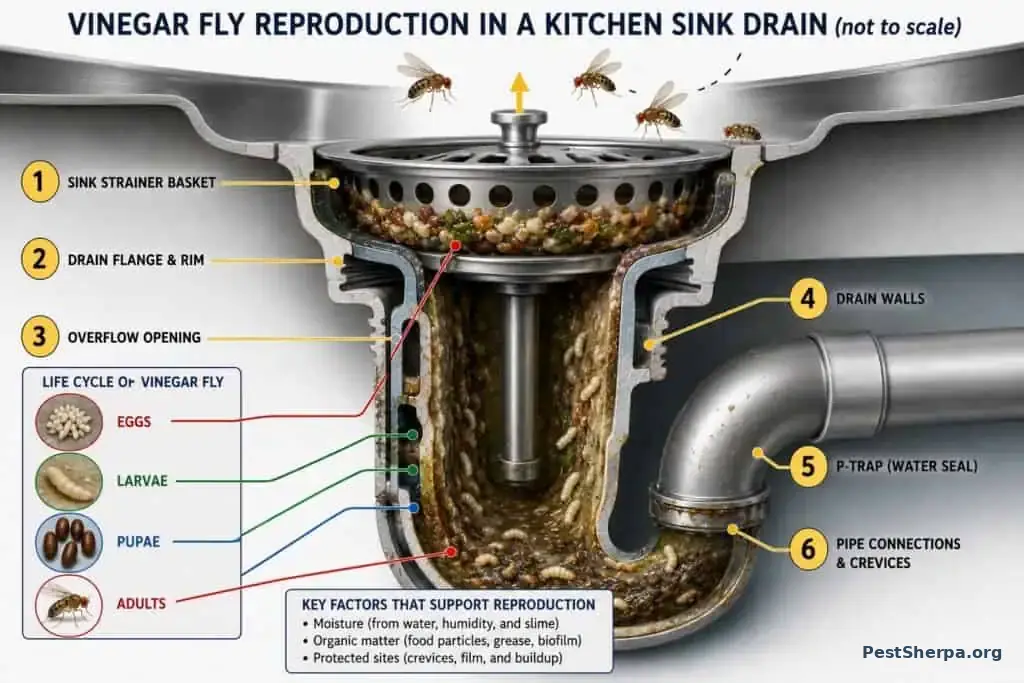
Organic biofilm inside drains often supports continuous vinegar fly reproduction. Simply killing adult flies will not eliminate the infestation if larvae continue developing inside the drain.
Risk Assessment
| Concern | Risk Level | Comments |
|---|---|---|
| Home Nuisance | Moderate | Populations increase rapidly indoors. |
| Restaurant Sanitation | High | May trigger customer complaints and health inspection concerns. |
| Food Contamination | Moderate | Adults may mechanically contaminate exposed foods. |
| Disease Transmission | Low | Not considered important disease vectors. |
| Structural Damage | None | They do not damage buildings or furnishings. |
| Difficulty of Control | Moderate | Source identification is often the greatest challenge. |
Are Vinegar Flies Harmful?
Vinegar flies are mainly nuisance pests. Unlike house flies, they are not regarded as significant disease vectors. Nevertheless, they should not be ignored, particularly in commercial food environments.
Adult flies often move between fermenting organic materials and exposed food or food-contact surfaces. While their ability to transmit disease is considered limited, their presence may mechanically transfer microorganisms and creates an obvious sanitation concern.
Restaurants, grocery stores, breweries, wineries, commercial kitchens, and food-processing facilities often have very low tolerance for vinegar flies. Visible flies can hurt customer confidence and regulatory inspections.
How to Get Rid of Vinegar Flies
Successful vinegar fly control depends on eliminating the breeding source, not simply killing adult flies. Integrated Pest Management (IPM) combines sanitation, source reduction, monitoring, moisture management, and targeted treatments to produce long-term control.
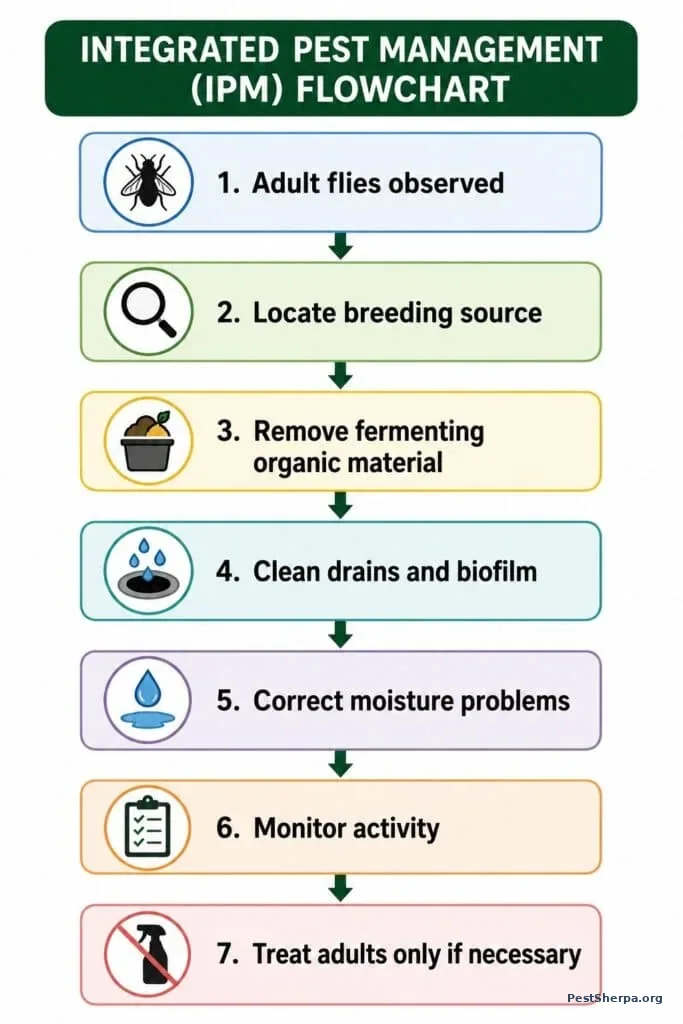
1. Improve Sanitation
Sanitation is the single most effective control measure. Every successful vinegar fly management program begins by removing the food sources supporting larval development.
- Discard overripe fruits and vegetables.
- Store produce in the refrigerator whenever practical.
- Clean beverage spills immediately.
- Wash recycling containers often.
- Scrub garbage cans.
- Clean beneath refrigerators, shelving, and food equipment.
- Remove food debris from cracks and corners.
- Clean garbage disposals regularly.
Remember that vinegar fly larvae feed mainly on yeast growing within fermenting organic matter. Even small accumulations of residue can sustain large fly populations.
2. Inspect and Monitor
Monitoring allows you to identify hidden breeding sites and evaluate whether control efforts are working.
- Sticky monitoring cards
- Commercial fruit fly traps
- Drain inspections
- Garbage room inspections
- Recycling area inspections
- Beverage station inspections
- Checks beneath equipment
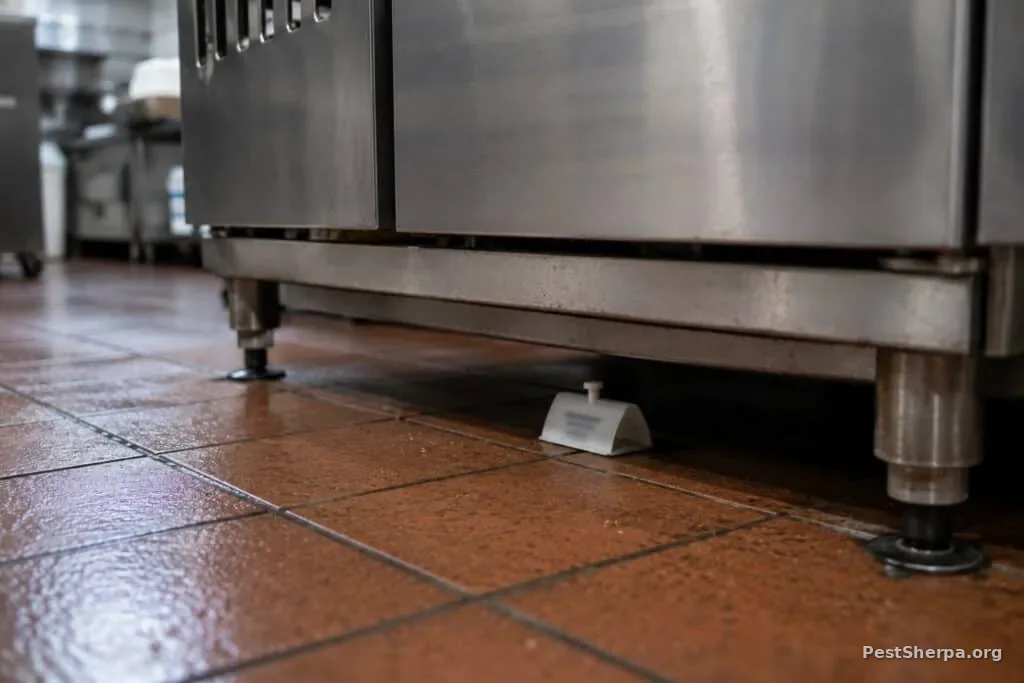
Monitoring traps help identify active breeding locations and measure the success of sanitation efforts over time.
3. Correct Moisture Problems
Moisture is essential for vinegar fly development. Eliminating unnecessary moisture reduces the suitability of breeding habitats.
- Repair plumbing leaks.
- Eliminate standing water.
- Improve floor drain drainage.
- Keep mop buckets clean and dry.
- Replace saturated cleaning cloths.
- Maintain dry storage areas whenever possible.
Foaming microbial drain cleaners usually work better than bleach or hot water. They remove the organic biofilm that feeds the larvae instead of just disinfecting the drain.
4. Use Chemical Controls Only as a Supplement
Insecticides alone rarely eliminate vinegar fly infestations because they kill only the flying adults. Eggs, larvae, and pupae can stay protected in drains, garbage containers, recycling bins, or fermenting organic material. New adults will keep emerging long after sprays have dried.
When chemical control is appropriate, it should always be combined with sanitation and source removal. Professional pest management programs may use approved residual insecticides, aerosol space treatments, insect growth regulators (IGRs), or specialized drain treatments. These fit within a broader Integrated Pest Management program.
Always follow pesticide label directions. The label is the law.
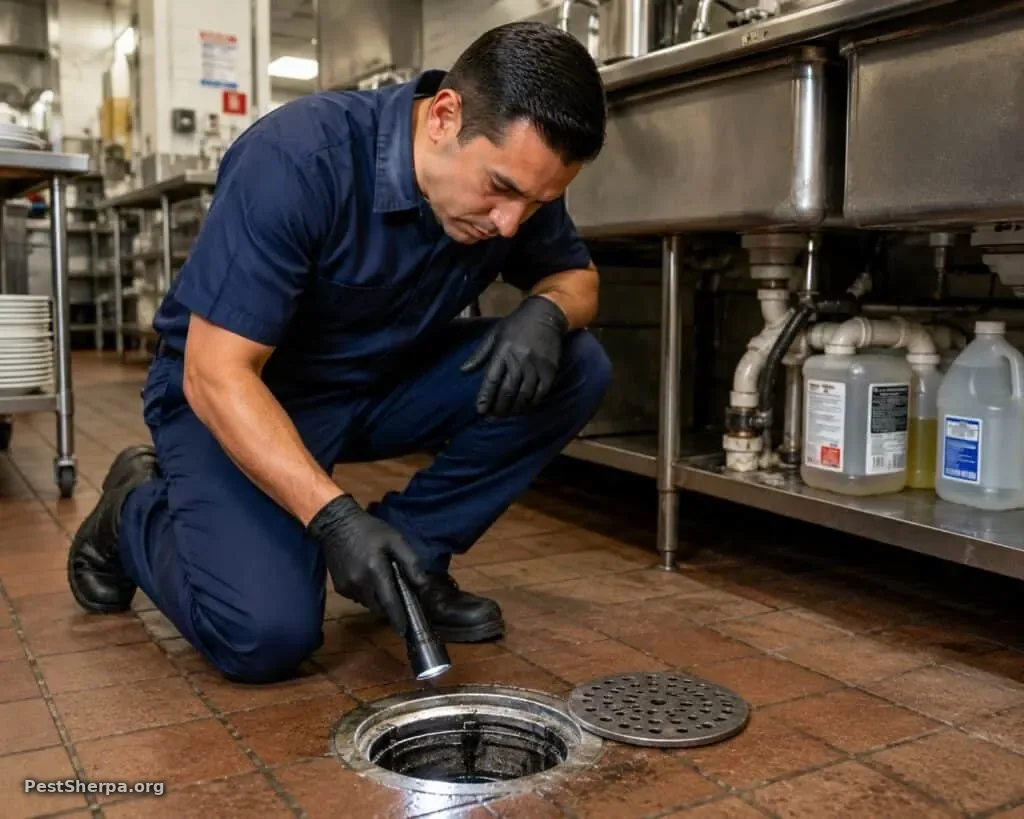
Professional inspections often locate hidden breeding sources that routine cleaning overlooks.
Vinegar Fly Prevention in Commercial Facilities
Commercial food facilities present ideal environments for vinegar flies because they generate a continuous supply of fermenting organic material, moisture, and food residues. Restaurants, bars, breweries, wineries, grocery stores, food-processing plants, and institutional kitchens should implement routine inspection and sanitation programs to prevent infestations before they become established.
A successful commercial prevention program should include:
- Daily sanitation schedules.
- Routine drain cleaning.
- Scheduled cleaning beneath equipment.
- Proper garbage handling.
- Frequent recycling container cleaning.
- Routine beverage station inspections.
- Sticky trap monitoring.
- Employee sanitation training.
- Regular inspections by a licensed pest management professional.
Common Mistakes That Allow Vinegar Flies to Return
Many recurring infestations result from treating only the visible adult flies while overlooking the breeding source. The following mistakes often allow vinegar fly populations to recover quickly.
- Spraying adult flies without removing breeding sites.
- Ignoring sink drains and floor drains.
- Relying on bleach to clean drains.
- Failing to wash recycling containers.
- Leaving overripe produce on countertops.
- Overlooking food residue beneath appliances.
- Ignoring garbage disposal buildup.
- Failing to monitor after treatment.
Pest Lab Insight
If adult vinegar flies continue appearing after treatment, assume a breeding site still exists. Successful control almost always comes from finding the source, not applying more insecticide.
Frequently Asked Questions
Are vinegar flies the same as fruit flies?
Yes. The terms “vinegar fly” and “fruit fly” are often used interchangeably when referring to species in the genus Drosophila. They should not be confused with agricultural fruit flies in the family Tephritidae.
Why do vinegar flies suddenly appear?
They usually appear after fermenting organic material becomes available. Because their life cycle is very short, populations can increase dramatically within one to two weeks.
Can vinegar flies breed in drains?
Yes. Organic biofilm inside drains provides an excellent environment for yeast growth and larval development, particularly for species such as Drosophila repleta.
Does bleach eliminate vinegar flies?
Usually not. Bleach disinfects surfaces but often fails to remove the organic biofilm where larvae develop. Mechanical cleaning or microbial drain cleaners are generally much more effective.
How long do vinegar flies live?
Adult lifespan varies with temperature and food availability, but most live several weeks. During that time, females may lay several hundred eggs.
What attracts vinegar flies?
Vinegar flies are attracted mainly to the yeasts and microorganisms growing on fermenting fruits, vegetables, sugary beverages, and other moist organic materials. The odor of fermentation is much more attractive than fresh produce.
Can homemade vinegar traps eliminate an infestation?
Homemade traps may capture adult flies and reduce nuisance levels, but they rarely eliminate an infestation because larvae continue developing in hidden breeding sites. Traps should be viewed as monitoring tools rather than complete control measures.
Related Pest Sherpa Articles
- Fruit Flies vs. Drain Flies: Learn how to tell apart these commonly confused nuisance flies.
- Drain Flies: Biology, identification, and drain sanitation.
- Fungus Gnats: Identification and management around indoor plants.
- House Flies: Understanding one of the world’s most common filth flies.
- Integrated Pest Management (IPM): The foundation of long-term pest prevention.
- Commercial Kitchen Pest Prevention: Best practices for restaurants and food-handling facilities.
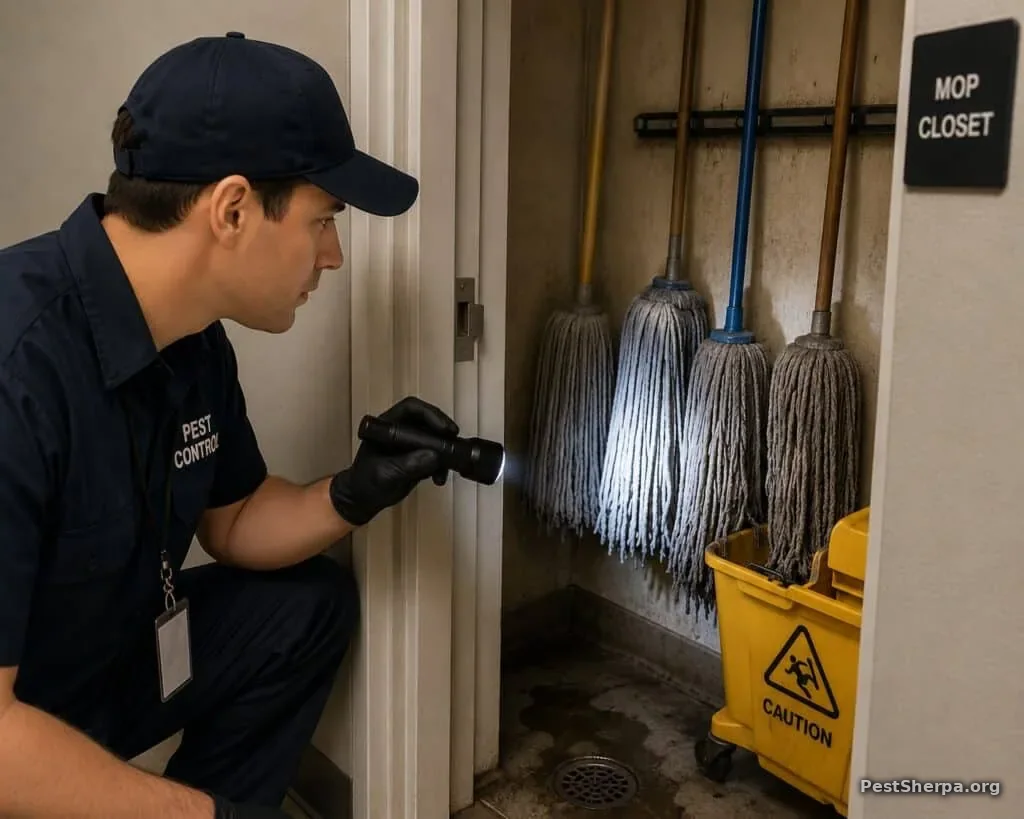
Routine inspections help identify hidden breeding sites before vinegar fly populations become established.
Conclusion
Vinegar flies are among the most common nuisance flies encountered in homes, restaurants, breweries, grocery stores, and other food-handling facilities. Although they are not considered important disease vectors, their rapid reproductive cycle allows infestations to develop quickly whenever fermenting organic material is available.
The most effective management program focuses on locating and eliminating breeding sources rather than simply killing adult flies. Careful sanitation, moisture management, drain maintenance, routine inspections, and ongoing monitoring remain the foundation of successful long-term control.
Sometimes vinegar fly activity persists despite sanitation efforts. Then a thorough inspection by a licensed pest management professional can often find hidden breeding sites that routine cleaning missed.
Authoritative References
- University of California Integrated Pest Management: Vinegar Flies
- University of Kentucky Entomology: Fruit Flies
- Texas A&M AgriLife Extension: Indoor Flies and Their Control
- Bonnefoy X., Kampen H., & Sweeney K. Public Health Significance of Urban Pests. World Health Organization Regional Office for Europe.
- Smith, E.H. & Whitman, R.C. NPMA Field Guide to Structural Pests, 2nd Edition.
About This Article
This article was reviewed for technical accuracy using current urban entomology references and Integrated Pest Management (IPM) principles. Pest Sherpa articles are written to help homeowners and pest management professionals understand pest biology, identify infestations accurately, and implement effective long-term control strategies.
This article was written by Greg Baumann, founder of Pest Sherpa, and reflects more than 40 years of professional pest management experience.
About the Author

Greg Baumann | Pest Control Expert
Greg Baumann is the founder of Pest Sherpa and a Pest Control Expert with more than 40 years of professional pest management experience. His articles combine decades of field experience, technical expertise, and science-based guidance to help homeowners identify pests correctly, understand real-world risks, and make informed pest management decisions.
Mission: Identify the pest. Understand the risk. Stop the problem. Prevent the comeback. Know when it’s time to call a professional.