
Kudzu Bugs: Identification, Home Entry, and What to Do
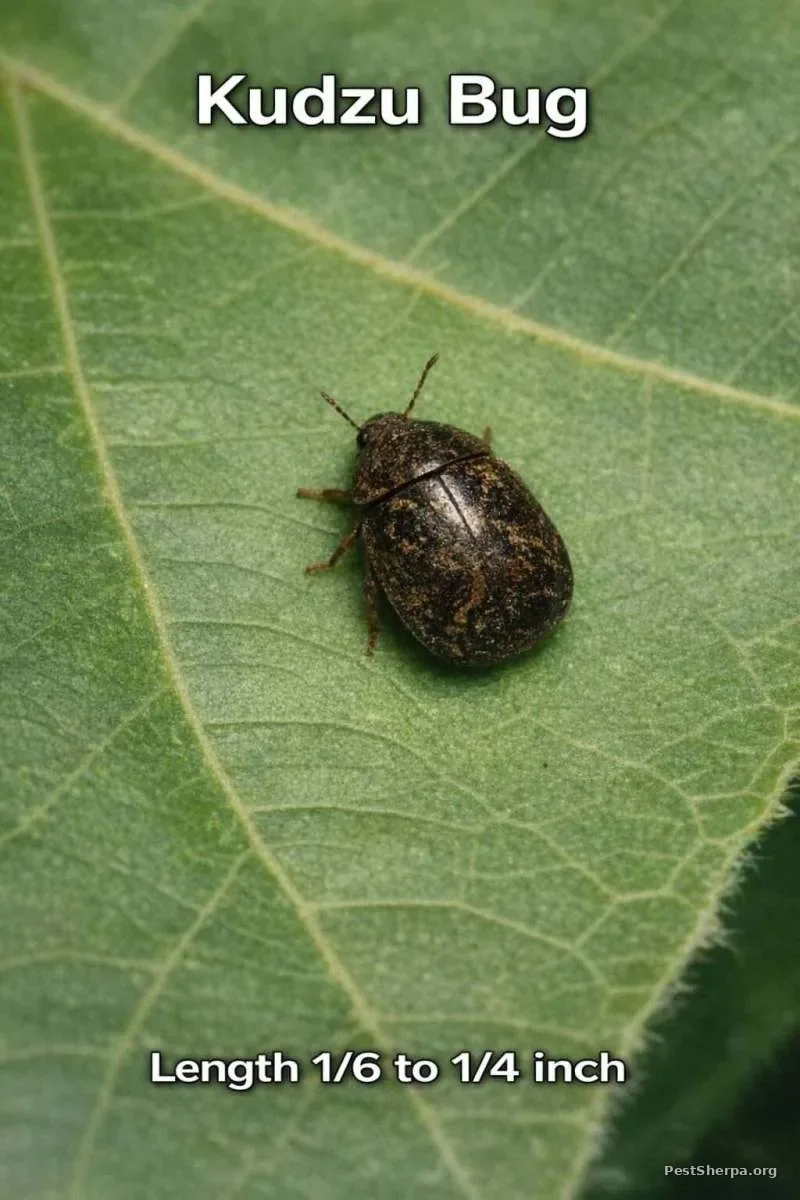
Kudzu bugs (Megacopta cribraria) are small, rounded, invasive true bugs that feed on kudzu, soybean, wisteria, and other legumes. Around homes, the main issue is seasonal nuisance activity: adults can gather on sunny exterior walls in late summer and fall, then slip through gaps while looking for sheltered overwintering sites. They do not damage wood, reproduce indoors, or bite, but they can release an odor and stain surfaces when crushed. This guide explains how to identify kudzu bugs, what their presence means, how to inspect for likely entry points, and when extension or professional guidance may be worth considering.
TL;DR
- Kudzu bugs are plant-feeding true bugs, not household breeding pests. Indoors, they are usually accidental or overwintering invaders.
- They are most noticeable in fall. Adults may gather on warm, sunny, light-colored exterior walls before entering cracks, vents, siding gaps, soffits, doors, and window frames.
- Do not crush them. Disturbed or crushed kudzu bugs may release an odor, stain surfaces, and irritate skin in some people.
- For homes, exclusion is the main long-term step. Vacuum indoor bugs, empty the vacuum promptly, and seal entry points before the next fall migration.
- For soybean fields, use scouting and extension thresholds. Routine spraying or treating only migrating adults is not the same as threshold-based IPM.
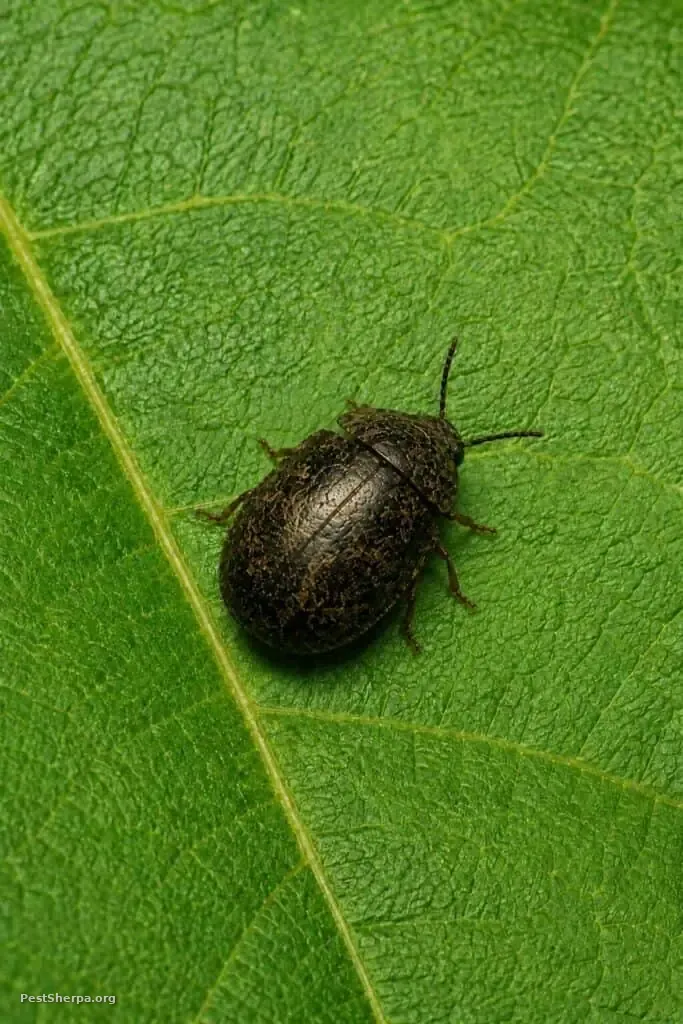
Adult kudzu bug showing rounded olive-brown body on a leaf.
Quick Navigation
- What Are Kudzu Bugs?
- Quick Identification
- What Kudzu Bugs Mean Around Your Home
- Seasonal Activity and Life Cycle
- Where Kudzu Bugs Are Found
- Host Plants and Soybean Injury
- What To Do
- What Does Not Work Well
- How Long Kudzu Bug Activity Lasts
- When Professional Help May Be Needed
- Lookalikes and Common Misidentifications
- Frequently Asked Questions
- References
What Are Kudzu Bugs?
The kudzu bug, Megacopta cribraria, is also called the bean plataspid, lablab bug, or globular stink bug. It is an invasive true bug native to Asia and was first detected in the United States near Atlanta, Georgia, in 2009. Since then, it has become established mainly in the southeastern United States, with additional reports into parts of the Mid-Atlantic. Virginia Cooperative Extension (2024) reports it has spread from Georgia to at least 18 additional states and the District of Columbia. It is a regional Southeast / Mid-Atlantic issue, not a nationwide fall invader on the same scale as brown marmorated stink bug.
Kudzu bugs matter for two different reasons:
- Plant and crop impact: They feed on kudzu and other legumes, including soybean, by using piercing-sucking mouthparts to remove plant fluids.
- Building nuisance activity: Adults may gather on buildings and enter cracks or gaps while seeking protected overwintering sites.
Although one common name includes the phrase “stink bug,” kudzu bugs are not the same insect as the familiar brown marmorated stink bug. Kudzu bugs belong to the family Plataspidae, while many typical stink bugs belong to Pentatomidae.
Quick Identification: What Kudzu Bugs Look Like
| Feature | What To Look For |
|---|---|
| Adult size | About 1/6 to 1/4 inch long, or roughly 4 to 6 mm |
| Adult shape | Rounded, compact, and somewhat oblong; more globular than many stink bugs |
| Adult color | Mottled olive-green to brown, often with speckling |
| Odor | May release a noticeable defensive odor when disturbed or crushed |
| Nymphs | Smaller, often clustered on host plants; later stages can appear darker and more robust |
| Eggs | Often laid in rows on host plants; eggs may be barrel-shaped and arranged in paired lines |
Important identification clue: Kudzu bugs are usually compact and rounded rather than long, narrow, or strongly shield-shaped. They may be found on kudzu, wisteria, soybean, and other legumes, or clustered on exterior walls during seasonal movement.
Safety note: Avoid crushing kudzu bugs with bare hands. Their defensive secretion can create odor, staining, and possible skin irritation. Use a vacuum, tissue, gloves, or another no-crush removal method indoors.
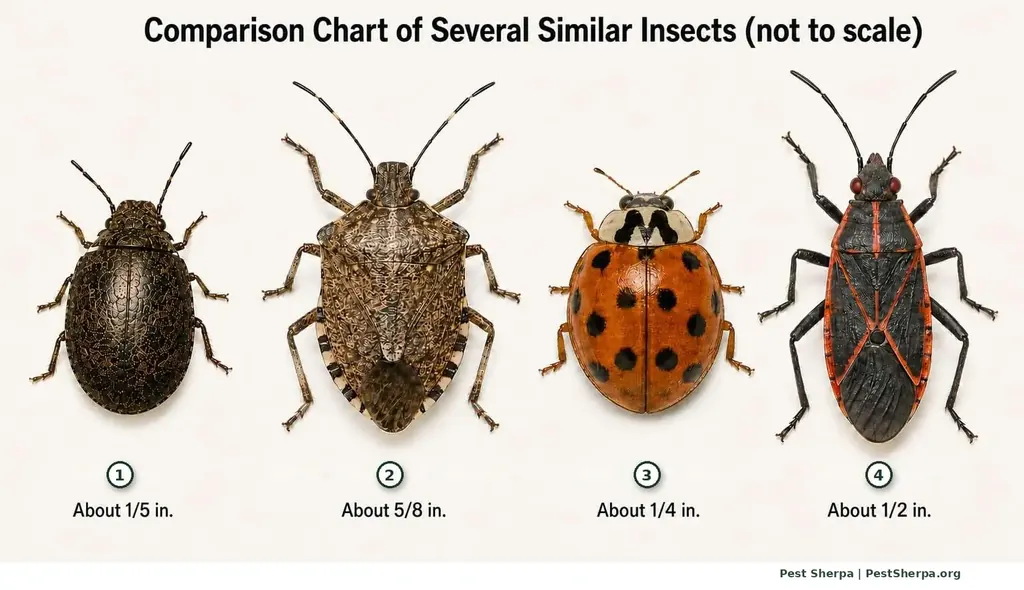
Which one do you see? Match the number:
- Kudzu bug: about 1/5 inch, olive-brown, squarish and bumpy. Gathers on light-colored siding in fall.
- Brown marmorated stink bug: about 5/8 inch, shield-shaped and mottled brown with light bands on the antennae and along the edges.
- Asian lady beetle: about 1/4 inch, orange and round with black spots and an M or W shaped mark behind the head.
- Boxelder bug: about 1/2 inch, black with red-orange lines on the back.
Comparison of kudzu bug, stink bug, lady beetle, and boxelder bug.
What Kudzu Bugs Mean Around Your Home
Kudzu bugs around a house usually mean adults are looking for shelter, not that they are feeding on the house or breeding indoors. They may collect on warm exterior walls, especially sunny walls near kudzu patches, wisteria, soybean fields, or other legume vegetation.
| What You See | Most Likely Meaning |
|---|---|
| One or two bugs indoors | Accidental entry or overwintering adults waking up |
| Many bugs on outside walls | Seasonal aggregation before overwintering |
| Bugs around windows or doors | Likely entry points nearby |
| Bugs mainly on sunny exterior walls | Adults are warming and gathering on favorable surfaces |
| Activity repeats each fall | Exclusion work should be done before the next seasonal movement |
Kudzu bugs do not eat wood, fabric, stored food, or structural materials. The main indoor concerns are nuisance presence, odor, staining, and the possibility of mild irritation after contact with their defensive secretions.
Seasonal Activity and Life Cycle
Kudzu bugs overwinter as adults in protected locations such as leaf litter, bark crevices, plant debris, and sheltered building gaps. In spring, adults become active and move to host plants such as kudzu, wisteria, and soybean. Females lay eggs on host plants, and young bugs develop through nymphal stages before becoming adults.
In warmer regions, development from egg to adult can occur in roughly six to eight weeks under favorable conditions. This timing matters because home nuisance activity and crop management decisions happen at different points in the season.
Home pattern: Adults are most likely to create building complaints in late summer and fall as they search for overwintering sites. Some may reappear indoors during warm winter or early spring days.
Agricultural pattern: In soybean, extension recommendations generally emphasize scouting and nymph-based thresholds rather than reacting only to newly migrating adults.
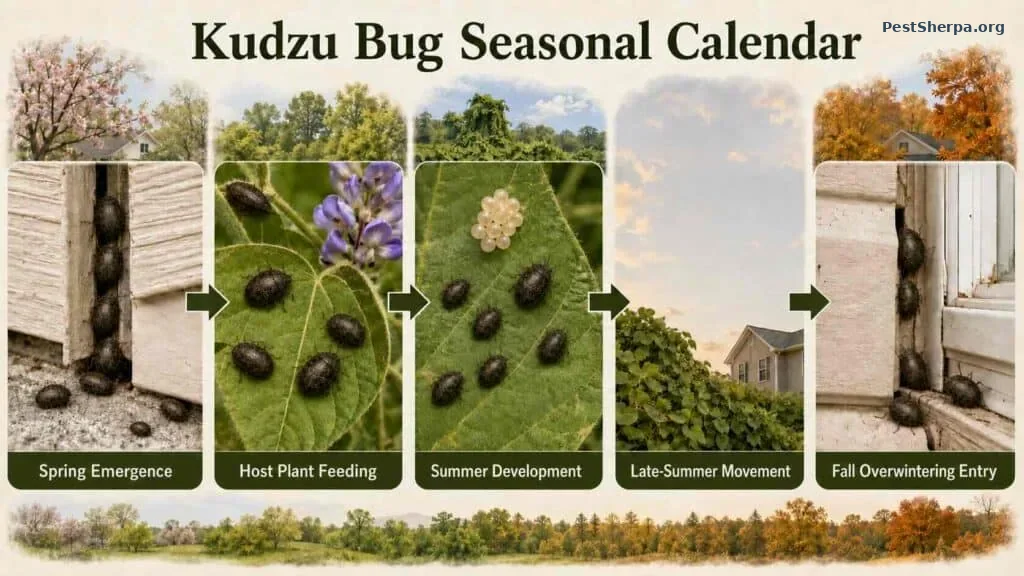
Seasonal life cycle calendar for kudzu bugs around homes and host plants.
Where Kudzu Bugs Are Found
Kudzu bugs are most associated with the southeastern United States, where kudzu and soybean hosts are common. Extension reports place it in Georgia plus at least 18 other states and the District of Columbia. Reports and severity vary by year, weather, host plant availability, biological control, and local cropping patterns. If you need current local status, check your state cooperative extension service or invasive species reporting system.
Distribution should not be treated as static. A county may have records of kudzu bugs without having severe current activity every year.
Host Plants and Soybean Injury
Kudzu bugs are phloem feeders. They use piercing-sucking mouthparts to remove plant fluids from stems, petioles, nodes, and other plant tissues. Their strongest associations are with kudzu and legumes, including soybean.
Common Host Plants
- Kudzu
- Soybean
- Wisteria
- Some beans and other legumes, depending on local conditions and suitability
Potential Soybean Injury
In soybean fields, adults and nymphs can reduce plant vigor by removing nutrients and moisture. Heavy, unmanaged infestations have been associated with yield loss, but the actual risk depends on pest density, crop stage, timing, and local population pressure. In many areas, kudzu bug numbers have declined compared with the early outbreak years. Research attributes part of this decline to a fungal epizootic involving Beauveria bassiana around 2015 in some areas, but scouting is still important where the insect occurs.
Soybean Scouting Context
For soybean growers, treatment decisions should be based on current extension guidance, crop stage, sampling method, and local thresholds. Extension sources commonly caution against treating only because migrating adults are present; nymphs and sustained populations are more important for timing decisions.
General threshold examples from extension guidance:
- Before mid-July: approximately 5 bugs per plant may be used as a decision point in some guidance.
- After mid-July: approximately 1 nymph per sweep, or 15 nymphs per 15-sweep sample, may be used as a decision point in some guidance.
These numbers are not a substitute for local recommendations. Field crop users should confirm thresholds with their state extension service before taking action.
What To Do About Kudzu Bugs
1. Confirm the Insect
Before making control decisions, compare the insect’s shape, size, and color with reliable photos. If the insect is larger, flatter, strongly shield-shaped, or patterned differently, it may be a stink bug or another fall invader instead.
2. Remove Indoor Bugs Without Crushing Them
- Use a vacuum for indoor adults.
- Empty the vacuum contents promptly outdoors.
- Avoid smashing them on walls, curtains, furniture, or skin.
- Clean stained surfaces gently according to the surface material.
3. Inspect Likely Entry Points
Focus on the side of the home where kudzu bugs are clustering. Common entry points include:
- Window and door frames
- Damaged screens
- Gaps under siding
- Soffit and fascia gaps
- Attic vents and gable vents
- Utility penetrations
- Garage door gaps
- Cracks around trim, masonry, and foundations
4. Improve Exclusion Before Fall Activity Peaks
- Repair torn screens.
- Add or replace door sweeps and weatherstripping.
- Seal small gaps around windows, trim, siding, and utility lines.
- Use appropriate screening on attic, soffit, and gable vents.
- Reduce clutter and debris near exterior walls where overwintering insects may shelter.
Exclusion works best when done before adults begin massing on buildings. Once bugs are already inside, sealing can still help, but it may not stop all activity from bugs that have already entered hidden spaces.
5. Review Nearby Host Plants
If kudzu, wisteria, or other dense legume growth is growing directly on or against the structure, consider pruning or managing vegetation where practical and lawful. Do not remove vegetation from neighboring property, public land, or protected areas without permission.
6. Use Pesticides Carefully, If They Are Used At All
Pesticides are not always necessary for kudzu bugs in homes. When exterior products are considered, timing, site, product label, and local regulations matter. Always read and follow the full label, keep children and pets away from treated areas until allowed by the label, avoid contaminating food-preparation areas, and do not apply pesticides into vents, drains, or indoor voids unless the label specifically allows that use.
For soybean or other crop settings, follow your state extension recommendations and pesticide labels. Agricultural decisions should be based on scouting and thresholds rather than calendar spraying.
What Does Not Work Well
- Crushing them indoors: This can create odor, stains, and possible irritation.
- Relying only on indoor sprays: Indoor activity often comes from bugs that already entered wall voids, attics, or gaps. Exclusion is usually more important.
- Using foggers as the main response: Foggers do not seal entry points and may create unnecessary pesticide exposure.
- Treating every plant in the yard: Kudzu bugs are linked to specific host plants, especially legumes. Broad spraying can affect beneficial insects and may not solve building entry.
- Treating soybean fields only because adults are migrating: Extension guidance generally emphasizes scouting and nymph populations before treatment decisions.
How Long Kudzu Bug Activity Lasts
Indoor activity may be brief if only a few adults entered. If many adults found overwintering sites inside walls, attics, or siding gaps, you may see intermittent activity during warm periods through winter and early spring. They are not reproducing indoors, so repeated indoor activity usually reflects hidden overwintering adults or continued entry from outside.
| Situation | Expected Pattern |
|---|---|
| A few indoor bugs | Often short-lived after removal |
| Large fall exterior aggregation | May continue during seasonal movement |
| Adults overwintering in gaps | Intermittent indoor sightings may occur on warm days |
| Entry points remain open | Activity may repeat in future seasons |
When Professional Help May Be Needed
Many small kudzu bug problems can be handled with careful vacuuming and exclusion. Professional help may be worth considering when identification is uncertain, bugs are entering in large numbers, activity is coming from difficult-to-reach wall or attic areas, or repeated fall intrusions continue despite sealing obvious gaps.
For farms, gardens, or crop settings, a local extension office, crop consultant, or qualified agricultural professional can help confirm identification, evaluate host plants, interpret thresholds, and choose label-compliant options when treatment is justified.
Lookalikes and Common Misidentifications
Kudzu bugs can be confused with other small insects that gather on homes in fall. Compare shape, color, behavior, and location before deciding what to do.
| Possible Lookalike | How It Differs |
|---|---|
| Brown marmorated stink bug | Larger, flatter, more shield-shaped, and marbled brown; also a common fall invader. |
| Lady beetles | Beetles rather than true bugs; often red, orange, or spotted with a more beetle-like shell. |
| Boxelder bugs | Longer and darker with red-orange markings; often gather on sunny walls in fall. |
| Carpet beetles | Much smaller beetles found indoors near fabrics, lint, dead insects, or stored materials; not associated with kudzu or soybean feeding. |
Correct identification matters because the best response for kudzu bugs is usually exclusion and no-crush removal, while other pests may require different source investigation or prevention steps.
Frequently Asked Questions
Are kudzu bugs dangerous?
Kudzu bugs are mainly nuisance insects around homes. They do not bite, sting, or damage structures. The main concerns are odor, staining, and possible irritation from defensive secretions if they are crushed or handled.
Do kudzu bugs reproduce inside houses?
No. Indoor kudzu bug activity usually comes from adults that entered while seeking overwintering shelter. They need suitable host plants for their life cycle.
Why are kudzu bugs all over one side of my house?
Adults often gather on warm, sunny exterior surfaces before overwintering. Light-colored siding, south- or west-facing walls, nearby host plants, and available cracks can make one side of a home more active than another.
Should I remove kudzu to get rid of kudzu bugs?
Managing kudzu or wisteria directly on your property may reduce nearby host habitat, but it may not eliminate all activity if host plants exist nearby. Kudzu removal can be difficult and may require repeated, lawful vegetation management. Do not remove plants from land you do not own or manage.
Do kudzu bugs kill kudzu?
Kudzu bugs feed on kudzu and can stress plants, but homeowners should not rely on them as a practical kudzu control method. Kudzu management usually requires a separate, long-term vegetation strategy.
Can I spray for kudzu bugs?
Sometimes exterior treatments may reduce activity when they are legal, label-compliant, and properly timed, but pesticides are not always necessary. For homes, exclusion and vacuum removal are often the most practical first steps. For crops, follow state extension scouting thresholds and product labels.
References
- NC State Extension: Kudzu Bugs: A Nuisance and Agricultural Pest
- NC State Extension Publications: Kudzu Bug
- Virginia Cooperative Extension: Kudzu Bug, Megacopta cribraria, a Pest of Soybeans
- UF/IFAS Extension: Bean Plataspid: Megacopta cribraria (Fabricius)
- Journal of Integrated Pest Management: Discovery and Distribution of Megacopta cribraria in Northeast Georgia
- University of Georgia CAES: Invasive Insect Pest of Legumes Threatens Georgia Agriculture
- University of Georgia CAES Field Report: Kudzu Bugs’ Decline Is Attributed to Two Factors
- USDA National Invasive Species Information Center: Kudzu Bug Species Profile
This article was written by Greg Baumann, founder of Pest Sherpa, and reflects more than 40 years of professional pest management experience.
About the Author

Greg Baumann | Pest Control Expert
Greg Baumann is the founder of Pest Sherpa and a Pest Control Expert with more than 40 years of professional pest management experience. His articles combine decades of field experience, technical expertise, and science-based guidance to help homeowners identify pests correctly, understand real-world risks, and make informed pest management decisions.
Mission: Identify the pest. Understand the risk. Stop the problem. Prevent the comeback. Know when it’s time to call a professional.