
Northern House Mosquito: Identification, Risk, and Control
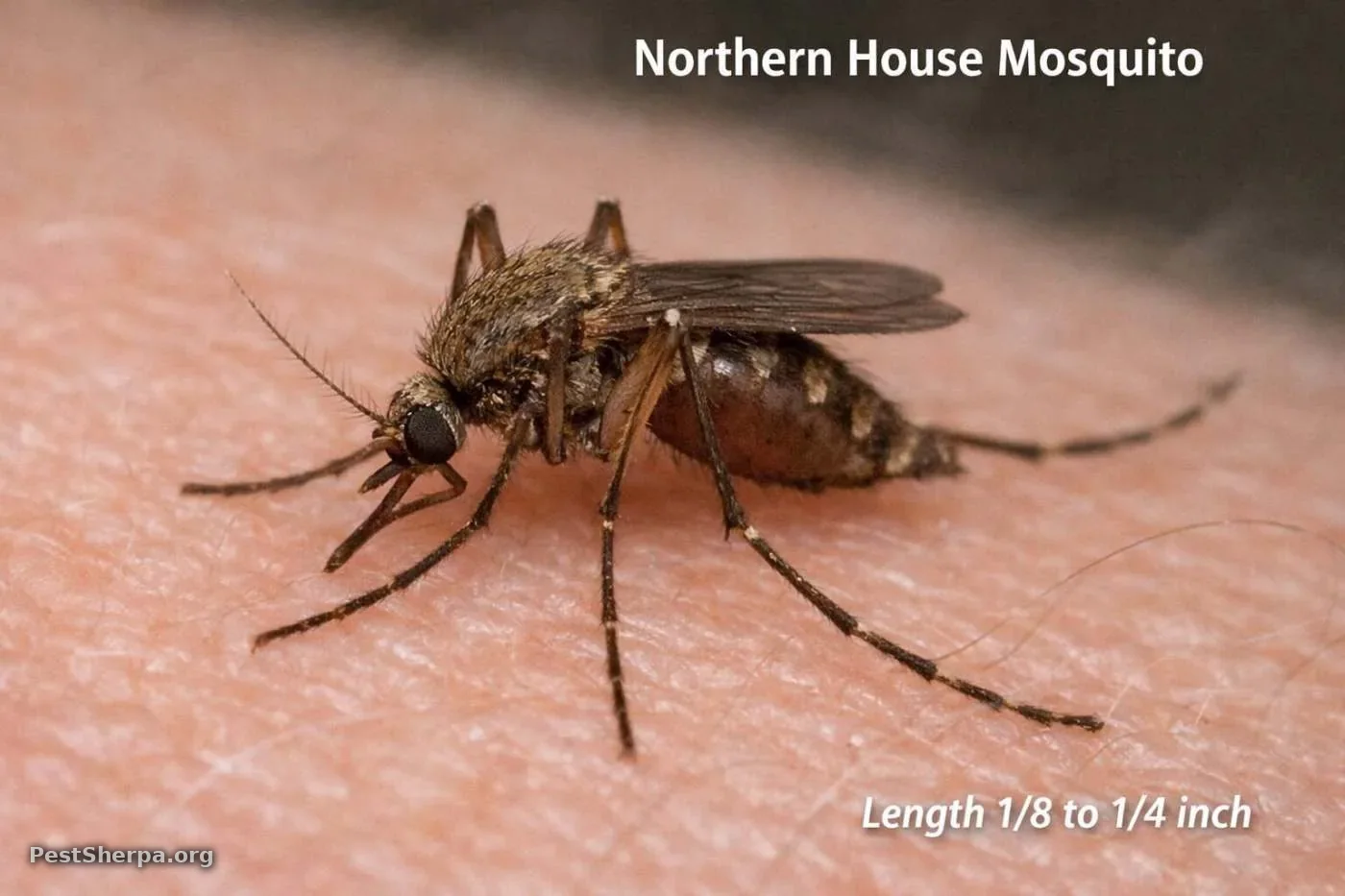
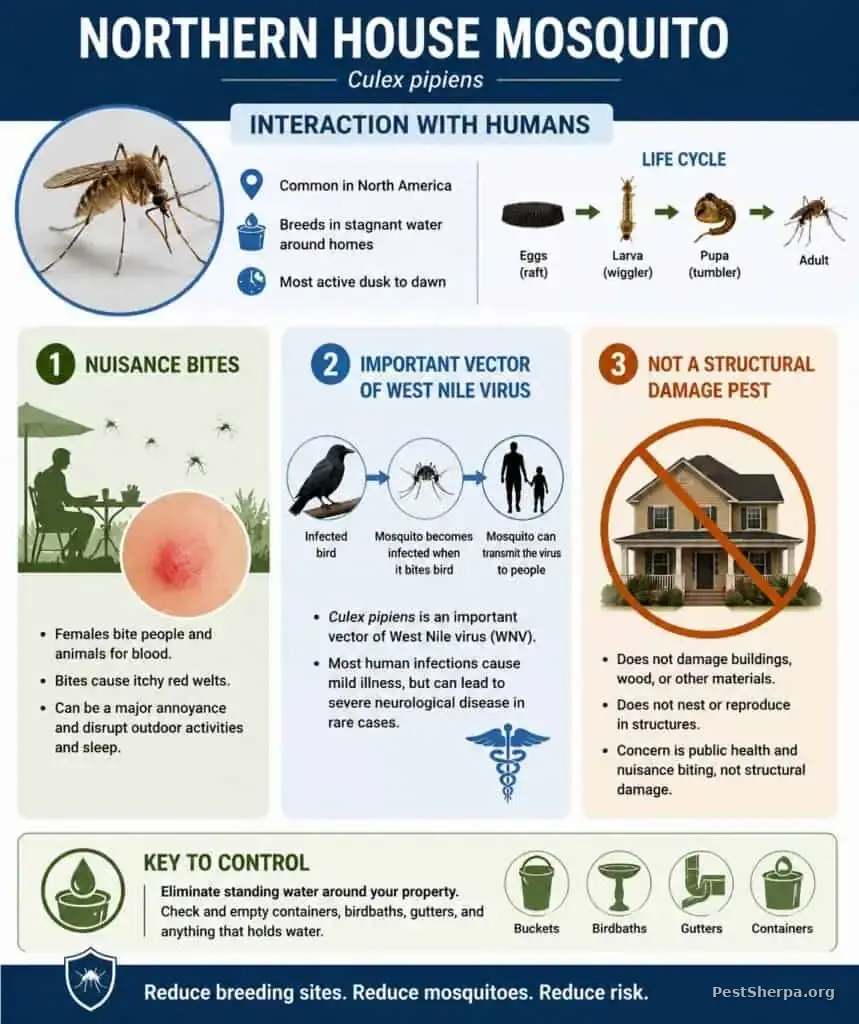
The northern house mosquito (Culex pipiens) is one of the most important house-associated mosquitoes in the northern United States. It matters for two reasons: it can be a persistent dusk-to-night nuisance, and it is one of the key West Nile virus vectors in northern states.
TL;DR
If you are seeing a plain brown mosquito that bites mostly from dusk into the night, especially around birdbaths, clogged gutters, rain barrels, catch basins, neglected containers, or other stagnant water, northern house mosquito is a reasonable suspect. The most important homeowner clue is often the pattern, not a perfect species-level visual ID.
- Best practical ID clue: plain brown/tan mosquito with pale abdominal banding, active mainly in the evening or at night.
- What it is often confused with: the bold black-and-white Asian tiger mosquito and yellow fever mosquito, which are much more visually distinctive and more associated with daytime biting.
- Why it matters: mainly a nuisance + public health pest, not a structural pest.
- What usually works best: remove standing water, correct gutter and drainage issues, refresh birdbath water at least weekly, and use a labeled larvicide only where water cannot realistically be drained.
- What wastes effort: relying on adult mosquito sprays alone while leaving breeding water sources in place.
Jump to: Identification | Why It Matters | What To Do | When To Call a Pro | Similar Pests / Misidentification | References
Identification
For homeowners, the safest claim is usually “this looks like a house mosquito or Culex-type mosquito” rather than a guaranteed species-level ID from appearance alone. That is because many mosquitoes are small and similar-looking, and several Culex species can overlap regionally. Ohio State notes subtle abdominal banding; UF/IFAS notes the species is commonly tied to organically rich standing water.
What it looks like
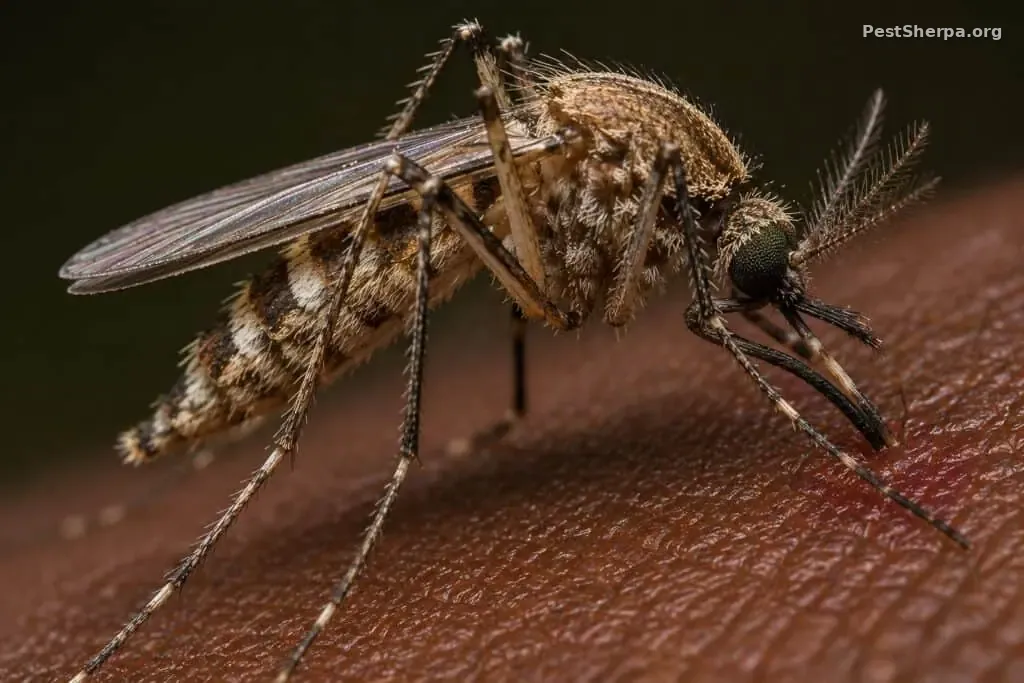
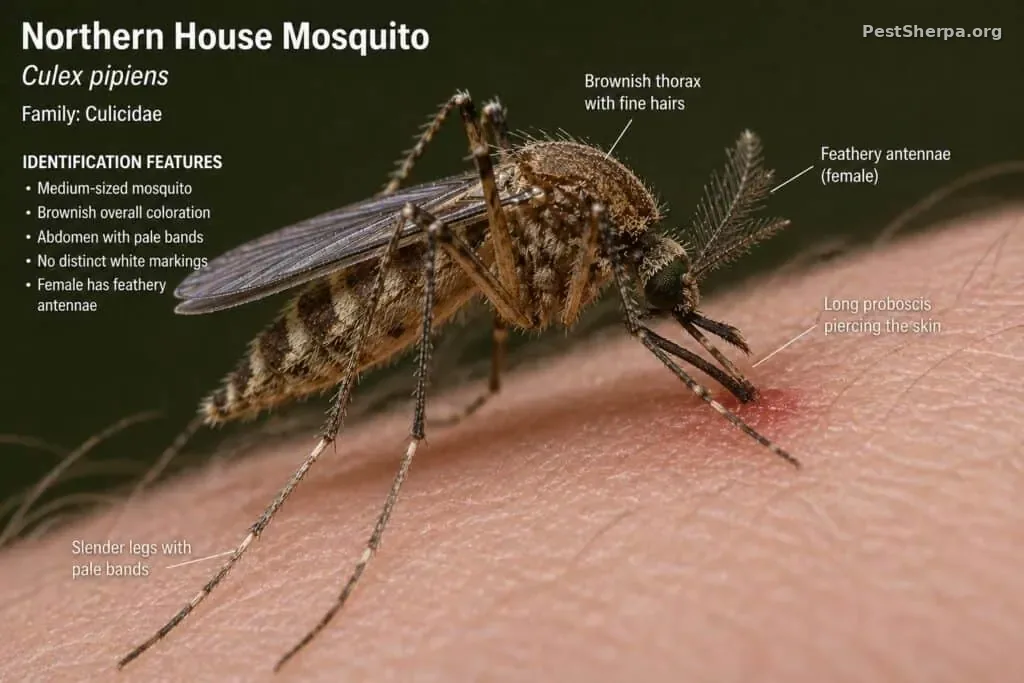
- Small mosquito, usually about 1/8 to 1/4 inch (3 to 7 mm) long
- Generally brown to tan, not black-and-white striped
- Subtle pale bands on the abdomen
- Females have simple antennae; males have noticeably feathery antennae
- Sometimes called a “bridge vector” because it can feed on birds in tree canopy and on humans or other hosts at ground level
Where homeowners commonly find it
Northern house mosquitoes are strongly associated with human settings and commonly develop in stagnant or nutrient-rich water such as birdbaths, rain barrels, catch basins, ditches, clogged gutters, flowerpots, buckets, tires, and neglected containers. See CDC and Ohio State.

What confirms the ID
- Most biting activity happens from dusk through night, not mainly during the day
- The mosquito is plain brown rather than boldly striped
- You can find or strongly suspect nearby standing water
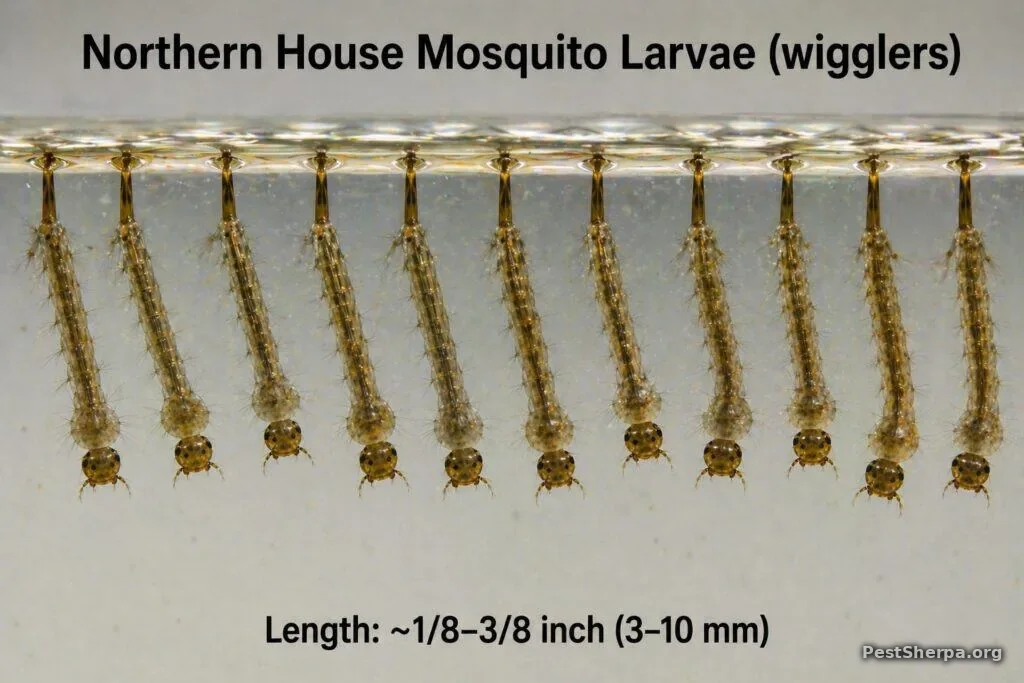
- Larvae in water appear as active “wigglers” near the surface
What commonly misleads homeowners
- Assuming every mosquito around the house is the same species
- Trying to force a species-level ID from one blurry adult
- Confusing a plain brown night-biting house mosquito with the highly visible daytime-biting Asian tiger mosquito
- Ignoring hidden breeding sites such as gutters, storm drains, rain barrels, and neglected containers because there is no obvious pond nearby
Useful reality check: if the mosquito is black with bright white striping and you are getting bitten in the daytime, a Culex house mosquito is a worse fit than Asian tiger mosquito or, in the right region, yellow fever mosquito.
Why It Matters
For most homeowners, northern house mosquitoes are a mixed concern:
- Nuisance: evening and nighttime biting can make outdoor spaces unpleasant
- Public health concern: Culex pipiens is one of the most important West Nile vectors in northern states
- Not a structural pest: mosquitoes do not damage wood, insulation, or the building itself
CDC’s West Nile guidance identifies Cx. pipiens as one of the primary vectors driving transmission in northern states.
That does not mean every mosquito around your house is infected. It does mean this is a pest worth taking seriously when populations are persistent, especially during warm-season periods when mosquito activity rises.
What To Do
1. Remove or refresh standing water first
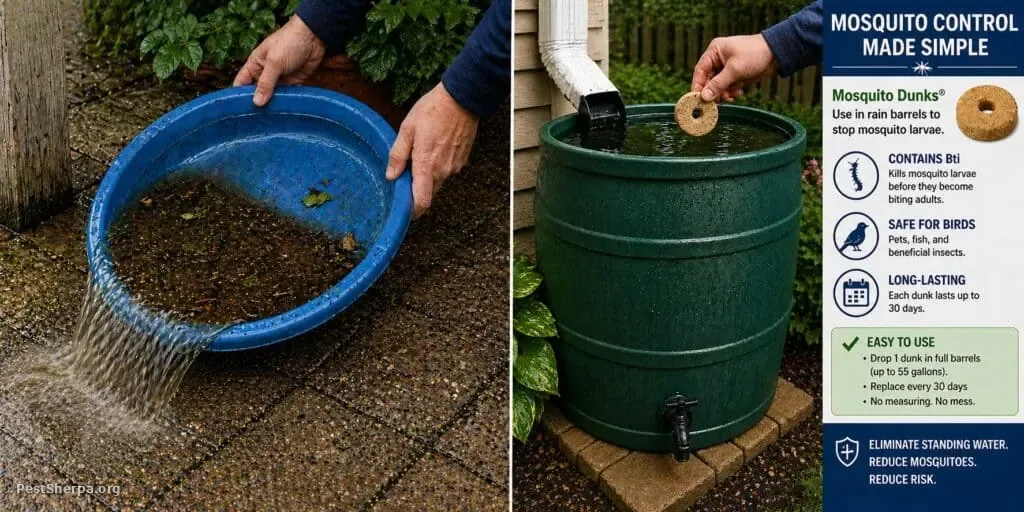
This is the most important step. EPA recommends removing mosquito habitats by getting rid of standing water in containers and changing water in birdbaths, fountains, and similar items at least weekly. See EPA.
- Empty buckets, toys, tarps, trays, and unused containers
- Refresh birdbath water at least once a week
- Keep rain barrels tightly screened or sealed
- Keep swimming pools treated and circulating
- Clean gutters so they do not hold stagnant water
2. Look beyond obvious containers
House mosquitoes often come from less obvious sites:
- clogged gutters
- catch basins or storm drains
- drainage swales and ditches
- unmaintained ornamental water
- neglected corners of the yard that hold water after rain
3. Use larvicide when water cannot realistically be drained
CDC notes that homeowners can use mosquito dunks or bits containing larvicide in small bodies of water where draining is not practical. See CDC larvicides guidance.
4. Reduce adult resting areas near activity zones
CDC notes that inactive adult Culex mosquitoes often rest in grass, shrubs, and dense vegetation. Trimming overly dense vegetation near doors, patios, and seating areas can help.
5. Protect people while you fix the source problem
Evening outdoor use may call for repellents, better screening, and timing changes because Culex mosquitoes are most active from dusk to dawn. See CDC.
What usually does not work well
- Adult sprays alone while breeding water remains in place
- Focusing only on your porch or patio without checking the water sources producing mosquitoes
- Treating every mosquito as a daytime container-breeder when the actual pattern points to a night-biting house mosquito
- Assuming there is no breeding source because you do not have a pond
When To Call a Pro
Call a licensed mosquito-control or pest professional when:
- mosquito pressure stays high after you have already removed obvious standing water
- the likely breeding site is a catch basin, storm drain, ditch, or other site you cannot safely or legally treat yourself
- the problem seems to involve neighboring properties or shared drainage infrastructure
- you need help deciding whether a larvicide is appropriate for a specific water source
- you are in an overlap region and are not confident whether the issue is southern house mosquito, northern house mosquito, or another mosquito altogether
For help sorting out what you are seeing before paying for service, use Ask the Sherpa.
Similar Pests / Misidentification Comparison
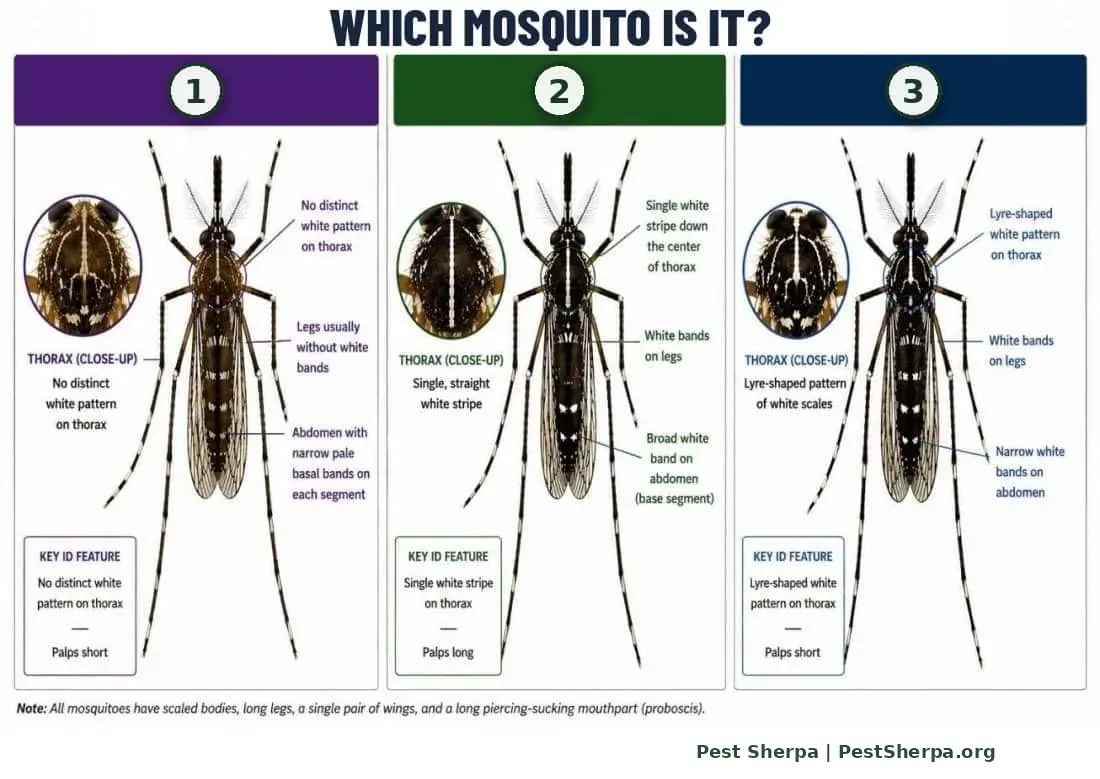
Which one do you see? Match the number:
- Northern house mosquito (Culex pipiens): no distinct white pattern on the thorax, legs usually without white bands, narrow pale bands at the base of each abdominal segment, short palps.
- Asian tiger mosquito (Aedes albopictus): a single straight white stripe down the center of the thorax, white bands on the legs, long palps.
- Yellow fever mosquito (Aedes aegypti): a lyre-shaped pattern of white scales on the thorax, white bands on the legs, short palps.
Northern house mosquito vs. Asian tiger mosquito
- Northern house mosquito: plain brown/tan, subtle banding, mainly dusk-to-night biting
- Asian tiger mosquito: black with bold white striping, often bites during the day
Northern house mosquito vs. yellow fever mosquito
- Northern house mosquito: plain house-associated Culex, usually not strongly patterned
- Yellow fever mosquito: black mosquito with white markings and a lyre-shaped thorax pattern
Northern house mosquito vs. southern house mosquito
- Northern house mosquito: more relevant in northern states and temperate regions
- Southern house mosquito: more relevant in warmer southern regions
Browse more mosquito pest guides if you are comparing patterns, habitats, and biting times across species.
References
- CDC: About Culex Mosquitoes
- CDC: Larvicides
- CDC: Guidelines for West Nile Virus Surveillance and Control
- U.S. EPA: Success in Mosquito Control: An Integrated Approach
- Ohio State University Extension: Northern House Mosquito
- UF/IFAS: Northern House Mosquito (Culex pipiens)
- Purdue Extension: West Nile
This article was written by Greg Baumann, founder of Pest Sherpa, and reflects more than 40 years of professional pest management experience.
About the Author

Greg Baumann | Pest Control Expert
Greg Baumann is the founder of Pest Sherpa and a Pest Control Expert with more than 40 years of professional pest management experience. His articles combine decades of field experience, technical expertise, and science-based guidance to help homeowners identify pests correctly, understand real-world risks, and make informed pest management decisions.
Mission: Identify the pest. Understand the risk. Stop the problem. Prevent the comeback. Know when it’s time to call a professional.