
Yellow Fever Mosquito (Aedes aegypti): Identification and Risk
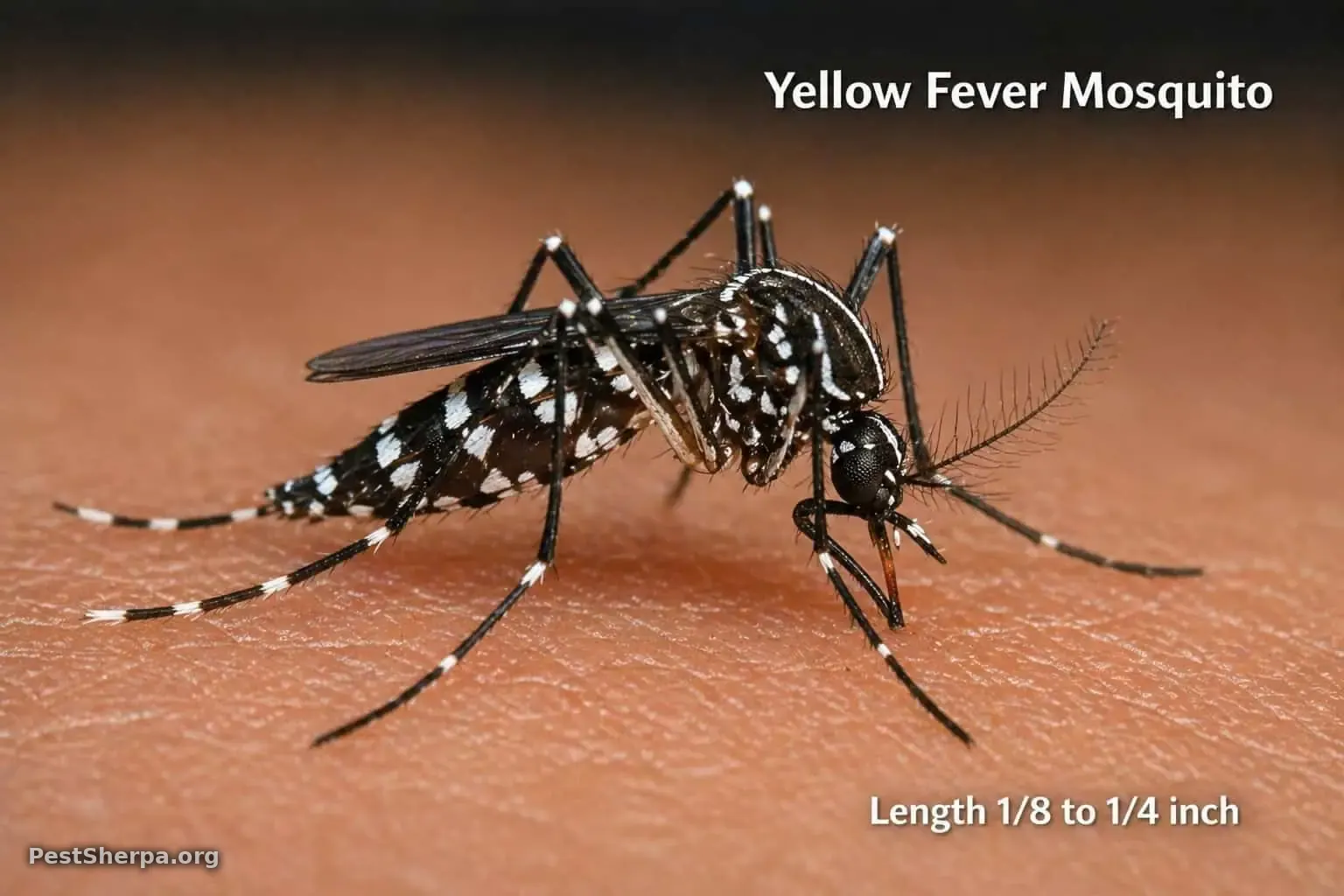
Updated for accuracy and usability: This page has been rebuilt to improve real-world identification, eliminate common misdiagnoses (especially confusion with the Asian tiger mosquito), and provide step-by-step control that actually works. You’ll find clearer visual ID guidance, a side-by-side comparison table, expert field insights, and practical actions prioritized by impact, so you can move from “what is this?” to “what should I do?” quickly and confidently.
Field-reviewed guidance: Yellow fever mosquitoes are small, black-and-white, container-breeding mosquitoes that live around people, bite during the day, and are among the most important disease vectors worldwide. The most reliable ID marker is the lyre-shaped white pattern on the thorax.
TL;DR (Quick ID + Action)
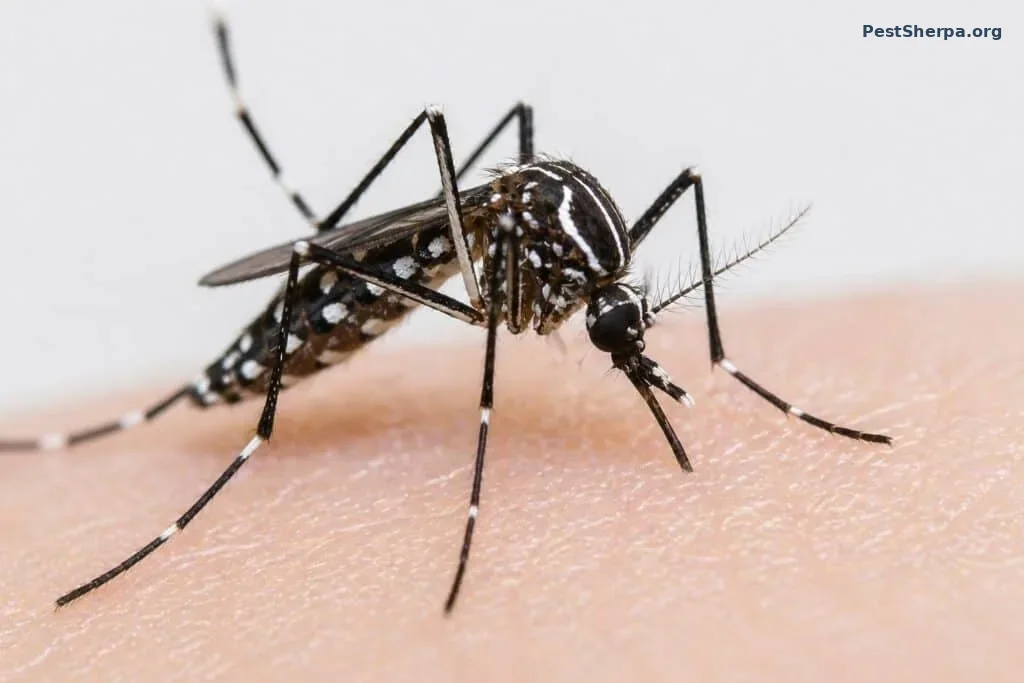
- ID: Black mosquito with white-banded legs + lyre-shaped marking on back
- Behavior: Day-biting, lives near people, breeds in containers
- Main fix: Dump + scrub standing water weekly
- Big mistake: Treating adults but ignoring water sources
Jump to Content: Identification | Comparisons | Why It Matters | What To Do | When To Call a Pro | Lookalikes | Common Questions | Resources
Identification (What Actually Confirms It)
Greg Baumann insight: In real inspections, homeowners almost always confuse this species with the Asian tiger mosquito. The thorax pattern, not the leg stripes, is the deciding feature.
- Black body with bright white markings
- White-banded legs
- Lyre-shaped thorax marking (key ID trait)
- Common indoors and around homes
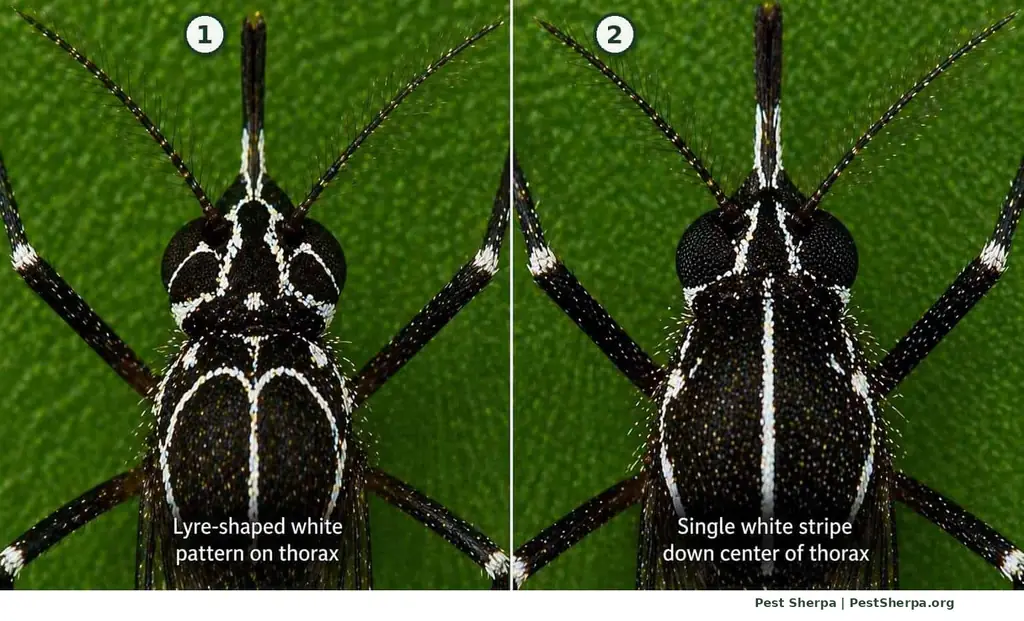
Which one do you see? Match the number:
- Yellow fever mosquito (Aedes aegypti): a white lyre-shaped pattern on the thorax: two curved outer lines with two thin lines down the middle. White bands on the legs. Bites in the daytime.
- Asian tiger mosquito (Aedes albopictus): a single bold white stripe straight down the center of the thorax. White bands on the legs. Also a daytime biter.
Common locations:
- Plant trays and flowerpots
- Birdbaths and buckets
- Old tires and toys
- Clogged gutters
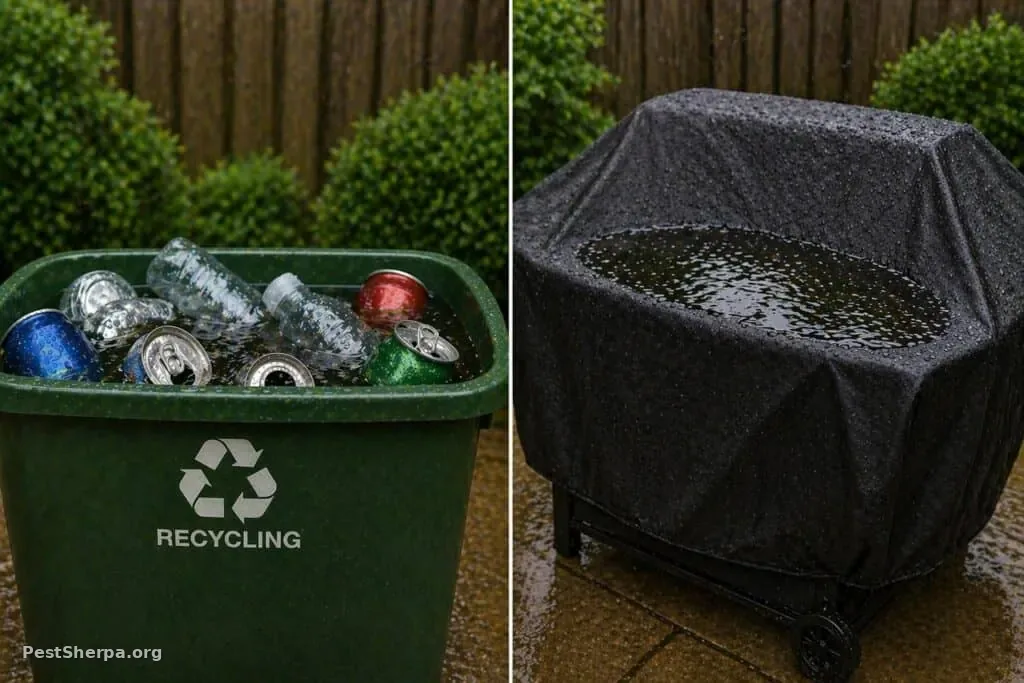
Pooling water is often overlooked. Most infestations come from containers close to the house, not from ponds.
Fast Comparison
| Feature | Aedes aegypti | Asian Tiger Mosquito | House Mosquito (Culex) |
|---|---|---|---|
| Thorax marking | Lyre-shaped | Single white stripe | None |
| Biting time | Daytime | Daytime | Night |
| Breeding sites | Containers | Containers | Stagnant water |
| Color | Black/white | Black/white | Brown/gray |
Why It Matters
This is a high-importance mosquito due to its close association with humans and ability to spread disease. It does not damage structures, but it directly affects comfort and health risk.
UF/IFAS calls it the primary vector of yellow fever virus, and it readily bites during the day, indoors as well as outdoors. CDC adds that because Aedes aegypti lives near people and prefers to feed on them, it is more likely to spread dengue, chikungunya, and Zika viruses than other types of mosquitoes. [UF/IFAS] [CDC] The 2026 federal order on mosquitoes and ticks, Executive Order 14433, calls this species the “Egyptian mosquito,” but yellow fever mosquito is the correct common name.
- Dengue: up to 400 million people are infected each year worldwide. About 1 in 4 infected people get sick, and about 1 in 20 of those develop severe dengue, which can cause shock, internal bleeding, and death. There is no dengue vaccine currently available in the United States. [CDC] [CDC] [CDC]
- Chikungunya: no medicines are available to treat it. If you are sick with it, avoid mosquito bites for the first week of illness so you do not pass the virus to local mosquitoes. [CDC]
- Zika: no vaccines or medicines are available, and infection during pregnancy can cause birth defects. [CDC]
Why Florida homeowners should pay attention: Florida has dealt with locally acquired dengue outbreaks, and this mosquito is a big reason why. For the latest national and state picture, see the What This Means Right Now section of the mosquito guide. The practical point does not change: a yellow fever mosquito breeding in a flowerpot saucer on your lanai can be the link between a traveler who brings dengue home and a neighbor who gets it. [UF/IFAS] [CDC]
Greg Baumann insight: The biggest risk isn’t the mosquito itself. It’s how easily it thrives in overlooked containers around homes.
What To Do
1. Eliminate water weekly (non-negotiable)

- Dump containers
- Clean gutters
- Refresh birdbaths
CDC notes these mosquitoes need only a small amount of water to lay eggs, and an egg can become a biting adult in 7 to 10 days. That is why weekly matters. In Florida summers, UF/IFAS recommends flushing birdbaths and bromeliads every three to four days. Tightly cover rain barrels and other water storage so females cannot get inside. [CDC] [UF/IFAS] [CDC: control at home]
2. Scrub container walls
Eggs stick to the inside walls of containers just above the waterline and can survive drying out for up to 8 months, so dumping alone leaves them behind. Scrub the inside walls of buckets, saucers, birdbaths, and pet bowls with a brush, or throw out containers you do not need. [CDC]
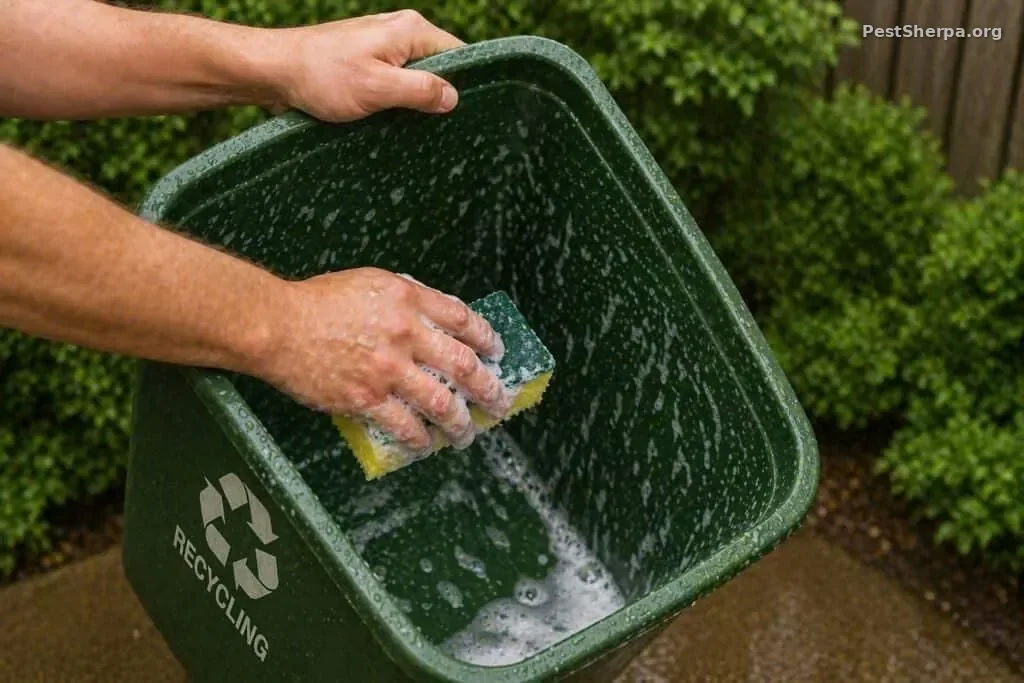
3. Treat standing water that cannot be removed
Use Bti larvicides where necessary. Bti (Bacillus thuringiensis subspecies israelensis) is a naturally occurring soil bacterium that targets the larvae of mosquitoes, black flies, and fungus gnats. Dunks and granules work in water you cannot dump, like an ornamental pond or a rain barrel you cannot seal. Follow the label, especially for any water used for drinking. [EPA: Bti]
4. Protect people
Use screens and repellents for immediate relief. Because this mosquito bites in daylight, protection is not just an evening job.
- Install or repair window and door screens, and use air conditioning when you can. [CDC] [CDC]
- Use an EPA-registered insect repellent outdoors during the day as well as at dusk. [CDC]
- Wear loose long sleeves and long pants when you will be outside for a while. [CDC]
5. Check indoors, too
Unlike the Asian tiger mosquito, Aedes aegypti lives indoors as well as outdoors. CDC says mosquitoes rest in dark, humid places like under sinks, in showers, in closets, under furniture, and in the laundry room, and that mosquitoes that get inside can start laying eggs indoors. Once a week, empty and scrub or throw out vases and other indoor items that hold water. If you still have mosquitoes after fixing screens and dealing with containers, an indoor insecticide labeled for mosquitoes can be used in those resting spots, but CDC is clear that an indoor insecticide alone will not keep your home free of mosquitoes. [CDC] [CDC: control at home]
What fails (common mistakes)
- Fogging without removing water
- Ignoring gutters and plant trays
- Assuming ponds are the source
When To Call a Pro
Most yellow fever mosquito problems are solved with a weekly container walk. Bring in help when that is not enough:
- The problem persists after 1 to 2 weeks of cleanup. Since eggs can become adults in 7 to 10 days, steady biting after two careful weekly cleanups usually means a source you have not found. [CDC]
- Breeding sites are inaccessible. Clogged gutters on a second story, roof valleys, tree holes, and drains are common hidden sources.
- Multiple properties are involved. If the source is a neighbor’s yard, an abandoned pool, or a vacant lot, you cannot fix it from your side of the fence.
- Someone in the home is sick, or there is local dengue activity. Anyone with symptoms of dengue, chikungunya, or Zika should see a healthcare provider, and should avoid mosquito bites during the first week of illness so they do not infect local mosquitoes. [CDC] [CDC]
Call your local mosquito control program first
In Florida, your county or district mosquito control program is often the best first call. UF/IFAS reports there are over 60 mosquito control programs of varying sizes across the state, and FDACS keeps a Mosquito Control Directory Map with contact information for each program by county. Elsewhere, CDC notes that local governments and mosquito control districts run surveillance and control and intensify their work when local mosquitoes are spreading viruses like dengue or Zika. Report standing water you cannot reach, such as a neglected pool next door. [UF/IFAS] [FDACS] [CDC]
What a good pro should do
A good pro inspects for containers and hidden water before spraying anything, treats water that cannot be removed with a labeled larvicide, and explains what you need to keep doing weekly. If the plan is only a fogging schedule with no water inspection, ask why. As noted in What To Do, fogging without removing water is one of the most common failures. For yard-wide control steps, see my mosquito guide.
Lookalikes
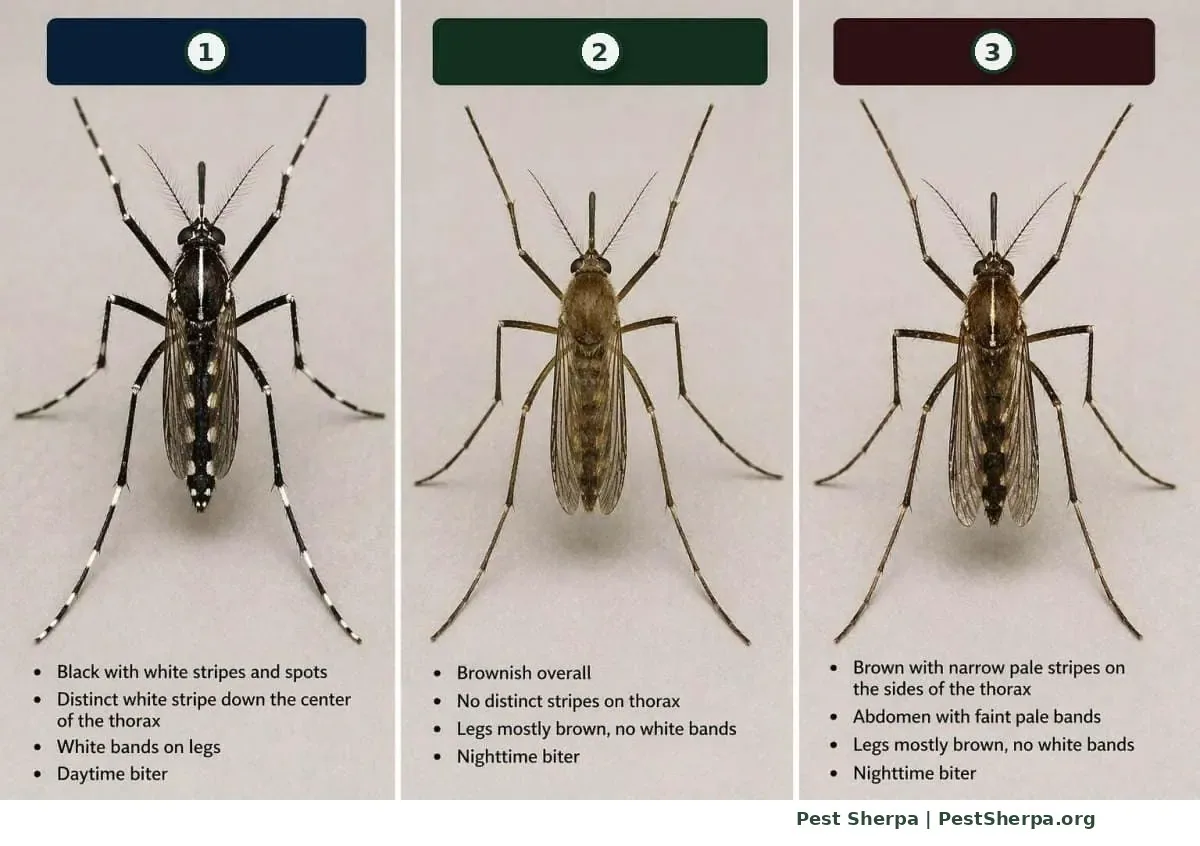
Which one do you see? Match the number:
- Asian tiger mosquito: black with bright white stripes and spots, a white stripe down the center of the thorax and white bands on the legs. Bites in the daytime.
- Northern house mosquito: plain brownish body with no distinct stripes on the thorax and no white leg bands. Bites at dusk and at night.
- Southern house mosquito: brown with narrow pale stripes on the sides of the thorax and faint pale bands on the abdomen. No white leg bands. Bites at night.
Common Questions
- I live in the southeast and we have had a lot of rain lately and even some flooding. What should I do to protect my children from mosquitoes?
- I live on the east coast of Florida and with mosquito season upon us, will my new puppy be bothered by mosquitoes?
References
- CDC: Aedes Mosquito Life Cycle
- EPA: Mosquito Control
- CDC: Potential Range of Aedes Mosquitoes
- CDC: Mosquito Control at Home
- CDC: Preventing Mosquito Bites
- CDC: About Dengue
- CDC: Dengue Signs and Symptoms
- CDC: About Chikungunya
- CDC: About Zika
- EPA: Bti for Mosquito Control
- UF/IFAS: Yellow Fever Mosquito, Aedes aegypti (IN792)
- UF/IFAS: Florida Mosquito Control (IN1045)
- FDACS: Mosquito Control Programs
This article was written by Greg Baumann, founder of Pest Sherpa, and reflects more than 40 years of professional pest management experience.
About the Author

Greg Baumann | Pest Control Expert
Greg Baumann is the founder of Pest Sherpa and a Pest Control Expert with more than 40 years of professional pest management experience. His articles combine decades of field experience, technical expertise, and science-based guidance to help homeowners identify pests correctly, understand real-world risks, and make informed pest management decisions.
Mission: Identify the pest. Understand the risk. Stop the problem. Prevent the comeback. Know when it’s time to call a professional.