
Supreme Court Roundup Decision: What Monsanto v. Durnell Means for Pesticide Labels, Pest Control Companies, and Homeowners
Published: June 30, 2026
Last Updated: July 1, 2026
Reading Time: Approximately 12 minutes
Disclaimer: This article is provided for educational and informational purposes only. It is not legal advice. Readers should consult qualified legal counsel, regulatory authorities, or licensed professionals regarding specific legal, regulatory, pesticide-labeling, licensing, or compliance questions.
Author note: Greg Baumann is not an attorney. This article summarizes the ruling from a pest control industry education and compliance perspective, and it should not be treated as legal advice or a legal opinion.
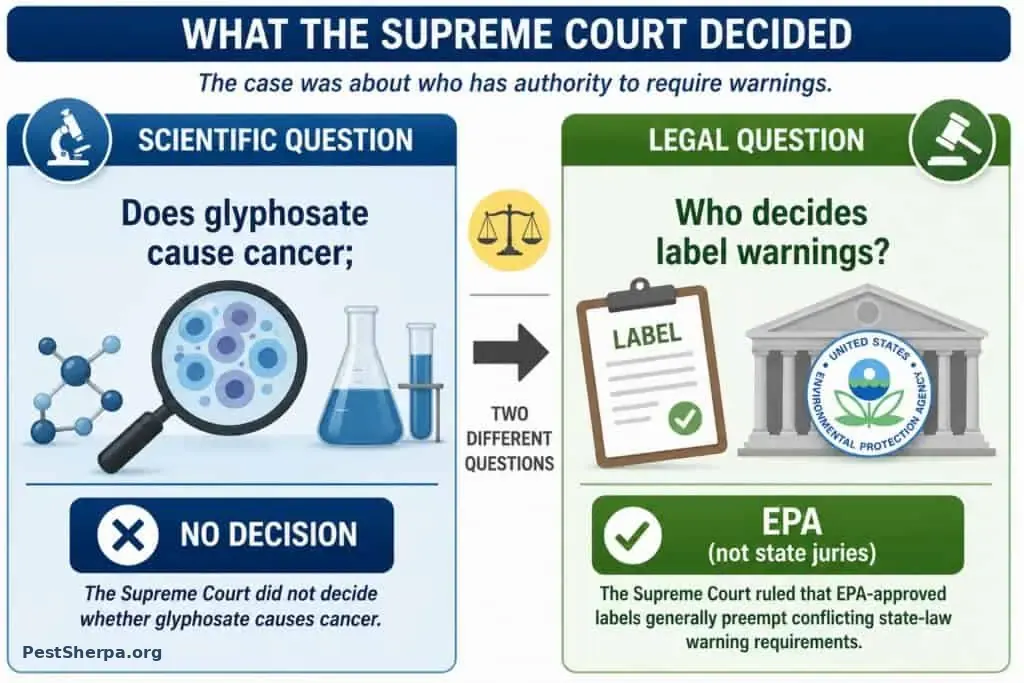
The Supreme Court’s decision in Monsanto Co. v. Durnell did not resolve the scientific debate over glyphosate. It clarified a legal question: who generally has authority to decide what warnings belong on federally approved pesticide labels?
Key Takeaways
- The Supreme Court did not decide whether glyphosate causes cancer.
- The Court held that FIFRA expressly preempted Durnell’s state-law failure-to-warn claim because the claim would have required a cancer warning that EPA had not required on Roundup’s federally approved label.
- The decision strengthens EPA’s central role in pesticide label approval and pesticide risk communication.
- Manufacturers now have a stronger defense against certain label-based state failure-to-warn lawsuits involving EPA-approved labels.
- Pest management professionals should continue treating EPA-approved labels as controlling legal documents.
- The ruling does not protect off-label use, careless application, poor training, incomplete records, or violations of state pesticide laws.
- Future pesticide-warning disputes will likely focus more heavily on EPA proceedings, scientific submissions, administrative petitions, public comments, and judicial review of agency decisions.
Background
On June 25, 2026, the United States Supreme Court issued its decision in Monsanto Co. v. Durnell, No. 24-1068. The case involved Roundup, glyphosate, cancer-warning claims, and the relationship between federal pesticide regulation and state failure-to-warn lawsuits.
The question before the Court was narrow. When EPA has approved a pesticide label and has not required a particular warning, can a state-law failure-to-warn verdict effectively require that additional warning anyway?
The Court answered no in this case. It concluded that the Federal Insecticide, Fungicide, and Rodenticide Act, commonly called FIFRA, expressly preempted Durnell’s state-law failure-to-warn claim because the claim would have required Monsanto to add a cancer warning that EPA had not required on the federally approved Roundup label.
For pesticide manufacturers, the decision creates a stronger defense for EPA-approved labels in label-based failure-to-warn cases. For pest control companies, it reinforces the practical importance of label compliance. For homeowners and consumer advocates, it means many future disputes over pesticide warnings may move away from state tort litigation and toward EPA petitions, public comments, scientific review, and administrative proceedings.
Why This Supreme Court Decision Matters
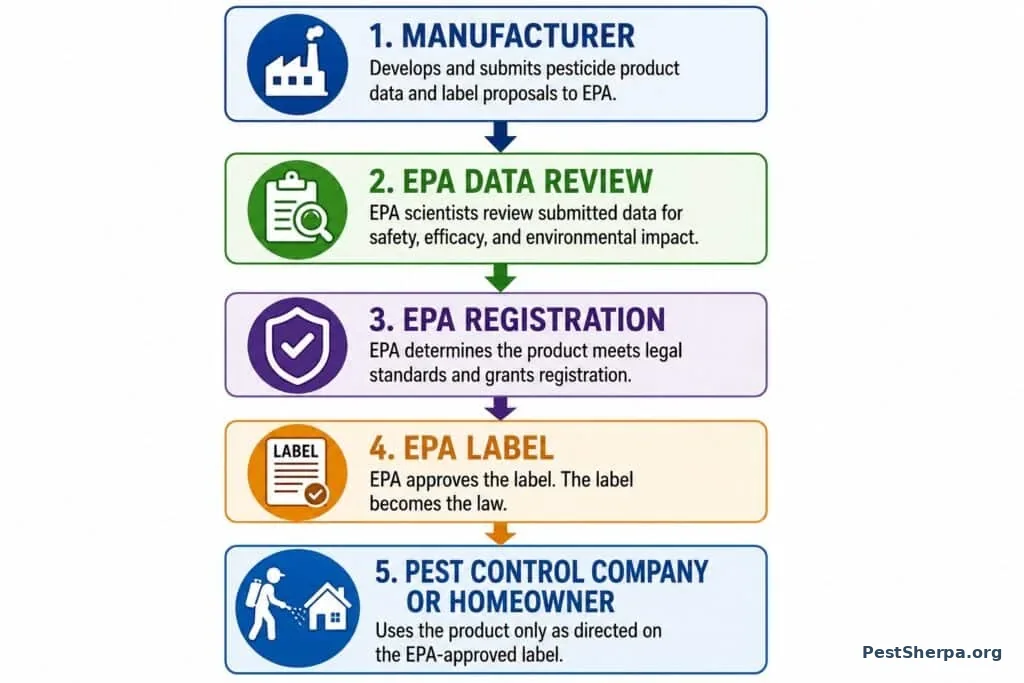
Pesticide labels are not ordinary marketing materials. EPA explains that pesticide labels are legally enforceable and that they translate EPA’s review into conditions, directions, and precautions governing who may use a pesticide, where it may be used, how much may be applied, and how often it may be used. EPA’s introduction to pesticide labels summarizes the industry rule in plain terms: the label is the law.
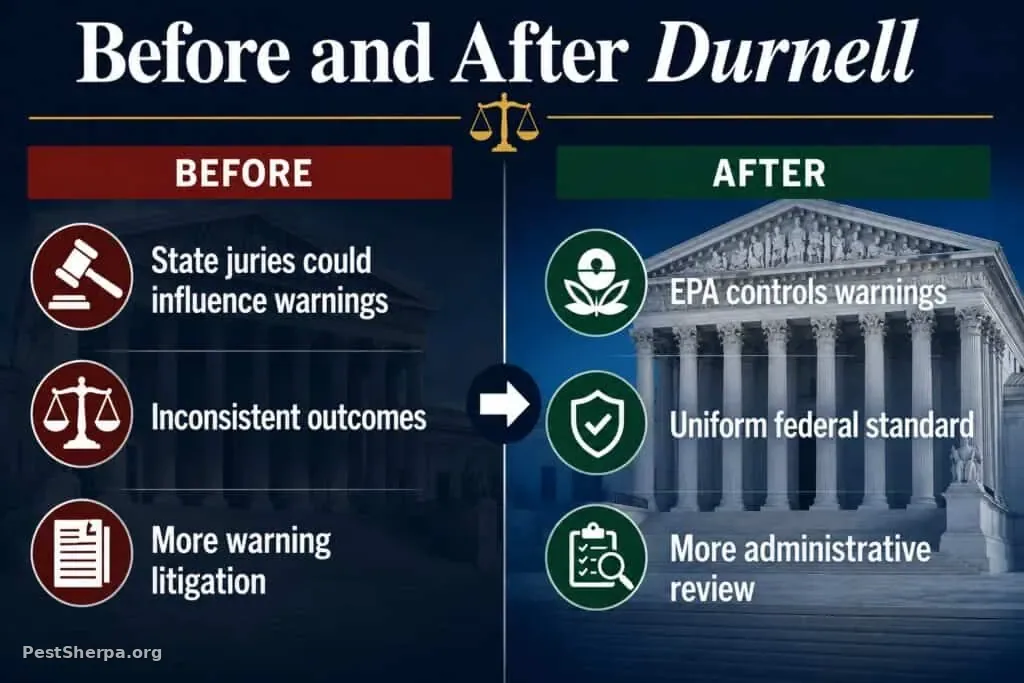
Before Durnell, manufacturers faced the possibility that a product could comply with EPA-approved labeling while a state jury later concluded that the label should have included additional warning language. The Supreme Court’s decision narrows that possibility when the state-law claim would require a warning that differs from or adds to EPA-approved labeling.
That does not give pesticide manufacturers a free pass. The decision makes the scientific and regulatory record submitted to EPA even more important. If EPA is the central decision-maker for pesticide labeling, then EPA needs full, current, and reliable information from registrants, researchers, incident reports, public comments, and other sources.
The ruling also matters beyond Roundup and glyphosate. Its reasoning may influence litigation involving other EPA-registered pesticides when plaintiffs seek warnings that EPA has not required. Courts may also cite Durnell in broader disputes about federal preemption and regulated product labels, although each statute has its own structure and limits.
What Is FIFRA?
FIFRA is the main federal law governing pesticide registration, labeling, distribution, sale, and use in the United States. EPA’s overview of the Federal Insecticide, Fungicide, and Rodenticide Act explains the federal-state structure of pesticide regulation and the limits on state labeling requirements.
Under FIFRA, a pesticide is not limited to agricultural insect sprays. The term covers substances or mixtures intended to prevent, destroy, repel, or mitigate pests. That includes many insecticides, herbicides, fungicides, rodenticides, antimicrobial products, disinfectants, sanitizers, wood preservatives, and other products when they are sold or used with pesticidal claims.
Before a pesticide may be sold, EPA evaluates the product’s composition, proposed uses, human-health information, environmental data, benefits, risks, and proposed label. EPA may also revisit registered pesticides through registration review. EPA describes that process as a review of each registered pesticide at least every fifteen years to ensure that the product can perform its intended function without creating unreasonable adverse effects to human health or the environment. See EPA’s registration review process.
For pest control operators, the practical consequence is direct. A pesticide label specifies approved use sites, application rates, mixing and dilution directions, required personal protective equipment, environmental precautions, reentry intervals when applicable, storage requirements, and disposal instructions. Using a pesticide in a manner inconsistent with its label can create enforcement risk, licensing risk, business risk, and liability exposure.
Why Did the Roundup Lawsuit Happen?
The lawsuit arose from the long-running public, scientific, and legal controversy surrounding glyphosate, the active ingredient historically used in many Roundup products.
EPA has repeatedly evaluated glyphosate and currently states that glyphosate is not likely to be carcinogenic to humans. The EPA glyphosate page also notes the 2022 Ninth Circuit remand and explains that EPA is continuing registration review. The International Agency for Research on Cancer, using a different classification framework, classified glyphosate in 2015 as probably carcinogenic to humans. IARC summarizes that position in its glyphosate monograph Q&A.
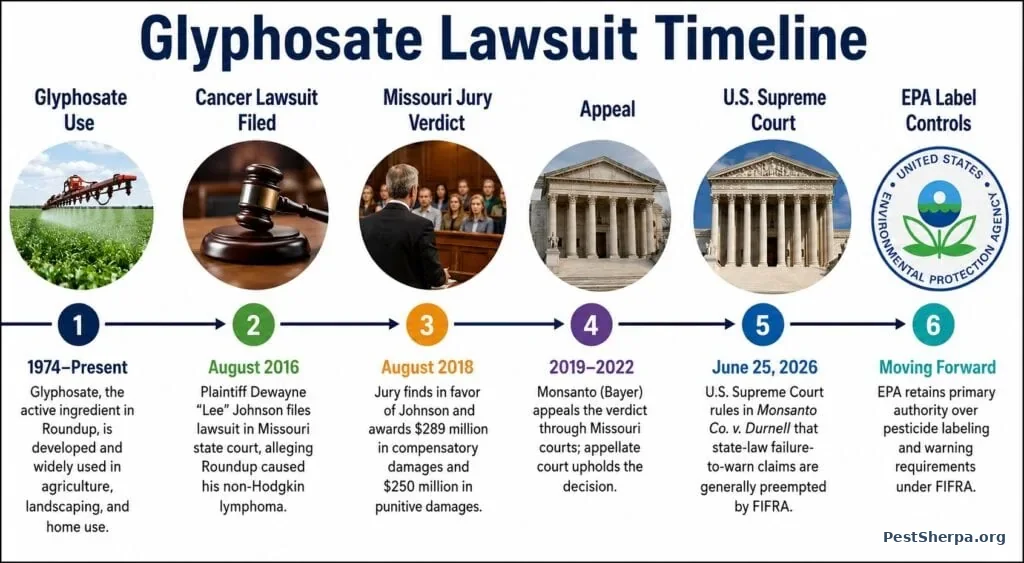
John Durnell alleged that he used Monsanto’s Roundup products for approximately twenty years and later developed non-Hodgkin’s lymphoma. He sued Monsanto in Missouri state court, arguing that Roundup should have carried a cancer warning. A Missouri jury agreed and awarded Durnell more than $1 million on a failure-to-warn theory. The Missouri Court of Appeals affirmed. Monsanto argued that the claim was barred by FIFRA because EPA had approved Roundup labels without requiring a cancer warning. That dispute ultimately reached the United States Supreme Court.
Timeline of Monsanto Co. v. Durnell
| Year / Date | Event |
|---|---|
| 1947 | Congress enacted the original FIFRA statute. |
| 1972 | Congress transformed FIFRA into a modern EPA-administered pesticide regulatory program. |
| 1974 | EPA first registered glyphosate-based pesticides and approved Roundup labeling without a cancer warning. |
| 1991 | EPA classified glyphosate as unlikely to cause cancer in humans. |
| 2015 | IARC classified glyphosate as probably carcinogenic to humans. |
| 2019 | John Durnell filed his lawsuit in Missouri state court. |
| 2020 | EPA’s interim registration review decision for glyphosate reiterated EPA’s position that glyphosate is not likely to be carcinogenic to humans. |
| 2022 | The Ninth Circuit vacated the human-health portion of EPA’s 2020 interim decision and remanded it for further analysis and explanation in NRDC v. EPA. |
| February 11, 2025 | The Missouri Court of Appeals affirmed the jury verdict for Durnell. |
| January 16, 2026 | The Supreme Court granted review limited to the FIFRA preemption question. See the Supreme Court docket. |
| April 27, 2026 | The Supreme Court heard oral argument. |
| June 25, 2026 | The Supreme Court reversed and remanded, ruling for Monsanto on the preemption issue. |
What the Supreme Court Actually Decided
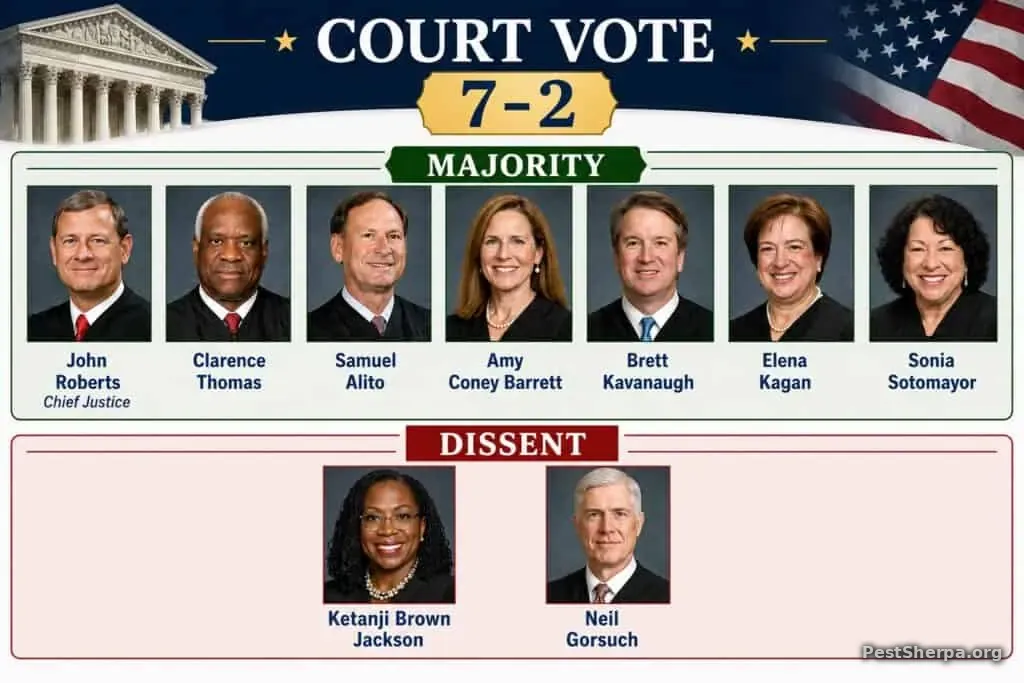
Justice Brett Kavanaugh wrote the majority opinion. Chief Justice John Roberts and Justices Clarence Thomas, Samuel Alito, Sonia Sotomayor, Elena Kagan, and Amy Coney Barrett joined it. Justice Thomas also wrote a separate concurrence. Justice Ketanji Brown Jackson dissented, joined by Justice Neil Gorsuch.
The Court held that FIFRA expressly preempts Durnell’s state-law failure-to-warn claim because the claim would require Monsanto to add a cancer warning to Roundup’s label even though EPA had not required that warning. In the Court’s view, the state-law verdict would impose a labeling requirement “in addition to or different from” the federal labeling requirements under FIFRA. The full opinion is available from the Supreme Court.
In practical terms, the Court recognized that state lawsuits can function like regulatory mechanisms. If a jury awards damages because a label omitted a particular warning, the manufacturer faces substantial pressure to change that label. But pesticide manufacturers generally cannot simply rewrite federally approved warning labels without EPA approval or direction.
The majority therefore treated EPA’s approved labeling determination as the controlling federal requirement for this type of failure-to-warn claim. Because EPA had not required a cancer warning for Roundup, Missouri could not impose one indirectly through a state tort verdict.
What the Court Did Not Decide
The Court did not decide whether glyphosate causes cancer. It did not conduct its own toxicology review, weigh the scientific evidence as a regulator, or declare that pesticides are always safe.
The Court also did not hold that EPA is always correct. The decision addressed legal authority and preemption, not the final scientific answer to glyphosate carcinogenicity. EPA can still revisit registrations, require additional data, amend labels, suspend registrations, or cancel registrations if the agency determines that the statutory standard is no longer met.
The ruling does not eliminate all pesticide litigation. Claims involving defective manufacture, contamination, fraud, negligent application, off-label use, exposure incidents, contractual disputes, or other non-label theories may raise different legal questions.
The decision also does not eliminate state authority over pesticides. States retain substantial power over pesticide sales, use restrictions, licensing, certification, enforcement, and certain product bans, subject to applicable law. The key limit is that states generally cannot impose pesticide labeling or packaging requirements that are in addition to or different from those imposed by FIFRA.
Practical Impact
For Manufacturers
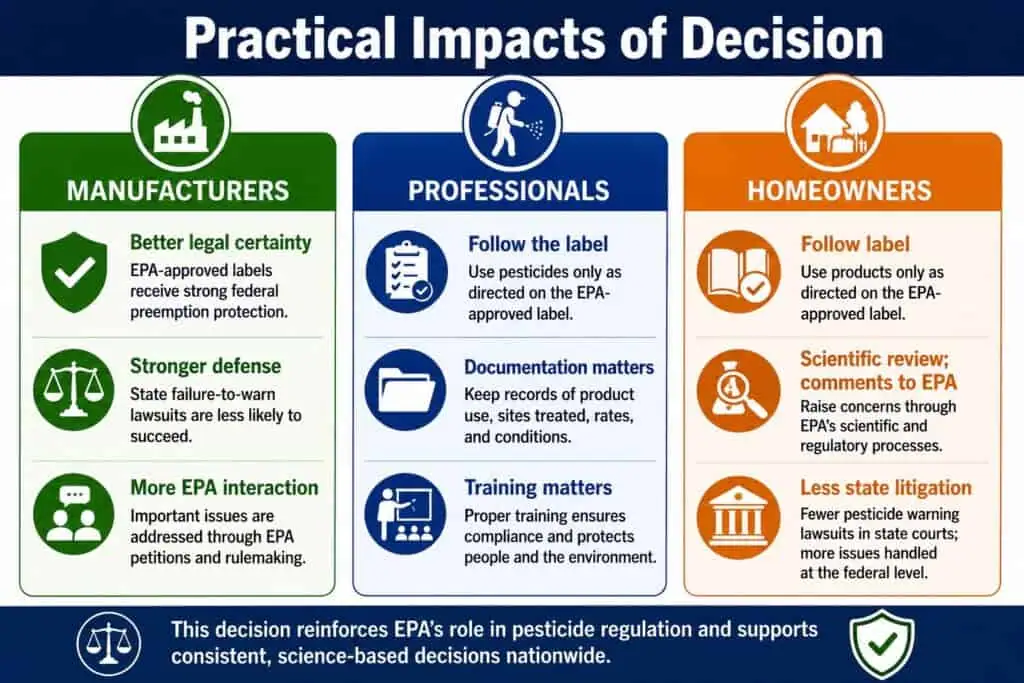
For pesticide manufacturers, Durnell provides a stronger defense against state-law failure-to-warn lawsuits that seek warnings EPA has not required on an approved pesticide label. That is a major development because many product-liability cases turn on arguments that a manufacturer should have provided additional warnings beyond those on the federally approved label.
Manufacturers should not treat the decision as a reason to relax compliance. If EPA is the primary decision-maker for pesticide warnings, manufacturers must ensure that EPA receives complete, accurate, and timely information about toxicology, adverse events, epidemiological research, environmental monitoring, scientific literature, registration review submissions, label amendments, and supplemental labeling.
For Pest Control Companies
For pest control companies, the decision changes less than some headlines may suggest. The practical rule remains the same: the label is the law.
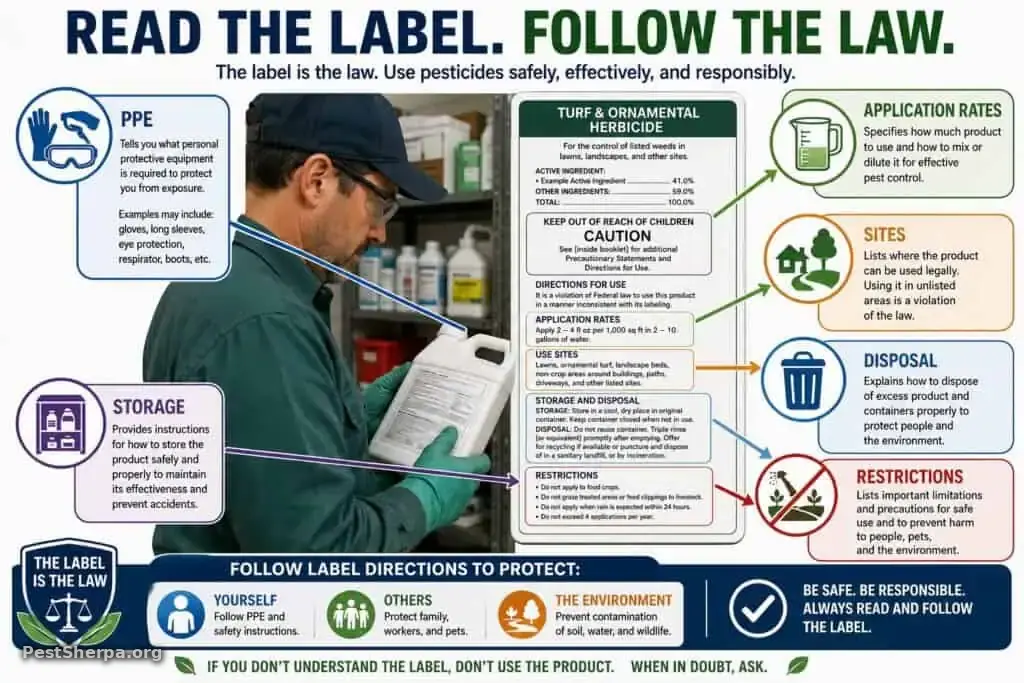
Pest management professionals should continue treating EPA-approved labels as controlling legal documents governing application rates, approved use sites, mixing and dilution directions, PPE, environmental restrictions, safety warnings, storage, disposal, reentry intervals when applicable, and recordkeeping obligations under federal, state, or local rules.
The decision may indirectly help applicators who use products exactly as labeled because plaintiffs may have a harder time arguing that applicators should have created warnings beyond EPA-approved labeling. But Durnell does not protect careless application, off-label use, improper mixing, inadequate training, poor documentation, customer statements that contradict the label, or violations of state pesticide regulations.
The best risk-management strategy remains simple: read the label, follow the label, train to the label, and document compliance.
For Homeowners and Consumers
For homeowners and consumers, the decision may feel frustrating because it narrows one path for challenging pesticide warnings through state-law litigation. A homeowner may believe that a pesticide should have included a stronger warning. After Durnell, that type of claim becomes more difficult when EPA has reviewed the product’s labeling and has not required the warning at issue.
Consumers still have practical options. Read the complete product label before purchase and before use. Check the active ingredient, because brand names and formulations can change. The Supreme Court opinion notes that Monsanto has phased out residential Roundup products containing glyphosate, which makes label reading and active-ingredient review especially important for retail buyers.
Consumers can also report pesticide incidents to the manufacturer and, where appropriate, to state pesticide regulators or EPA; submit information during EPA public comment periods; and support administrative petitions when credible new evidence exists.
Federal vs. State Authority After Monsanto Co. v. Durnell
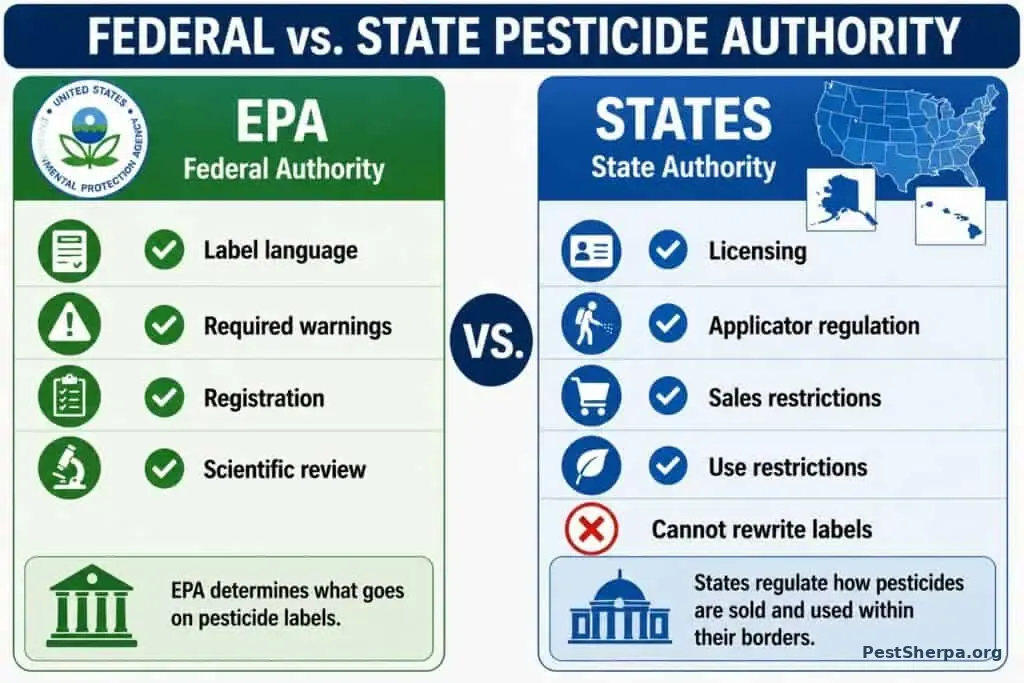
One of the easiest ways to understand Durnell is this: EPA controls federally approved pesticide labeling, while states retain substantial authority over pesticide sale and use.
| EPA Authority | State Authority |
|---|---|
| Registers pesticides under FIFRA | Licenses applicators |
| Approves pesticide labels | Establishes certification and training requirements |
| Determines federally required warning language | Regulates application practices |
| Conducts registration review | Restricts use in certain locations, where state law permits |
| Requires additional studies or data | Creates notification or posting programs |
| Modifies, suspends, or cancels registrations | Restricts or bans certain products or uses within the state, subject to applicable law |
| Oversees national pesticide risk communication through labeling | Enforces state pesticide laws and may cooperate with EPA as a state lead agency |
The decision does not federalize all pesticide regulation. It confirms that pesticide labeling is primarily a federal responsibility while preserving substantial state authority over how pesticides are sold, applied, restricted, and enforced within state borders.
EPA’s Central Role After Durnell
One of the most significant institutional consequences of Durnell is the Court’s reaffirmation of EPA’s central role in pesticide risk communication and label approval.
This places substantial responsibility on EPA. If state juries generally cannot impose additional warning requirements that conflict with EPA-approved labeling, then EPA’s scientific review process becomes even more important.
EPA’s authority extends beyond the initial registration decision. EPA may require additional studies, issue data call-in notices, revisit registration decisions, modify label requirements, suspend registrations, cancel pesticide registrations, respond to administrative petitions, and conduct registration review.
As a result, manufacturers, scientists, advocacy groups, pest management professionals, and consumers will likely devote greater attention to registration review proceedings, EPA dockets, scientific advisory processes, administrative petitions, public comment opportunities, and judicial review of agency decisions.
Why This Decision May Extend Beyond Roundup
Although Monsanto Co. v. Durnell arose from litigation involving glyphosate and Roundup, the Court’s reasoning may have consequences beyond a single herbicide.
The majority relied on broader principles involving federal preemption, EPA label approval, agency expertise, uniform national labeling, and regulatory consistency. The majority also compared FIFRA’s preemption clause to similar provisions in other federal labeling statutes, including the medical-device statute at issue in Riegel v. Medtronic, Inc..
That does not mean every regulated product case will come out the same way. It does mean that lawyers, regulators, manufacturers, and advocacy groups will likely cite Durnell in future cases involving federally approved labels and state-law warning claims. In the pesticide context, the decision may influence disputes involving agricultural herbicides, insecticides, rodenticides, antimicrobial products, and other EPA-registered products where a plaintiff’s theory would require a warning that EPA has not required.
The Dissent and Justice Thomas’s Concurrence
Justice Ketanji Brown Jackson, joined by Justice Neil Gorsuch, disagreed with the majority’s approach. The dissent argued that state-law failure-to-warn claims can operate alongside FIFRA when they parallel FIFRA’s own prohibition against misbranded pesticides. In the dissent’s view, Durnell’s claim did not impose a different labeling requirement; it sought to enforce a duty equivalent to FIFRA’s requirement that pesticide labels include adequate and necessary warnings.
The dissent also criticized the majority for treating EPA’s approval of a pesticide label as a federal labeling requirement that displaces state tort law. More broadly, Justice Jackson expressed concern that the decision reduces remedies available to individuals who believe they were harmed by pesticides and shifts too much practical authority to federal regulators.
Justice Clarence Thomas joined the majority opinion in full but wrote separately to raise broader constitutional concerns. His concurrence questioned whether portions of FIFRA exceed Congress’s authority under the Commerce Clause, raised concerns about Congress delegating broad regulatory authority to administrative agencies such as EPA, and questioned the constitutional foundations of administrative preemption doctrine.
Those issues were not the basis of the Court’s holding, but the separate opinions show that broader debates over federal regulatory authority, state tort remedies, and administrative law are likely to continue.
Practical Analysis
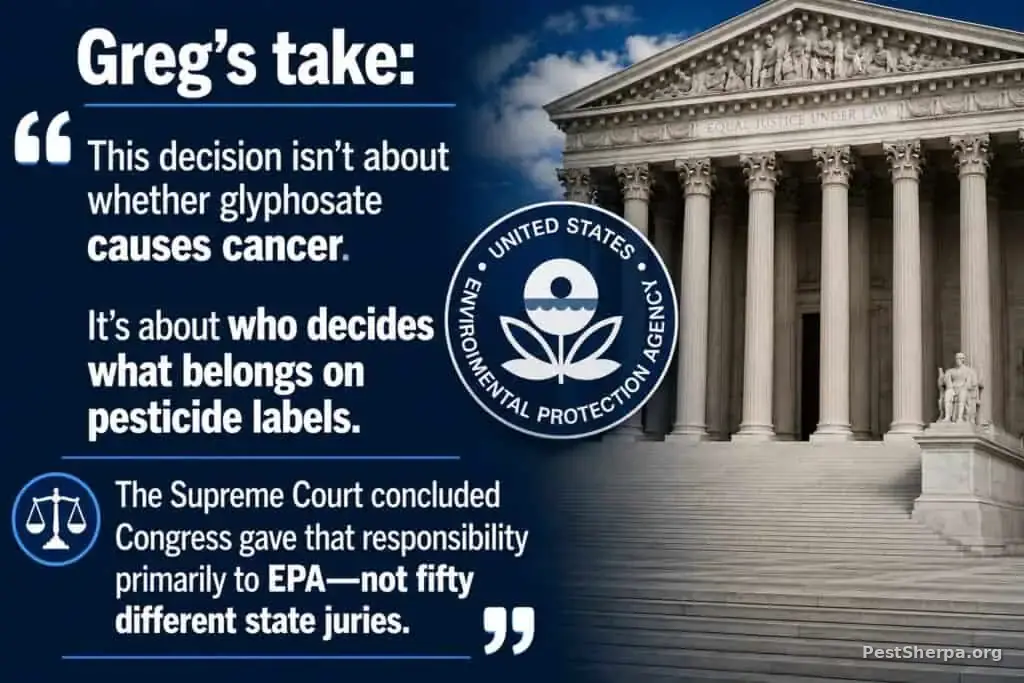
In many respects, Monsanto Co. v. Durnell is not primarily a case about Roundup. It is a case about institutional authority: who decides what warnings belong on a pesticide label?
The Supreme Court’s answer was that Congress assigned primary responsibility for pesticide-warning decisions to EPA, not to state juries operating independently across the country. For pesticide labeling, Durnell favors a uniform federal label over a patchwork of state-law warning requirements.
For pest management professionals, the practical lesson remains consistent with long-standing industry practice: the label remains the law. Read the label before using any pesticide. Follow the directions. Do not assume that a product is harmless because it is sold at retail. Do not assume that a product can be mixed, applied, stored, or disposed of in any manner that seems convenient.
For manufacturers, the lesson is equally clear. If EPA is the central decision-maker, then the scientific and administrative record submitted to EPA must be complete, accurate, transparent, and defensible. For homeowners and consumer advocates, future debates over pesticide warnings may increasingly move through EPA proceedings, administrative petitions, scientific review, and judicial review of agency action rather than state jury verdicts.
Frequently Asked Questions
Did the Supreme Court rule that glyphosate does not cause cancer?
No. The Court decided a legal preemption question. It did not conduct a toxicology review or decide the scientific question of glyphosate carcinogenicity.
Did Monsanto win every Roundup lawsuit?
No. The decision primarily affects label-based failure-to-warn claims that would require additional or different warnings from those required by EPA. Other legal theories may involve different facts, different claims, and different defenses.
Can EPA require a cancer warning in the future?
Yes. EPA retains authority to revisit pesticide registrations, require additional data, amend labels, suspend registrations, or cancel registrations if the agency determines that the statutory standard is no longer met or that different warnings are required.
Can states still regulate pesticides?
Yes. States retain substantial authority over licensing, certification, use restrictions, enforcement, and certain sales or product restrictions. The key limitation after Durnell is that states generally cannot impose pesticide labeling or packaging requirements in addition to or different from FIFRA requirements.
Does this decision affect only Roundup?
Probably not. Although the case involved Roundup and glyphosate, the reasoning may apply to other EPA-registered pesticides when a state-law warning claim conflicts with an EPA-approved label.
Does this mean pesticides are safe?
No. The word “safe” can be misleading because pesticide risk depends on the product, formulation, exposure route, use site, application method, dose, label restrictions, and user behavior. The practical message is not that pesticides require no caution. The message is that pesticide users must follow the label.
What should pest control companies do now?
Continue building operations around label compliance: read labels, train technicians, maintain current product information, document applications, follow state rules, and avoid customer-facing statements that contradict EPA-approved labeling.
What’s Next After Monsanto Co. v. Durnell?
The long-term effects of Monsanto Co. v. Durnell will likely extend beyond glyphosate litigation.
- Manufacturers of EPA-registered pesticides will likely give even more attention to building comprehensive scientific and administrative records.
- Plaintiffs and consumer advocacy organizations may shift more strategy toward EPA petitions, public comments, agency challenges, and judicial review of EPA decisions.
- State governments may focus on sales restrictions, use restrictions, licensing, environmental protections, buffers, notification programs, and enforcement rather than warning labels themselves.
- Pest control companies should review current labels, technician training, continuing education, application records, customer communication, PPE practices, and state-law requirements.
Conclusion
Monsanto Co. v. Durnell is one of the most consequential pesticide-labeling decisions in recent years. The ruling does not resolve the scientific debate surrounding glyphosate. It does, however, establish that EPA-approved pesticide labels carry substantial preemptive force against state-law failure-to-warn claims that would require additional or different warning language.
For manufacturers, the decision increases the importance of complete, accurate, and scientifically defensible submissions to EPA. For pest control professionals, it reinforces a long-standing industry principle: the label remains the law. For homeowners and consumer advocates, future disputes over pesticide warnings may increasingly move from state courtrooms to EPA proceedings, scientific review, and agency oversight.
The Supreme Court did not decide whether glyphosate causes cancer. It answered a different and potentially more consequential question: who has authority to determine what warnings belong on pesticide labels?
Under FIFRA, the Supreme Court concluded that responsibility belongs primarily to the Environmental Protection Agency.
Related Topics
Readers interested in this decision may also wish to explore:
- FIFRA compliance requirements for pest management professionals
- EPA pesticide registration and registration review procedures
- Glyphosate litigation history and regulatory developments
- Best practices for pest control documentation and recordkeeping
- State pesticide licensing and certification requirements
- Federal preemption doctrine and product-liability law
- EPA pesticide risk assessment and risk communication processes
- How to read and follow a pesticide label
Primary Sources
Primary sources and reference materials for this article include:
- Monsanto Co. v. Durnell, No. 24-1068, 609 U.S. ___ (2026)
- Supreme Court docket for Monsanto Company v. John L. Durnell, No. 24-1068
- EPA overview of the Federal Insecticide, Fungicide, and Rodenticide Act (FIFRA)
- EPA introduction to pesticide labels
- EPA registration review process
- EPA glyphosate materials
- IARC Q&A on glyphosate
- Natural Resources Defense Council v. EPA, Ninth Circuit decision on EPA’s 2020 glyphosate interim decision
- Bates v. Dow Agrosciences LLC, 544 U.S. 431 (2005)
- Riegel v. Medtronic, Inc., 552 U.S. 312 (2008)
This article was written by Greg Baumann, founder of Pest Sherpa, and reflects more than 40 years of professional pest management experience.
About the Author

Greg Baumann | Pest Control Expert
Greg Baumann is the founder of Pest Sherpa and a Pest Control Expert with more than 40 years of professional pest management experience. His articles combine decades of field experience, technical expertise, and science-based guidance to help homeowners identify pests correctly, understand real-world risks, and make informed pest management decisions.
Mission: Identify the pest. Understand the risk. Stop the problem. Prevent the comeback. Know when it’s time to call a professional.