
Boxelder Bugs: Identification, Causes, and What to Do
Seeing boxelder bugs on siding, windows, curtains, attic spaces, or sunny interior walls is usually a seasonal nuisance problem, not a sign that your home is being damaged. These black true bugs with red-orange markings often gather in large numbers on warm exterior surfaces in late summer and fall, then slip into cracks, siding gaps, attic spaces, soffits, vents, and wall voids to overwinter.
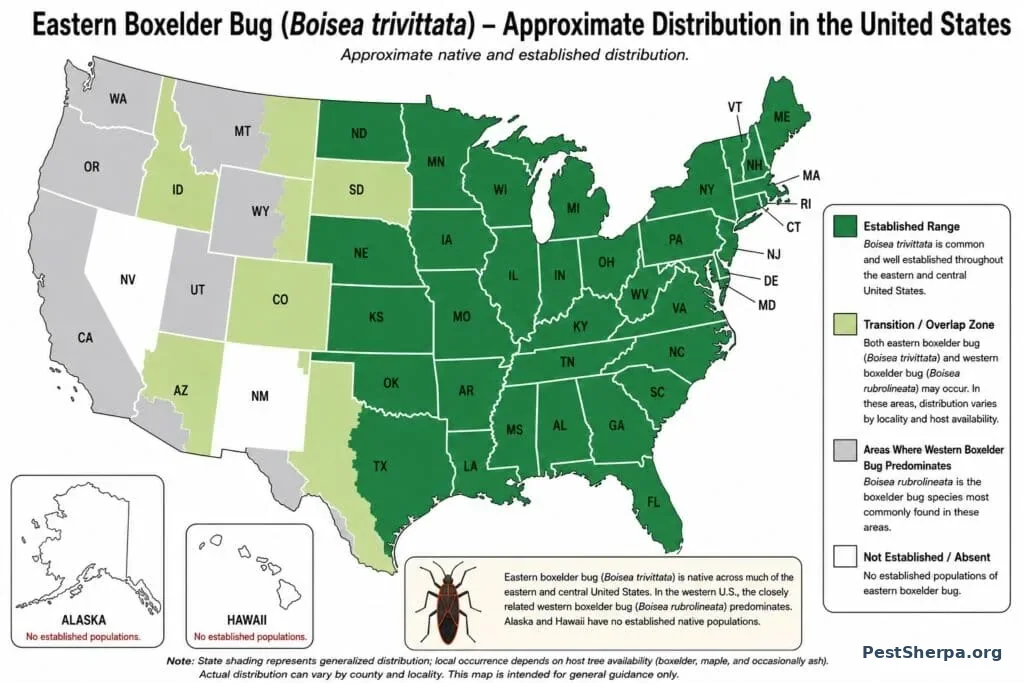
Boxelder bugs, commonly listed as Boisea trivittata and also encountered in some sources as Boisea trivittatus, do not damage wood, wiring, insulation, drywall, stored food, or household fabrics. They do not reproduce indoors. The main concerns are nuisance numbers, staining if crushed, odor when disturbed, and repeated indoor appearances on warm winter or spring days.
This guide explains how to identify boxelder bugs, why they suddenly appear, where they usually enter, what homeowners can check first, what does not work well, and when professional help may be worth considering for recurring fall invasions.
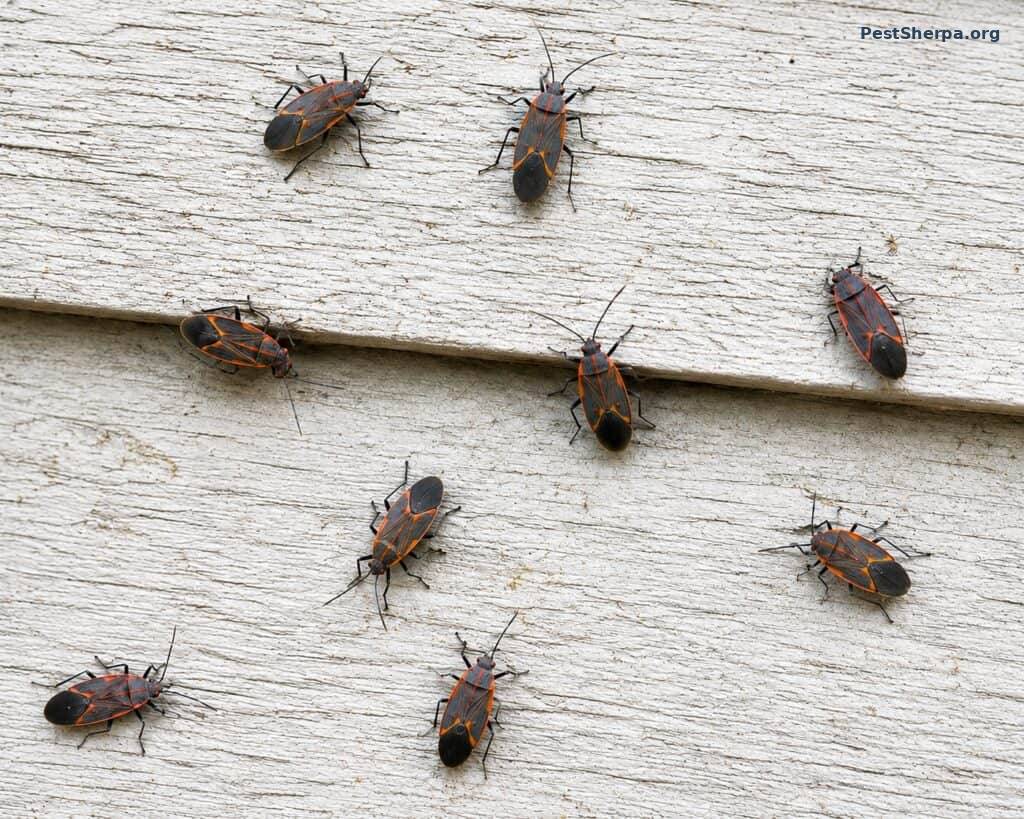
Boxelder bugs clustered on sun-exposed siding in fall.
TL;DR
- Boxelder bugs are seasonal nuisance insects that often gather on sunny south- and west-facing walls in late summer and fall.
- They enter homes for shelter, not to feed on people, pets, wood, clothing, food, or building materials.
- Winter or spring sightings usually mean adults that entered in fall are becoming active again inside wall voids, attics, or living spaces.
- The most useful long-term steps are exterior inspection, sealing entry points before fall migration, repairing screens, improving door sweeps, and reducing access around vents, siding gaps, utility penetrations, and rooflines.
- Indoor sprays rarely solve the problem once bugs are already hidden inside. Vacuuming visible insects and preventing future entry are usually more effective.
Quick Navigation
- What Boxelder Bugs Mean in Your Home
- Quick Identification
- Quick Assessment
- Seasonal Activity and Life Cycle
- Why Boxelder Bugs Come Back Every Year
- Where To Inspect Outside and Inside
- Why They Suddenly Appeared
- Common Sources, Attractants, and Entry Points
- What To Do
- What Does Not Work Well
- How Long Will It Last?
- Health, Damage, and Safety Concerns
- When Professional Help May Be Needed
- Lookalikes and Common Misidentifications
- Frequently Asked Questions
- References
What Boxelder Bugs Mean in Your Home
Boxelder bugs inside a house usually mean adults found a way in during fall and are now moving out of hidden overwintering spaces. They are commonly seen around windows, patio doors, baseboards, warm walls, attics, upper floors, and rooms with strong sunlight.
The window is usually not the source. It is often where the bugs are trying to reach warmth and light after becoming active indoors.
| What You See | What It Usually Means |
|---|---|
| A few bugs indoors in winter | Adults that entered in fall are waking up on warm days |
| Large groups on sunny siding in fall | Outdoor aggregation before overwintering |
| Bugs around windows | Adults are moving toward warmth and light |
| Bugs in attic or upper floors | Possible entry near roofline, vents, soffits, fascia, or siding gaps |
| Repeated annual fall activity | Nearby host trees, warm exterior walls, and recurring entry points may be involved |
| Small red nymphs outdoors in summer | Developing boxelder bugs near host plants or seeds |
Important: Indoor sightings do not mean boxelder bugs are nesting or multiplying inside the home. They overwinter as adults and do not reproduce indoors.
Quick Identification: What Boxelder Bugs Look Like
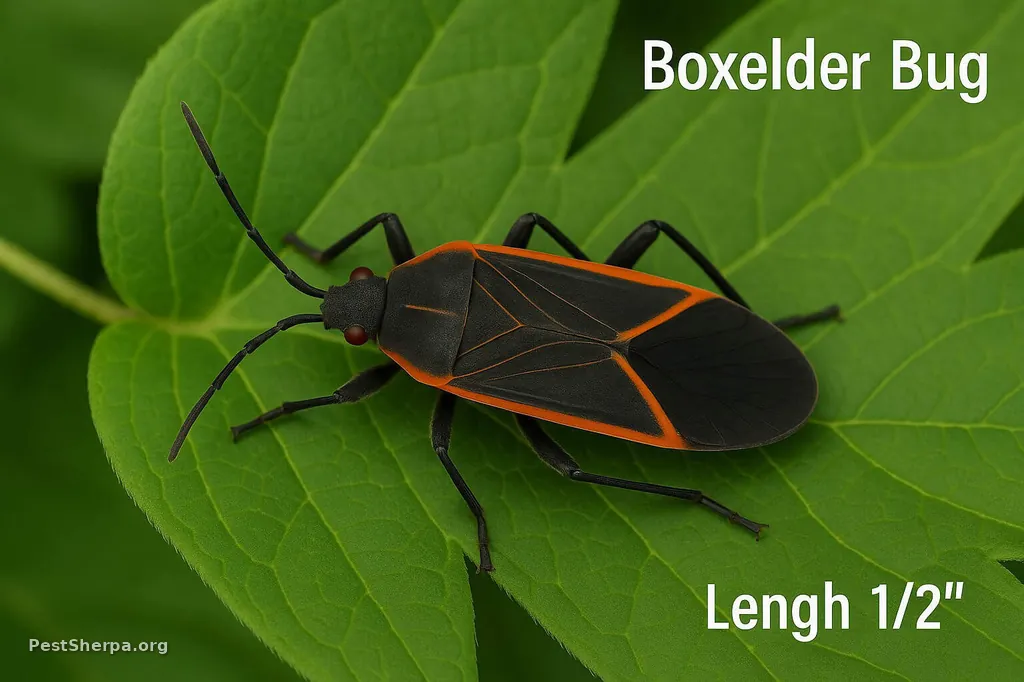
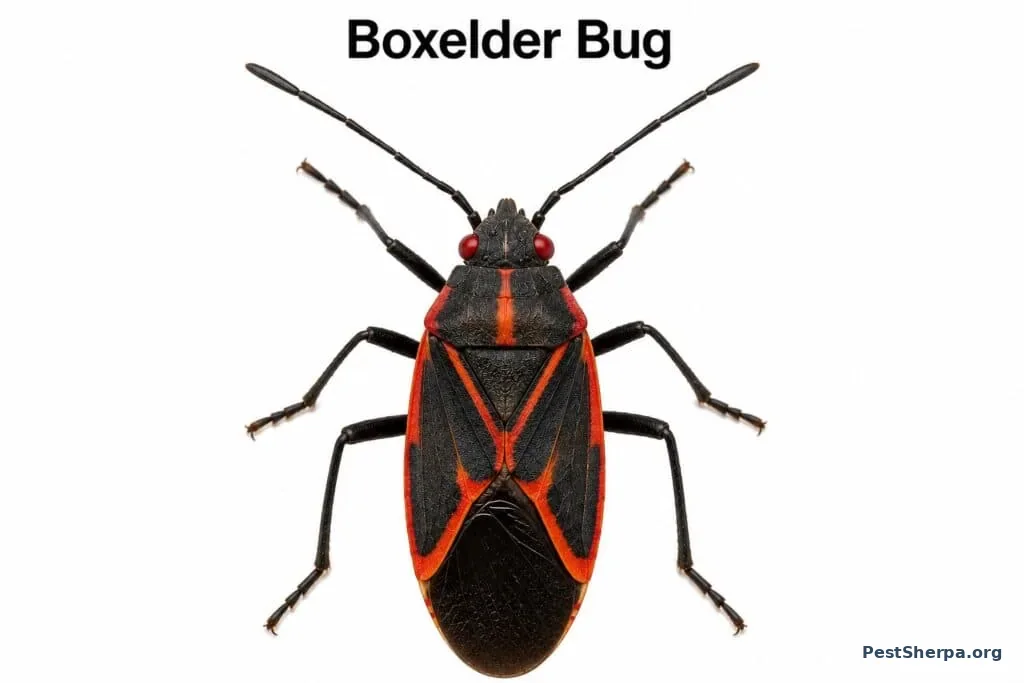
Adult boxelder bugs are true bugs with a narrow, oval body. They are usually easy to recognize once you know the red-orange pattern on the back.
- Adult size: About 1/2 inch long.
- Adult color: Black or dark gray with red or orange lines on the thorax and wings.
- Wing pattern: Wings overlap flat across the back and often form an X-shaped pattern.
- Nymphs: Smaller, wingless or partly winged, often bright red when young and darker as they mature.
- Behavior: Often cluster on sunny exterior walls, foundations, rocks, tree trunks, fences, and windows.
- Season: Most noticeable around homes in late summer, fall, winter warm-ups, and spring.
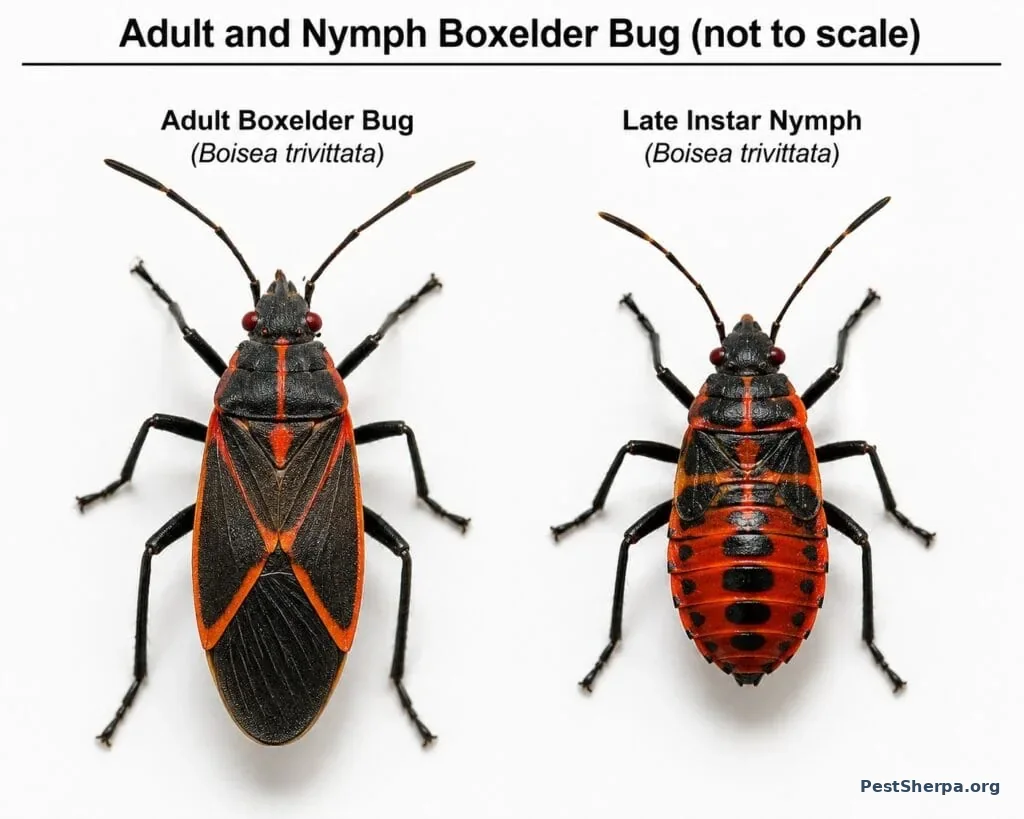
Adult boxelder bug and red nymph showing identifying markings.
Boxelder Bug Quick Assessment
Use this table to judge whether you are seeing a normal nuisance level or a recurring structural entry issue that deserves closer inspection.
| Situation | Severity | Best Next Step |
|---|---|---|
| One or two bugs indoors | Low | Remove with a vacuum or tissue and check nearby screens or door gaps |
| Several bugs around one sunny window | Low to Moderate | Vacuum visible bugs and inspect exterior around that window |
| Dozens on exterior siding in fall | Moderate | Inspect south- and west-facing walls, siding seams, window frames, doors, vents, and foundation gaps |
| Large numbers indoors every winter or spring | Moderate to High | Prioritize late-summer exterior exclusion before the next fall migration |
| Bugs appearing from attic, ceiling fixtures, recessed lights, or wall gaps | High | Inspect attic, soffits, roofline, vents, siding edges, and utility penetrations |
| Heavy annual fall invasion despite sealing obvious gaps | High | Consider a detailed exterior inspection and professional evaluation of hidden entry routes |
Seasonal Activity and Life Cycle of Boxelder Bugs
Boxelder bugs undergo incomplete metamorphosis: egg, nymph, and adult. Their activity changes throughout the year, which is why infestations often feel sudden even though the population developed outdoors over time.
| Season | What Boxelder Bugs Are Doing | What Homeowners Usually Notice |
|---|---|---|
| Spring | Overwintered adults become active and move back outdoors toward host trees and seeds | Bugs around windows, doors, siding, and sunny walls as they try to leave |
| Summer | Adults feed and reproduce outdoors; nymphs develop on or near host plants | Red nymphs and adults may be seen around boxelder, maple, ash, seeds, low vegetation, or nearby surfaces |
| Late Summer to Fall | Adults gather on warm surfaces and begin seeking protected overwintering sites | Large clusters on south- and west-facing siding, brick, foundations, fences, and window frames |
| Winter | Adults remain mostly hidden in protected spaces but may become active during warm indoor or sunny periods | Bugs appear indoors near windows, lights, baseboards, attics, upper rooms, or warm walls |
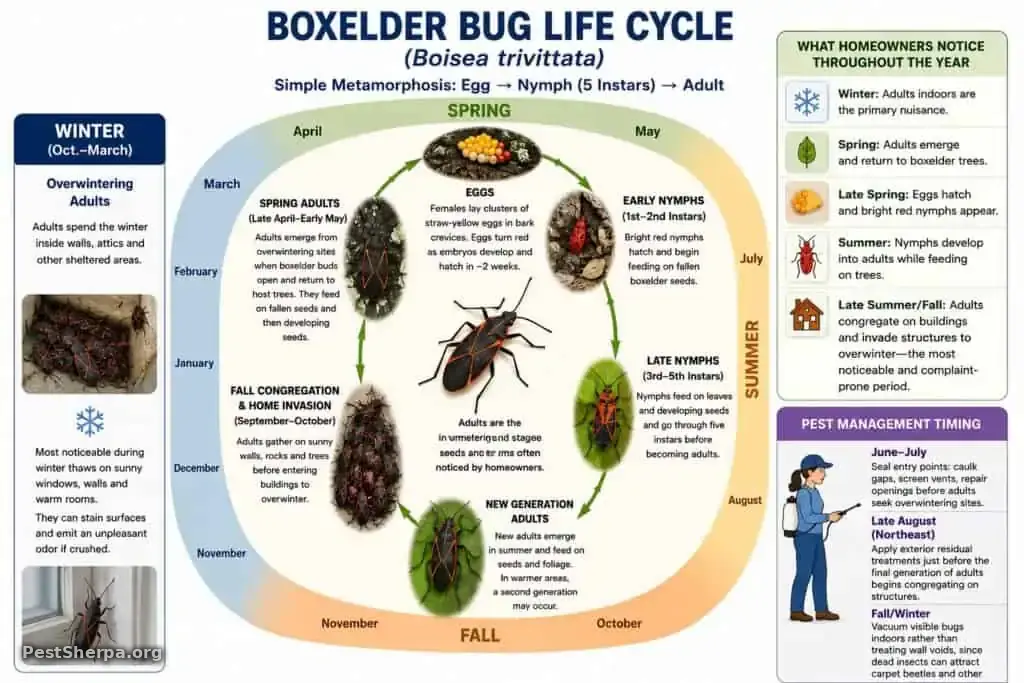
Boxelder bug life cycle showing egg, nymph, and adult stages.
Why Boxelder Bugs Come Back Every Year
Recurring boxelder bug problems usually happen when the same property offers both outdoor attraction and easy overwintering access. A house with warm exterior surfaces and many small openings can become a predictable shelter site each fall.
- Nearby host trees: Boxelder bugs are associated with boxelder trees and may also use maple or ash trees.
- Seed-bearing boxelder trees: Trees producing abundant seeds can support more activity nearby.
- Sunny building exposure: South- and west-facing walls warm up and attract aggregating adults.
- Hidden entry points: Gaps around windows, doors, siding, vents, soffits, fascia boards, rooflines, utility lines, and foundations can allow entry.
- Older or complex siding: Vinyl siding, loose trim, brick gaps, stone veneer, and layered construction can provide protected spaces.
- Repeat overwintering sites: If a structure worked as shelter one year, the same areas may collect bugs again in future fall seasons.
Removing a nearby tree is not always practical, desirable, or sufficient because adult boxelder bugs can fly in from surrounding areas. For most homes, reducing entry points is the more realistic long-term strategy.
Where To Inspect Outside and Inside
Boxelder bug prevention works best when inspection happens before the main fall movement indoors. Start outside, especially on the warmest sides of the structure.
Exterior Inspection Checklist
- South- and west-facing siding, brick, stucco, stone, and foundation walls
- Window frames, weep gaps, trim edges, and damaged caulk
- Door thresholds, garage door bottoms, patio doors, and missing door sweeps
- Rooflines, fascia boards, soffits, attic vents, ridge vents, and gable vents
- Utility penetrations for cable, phone, electrical lines, plumbing, hose bibs, dryer vents, and HVAC lines
- Loose siding, siding corners, J-channels, gaps behind shutters, and trim-to-siding seams
- Cracks where different materials meet, such as brick to siding, foundation to framing, or chimney to wall
- Nearby boxelder, maple, ash, seed litter, leaf piles, firewood stacks, rock walls, and landscape edges where bugs may gather
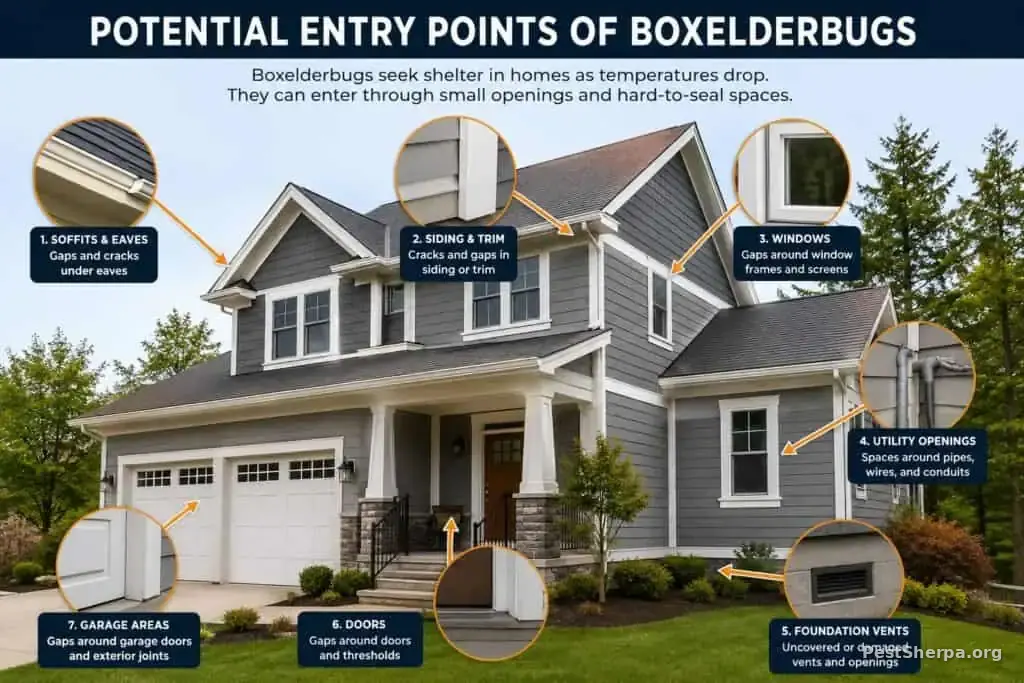
Common boxelder bug entry points around a home exterior.
Interior Clues To Trace
| Indoor Location | Exterior Area To Check |
|---|---|
| Bugs at a sunny living room window | Window frame, siding seams, caulk lines, shutters, and exterior trim around that window |
| Bugs on upper floors | Soffits, fascia, roofline gaps, attic vents, and siding transitions |
| Bugs in attic | Gable vents, roof vents, soffit screens, utility penetrations, and roofline gaps |
| Bugs near baseboards | Foundation cracks, sill plate gaps, exterior wall penetrations, and door thresholds |
| Bugs near recessed lights or ceiling fixtures | Attic spaces, ceiling voids, and nearby roofline entry points |
| Bugs around garage doors | Garage door bottom seal, side weatherstripping, corners, and framing gaps |
Why Boxelder Bugs Suddenly Appeared
Boxelder bugs often seem to appear all at once because their behavior is strongly tied to temperature, sunlight, and season. A warm fall afternoon can draw large numbers onto one side of a house. A sunny winter day can warm wall voids and cause hidden adults to move into rooms. In spring, surviving adults may try to leave the home and gather around windows or doors.
Sudden activity is usually caused by one or more of the following:
- Warm sunlight hitting exterior siding, brick, stone, or stucco
- Adults leaving host trees and searching for overwintering shelter
- Temperature swings that wake hidden adults inside wall voids or attics
- Gaps around windows, doors, siding, vents, rooflines, or foundations
- Nearby seed-bearing boxelder trees or other host trees supporting outdoor populations
- Indoor warmth and light drawing overwintering adults toward living areas
Common Sources, Attractants, and Entry Points
Boxelder bugs are outdoor insects. The “source” is usually a combination of nearby host plants, favorable sun exposure, and structural openings rather than an indoor nest.
| Category | Common Examples | Why It Matters |
|---|---|---|
| Host trees | Boxelder, maple, and sometimes ash | Adults and nymphs feed outdoors on seeds and plant material |
| Warm exterior surfaces | South- and west-facing siding, brick, stone, stucco, fences, and foundations | Adults gather on surfaces that hold heat |
| Entry points | Cracks, loose trim, window gaps, door gaps, utility penetrations, vents, soffits, and siding seams | Adults use small protected openings to reach overwintering spaces |
| Overwintering spaces | Wall voids, attics, soffits, behind siding, under trim, and sheltered cracks | Adults hide there during colder weather |
| Indoor attraction | Warm rooms, sunny windows, lights, and upper floors | Hidden adults may move toward warmth and light after waking up |
What To Do About Boxelder Bugs
1. Confirm the Pest
Check for the black body, red-orange lines, flat overlapping wings, and clustering behavior. If the insect is brown, shield-shaped, strongly odor-producing, or lacks the red-orange wing markings, compare it with the lookalikes section before deciding on next steps.
2. Remove Visible Bugs Indoors
Use a vacuum, broom, dustpan, or tissue to remove visible bugs. Empty the vacuum or remove the bag afterward if many bugs were collected. Avoid crushing boxelder bugs on curtains, walls, upholstery, or light-colored surfaces because they may stain and release odor.
3. Do an Exterior Inspection
Focus on the side of the house where bugs cluster in fall and the exterior wall near indoor sightings. Look closely at gaps around windows, doors, siding, soffits, attic vents, utility lines, foundation cracks, and garage doors.
4. Seal and Repair Entry Points Before Fall
- Repair or replace damaged window screens and door screens.
- Install or replace door sweeps and garage door bottom seals.
- Seal cracks around windows, doors, fascia boards, utility lines, pipes, and exterior penetrations.
- Repair damaged soffit, roof vent, bathroom fan, kitchen fan, and attic vent screens.
- Use appropriate materials for the gap, such as exterior caulk, copper mesh, sealant, weatherstripping, or other building-compatible exclusion materials.
- Do not block required ventilation openings or seal masonry weep holes without proper vented inserts or building-appropriate guidance.
5. Reduce Outdoor Aggregation Where Practical
Rake heavy seed litter near foundations, move firewood and clutter away from walls, reduce leaf buildup near entry points, and keep exterior gaps visible for inspection. Tree removal is usually not the first step because boxelder trees can have landscape value and adult bugs may fly from surrounding properties.
6. Use Pesticides Carefully, If They Are Used
Exterior pesticide treatments are generally most relevant before bugs enter, when adults first begin clustering on building exteriors in late summer or early fall. Indoor pesticide use after bugs are already hidden in wall voids usually provides limited benefit. Always read and follow the product label, use only products labeled for the site and pest situation, and avoid unnecessary indoor exposure.
What Does Not Work Well
Many frustrating boxelder bug problems continue because the response focuses only on visible insects instead of entry prevention.
| Common Attempt | Why It Usually Falls Short |
|---|---|
| Crushing bugs indoors | May stain surfaces and release odor |
| Spraying only the bugs you see inside | Does not stop hidden adults from emerging later |
| Foggers or bug bombs | Do not seal entry points and may increase unnecessary pesticide exposure |
| Waiting until winter to seal obvious gaps | Many adults may already be inside wall voids or attics |
| Removing one tree without inspecting the house | Bugs may come from other nearby trees and still enter through structural gaps |
| Ignoring vents, soffits, and rooflines | Upper-level entry points are common when bugs appear upstairs or in attics |
How Long Will Boxelder Bugs Last?
The answer depends on when you are seeing them and whether they already entered the structure.
- Fall exterior clusters: Activity usually continues until colder weather pushes adults into protected places or ends outdoor movement.
- Winter indoor sightings: Bugs may appear off and on during warm, sunny periods because not all hidden adults wake up at the same time.
- Spring indoor sightings: Surviving adults are usually trying to move back outdoors. Activity generally declines as they leave or die.
- Recurring annual infestations: The pattern may repeat each fall unless entry points are sealed and exterior access is reduced before migration begins.
One important expectation: after sealing and prevention work, you may still see some bugs that were already inside hidden spaces. Prevention is usually judged over the next fall season, not only by what happens the day after repairs.
Health, Damage, and Safety Concerns
Boxelder bugs are nuisance pests. They are not known for damaging structures, feeding on wood, infesting stored food, or reproducing indoors. They are not considered a major health threat to people or pets.
The most common concerns are:
- Staining on curtains, walls, upholstery, or other light-colored surfaces if crushed
- Odor when bugs are disturbed or smashed
- Large visible clusters on homes, windows, siding, and foundations
- Repeated nuisance appearances in living areas during winter or spring warm-ups
- Potential pesticide exposure if excessive indoor spraying is used instead of physical removal and prevention
For homes with children, pets, asthma concerns, sensitive occupants, or heavy indoor activity, avoid unnecessary pesticide use indoors. Vacuuming visible bugs and sealing entry points are usually safer and more practical first steps.
When Professional Help May Be Needed
Professional help may be worth considering when the issue is recurring, heavy, difficult to inspect, or connected to structural entry points that are hard to reach safely.
- Large numbers enter every fall despite basic sealing efforts.
- Bugs appear from attics, recessed lights, ceiling gaps, wall voids, or upper floors.
- The home has complex siding, high rooflines, many vents, stone or brick gaps, or difficult access areas.
- Exterior walls are heavily covered with bugs during late summer or fall.
- You need help distinguishing boxelder bugs from lookalikes such as kissing bugs, seed bugs, milkweed bugs, or stink bugs.
- A pesticide treatment is being considered and you want it timed, targeted, and label-compliant.
A neutral inspection should focus on identification, exterior entry points, timing, exclusion options, and whether any treatment is appropriate before bugs enter for winter.
Lookalikes and Common Misidentifications
Several insects can be confused with boxelder bugs, especially when they appear on walls, windows, plants, or sunny exterior surfaces. Correct identification matters because the source and next steps can differ. The following insects are listed for comparison but several do not occupy the same geographical territory.
| Lookalike | How It Differs From Boxelder Bugs | Why It Matters |
|---|---|---|
| Small milkweed bug | Orange-red and black seed bug often associated with milkweed; pattern differs from the narrow red lines on boxelder bugs | Usually tied to outdoor host plants rather than home overwintering in the same way |
| Goldenrain tree bug | Similar red-orange and black coloration but associated with goldenrain trees in some regions | Host tree identification may change the outdoor source investigation |
| Western conifer seed bug | Brown, longer-legged, and often has widened hind legs; lacks the bright red-orange boxelder bug wing lines | Another fall invader that may enter homes for overwintering |
| Brown marmorated stink bug | Shield-shaped brown body with banded antennae and a strong odor when disturbed | Also a fall invader, but identification and monitoring differ |
| Kissing bug | Usually more elongated with a different head shape and different markings | Some species can bite and have public health relevance in certain regions, so careful identification is important |
| Elm seed bug | Smaller brownish seed bug that may invade homes in some regions | Often connected to elm trees and may require different source context |
Frequently Asked Questions
Do boxelder bugs bite?
Boxelder bugs are not considered biting pests in homes. Rare pinching or probing incidents may be reported, but they do not feed on people and are mainly a nuisance invader.
Do boxelder bugs reproduce indoors?
No. Indoor winter and spring sightings are usually adults that entered the previous fall. They do not establish indoor breeding populations in normal household conditions.
Why are boxelder bugs all over one side of my house?
They are attracted to warmth. South- and west-facing walls often receive more afternoon sun, so those surfaces can collect large numbers of adults during fall movement.
Why do boxelder bugs show up inside during winter?
Adults hidden in wall voids, attics, soffits, or siding spaces may become active during warm indoor or sunny periods. They often move toward windows, lights, or warm rooms.
Will removing a boxelder tree solve the problem?
Not always. Removing a nearby seed-bearing boxelder tree may reduce local pressure in some cases, but adults can fly from surrounding properties. Sealing entry points is usually the more practical first priority.
Should I spray inside the house?
Indoor sprays usually do not solve the problem once bugs are hidden in walls or attics. Physical removal of visible insects and exterior prevention before fall entry are usually more useful. If any pesticide is used, read and follow the label exactly.
Why do they keep coming back after I vacuum them?
Vacuuming removes the bugs you can see, but it does not remove adults still hidden in wall voids, attic spaces, or siding gaps. More may emerge on later warm days.
Are boxelder bugs harmful to pets?
They are not considered dangerous to pets, but they may taste unpleasant and can release odor if chewed or crushed. Avoid letting pets eat large numbers of nuisance insects.
What is the best time to prevent boxelder bugs?
Late summer before the main fall movement indoors is the best time to inspect and seal entry points. Waiting until bugs are already indoors makes prevention harder for that season.
Are boxelder bugs the same as stink bugs?
No. Both can be nuisance invaders and both may release odor when disturbed, but boxelder bugs are black with red-orange markings, while many stink bugs are shield-shaped and brown or green.
Bottom Line
Boxelder bugs are predictable seasonal invaders. They are frustrating because they gather in large numbers and may appear indoors for months after fall entry, but they are not structural pests and they do not reproduce inside homes.
The most effective long-term strategy is prevention before fall movement indoors: identify the insect, vacuum visible indoor bugs, avoid crushing them, inspect the warm sides of the home, seal entry points, repair screens and door seals, and pay special attention to attic, soffit, siding, window, door, roofline, and utility gaps. For heavy recurring infestations, a more detailed exterior inspection may help identify hidden entry routes and determine whether any targeted, label-compliant treatment is appropriate.
How much does DIY exclusion for boxelder bugs usually cost?
For many houses, latex caulk, door sweeps, and sealing cracks near windows and lights runs roughly $50 to $100 in materials, depending on the condition of the home and how many bugs are pressing indoors. Leave brick weep holes open. The same exclusion work also helps against overwintering lady beetles and stink bugs. A pro exclusion job costs more because of labor, but it often includes a seasonal return promise.
After I vacuum boxelder bugs, how often should I reinspect?
Vacuum or sweep indoor bugs and discard the vacuum contents afterward. Then reinspect weekly until you see no more. If you find a dozen or more at once, look for a main opening such as a gap under a door or a crack around a window. Indoor sprays rarely add value for this pest. See also: Are Asian lady beetles and boxelder bugs dangerous, and how do I keep them out?
References
- University of Minnesota Extension: Boxelder Bugs
- Penn State Extension: Boxelder Bug
- University of Wisconsin Horticulture Extension: Boxelder Bug, Boisea trivittatus
- Northeastern IPM Center: Boxelder Bug
- UMass Extension: Boxelder Bug
- University of Minnesota Extension Diagnostic Tool: Boxelder Bug
This article was written by Greg Baumann, founder of Pest Sherpa, and reflects more than 40 years of professional pest management experience.
About the Author

Greg Baumann | Pest Control Expert
Greg Baumann is the founder of Pest Sherpa and a Pest Control Expert with more than 40 years of professional pest management experience. His articles combine decades of field experience, technical expertise, and science-based guidance to help homeowners identify pests correctly, understand real-world risks, and make informed pest management decisions.
Mission: Identify the pest. Understand the risk. Stop the problem. Prevent the comeback. Know when it’s time to call a professional.