
Asian Needle Ants
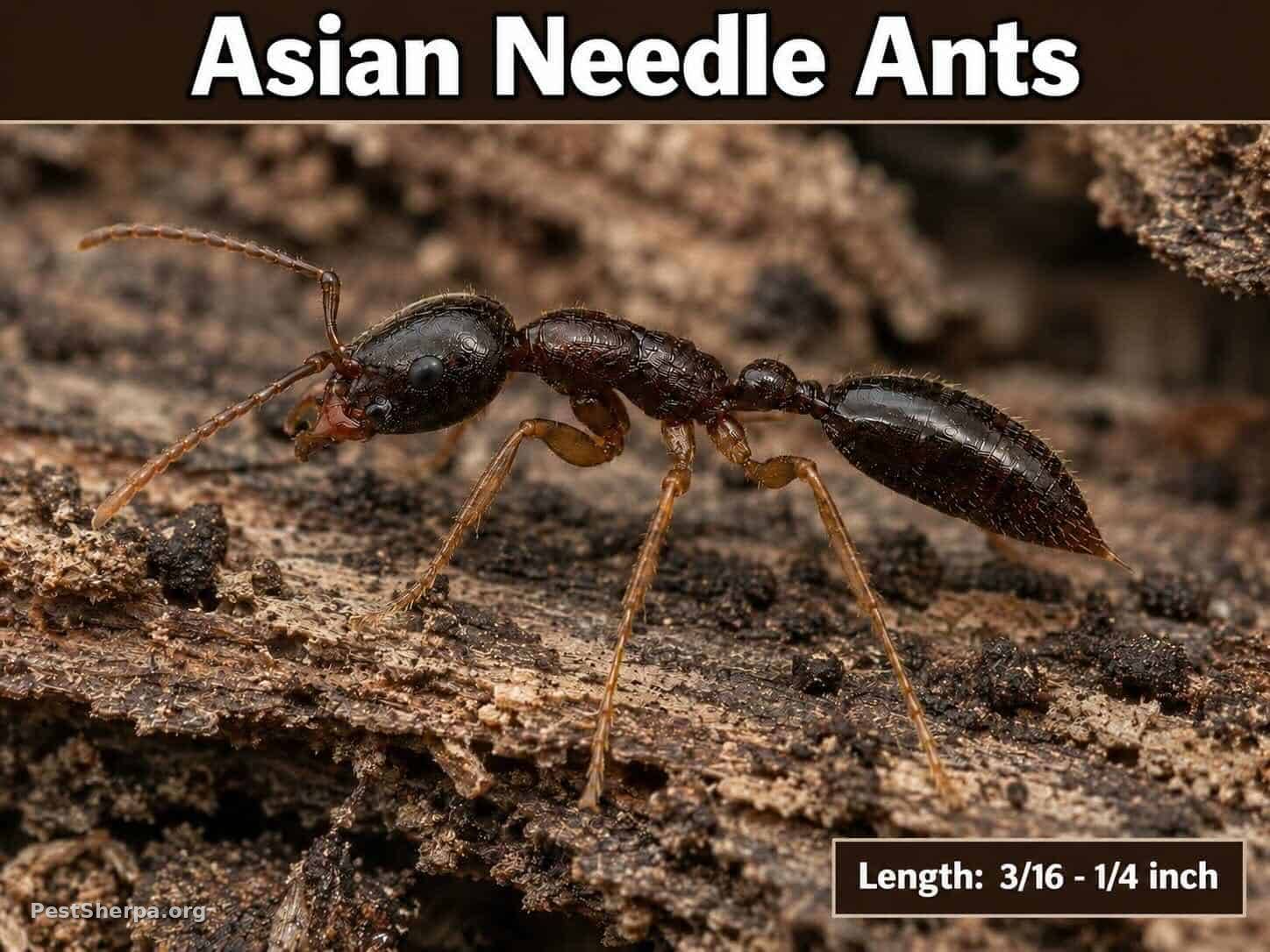
The Asian needle ant, Brachyponera chinensis, is an invasive stinging ant found in parts of the eastern United States. Older publications may identify it by the former scientific name Pachycondyla chinensis. Native to Asia, this ant has been documented in the United States since the early twentieth century and has expanded into residential landscapes, commercial properties, and hardwood forests.
TL;DR
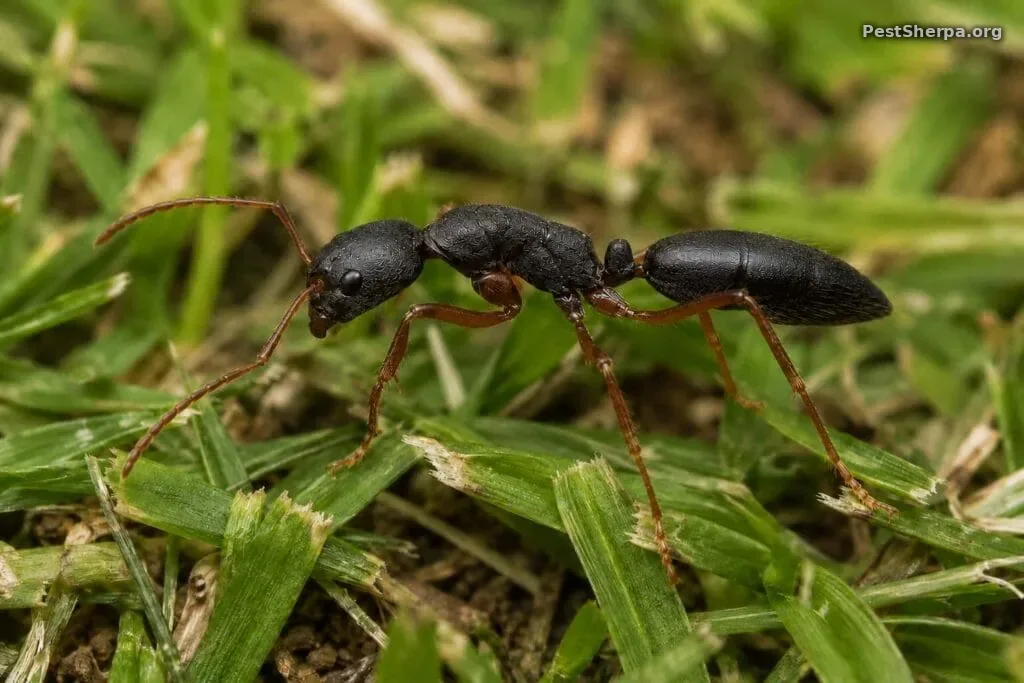
- ID first: Slender, shiny dark brown to nearly black workers about 3/16 to 1/4 inch long, often with lighter brown or orange-brown legs and mandibles. Color alone is not enough.
- Nest clue: Prefer shaded, damp harborages under mulch, logs, stones, pavers, and leaf litter. They rarely build obvious fire-ant-style mounds.
- Risk: Workers can sting when trapped against skin or when people handle nest materials. Medically documented allergic reactions, including anaphylaxis, have occurred. Seek emergency care for severe symptoms.
- Control: Confirm ID, inspect damp harborages, reduce moisture and debris, and use labeled products carefully. They are not typical sugar-trail kitchen ants, so ordinary sugar baits often disappoint.
- See the ant guide for broader species comparison.
Jump to: Identification | Why It Matters | Where They Nest | What To Do | When To Call a Pro | Similar Pests | Common Questions | References
Identification: What Asian Needle Ants Look Like
Asian needle ant workers are slender and usually about 3/16 to 1/4 inch (5 to 6.5 mm) long. Workers are generally similar in size. Their bodies are shiny dark brown to nearly black, while the legs, mandibles, and parts of the antennae are often lighter brown, reddish brown, or orange-brown.
Color can provide a useful clue, but it should not be the only basis for identification. Asian needle ants have elbowed antennae, a narrow waist, and a functional sting. Similar dark-colored ants can be difficult to separate without magnification.
What confirms the ID
- Slender, shiny dark workers in the 3/16 to 1/4 inch range.
- Lighter brown to orange-brown legs and mandibles contrasting with a darker body.
- Nesting in damp, concealed sites rather than open sunny mounds.
- Foraging that is often scattered rather than loud kitchen mass trails.
- A painful sting when a worker is pressed against skin or trapped in clothing.
What commonly misleads homeowners
- Fire ants and red imported fire ants: painful stings and dark or reddish workers lead many people to assume every stinging ant is a fire ant. Fire ants more often nest in open sunny soil with visible mounds.
- Harvester ants: large outdoor stingers that clear bare disks around nest openings and collect seeds. Nest architecture differs.
- Other dark outdoor ants under mulch or logs: size, waist characters, and nest habits need closer look.
One supporting behavioral clue is that Asian needle ants may have difficulty climbing very smooth vertical surfaces such as clean glass. This observation can help during preliminary identification, but physical characteristics should determine the final identification. When certainty is important, specimens should be evaluated by a pest management professional or Extension specialist.
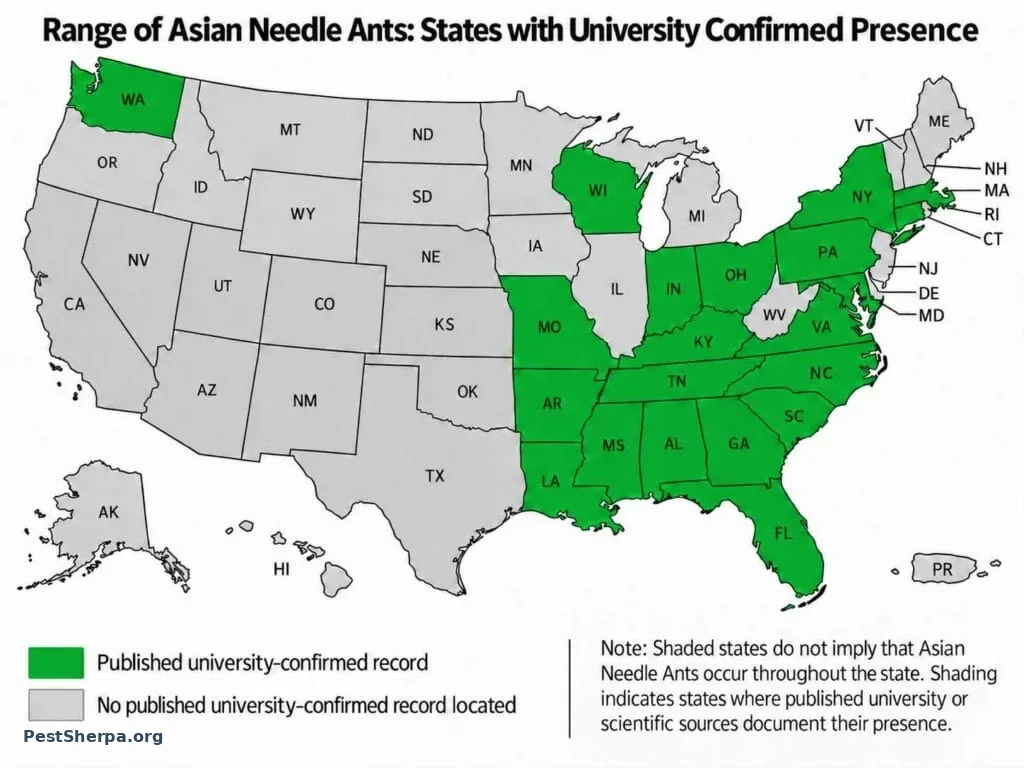
Known U.S. range is concentrated in parts of the East and Southeast and is not continental.
Why Asian Needle Ants Matter
While fire ants typically have very visible mounds, Asian needle ants rarely are obvious, preferring to blend in with vegetation and debris. Colonies often occupy damp, concealed sites, so infestations may remain unnoticed until workers turn up around mulch, logs, stones, pavers, firewood, or building edges.
Asian needle ants matter for two practical reasons. First, they can displace native ants and disrupt ecological functions such as seed dispersal in wooded and landscaped habitats. Second, their workers can sting people. As with many pest ants, the range is specific to particular geographical areas and is not found everywhere in North America.
Presence near play areas, garden beds you work by hand, firewood stacks, or mulched walkways raises sting exposure risk even when you never see a classic mound. That stealth nesting pattern is why many people first notice the species after a sting, not after spotting trails on a counter.
Biology and Seasonal Activity
Asian needle ants undergo complete metamorphosis through egg, larva, pupa, and adult stages. Colonies include workers, immature ants, and reproductive males and females.
Colony structure can vary. Both single-queen and multiple-queen colonies have been reported, and local populations may occupy several related nesting sites. Colony size also ranges widely, from small groups to hundreds or thousands of ants spread among protected harborages.
Worker activity increases during warmer months. Research from the southeastern United States indicates that reproductive males and females are produced mainly in summer, with strong reproductive activity around midsummer. This species also tolerates cool conditions better than several other invasive ants, which may help explain its success in forest habitats and its spread into areas where colder temperatures can limit other invasive species.
Where Asian Needle Ants Nest
Moisture is a major feature of Asian needle ant nesting sites. Colonies commonly occupy shaded, protected places containing damp soil, decaying wood, mulch, leaf litter, or other organic material.
Common nest and harborage sites include:
- Beneath rocks, stones, pavers, and landscape timbers
- Under loose bark or inside decaying logs
- Around tree bases and in moist mulch
- Beneath objects that rest directly on soil
- Near irrigation and sprinkler components
- In leaf litter, loose soil, and woody debris
Unlike imported fire ants, Asian needle ants usually do not build obvious soil mounds. Their foraging activity can also be easy to miss because workers do not typically form the conspicuous mass trails associated with some household ants. Infested mulch, wood, soil, potted plants, and landscaping materials may help move colonies from one location to another.
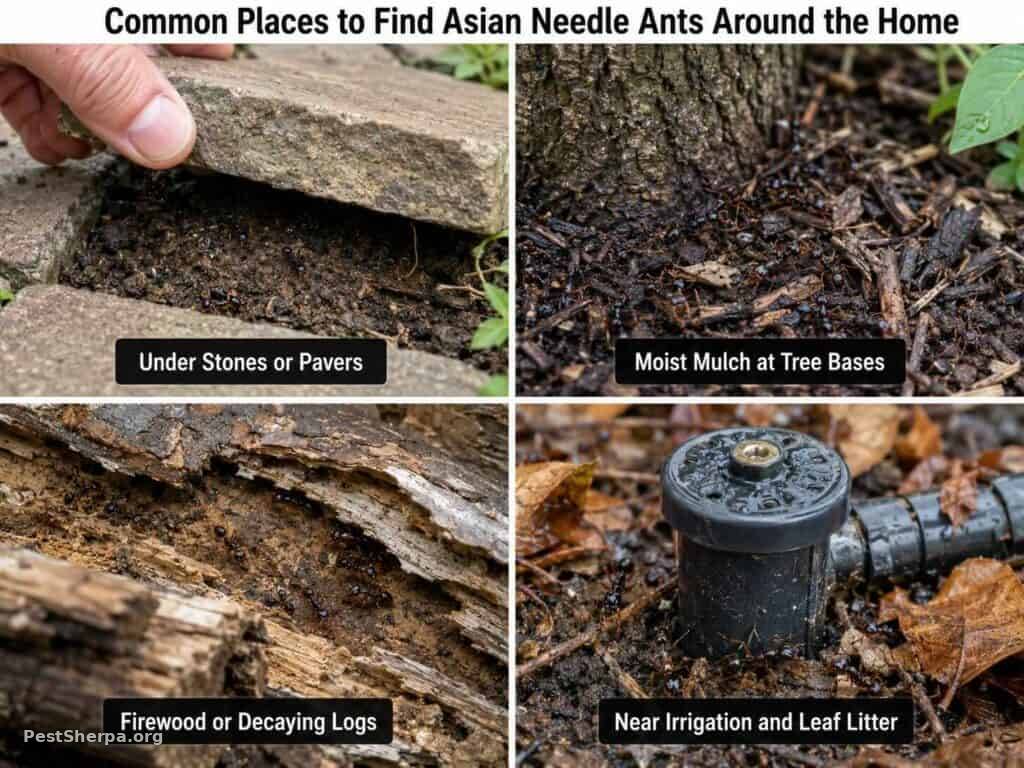
Sites favored by Asian needle ants.
What Asian Needle Ants Eat
Asian needle ants are predators and scavengers with a strong association with termites. Research has described them as termite specialists, although workers also prey on or scavenge other insects and small arthropods.
Their feeding habits are important for control. They should not be treated as typical sugar-feeding household ants. Studies suggest they may not depend heavily on liquid carbohydrates such as nectar or honeydew, and conventional ant baits may not always be attractive. Research has found that termite-derived compounds can improve acceptance of certain bait formulations.
Stings and Health Concerns
Asian needle ants are generally less aggressively defensive than imported fire ants, but workers can sting when trapped against the skin or disturbed while people handle mulch, logs, stones, firewood, or other materials containing a colony. Because these ants often lack an obvious presence such as the visible mounds common to fire ants, contact can feel “stealthy,” including stings to bare feet or ankles while working in beds or walking through mulched areas. People wearing open shoes when mowing increase exposure.
The sting can be painful, and medically documented cases of serious allergic reactions, including anaphylaxis, have occurred. Anyone who develops difficulty breathing, swelling of the mouth or throat, widespread hives, dizziness, faintness, or other signs of a severe allergic reaction after a sting should seek emergency medical attention. This guide does not replace medical advice; follow local emergency guidance for sting reactions.
Gloves can reduce direct contact when moving wood, mulch, stones, leaf litter, or other materials where ants may be concealed.
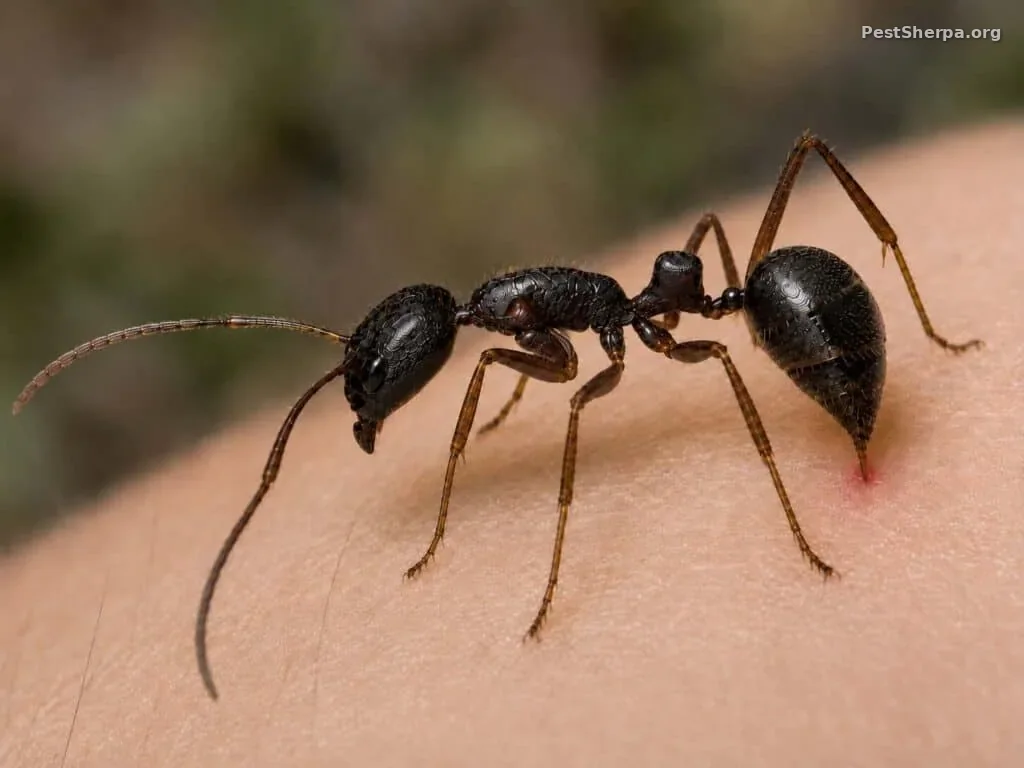
Asian needle ant stinging when pressed against skin.
What To Do
Effective management starts with correct identification and a careful inspection. Eliminating visible workers alone does not eliminate a colony or prevent further Asian needle ant activity.
1. Confirm identification before treating
Rule out fire ants and other outdoor stingers when possible. Wrong ID leads to the wrong product and the wrong nest search pattern. If you are unsure, use Ask the Sherpa or a local Extension office before spraying.
2. Inspect shaded, damp harborages first
Check mulch beds, tree bases, rotting wood, landscape timbers, firewood piles, stones, pavers, leaf litter, irrigation equipment, and objects resting on moist soil. If ants are found indoors, inspect nearby exterior areas because workers often originate from outdoor colonies.
3. Reduce nesting conditions
Remove unnecessary boards, logs, stones, and moisture-retaining debris near structures when practical. Store firewood away from buildings and above the soil. Correct drainage problems and persistent moisture, and avoid allowing deep, wet mulch to remain directly against foundations.
4. Use labeled products carefully
Baits may be useful, but bait acceptance varies. Products that work well for common household ants may perform poorly against Asian needle ants because of their feeding preferences. When a nest can be located, an appropriately labeled ant-control product may be applied directly according to label directions. Monitor results rather than assuming a kitchen sugar bait will finish the job.
5. Avoid treating only the ants you see
Broad spraying of visible workers should not be confused with colony elimination. Hidden brood, multiple nesting sites, and concealed queens may allow activity to continue after exposed ants are killed.
When To Call a Pro
- You cannot confirm whether the ants are Asian needle ants, fire ants, or another outdoor stinger.
- Activity continues after habitat cleanup and careful labeled treatment.
- Nests appear across many mulched beds, wood piles, or landscape features.
- Someone on the property has a history of severe insect-sting reactions.
- The property is commercial, institutional, or liability-sensitive (playgrounds, schools, HOA commons).
- Indoor trails keep returning and you need help tracing outdoor sources.
A qualified pest management professional can help confirm the species, locate nesting areas, choose labeled control methods, and recommend changes that reduce future activity.
Similar Pests / Misidentification Comparison
Painful stings and dark workers lead many homeowners to assume every stinging ant is a fire ant. Asian needle ants are different in habitat and nest structure, so wrong ID leads to the wrong treatment path.
- Fire ants: Often aggressive mound builders in open sunny soil. Asian needle ants more often nest under debris in shaded, damp wooded or landscaped areas and do not build classic fire ant mounds.
- Harvester ants: Larger outdoor ants that clear bare circles around nest openings and collect seeds. Nest architecture and foraging differ from Asian needle ants.
- Red imported fire ants: A major fire ant species with mound and sting patterns that differ from Asian needle ant colonies under leaf litter and wood.
Common Questions
Do Asian needle ants build fire ant mounds?
Usually no. They prefer concealed damp sites under mulch, logs, stones, and litter. Lack of a classic mound is a major reason they are missed until someone is stung.
Are Asian needle ant stings dangerous?
Stings are painful. Medically documented serious allergic reactions, including anaphylaxis, have occurred. Seek emergency care for breathing trouble, throat swelling, widespread hives, dizziness, or fainting. Mild local pain alone is common; this page is not medical advice.
Will sugar ant bait wipe them out?
Often not reliably. Asian needle ants lean toward protein and arthropod prey, with a strong termite association. Conventional sugar baits that work on kitchen trail ants may be poorly accepted. Match products to label directions and monitor.
Why do I find them when I move mulch or firewood?
Those materials hold moisture and cover. Colonies sit under or inside them. Gloves and careful handling reduce sting risk when you rearrange landscape materials.
When should I call a professional?
When ID is uncertain, nests are widespread, DIY labeled treatments fail, or sting allergy risk is a concern on the property.
References
- University of Tennessee Extension: The Asian Needle Ant: A Medically and Ecologically Important Emerging Pest
- NC State Extension: Asian Needle Ant Around Landscape and Home
- USDA Forest Service: Asian Needle Ant: An Invasive Stinging Ant (SRS-SU-143)
- University of Georgia Extension: Insect and Arthropod Pests of Southeastern Neighborhoods
- Clemson University (Allen): Biology and Behavior of the Asian Needle Ant, Brachyponera chinensis
- Clemson University (Mo): Temporal Food Preference and Effectiveness of Selected Bait Products Against Pachycondyla chinensis
- Pest Management Science (Buczkowski): Termite Cuticular Extracts Improve Acceptance of Bait for Controlling Invasive Asian Needle Ants
- Journal of Economic Entomology (Rice, Shik, and Silverman): Effect of Scattered and Discrete Hydramethylnon Bait Placement on the Asian Needle Ant
This article was written by Greg Baumann, founder of Pest Sherpa, and reflects more than 40 years of professional pest management experience.
About the Author

Greg Baumann | Pest Control Expert
Greg Baumann is the founder of Pest Sherpa and a Pest Control Expert with more than 40 years of professional pest management experience. His articles combine decades of field experience, technical expertise, and science-based guidance to help homeowners identify pests correctly, understand real-world risks, and make informed pest management decisions.
Mission: Identify the pest. Understand the risk. Stop the problem. Prevent the comeback. Know when it’s time to call a professional.