

How do rats get into a house?
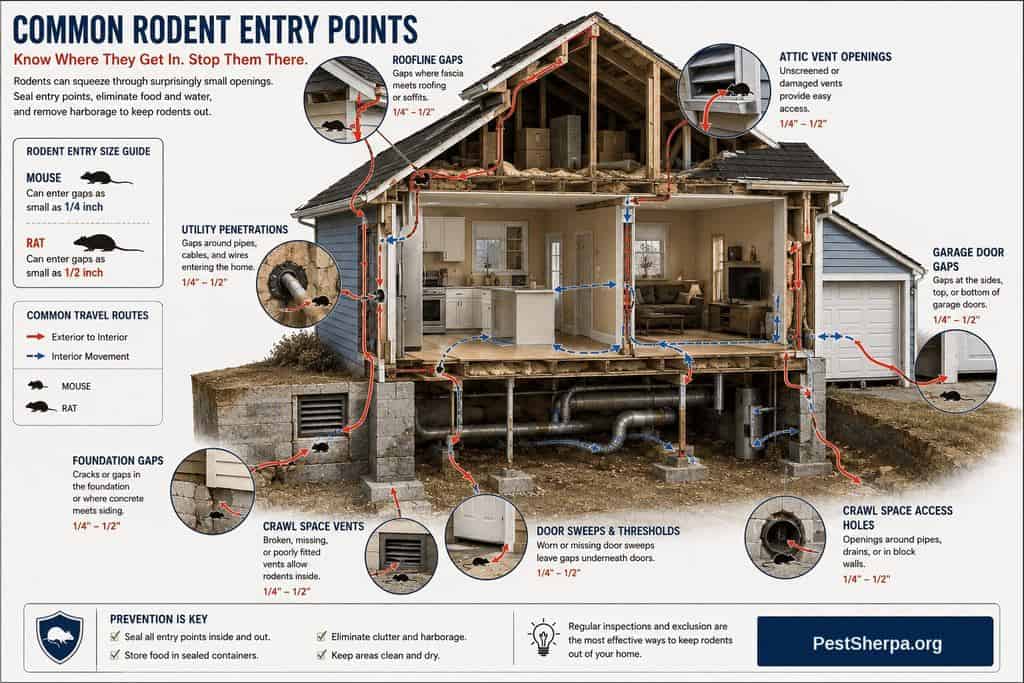
Short answer: Most rats walk in through openings that homeowners stop noticing: a garage door left open for hours, foundation gaps from damage, basement and crawlspace openings, and the space under exterior doors. A young rat can squeeze under a door with only a 1/2-inch gap. Keep the garage closed, seal holes larger than 1/4 inch with durable materials, and fit tight door sweeps.
The garage door that stays open
In my experience, the garage is the clearest and easiest path into a house for a rat. A garage door that sits open for hours at a time while you work in the yard or unload the car is an open invitation. Once a rat is in the garage, the door into the house, utility openings, and stored pet food or seed give it every reason to stay.
Keep the garage door closed when you are not actively using it, and check the rubber seal along the bottom of the door. If you can see daylight under it, a rat can find that gap too.
Basements and crawlspaces get ignored
Basements and crawlspaces are the parts of a house people visit least, which is exactly why rats use them. Gaps in a foundation from settling or damage and openings where pipes, wires, and vents pass through the wall create easy access. Norway rats burrow along building foundations, and when they move indoors they tend to stay in the basement or on the ground floor.

Walk the foundation with a flashlight. Look for cracks, broken vent screens, an unsealed crawlspace access, and gaps around every pipe, wire, and cable entry. University of California IPM recommends covering foundation vents with galvanized 1/2-inch wire mesh and warns against lightweight chicken wire, which rats pass through easily.
The space under exterior doors
Rats of either common species, especially young rats, can squeeze beneath a door with only a 1/2-inch gap. If the door is wood, a rat may gnaw the bottom edge to make the opening larger. Fit every exterior door with a tight door sweep and a sealed threshold, including the door between the garage and the house. Ordinary weatherstripping may not be enough on its own where rats are active, and metal edging on a chewed door bottom is a good upgrade.
Roof rats come in higher
If you live where roof rats are found, look up as well as down. Roof rats are agile climbers that travel along utility lines, fence tops, and tree limbs, and they favor attics, wall voids, and soffit openings. Trim tree limbs and climbing vines back from the roof and check roof vents and eaves.
Seal with materials rats cannot chew
Rats can chew through plastic, foam, wood, and caulk, so those materials alone will not hold. Use hardware cloth, sheet metal, cement, or a metal mesh packed into the gap and then sealed over. Steel wool works for a while, but it rusts, and rodents can work their way between steel wool and the edge of the opening. Copper mesh does not rust, so it lasts longer, but caulk over it as well so it cannot be pushed aside.
Summary checklist
- Keep the garage door closed unless you are actively using it.
- Replace a worn garage door bottom seal.
- Fit tight door sweeps and thresholds on all exterior doors, including the garage entry door.
- Inspect the foundation, basement, and crawlspace for damage gaps and unsealed pipe, wire, and vent openings.
- Seal openings larger than 1/4 inch with metal-based materials, not foam alone.
- Trim limbs and vines away from the roof if roof rats are in your area.
- Store pet food, birdseed, and grass seed in lidded containers.
For identification, habits, and control of the most common rat in American basements, see my Norway rat guide. If you are wondering where rats spend the cold months, read where rats go in winter.
Related guides
- Rodent Guide
- Roof Rat Guide
- Where do rats go in winter?
- How do I keep pests out of trash cans?
- More Ask the Sherpa Q&A
References
- UC IPM Pest Notes: Rats
- CDC: How to Seal Up to Prevent Rodents
- National Park Service: Rodent Exclusion Manual (2019)
This article was written by Greg Baumann, founder of Pest Sherpa, and reflects more than 40 years of professional pest management experience.
About the Author

Greg Baumann | Pest Control Expert
Greg Baumann is the founder of Pest Sherpa and a Pest Control Expert with more than 40 years of professional pest management experience. His articles combine decades of field experience, technical expertise, and science-based guidance to help homeowners identify pests correctly, understand real-world risks, and make informed pest management decisions.
Mission: Identify the pest. Understand the risk. Stop the problem. Prevent the comeback. Know when it’s time to call a professional.