
Cuban Cockroach (Green Banana Roach): Habitat and What to Do
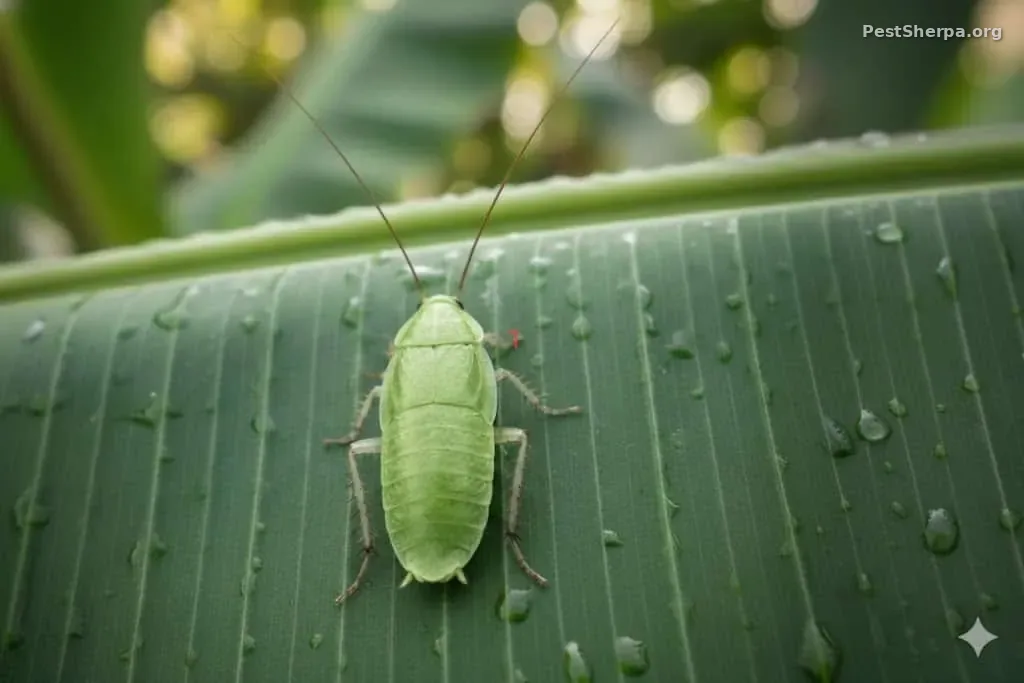
The Cuban cockroach (Panchlora nivea), also called the green banana cockroach, is a bright green outdoor cockroach most often noticed when adults fly to lights at night. Its color can be startling, but this species behaves very differently from indoor pest cockroaches such as the German cockroach or American cockroach. Cuban cockroaches usually live outdoors in warm, humid, plant-rich areas and only occasionally wander or fly indoors.
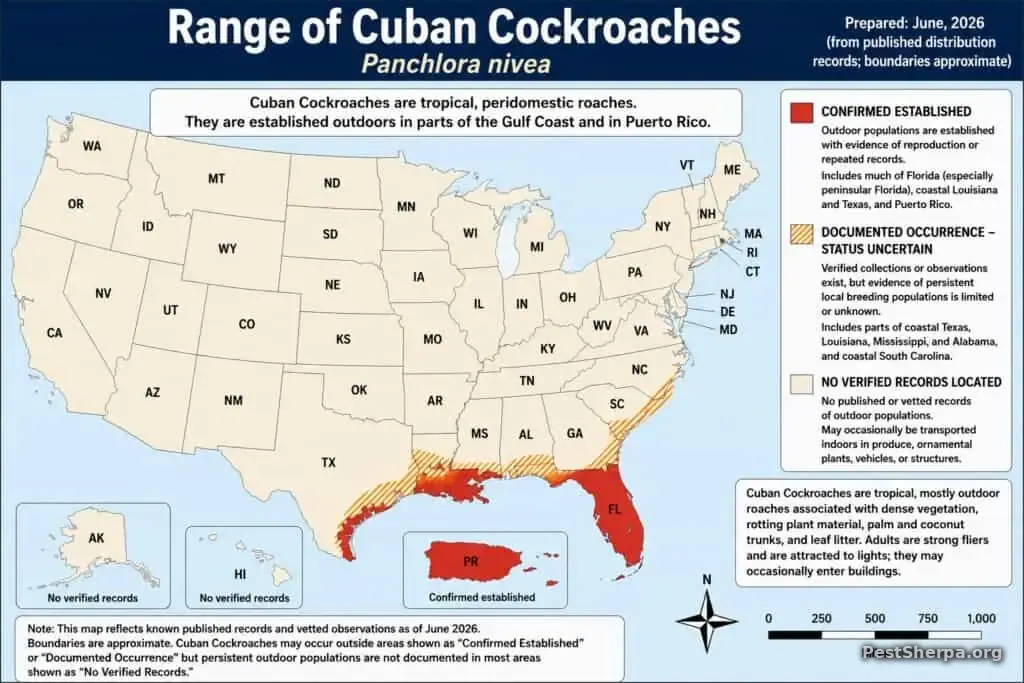
This guide explains how to identify Cuban cockroaches, what a sighting usually means, where they come from, how to reduce encounters around the home, and when a more detailed inspection may be worth considering.
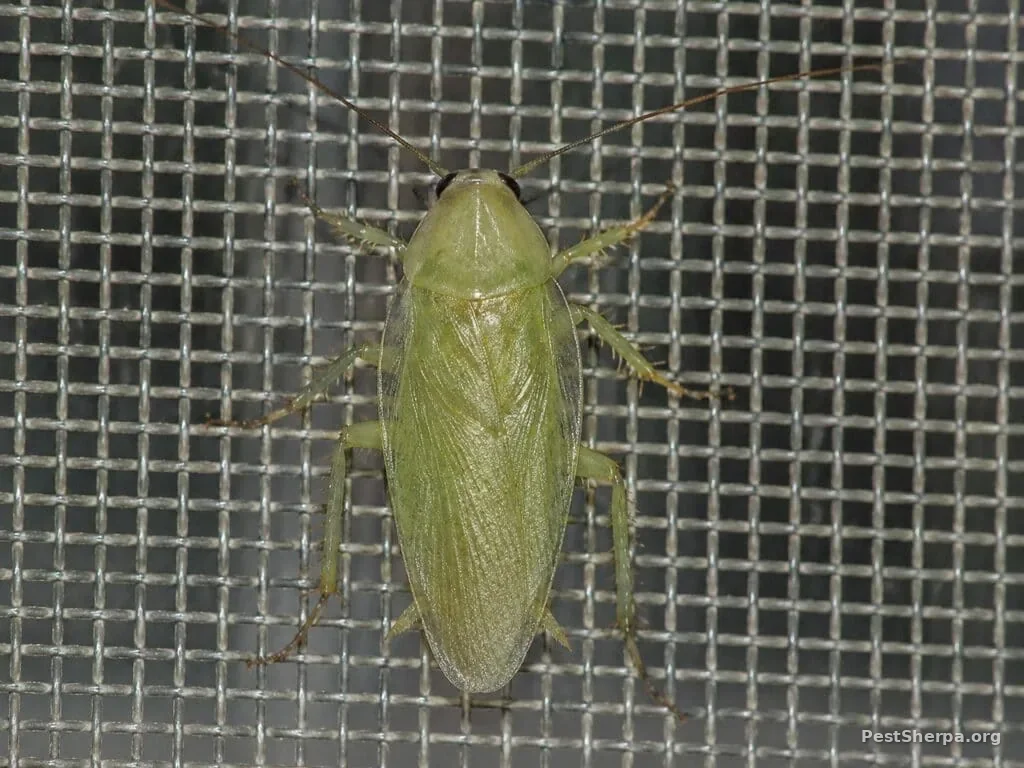
Adult Cuban cockroach showing pale green body and wings.
TL;DR
Cuban cockroaches are outdoor cockroaches, not typical kitchen-infesting roaches. Adults are pale to bright green, usually about 7/8 to 1 inch long, have fully developed wings, and are strong fliers. They are often attracted to porch lights, patio lights, and illuminated windows at night.
One Cuban cockroach indoors usually means an accidental visitor. Repeated sightings near doors, windows, mulch, shrubs, or outdoor lights usually point to outdoor habitat and light attraction rather than an indoor colony.
The best first steps are confirming identification, reducing light attraction near entry points, repairing screens and gaps, and reducing damp organic debris close to the structure.
Quick Navigation
- Quick Identification
- What Cuban Cockroaches Mean Around a Home
- Identification and Lookalikes
- Habitat and Behavior
- Life Cycle
- Source Investigation Checklist
- Health and Home Risk
- What To Do
- What Does Not Work Well
- How Long Activity May Last
- When Professional Help May Be Needed
- Frequently Asked Questions
- References
Quick Identification
| Feature | Cuban Cockroach Clue |
|---|---|
| Scientific name | Panchlora nivea |
| Common names | Cuban cockroach, green banana cockroach |
| Adult color | Pale green to bright leaf-green |
| Nymph color | Brown to dark brown or blackish |
| Adult size | Usually about 7/8 to 1 inch long |
| Wings | Fully developed; adults fly well |
| Common location | Outdoors in mulch, leaves, shrubs, trees, wood piles, and plant debris |
| Indoor meaning | Usually accidental entry, especially near lights |
Key point: A green adult cockroach on a screen, patio wall, porch, or lighted window is much more consistent with a Cuban cockroach than with the main indoor cockroach pests.
What Cuban Cockroaches Mean Around a Home
Cuban cockroaches are usually a sign of outdoor conditions, not a dirty kitchen or a hidden indoor cockroach infestation. They are most often associated with warm, humid outdoor areas that provide shade, moisture, and decaying plant material.
| What You See | What It Usually Means |
|---|---|
| One green cockroach indoors | Likely accidental entry |
| Adults on porch screens or exterior walls | Light attraction at night |
| Repeated adults near doors or windows | Outdoor population nearby plus entry opportunities |
| Brown nymphs in mulch or leaf litter | Outdoor development site nearby |
| Multiple brown roaches in kitchen cabinets | May be a different cockroach; compare with indoor pest species |
For broader roach comparison, see the cockroach identification guide.
Identification and Lookalikes
Adult Cuban cockroaches are among the easiest cockroaches to recognize because of their green coloration. Adults are pale green to lime green, with wings that cover the body and allow strong flight. The front edge behind the head may show a yellowish margin. Nymphs look very different from adults because they are brown to dark brown and wingless.
That color difference matters. A homeowner may see green adults at lights and brown nymphs in mulch and not realize they are the same species.
| Possible Lookalike | How It Differs |
|---|---|
| German cockroach | Small tan indoor species with dark stripes behind the head; strongly associated with kitchens and indoor breeding. |
| American cockroach | Large reddish-brown cockroach; often associated with sewers, basements, drains, and warm structural areas. |
| Smokybrown cockroach | Dark brown, strong flier, and outdoor-associated, but not green. |
| Australian cockroach | Brown cockroach with pale markings; can occur outdoors and in warm, humid areas, but adults are not green. |
| Palmetto bugs | Common name often applied to large outdoor roaches; usually brown, not leaf-green. |
Identification caution: A brown nymph alone can be harder to identify than a green adult. If you are only seeing small brown roaches indoors, compare them with common indoor cockroach pests before assuming they are Cuban cockroach nymphs.
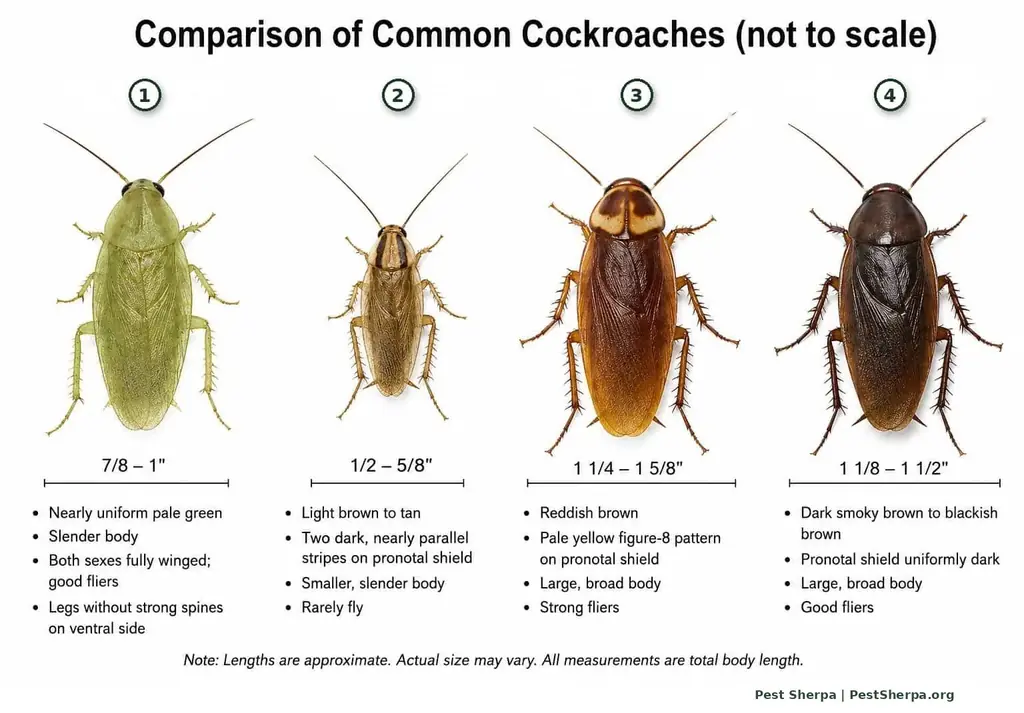
Which one do you see? Match the number:
- Cuban cockroach: 7/8 to 1 inch, nearly uniform pale green. Strong fliers drawn to lights.
- German cockroach: 1/2 to 5/8 inch, light brown to tan with two dark parallel stripes on the shield behind the head.
- American cockroach: 1 1/4 to 1 5/8 inch, reddish-brown with a pale yellow figure-8 pattern on the shield.
- Smokybrown cockroach: 1 1/8 to 1 1/2 inch, uniformly dark smoky brown to blackish.
Habitat and Behavior
Cuban cockroaches are primarily outdoor insects. They are most often associated with warm, humid, shaded areas that contain plant material and organic debris.
- Mulch beds
- Leaf litter
- Compost or decaying plant material
- Firewood and lumber piles
- Dense shrubs and tropical landscaping
- Trees, herbaceous plants, and sheltered vegetation
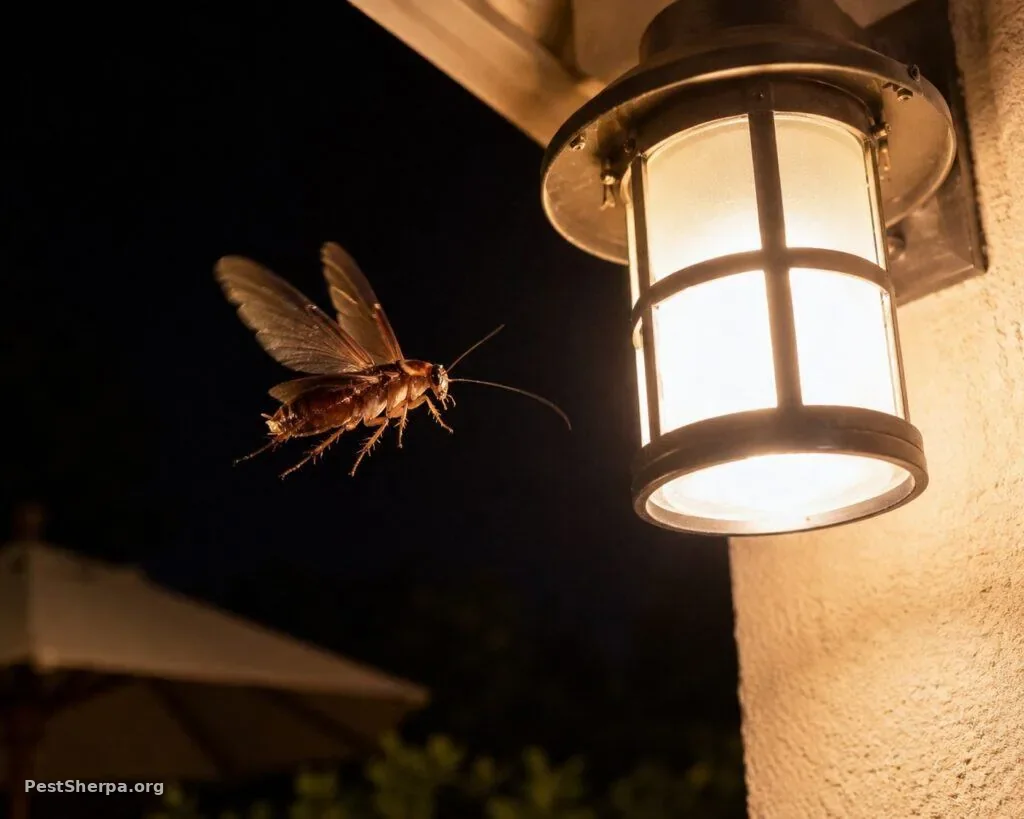
Adults are nocturnal and commonly fly to lights. This is why they may appear on porch screens, patio doors, exterior walls, and windows after dark. Their presence near the home often reflects nearby outdoor habitat plus lighting that draws adults toward the structure.
Life Cycle
Like other cockroaches, Cuban cockroaches develop through egg, nymph, and adult stages. Females do not drop a typical external egg case in the same way many familiar cockroach species do. Instead, they retain the egg case internally and give birth to live young after the eggs hatch inside the female.
Nymphs are brown to dark brown and tend to remain in protected outdoor areas such as leaf litter, decaying logs, and organic debris. Adults are green, winged, and more likely to be noticed because they fly to lights.
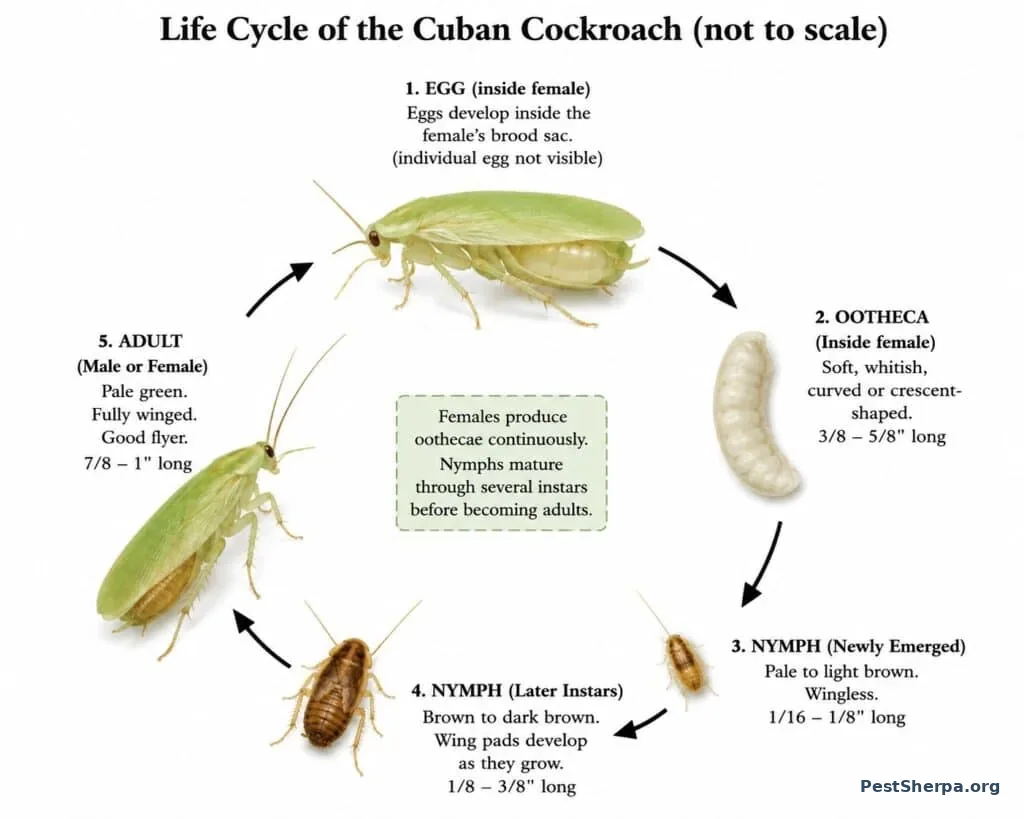
Cuban cockroach nymph and adult life stages showing brown nymph and green adult.
Source Investigation Checklist
If Cuban cockroaches keep appearing near the home, investigate the outdoor conditions first. The goal is to reduce attraction and entry points, not to treat the home as though it has a typical indoor cockroach infestation.
Step 1: Check Where Adults Are Appearing
- Porch lights
- Patio lights
- Lighted windows
- Garage doors
- Sliding glass doors
Step 2: Inspect Nearby Outdoor Habitat
- Deep mulch against the foundation
- Damp leaf litter
- Dense shrubs touching the home
- Firewood stacked against the building
- Compost, fallen fruit, or decaying plant debris
Step 3: Look for Entry Opportunities
- Torn window screens
- Loose door sweeps
- Gaps around exterior doors
- Unscreened vents
- Open garage doors at night
If most activity is outdoors and adults are gathering near lights, the issue is usually light attraction and nearby habitat. If brown roaches are repeatedly found inside kitchens, bathrooms, appliances, or cabinets, reconsider the identification.
Health and Home Risk
Cuban cockroaches are not considered major indoor structural or kitchen pests. They are not known for establishing the same kind of indoor infestations associated with German cockroaches. Their occasional indoor presence is usually brief and related to flight, light attraction, or an open entry point.
That does not mean cockroach identification should be ignored. Common indoor cockroaches can contaminate surfaces and contribute to allergen concerns in some settings. The important distinction is that a green Cuban cockroach on a window or patio door usually calls for exclusion, lighting changes, and outdoor habitat reduction rather than aggressive indoor pesticide use.
What To Do
1. Confirm the Identification
Look for the green adult body, full wings, and nighttime attraction to lights. If the insect is brown and repeatedly found indoors, compare it with other cockroach species before deciding on next steps.
2. Reduce Light Attraction
- Switch bright exterior lights near doors to warmer, lower-attraction bulbs.
- Use motion-activated lights where practical.
- Move lighting away from doors and windows when possible.
- Close curtains or blinds at night to reduce light shining through windows.
3. Improve Exclusion
- Repair torn screens.
- Install or replace door sweeps.
- Seal gaps around doors, utility lines, and exterior openings.
- Screen attic vents and other openings where appropriate.
4. Reduce Outdoor Habitat Near the Structure
- Pull deep mulch back from the foundation where practical.
- Remove piles of wet leaves and decaying plant debris.
- Store firewood away from exterior walls.
- Trim dense shrubs so they do not press against siding, doors, or windows.
- Avoid overwatering beds directly against the home.
5. Handle Indoor Visitors Simply
For an occasional indoor Cuban cockroach, a cup-and-card removal, vacuum, or sticky trap can remove the individual. Then focus on how it entered and what attracted it.
Pesticides are not always necessary for occasional Cuban cockroach sightings. If any pesticide is used, read and follow the product label, keep products away from children, pets, food-contact surfaces, drains, and ventilation openings, and avoid applying products in ways not listed on the label.
What Does Not Work Well
- Treating one green roach like a German cockroach infestation: The biology and source are usually different.
- Routine indoor spraying without identification: This may miss the outdoor cause and add unnecessary pesticide exposure.
- Ignoring porch lights and entry gaps: Adults often arrive because lights draw them to doors and windows.
- Only killing adults: Adult removal does not address mulch, leaf litter, shrubbery, or other outdoor habitat.
How Long Activity May Last
Activity depends on weather, lighting, nearby habitat, and local population levels. One indoor visitor may be a one-time event. Repeated nighttime sightings may continue while adults are active outdoors and lights keep drawing them toward the structure.
| Situation | Likely Pattern |
|---|---|
| One adult indoors | Often ends once the individual is removed and entry is corrected |
| Adults at porch lights | May continue during warm, humid nights |
| Deep mulch and dense vegetation near doors | May continue until habitat and moisture are reduced |
| Brown roaches repeatedly indoors | Recheck identification; another cockroach species may be involved |
When Professional Help May Be Needed
Professional help may be worth considering when identification is uncertain, many cockroaches are repeatedly found indoors, or brown roaches are appearing in kitchens, bathrooms, appliances, cabinets, or other indoor harborage areas. Those signs may indicate a different species or a broader cockroach issue.
For likely Cuban cockroach activity, a useful inspection should focus on species identification, lighting, entry points, mulch, vegetation, moisture, and outdoor harborage rather than assuming an indoor infestation.
Frequently Asked Questions
Are Cuban cockroaches dangerous?
Cuban cockroaches are not considered major indoor health pests in the same way as German cockroaches. Their main concern around homes is nuisance entry, especially when adults fly to lights.
Does one Cuban cockroach mean I have an infestation?
Usually no. One green adult indoors often means an accidental visitor. Repeated sightings should prompt an outdoor inspection around lights, doors, windows, mulch, shrubs, and leaf litter.
Why are Cuban cockroaches coming to my porch?
Adults are strong fliers and are attracted to lights at night. Porch lights, patio lights, and illuminated windows can draw them toward the house.
Do Cuban cockroaches breed indoors?
They are not normally considered indoor-breeding pests. They are more often associated with outdoor vegetation, mulch, leaves, wood piles, and other sheltered organic material.
Why are the small ones brown if the adults are green?
Cuban cockroach nymphs are brown to dark brown, while adults are green and winged. This color change can make the life stages look like different insects.
Should I spray for Cuban cockroaches?
Spraying is usually not the first step for occasional Cuban cockroach sightings. Confirm identification, reduce lighting attraction, repair entry points, and reduce damp outdoor habitat first. If a pesticide is used, follow the label exactly and avoid unnecessary indoor applications.
References
- University of Florida Entomology and Nematology Department: Cuban Cockroach, Panchlora nivea
- Texas Invasive Species Institute: Green Banana Cockroach / Cuban Cockroach
- LSU AgCenter: Rural Cockroaches
- Texas Invasives: Panchlora nivea
- Texas A&M Entomology: Panchlora nivea, Green Banana Cockroach
This article was written by Greg Baumann, founder of Pest Sherpa, and reflects more than 40 years of professional pest management experience.
About the Author

Greg Baumann | Pest Control Expert
Greg Baumann is the founder of Pest Sherpa and a Pest Control Expert with more than 40 years of professional pest management experience. His articles combine decades of field experience, technical expertise, and science-based guidance to help homeowners identify pests correctly, understand real-world risks, and make informed pest management decisions.
Mission: Identify the pest. Understand the risk. Stop the problem. Prevent the comeback. Know when it’s time to call a professional.