
Cockroach Guide: Identification, Risk, and What to Do
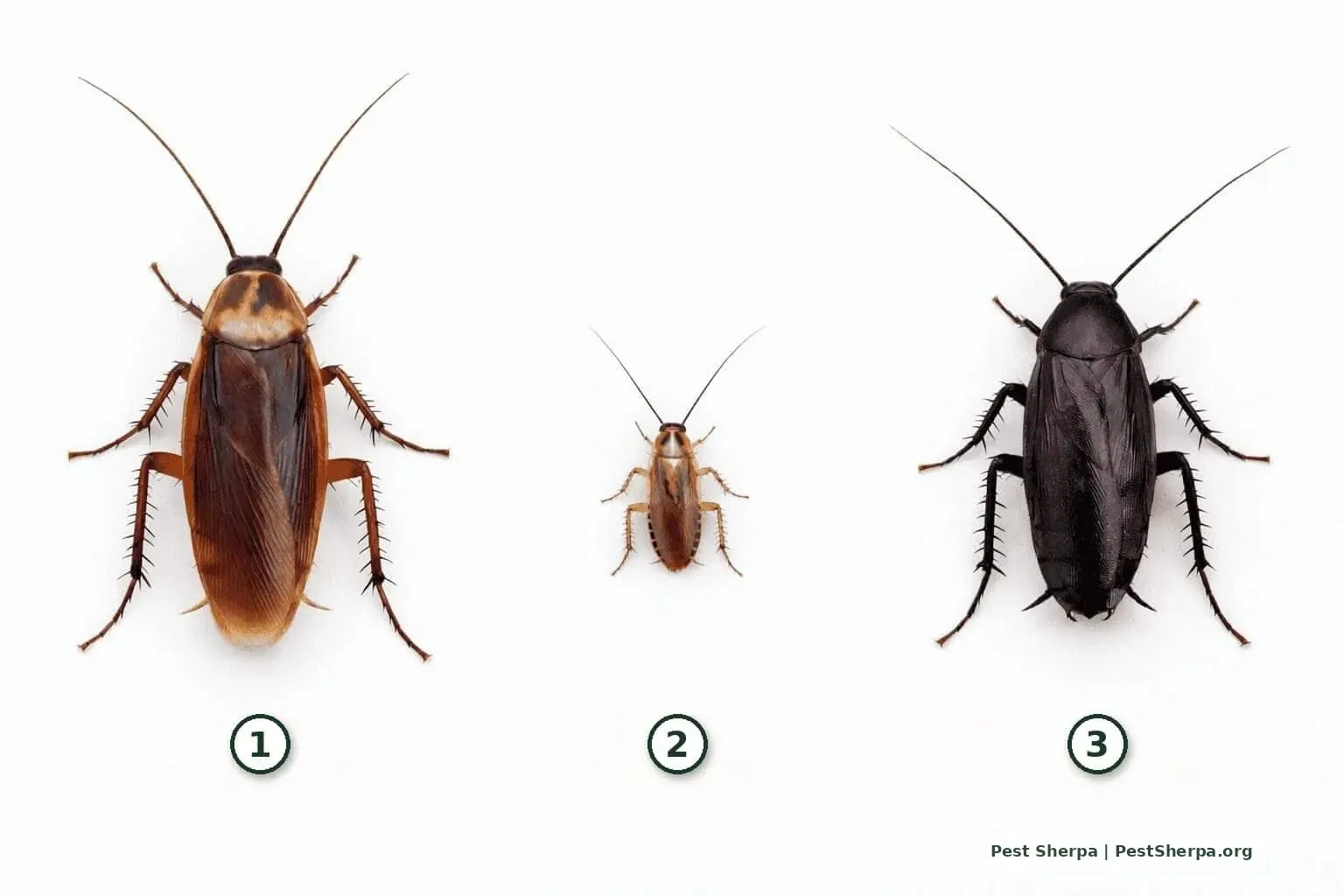
Which one did you find? Match the number:
- American cockroach: the biggest of the three, reddish-brown with a pale yellowish band around the shield behind the head.
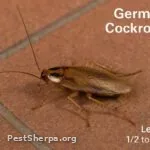
- German cockroach: small and tan with two dark stripes behind the head. The one most often found in kitchens.
- Smokybrown cockroach: large and a uniform dark mahogany to nearly black, with no pale markings.
Not every roach means the same thing. Small tan roaches in the kitchen usually mean German cockroaches breeding indoors, and that needs action now. One big roach after a storm is usually an outdoor roach that wandered in. Use the quick ID below, then open the matching guide.
Which roach is it?
- Small (about 1/2 inch), tan, two dark stripes behind the head, in the kitchen or bathroom: German cockroach (indoor breeder, top priority)
- Big (1.5 to 2 inches), reddish brown, near drains, basements or sewers: American cockroach (often called a palmetto bug)
- Dark brown to black, slow, in damp crawlspaces or drains: Oriental cockroach
- Shiny dark mahogany, flies to porch lights on warm nights: Smokybrown cockroach
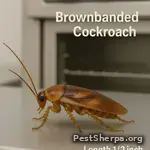
- Small with light bands across the wings, in dry rooms, up high on walls, furniture or electronics: Brownbanded cockroach
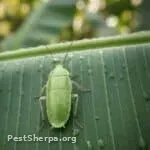
- Light green, flies to lights: Cuban cockroach
- Looks like an American roach with yellow markings on the thorax and wing edges: Australian cockroach
- Around the foundation outdoors; males reddish, females dark: Turkestan cockroach
- Heard it called a palmetto bug?: Palmetto bug guide
Small beetles in flour or cereal are not roaches. See the pantry pests pages instead. Still stuck? Jump to the side-by-side ID chart.
What to do first
- Don’t fog. Bug bombs miss the cracks where roaches hide, and sprays can scatter German roaches deeper into walls.
- Take away food, water and shelter. Clean up crumbs and grease, fix drips, and seal gaps. For small kitchen roaches, put gel bait in cracks near where you see them. For big roaches, focus on drains, damp areas and entry gaps.
- Know when to call. If you still see roaches after cleaning, sealing and baiting, or they show up in more than one room or unit, call a licensed professional. One big roach after a storm is not an infestation.
Full step-by-step plan: How to Get Rid of Cockroaches. Quick version by species: What To Do and When to Call a Professional. Based on UC IPM and university extension guidance cited in the References below.
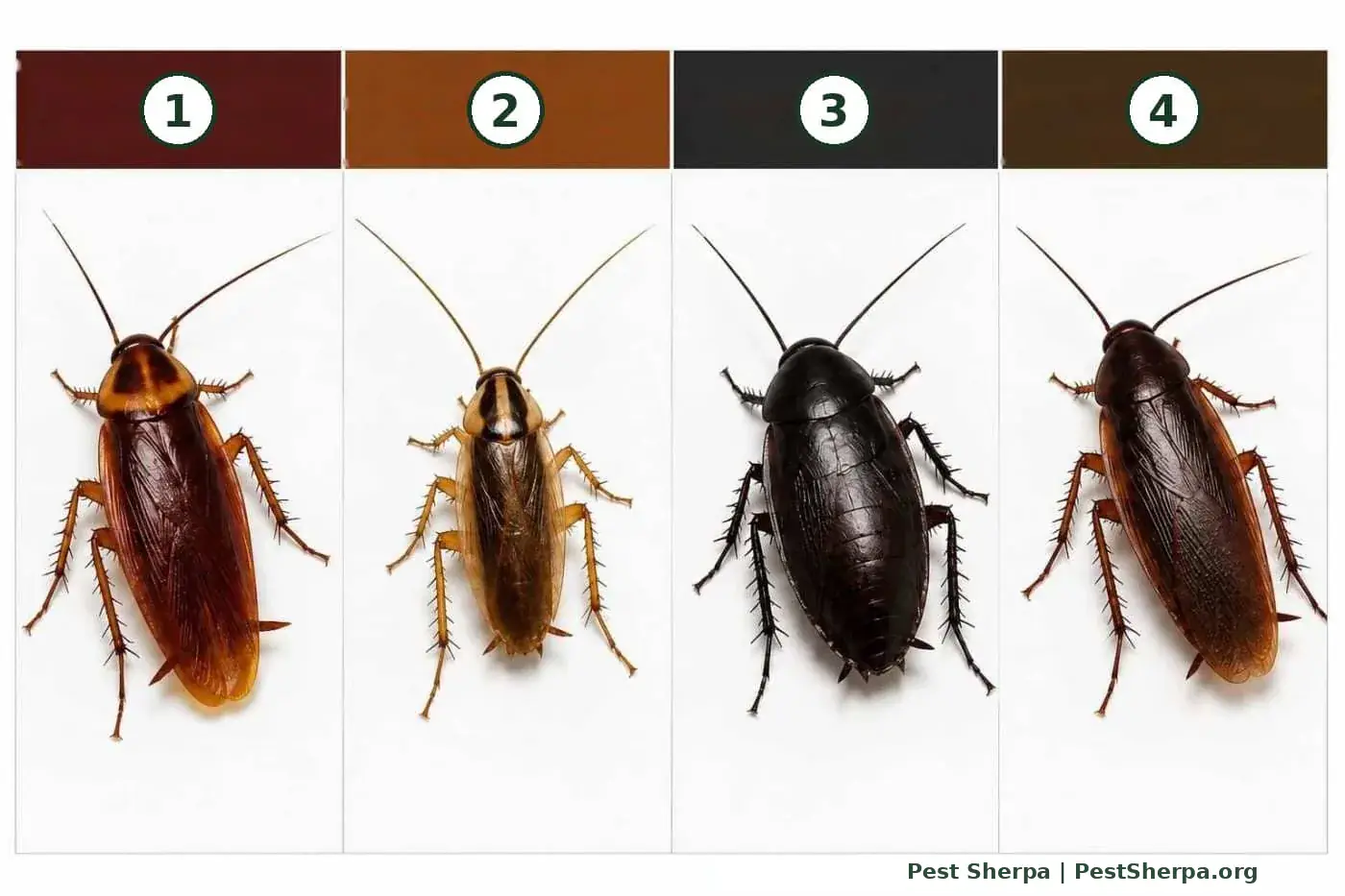
Which one did you find? Match the number:
- American cockroach: the largest, reddish-brown with a pale yellowish band around the shield behind the head.
- German cockroach: small and tan with two dark parallel stripes behind the head.
- Oriental cockroach: shiny black to dark brown with a wide, oval body and short wings.
- Smokybrown cockroach: large and a uniform dark mahogany brown with no pale markings.
Tap a column in the chart to open that cockroach guide.
Four common cockroach species in structures (not to scale to clearly show differences)
TL;DR: Roaches Mean Harborage + Moisture + Food
- Roaches don’t appear randomly → they follow food, water, and shelter
- German cockroaches = indoor infestation (highest priority)
- Large roaches = usually coming from outside or drains
- Killing visible roaches does NOT solve the problem
- Source control + targeted treatment is required
Palmetto bug? In everyday talk, “palmetto bug” usually means a large outdoor cockroach, most often the American cockroach, and university guides also apply the nickname to other large Periplaneta such as the smokybrown. In parts of Florida it can also mean the Florida woods cockroach. It is not another name for the small tan German cockroach that breeds in kitchens. Start with size and location, then read the palmetto bug guide. [Texas A&M E-359] [UF/IFAS] [UF Featured Creatures]
What this means right now
As of October 17, 2026: A new University of Kentucky study tested four store-bought essential oil roach products (Scientific Reports; University of Kentucky). Sprayed right on German cockroaches, they killed more than 96%. But after three of them dried on tile and pine for 24 hours, a week, or a month, nearly every treatment killed fewer than half the roaches, and most killed fewer than 10%. The best result was 78%, still short of the 90% level in EPA guidance for effectiveness claims of a registered pesticide, which most essential oils are not. Many essential oil insecticides qualify as minimum-risk pesticides, which are regulated but exempt from the EPA’s standard registration process, so their label claims can get less scrutiny. Here is what I tell homeowners: the roach you see is not the problem. The ones hiding behind the fridge and inside cabinets are. The researchers recommend insecticidal baits, and so do I. Put small dabs of gel bait where roaches hide, like under the sink, behind appliances, and along cabinet hinges, and keep sprays away from the bait.
Jump to:
- How to Identify Cockroaches
- Why It Matters
- Where Roaches Hide
- Why Roaches Suddenly Appear
- What To Do
- When to Call a Professional
- What a Pro Visit Looks Like
- What It Costs
- Roach Species Guide
- Prevention Strategy
- Common Questions
- References
How to Identify Cockroaches
Most control failures happen because the species, and hiding location, were misidentified.
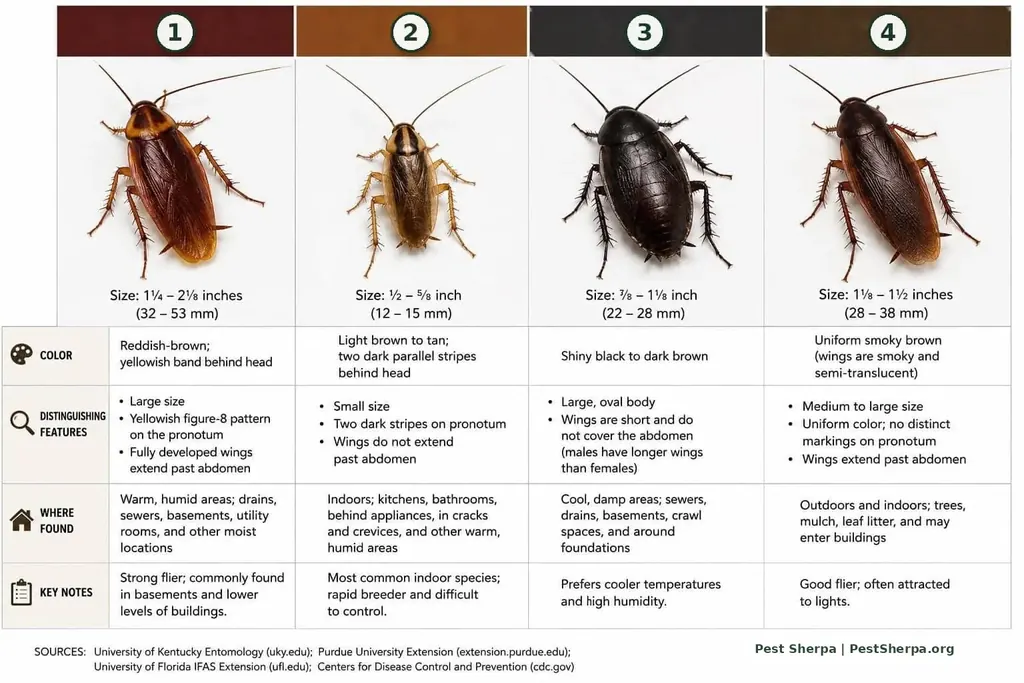
Which one did you find? Match the number:
- American cockroach: largest, reddish-brown, yellowish figure-8 pattern behind the head.
- German cockroach: small and tan with two dark parallel stripes behind the head.
- Oriental cockroach: shiny black to dark brown, wide oval body, short wings that do not cover the abdomen.
- Smokybrown cockroach: uniform smoky brown, no markings behind the head, wings past the abdomen.
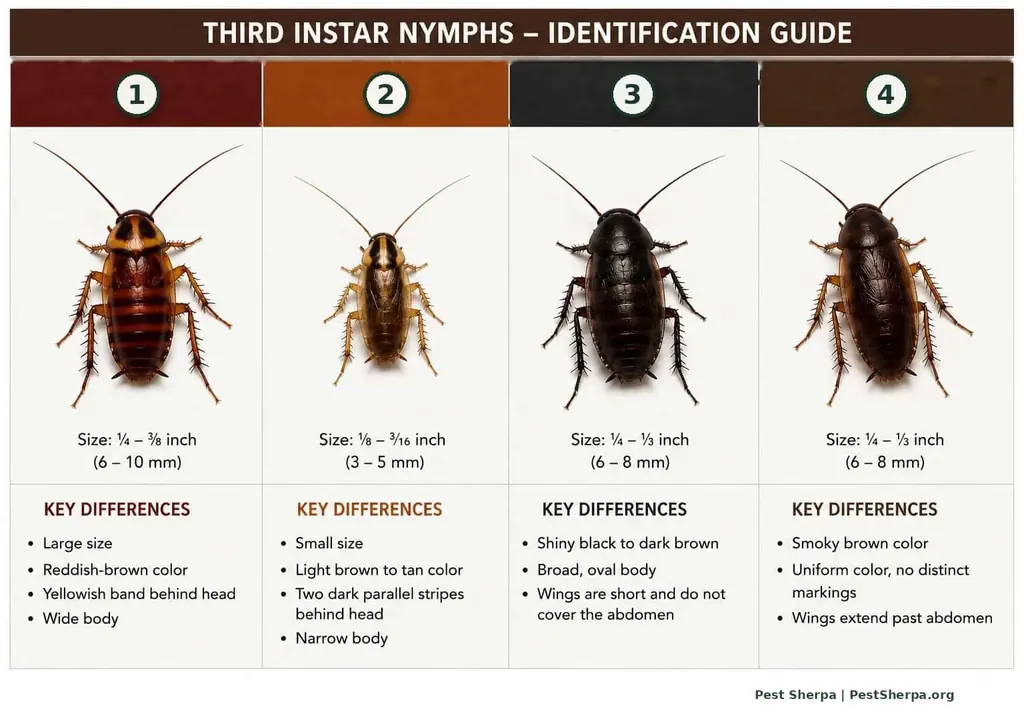
Which one did you find? Match the number:
- American cockroach nymph: the largest, reddish-brown with a yellowish band behind the head.
- German cockroach nymph: the smallest, with two dark stripes behind the head and a narrow body.
- Oriental cockroach nymph: shiny black to dark brown with a broad, oval body.
- Smokybrown cockroach nymph: smoky brown and uniform, with no distinct markings.
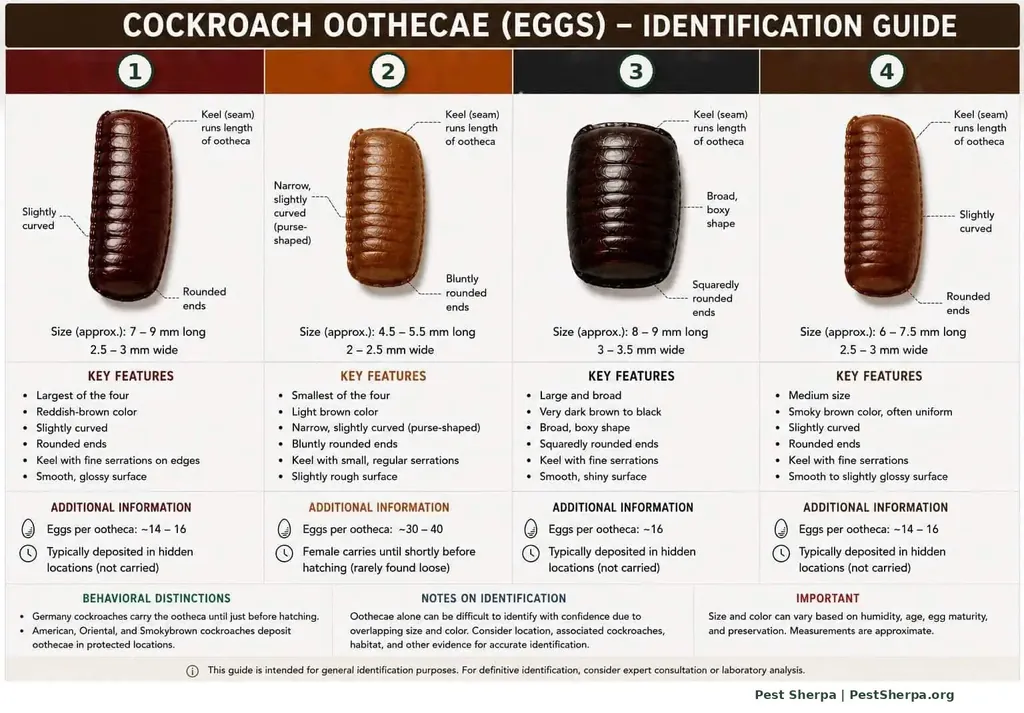
Which one did you find? Match the number:
- American cockroach egg case: largest of the four, dark reddish-brown, slightly curved with rounded ends.
- German cockroach egg case: smallest and light brown. The female carries it until just before hatching.
- Oriental cockroach egg case: very dark, broad and boxy with squared ends.
- Smokybrown cockroach egg case: medium size, uniform smoky brown, slightly curved.
People might see adults, nymphs, or egg cases. Match what you found to the numbered charts above.
Key Identification Factors
- Size: small (German) vs large (American, smokybrown)
- Color: tan, brown, dark brown, reddish
- Location: kitchen, bathroom, outdoors, ceilings
- Activity: night sightings, fast movement
Common Misidentifications
- German vs brownbanded cockroaches
- American vs smokybrown cockroaches
- Outdoor roaches mistaken for infestations
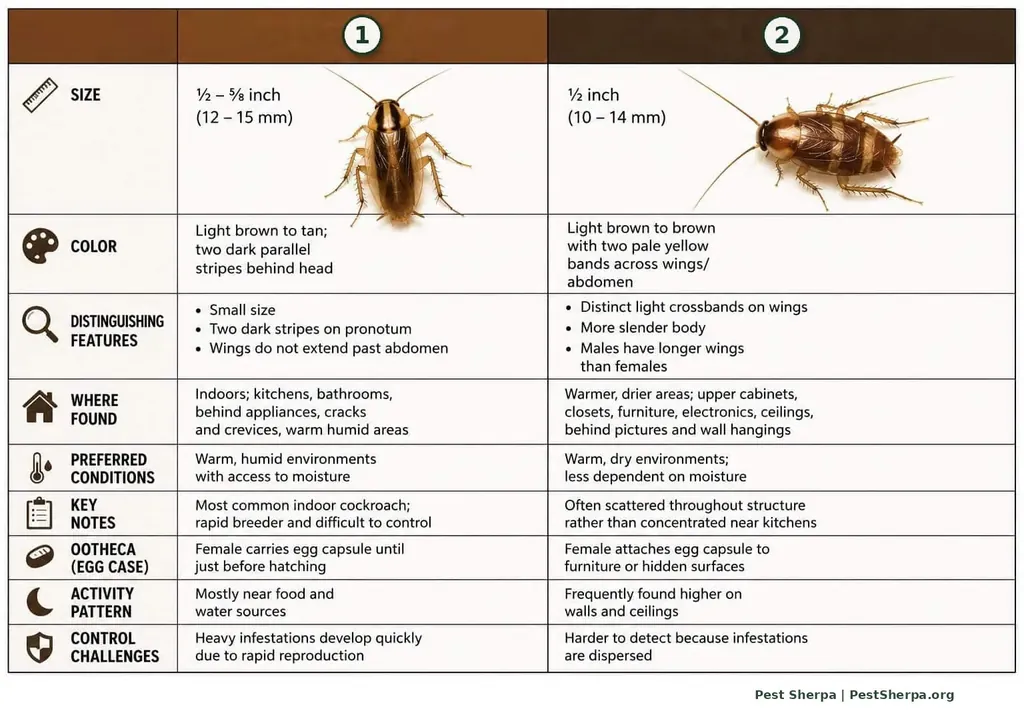
Which one did you find? Match the number:
- German cockroach: two dark parallel stripes behind the head. Usually in kitchens and bathrooms near moisture.
- Brownbanded cockroach: two pale bands across the wings and body. Often found higher up and in drier rooms.
American vs German vs smokybrown (quick ID)
Most control mistakes start with a wrong ID. Use this chart, then open the matching species guide. (Not to scale.)
| Cue | German | American | Smokybrown |
|---|---|---|---|
| Length | About ½ to ⅝ inch | About 1½ to 2 inches (largest common “palmetto” type) | About 1¼ to 1½ inches |
| Look | Light brown; two dark stripes behind the head | Reddish-brown; pale / yellowish border on the pronotum | Uniform shiny mahogany to dark brown; dark pronotum (no pale band) |
| Where they live | Indoors: kitchens, bathrooms, appliances, cabinets | Mostly outdoors / sewers / drains; moist mulch, wood piles; may wander indoors | Mostly outdoors: mulch, woodpiles, plantings, tree holes; may use attics / upper levels |
| Indoor vs outdoor | Lives and breeds indoors (highest priority) | Occasional / sewer-linked invader more often than a kitchen breeder | Outdoor species that can invade; strong flier on warm nights |
| Flight / lights | Has wings but typically does not fly | Can fly / glide | Strong flier; often attracted to lights at night |
Cockroach Species Guides
Browse our expert guides to identify the cockroach you’re dealing with and learn the appropriate control strategy.
American Cockroaches: Identification, Health Risks, and Control
Australian Cockroaches: Identification, Signs, and What to Do
Brownbanded Cockroaches: Identification, Signs, and What to Do
Cockroach Myths That Waste Your Time (And the Facts That Actually Matter)
Cuban Cockroach (Green Banana Roach): Habitat and What to Do
German Cockroaches: Identification, Signs, Risks, and What To Do
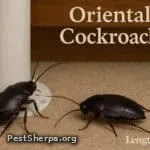
Oriental Cockroaches: Identification, Risks, Habitat, and Control
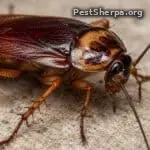
Palmetto Bugs: Identification, Meaning, and How to Keep Them Out
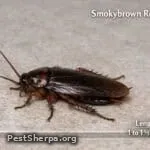
Smokybrown Cockroaches: Identification, Causes, and Control
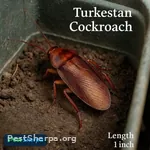
Turkestan Cockroaches: Identification and Control
Why It Matters
Health Risk
- Contaminate food and surfaces
- Can trigger allergies and asthma
Infestation Risk
- German cockroaches reproduce rapidly indoors
- Hidden populations grow quickly
Nuisance vs Infestation
- Occasional large roach ≠ infestation
- Small roaches indoors usually = active infestation
Key Insight: The species determines whether you have a serious infestation or an occasional invader.
Where Roaches Hide (By Location)
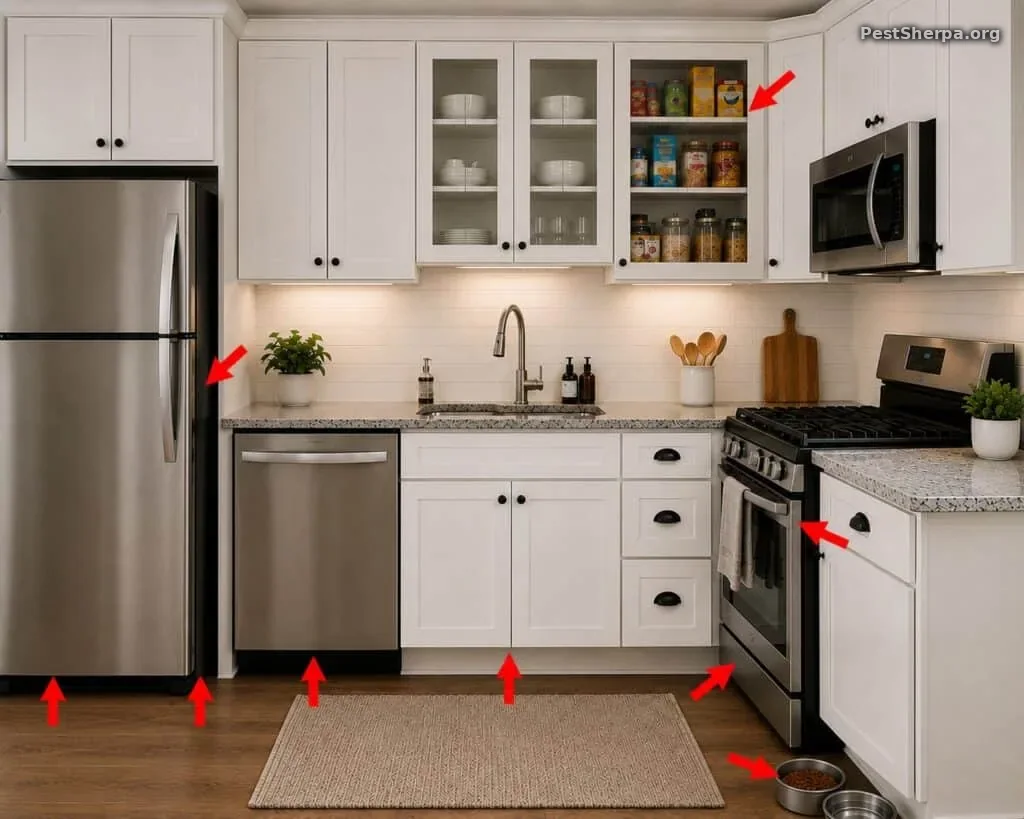
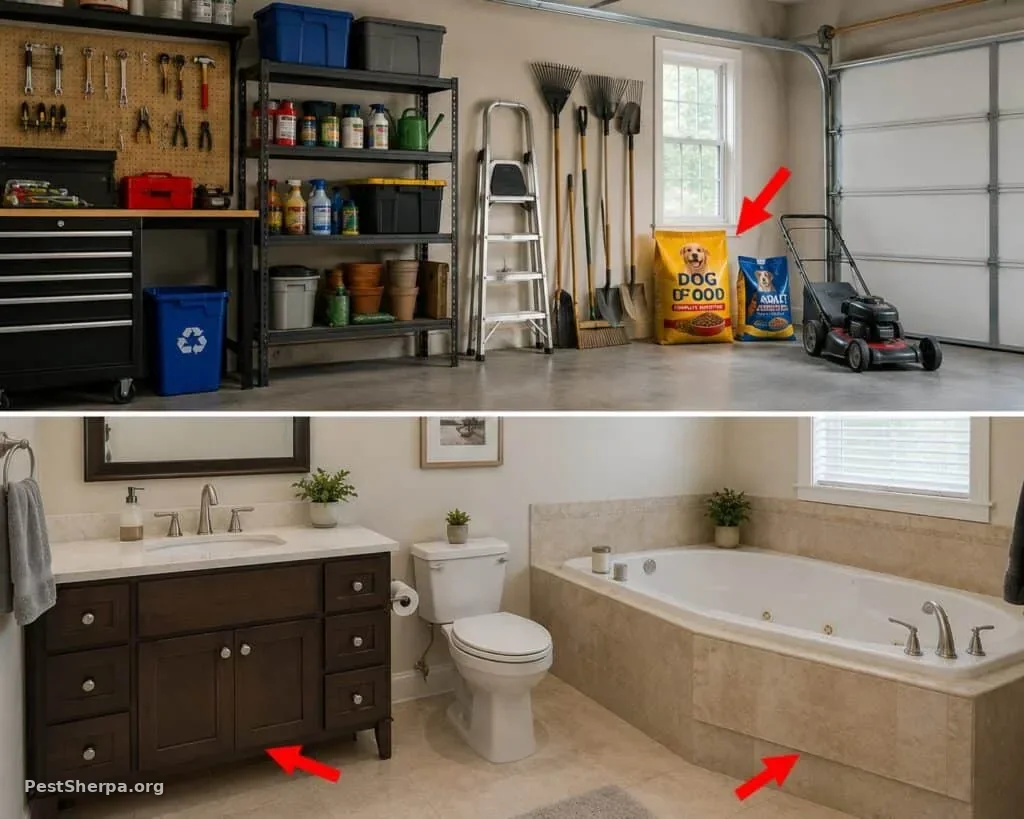
Cockroaches need food, shelter or “harborage” and water. There is abundant of each in kitchens, garages, and bathrooms.
Kitchen Areas
- Under appliances
- Inside cabinets
- Behind refrigerators
Bathrooms & Drains
- Under sinks
- Around plumbing
- Sewer connections
Wall Voids & Hidden Spaces
- Inside walls
- Behind baseboards
- Electrical outlets
Outdoor Harborage
- Mulch, leaf litter
- Gutters and drains
- Around foundations
Key Insight: Roaches stay hidden close to food, moisture, and warmth.
Thick organic mulch against the foundation is classic harborage for large outdoor cockroaches. UF/IFAS notes they breed prolifically in pine-straw mulch and poorly on gravel or bare soil, so pull mulch back from the house and keep only a thin band near the foundation so the soil can dry. Pair that with sealed doors and screened vents before you assume you need an indoor “roach spray.” [UF/IFAS IG082]
Why Roaches Suddenly Appear
Common Causes
- Food availability → crumbs, spills, trash
- Moisture → leaks, humidity, drains
- New introduction → groceries, boxes, used furniture
- Seasonal movement → outdoor roaches entering homes
What This Means
- A sudden appearance usually indicates a nearby harborage area or entry point
What To Do
The species decides the plan, so start with the ID above. The full plan, with bait placement, sticky-trap monitoring, and what to stop doing, is in How to Get Rid of Cockroaches. The short version:
- German roaches breeding indoors: gel bait in the cracks, strict sanitation, sticky traps to track progress. No sprays or foggers.
- An occasional big roach (American, smokybrown, Oriental): an entry and moisture problem. Seal door gaps, fix leaks, check drains.
- Brownbanded roaches: look high and warm, in furniture and electronics, and treat there.
- Fliers at the porch light: cut harsh exterior lighting and seal soffits, vents, and doors. [Oklahoma State Extension] [UC IPM]
What fails: spraying only the roaches you see, repellents that scatter them, and treating before you know the species.
When to Call a Professional
Greg Baumann insight: Spotting one large outdoor roach after a storm is a different problem than small tan roaches every night in the kitchen. University IPM programs treat German cockroaches as the indoor priority: they live and breed where you prepare food, reproduce quickly, and need sanitation plus targeted baits, not fogger bombs that miss the cracks. Call a licensed professional when sightings continue after you have cleaned, sealed, and baited; when activity spreads to multiple rooms or units; when you cannot find the harborage; or when the population is clearly established, not for a single incidental visitor. [UC IPM] [NC State] [UF/IFAS]
- Regular small kitchen/bath roaches (likely German) after sanitation and baiting
- Roaches persist after treatment
- Activity in multiple rooms or neighboring units
- You cannot locate harborage (voids, appliances, drains)
- Asthma/allergy concerns in the home: prefer baits/IPM; avoid sprays and foggers as asthma triggers (CDC)
High-priority cases:
- German cockroach infestations
- Large or recurring indoor populations of outdoor species moving in through drains/soffits
What a pro visit looks like
Most cockroach jobs, and nearly all German cockroach jobs, are won with inspection, sanitation, and bait, not a spray.
The inspection
Expect the technician to identify the species first, then check kitchens, bathrooms, appliance voids, cabinet hinges, plumbing penetrations, and, in apartments, shared walls. Sticky monitors are often set to measure how heavy the activity is and where it is concentrated.
Your prep before the visit
- Clean up grease, crumbs, and pet food, but do not spray store-bought insecticide before the visit; it can scatter roaches and repel bait.
- Empty the cabinets under the sink and the most active kitchen cabinets.
- Make notes on where and when you see roaches, including small nymphs.
- Tell the technician about children, pets, and anyone with asthma.
The treatment
- Gel or station baits in cracks, hinges, and voids where roaches hide.
- An insect growth regulator in many programs, to stop nymphs from maturing.
- Dusts in wall voids and behind appliances where the label allows.
- Sealing and sanitation recommendations written for your home.
Follow-up
Plan on at least one follow-up visit to replace eaten bait and read the monitors. In apartments, results depend on whether neighboring units are treated too.
Questions to ask before you book
- Which species do I have, and how does that change the plan?
- Which baits and products will you use, and where?
- How many follow-up visits are included?
- What do I need to do between visits?
What it costs
Angi’s October 2026 data puts cockroach extermination at $100 to $600.[11] HomeGuide’s January 2026 price list shows the same $100 to $600 for a typical job, with tenting and fumigation for major infestations at $1,000 to $7,500.[12]
Typical national ranges (these are not suggestions but referenced data)
- Cockroach extermination: $100 to $600 (Angi, 2026)[11]
- Typical exterminator job: $100 to $600 (HomeGuide, 2026)[12]
- Major infestation with tenting and fumigation: $1,000 to $7,500 (HomeGuide, 2026)[12]
- Quarterly general pest plan, per visit: $100 to $300 (HomeGuide, 2026)[12]
These are national figures from consumer cost surveys, not quotes. Prices vary by region, home, and job, so treat them as a starting point for comparing written estimates.
What moves the price
- Species: German cockroaches indoors take more visits than outdoor invaders such as American cockroaches.
- Infestation size and the number of rooms or units involved.
- Clutter and sanitation, which affect how well bait works.
- Apartments and multi-unit buildings where neighbors need treatment.
One-time job or ongoing plan
A German cockroach infestation is usually a short series of visits to clear it; a monthly or quarterly plan makes sense mainly for occasional outdoor invaders.
Red flags in a quote
- A single treatment with no follow-up.
- No species identification.
- Spraying an entire home or apartment as the main treatment.
- Long contracts required before the first visit.
Our guide to hiring a pro for German cockroaches lists more questions to ask.
For one-time and plan pricing side by side, see current cockroach exterminator prices in our national cost guide.
Species Guide to Common Cockroach Types
Cockroach Guide Page
Flying Roaches Attracted to Lights
Small Outdoor Roaches in Mulch & Soil
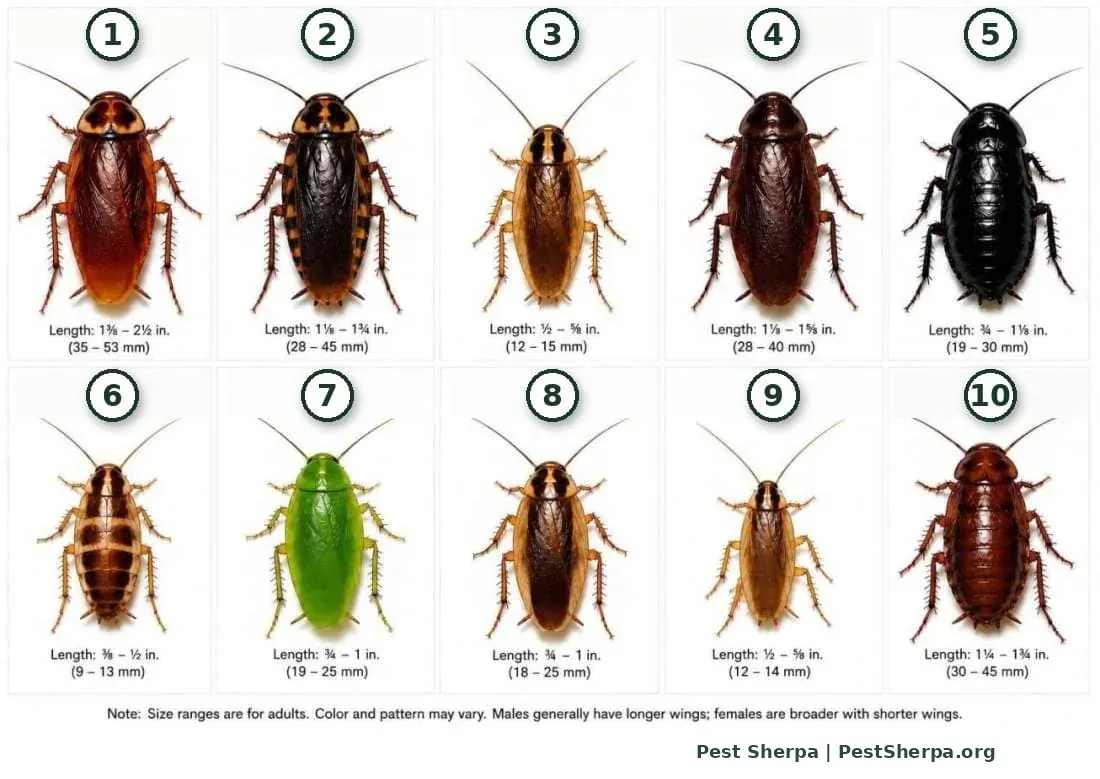
Which one did you find? Match the number:
- American cockroach: large and reddish-brown with a pale band behind the head.
- Australian cockroach: reddish-brown with bright yellow edges on the head shield and yellow streaks on the wings.
- German cockroach: small and tan with two dark stripes behind the head.
- Smokybrown cockroach: large and uniform dark mahogany brown.
- Oriental cockroach: shiny black with short wings.
- Brownbanded cockroach: small with pale bands across the body.
- Cuban cockroach: bright green.
- Turkestan cockroach: tan to brown with pale edges on the wings.
- Asian cockroach: looks almost like the German cockroach, light brown with two dark stripes. Flies toward lights.
- Surinam cockroach: dark reddish-brown and stout. Often found in potting soil.
Tap a cockroach in the chart to open its guide when one is available.
A chart from university publications showing cockroach types and differences (not to scale)
German Cockroach
- Small (1/2 to 5/8”), tan with two dark stripes behind the head
- Lives and breeds indoors (kitchens, appliances, cabinets)
- Fastest reproduction → highest infestation risk
- Primary control: gel baits + sanitation (avoid sprays that scatter)
- Full German Cockroach Guide
American Cockroach
- Large (1.5 to 2”), reddish-brown, capable of gliding
- Associated with sewers, drains, basements
- Often an occasional invader indoors
- Primary control: exclusion + moisture reduction + drain focus
- Often called a palmetto bug in the Southeast, a nickname also used for other large outdoor cockroaches
- Full American Cockroach Guide
Oriental Cockroach
- Dark brown/black, slower moving
- Strongly tied to damp environments (crawlspaces, drains)
- Indicator of moisture problems
- Primary control: fix leaks, dry areas, treat harborage
- Full Oriental Cockroach Guide
Smokybrown Cockroach
- Dark mahogany brown, attracted to lights
- Outdoor species that enters homes seasonally
- Common around gutters, attics, and rooflines
- Primary control: exterior treatment + lighting management
- Full Smokybrown Cockroach Guide
Brown-Banded Cockroach
- Small with light bands across wings/abdomen
- Prefers dry, elevated areas (ceilings, furniture, electronics)
- Scattered harborages (harder to target than German roaches)
- Primary control: targeted baiting in upper areas
- Full Brown-Banded Cockroach Guide
Cuban Cockroach
- Light green, strong flyer, attracted to light
- Primarily outdoor; accidental indoor entry
- Low infestation risk indoors
- Primary control: reduce lighting attraction + seal entry points
- Full Cuban Cockroach Guide
Australian Cockroach
- Similar to American but with yellow markings on thorax/wing edges
- Outdoor/indoor transitional species in warm climates
- Primary control: exterior sanitation + exclusion
- Full Australian Cockroach Guide
Turkestan Cockroach
- Males reddish, females dark; often found around foundations
- Displacing other outdoor species in parts of the U.S.
- Primary control: exterior perimeter + harborage reduction
- Full Turkestan Cockroach Guide
Prevention Strategy
Sanitation
- Remove food sources
- Clean regularly
Moisture Control
- Fix leaks
- Reduce humidity
Exclusion
- Seal cracks and entry points
In summary, cockroach problems are rarely random. The species you find, where you find it, and how often you see it usually reveal whether you’re dealing with a true indoor infestation, a moisture issue, or occasional outdoor invaders. Correct identification is the key to effective control, because different cockroach species require very different treatment strategies. Use the guides above to compare species, identify likely hiding areas, and choose the most effective next step for long-term control.
Common Questions
Is a palmetto bug the same as a German cockroach?
No. “Palmetto bug” is a common name for large outdoor cockroaches, often the American, and sometimes smokybrown or (in Florida) the Florida woods cockroach. German cockroaches are small, tan, striped, and breed indoors. See palmetto bugs, American, and German. [UF/IFAS] [Texas A&M]
Does one large cockroach mean I have an infestation?
Not always. One American, smokybrown, or other large outdoor-associated roach may have wandered in after rain or from a damp exterior harborage. Repeated sightings, nymphs, egg cases, droppings, daytime activity, or roaches in several rooms are stronger signs that moisture, entry points, and nearby harborage need work. Use the species cards and What To Do above to match what you are seeing.
I brought cockroaches home from an office. Bait and spray failed. Should I fog?
No. Fogging rarely reaches the harborages that keep German cockroaches going, and it can drive them deeper. Pause broadcast DIY, keep food sealed, and get a species ID plus a plan that targets cracks, voids, and adjoining units if you are in multifamily housing. More detail: office cockroaches, bait, spray, and fogging.
How do I choose a cockroach pesticide when labels are confusing?
Identify the species first, then pick a product labeled for that pest (for example cockroach bait stations for German cockroaches). Roaches are considered public health pests, so the type of roach must be listed on the label. Read and follow the label, including any pet-related precautions. For stubborn infestations or if you prefer to not even tackle the issue, as is most commonly the case, contact a professional pest control company. More detail: confused about pesticide labels.
Do bug bombs work on cockroaches?
Total-release foggers are a poor choice for most cockroach problems. They often miss hidden harborages in wall voids, cabinets, and drains, and they can scatter insects without ending the infestation. Sanitation, exclusion, monitoring, and targeted baits or professional IPM outperform fogging for German cockroaches and for large outdoor species moving indoors.
When should I call a professional for cockroaches?
Call when sightings keep returning after sanitation and baiting, when you find nymphs or egg cases in multiple rooms, when you are in a multifamily building with shared walls, when the species ID is unclear, or if you prefer to have a professional handle the challenge. A pro can confirm the species, inspect adjoining spaces, and build a follow-up plan, and the work can be done more quickly and efficiently than most DIY attempts. See When to Call a Professional on this page.
References
- University of California IPM: Cockroaches: Identification and Management
- Purdue University Extension: Cockroaches: Identification, Biology, and Control
- Purdue University Extension: Practical Guide to Cockroach Control in Multi-Family Housing
- National Pesticide Information Center: Cockroach Control and Pesticide Safety
- University of Florida / IFAS: Cockroaches and Their Management (IG082)
- University of Florida Featured Creatures: Florida Woods Cockroach / Palmetto Bug (IN915)
- Texas A&M AgriLife Extension: Cockroach Biology and Management (E-359)
- NC State Extension: German Cockroach Surveillance and Management
- Oklahoma State Extension: Smokybrown Cockroach
- CDC: Asthma Control (cockroach triggers; avoid sprays and foggers)
- Angi, How Much Does Pest Control Cost? [2026 Data], updated October 9, 2026
- HomeGuide, How Much Does an Exterminator Cost?, January 9, 2026
This article was written by Greg Baumann, founder of Pest Sherpa, and reflects more than 40 years of professional pest management experience.
About the Author

Greg Baumann | Pest Control Expert
Greg Baumann is the founder of Pest Sherpa and a Pest Control Expert with more than 40 years of professional pest management experience. His articles combine decades of field experience, technical expertise, and science-based guidance to help homeowners identify pests correctly, understand real-world risks, and make informed pest management decisions.
Mission: Identify the pest. Understand the risk. Stop the problem. Prevent the comeback. Know when it’s time to call a professional.