
Turkestan Cockroaches: Identification and Control
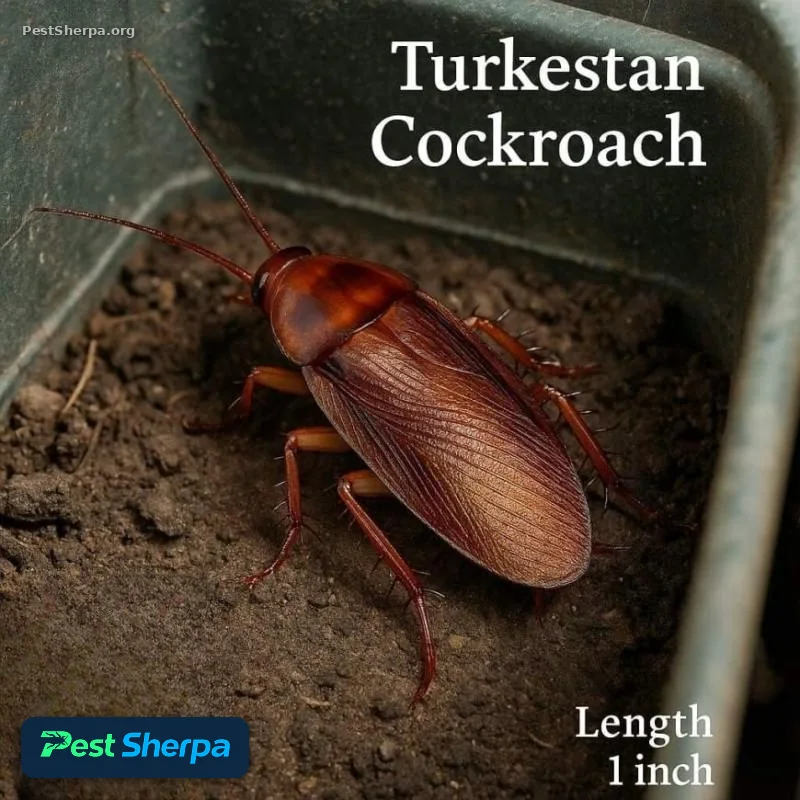
The Turkestan cockroach, commonly called the red runner cockroach, is an outdoor cockroach that often concerns homeowners because males can appear suddenly around lights, garages, patios, and entry doors. The current Blattodea Species File recognizes this roach as Periplaneta lateralis.
This roach is particularly established as a peri-domestic pest in the Southwest and other warm, dry western areas. It is not usually the same kind of indoor infestation problem as a German cockroach, but repeated indoor sightings can point to a large outdoor population, entry gaps, or favorable conditions near the building.
This guide will help you identify Turkestan cockroaches, understand what indoor sightings usually mean, compare them with common lookalikes, inspect likely outdoor sources, and choose safe next steps.
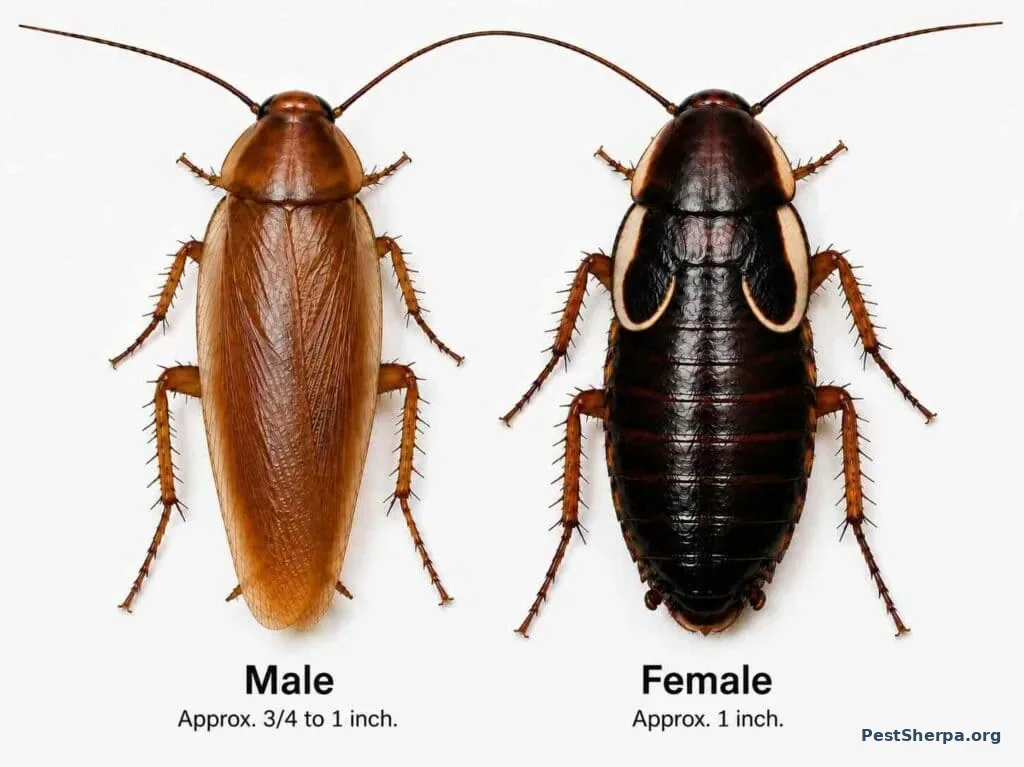
Male and female Turkestan cockroaches showing color and wing differences.
TL;DR
- Turkestan cockroaches are mostly outdoor cockroaches, not a typical kitchen-breeding roach like German cockroaches.
- Adult males are tan to reddish brown, have long wings, and are often seen near lights at night.
- Adult females are darker, have short wing pads, cannot fly, and are often confused with Oriental cockroaches.
- Repeated indoor sightings usually mean the outdoor population is close to the building or entry points need attention.
- The best long-term approach is exterior habitat reduction, moisture management, exclusion, monitoring, and targeted baiting when needed.
Quick Navigation
- Quick Identification
- What Turkestan Cockroaches Mean Around a Home
- Identification Details
- Lookalikes and Common Misidentifications
- Where They Live Outdoors
- Why They Come Indoors
- Inspection Checklist
- Life Cycle and Seasonal Activity
- Health and Structural Concerns
- What To Do
- What Does Not Work Well
- How Long Activity May Last
- When Professional Help May Be Needed
- Frequently Asked Questions
- References
Quick Identification
| What You See | Turkestan Cockroach Clue | What It Usually Means |
|---|---|---|
| Tan or reddish-brown roach with long wings near lights | Often an adult male | Likely came from an outdoor population nearby |
| Dark brown to black roach with short wings | Often an adult female | May be hiding in exterior cracks, meter boxes, mulch, or debris |
| Dark nymph with reddish-brown head or front body area | Immature Turkestan cockroach | Outdoor breeding may be occurring close to the structure |
| Several roaches in garage or near door thresholds | Entry-point issue likely | Inspect door sweeps, utility gaps, and nearby exterior harborage |
| Roaches mostly outdoors at night | Typical behavior | Focus on exterior habitat, moisture, sanitation, and exclusion |
For a broader comparison of roach groups, see the cockroach identification guide.
What Turkestan Cockroaches Mean Around a Home
A Turkestan cockroach sighting does not automatically mean there is a reproducing indoor infestation. This species lives and breeds outdoors and does not normally establish reproducing populations indoors. Indoors, individuals often appear near doors, garages, windows, or lower-level entry points after wandering in from nearby exterior harborages.
The pattern matters more than a single sighting.
| Observation | Most Likely Meaning | Best Next Step |
|---|---|---|
| One roach indoors | May be an accidental invader | Confirm identification and check nearby entry points |
| Several males near porch lights | Outdoor population close to the home | Inspect irrigated landscaping, meter boxes, debris, and cracks |
| Roaches in garage | Door gaps or exterior harborages nearby | Improve door sweeps, thresholds, and garage sealing |
| Females or nymphs near foundation | Breeding habitat may be close to the structure | Reduce harborage, moisture, food, and clutter outside |
| Frequent indoor sightings over days or weeks | High outdoor pressure or unresolved entry points | Use monitoring traps and consider targeted exterior management |
A practical question many readers have is whether a single roach means an infestation. The answer depends on the species, where it was found, and whether more are appearing. The Pest Sherpa Q&A on one roach and infestation risk is a useful companion if you are trying to decide how serious one indoor sighting may be.
Identification Details
Turkestan cockroaches show strong sexual dimorphism, which means adult males and females look very different from each other. This is one reason the species is often misidentified.
Adult Males
- Usually about 3/4 to 1 inch long, with males generally slightly smaller than females
- Light tan, brownish orange, or reddish-brown appearance
- Fully developed wings that extend to or beyond the end of the abdomen
- Often attracted to lights at night
- Males can fly and are commonly attracted to lights on warm nights.
Adult Females
- Dark brown to nearly black
- Broader-bodied than males
- Short wing pads rather than full-length wings
- Unable to fly
- Often show pale or cream-colored markings along the margins behind the head and along the short wing pads.
Nymphs
- Immature stages are wingless
- Often dark brown to black with reddish coloration on the head, thorax, and legs.
- Found close to protected outdoor harborages when breeding is occurring nearby
Like other cockroaches, Turkestan cockroaches reproduce by producing egg capsules called oothecae. These capsules are placed in protected sites where temperature, shelter, and moisture are suitable. An ootheca averages about 17 eggs.
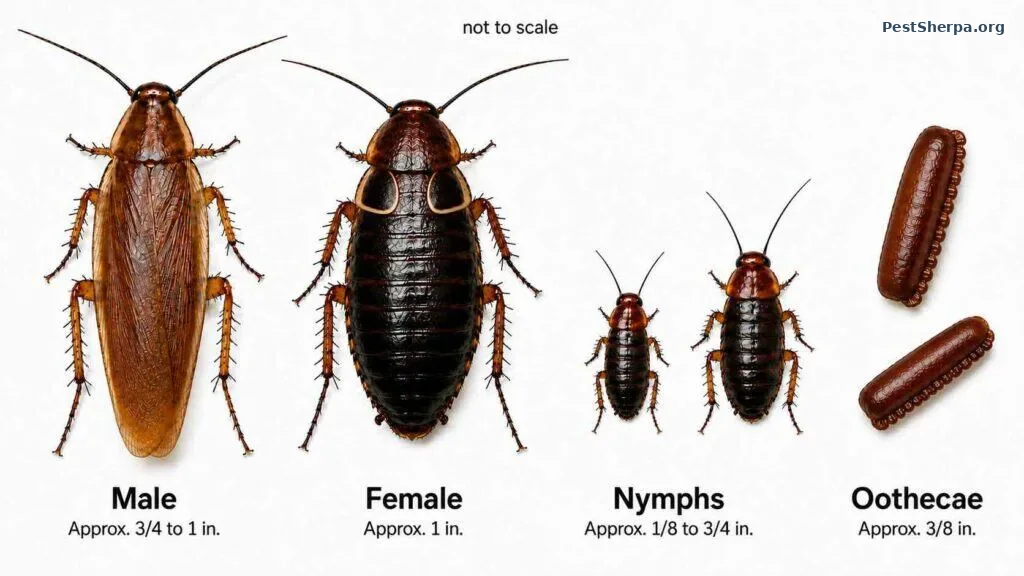
Turkestan cockroach male, female, nymph, and egg capsule comparison.
Lookalikes and Common Misidentifications
Turkestan cockroaches are commonly confused with other large or outdoor cockroaches. The lookalike depends on whether the insect is male, female, or immature.
| Possible Lookalike | Why It Is Confused | Key Difference |
|---|---|---|
| Oriental cockroach | Females are dark and short-winged | Female Turkestan cockroaches often have pale edging on the wing pads; Oriental cockroaches are usually more uniformly dark and tend to have a wider thorax. |
| American cockroach | Male Turkestan cockroaches are winged and brownish | American cockroaches are usually larger and more reddish brown |
| Smokybrown cockroach | Both can be outdoor-associated and winged as adults | Smokybrown cockroaches are more uniformly dark mahogany-brown and lack the same male/female contrast |
| German cockroach | Any indoor roach can raise concern about kitchens | German cockroaches are smaller, indoor-breeding pests with two dark stripes behind the head |
Correct identification matters because the response is different. A German cockroach problem usually focuses heavily on indoor kitchens, bathrooms, and hidden interior harborages. Turkestan cockroach activity usually starts with the exterior landscape and building perimeter.
Where Turkestan Cockroaches Live Outdoors
Turkestan cockroaches are strongly associated with sheltered outdoor areas that provide darkness, moisture, food debris, and cracks or voids where they can hide during the day.
- Water meter boxes, irrigation boxes, and valve boxes, hollow concrete-block walls and sewer systems.
- Cracks in concrete, pavement, masonry, and rock walls
- Mulch, leaf litter, compost, and yard debris
- Wood piles, lumber, stored materials, and clutter near foundations
- Outdoor drainage areas, utility boxes, and protected crevices
- Pet feeding areas, outdoor garbage storage, and places with food residue
- Potted plants, dense groundcover, and heavily irrigated landscape beds
Urban landscapes can be ideal when irrigation, mulch, shade, food residue, and structural cracks occur together. Even if the home interior is clean, a favorable exterior perimeter can support large numbers.
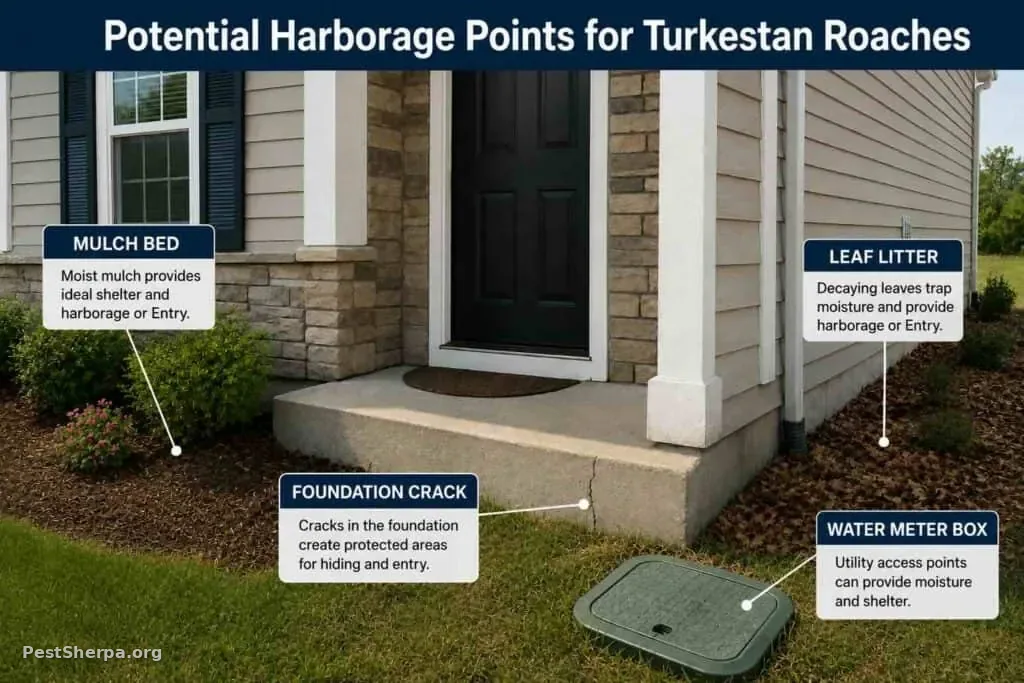
Common outdoor Turkestan cockroach harborage areas around a home.
Why Turkestan Cockroaches Come Indoors
Indoor sightings usually happen when outdoor cockroaches find openings or are attracted toward light, moisture, or shelter. Adult males are especially noticeable because they are winged and often come to lights.
Common entry points include:
- Gaps under exterior doors and garage doors
- Missing or worn door sweeps
- Damaged window and door screens
- Foundation cracks and expansion joints
- Gaps around pipes, wiring, conduit, and utility penetrations
- Unsealed crawlspace, basement, or garage openings
- Dry or unprotected drains in seldom-used areas, where applicable; sewer or drain connections may occasionally provide a route indoors
Seeing dead or upside-down individuals indoors can happen because this species does not thrive indoors the way some structural cockroaches do. However, frequent sightings still deserve attention because they suggest the exterior source pressure is high or entry points are easy to access.
Turkestan Cockroach Inspection Checklist
Step 1: Confirm the Pattern
- Are you seeing one roach or repeated roaches?
- Are most sightings indoors, outdoors, or in the garage?
- Are they appearing near lights, doors, windows, or lower-level rooms?
- Are you seeing mostly tan winged males or dark females and nymphs?
Step 2: Inspect at Night
Turkestan cockroaches are most active after dark. Use a flashlight to inspect the perimeter on warm, calm evenings. Focus on the areas directly outside rooms where indoor sightings occur.
Step 3: Check Exterior Harborages
- Lift lids on water meter boxes and irrigation boxes carefully
- Inspect cracks in concrete, pavement, retaining walls, and masonry
- Look under loose pavers, stones, landscape timbers, and stored items
- Check heavy mulch, leaf litter, compost, and groundcover close to the foundation
- Inspect trash storage, recycling, pet feeding, and outdoor food residue areas
Step 4: Check Entry Points
- Look for daylight under exterior doors and garage doors
- Check weather stripping and door sweeps
- Inspect utility penetrations and gaps around pipes or cables
- Repair torn screens and gaps around window frames
- Inspect crawlspace vents, basement entries, and garage corners
Step 5: Monitor Before and After Changes
Sticky traps can help show where cockroaches are entering or which side of the home has the most activity. Place traps along walls near garage doors, exterior doors, and suspected entry points. Keep them away from children, pets, and food-contact areas.
Life Cycle and Seasonal Activity
Turkestan cockroaches develop through incomplete metamorphosis: egg, nymph, and adult. Females produce oothecae, and nymphs grow through a series of molts before becoming adults.
Development speed depends on temperature, moisture, food, and shelter. Published research and extension summaries indicate that Turkestan cockroaches can mature faster and produce more egg capsules than Oriental cockroaches under studied conditions. That helps explain why this species can build large outdoor populations when conditions are favorable.
Activity is often most noticeable during warm weather. Males may become especially obvious at night because they move toward lights and are more likely than females to be seen in open areas.
Health and Structural Concerns
Turkestan cockroaches do not chew wood, damage structural lumber, or sting. Their main concerns are nuisance, sanitation, and indoor contamination risk when individuals move from outdoor harborages into human spaces.
As with other cockroaches, individuals moving through unsanitary outdoor environments may mechanically transfer microorganisms to surfaces. Cockroach body fragments, feces, and shed material are recognized sources of allergens, although most research on cockroach allergens has involved indoor pest species rather than Turkestan cockroaches. The risk is usually much greater when roaches are established indoors, but repeated indoor entry should still be addressed.
In homes, the practical goal is to reduce exterior populations and keep individuals from entering. In food-handling, healthcare, school, or multi-unit settings, repeated sightings may require closer documentation and a coordinated management plan.
What To Do About Turkestan Cockroaches
1. Start Outside
Because Turkestan cockroaches usually breed outdoors, interior-only control rarely solves the problem. Begin with the building perimeter, especially the side where roaches are being seen indoors.
2. Reduce Harborage
- Move firewood, lumber, bins, and stored items away from the foundation
- Thin heavy groundcover and remove excess leaf litter
- Keep mulch from building up heavily against exterior walls
- Seal or repair cracks in masonry, hardscape, and foundation areas where practical
- Clean debris from meter boxes and irrigation boxes where safe and accessible
3. Manage Moisture
- Repair leaking irrigation lines and outdoor faucets
- Avoid overwatering foundation plantings
- Improve drainage where water collects near the structure
- Keep seldom-used drains maintained according to the fixture type and local guidance
4. Remove Food Sources
- Store garbage in tight-lidded containers
- Clean residue from outdoor trash and recycling areas
- Bring pet food indoors at night
- Reduce spilled bird seed, pet waste, and food scraps near the home
5. Improve Exclusion
- Install or replace door sweeps
- Repair garage door seals and thresholds
- Seal utility gaps around pipes, cables, and conduit
- Repair damaged screens and weather stripping
- Seal exterior cracks and gaps where roaches are entering
6. Use Targeted Controls Carefully When Needed
Pesticides are not always necessary. When they are used, they work best as one part of a broader plan that includes sanitation, moisture reduction, harborage reduction, and exclusion. For established outdoor populations, strategically placed cockroach baits can be an important component of control and are generally preferable to relying on broad indoor treatment.
Always read and follow the product label. Keep products away from children, pets, food, food-preparation surfaces, drains, and water sources unless the label specifically allows that use. Do not apply products in storm drains, public drains, or other water-connected areas unless you are legally authorized and the label permits it.
What Does Not Work Well
- Indoor foggers or bug bombs: Indoor foggers or bug bombs: These do not address the outdoor population responsible for most Turkestan cockroach problems and therefore should not be relied upon as the primary control method.
- Spraying indoors only: Turkestan cockroach pressure usually starts outdoors, so interior-only treatment misses the main issue.
- Ignoring entry points: A large outdoor population will keep sending individuals indoors if doors, screens, and utility gaps remain open.
- Treating drains or storm drains casually: These areas can connect to water systems, and pesticide use there can be unsafe, off-label, or restricted.
- Relying only on traps: Sticky traps help monitor activity, but they do not remove outdoor habitat or seal entry points.
How Long Activity May Last
The timeline depends on why the roaches are appearing.
| Situation | Likely Timeline | What Helps Most |
|---|---|---|
| One accidental indoor roach | May be over once removed | Check nearby doors and screens |
| Males attracted to lights | May recur during warm nights | Reduce exterior habitat and improve exclusion |
| Outdoor harborage near foundation | Can continue until habitat changes are made | Reduce mulch, debris, moisture, and cracks |
| Large outdoor population | May require monitoring and repeated corrective steps | Combine sanitation, exclusion, and targeted controls if needed |
| Commercial or multi-unit setting | May persist if sources are shared | Document activity and coordinate building-wide corrections |
After exterior sources are corrected, activity should decline as existing adults die or stop entering. If sightings continue, re-check the perimeter and look for missed harborages or entry points.
When Professional Help May Be Needed
Many small problems can be improved with inspection, cleanup, moisture correction, and exclusion. Professional help may be worth considering when identification is uncertain, activity is heavy, or the source is difficult to access.
- Large numbers are appearing around several sides of the building
- Females, nymphs, and egg capsules are being found near the structure
- Roaches are entering a commercial kitchen, healthcare facility, school, or multi-unit property
- Activity appears linked to utility boxes, drains, sewers, or public infrastructure
- DIY pesticide use would involve areas near drains, water, children, pets, or food handling
- The roach may actually be German, American, Oriental, or another species requiring a different approach
Frequently Asked Questions
Are Turkestan cockroaches the same as red runner roaches?
Yes, “red runner roach” is a common name often used for Turkestan cockroaches, especially in the feeder insect trade. Do not release feeder cockroaches outdoors. In suitable climates, escaped or released insects may contribute to local populations.
Does one Turkestan cockroach indoors mean I have an infestation?
Not necessarily. One indoor Turkestan cockroach may have wandered in from outside. Repeated sightings, females or nymphs near the foundation, or roaches appearing in the same entry area suggest an outdoor source and entry-point problem that should be investigated.
Why do I see tan flying roaches near my porch lights?
Those are often adult males. Male Turkestan cockroaches are winged and commonly move toward lights at night. The light is usually where you notice them, not the root cause. Inspect nearby landscape beds, cracks, meter boxes, and debris.
Can Turkestan cockroaches live indoors?
They are primarily outdoor cockroaches and usually do not thrive indoors like German cockroaches. However, high outdoor populations can lead to repeated indoor entry, especially through gaps, garage doors, and lower-level openings.
Are Turkestan cockroaches dangerous?
They do not sting, bite, or damage wood. The concern is sanitation and nuisance. Cockroaches that move through garbage, drains, and debris can contaminate surfaces if they enter homes or food-handling areas.
What is the fastest way to reduce Turkestan cockroaches?
Find where they are living outdoors, reduce shelter and moisture, seal entry points, and monitor with sticky traps. If numbers are high, targeted baiting may help when used according to the label and combined with cleanup and exclusion.
Should I spray inside my home?
Indoor spraying is usually not the main solution because the source is often outside. Avoid foggers and unnecessary indoor applications. If a pesticide is used, choose a product labeled for the intended site and follow all label directions carefully.
References
- UC Statewide IPM Program: Turkestan Cockroach (Blatta lateralis)
- UC Statewide IPM Program: Cockroaches
- Texas A&M AgriLife Extension: The Turkestan Cockroach: An Emerging Pest in Texas
- University of Tennessee Extension: Turkestan Cockroaches
- Kim and Rust: Life History and Biology of the Invasive Turkestan Cockroach
- USDA National Agricultural Library: Shelfordella lateralis
This article was written by Greg Baumann, founder of Pest Sherpa, and reflects more than 40 years of professional pest management experience.
About the Author

Greg Baumann | Pest Control Expert
Greg Baumann is the founder of Pest Sherpa and a Pest Control Expert with more than 40 years of professional pest management experience. His articles combine decades of field experience, technical expertise, and science-based guidance to help homeowners identify pests correctly, understand real-world risks, and make informed pest management decisions.
Mission: Identify the pest. Understand the risk. Stop the problem. Prevent the comeback. Know when it’s time to call a professional.