
How to Get Rid of Skunks Under a House, Deck, or Shed
Few wildlife calls come with as much urgency as a skunk under the house. The odor can drift into living spaces, the family dog is one unfortunate encounter away from a memorable bath, and nobody wants to crawl beneath a porch to investigate. The good news is that healthy skunks are generally mild-tempered animals that prefer to avoid confrontation. Removing one from beneath a structure is usually manageable when the problem is identified correctly and exclusion is performed at the appropriate time of year.
Key Points
The striped skunk (Mephitis mephitis) is the species most homeowners are likely to encounter. Skunks may den beneath porches, decks, sheds, and crawl spaces. They dig small, cone-shaped holes in lawns while searching for grubs and other invertebrates. Their defensive spray contains powerful sulfur-containing compounds and can reach a target approximately 6 to 10 feet (1.8 to 3 m) away. Skunks are also important wildlife hosts of rabies in parts of North America and should never be handled by homeowners.
UC IPM Pest Notes | CDC Rabies Guidance
The most reliable long-term solution for a skunk den beneath a structure is exclusion. First confirm the animal is using the den and that no dependent young will be trapped. When appropriate, a monitored one-way gate allows the skunk to leave before the opening is permanently sealed with durable metal screening. Removing food sources and sheltered hiding places helps prevent additional animals from moving in.
Trapping should generally be left to experienced wildlife control professionals. Relocation is restricted or prohibited in many states, captured skunks may spray when frightened, and bites or scratches require prompt medical evaluation because of the potential for rabies exposure.
In This Guide
- Identification and Habits
- Signs of a Skunk Under the House
- Health and Safety Risks
- How to Get Rid of Skunks
- Timing Around Kits
- Laws and Relocation
- What Does Not Work
- Removing Skunk Odor
- When to Call Licensed Wildlife Control
- What a Pro Visit Looks Like
- What It Costs
- Common Questions
- References
Identification and habits
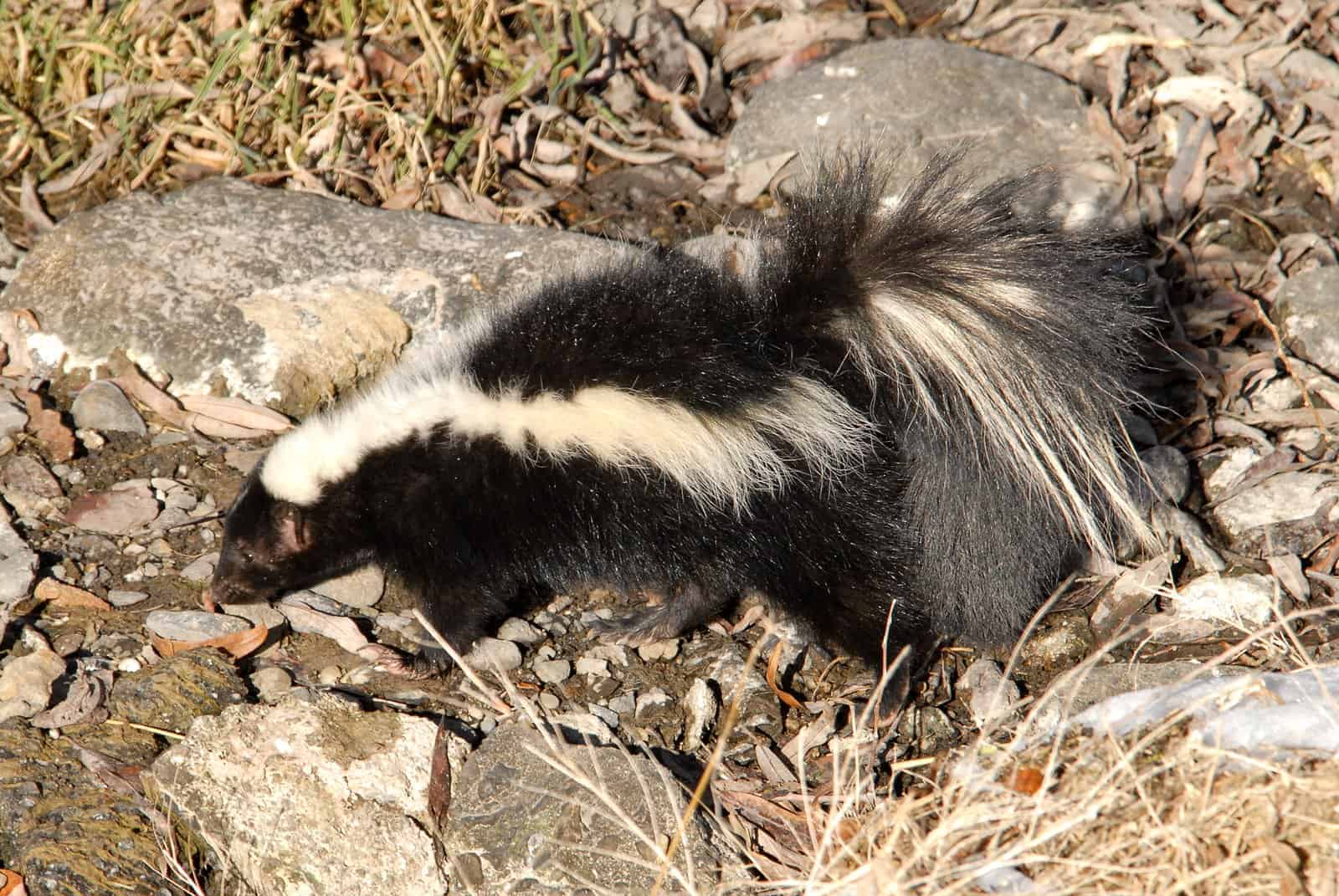
Striped skunks are approximately the size of a house cat, with a relatively small head, a bushy tail, and short, powerful legs equipped with long front claws for digging. Their fur is predominantly black, with a narrow white marking on the forehead and a white area near the neck that typically divides into two stripes forming a V-shaped pattern down the back. The amount and arrangement of white fur vary considerably among individuals.
Spotted skunks are smaller and more slender, with distinctive white spots or broken stripes. Their behavior and distribution differ somewhat from those of striped skunks. The striped skunk is the most widespread and commonly encountered skunk around homes across much of the United States.
Skunks are primarily active from dusk through the night, although they sometimes forage during daylight. Their diet includes insects, grubs, earthworms, small rodents, eggs, fruit, and accessible pet food. The proportions change seasonally according to food availability.
Skunks have relatively poor eyesight but well-developed senses of smell and hearing.
A healthy skunk generally tries to escape rather than confront a person or predator. Before spraying, a striped skunk often gives recognizable warnings: stamping its front feet, hissing, arching its body, or raising its tail.
If you encounter these behaviors, stop approaching and move away slowly. Do not corner the animal or allow a pet to investigate. Giving the skunk an unobstructed escape route usually prevents a defensive encounter.
UC IPM Pest Notes | Colorado State University Extension
Signs of a skunk under the house
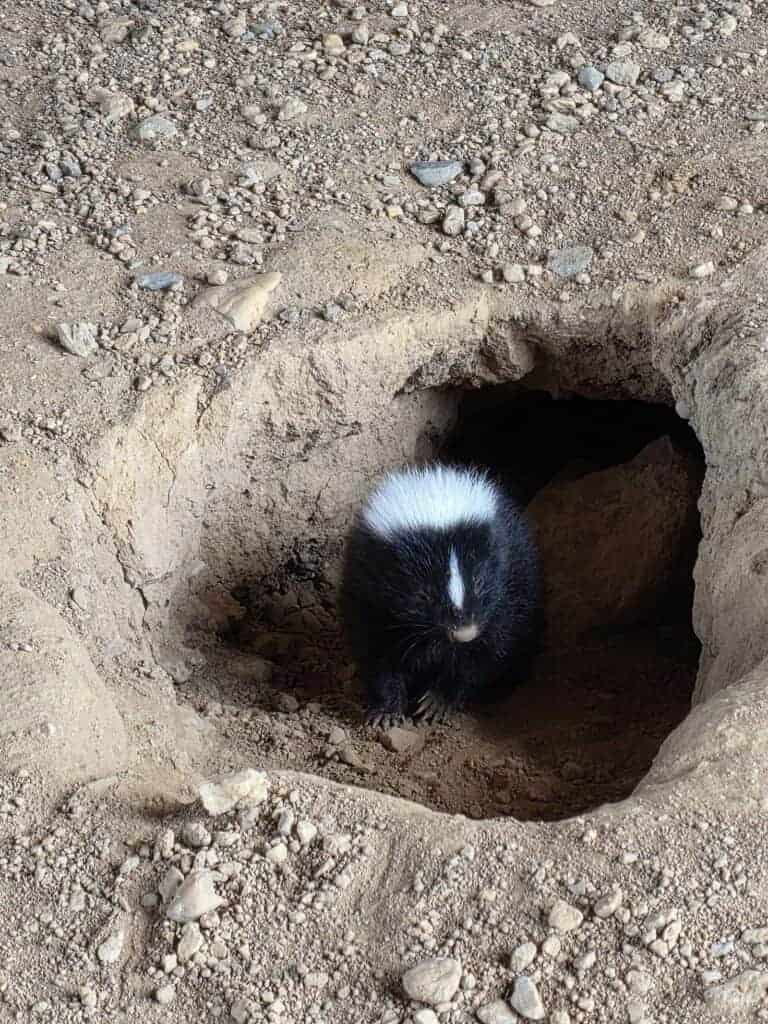
- Burrow entrances or openings: Look for gaps along foundations, porch steps, deck skirting, or shed floors. An active opening may have disturbed soil, worn edges, or tracks nearby.
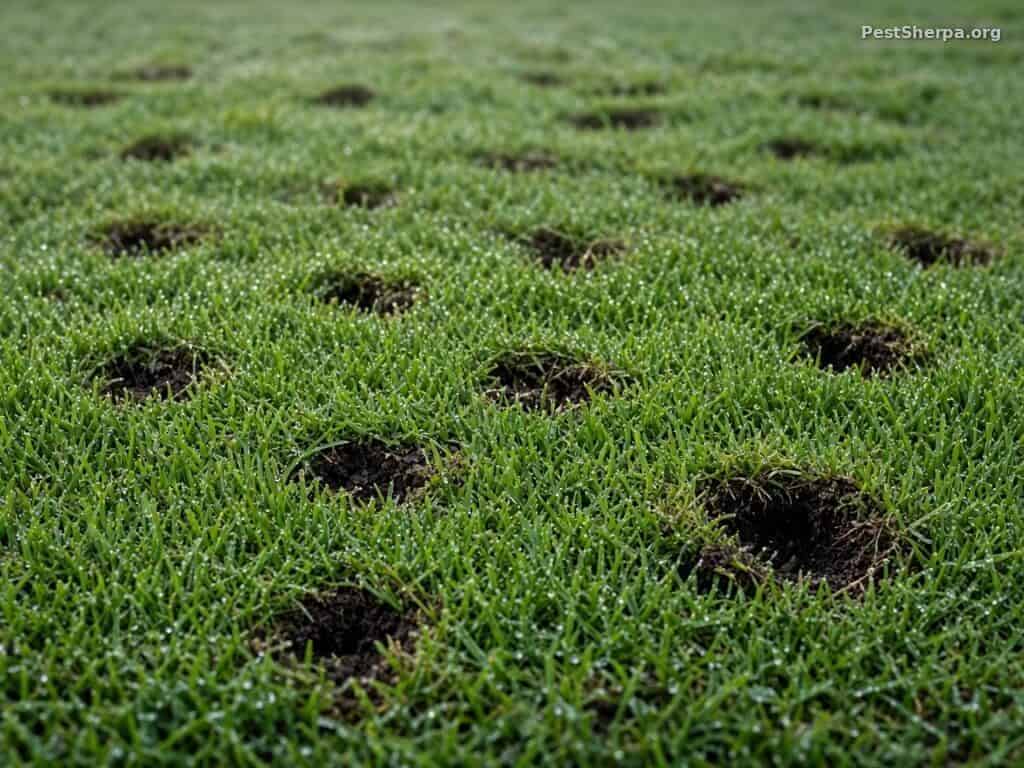
- Small holes in lawns: Skunks dig shallow, cone-shaped holes, typically 3 to 5 inches (8 to 13 cm) across, while searching for grubs and other soil-dwelling invertebrates. Damage often becomes noticeable in the morning.
- Droppings: Skunk droppings are often approximately 1/4 to 1/2 inch (6 to 13 mm) in diameter and may contain recognizable insect fragments, seeds, or other food remains.
- Musky odor: A strong skunk odor near a porch, foundation, or crawl space may indicate a recent spray or nearby activity.
- Tracks: Skunks leave five-toed footprints. Their front tracks often show conspicuous claw marks associated with their digging adaptations.
None of these signs, by itself, conclusively establishes that a skunk is living beneath the structure. Other wildlife can create similar holes, droppings, and disturbances.
Odor alone is particularly unreliable. A dog sprayed elsewhere may carry the odor home, or a skunk may have sprayed outdoors without establishing a den.
Confirm activity through direct observation, clearly identified tracks, or a trail camera before attempting exclusion.
Health and safety risks
Skunk spray contains sulfur-bearing chemicals, principally thiols and related compounds, responsible for its penetrating odor. Direct exposure may cause nausea, eye irritation, intense burning, and temporary visual impairment. Severe eye exposure requires prompt medical evaluation.
The more serious health concern is the potential transmission of rabies.
Skunks are among the important terrestrial wildlife reservoirs of rabies in the United States. CDC identifies skunks, raccoons, foxes, and bats among the wildlife species commonly reported with rabies, although prevalence varies by region.
Skunks may also carry other disease-causing organisms, including those associated with leptospirosis and tularemia. Canine distemper is another important wildlife disease, especially for susceptible domestic animals.
Not every skunk carries these diseases, and ordinary observation from a distance is not a meaningful exposure. Nevertheless, skunks should not be handled, and pets should be kept away from them.
Daytime activity alone is not proof of rabies. However, persistent disorientation, paralysis, unusual aggression, or other serious neurological abnormalities warrant notifying animal control or a public health authority.
If someone is bitten or scratched
- Immediately wash the wound thoroughly with soap and running water for approximately 15 minutes.
- Contact a healthcare professional or local health department immediately for a rabies exposure assessment. Do not delay evaluation while observing the wound.
- Do not attempt to capture, destroy, or transport the animal yourself. Follow directions from animal control or public health officials, who may arrange testing.
- If a pet has been bitten or otherwise exposed, contact a veterinarian promptly. Vaccinated pets may still require a rabies booster and observation according to applicable public health guidance.
Rabies prevention depends on prompt assessment and, when indicated, appropriate post-exposure treatment.
How to get rid of skunks
Exclusion is generally the preferred long-term approach for skunks using sheltered spaces beneath buildings. It avoids unnecessary handling and addresses the opening that allowed the animal to establish a den.
The following steps apply to an active den beneath a porch, deck, shed, or similar structure.
Confirm a skunk is using the opening. Spread a smooth layer of flour approximately 1/8 inch (3 mm) thick across a small tracking area immediately outside the suspected entrance. Examine it after dark or early the next morning.
Tracks may reveal the direction of movement and help establish activity. However, tracks leading outward do not prove the entire den is empty. Other adults or dependent young may remain inside.
A motion-activated trail camera can provide additional evidence and is especially useful where several entrances exist.
Identify and secure secondary openings. Inspect the full perimeter for other gaps, concealed entrances, and damaged skirting. These may be secured as part of an exclusion plan, but do not trap animals inside by closing openings prematurely.
Make sure no kits are inside. During spring and early summer, a female may be sheltering young that are unable to follow her out. Observe the den for repeated visits by an adult and look or listen for signs of kits.
If kits may be present, postpone exclusion or have an experienced wildlife professional determine an appropriate method. Do not install a one-way door that separates dependent young from their mother.
Install a one-way gate when appropriate. University Extension publications describe a gate made from hardware cloth, hinged at the top and secured around the entrance. The gate swings outward when the skunk pushes through but discourages its return.
The gate must be correctly fitted, allow unobstructed exit, and be monitored regularly. It should be used only when the animals are mobile and exclusion will not strand young inside.
Colorado State University Extension describes a 1/4-inch (6-mm) hardware cloth gate extending beyond the opening, with its lower portion projecting outward approximately 6 inches (15 cm).
Confirm departure before sealing permanently. Observe the entrance over several days and verify that all animals have left. The absence of fresh tracks during a single inspection is not sufficient by itself.
Once the den is confirmed vacant, permanently close the opening and secure other potential entry points.
Install durable exclusion screening. UC IPM recommends 1/4-inch (6-mm) hardware cloth around openings under buildings, sheds, porches, and decks. Secure it tightly to prevent animals from pulling it loose.
Where the screening meets soil, bury the lower edge at least 6 inches (15 cm). An outward-facing, buried L-shaped apron can provide additional protection against digging. All seams, corners, and supports should be secured to avoid gaps.
The small mesh also helps exclude rats and house mice.
Remove attractants. Feed pets indoors, secure garbage cans, collect fallen fruit and spilled birdseed, and remove unnecessary lumber piles, brush, and other sheltered hiding places.
Temporary disturbances, including lighting directed toward an unoccupied portion of a shelter, may sometimes encourage a skunk to move elsewhere. However, these measures are not reliable substitutes for exclusion and should not be used to force a mother away from dependent young.
Timing around kits
Striped skunks generally breed during February and March. Following a gestation period of approximately nine weeks, females commonly give birth during May or early June. Litters typically contain four to six kits, although numbers vary.
Kits are born with their eyes closed and remain dependent on the mother during early development. They begin walking at approximately five weeks and are generally weaned around six to eight weeks. Young skunks commonly begin accompanying their mother on nighttime foraging trips during the following weeks and become progressively more independent.
The exact schedule varies by region, weather conditions, and individual animals. Calendar dates are useful guidelines but cannot establish whether a particular den is safe to close.
| Time of year | What is happening | What to do |
|---|---|---|
| Late winter | Breeding begins; males may travel more widely | Secure vacant openings before denning occurs |
| Spring to early summer | Females give birth and care for dependent kits | Avoid one-way exclusion when young may remain inside; consult a professional |
| Mid to late summer | Young become mobile and accompany their mother | Exclusion may be practical after confirming all animals can leave |
| Fall to early winter | Skunks seek shelter and reduce activity during cold weather | Inspect and exclude only after confirming that the den is vacant or that all occupants can safely leave |
Skunks do not undergo true hibernation, but they may remain inside dens for extended periods during severe winter weather.
Never assume that a burrow is empty because no skunk has been seen for several nights.
Laws and relocation
Skunks are regulated as furbearers, nongame mammals, or nuisance wildlife depending on state law. Trapping seasons, permit requirements, authorized control methods, and rules for captured animals vary considerably.
California classifies skunks as nongame mammals and prohibits relocation without written permission from the California Department of Fish and Wildlife.
Virginia prohibits trapping wildlife and releasing it at another location. The state’s Department of Wildlife Resources advises residents to confirm the legal requirements and obtain help from authorized wildlife control specialists when necessary.
Moving a skunk to unfamiliar territory also can harm the animal and may spread disease to other wildlife populations.
Do not set a trap unless you know what must legally happen to a captured skunk. Permission to trap does not automatically authorize off-site release.
Skunks are important rabies hosts, making proper handling and disposition especially important.
No toxicants are registered for general homeowner skunk control in the UC IPM recommendations. Using rodenticides or other pesticide products against skunks when the label does not authorize that use is unlawful and creates unnecessary risks for pets and wildlife.
Contact your state fish and wildlife agency for current requirements before trapping or attempting removal.
What does not work
Ammonia-soaked rags under the house: Strong-smelling repellents have sometimes been used to disturb skunks, but their effectiveness is inconsistent. UC IPM specifically cautions against placing ammonia beneath occupied buildings because fumes may enter living spaces through vents or air movement.
Mothballs: Mothballs are pesticides intended for specific labeled uses. Placing them in animal burrows, crawl spaces, or other unapproved locations is misuse and can expose people and pets to harmful vapors.
Commercial skunk repellents and predator urine: Products marketed to repel skunks generally provide inconsistent or temporary results. They should not replace exclusion.
Blocking the hole during the day: Skunks commonly rest in dens during daylight. Sealing an active entrance may trap an adult or dependent kits beneath the building.
Trapping without a plan: A captured skunk must still be handled and disposed of legally. An inexperienced person approaching an exposed cage trap may provoke spraying or injury.
Poison: Ordinary rodent baits and other pesticides not labeled for skunks must not be used against them. Misuse can endanger pets, wildlife, and people.
The dependable approach remains identification, removal of attractants, appropriate exclusion, and professional assistance where necessary.
Removing skunk odor
Skunk odor is particularly persistent because the spray contains sulfur-bearing chemicals that can adhere to fur, clothing, and other surfaces.
For dogs sprayed by skunks, UC IPM describes a household formula that can help neutralize the odor:
- 1 quart (946 mL) of 3% hydrogen peroxide
- 1/4 cup (approximately 60 mL) of baking soda
- 1 teaspoon (5 mL) of liquid dish soap
Mix the ingredients immediately before use in an open container.
Apply carefully to affected fur, avoiding the eyes, nose, mouth, and other sensitive areas. Do not allow the pet to lick the mixture. Rinse thoroughly with clean water after treatment.
The mixture works through oxidation of odor-producing compounds. It can also lighten fur or discolor fabrics, so use caution.
Never store the mixture in a sealed container. Hydrogen peroxide and baking soda react and release oxygen, creating pressure that can rupture a closed bottle.
Dilute any leftover solution with several volumes of water before disposal according to applicable local guidance.
Consult your veterinarian if the spray entered the animal’s eyes, if irritation continues, or if the animal shows signs of distress.
For odor beneath a house, first determine whether the source is a recent spray, contaminated material, or a dead animal.
Once any animal has been safely removed and the area confirmed vacant, ventilation and removal of heavily contaminated debris or insulation may help. Professional odor treatment may be necessary if the smell has entered living spaces or building materials.
When to call licensed wildlife control
Professional assistance is appropriate when:
- Kits are present or may be present beneath a structure.
- The den is in an inaccessible crawl space, beneath a concrete slab, or in another location that cannot be safely inspected.
- A skunk is trapped in a window well, garage, basement, or other confined area.
- State or local law requires an authorized operator for trapping or removal.
- The animal is displaying seriously abnormal behavior.
- A person or pet has been bitten, scratched, or had other potential rabies exposure.
For bites or suspected rabies exposure, contact the appropriate medical, veterinary, or public health authority promptly. A wildlife control operator is not a substitute for medical evaluation.
UC IPM recommends experienced wildlife professionals for skunk trapping because they are familiar with the animals’ defensive behavior and have appropriate equipment for safe handling.
What a pro visit looks like
A competent skunk-management service should begin with identification and inspection, not immediate trapping or indiscriminate use of repellents.
The goal is to resolve the current problem and prevent another skunk from using the same shelter.
The inspection
The technician should inspect the perimeter of the house, porch, deck, and shed for burrows, openings, disturbed soil, tracks, and other evidence of skunk activity.
Crawl space vents, foundation gaps, and damaged deck skirting should be examined.
During spring and early summer, the inspection should consider whether a female is caring for dependent kits.
The technician should also investigate accessible food sources, such as unsecured garbage, pet food, and fallen fruit.
Your prep before the visit
- Keep pets indoors and away from the suspected den.
- Do not block openings before the technician determines whether they are occupied.
- Bring pet food indoors and secure birdseed and garbage containers.
- Clear stored materials away from deck, porch, and shed edges to allow inspection and installation of exclusion materials.
The treatment
Depending on the circumstances and applicable law, an appropriate management plan may include:
- Confirmation of activity using tracks, a tracking patch, or a trail camera.
- A monitored one-way exclusion gate when all occupants can safely leave, or professional trapping where permitted.
- Permanent installation of securely attached 1/4-inch (6-mm) hardware cloth, buried at least 6 inches (15 cm) or protected by an outward-facing buried apron.
- Removal of contaminated nesting material or insulation when needed.
- Odor treatment if skunk spray has affected building materials or living spaces.
Permanent closure should occur only after the technician confirms that the den is empty.
Follow-up
Skunk exclusion may require more than one visit, particularly when the technician installs a one-way gate or monitors trapping activity.
One visit may be sufficient for a vacant den or straightforward preventive repair. Active dens, multiple animals, and dependent kits can require additional visits or postponement of exclusion.
Ask whether follow-up inspections and permanent sealing are included in the quoted price and whether the exclusion work carries a written warranty.
Questions to ask before you book
- How will you determine whether kits are present before closing the entrance?
- Is trapping or relocation legal here, and what happens to a captured skunk?
- What screening material and burial depth will you use?
- Is cleaning, odor treatment, or insulation removal included or quoted separately?
- What does the warranty cover if another skunk enters the repaired area?
Our guide to hiring a wildlife professional provides additional questions for evaluating service providers.
What it costs
Removing a skunk from an open, accessible area is generally less complicated than removing one from beneath a deck, porch, or crawl space.
Costs increase when multiple animals are present, dependent kits require special handling, or extensive exclusion and odor treatment are needed.
Compare written estimates with published national cost guides, but remember that a basic removal price may not include permanent exclusion or repairs.
Typical national ranges
Published consumer cost estimates include:
- Skunk removal: Approximately $300 to $600, with a reported national average of $450 (Angi, 2026).
- Sanitizing and disinfecting: Approximately $190 to $588 for affected areas (Angi, 2026).
- Professional odor treatment: Often approximately $100 in additional charges for limited work, with severe cases potentially costing $200 to $1,000 (Angi, 2026).
- Skunk removal: Approximately $300 to $700, depending on the number of animals, access, and complexity (HomeGuide).
These estimates are not guaranteed prices and may reflect differing combinations of trapping, inspection, travel, exclusion, and cleanup services.
Ask whether permanent screening, follow-up inspections, and repairs are included.
What moves the price
- Den location: Crawl spaces, basements, and inaccessible areas beneath decks require more labor than open locations.
- Number of animals: A female with kits or several skunks using a shelter may increase the complexity.
- Exclusion materials: The amount of hardware cloth, digging, attachment work, and repairs affects the total.
- Cleanup: Contaminated insulation, odor treatment, and sanitation may require separate services.
- Scheduling: Emergency, nighttime, weekend, and holiday work may cost more.
One-time job or ongoing plan
Most residential skunk problems can be resolved through a one-time removal or exclusion project followed by routine maintenance.
Once the opening is securely sealed and attractants are removed, repeated trapping should not ordinarily be necessary.
Periodic inspection of buried screening, deck skirting, and foundation openings is useful, especially where wildlife activity is common.
A written exclusion warranty may be valuable, but coverage and exclusions should be clearly defined. Even well-installed barriers require occasional inspection for damage or new digging.
Red flags in a quote
- Trapping is proposed without investigating the den or discussing permanent exclusion.
- Ammonia, mothballs, or strong-smelling substances are recommended beneath an occupied home.
- Relocation is offered without explaining applicable wildlife laws.
- The company proposes sealing an active den during spring or early summer without checking for kits.
- No plan is provided to confirm the den is vacant before permanently closing it.
Ask for animal removal, permanent exclusion, follow-up, and any odor or sanitation work to be itemized in the same written estimate.
Common questions about skunks
How do I know a skunk is living under my house?
Look for an active opening along the foundation, porch, or deck skirting, often accompanied by disturbed soil or worn edges. Other clues include small cone-shaped holes in the lawn, five-toed tracks with prominent front claws, droppings containing insect parts, and skunk odor.
These signs are not conclusive individually. A tracking patch or trail camera can help confirm which animal is using the entrance.
Will a skunk leave on its own?
Sometimes. Skunks may use multiple shelters and move between dens. A wandering male or an animal using temporary cover may leave naturally.
A female caring for dependent kits is more likely to remain near an established den until the young become mobile.
Once the shelter is confirmed empty, permanently closing the opening helps prevent renewed occupancy.
When is it safe to seal a skunk out?
Late summer through fall is often a suitable period, provided the young are mobile and all animals can safely leave.
However, skunks may occupy dens at other times, and they do not truly hibernate. Do not rely solely on the calendar.
Before permanent exclusion, confirm that no adult or dependent kits remain inside.
Do ammonia or mothballs get rid of skunks?
These methods are not dependable long-term solutions.
UC IPM cautions against using ammonia or other strong-smelling repellents beneath occupied buildings because fumes can enter living areas.
Mothballs must be used only according to their pesticide labels and are not appropriate wildlife repellents.
Permanent exclusion and removal of accessible food are more reliable.
Can I trap a skunk and release it somewhere else?
Not necessarily. California requires written permission for wildlife relocation, and Virginia prohibits trapping wildlife and releasing it elsewhere.
Other states have their own wildlife regulations, trapping requirements, and disposition rules.
Check with your state wildlife agency before trapping. An experienced wildlife control operator should be able to explain the legal options.
How do I get skunk smell off my dog?
UC IPM describes a freshly mixed solution of 1 quart (946 mL) of 3% hydrogen peroxide, 1/4 cup (60 mL) of baking soda, and 1 teaspoon (5 mL) of liquid soap.
Apply carefully to affected fur, avoid the eyes and other sensitive areas, and rinse thoroughly. Do not allow the dog to lick the mixture.
Never store the mixture in a sealed container because the reaction releases oxygen and can cause pressure buildup.
Contact your veterinarian if the dog has eye irritation or other symptoms.
How much does skunk removal cost?
Angi’s 2026 estimate places skunk removal at approximately $300 to $600, with a national average of $450.
Inaccessible dens, multiple animals, permanent exclusion, odor treatment, and sanitation can increase the price.
Request a written estimate identifying which services are included and which are additional.
Is a skunk out during the day rabid?
Not necessarily. Healthy skunks may forage or travel during daylight, especially when disturbed or searching for food.
However, skunks are important rabies hosts in parts of the country. An animal showing persistent disorientation, paralysis, unusual aggression, or other seriously abnormal behavior should be reported to local animal control or public health authorities.
Never approach or attempt to handle a skunk that may be ill.
This guide is part of our Nuisance Wildlife guide. If an animal sheltering under your porch has a gray coat and a long, nearly hairless tail, consult the opossum guide. If you find torn garbage and tracks resembling small handprints, compare the evidence with the raccoon guide.
References
- UC IPM Pest Notes: Skunks
- Penn State Extension: Skunks, Solutions to Common Problems
- Colorado State University Extension
- Internet Center for Wildlife Damage Management: Skunks
- Virginia DWR: Problems with Skunks and Opossums
- CDC: About Rabies
- Association of Fish and Wildlife Agencies: U.S. State and Territorial Fish and Wildlife Agencies (member list)
- Angi, How Much Does Skunk Removal Cost? [2026 Data], updated October 12, 2026
- HomeGuide, How Much Does Skunk Removal Cost?, March 14, 2025
Top photo: U.S. Fish and Wildlife Service, Pacific Southwest Region, public domain (U.S. federal government work), via Wikimedia Commons.
This article was written by Greg Baumann, founder of Pest Sherpa, and reflects more than 40 years of professional pest management experience.
About the Author

Greg Baumann | Pest Control Expert
Greg Baumann is the founder of Pest Sherpa and a Pest Control Expert with more than 40 years of professional pest management experience. His articles combine decades of field experience, technical expertise, and science-based guidance to help homeowners identify pests correctly, understand real-world risks, and make informed pest management decisions.
Mission: Identify the pest. Understand the risk. Stop the problem. Prevent the comeback. Know when it’s time to call a professional.