
What to Look for When Hiring a Pro for Wildlife in the Home
When something larger than a mouse is thumping in the attic (raccoons, squirrels, bats, and similar neighbors) you have migrated from traditional pest control. The Internet Center for Wildlife Damage Management (ICWDM) distinguishes pest management professionals (primarily insects and mice/rats, often pesticide-focused) from wildlife control operators (WCOs/NWCOs) trained to resolve wildlife conflicts and often licensed by state fish-and-wildlife agencies or other agencies depending on the state and even the pest.. Washington Department of Fish and Wildlife (WDFW), Virginia Tech Extension, Penn State Extension, University of Nebraska-Lincoln Wildlife Damage Management, CDC, and USDA-APHIS wildlife damage materials converge on a gold standard: confirm species and young, evict humanely, exclude with durable repairs, and never seal dependent animals inside. This guide helps you hire the right licensed professional for the job.
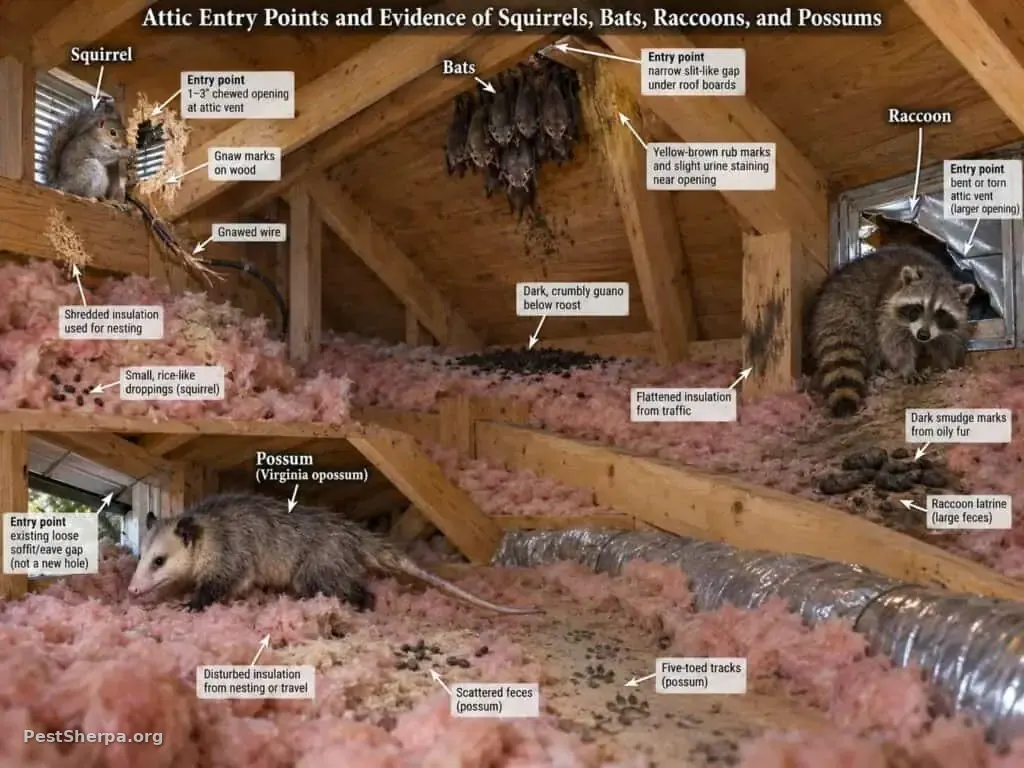
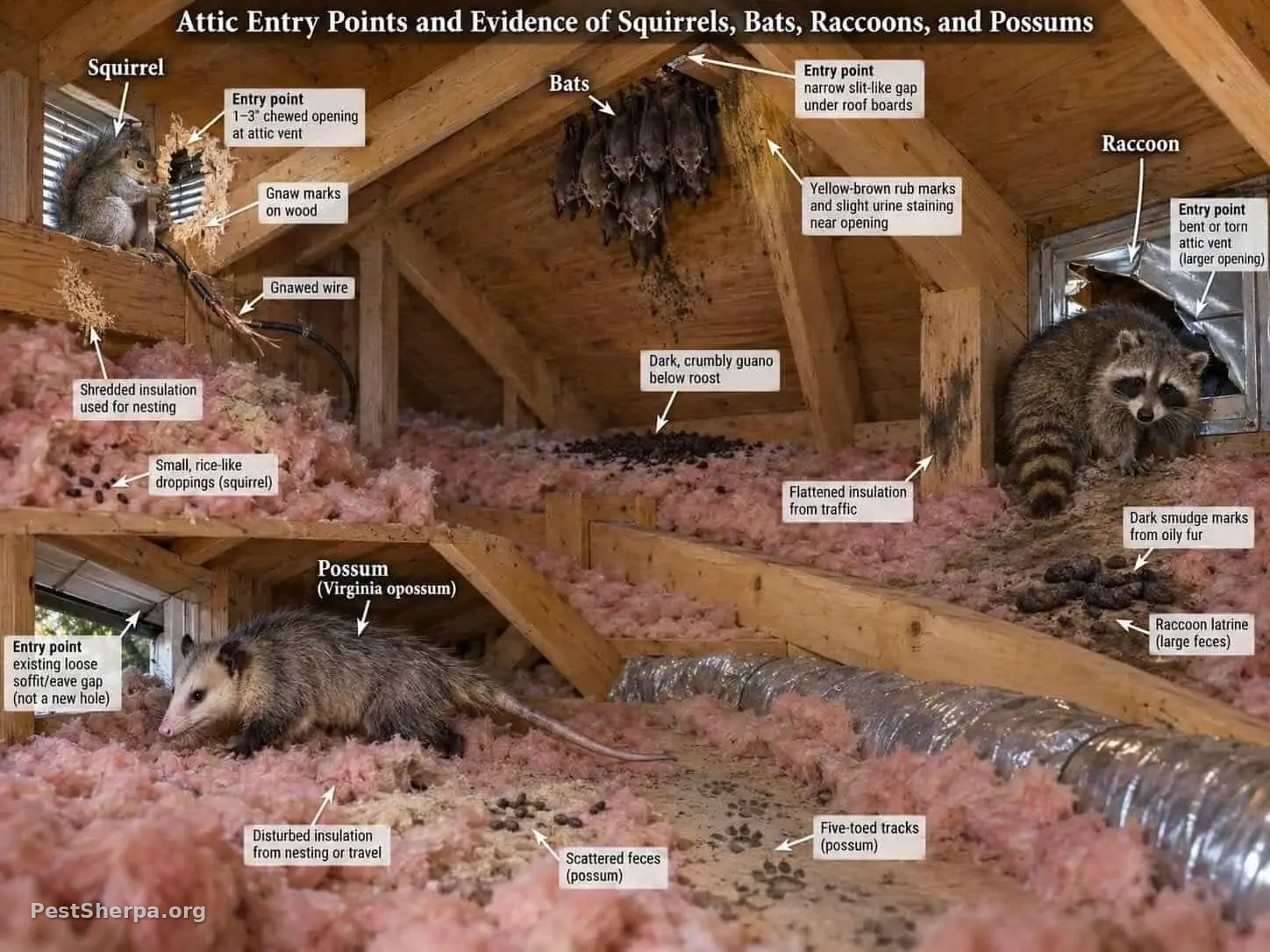
Entry points and signs of infestation by select unwanted wildlife.
Confirm Wildlife Presence Before Anyone Seals a Hole
Identify the type of pest, entry points, and whether young are present. WDFW frames these as mandatory first steps. Daytime scampering and baseball-size chewed openings often suggest tree squirrels (Penn State). Nocturnal thumping, grease stains on downspouts, or uncapped chimneys often point to raccoons (WDFW; Virginia Tech). Guano piles under roof peaks, musty odor, and dusk exits suggest bats (ICWDM; CDC).
For mammals other than bats or birds, WDFW describes checking whether lightly stuffed newspaper or a tracking patch is disturbed. Do not stuff openings if bats or birds may be trapped inside. There is no dedicated wildlife hub on this site; use the pest guides index for related education and the rodent guide when the issue is mice or rats. Disease cleanup questions still matter when droppings accumulate. See hantavirus person-to-person risk for rodent-oriented public-health framing, and use CDC guidance for bat guano / histoplasmosis concerns discussed below.
DIY Versus Hiring a Wildlife Control Operator
Reasonable DIY includes trimming limbs away from roofs, securing trash and pet food, and installing chimney caps only after confirming nothing is inside. Seal unused openings only when animals are confirmed gone. A single bat in living space: follow CDC/FWS capture-or-exit guidance and contact the health department if any possible contact occurred.
Hire a wildlife professional when animals are inside attic, chimney, walls, or crawlspace; when young may be present; when a rabies-vector species would require handling; when roofs, ladders, or large droppings piles create safety hazards; or when state rules require a licensed NWCO/WCO for hire work (ICWDM; WDFW; Virginia Tech). Ask directly: “Do you hold a current state wildlife control company license and are the technicians certified?” A general pest control license alone may not authorize capturing raccoons, squirrels, or bats for hire, depending on the state. Also some state and local regulations may require relocation and other state and local regulations may prohibit relocation, due to fear of disease.
What Good Wildlife Service Means: Eviction + Exclusion
- Inspect. type of wildfire preferably down to Species, all entries, young, contamination.
- Evict. One-way doors or legal trapping as appropriate. WDFW and Penn State describe one-way devices for squirrels/raccoons; leave devices long enough to confirm vacancy (WDFW often ~7 days; longer in cool/rainy weather) before permanent sealing. For bats, ICWDM/CDC describe one-way netting or tubes; leave devices at least 3 to 5 days (longer in bad weather).
- Exclude with durable materials. Heavy hardware cloth, flashing, chimney caps: pest-appropriate. Bats can use openings approximately 1/4 inch diameter (CDC). Steel wool is not always a good choice because it can rust away leaving openings as a pathway for wildlife. If steel wool is used, check it periodically for integrity and replace if missing or degraded. Copper mesh is available for similar use and it will not rust away.
- Never seal animals, especially young, inside. Locked-in squirrels chew aggressively (Penn State). Trapped young create odor, damage, welfare crises, and living-space invasions (WDFW; ICWDM).
- Sanitize and repair. Scope guano/latrine cleanup and insulation replacement separately when contamination is heavy. Many wildlife companies perform this work but some leave it to the homeowner to either do the work or hire a clean up company.
- Verify and follow up. Tracking patches, quiet attic days, then frequent checks for about two weeks after sealing: scent trails can attract others for months (WDFW). If a professional is used, they can provide advice.
Timing: especially bats (verify locally)
Bat maternity windows are local legal and biological constraints. Do not invent a single national calendar as law. CDC: fall/winter migration periods are often best for bat-proofing; if working May to August, do not trap young inside; heed local laws; some bats are endangered. ICWDM generally advises avoiding eviction/exclusion about May 15 to August 15 because of flightless pups, and avoiding winter eviction if bats hibernate in the structure. U.S. Fish and Wildlife Service guidance: if hibernating bats are found in winter, wait until spring; use one-way tubes then; seal roost-to-living-space gaps in the meantime; check state DNR before excluding a colony. Raccoon and squirrel young dependency is typically spring into summer. Confirm no dependent young before one-way doors or permanent seals (Virginia Tech; WDFW).
Weak methods and misuse
- Ultrasonics. WDFW: no scientific evidence they drive animals from buildings. ICWDM: not appropriate for bats / not suited as domestic bat control. While some studies show some limited effects on certain wildlife, there is no evidence that these devices are suitable alone for eviction.
- Mothballs / ammonia for raccoons. Virginia Tech: not registered for raccoons; in states where a pest must be on the pesticide label, this would not be a legal use.
- Toxicants for squirrels, bats, or raccoons. Penn State: no federal toxicants for squirrels. ICWDM: no toxicants for bats. Virginia Tech: nothing registered as a raccoon toxicant/fumigant.
- Long-distance trap-and-relocate as the “humane default.” USDA-APHIS Wildlife Damage Management Technical Series on translocation: rarely legal or biologically sound; disease, stress, low survival, and liability concerns; AVMA and public-health groups oppose wildlife translocation for disease reasons. Ask what local law actually allows (on-site release after exclusion, euthanasia per rules, rehab), not a park 20 miles away. While relocation might seem humane, it rarely is and might be prohibited by law.
- Bat trapping as primary control. ICWDM: not recommended; exclusion is more effective and less stressful unless the bat is released immediately outside and sealing is done to prevent re-entry.
- Using insecticides that are for insects or termites to treat attics, crawlspaces, or basements for wildlife. This might sound common sense, but wildlife management professionals frequently find used bug bombs and other insecticides that the homeowner thought might control wildlife. They have no effect other than to stress the animal which can lead to damage as the animal tries to escape the area.
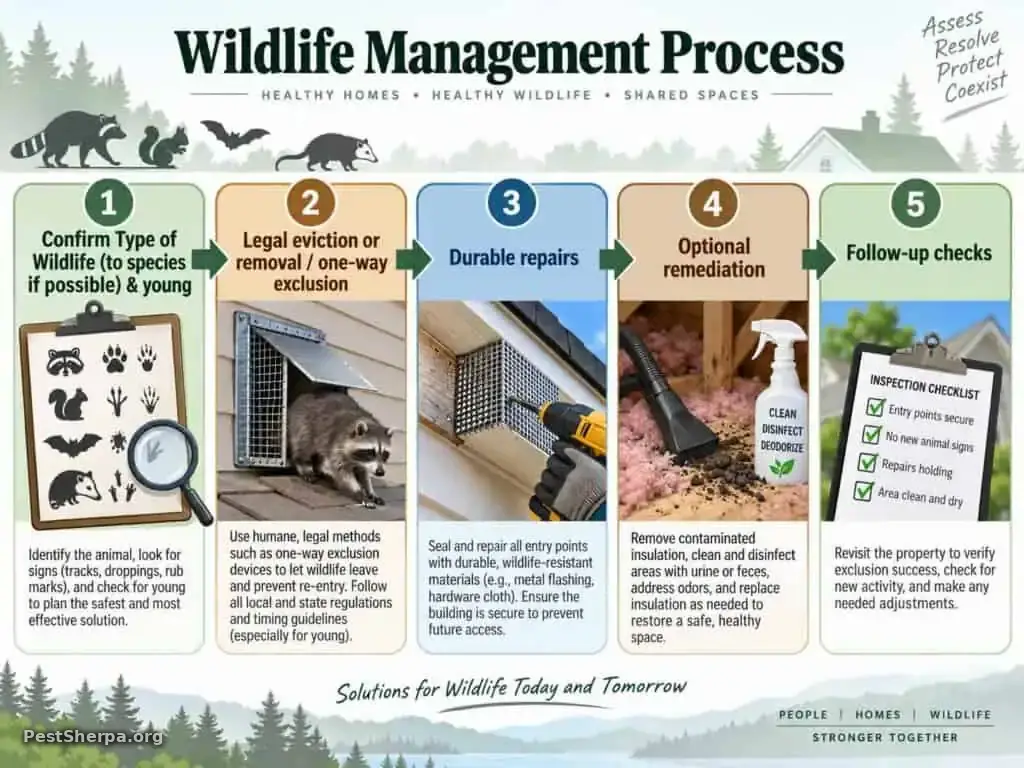
Smart flow chart showing recommended method of wildlife control process.
Interview Questions when Selecting a Professional, Licensing, and Bids
- Are you licensed as a wildlife control operator (which agency, license number)?
- Are you insured for general liability? Will you provide a certificate of insurance if hired?
- What type of training do you have and are you a member of professional wildlife management groups?
- What type of wildlife (preferably species) is present, and how will you confirm young are not trapped?
- Will you use exclusion / one-way devices, and what permanent repair materials?
- For bats: how will work respect maternity/hibernation timing and living-space bat-proofing?
- What happens to captured animals under local law, and is off-site relocation illegal here?
- What is included: inspection record and diagram, eviction, all entry points, cleanup, insulation, warranty?
- Separate from general liability insurance, do you carry insurance / workers’ compensation for roof work? Can you provide a copy of the declaration page or certificate of insurance if hired?
- Droppings/urine cleanup methods (PPE, wetting, HEPA, disposal)?
Compare repair scope and materials, not the cheapest trap set. Green flag: written warranty on exclusion at listed points. Red flag: “lifetime trap-out” with no repairs, or promise to relocate if you find that is not locally permitted. Do your homework about what the requirements are where you live and work.
While noise and fear that the wildlife might enter your living space can create anxiety, there is no reason that you must sign an agreement with a company for immediate work. Buy value and trust with price not being the first priority. Interview several companies and choose wisely. While this can take a few days, it will give you the best experience and peace of mind.
Safety Notes (Calm and Sourced)
- Rabies. CDC: bats are the most commonly reported rabid animals in the U.S.; most U.S. human rabies deaths involve bat exposure. Do not handle bats bare-handed; seek medical and health-department guidance after possible contact. Raccoons are a major terrestrial reservoir. Bites/scratches need clinician + local health department (Virginia Tech).
- Histoplasmosis. CDC: risk rises when disturbing soil or material with bird or bat droppings; large accumulations should be cleaned by professionals specializing in that hazardous cleanup.
- Raccoon roundworm (Baylisascaris). Virginia Tech: attic latrines need careful wetting, PPE, and proper disposal; prefer pros for significant contamination.
- Do not dry-sweep dried guano or feces; check wiring and smoke detectors after wildlife occupancy (WDFW).
Hiring Checklist: Nuisance Wildlife Summary
- Confirm species and young before sealing anything.
- Hire a WCO/NWCO for attic, basement, or crawlspace wildlife, not only a traditional pest control company unless they are credentialed for both types of work (ICWDM distinction).
- Demand eviction + durable exclusion; never seal in young.
- Treat bat maternity timing as local: verify with state wildlife/health guidance.
- Reject ultrasonics, mothballs, and long-distance translocation as the default “humane” pitch (WDFW; Virginia Tech; APHIS).
- Get entry maps, materials, cleanup scope, and warranty in writing.
- Use the pest guides index, Ask the Sherpa, and pest control Q&A for related questions.
Wildlife jobs are half biology and half building repair. Hire the operator who respects both, and who leaves your house stronger than they found it.
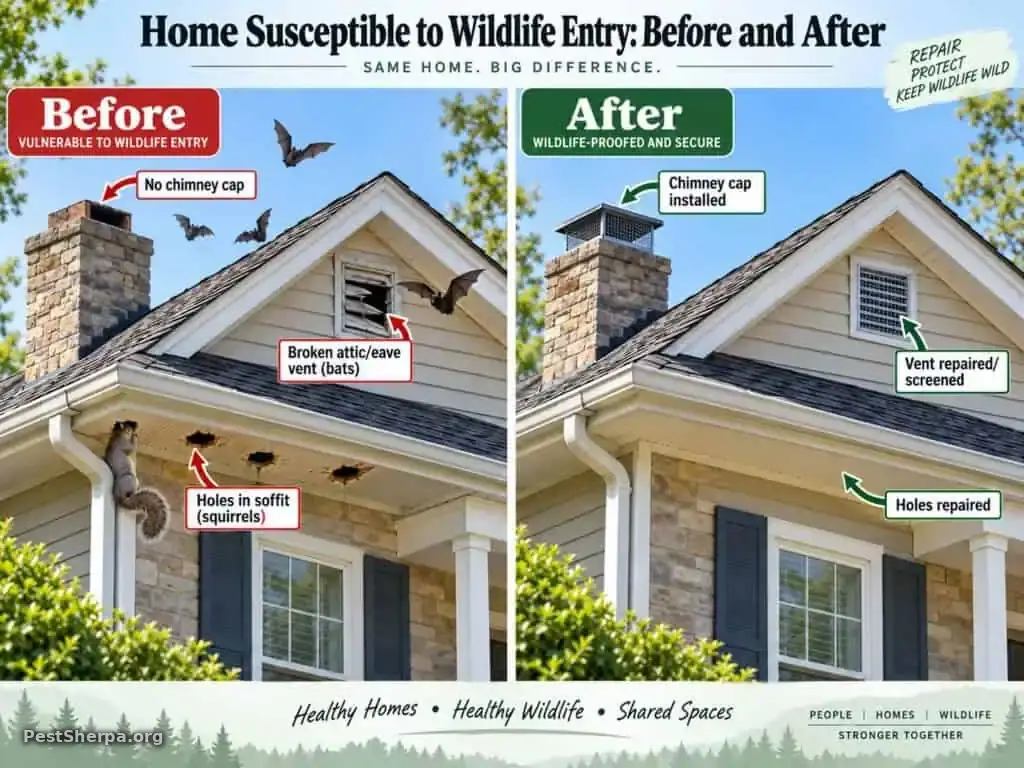
Comparison of before and after home susceptible to wildlife and same home after exclusion (preventative) action.
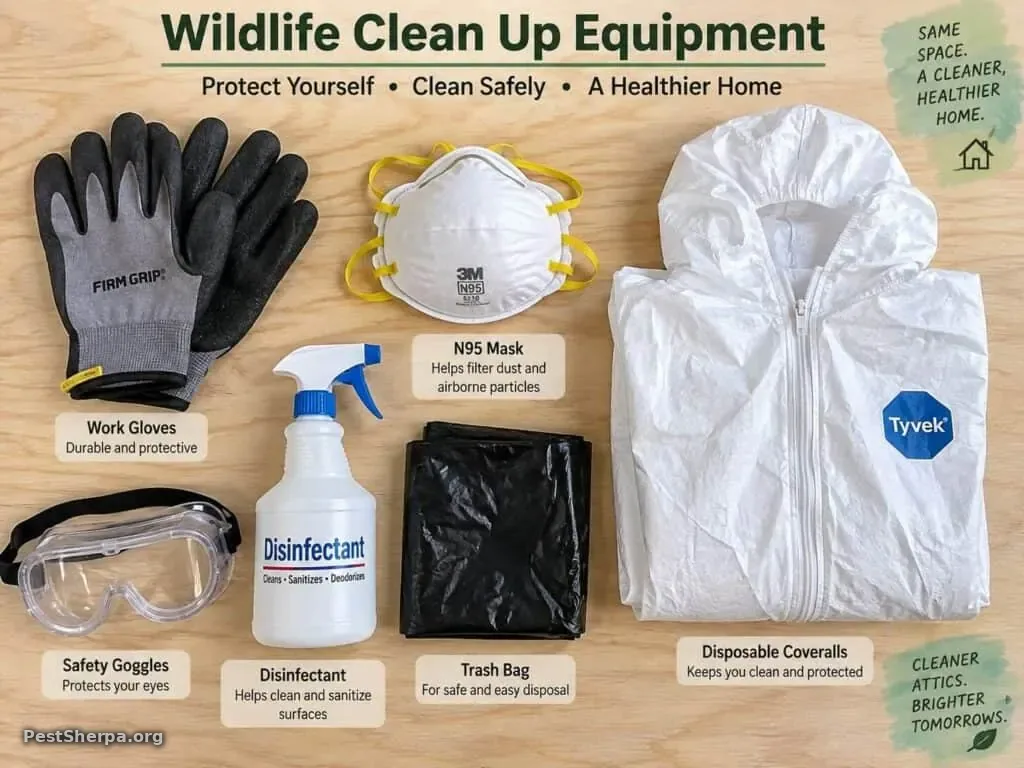
Safety PPE flat-lay for attic cleanup: gloves, N95/respirator, coveralls, spray bottle of labeled disinfectant. Most professional companies should use these safety tools. Homeowners should use same precautions.
Sources & Further Reading
Selected public authorities used to check the hiring guidance above (not an exhaustive bibliography):
- CDC: Bats and Rabies Prevention
- CDC: Histoplasmosis Prevention (droppings)
- USDA-APHIS: Wildlife Translocation (WDM Technical Series PDF)
- ICWDM: Bat Damage Prevention and Control Methods
- Penn State Extension: Tree Squirrels
This article was written by Greg Baumann, founder of Pest Sherpa, and reflects more than 40 years of professional pest management experience.
About the Author

Greg Baumann | Pest Control Expert
Greg Baumann is the founder of Pest Sherpa and a Pest Control Expert with more than 40 years of professional pest management experience. His articles combine decades of field experience, technical expertise, and science-based guidance to help homeowners identify pests correctly, understand real-world risks, and make informed pest management decisions.
Mission: Identify the pest. Understand the risk. Stop the problem. Prevent the comeback. Know when it’s time to call a professional.