
Brown Recluse Spiders: Identification, Range, Bites, and Control
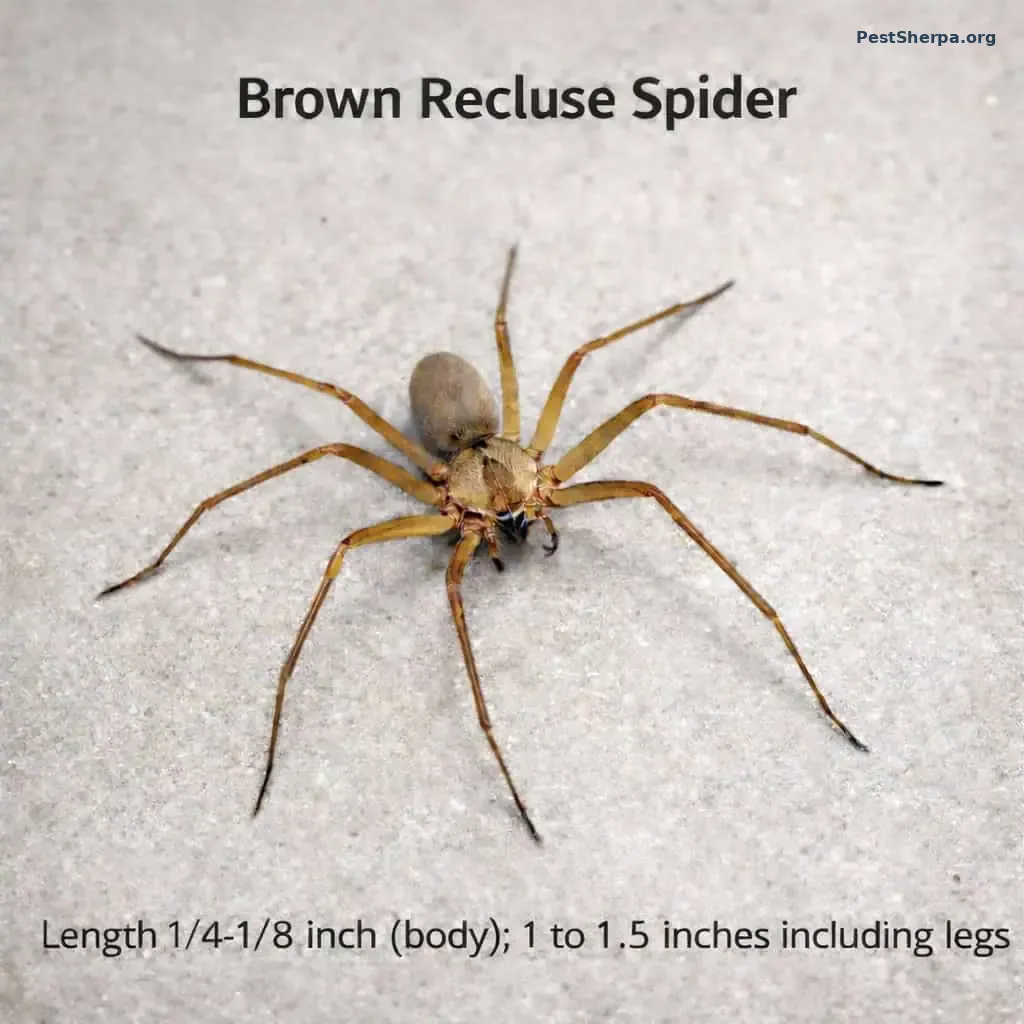
The brown recluse spider (Loxosceles reclusa) causes more worry than almost any other indoor spider because people connect it with medically significant bites. The concern is understandable, but the first question is usually not “How dangerous is it?” It is “Is this actually a brown recluse?” Many harmless brown spiders are misidentified as brown recluses, and many skin lesions blamed on brown recluse bites are caused by something else.
This guide helps homeowners identify brown recluse spiders and understand where they are most likely to occur. It also shows how to check the right hiding places, reduce indoor activity safely, and avoid common mistakes. Finally, it helps you decide when expert identification or professional pest help may be worth considering.
TL;DR
Brown recluse spiders are medically significant, but they are often misidentified. The most reliable identification clue is not just the “violin” mark. It is the spider’s six eyes arranged in three pairs. Look for that along with a plain abdomen, evenly colored legs, and the correct geographic range.
If you live outside the brown recluse’s established range, repeated “brown recluse” sightings are often another spider. Do you live within the range and keep finding small tan-to-brown spiders in closets, storage rooms, basements, attics, or boxes? Then careful inspection and monitoring are worthwhile.
Good first steps include reducing clutter and shaking out stored clothing and shoes. Use sticky monitoring traps along walls, seal entry points, vacuum hiding areas, and reduce indoor insect prey. Seek medical care for concerning skin symptoms, especially spreading redness, severe pain, fever, chills, or an open wound.
Quick Navigation
- What a Brown Recluse Sighting Usually Means
- Quick Identification
- Geographic Range
- Quick Assessment
- Where To Check Indoors and Outdoors
- Biology, Life Cycle, and Seasonal Activity
- Why Brown Recluse Spiders Suddenly Appear
- What To Do
- What Doesn’t Work
- Bites, Health Concerns, and Safety
- When Professional Help May Be Needed
- Lookalikes and Misidentifications
- FAQs
- References
What a Brown Recluse Sighting Usually Means
A single brown spider does not automatically mean you have a brown recluse infestation. Brown recluse spiders are small, plain-looking spiders, and many other indoor spiders are also brown. The meaning of a sighting depends on the spider’s appearance, your location, where it was found, and whether sightings keep happening.
| What You See | What It Usually Means | Best Next Step |
|---|---|---|
| One small brown spider | Could be a harmless lookalike or an occasional indoor spider | Capture or photograph it for identification if safe |
| Repeated small brown spiders in closets, boxes, basement, attic, or storage areas | Possible indoor population if you are within brown recluse range | Start monitoring and inspect undisturbed areas |
| Brown spiders outside the known range | Misidentification is more likely than an established brown recluse population | Confirm with an extension office, entomologist, or qualified identifier |
| Spiders plus shed skins or egg sacs in cluttered storage | Activity may be established nearby | Declutter carefully, vacuum, and monitor |
| A skin wound but no spider seen biting | Cannot confirm a brown recluse bite from the wound alone | Seek medical advice for concerning symptoms |
Key point: Brown recluse management starts with correct identification. Treating every brown spider as a brown recluse can lead to unnecessary fear and ineffective control efforts.
Quick Identification: What Brown Recluse Spiders Look Like
Brown recluse spiders belong to the genus Loxosceles. They are arachnids, not insects, and have two main body regions, eight legs, no antennae, and fang-bearing mouthparts called chelicerae.
| Feature | Brown Recluse Clue | Why It Matters |
|---|---|---|
| Eyes | Six eyes arranged in three pairs | One of the most useful identification features |
| Body color | Tan, light brown, or darker brown | Usually fairly uniform, not brightly patterned |
| Cephalothorax marking | Dark violin-shaped mark may be present | Helpful but not reliable by itself |
| Abdomen | Plain, oval, and covered with fine hairs | Usually lacks bold stripes, bands, or spots |
| Legs | Long, slender, and fairly uniform in color | Legs lack obvious banding or heavy spines |
| Typical body length | About 1/4 to 3/8 inch | Leg span can make the spider appear larger |
| Webbing | Small, irregular silk retreats | Not a large orb web or neat cobweb |
The “violin” marking is the feature most people know, but it should not be used alone. Lighting, age, posture, damage, and natural variation can make markings misleading. A hand lens or close-up photo is usually needed to see the six-eye pattern clearly.
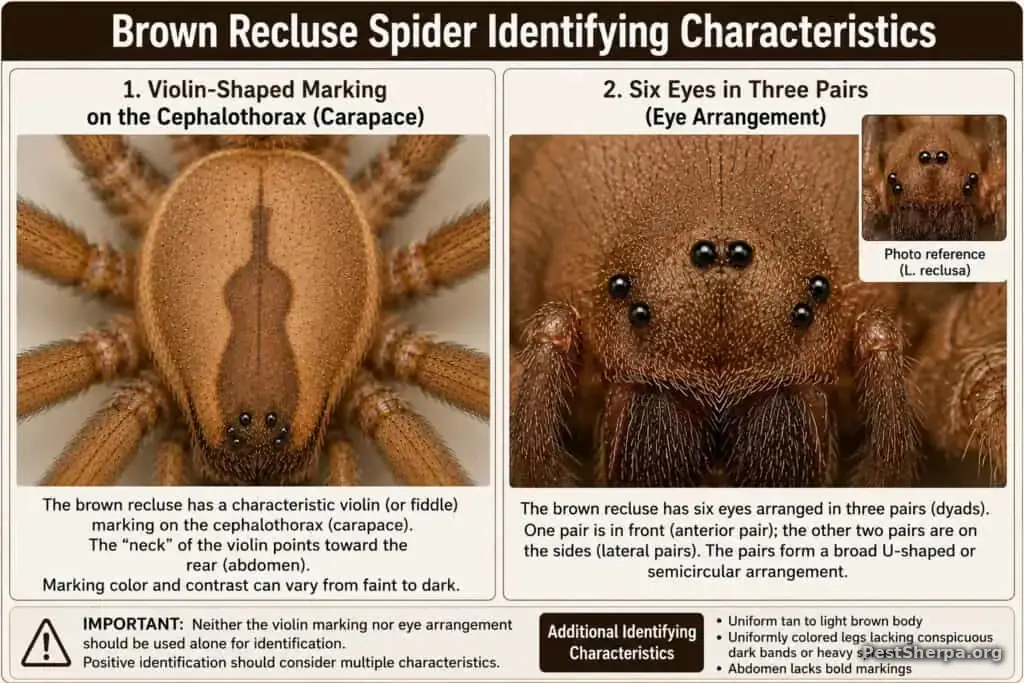
Brown recluse spider identification features showing six eyes, violin marking, plain abdomen.
Geographic Range: Where Brown Recluse Spiders Are Most Likely
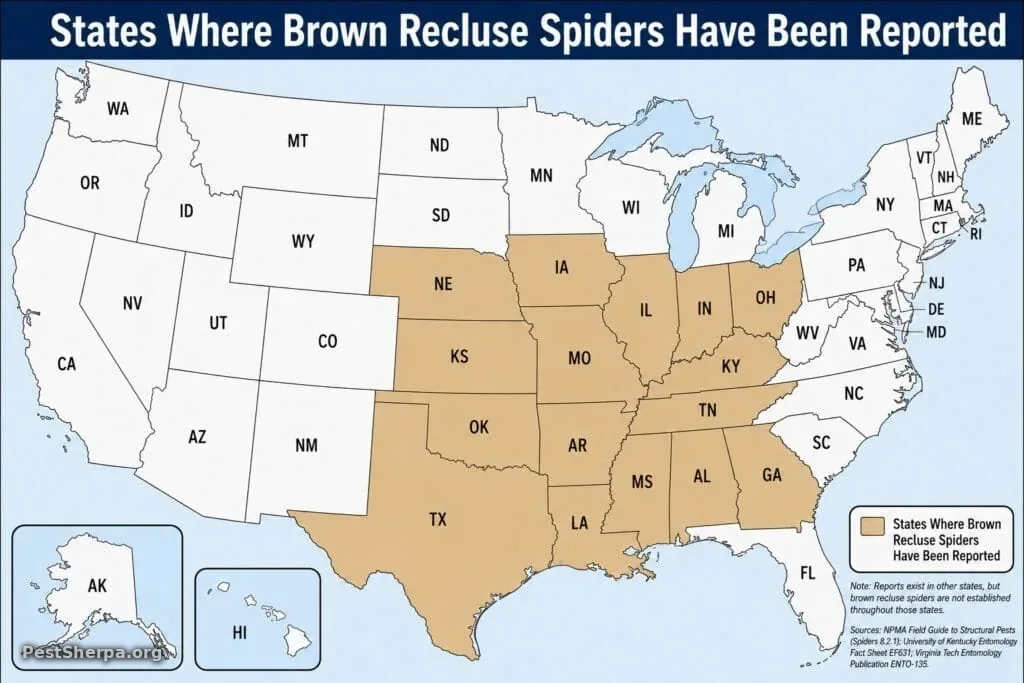
The brown recluse spider is native mainly to the central and south-central United States. Its core range includes areas such as Missouri, Arkansas, Oklahoma, Kansas, Texas, Tennessee, Kentucky, and portions of nearby states.
Brown recluse spiders can be accidentally moved in boxes, furniture, luggage, or shipped materials. But one spider carried in does not always mean a breeding population is established. Outside the usual range, repeated brown recluse reports should be confirmed carefully because misidentification is common.
Practical range rule: If you are in or near the central/south-central range, a suspected brown recluse deserves careful checking. If you are far outside that range, assume “possible lookalike” until the spider is confirmed.
Brown Recluse Quick Assessment
Use this table to decide how much concern a sighting deserves.
| Situation | Concern Level | What To Do |
|---|---|---|
| One brown spider in a living area | Low to moderate | Capture/photo for ID; check nearby clutter |
| One brown spider in a storage box, closet, attic, or basement | Moderate if within range | Inspect similar hiding places and set monitoring traps |
| Repeated sightings in several rooms | Moderate to high | Begin structured inspection and clutter reduction |
| Multiple spiders caught on sticky traps | Higher | Map activity and focus on source areas |
| Spiders found in clothing, shoes, towels, or bedding | Higher bite-prevention concern | Shake out items, reduce clutter, and inspect storage zones |
| Suspected bite with worsening symptoms | Medical concern | Seek medical advice; do not rely on pest ID alone |
Where To Check Indoors and Outdoors
Brown recluse spiders prefer dark, dry, quiet, and undisturbed places. They are most likely to be found where clutter, stored items, insect prey, and small crevices are available.
Room-by-Room Indoor Inspection
| Area | Where To Look | What To Watch For |
|---|---|---|
| Closets | Shoes, stored clothing, boxes, corners, baseboards | Spiders, shed skins, small irregular silk retreats |
| Bedrooms | Under beds, behind furniture, stored items, bedding touching floors | Wandering spiders at night or trapped spiders in fabrics |
| Basements | Cardboard boxes, wall edges, storage shelves, utility areas | High trap counts or repeated sightings |
| Attics | Stored materials, insulation edges, rafters, cardboard, dark corners | Undisturbed harborages and insect prey |
| Garages | Tools, work gloves, shoes, stacked items, door edges | Spiders hiding in items that are handled occasionally |
| Crawl spaces | Foundation edges, sills, debris, utility penetrations | Dry sheltered cracks and prey insects |
| Storage rooms | Paper products, boxes, holiday decorations, fabric items | Long-term hiding and egg sac locations |
Exterior Inspection
Outdoors, brown recluse spiders may hide beneath rocks, loose bark, debris, boards, stacked firewood, and stored materials. They may also use sheds, garages, and other protected structures. Focus on areas close to the home first, especially where outdoor clutter touches the foundation.
- Move firewood and stored materials away from the foundation when practical.
- Remove debris, unused boards, and clutter near doors and garages.
- Seal gaps around doors, utility penetrations, foundation cracks, vents, and siding openings.
- Repair torn screens and add door sweeps where gaps are visible.
- Reduce insects that attract spiders by improving sanitation, lighting, and exclusion.
Biology, Life Cycle, and Seasonal Activity
Brown recluse spiders develop through simple metamorphosis: egg, spiderling, and adult. Spiderlings resemble smaller, lighter versions of adults and molt as they grow.
Egg Stage
Female brown recluse spiders produce small silk egg sacs in protected locations. Common sites include cardboard boxes, behind baseboards, beneath furniture, inside storage containers, in wall voids, and other quiet spaces.
Egg sacs often contain several dozen eggs, with numbers varying by conditions and source. Warm, protected indoor areas can support development when food and shelter are available.
Spiderlings
Newly hatched spiderlings are lighter than adults and may lack fully developed markings. They remain near protected shelter at first, then disperse into nearby cracks, clutter, and storage areas.
Adults
Development to adulthood can take many months and may approach a year depending on temperature, humidity, food availability, and other conditions. Adults can live for extended periods compared with many household arthropods and can survive long intervals without feeding.
Feeding Behavior
Brown recluse spiders are nocturnal predators. They feed on insects and other small arthropods, including prey such as cockroaches, crickets, silverfish, ants, and other small insects. They use irregular silk retreats for shelter rather than building large prey-catching webs.
Seasonal Activity
People often notice more activity during warmer months because spiders and insect prey are more active. Indoors, however, brown recluse spiders can persist year-round in protected spaces. Sightings may increase when stored items are moved, when clutter is disturbed, or when males wander while searching for mates.
Why Brown Recluse Spiders Suddenly Appear
A sudden sighting does not always mean the spiders just arrived. Brown recluse spiders can remain hidden for long periods. They may become noticeable when conditions change.
- Stored items were moved: Boxes, clothing, decorations, furniture, and garage items can disturb hiding spiders.
- Clutter increased: Cardboard, paper, fabric, and rarely used storage create more harborages.
- Prey insects increased: More insects can support more spiders.
- Weather changed: Heat, cold, drought, or heavy rain can shift spider and prey activity.
- Males are wandering: Adult males may travel farther than females, especially during mating activity.
- Monitoring revealed activity: Sticky traps often show spiders that were present but unnoticed.
Signs of Brown Recluse Activity
Brown recluse spiders are secretive, so activity may be easy to miss. Look for patterns rather than relying on one sighting.
- Small tan-to-brown spiders seen at night or in undisturbed storage areas
- Spiders caught on sticky monitoring traps along walls
- Small irregular silk retreats in corners, boxes, wall edges, or clutter
- Shed skins from growing spiderlings
- Egg sacs in protected spaces
- Repeated sightings in the same storage zone, closet, basement, attic, or garage
Sticky traps are useful for monitoring, but they should be placed thoughtfully. Put them along walls, behind furniture, near storage areas, and in low-traffic corners where children and pets cannot contact them.
What To Do About Brown Recluse Spiders
1. Confirm the Identification
Do not rely on color alone. If you can do so safely, capture the spider in a clear container or take a close photo. Look for the six eyes in three pairs, plain abdomen, unbanded legs, and the correct body shape. DO NOT TOUCH the spider. Contact a pest professionals or universities to identify the spider.
2. Use Sticky Traps To Map Activity
Place sticky monitoring traps along walls in closets, basements, storage rooms, garages, attics, and other low-traffic areas. Check them regularly. Where traps catch the most spiders, focus your inspection and clutter reduction.
3. Reduce Clutter Carefully
Wear gloves when handling stored items in suspected brown recluse areas. Replace cardboard boxes with sealed plastic bins when possible. Lift and move items carefully rather than reaching blindly into boxes, piles, or dark spaces.
4. Vacuum Hiding Areas
Vacuum corners, baseboards, storage edges, behind furniture, closet floors, garage edges, and visible silk retreats. Empty the vacuum contents into a sealed bag and remove it from the home when finished.
5. Seal Entry Points
Seal cracks and gaps around foundations, door frames, window frames, siding, vents, utility lines, and wall penetrations. Install or repair door sweeps and screens. Exclusion also helps reduce insect prey that supports spiders indoors.
6. Reduce Insect Prey
Brown recluse spiders feed on other arthropods. Reducing cockroaches, crickets, silverfish, ants, flies, and other indoor insects can make indoor spaces less supportive for spiders over time.
7. Use Bite-Prevention Habits in Suspected Areas
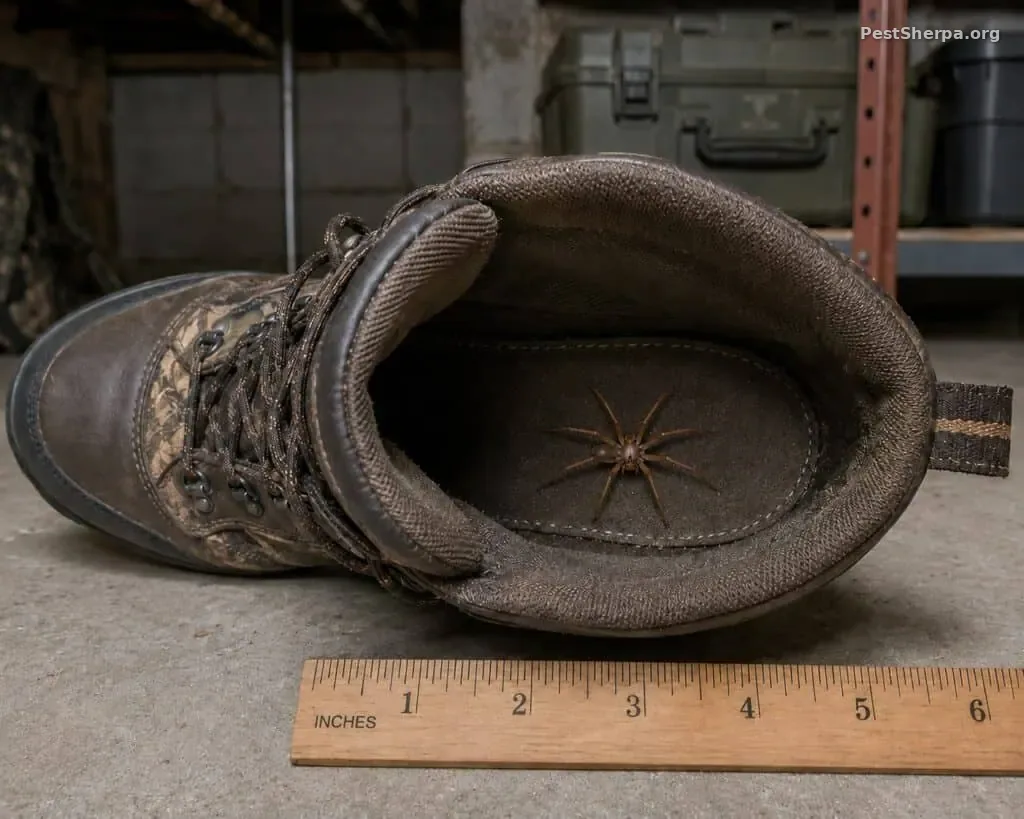
- Shake out shoes, gloves, towels, bedding, and stored clothing before use.
- Keep beds slightly away from walls when activity is suspected.
- Avoid leaving clothing piles on the floor.
- Store rarely used items in sealed containers.
- Wear gloves when moving boxes, firewood, or long-stored materials.
What Doesn’t Work
Brown recluse control is usually frustrating when the focus is only on visible spiders. The hidden harborages and prey sources matter more.
| Approach | Why It Usually Falls Short | Better Approach |
|---|---|---|
| Only killing spiders you see | Most activity may be hidden | Use monitoring traps and inspect harborages |
| Relying only on the violin mark | Many spiders appear to have similar markings | Check the six-eye pattern and full body features |
| Spraying open surfaces randomly | Brown recluse spiders hide in cracks, clutter, and voids | Focus on inspection, clutter, exclusion, and targeted treatment when appropriate |
| Bug bombs or foggers | May not reach protected retreats and can increase pesticide exposure indoors | Use safer, targeted, label-following methods |
| Ignoring insect prey | More prey can support more spiders | Reduce the insects spiders feed on |
| Diagnosing a bite from a wound alone | Many medical conditions can resemble suspected spider bites | Seek medical evaluation and confirm spider presence when possible |
If pesticides are used, read and follow the product label exactly. Avoid applying pesticides to bedding, clothing, toys, food-contact surfaces, or areas accessible to children or pets unless the label specifically allows that use.
How Long Will Brown Recluse Activity Last?
The timeline depends on whether you are dealing with one spider, occasional entry, or an established indoor population.
| Situation | Likely Timeline | What Helps Most |
|---|---|---|
| One accidental spider | May end after removal | Capture, identify, inspect nearby area |
| Occasional indoor activity | May continue seasonally | Exclusion, decluttering, monitoring |
| Established indoor population | Can persist for months or longer | Repeated inspection, trapping, clutter reduction, prey reduction, targeted help if needed |
| Activity tied to stored items | Often improves after careful cleanup | Replace cardboard, vacuum, seal containers |
| High trap counts in multiple areas | May require a structured management plan | Map trap catches and address source zones |
Bites, Health Concerns, and Safety
Brown recluse spiders are medically significant, but they are not aggressive. Bites usually occur when a spider is trapped against skin, such as inside clothing, shoes, bedding, towels, or gloves. Many suspected bites are never confirmed because the spider was not seen or collected.
Some bites may cause minor localized symptoms. Others can become painful, blistered, ulcerated, or slow to heal. Rarely, systemic symptoms such as fever, chills, rash, nausea, dizziness, or widespread illness may occur. Children, older adults, and people with underlying health concerns may need extra caution.
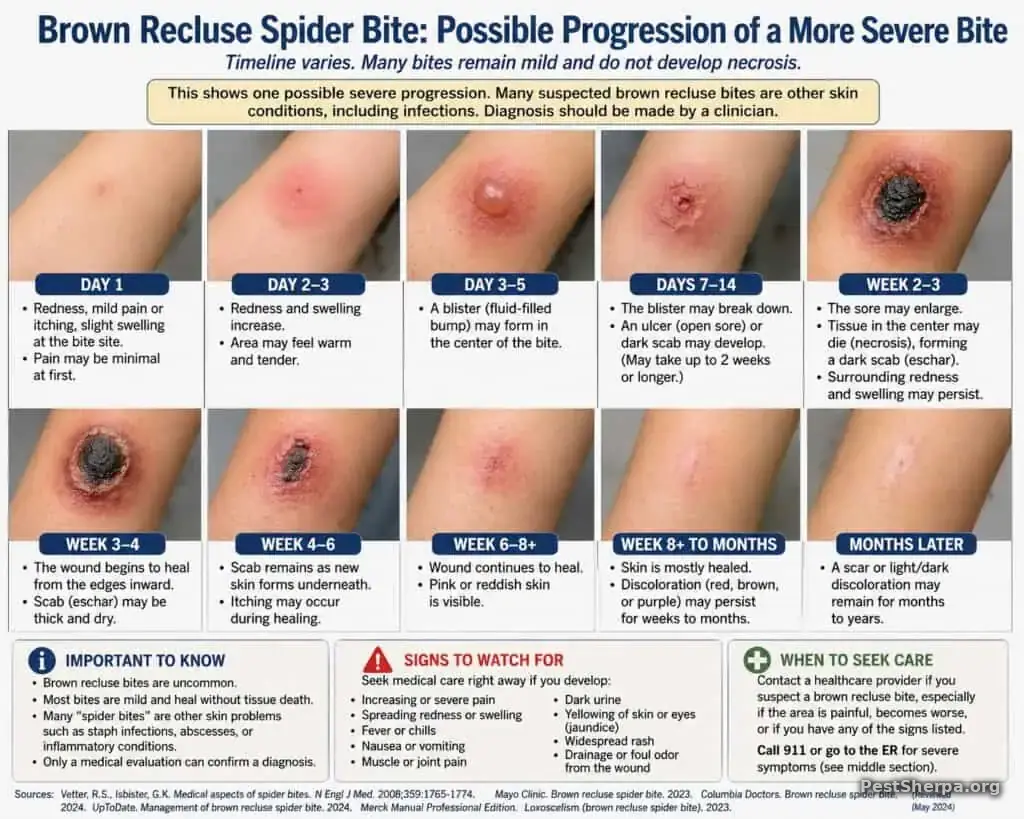
Important: Do not diagnose a brown recluse bite based only on a skin lesion. Bacterial infections, other arthropod bites, allergic reactions, medication reactions, and other medical conditions can look similar. Seek medical care for severe pain, spreading redness, fever, chills, drainage, a growing wound, or any symptom that concerns you.
Children, Pets, and Pesticide Safety
In homes with children or pets, focus first on nonchemical steps. These include decluttering, vacuuming, sealing gaps, careful storage, and placing monitoring traps where children and pets cannot reach them. Avoid leaving sticky traps where pets can step on them or children can handle them.
If an insecticide is considered, choose a product labeled for the target site and pest. Follow all directions. Keep people and pets away from treated areas until the label allows reentry. Do not use outdoor-only products indoors.
When Professional Help May Be Needed
Professional help may be worth considering when identification is uncertain, sightings are repeated, or trap counts are high. It may also help when spiders are found in bedrooms or clothing areas. The same goes for homes with extensive clutter, crawl spaces, attics, wall voids, or other areas that are hard to inspect.
A careful professional assessment may include specimen identification, inspection of harborages, and monitoring trap placement. It may also include exclusion recommendations, insect prey reduction, and targeted treatment of cracks, voids, or hiding places when appropriate. The goal should be confirmation and risk reduction, not unnecessary broad spraying.
Lookalikes and Common Misidentifications
Many spiders are brown, fast-moving, or found indoors. That does not make them brown recluses. Comparing key features can prevent unnecessary alarm.
Often confused with yellow sac spiders: pale yellowish wanderers on walls and ceilings are often yellow sac spiders, not brown recluses. Is your spider cream to pale yellow and resting in a small silk sac? If it does not match the recluse eye pattern and body profile, start with the yellow sac comparison before assuming a recluse.
| Lookalike | How It Differs From Brown Recluse | Helpful Clue |
|---|---|---|
| Yellow sac spider | Pale yellow to tan, wandering spider; lacks the brown recluse eye arrangement and classic recluse body profile | Often seen on walls and ceilings at night |
| Wolf spider | Usually larger, hairier, more robust, and often patterned | Active hunter often found on floors or outdoors |
| Cellar spider | Very long thin legs and delicate body | Often hangs in loose webs in corners or basements |
| House spider/cobweb spider | Often associated with messy cobwebs and rounder abdomen | Web location helps separate it from wandering recluse behavior |
| Southern house spider | Can look similar in color, but eye pattern and body form differ | Females may be mistaken for recluses in some areas |
| Black widow spider | Glossy dark body, rounded abdomen, often red hourglass on underside | Different shape, web, and markings |
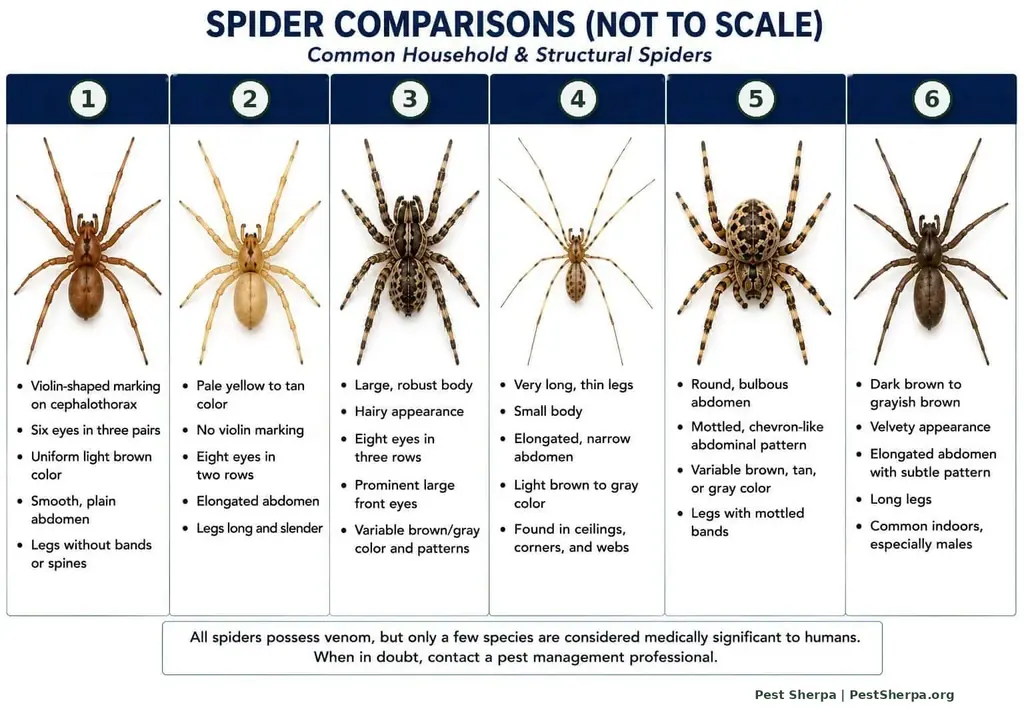
Which one did you find? Match the number:
- Brown recluse: uniform light brown with a violin marking on the front body section and plain legs.
- Yellow sac spider: pale yellow to tan with no violin marking and a long abdomen.
- Wolf spider: large, hairy and robust with striped brown and gray patterns.
- Cellar spider: very long, thin legs and a small body.
- Common house spider: round, bulbous mottled abdomen and banded legs.
- Southern house spider: dark brown to grayish brown with a velvety look and long legs.
Think you have number 1? Do not handle it. Trap it in a jar if you can and contact a licensed pro.
Brown recluse spider compared with common indoor spider lookalikes.
Frequently Asked Questions
How can I tell if a spider is a brown recluse?
Look for a combination of features. These include six eyes arranged in three pairs, a plain abdomen, long slender legs without bands, and tan-to-brown coloring. Also check for a possible violin-shaped mark on the cephalothorax (the front body section) and the correct geographic range. The violin mark alone is not enough.
Does one brown recluse mean I have an infestation?
Not necessarily. One spider may be accidental or may be a lookalike. Repeated sightings, multiple spiders on sticky traps, or spiders found in several storage areas are stronger signs that more investigation is needed.
Where do brown recluse spiders hide in homes?
They often hide in dark, dry, undisturbed spaces. Common spots include closets, basements, attics, garages, crawl spaces, cardboard boxes, stored clothing, shoes, behind baseboards, and inside cluttered storage areas.
Are brown recluse spiders aggressive?
No. They usually avoid people. Bites most often happen when a spider is trapped against skin in clothing, bedding, shoes, towels, or gloves.
Can a doctor diagnose a brown recluse bite without the spider?
A medical professional can evaluate and treat the wound, but confirming the cause is difficult without a spider seen biting or a collected specimen. Many conditions can resemble suspected brown recluse bites.
What should I do if I think I was bitten?
Wash the area and avoid scratching. Seek medical care if symptoms are severe, spreading, or infected-looking, or if they come with fever, chills, rash, nausea, dizziness, or a growing wound. Capture the spider only if it can be done safely.
Do sticky traps control brown recluse spiders?
Sticky traps help monitor and reduce wandering spiders. They work best as part of a broader plan that includes identification, clutter reduction, vacuuming, exclusion, and prey reduction.
Should I use a bug bomb for brown recluse spiders?
Bug bombs are usually a poor choice because they may not reach protected hiding places and can increase pesticide exposure indoors. Targeted inspection, monitoring, clutter reduction, exclusion, and label-following treatments are more practical.
Bottom Line
Brown recluse spiders deserve respect, but not panic. The most useful steps are accurate identification, range awareness, and careful inspection of undisturbed areas. Add sticky trap monitoring, clutter reduction, exclusion, and safer handling habits around stored items. If the spider cannot be confirmed or activity continues in living areas, expert identification or a structured pest assessment may be worthwhile.
References
- University of Kentucky Entomology: Brown Recluse Spider
- Missouri Department of Conservation: Brown Recluse / Violin Spider
- UC IPM: Brown Recluse and Other Recluse Spiders
- Michigan State University Plant & Pest Diagnostics: Brown Recluse
- UF/IFAS Extension: Brown Recluse Spider, Loxosceles reclusa Gertsch & Mulaik
- Journal of Integrated Pest Management: Integrated Pest Management of the Brown Recluse Spider
- Western Journal of Medicine / PubMed Central: Myth: Idiopathic Wounds Are Often Due to Brown Recluse or Other Spider Bites Throughout the United States
This article was written by Greg Baumann, founder of Pest Sherpa, and reflects more than 40 years of professional pest management experience.
About the Author

Greg Baumann | Pest Control Expert
Greg Baumann is the founder of Pest Sherpa and a Pest Control Expert with more than 40 years of professional pest management experience. His articles combine decades of field experience, technical expertise, and science-based guidance to help homeowners identify pests correctly, understand real-world risks, and make informed pest management decisions.
Mission: Identify the pest. Understand the risk. Stop the problem. Prevent the comeback. Know when it’s time to call a professional.