
Lone Star Ticks: Identification, Bite Risks, and Prevention
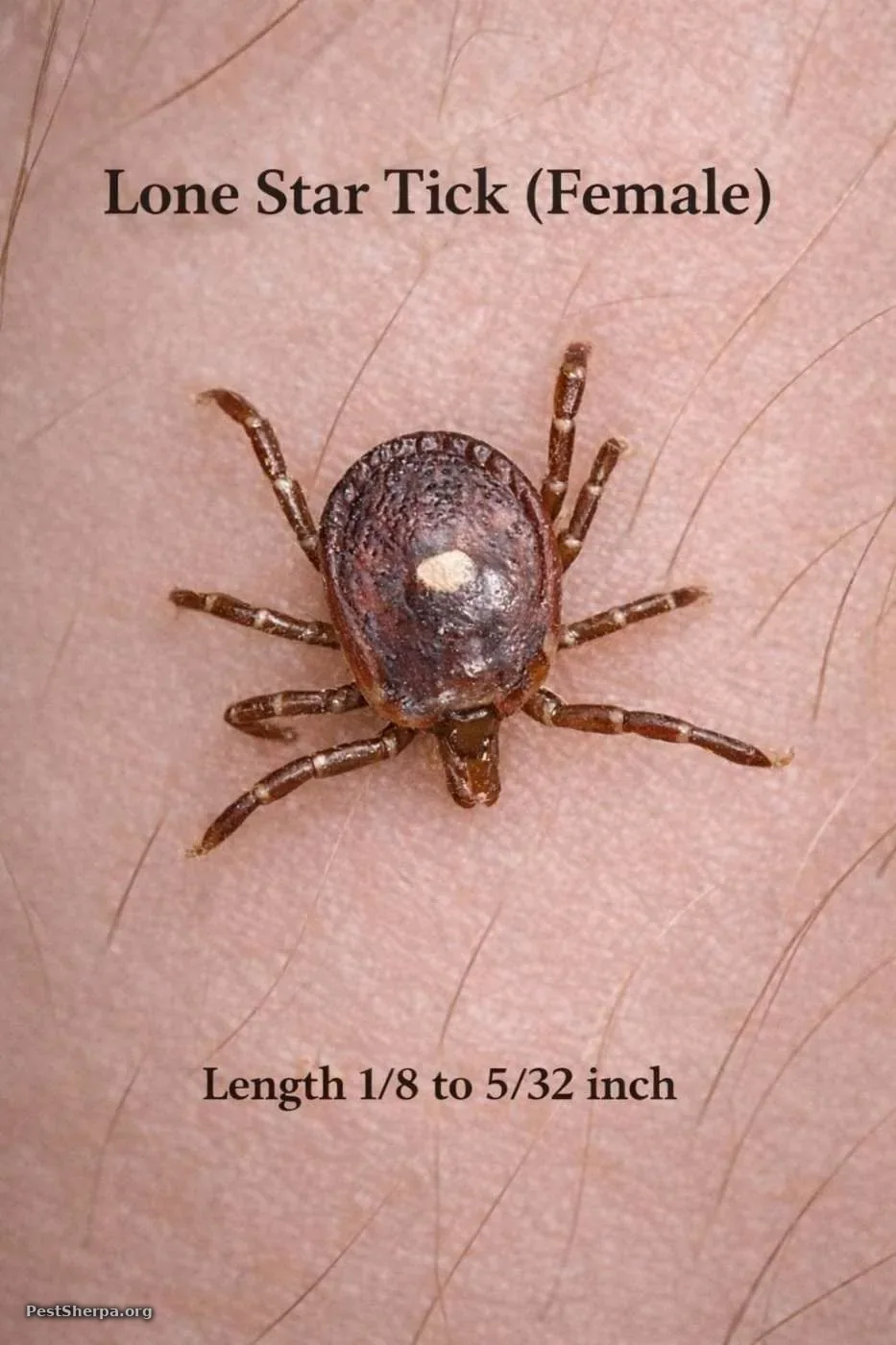
The Lone Star tick (Amblyomma americanum) is one of the most noticeable human-biting ticks in the eastern, southeastern, and parts of the midwestern United States. It is best known for the adult female’s single pale spot, its active host-seeking behavior, and its connection to several tick-associated health concerns.
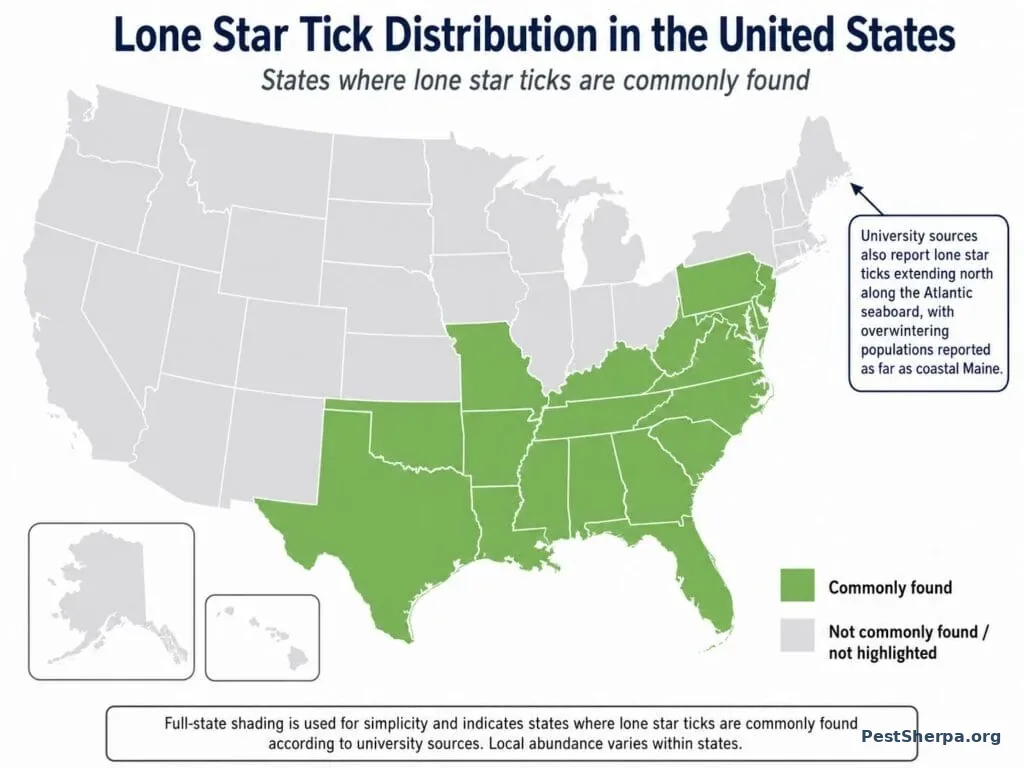
This guide helps you identify Lone Star ticks (Amblyomma americanum), understand what to do if bitten by a Lone Star tick, tighten lone star tick bite prevention around home and trails, and decide when to seek care. It is educational public-health adjacent guidance, not medical advice.
TL;DR: What To Do If Bitten by a Lone Star Tick
- Adult females are the easiest to recognize because they usually have one pale white or silvery spot on the back.
- Males do not have the single “lone star” spot. They usually have pale markings around the edge of the body.
- Larvae and nymphs are much smaller and may not show obvious markings, so size and life stage matter.
- Lone Star ticks are active host-seekers. They may move toward people and animals instead of only waiting passively on vegetation.
- They are associated with ehrlichiosis, tularemia, STARI, Heartland virus, Bourbon virus, and alpha-gal syndrome. Not every tick is infected, and not every bite causes illness.
- Prompt removal and bite monitoring matter. Remove attached ticks with fine-tipped tweezers, clean the bite area, and seek medical advice if rash, fever, flu-like symptoms, or allergic symptoms develop.
What to do if bit (quick steps): remove properly with fine-tipped tweezers → clean the skin → save the tick in a sealed bag or photograph it → watch for symptoms → contact a clinician as appropriate. Jump to the full What To Do After a Tick Bite section. For species and prevention basics, see the ticks hub.
Bite appearance limits: a lone star tick bite can look like a small red spot, itch, or mild swelling. Appearance varies and is not diagnostic of STARI, alpha-gal syndrome, or other illness from a photo alone.
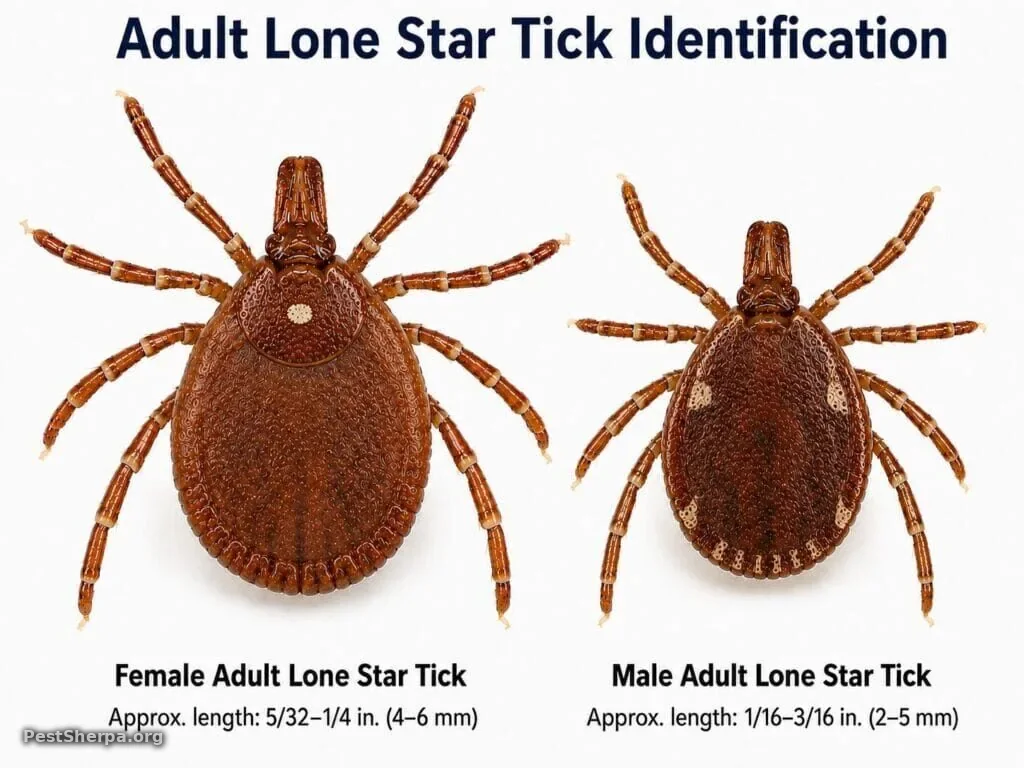
Adult female and male Lone Star ticks showing the female white spot and male edge markings
Quick Navigation
- Quick Identification
- Detailed Identification
- Lookalikes and Similar Ticks
- Distribution and Habitat
- Life Cycle and Seasonal Activity
- Feeding Behavior and Hosts
- Health Importance
- What To Do After a Tick Bite
- Property Inspection Checklist
- Prevention and Control
- What Does Not Work Well
- When Professional Help May Be Needed
- FAQs
- References
Quick Identification: Is This a Lone Star Tick?
| What You See | What It Suggests | Important Note |
|---|---|---|
| Brown tick with one pale white spot on the back | Adult female Lone Star tick is likely | The spot is on the scutum, or shield-like plate, near the front/top of the body |
| Brown tick with pale markings around the back edge | Adult male Lone Star tick is possible | Males lack the single central white spot |
| Very small tick with 8 legs and no obvious white spot | Nymph may be possible | Nymphs can be difficult to identify without magnification |
| Tiny “seed tick” with 6 legs | Larval tick | Larvae are immature ticks and can occur in clusters |
| Flat, gray-brown tick on a dog or wall indoors | May be a different tick, such as brown dog tick | Indoor tick activity should be identified carefully before choosing next steps |
Expert Insight: The female white spot is helpful, but it does not identify every Lone Star tick. Males, nymphs, and larvae look different, so do not rule out Lone Star ticks just because a small tick lacks the obvious “star.”
Lone Star Tick Identification
The Lone Star tick is a hard tick in the family Ixodidae. Like other ticks, it is an arachnid, not an insect. Adult ticks have eight legs and a compact body without the distinct head, thorax, and abdomen pattern seen in insects.
Adult Lone Star ticks are usually reddish-brown to dark brown. Unfed adults are roughly around 1/8 inch long, although size changes dramatically after feeding. Engorged ticks can look swollen, grayish, and much larger than unfed ticks.
Adult Female Lone Star Tick
Adult females are the stage most people recognize. The key feature is a single pale white or silvery spot on the dorsal shield, which gives the tick its common name.
Adult Male Lone Star Tick
Adult males do not have one central white spot. Instead, males usually have scattered pale markings, often around the rear edge of the body. This difference is a common reason people misidentify male Lone Star ticks.
Nymphs and Larvae
- Nymphs: very small, eight-legged, and lacking the obvious adult female spot.
- Larvae: extremely small, six-legged, and sometimes called “seed ticks.”
Because immature stages are small and easy to overlook, tick checks after outdoor activity should include hidden areas such as the scalp, behind the ears, waistline, armpits, backs of knees, groin area, socks, shoes, and pet fur.
Lookalikes and Similar Ticks
Several tick species may occur in the same regions as Lone Star ticks. Correct identification matters because different ticks have different hosts, habitats, seasonal patterns, and disease associations.
| Tick | How It Differs | Why It Matters |
|---|---|---|
| Lone Star tick | Adult female has a single pale spot; males have pale edge markings | Associated with aggressive biting behavior, ehrlichiosis, STARI, tularemia, Heartland virus, Bourbon virus, and alpha-gal syndrome |
| Blacklegged tick / deer tick | Smaller, darker legs, no female “lone star” spot | Important Lyme disease vector in many regions |
| American dog tick | Larger adult tick with ornate pale markings; does not have a single female white spot | Often associated with dogs, grassy edges, and some tick-borne disease risks |
| Brown dog tick | More uniformly brown and strongly associated with dogs and kennels | Can establish indoors where dogs are present |
Lone Star ticks have not been shown to transmit the bacterium that causes Lyme disease. For Lyme disease background and broader public-health context, see the Pest Sherpa Lyme disease research overview.
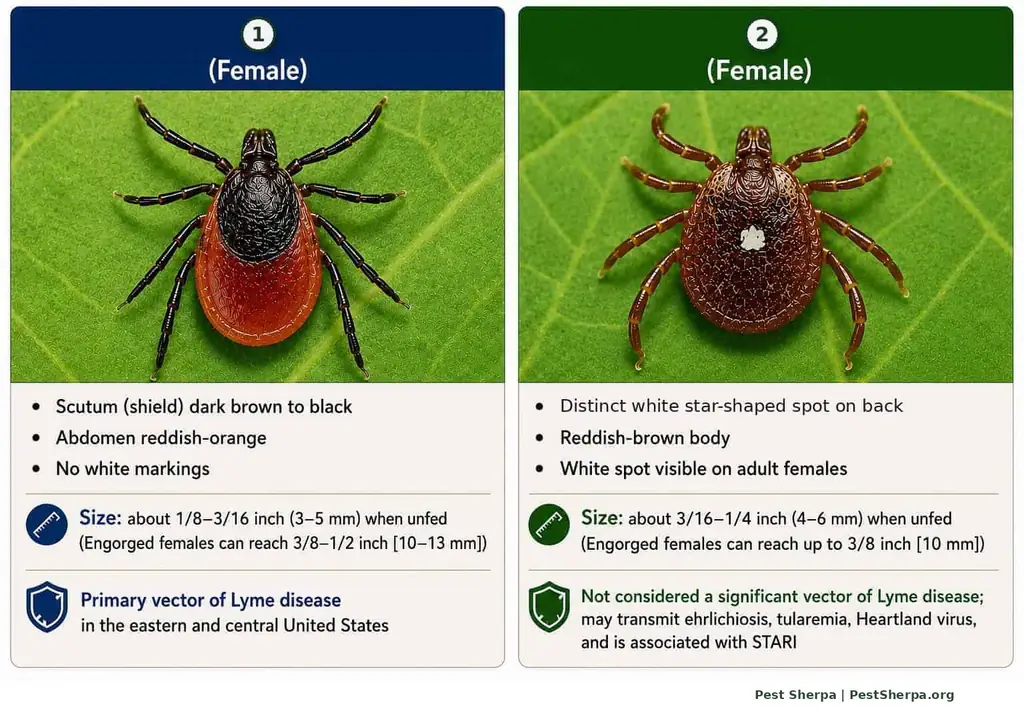
Which one did you find? Match the number:
- Blacklegged tick (deer tick): dark brown to black shield, reddish-orange abdomen and no white markings. The main carrier of Lyme disease in the eastern and central United States.
- Lone star tick: reddish-brown with a single white spot in the middle of the back on adult females. Not a significant carrier of Lyme disease, but can spread other illnesses.
Distribution and Habitat
Lone Star ticks are widely distributed across much of the eastern United States, including many areas of the Southeast, Northeast, South, and Midwest. Local abundance can vary by county, habitat, wildlife movement, weather, and season.
They are commonly associated with:
- Wooded areas
- Brushy edges
- Leaf litter
- Shaded trails and path edges
- Tall grass near wooded borders
- Yards that border forest, brush, or wildlife corridors
- Areas used by deer, dogs, livestock, ground-feeding birds, and other wildlife
Ticks need humidity to survive, so shaded vegetation, leaf litter, and protected ground cover often create better tick habitat than dry, open, sunny areas.
Life Cycle and Seasonal Activity
The Lone Star tick has four life stages: egg, larva, nymph, and adult. Larvae, nymphs, and adults all require a blood meal before developing or reproducing.
| Life Stage | What Happens | Common Reader Concern |
|---|---|---|
| Egg | Fed adult females drop from the host and lay thousands of eggs in protected areas | Eggs are usually hidden in leaf litter, soil, or protected outdoor sites |
| Larva | Six-legged larvae seek a blood meal from small animals, birds, reptiles, or people | Can appear as tiny “seed ticks,” sometimes in groups |
| Nymph | Eight-legged nymphs seek another host | Small size makes them easy to miss during tick checks |
| Adult | Adults feed, mate, and females later lay eggs | Adult females are easiest to recognize by the white spot |
Seasonal timing varies by region, but adults and nymphs are often most noticeable from spring into summer, while larvae are commonly encountered later in summer into early fall. In warmer regions, tick exposure can occur outside the peak season whenever conditions allow ticks to remain active.
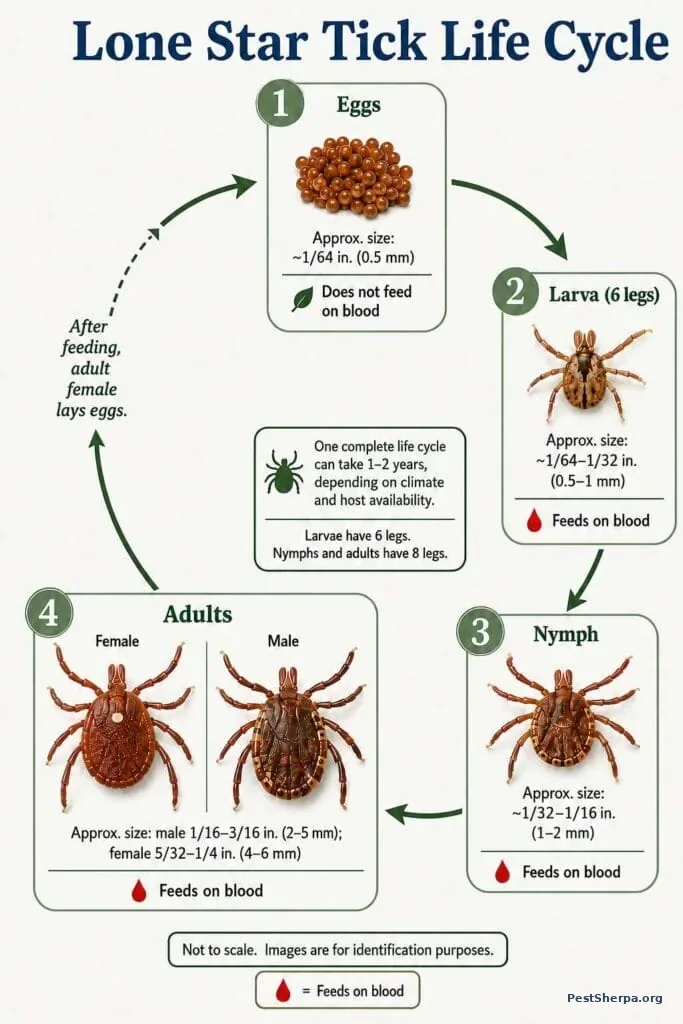
Lone Star tick life cycle from egg to larva, nymph, and adult. Note the very small size of each stage.
Feeding Behavior and Host Preferences
Lone Star ticks are known for aggressive host-seeking. They can detect cues such as movement, heat, and carbon dioxide, and they may move toward hosts. This makes them especially noticeable to hikers, hunters, gardeners, outdoor workers, pet owners, and people living near wooded or brushy areas.
Host use changes by life stage, but Lone Star ticks can feed on a wide range of animals.
- Larvae: birds, small mammals, reptiles, and sometimes people
- Nymphs: birds, mammals, dogs, wildlife, and people
- Adults: deer, livestock, dogs, medium to large mammals, and people
White-tailed deer are especially important hosts for adult Lone Star ticks in many landscapes. Reducing deer activity immediately around homes may help reduce tick pressure, but deer control alone is not usually a complete solution.
Medical and Public Health Importance
Lone Star ticks are medically important because their bites are associated with several human health concerns. Risk depends on location, tick life stage, infection status, attachment, individual immune response, and other factors.
Conditions associated with Lone Star ticks include:
- Ehrlichiosis
- Tularemia
- Southern tick-associated rash illness (STARI)
- Heartland virus disease
- Bourbon virus disease
- Alpha-gal syndrome, a delayed allergy associated with mammalian meat or other mammal-derived products in some people after tick bites
Not every Lone Star tick carries a pathogen, and not every bite causes illness. However, rash, fever, headache, fatigue, muscle aches, joint pain, swollen lymph nodes, unusual gastrointestinal symptoms, or allergic symptoms after a tick bite should be discussed with a healthcare provider.
Safety note: Seek urgent medical care for symptoms of a severe allergic reaction, such as trouble breathing, swelling of the lips or throat, dizziness, fainting, or widespread hives.
What To Do After a Tick Bite
If you find an attached tick, remove it as soon as possible. Do not wait for an appointment just to remove the tick. These steps align with standard public guidance such as CDC after-a-tick-bite recommendations already linked in References; they are not a substitute for personal medical care.
- Use clean fine-tipped tweezers if available.
- Grasp the tick as close to the skin surface as possible.
- Pull upward with steady, even pressure.
- Do not twist, jerk, crush, burn, smother, or coat the tick with petroleum jelly, nail polish, or other substances.
- Clean the bite area and your hands with soap and water, rubbing alcohol, or hand sanitizer.
- Save the tick in a sealed bag or take a clear photo (helpful for ID talk with a clinician). Do not rely on commercial tick tests alone for treatment decisions.
- Watch for rash, fever, flu-like symptoms, or allergic symptoms in the following days and weeks, and contact a clinician as appropriate.
Commercial tick testing is generally not a good basis for medical decisions. If symptoms develop after a tick bite, speak with a healthcare provider and mention the bite, when it occurred, and where the tick was likely picked up.
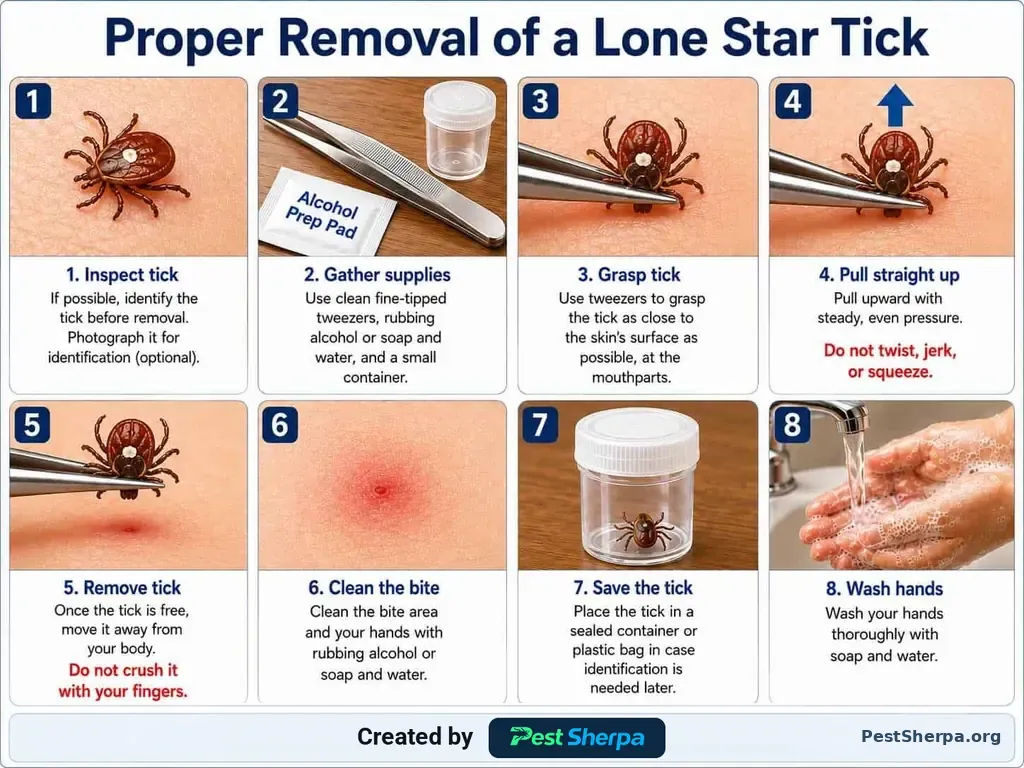
Correct tick removal using tweezers close to the skin.
Property Inspection Checklist
Finding Lone Star ticks on people or pets does not always mean the yard is heavily infested. Ticks may be picked up from trails, parks, hunting land, wooded edges, pet paths, or neighboring vegetation. Use the pattern of encounters to decide where to inspect first.
Start With High-Risk Areas
- Wooded borders
- Brush piles and overgrown vegetation
- Leaf litter along fence lines
- Deer trails or wildlife paths
- Pet resting areas
- Edges of trails, sheds, woodpiles, and outbuildings
- Shaded, humid ground cover
Clues That Tick Pressure May Be Coming From the Property
| Observation | What It May Mean |
|---|---|
| Ticks repeatedly found after spending time only in the yard | Yard or nearby edge habitat may be a source |
| Ticks found mostly after hiking, hunting, or visiting parks | Exposure may be occurring away from home |
| Ticks frequently found on dogs | Inspect pet paths, resting areas, fence lines, and veterinary prevention plans |
| Large numbers of tiny seed ticks | Larval tick activity nearby is possible |
| Heavy deer activity near the home | Adult tick host activity may be contributing to local tick pressure |
Tick dragging or flagging can help document tick presence, but it also creates exposure risk. People using these methods should understand tick precautions, wear protective clothing, use appropriate repellents, and perform careful tick checks afterward.
Lone Star Tick Bite Prevention and Control
Lone star tick bite prevention works best as an integrated approach: personal protection outdoors, yard habitat reduction, pet prevention, and pesticides only when appropriate and label-compliant. The goal is fewer bites, not a promise of zero ticks.
Personal Protection
- Avoid brushing against tall grass, leaf litter, and dense vegetation when possible.
- Walk near the center of trails.
- Wear light-colored clothing to make ticks easier to see.
- Consider tucking pants into socks in high-risk areas.
- Use EPA-registered tick repellents according to the label.
- Check clothing, gear, children, and pets after outdoor activity.
- Shower after outdoor activity when practical, and perform a full-body tick check.
Habitat Modification Around Homes
- Keep grass mowed in frequently used areas.
- Remove leaf litter from play areas, paths, patios, and immediate home edges.
- Trim back dense brush near outdoor living spaces.
- Create a dry, open transition zone between wooded edges and high-use lawn areas.
- Move woodpiles, brush piles, and unused debris away from play and seating areas.
- Reduce deer attractants near the home where practical and legal.
Pets and Livestock
Dogs, livestock, and other animals can pick up ticks and bring them close to people. Work with a veterinarian for pet or livestock tick prevention. Do not use a pesticide, repellent, or livestock product on an animal unless the label specifically allows that use.
Acaricides and Yard Treatments
Acaricides are pesticides labeled for ticks. They may be considered for high-risk tick habitat, property edges, or specific outdoor areas where ticks are documented or strongly suspected. They are not always necessary, and they should not replace personal protection and habitat management.
Always read and follow the product label. Keep children and pets away from treated areas until the label allows re-entry. Avoid drift, avoid treating flowering plants visited by pollinators unless the label allows it, protect water sources, and never apply products to drains, food-contact surfaces, or areas not listed on the label.
What Does Not Work Well
- Ignoring habitat: Ticks often persist when dense vegetation, leaf litter, and wildlife movement remain unchanged.
- Relying only on sprays: Pesticides may reduce ticks in targeted areas, but they do not remove every tick or prevent future exposure.
- Using indoor bug bombs for outdoor tick problems: Foggers do not solve yard tick habitat and can create unnecessary pesticide exposure.
- Unsafe tick removal tricks: Heat, petroleum jelly, nail polish, and harsh chemicals should not be used to force a tick to detach.
- Assuming one method is enough: Tick prevention usually requires personal protection, pet protection, habitat changes, and monitoring.
When Professional Help May Be Needed
Professional help may be worth considering when tick encounters are repeated, the source area is unclear, or the property includes high-risk wooded edges, brush, heavy deer activity, pets, children’s play areas, or commercial/outdoor work areas.
A qualified pest management professional, extension office, public health department, veterinarian, or land manager may help with identification, risk assessment, habitat recommendations, and label-compliant treatment options when they are appropriate.
Frequently Asked Questions
Do Lone Star ticks transmit Lyme disease?
Lone Star ticks have not been shown to transmit the bacterium that causes Lyme disease the way blacklegged ticks (Ixodes) do. They are associated with other conditions, including ehrlichiosis, tularemia, STARI, Heartland virus, Bourbon virus, and alpha-gal syndrome. For Lyme basics (a different tick disease story), see the Pest Lab Lyme disease page.
Does every Lone Star tick bite cause alpha-gal syndrome?
No. Alpha-gal syndrome can develop after tick bites in some people, but not everyone bitten by a Lone Star tick develops it. Anyone with delayed allergic symptoms after eating mammalian meat or exposure to mammal-derived products should speak with a healthcare provider.
Why did I find tiny seed ticks on my legs?
Seed ticks are larval ticks. Larvae are very small and may occur in groups. Wash clothing, shower, and carefully check the body for attached ticks after exposure.
Can Lone Star ticks live inside my home?
Lone Star ticks are usually associated with outdoor habitats and hosts. If ticks are repeatedly found indoors, check pets, clothing, gear, and possible tick entry from outdoor activity. Brown dog ticks are more likely than Lone Star ticks to establish indoors.
What should I do if I find a tick on my dog?
Remove attached ticks carefully, check the dog and your own clothing for additional ticks, and ask a veterinarian about tick prevention options appropriate for the animal. Do not apply human repellents or yard pesticides to pets unless the label specifically allows that use.
Will mowing the lawn eliminate Lone Star ticks?
Mowing can make high-use areas less favorable for ticks, but it will not eliminate ticks from wooded edges, brush, leaf litter, wildlife corridors, or neighboring properties. Mowing works best as one part of an integrated prevention plan.
What should I do if bitten by a Lone Star nymph?
Treat nymph bites the same way: remove promptly with fine-tipped tweezers, clean the skin, save or photograph the tick if you can, and watch for symptoms. Nymphs are small and easy to miss, so full-body checks after outdoor time matter.
Should I get the tick tested?
Saving the tick or a photo can help identification conversations, but commercial tick testing is generally not a reliable basis for medical decisions. Symptom monitoring and clinician guidance matter more than a mail-in tick result.
References
- Centers for Disease Control and Prevention: Lone Star Tick Surveillance
- Centers for Disease Control and Prevention: Preventing Tick Bites
- Centers for Disease Control and Prevention: What to Do After a Tick Bite
- Centers for Disease Control and Prevention: About Alpha-gal Syndrome
- Centers for Disease Control and Prevention: About Southern Tick-Associated Rash Illness
- Centers for Disease Control and Prevention: Clinical Overview of Ehrlichiosis
- Centers for Disease Control and Prevention: About Heartland Virus
- Centers for Disease Control and Prevention: About Bourbon Virus
- Oklahoma State University Extension: Lone Star Tick (Amblyomma americanum)
- University of Missouri Extension: Guide to Ticks and Tick-Borne Diseases
This article was written by Greg Baumann, founder of Pest Sherpa, and reflects more than 40 years of professional pest management experience.
About the Author

Greg Baumann | Pest Control Expert
Greg Baumann is the founder of Pest Sherpa and a Pest Control Expert with more than 40 years of professional pest management experience. His articles combine decades of field experience, technical expertise, and science-based guidance to help homeowners identify pests correctly, understand real-world risks, and make informed pest management decisions.
Mission: Identify the pest. Understand the risk. Stop the problem. Prevent the comeback. Know when it’s time to call a professional.