
Old House Borers: Identification, Damage Signs, and What to Do
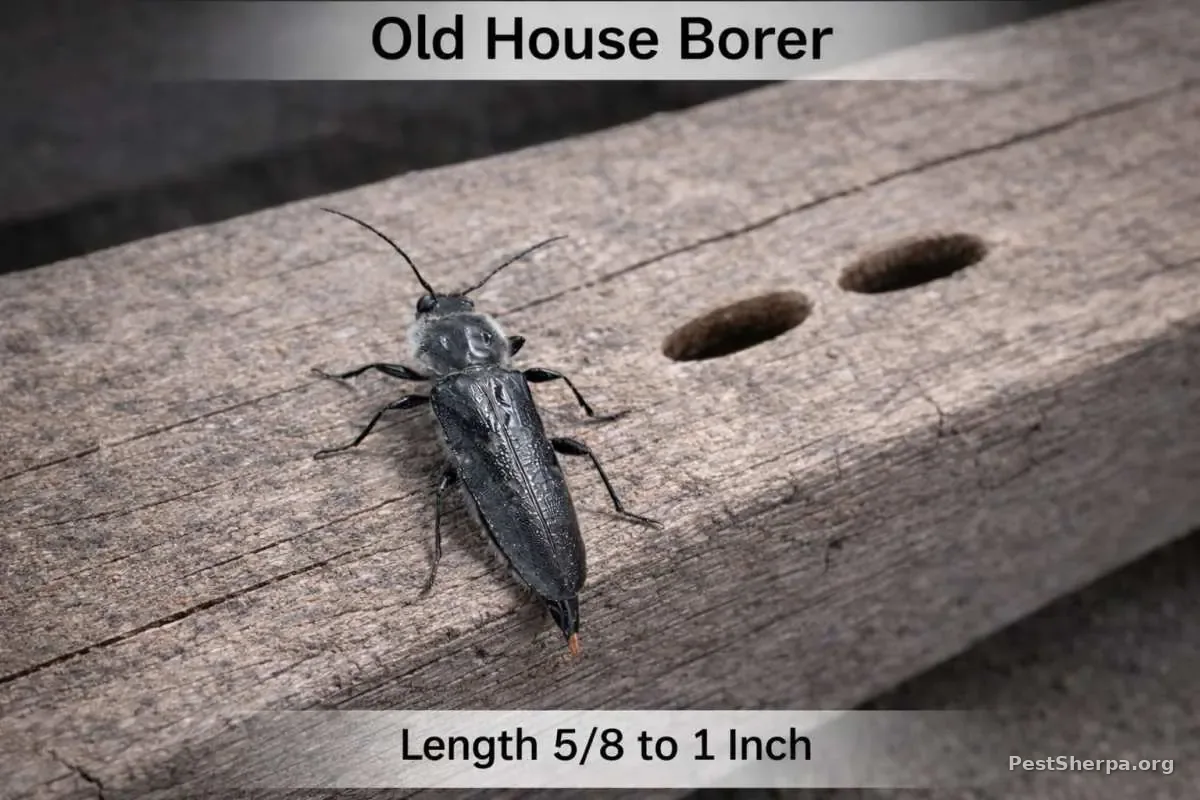
Old house borers are wood-boring longhorned beetles that can damage softwood framing, joists, rafters, beams, and other structural lumber. The species most often discussed in buildings is Hylotrupes bajulus. The adult beetle is only seen briefly, but the larvae can stay hidden inside wood for years, tunneling through sapwood before adult beetles finally emerge. The name can be misleading. Old house borers do not infest on ly old houses; however, under less than ideal conditions, the life cycle may be take years thus the name.
A few beetles or old exit holes do not automatically mean a home has an active infestation. The most useful next step is to confirm the insect, decide whether the evidence is new or old, and look for fresh frass, new oval holes, damaged softwood, moisture problems, and activity in attics, crawlspaces, or unfinished framing areas.
TL;DR: What Old House Borers Mean
Old house borer larvae feed inside softwood, especially pine, fir, spruce, and similar conifer lumber. They can reinfest structural timbers, but the damage usually develops slowly. Evidence such as fresh pale frass, newly opened oval holes, audible chewing sounds, or live larvae is more concerning than old darkened holes with no fresh material.
| What You See | What It May Mean | Best Next Step |
|---|---|---|
| One adult beetle indoors | Could be incidental, especially near windows | Save the specimen for identification and inspection |
| Oval holes about 1/4 to 3/8 inch wide | Possible old house borer emergence holes | Check whether edges and frass look fresh |
| Fresh, pale, sawdust-like frass | Possible current activity | Clean it up, mark the area, and monitor for return |
| Chewing, rasping, or clicking from wood | Possible larval feeding | Inspect accessible framing and consider professional evaluation |
| Softwood framing with widespread damage | Potential structural concern | Document damage before repairs and consider structural assessment |
Key point: The goal is not to apply a pesticide first. The goal is to identify the beetle, determine whether the infestation is active, find the affected wood, reduce moisture when present, and decide whether replacement, monitoring, or professional treatment is justified.
Quick Navigation
- Identification
- Damage and Signs of Infestation
- Active vs. Old Infestation
- Where To Inspect
- Biology and Life Cycle
- Habits, Wood Preference, and Moisture
- How Serious Is It?
- Lookalikes and Common Misidentifications
- What To Do
- What Does Not Work
- When Professional Help May Be Needed
- FAQs
- References
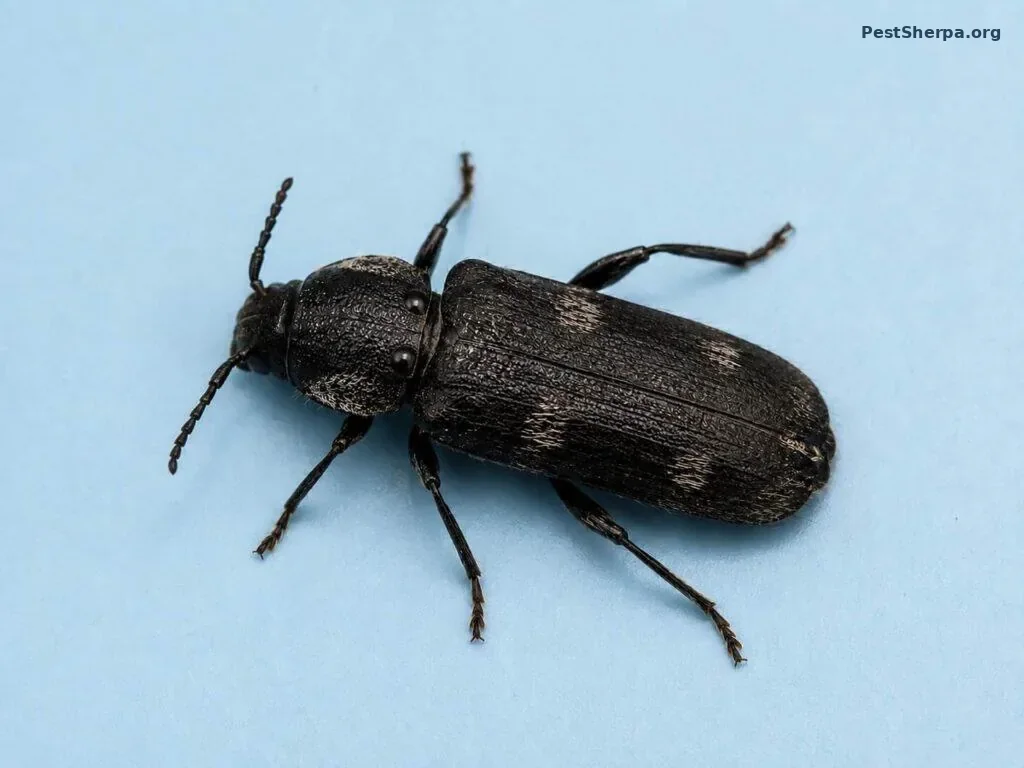
Adult old house borer beetle showing dark body, long antennae, and size scale.
Identification: What Old House Borers Look Like
The old house borer is a longhorned beetle in the family Cerambycidae. Adults are usually dark brown to black, somewhat flattened, and about 5/8 to 1 inch long, though size varies. The antennae are long, but not usually longer than the body. A useful adult feature is the pair of raised, shiny bumps on the section directly behind the head, often with faint gray patches on the wing covers. Live adult old house borers are rarely seen.
Adults are not the damaging stage. The larvae are the wood-feeding stage. Mature larvae are creamy white, grub-like, and can be about 1 inch or slightly longer. They remain inside the wood, so homeowners usually notice damage, frass, sounds, or exit holes before they ever see a larva.
| Stage | What To Look For | Why It Matters |
|---|---|---|
| Adult | Dark longhorned beetle, about 5/8 to 1 inch, long antennae, raised bumps behind head | May confirm the species if a specimen is found |
| Larva | Creamy white, segmented, hidden inside softwood | Main damage-causing stage |
| Pupa | Develops near wood surface before adult emergence | Rarely seen unless wood is opened |
| Exit hole | Oval, often about 1/4 to 3/8 inch wide | Evidence that an adult emerged from wood |
Because several wood-boring insects can leave holes in lumber, identification should be based on the insect, hole shape, frass texture, wood type, and location. For comparison with other wood pests, see the Pest Sherpa guide to lyctid powderpost beetles and the broader termite guide.
Damage and Signs of Infestation
Old house borer damage is usually hidden at first because larvae tunnel inside the wood. The most visible sign is often an oval exit hole where an adult beetle emerged. Fresh frass, new holes, or sounds from wood are more useful than old holes alone.
- Oval exit holes: Often about 1/4 to 3/8 inch wide, sometimes with ragged edges.
- Frass: Sawdust-like material made of wood fragments and insect waste. Old house borer frass may include small pellet-like particles.
- Internal galleries: Tunnels may run through sapwood and can be packed with frass.
- Audible feeding: Larger larvae may produce rasping, clicking, or chewing sounds inside wood, especially when conditions are favorable.
- Visible weakening: Severely damaged framing can sound hollow, feel weakened, or show hidden tunneling when probed.
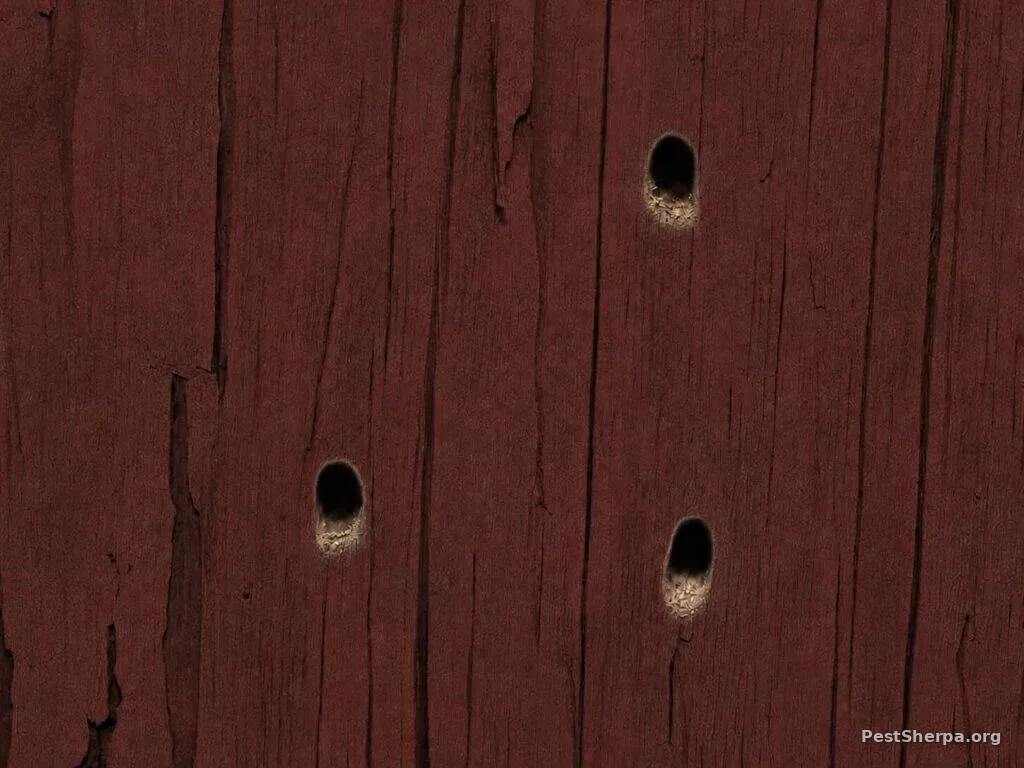
Oval old house borer exit holes and sawdust-like frass in softwood.
Active vs. Old Infestation: How To Tell the Difference
Exit holes can remain visible long after beetle activity has stopped. Before assuming the infestation is active, look for changes over time.
| Evidence | More Likely Old | More Likely Active |
|---|---|---|
| Exit holes | Darkened, dusty, painted over, or unchanged | Fresh edges, new openings, or new holes after monitoring |
| Frass | Absent, dusty, mixed with cobwebs, or does not return after cleaning | Fresh pale material returns after cleaning |
| Sound | No sound during repeated checks | Rasping or clicking from the same wood area |
| Insects | No specimens found | Adult beetles, larvae, or pupae found near affected framing |
| Damage | Stable, no new weakening | Progressive softening, new frass, or newly exposed galleries |
A practical monitoring method is to clean up loose frass, photograph the area, mark existing holes lightly with painter’s tape or a sketch, and recheck the area later. Fresh frass returning below the same holes or new holes appearing nearby is stronger evidence of activity than old holes alone.
Where To Inspect in a Home
Old house borer evidence is most often found where softwood framing is exposed or partly exposed. Finished walls and ceilings can hide damage, so start with accessible areas before opening anything.
- Attics, rafters, roof framing, and trusses
- Crawlspaces, sill areas, joists, and subfloor framing
- Unfinished basements and storage areas
- Log homes, exposed beams, or unfinished pine surfaces
- Areas where moisture, condensation, roof leaks, or poor ventilation affect wood
- Newer structures where infested lumber may have been installed before construction was completed
Use a flashlight, a small mirror, a phone camera, and a simple sketch of the affected area. Avoid aggressive probing until you have photographed evidence. If the wood may be load-bearing, avoid removing or cutting it without appropriate structural guidance.
Biology and Life Cycle
Old house borers develop through complete metamorphosis: egg, larva, pupa, and adult. Females lay eggs in cracks, crevices, joints, or rough areas of exposed wood. After hatching, larvae bore into the wood and feed inside the sapwood.
The larval stage is the long, damaging stage. Development time varies with temperature, wood quality, and wood moisture. In many sources, old house borer development is described as taking several years, with longer development possible when conditions are less favorable. Adult emergence is commonly noticed during warmer months, especially late spring through summer.
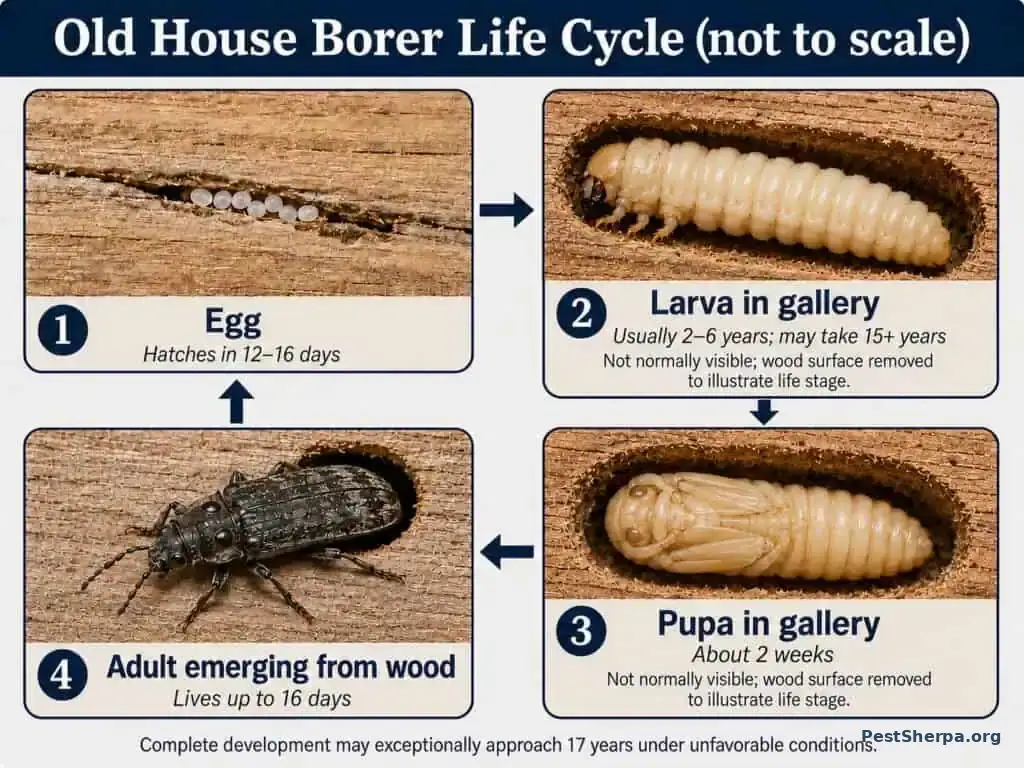
IOld house borer life cycle from egg to larva, pupa, and adult beetle emerging from wood.
Habits, Wood Preference, and Moisture
Old house borers primarily attack softwoods such as pine, spruce, fir, and other conifers. They are associated with the sapwood portion of lumber, which is more nutritious than heartwood. This is one reason infestations are often associated with structural timbers rather than hardwood furniture or hardwood flooring.
Despite the name, old house borers are often associated with newer structures because lumber may already contain larvae before construction. They can also reinfest older softwood if conditions remain suitable.
Moisture matters. Wood that is protected, dry, sealed, and well ventilated is generally less favorable than damp, poorly ventilated, unfinished softwood. Moisture correction will not instantly kill hidden larvae, but it can make the structure less favorable over time and should be part of any long-term plan.
How Serious Is an Old House Borer Problem?
Old house borers are more structurally important than many beetles that simply emerge from lumber once and do not reinfest. However, severity depends on the amount of active wood, how long the activity has continued, which structural members are affected, and whether moisture or access problems are present.
| Situation | Concern Level | Why |
|---|---|---|
| One adult beetle, no damaged wood found | Low to uncertain | May be incidental or from a single emergence |
| Old holes only, no fresh frass | Uncertain | Could be inactive; monitor before assuming treatment is needed |
| Fresh frass or new holes in softwood framing | Moderate | Suggests possible ongoing activity |
| Multiple affected rafters, joists, or beams | High | Extent and structural role matter |
| Hidden activity plus moisture or poor access | High | May require specialized inspection or treatment planning |
If the affected wood is structural, the question is not only “What insect is this?” but also “How much sound wood remains?” A pest identification may need to be paired with a building or structural assessment when major members are weakened.
Lookalikes and Common Misidentifications
Several pests can be confused with old house borers because they involve holes, frass, or wood damage. Correct identification matters because the best response can be very different.
| Pest or Damage Type | How It Differs | Useful Link |
|---|---|---|
| Lyctid powderpost beetles | Usually attack seasoned hardwoods; exit holes are much smaller and round; frass is very fine and flour-like | Lyctid powderpost beetles |
| Drywood termites | Produce hard, pellet-like fecal pellets rather than old house borer frass; galleries and evidence differ | Drywood termites |
| Dampwood termites | Associated with moisture-damaged wood and termite galleries, not longhorned beetle exit holes | Dampwood termites |
| Subterranean termites | Often associated with soil contact, shelter tubes, and hidden galleries; they do not leave old house borer-style oval exit holes | Termite guide |
| Carpenter bees | Make round entry holes in exposed wood and create galleries for nesting, usually in exterior wood surfaces | Carpenter bees |
| Wood wasps or horntails | May emerge from new construction lumber but usually do not reinfest finished structural wood | |
| Deathwatch beetles | Can make smaller round holes and gritty frass; often requires closer identification |
What To Do: Practical Next Steps
1. Save evidence before disturbing the area
Photograph holes, frass, damaged wood, and any adult beetles. If you find an adult beetle, place it in a small sealed container or clear bag for identification. Do not throw away the only specimen before confirming what it is.
2. Confirm the wood type and location
Old house borers are primarily associated with softwood structural lumber. Hardwood flooring, bamboo, furniture, and trim may point toward powderpost beetles or other wood-boring beetles instead.
3. Decide whether activity appears fresh
Clean up loose frass, mark existing holes, and recheck later. Fresh material returning, newly formed holes, or repeated sounds from the same wood area are stronger evidence than old holes by themselves.
4. Reduce conditions that favor activity
- Repair roof leaks, plumbing leaks, and exterior water intrusion.
- Improve attic and crawlspace ventilation where practical.
- Keep exposed wood dry and accessible for inspection.
- Do not store damp lumber, scrap wood, or firewood against the house.
- Seal, paint, varnish, or otherwise finish exposed susceptible wood when appropriate.
5. Consider removal or replacement when damage is localized
If activity is limited to one board, one decorative member, or a small accessible area, removal and replacement may be more practical than pesticide treatment. Structural members should be evaluated carefully before cutting, drilling, or removing wood.
6. Use pesticides only when appropriate
Pesticides are not always necessary. When they are considered, identification and access matter because larvae feed inside wood. Any pesticide product must be used only according to its label. Avoid applying insecticides around children, pets, food areas, air returns, drains, or poorly ventilated spaces unless the label specifically allows that use.
What Does Not Work
- Spraying random surfaces: Larvae are inside the wood, so surface sprays may not reach the problem.
- Assuming every hole is active: Old holes can remain long after beetles are gone.
- Ignoring moisture: Moisture problems can make wood more favorable and can also indicate other structural issues.
- Throwing away specimens: Identification is much harder without the insect.
- Using foggers or “bug bombs” for hidden larvae: These are unlikely to solve larvae feeding inside wood and can create unnecessary exposure risk.
When Professional Help May Be Needed
Professional help may be worth considering when the evidence suggests current activity, the affected wood is structural, the damaged area is hidden or widespread, or the insect cannot be confidently identified.
- Fresh frass keeps returning after cleanup.
- New exit holes appear after monitoring.
- Rafters, joists, beams, sill plates, or other load-bearing members are affected.
- Damage is inside walls, ceilings, crawlspaces, or other hard-to-access areas.
- You need help distinguishing old house borers from termites, powderpost beetles, deathwatch beetles, or construction-related wood borers.
- Localized treatment, fumigation, or structural replacement is being considered.
Possible management options may include monitoring, moisture correction, wood replacement, localized treatment of accessible wood, or, in unusual widespread cases, whole-structure fumigation. The appropriate option depends on identification, activity, access, extent of damage, and label-allowed treatment choices.
FAQs About Old House Borers
Do old house borers only infest old houses?
No. The name is misleading. Infestations are often associated with newer structures because larvae may already be inside lumber before or during construction. Older structures can still be reinfested if suitable softwood and conditions are present.
Are old house borers the same as termites?
No. Old house borers are beetles. Termites are social insects with very different biology, signs, and treatment decisions. The hole shape, frass, wood type, and insect specimen help separate them.
Does one old house borer beetle mean the house is infested?
Not necessarily. One beetle may have emerged from a single piece of wood or entered from another source. Look for fresh frass, repeated adult emergence, new holes, damaged softwood, or sounds from wood before assuming a larger infestation.
How long can old house borer larvae live in wood?
The larval stage can last several years, and development may be longer when conditions are less favorable. This long hidden stage is why adult emergence can happen years after lumber was installed.
What do old house borer exit holes look like?
Exit holes are usually oval and often about 1/4 to 3/8 inch wide. Ragged edges and fresh pale frass nearby can suggest recent emergence, but old holes alone do not prove current activity.
Can old house borers reinfest wood?
Yes. Unlike many borers that simply emerge from construction lumber and do not continue in seasoned wood, old house borers are known for their ability to reinfest suitable softwood structural timbers.
Should I treat the wood immediately?
Not always. First confirm identification and activity. If evidence is old and inactive, monitoring and moisture correction may be enough. If fresh activity is present in structural wood, further evaluation may be justified.
Can I solve old house borers with a store-bought spray?
Usually not by spraying randomly. Larvae feed inside wood, so access and product labeling matter. Do not drill, inject, fog, or apply insecticides inside building cavities unless the product label allows that use and you understand the exposure risks.
References
- University of Maryland Extension: Old House Borer
- University of Kentucky Entomology: Old House Borer
- Penn State Extension: Old House Borer
- Texas A&M AgriLife Extension: Structure-Infesting Wood-Boring Beetles
- UC IPM: Wood-Boring Beetles in Homes
This article was written by Greg Baumann, founder of Pest Sherpa, and reflects more than 40 years of professional pest management experience.
About the Author

Greg Baumann | Pest Control Expert
Greg Baumann is the founder of Pest Sherpa and a Pest Control Expert with more than 40 years of professional pest management experience. His articles combine decades of field experience, technical expertise, and science-based guidance to help homeowners identify pests correctly, understand real-world risks, and make informed pest management decisions.
Mission: Identify the pest. Understand the risk. Stop the problem. Prevent the comeback. Know when it’s time to call a professional.