
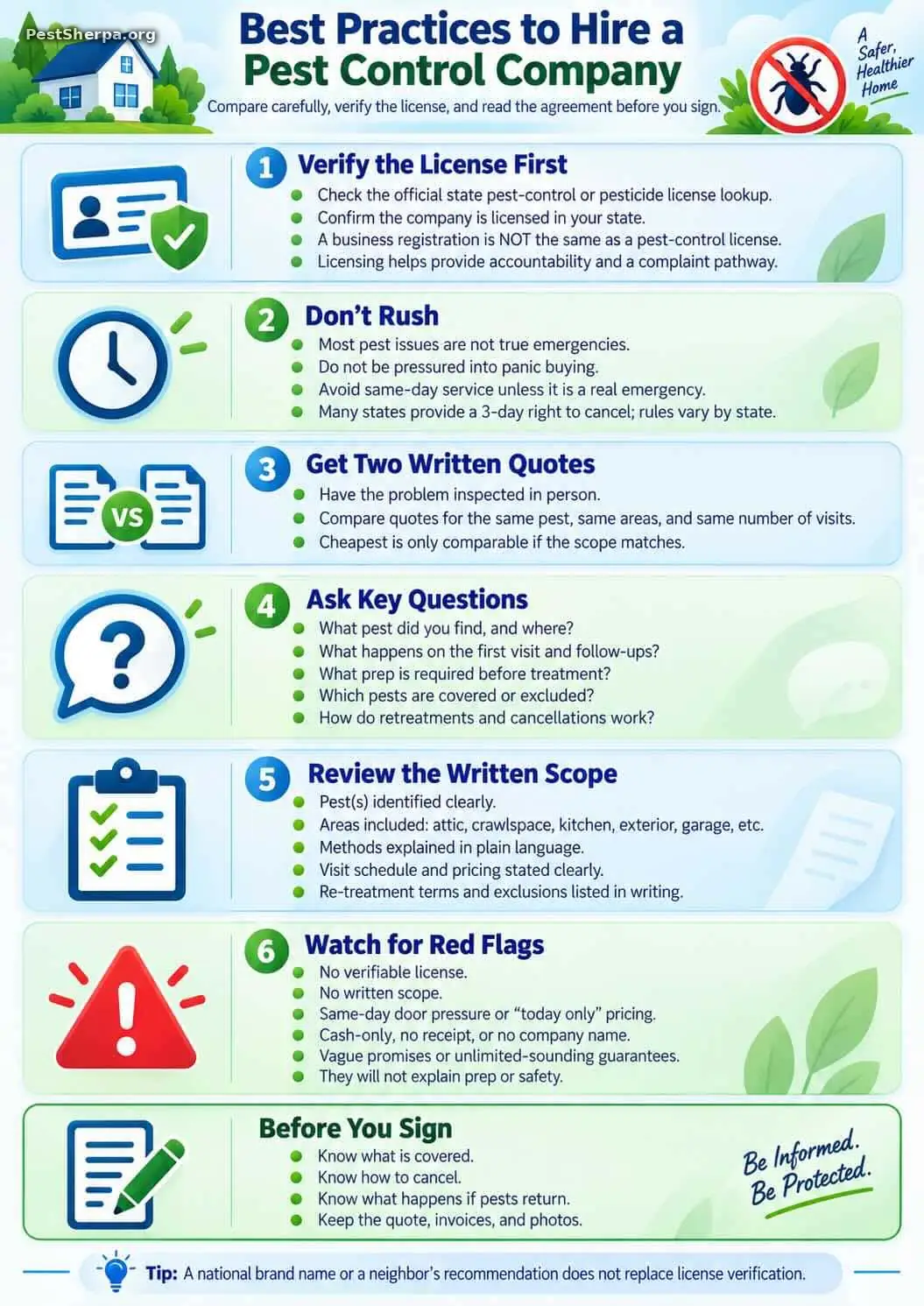
What to Look for When Hiring a Pro for Mosquitoes
Mosquito service is often sold as a yard or shrub spray subscription. That can trim adult biting pressure for a while, but it is not the foundation of control. The Centers for Disease Control and Prevention (CDC) puts weekly source reduction, emptying and scrubbing water-holding containers, at the center of home mosquito work, along with screens, personal protection, and targeted adulticides only as a supporting layer. CDC’s outdoor spraying fact sheet is plain: outdoor spraying alone will not keep a yard free of mosquitoes. On automatic misting systems, CDC states it does not recommend misting systems by homeowners or in residential areas; EPA adds that misters have not been studied sufficiently to document effectiveness for mosquito control or proven prevention of West Nile virus. Hire for integrated mosquito management (IMM), not for a fog that pretends to replace dumping the bucket.
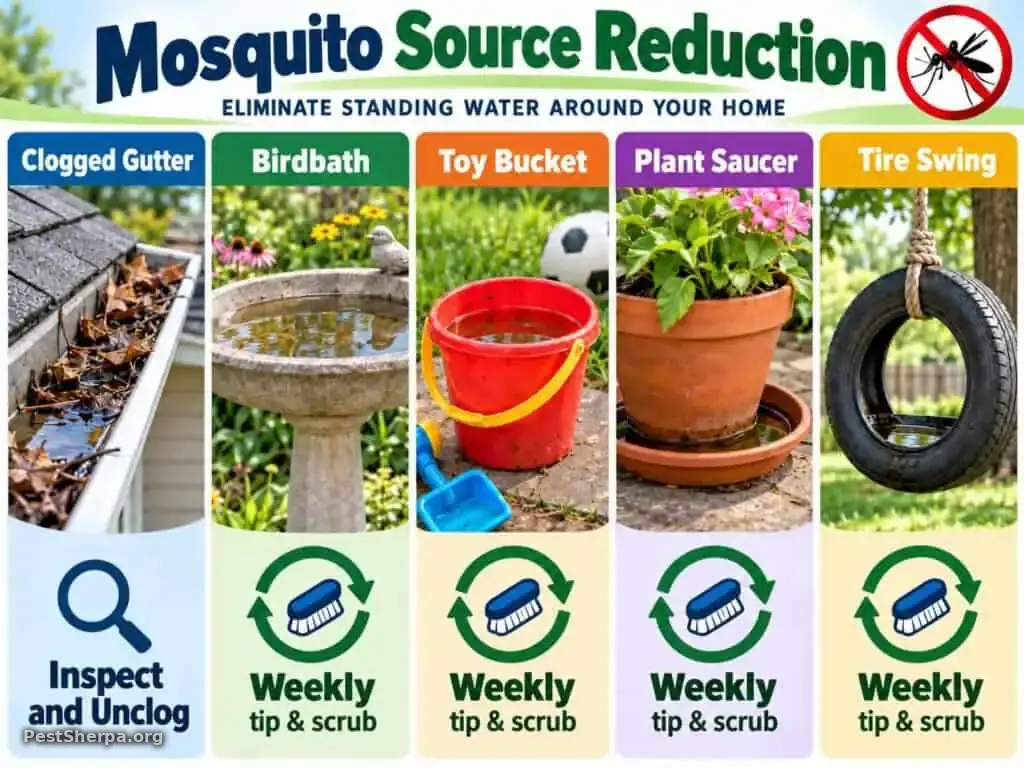
A little effort greatly reduces the breeding sites of mosquitoes.
Confirm the Problem and Set Realistic Goals
Pressure rises when standing water persists weekly, when adults rest in cool dark humid sites near people (under decks, thick vegetation, sheds), and during warm-season activity windows that vary by species and region (CDC; UF/IFAS). A yard is part of a larger landscape, University of Wisconsin-Madison Extension notes some mosquitoes can move in from well beyond your lot line, so local sprays cannot “seal” a property.
Start with our mosquito guide. After heavy rain or flooding, see protecting children from mosquitoes after rain and flooding. Most bites are nuisance; disease risk is real but managed with layered prevention, not scare sales.
DIY Versus Professional Help
DIY wins the ground game: once a week, empty, scrub, turn over, cover, or discard water-holding items; maintain gutters; screen rain barrels; repair window and door screens; use EPA-registered skin repellents when outdoors; consider fans at seating areas (CDC; UF/IFAS; UW Extension). Where small water bodies cannot be dumped, labeled larvicides such as Bti dunks/bits are a homeowner option. Follow the label; treat only water that will not be used for drinking (CDC larvicides).
Hire a licensed applicator when breeding sites are large or hard to access, when adults persist after source work, when you want calibrated residual barrier applications on vegetation and structures, or when you need product and pollinator guidance in writing (UW Extension; CDC). Community outbreaks and high trap counts remain the domain of local mosquito control districts using surveillance-led IMM. Private yard service complements, it does not replace, public programs (CDC; EPA).
What Good Mosquito Service Looks Like
- Source reduction first. Written findings on gutters, low spots, ornamental water, toys, and trash (UF/IFAS; CDC; UW Extension).
- Larvicides where water cannot be removed. Bacterial products such as Bti and other labeled options; CDC states that when used according to label, larvicides do not harm people, pets, or the environment as described on CDC’s larvicides page.
- Personal protection and screens remain part of every plan.
- Targeted adulticides / barrier sprays: temporary. CDC: treat resting sites; do not treat flowering plants; fog or residual sprays can reduce adults quickly but may need reapplication and cannot stand alone. If not done properly, this can also harm beneficial insects. UW Extension: pyrethroid residuals on vegetation may last days to weeks; mosquitoes then reinvade; frequent calendar spraying raises pollinator and nontarget concerns. A single treatment before an outdoor event can be reasonable when numbers are high; season-long “mosquito-free” guarantees are not.
- IMM framing. Inspect, reduce sources, treat larvae, use adults tools when needed, and evaluate, matching CDC and EPA integrated messaging.
Misting systems: read the federal language carefully
CDC (updated May 14, 2024): CDC does not recommend misting systems for homeowners or residential areas. Routine timed sprays can harm pollinators, increase unintended exposure, may spray when mosquitoes are not present, are not EPA-regulated as equipment, and lack effectiveness data consistent with sound IMM. Minimum-risk products used in misters are not EPA-evaluated for effectiveness.
EPA’s mosquito misting systems page: the equipment itself is not EPA-regulated (EPA registers the pesticides). Systems have not been studied sufficiently to document effectiveness for mosquito control and are not proven to control or prevent West Nile virus or other diseases. Using a product whose label prohibits misting-system use is illegal. States may add rules. IPM is preferred.
Gadgets that are not primary control
- Bug zappers / UV lights (mostly non-mosquitoes; harm beneficials): UF/IFAS; UW Extension.
- Ultrasonic / electronic / phone-app “repellers.”
- Repellent plants left uncrushed in the yard; vitamin B or dietary garlic; bracelets and dragonfly mimics (UF/IFAS; UW Extension).
- Vague “all natural / chemical-free” adult fogs that still use pesticides without clear EPA-registered actives. Any pesticide exempt from EPA registration must still have all ingredients and other labeling information. They cannot be called “safe” or “chemical free.”
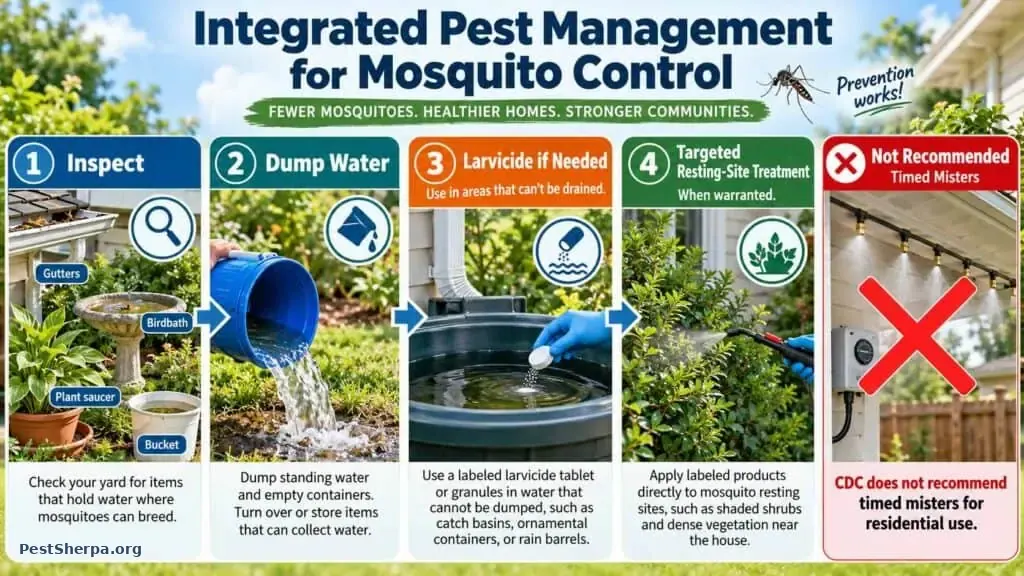
Integrated pest management should be the cornerstone of any mosquito control program and should not rely solely on pesticide applications.
Credentials and Questions
Pesticide rules are state-specific: verify commercial applicator certification for mosquito or public-health pest work, company insurance, and the product label before treatment. CDC points to NPMA hiring tips and NPIC (1-800-858-7378) for insecticide health questions.
- Are you licensed/certified for mosquito applications in this state?
- Do you practice IPM? Will you inspect standing water before spraying?
- What is the active ingredient, and may I see the label and SDS?
- Is this fog/knockdown, residual barrier, larvicide, or a combination, and how long should I expect relief?
- What is the re-entry interval for people, pets, and irrigation?
- How do you protect pollinators and avoid flowering plants?
- Calendar spray or inspection-triggered service?
- Do you sell misting systems? If yes, disclose CDC’s non-recommendation and EPA’s lack of proven disease/control efficacy.
- What follow-up applies if pressure returns after rain?
- How do you coordinate with local mosquito control district guidance?
Comparing Bids, Safety, and Aftercare
Prefer IPM plans with source coaching and larval work over spray-only subscriptions. Sources do not prescribe a standard consumer warranty. Expect temporary adult reduction and ask in writing what callbacks cover versus what neighboring habitat excludes.
Label is the law. Keep people and pets off treated surfaces until dry or as directed. Broad-spectrum adulticides can affect bees and other beneficials; keep applications away from fish ponds as labels require. Continue weekly water dumps after every service: pros cannot empty your plant saucers every evening.
Red flags
- Guarantees of a mosquito-free yard all season.
- Spray-only quotes with no water inspection.
- Misting systems as the main solution without CDC/EPA disclosures.
- Refusal to name active ingredients or provide pesticide labels and Safety Data Sheets for any product to be used.
- Treating flowering plants with no pollinator protection plan.
- Upselling zappers, ultrasonics, or vitamin-B kits as core control.
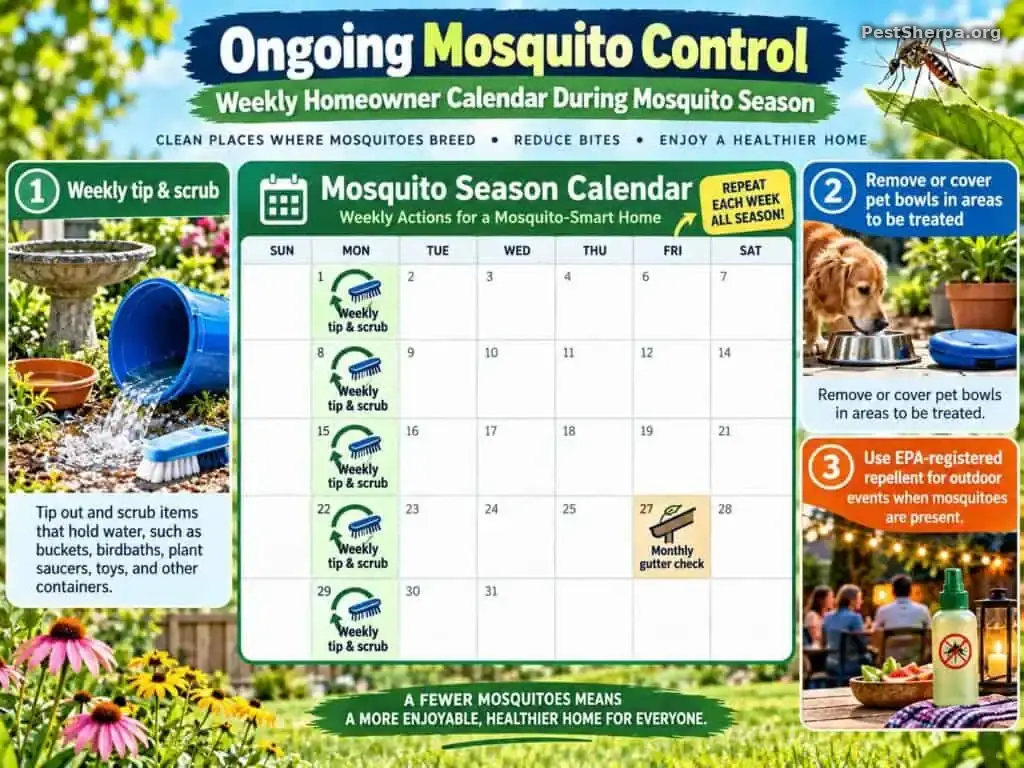
During mosquito season, schedule weekly and monthly mosquito control activity.
Hiring Checklist: Mosquitoes
- Put source reduction first: read the mosquito guide.
- Treat barrier/fog service as temporary adult reduction, not a cure.
- Remember: CDC does not recommend residential misting; EPA says misters are not proven for WNV prevention.
- Hire licensed IPM applicators who inspect breeding sites and protect pollinators.
- Keep screens, larvicides for undrainable water, and personal repellents in the stack.
- Proposal questions: Ask the Sherpa.
The best mosquito hire makes your property harder to breed in, and uses chemistry as a scalpel after the water is gone.
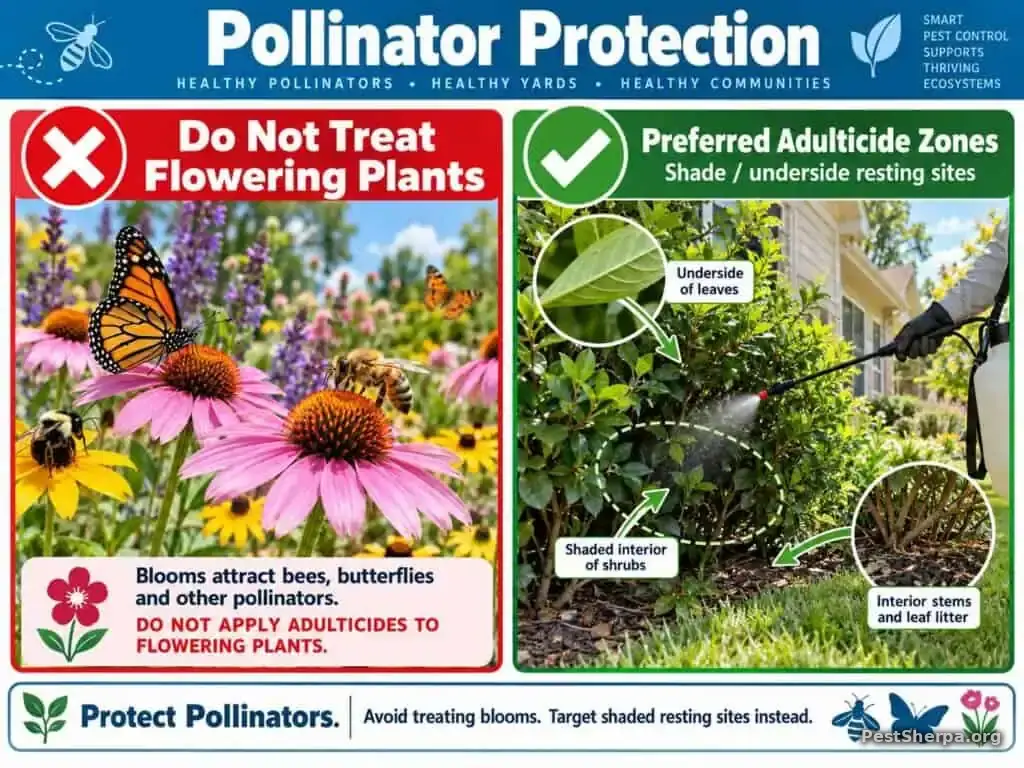
Pollinator protection when developing a mosquito control program with or without a professional service should be a priority in any program.
Sources & Further Reading
Selected public authorities used to check the hiring guidance above (not an exhaustive bibliography):
- CDC: Mosquito Control at Home
- CDC: Misting Systems for Mosquitoes (does not recommend residential misting)
- EPA: Mosquito Misting Systems
- CDC: Outdoor Spraying for Mosquitoes (PDF)
- UW-Madison Extension: Making Informed Mosquito Control Decisions
This article was written by Greg Baumann, founder of Pest Sherpa, and reflects more than 40 years of professional pest management experience.
About the Author

Greg Baumann | Pest Control Expert
Greg Baumann is the founder of Pest Sherpa and a Pest Control Expert with more than 40 years of professional pest management experience. His articles combine decades of field experience, technical expertise, and science-based guidance to help homeowners identify pests correctly, understand real-world risks, and make informed pest management decisions.
Mission: Identify the pest. Understand the risk. Stop the problem. Prevent the comeback. Know when it’s time to call a professional.