
Furniture Carpet Beetles: Identification, Damage, and What to Do
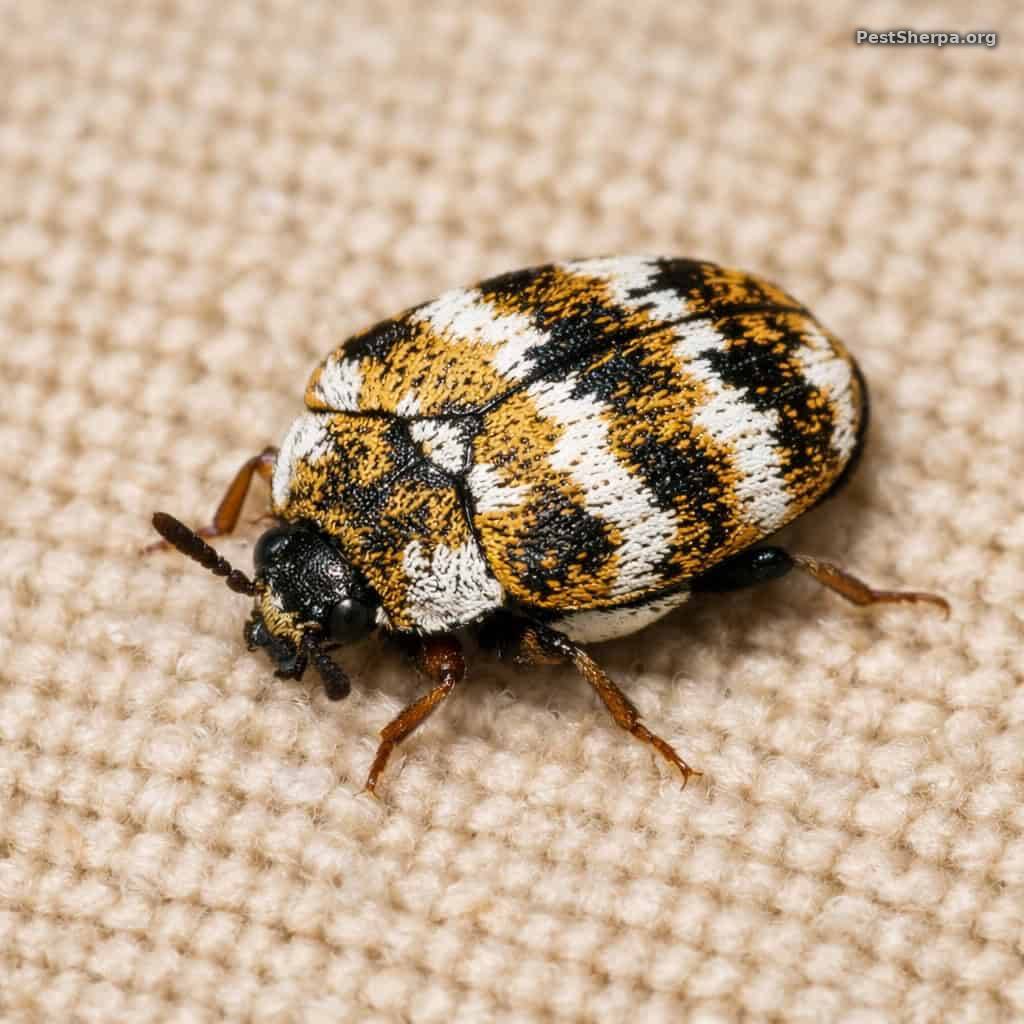
The furniture carpet beetle (Anthrenus flavipes) is a small dermestid beetle whose larvae can damage wool, fur, feathers, silk, leather, felt, taxidermy, natural-bristle brushes, and other animal-based materials. Adults are usually noticed first near windows or lights, but the larvae are the stage that causes fabric and stored-material damage.
Finding one adult furniture carpet beetle does not always mean there is a serious infestation. Repeated sightings, shed larval skins, damaged natural fibers, or larvae in closets, furniture seams, carpet edges, attics, or storage boxes are stronger signs that a hidden food source is supporting development. This guide explains how to identify furniture carpet beetles, where to inspect, what the damage means, and which next steps are most useful.
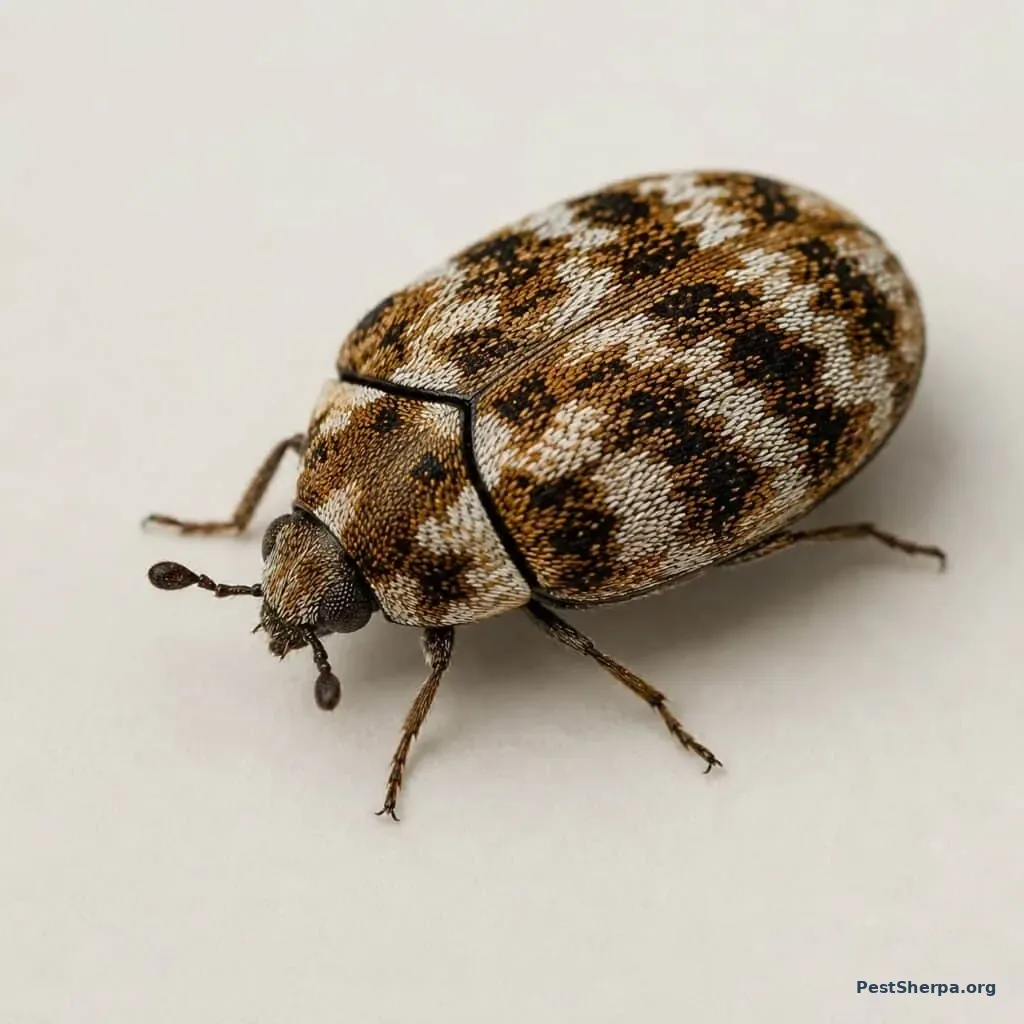
Adult furniture carpet beetle showing mottled wing-cover pattern.
TL;DR
Furniture carpet beetles are small, rounded beetles, but the larvae are the damaging stage. Larvae feed in dark, undisturbed places where animal-based materials or organic debris are available.
- Most likely signs: shed larval skins, irregular holes in wool or natural fibers, larvae along carpet edges, and adult beetles on windowsills.
- Most common sources: woolens, furs, feathers, pet hair, lint, dead insects, bird or rodent nests, upholstered furniture, and stored natural-fiber items.
- Best first step: inspect and clean the hidden source area rather than relying on sprays alone.
- Pesticides: not always necessary; when used, they must be labeled for the site and pest, and all label directions should be followed.
Quick Navigation
- What Furniture Carpet Beetles Mean Indoors
- Identification
- Larvae and Damage
- Source Investigation Checklist
- Life Cycle and Seasonal Activity
- Where They Hide
- What To Do
- What Does Not Work Well
- How Long Activity May Last
- Lookalikes and Common Misidentifications
- Frequently Asked Questions
- References
What Furniture Carpet Beetles Mean Indoors
Furniture carpet beetles are often more important as a clue than as a visible nuisance. Adults may fly indoors from flowers or enter on items brought inside. Larvae, however, usually mean there is a food source nearby.
| What You See | What It May Mean | What To Check First |
|---|---|---|
| One adult beetle at a window | Possible outdoor entry or early indoor emergence | Windowsills, nearby curtains, cut flowers, and light fixtures |
| Several adults over multiple days | Possible indoor source nearby | Closets, carpet edges, upholstered furniture, and stored textiles |
| Larvae or shed skins | Larval feeding site is likely close | Dark seams, folds, baseboards, pet bedding, lint, and undisturbed storage |
| Irregular holes in wool or fur | Fabric pest damage possible | Both carpet beetles and clothes moths should be considered |
| Beetles near attic, chimney, or wall void areas | Bird nests, wasp nests, dead insects, or rodent debris may be involved | Attic edges, eaves, vents, crawlspaces, and void-adjacent rooms |
Key point: Adult beetles do not chew holes in fabrics. The hidden larvae are responsible for carpet beetle damage.
Identification: What Furniture Carpet Beetles Look Like
Adult Furniture Carpet Beetle
- Scientific name: Anthrenus flavipes
- Size: about 1/16 to 1/8 inch long, or roughly 2 to 3.5 mm
- Shape: small, rounded to broadly oval beetle
- Color: mottled pattern of pale, yellowish, orange, black, and white scales; underside is usually pale or white
- Behavior: adults are often found at windows or lights indoors and on flowers outdoors
- Damage: adults feed on pollen and nectar; they do not damage fabrics
Older adults may look darker if the body scales have rubbed off. Because furniture carpet beetles look similar to other Anthrenus carpet beetles, close inspection may be needed for species-level confirmation.
Furniture Carpet Beetle Larvae
- Size: commonly up to about 1/4 inch or less when mature
- Appearance: hairy, oval to tapered larvae that darken as they mature
- Color: whitish when very young, becoming darker reddish brown, chestnut, or brown
- Shape: broader toward the front and narrower toward the rear
- Important sign: shed larval skins may remain where feeding occurred
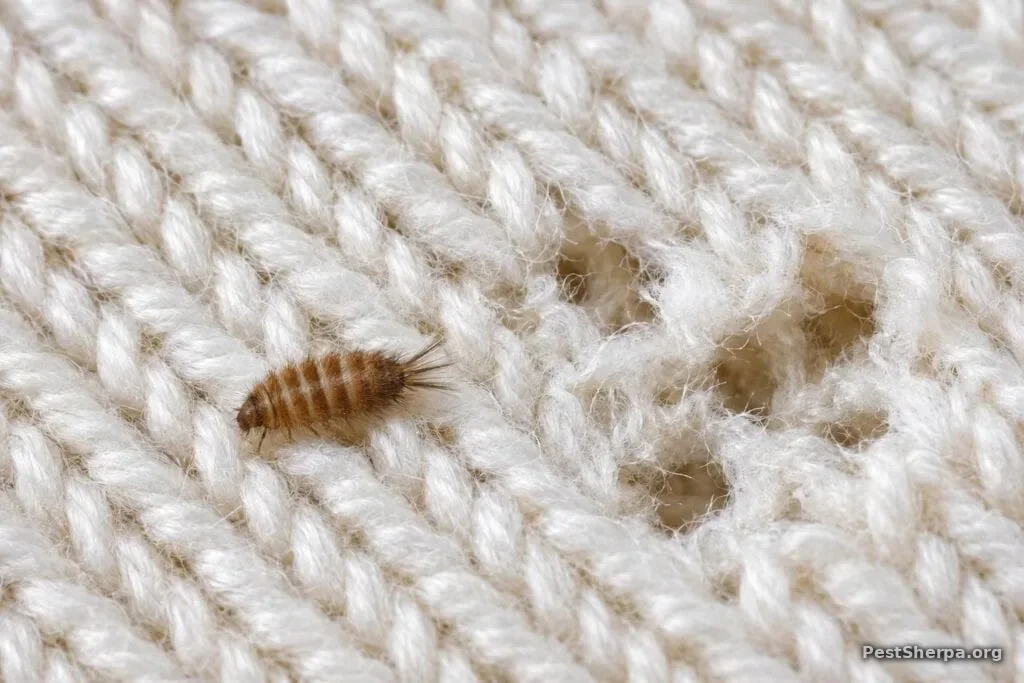
Furniture carpet beetle larva and woolen knit damage
Larvae and Damage: Why the Hidden Stage Matters
Furniture carpet beetle larvae feed on materials that contain animal proteins or dried organic matter. They are not limited to carpets. In homes, larvae may feed on wool rugs, clothing, furs, feathers, silk, leather, taxidermy, pet hair, lint, dead insects, and organic debris in protected areas.
| Material or Location | Risk Level | Why It Matters |
|---|---|---|
| Wool rugs, wool clothing, felt, and fur | High | Animal-based fibers are preferred feeding materials |
| Feathers, taxidermy, natural-bristle brushes, and animal skins | High | These materials can support larvae in storage or display areas |
| Upholstered furniture seams and padding | Moderate to high | Hair, lint, dead insects, or animal fibers can accumulate inside seams |
| Carpet edges, baseboards, and under furniture | Moderate to high | Dark, undisturbed edges collect lint, pet hair, and insect debris |
| Clean cotton or synthetic fabrics | Lower | Less likely unless blended with wool or heavily soiled with food, sweat, or oils |
| Attics, chimneys, vents, and wall voids | Variable | Bird nests, wasp nests, dead insects, or rodent debris can support dermestid larvae |
Damage often appears as irregular holes, thinned areas, loose fibers, or surface grazing. Shed skins and small debris near the damaged item are strong clues that larvae have been feeding there.
Furniture Carpet Beetle Source Investigation Checklist
Start where evidence is strongest, then work outward. Adult beetles at a window may be several feet or even rooms away from the larval source, so the inspection should focus on hidden food materials rather than only on the windowsill.
Step 1: Confirm the Pest
Look for small, rounded mottled adult beetles and hairy larvae. If the insects are jumping, biting, fuzzy-winged, or pantry-associated, another pest may be involved.
Step 2: Inspect Damaged Items
- Wool sweaters, coats, blankets, rugs, and felt items
- Furs, feathers, taxidermy, animal skins, and leather items
- Upholstery seams, cushions, and furniture undersides
- Stored fabric boxes, closet corners, drawers, and seldom-used shelves
Step 3: Follow the Debris Trail
Inspect lint, pet hair, dead insects, spider webs, and dust accumulations along baseboards, under appliances, behind furniture, inside floor vents, and around carpet tack strips.
Step 4: Check Animal-Related Sources
Bird nests, rodent nests, wasp nests, dead insects, old pet bedding, and stored animal products can support carpet beetles. If beetles are appearing near fireplaces, attics, soffits, or upper-floor windows, check for nest or void-related sources where accessible.
Step 5: Inspect Items Brought Indoors
Secondhand furniture, vintage clothing, wool rugs, craft materials, taxidermy, dried flowers, and cut flowers can introduce adults, eggs, or larvae. Inspect these items before storing them with clean fabrics.
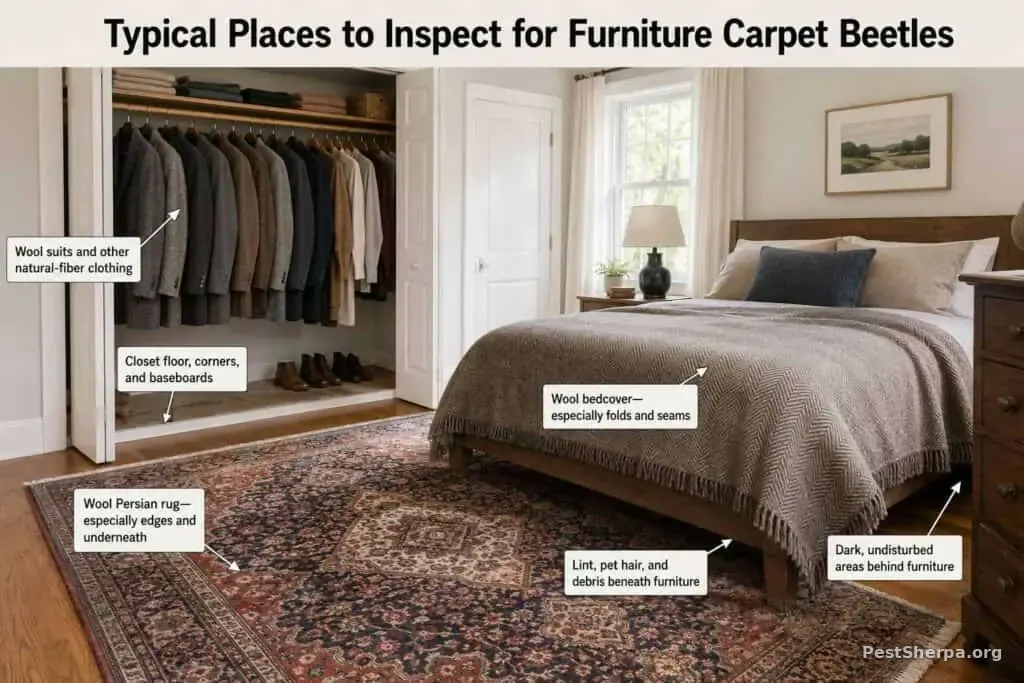
Furniture carpet beetle inspection areas in a bedroom and closet.
Life Cycle and Seasonal Activity
Furniture carpet beetles develop through egg, larva, pupa, and adult stages. Indoors, development depends on temperature, humidity, food quality, and how long materials remain undisturbed.
| Stage | What Happens | Why Readers Notice It |
|---|---|---|
| Egg | Eggs are placed on or near larval food sources | Eggs are tiny and usually not noticed |
| Larva | Larvae feed in dark, protected areas and molt as they grow | This is the damaging stage; shed skins may be visible |
| Pupa | Pupation usually occurs near the feeding site | May be hidden inside the last larval skin or nearby debris |
| Adult | Adults emerge, move toward light, and may feed on pollen outdoors | Adults are often found at windows, curtains, or light fixtures |
Adults are commonly noticed in spring or warmer periods when they become active and move toward light. Indoor activity can also appear at other times if heated buildings allow development to continue.
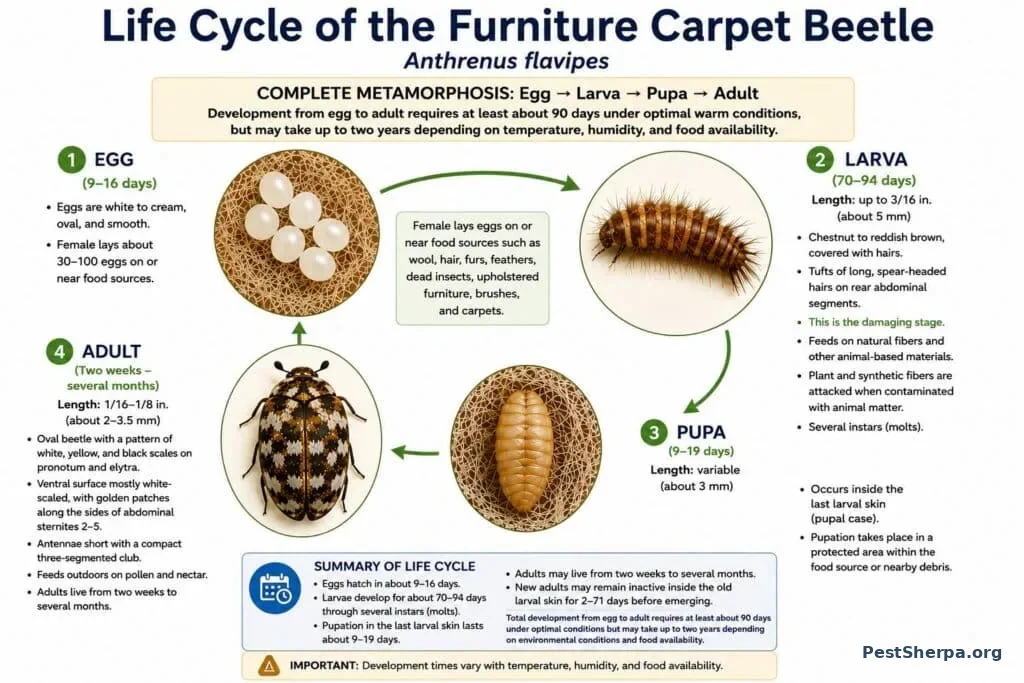
Furniture carpet beetle life cycle from egg to adult.
Where Furniture Carpet Beetles Hide
Furniture carpet beetle larvae prefer protected areas where food is available and disturbance is low. A clean home can still have carpet beetles if a hidden source is present.
- Carpet edges, under rugs, and around tack strips
- Under heavy furniture and behind baseboards
- Closets, drawers, garment bags, and storage boxes
- Upholstered furniture seams, cushion edges, and furniture undersides
- Pet bedding, pet hair deposits, and lint accumulations
- Attics, wall voids, chimneys, vents, and areas with bird, rodent, or wasp nesting debris
- Stored natural-history items, feathers, taxidermy, dried insects, and craft materials
What To Do About Furniture Carpet Beetles
1. Identify the Insect and the Damaging Stage
Collect a few adults, larvae, or shed skins in a clear container or on tape. Confirm whether you are dealing with furniture carpet beetles, another carpet beetle, clothes moths, pantry beetles, fleas, or another small household insect.
2. Find and Remove the Source
Removing the larval food source is the most important step. Discard badly infested items when they cannot be cleaned, and seal them in a bag before carrying them through the home.
3. Clean Hidden Edges Thoroughly
Vacuum carpet edges, baseboards, furniture seams, closet floors, cracks, drawers, vents, and under appliances. Empty the vacuum outdoors or seal the contents before disposal so larvae and debris are not left inside the home.
4. Treat Infested Fabrics Without Guesswork
Wash, heat-dry, dry clean, or otherwise handle infested fabrics according to the item’s care instructions. Delicate wool, fur, feathers, leather, taxidermy, museum objects, and heirlooms may require specialized cleaning or conservation advice.
5. Improve Storage
Store clean, pest-free woolens, furs, feathers, and other susceptible items in sealed containers or well-sealed garment storage. Avoid placing uninspected vintage items or untreated animal-based materials directly into long-term storage with clean fabrics.
6. Reduce Entry and Reinfestation
Repair window screens, reduce gaps around doors and vents, inspect cut flowers, and remove old nests where safe and accessible. If bird, rodent, or wasp nesting debris is suspected in a void, attic, chimney, or eave, use appropriate safety precautions before disturbing it.
7. Use Pesticides Carefully, If Needed
Pesticides are not always necessary when the source is found, cleaned, or removed. If a pesticide is used, choose a product labeled for carpet beetles and the specific treatment site, and read and follow the full label. Do not spray clothing, bedding, food-contact surfaces, pet bedding, or children’s items unless the label specifically allows that use. Keep people and pets away from treated areas until the label says reentry is allowed.
What Does Not Work Well
- Only spraying visible adults: adults are not the damaging stage, and the larval source may remain.
- Ignoring lint and pet hair: small hidden food sources can keep larvae active.
- Relying on cedar alone: cedar products are not a reliable stand-alone solution for an active infestation.
- Storing dirty woolens: food stains, sweat, and body oils can make items more attractive and vulnerable.
- Treating the wrong pest: clothes moths, pantry beetles, and other small beetles can be mistaken for carpet beetles.
How Long Will Furniture Carpet Beetle Activity Last?
Activity may stop quickly if only one adult entered from outdoors. If larvae are feeding indoors, adults may continue to appear until the source is found and cleaned, removed, or exhausted. Hidden sources can cause repeated waves of adults because larvae and pupae may be developing out of sight.
| Situation | Expected Pattern | Best Next Step |
|---|---|---|
| One adult at a window | May be temporary | Remove it and monitor nearby areas |
| Adults appearing for several days | Possible indoor emergence | Inspect closets, rugs, upholstery, and storage |
| Larvae or shed skins found | Active or recent larval site likely | Clean, remove, or isolate the source |
| Damage continues after cleaning | Source may have been missed | Expand inspection to voids, nests, pet areas, and stored items |
Lookalikes and Common Misidentifications
Several small pests are confused with furniture carpet beetles. Correct identification matters because the source and control steps are different.
| Lookalike | How It Differs | Helpful Next Step |
|---|---|---|
| Varied carpet beetle | Very similar small mottled Anthrenus beetle; species-level separation may require close inspection | Inspect the same fabric, lint, nest, and stored-item sources |
| Black carpet beetle | Adults are darker and more elongate; larvae are carrot-shaped with a rear hair tuft | Inspect fabrics and stored products, especially dry organic materials |
| Clothes moths | Larvae may web or remain on fabric; adults are small moths, not beetles | Inspect woolens, folded clothing, and hidden fabric folds |
| Warehouse beetle | Stored-product dermestid more associated with dried foods and stored materials than wool carpet damage | Inspect pantry goods, dry pet food, and stored products |
| Fleas | Flattened jumping insects; not rounded, mottled beetles | Check pets, pet bedding, and bite complaints rather than fabric damage |
| Small pantry beetles | Usually associated with flour, grains, cereals, spices, or dry pet food | Inspect food packaging and pantry shelves |
When Professional Help May Be Worth Considering
Professional help may be useful when identification is uncertain, damage continues after cleaning, larvae are found in multiple rooms, a hidden attic or wall-void source is suspected, or valuable items such as taxidermy, rugs, antiques, museum objects, or heirloom textiles are involved.
For apartments, museums, storage facilities, and commercial spaces, the most useful inspection usually looks beyond the visible beetles and focuses on the source: stored animal-based materials, lint, dead insects, bird or rodent nesting debris, and hard-to-reach voids.
Frequently Asked Questions
Do furniture carpet beetles bite?
Furniture carpet beetles do not bite people. Some people may react to contact with carpet beetle larvae, shed skins, or hairs, but the main concern in homes is usually damage to susceptible materials.
Does one furniture carpet beetle mean I have an infestation?
No. One adult beetle may have flown in from outdoors or arrived on an item brought inside. Repeated adult sightings, larvae, shed skins, or fabric damage are stronger evidence of an indoor source.
Why are furniture carpet beetles on my windowsill?
Adults are attracted to light. A windowsill is usually where adults are trying to leave or move toward light, not necessarily where larvae are feeding.
What materials do furniture carpet beetle larvae damage?
They are most associated with animal-based materials such as wool, fur, feathers, silk, leather, hair, dried insects, and similar debris. Clean synthetic fabrics are less likely to be attacked unless blended with animal fibers or heavily soiled.
Can furniture carpet beetles come from bird nests?
Yes. Bird nests, wasp nests, rodent debris, dead insects, and other organic material in attics, chimneys, eaves, or wall voids can support dermestid beetles. Remove old nests only when it is safe and legal to do so.
Will vacuuming get rid of furniture carpet beetles?
Vacuuming is one of the most useful steps, especially along edges, seams, and hidden areas. It works best when paired with source removal, cleaning or isolating infested items, and improved storage.
Are pesticides required?
Not always. If the source is found and removed, cleaning and storage changes may be enough. If pesticides are used, they should be labeled for the pest and site, and the label should be followed exactly.
References
- UC IPM: Carpet Beetles
- University of Kentucky Entomology: Carpet Beetles
- MuseumPests.net: Furniture Carpet Beetle
- Colorado State University Extension: Dermestid Beetles (Carpet Beetles)
- University of Maine Cooperative Extension: Carpet Beetles
- Virginia Cooperative Extension: Carpet Beetles
This article was written by Greg Baumann, founder of Pest Sherpa, and reflects more than 40 years of professional pest management experience.
About the Author

Greg Baumann | Pest Control Expert
Greg Baumann is the founder of Pest Sherpa and a Pest Control Expert with more than 40 years of professional pest management experience. His articles combine decades of field experience, technical expertise, and science-based guidance to help homeowners identify pests correctly, understand real-world risks, and make informed pest management decisions.
Mission: Identify the pest. Understand the risk. Stop the problem. Prevent the comeback. Know when it’s time to call a professional.