
Warehouse Beetles: Identification, Sources, Risks, and Control
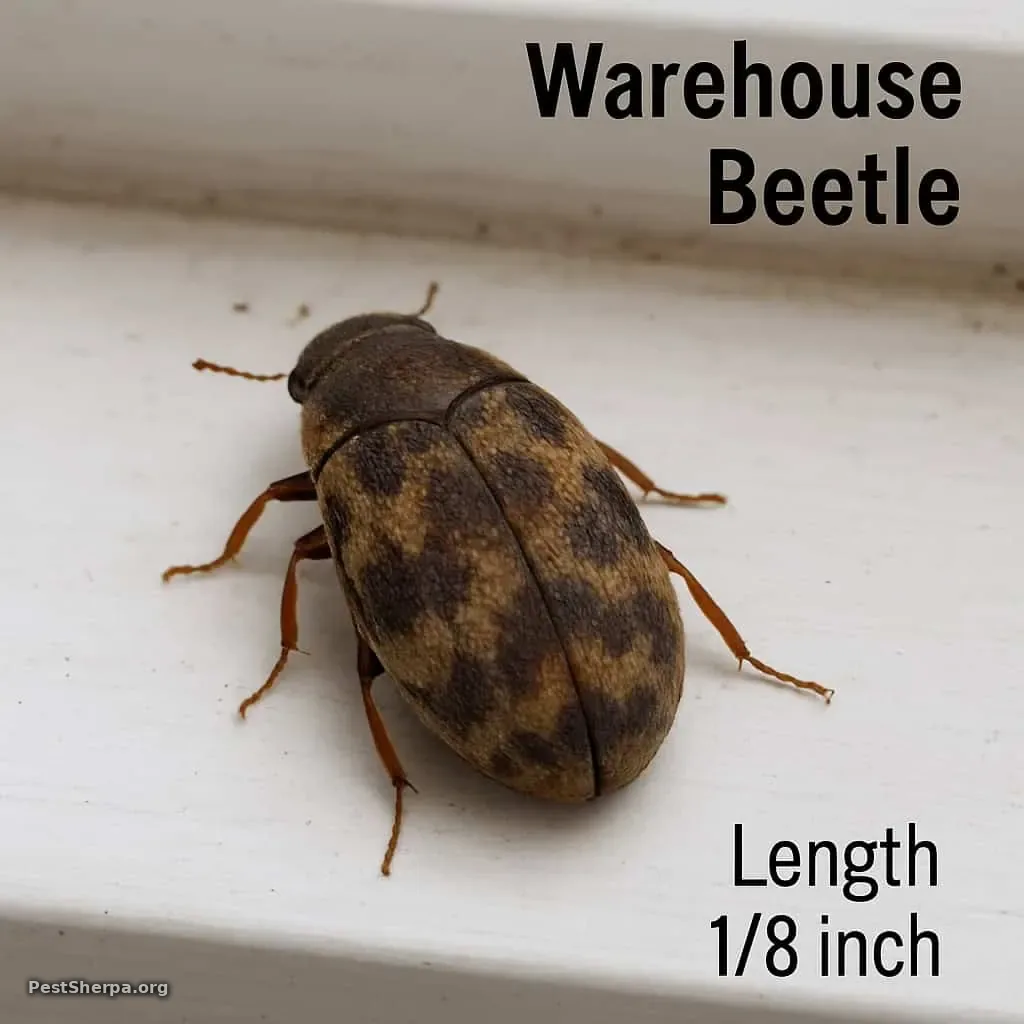
The warehouse beetle, Trogoderma variabile Ballion, is a stored-product dermestid beetle that can infest pantries, warehouses, food-processing areas, feed storage, retail stockrooms, and other places where dried plant or animal materials are stored. In homes, the first clue is often a small dark beetle, a hairy larva, or shed larval skins in or near dry foods. In larger facilities, the concern is usually product contamination, hidden larval activity, and repeated detections after the obvious food source has been removed.
Warehouse beetles do not bite, sting, or damage wood, but their larvae can contaminate stored products with feeding debris, cast skins, and irritating hairs. The most effective response is not spraying exposed adults; it is finding the infested material, removing or isolating it, cleaning up food dust and debris, and improving storage so the problem does not restart.
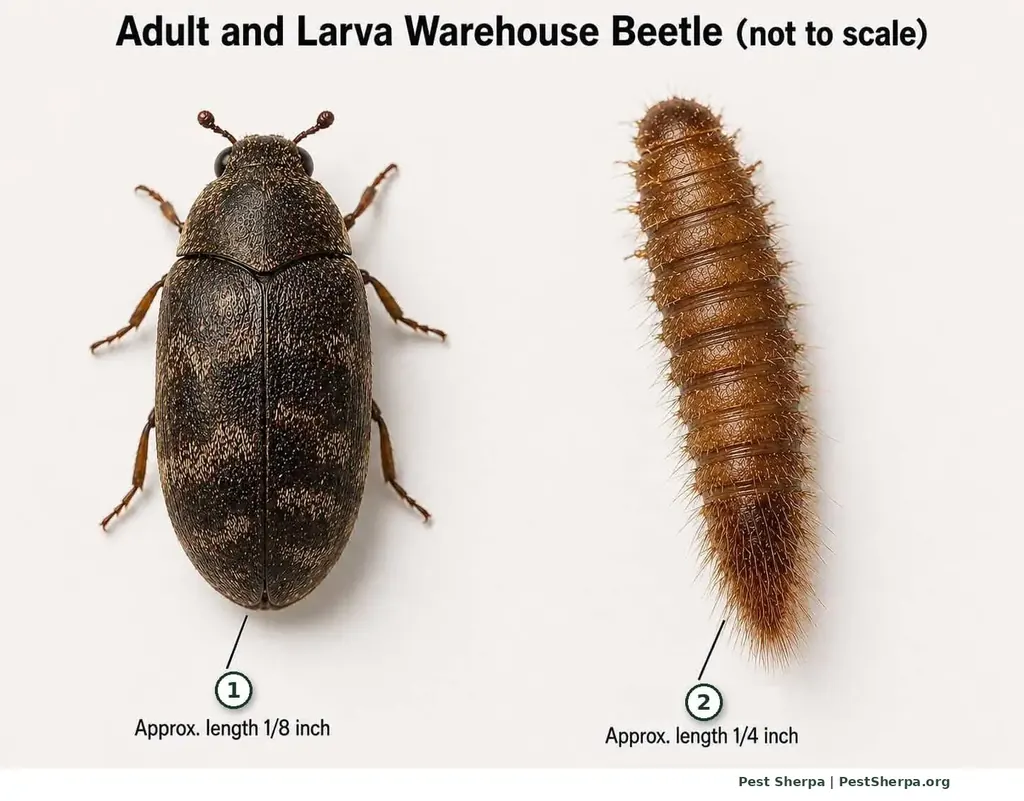
Which stage do you see? Match the number:
- Adult: small, oval beetle about 1/8 inch long, dark with mottled pale bands across the wing covers.
- Mature larva: hairy and banded brown with a tuft of long hairs at the tail end, about 1/4 inch long. The hairs can irritate skin, so do not handle it bare-handed.
Adult warehouse beetle and hairy warehouse beetle larva for identification.
TL;DR
Warehouse beetles are stored-product pests. The larvae are the main problem because they feed in dry foods and leave behind cast skins, hairs, and insect debris. A single adult beetle may not mean a major infestation, but repeated sightings, larvae, shed skins, or insects in multiple packages usually mean an infested food or debris source needs to be found.
Start by inspecting dry foods, pet food, bird seed, spices, nuts, seeds, dried milk products, rodent bait, old pantry goods, and hidden food debris. Discard clearly infested items, clean shelves and cracks thoroughly, and move unaffected foods into tight containers. Pesticides are not a substitute for source removal and should never be applied directly to food.
Quick Navigation
- What Warehouse Beetles Mean in a Home or Facility
- Quick Identification
- Why Warehouse Beetles Matter
- Source Investigation Checklist
- Foods, Materials, and Hidden Harborage
- Life Cycle and Why Infestations Persist
- Signs of Infestation
- Lookalikes and Similar Stored-Product Pests
- What To Do
- What Does Not Work Well
- Prevention and Storage Tips
- When Professional Help May Be Worth Considering
- Frequently Asked Questions
- References
What Warehouse Beetles Mean in a Home or Facility
Warehouse beetles are usually a clue that a dry food, feed product, seed product, or hidden organic material has been available long enough for larvae to develop. In a kitchen or pantry, the source may be a single old bag of dry pet food, a forgotten box of cereal, a spice container, nuts, seeds, or bulk food stored in weak packaging. In a warehouse or processing area, the source may be spilled product, food dust, damaged packaging, residues under equipment, product residues around pallets or stock that has sat undisturbed.
| What You See | What It Usually Means | First Step |
|---|---|---|
| One adult beetle | Could be a stray adult or an early sign | Inspect nearby dry foods and window areas |
| Hairy larvae in food | Active or recent infestation | Discard or isolate the infested item |
| Cast larval skins | Larvae developed nearby | Search packages, cracks, and shelf joints |
| Adults near windows or lights | Adults may be dispersing after emergence | Look beyond the window for the source |
| Repeated activity after cleaning | Hidden source or surviving larvae may remain | Expand inspection to non-food and storage areas |
Key point: The visible beetles are often only part of the issue. The source that produced them matters more than the adults crawling across a shelf or window sill.
Quick Identification
Adult warehouse beetles are small, oval beetles, usually around 1/8 inch long. They are usually brownish black with irregular pale, yellowish, orange, or brownish markings formed by scales and hairs. The pattern can vary, which makes casual identification sometimes challenging.
The larvae are easier to connect with damage. They are narrow, hairy, and yellowish when young, becoming darker brown as they mature. Older larvae have dense hair and have distinctive longer hairs toward the rear. These larvae are usually found in or near infested material, but they may wander away before pupating.
| Stage | What To Look For | Why It Matters |
|---|---|---|
| Adult | Small oval beetle, dark with pale or yellowish markings | May fly and disperse from the source |
| Larva | Hairy, tapered, yellowish to brown larva | Main feeding and contamination stage |
| Cast skin | Dry, hairy larval skin left behind after molting | Often one of the easiest signs to notice |
| Pupa | Often hidden in or near the final larval skin | May be found away from the original food source |
Several Trogoderma species look similar, and warehouse beetles can be confused with other dermestid beetles. If the setting involves a food facility, imported goods, regulatory inspection, or possible khapra beetle concern, identification should be confirmed by a qualified entomologist, diagnostic lab, extension service, or trained pest professional.
Why Warehouse Beetles Matter
Warehouse beetles are mainly contamination pests. The larvae feed in stored products and leave behind cast skins, hairs, fragments, and fine debris. In a home pantry, that usually means infested food should be discarded. In food-handling, warehouse, retail, or processing environments, the consequences can be more serious because contaminated products may need to be isolated, inspected, rejected, or removed from sale.
Larval hairs and hairs remaining on cast skins can cause irritation, particularly if contaminated food is consumed; airborne dermestid hairs and cast-skin fragments may also cause allergic irritation in susceptible individuals. This does not mean every sighting is a health emergency, but it does mean food with larvae, cast skins, or insect debris should not be eaten.
Warehouse Beetle Source Investigation Checklist
Use the insects as clues. Start where beetles, larvae, or cast skins are found, then work outward. Warehouse beetles may develop in obvious pantry foods, but they may also use less obvious materials that sit undisturbed.
Step 1: Inspect the Most Likely Food Sources
- Dry pet food, livestock feed, and bird seed
- Cereal, oatmeal, grits, cornmeal, flour, and baking mixes
- Rice, pasta, noodles, beans, peas, and legumes
- Nuts, seeds, trail mix, dried fruit, and spices
- Dried milk, fish meal, and animal-based feed ingredients
- Old bulk foods, opened packages, and products stored in cardboard or thin plastic
Step 2: Look for Cast Skins and Food Dust
Cast larval skins can be easier to see than eggs or small larvae. Check shelf corners, package seams, pantry cracks, bin edges, pallet joints, under shelving, and areas where food dust collects.
Step 3: Check Non-Food Sources
Warehouse beetles can also use dried animal and plant materials. In homes, that may include rodent bait, dried decorative materials, old bird or rodent nesting material containing feathers, hair, dead insects, or food debris, dead insects in wall voids or attics, and forgotten pet treats. In facilities, check product residues, sweepings, floor-wall junctions, and inaccessible equipment bases.
Step 4: Expand the Search if Adults Are Dispersing
Adults can fly, and larvae may wander before pupation. If beetles are appearing at windows, lights, or in rooms away from the pantry, inspect adjoining storage spaces, wall edges, attic access points, utility rooms, garages, and nearby bulk-storage areas.
Foods, Materials, and Hidden Harborage
Warehouse beetle larvae are adaptable feeders. They are often associated with stored seeds, grain products, high-protein dried foods, animal feed, and organic debris. They can also develop in products that seem unrelated to the pantry if those materials contain dried plant or animal matter.
- Cereals, grains, flour, cornmeal, oats, and grits
- Beans, peas, legumes, nuts, seeds, and dried fruit
- Spices, cocoa, cake mixes, cookies, pasta, and dry baking ingredients
- Dry pet food, bird seed, livestock feed, and fish meal
- Dried milk, protein-rich powders, and animal-based feed products
- Dead insects, rodent bait, old nests, and dried organic debris
Larvae commonly occur in protected areas where suitable food or residues accumulate. They may be found inside packages, under shelf liners, along shelving joints, behind baseboards, in pallet edges, beneath equipment, or inside cracks where food dust has accumulated.
Life Cycle and Why Infestations Persist
Warehouse beetles go through complete metamorphosis: egg, larva, pupa, and adult. Females lay eggs loosely in or near suitable food materials. Larvae hatch and begin feeding, then molt several times before pupating and becoming adults.
Development can also be greatly prolonged because older larvae may enter diapause, a physiologically arrested developmental state. Diapause and environmental conditions can allow larvae to persist much longer than the rapid development seen under favorable conditions.
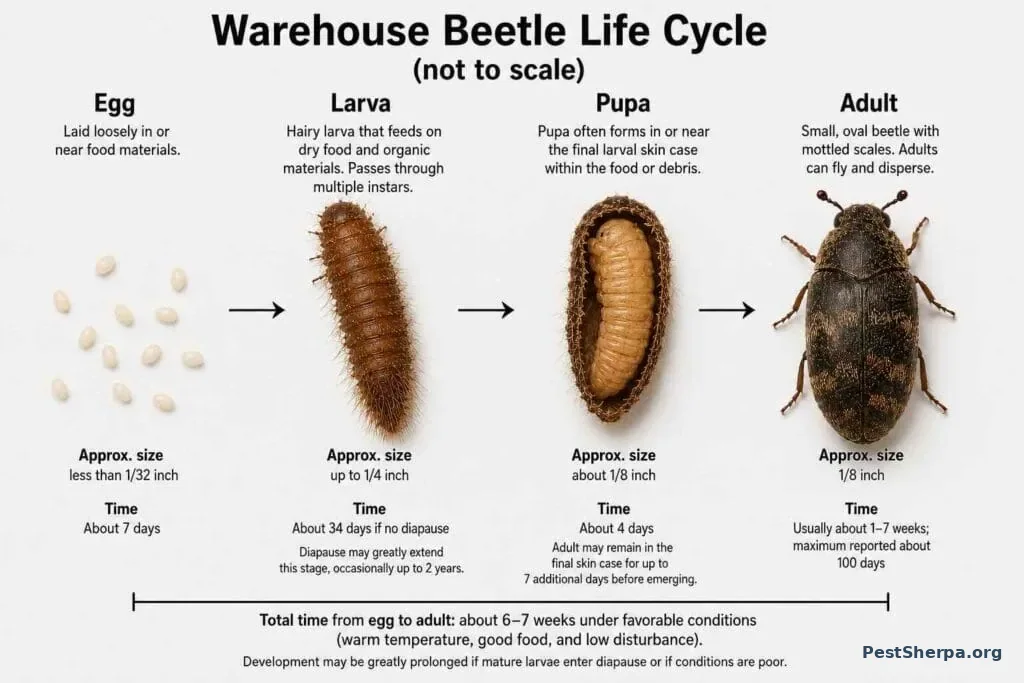
Warehouse beetle life cycle from egg to larva, pupa, and adult.
Signs of Infestation
Warehouse beetle infestations are often noticed because of larvae or cast skins rather than obvious feeding damage. Look for the pattern of evidence, not just a single insect.
- Small dark beetles near shelves, windows, lights, or stored foods
- Hairy larvae inside packages or crawling near food-storage areas
- Cast larval skins in food, shelf cracks, bins, or floor-wall edges
- Fine debris, insect fragments, or food dust around packages
- Chewed or damaged packaging, especially cardboard or thin plastic
- Recurring insects after one obvious food package has already been removed
Lookalikes and Similar Stored-Product Pests
Warehouse beetles are part of a larger group of pantry and stored-product pests. Correct identification matters because different pests point to different food sources, materials, and control priorities.
| Pest | How It Differs | Why It Matters |
|---|---|---|
| Sawtoothed grain beetle | Slender brown beetle with saw-like projections on the thorax | Often points to grain, cereal, flour, and packaged pantry foods |
| Merchant grain beetle | Similar to sawtoothed grain beetle and often associated with processed foods | Useful comparison for small brown pantry beetles |
| Red flour beetle | Reddish-brown beetle, not hairy like warehouse beetle larvae | Common in flour, cereal products, and milled grains |
| Indianmeal moth | Adult is a small moth, not a beetle | Often found around pantry foods, bird seed, and pet food |
| Varied carpet beetle | Small patterned dermestid beetle; larvae may be found in fabrics and animal materials | Can be confused with warehouse beetles and other dermestids |
| Black carpet beetle | Dark adult dermestid; larvae often associated with animal-based materials | Important lookalike when beetles are found away from food |
| Furniture carpet beetle | Dermestid beetle associated with fabrics, animal materials, and hidden debris | Helpful comparison when the source is not obvious pantry food |
Khapra beetle, Trogoderma granarium, is another important lookalike in the same genus and is a serious quarantine pest. Because Trogoderma species can be difficult to distinguish, suspected khapra beetles in imported commodities or regulated facilities should be submitted for authoritative identification.
What To Do
1. Confirm the Pest as Closely as Practical
Look for the combination of small dark adults, hairy larvae, cast skins, and dry stored products. If the beetles are coming from food, save a few specimens in a sealed container or clear bag for identification if needed.
2. Find the Infested Item or Debris Source
Inspect all susceptible foods and materials, especially older packages and bulk products. Do not stop after finding one package if beetles have been seen in several areas.
3. Discard or Isolate Infested Material
Food that contains larvae, cast skins, beetles, or insect debris should not be eaten. Seal infested items in a bag before disposal so insects are not spread through the home or facility.
4. Clean the Area Thoroughly
Vacuum shelves, cracks, corners, shelf-pin holes, floor-wall edges, and nearby storage spaces. Remove shelf liners if food dust or cast skins are underneath. Empty the vacuum outside or seal and discard the contents promptly.
5. Protect Uninfested Foods
Move uninfested susceptible foods into tight containers made of glass, metal, or durable plastic with secure lids. Cardboard boxes, paper bags, and thin plastic packaging are not reliable long-term barriers.
6. Monitor for Continued Activity
Warehouse beetle pheromone traps or other appropriate monitoring traps may help show whether activity is continuing, especially in storage rooms and commercial settings. Traps should support inspection; they should not replace source removal.
What Does Not Work Well
- Spraying pantry shelves without removing the source: Insects inside packages or hidden debris will continue developing.
- Relying only on sticky traps: Traps may catch adults, but they do not remove larvae inside food.
- Wiping shelves with bleach or disinfectant as the main control: Cleaning is useful, but disinfectants do not eliminate insects hidden in products.
- Keeping questionable food because it looks mostly normal: Cast skins, webbing, larvae, beetles, or debris are enough reason to discard food.
- Foggers or bug bombs: These are poorly suited to insects developing inside food packages and can create unnecessary pesticide exposure risks.
If any pesticide is considered, read and follow the label exactly. Do not apply pesticides to food, dishes, utensils, food-contact surfaces, drains, vents, or areas accessible to children or pets unless the label specifically allows that use. In many pantry infestations, pesticides are not necessary once the source is found and removed.
Prevention and Storage Tips
Prevention is mostly about reducing access to food, reducing storage time, and removing small residues that can support larvae.
- Inspect dry foods, pet food, and bird seed before storing them.
- Use older products first and avoid keeping bulk foods longer than you can monitor them.
- Store susceptible foods in tight glass, metal, or heavy plastic containers.
- Clean pantry shelves, bins, cracks, and corners before adding new products.
- Do not store dry pet food, bird seed, or bulk grain products in open bags.
- Check garages, basements, utility rooms, and storage closets where old dry products may be forgotten.
- In facilities, keep product dust, spillage, damaged packaging, and old residues from accumulating under equipment or along wall-floor edges.
When Professional Help May Be Worth Considering
Professional or extension-based identification may be worth considering when beetles continue after obvious sources are removed, when larvae are appearing far from the pantry, when the infestation involves a food-handling business, or when Trogoderma identification has regulatory importance.
In commercial settings, an integrated approach may include specimen identification, mapping detections, sanitation review, stock rotation, inspection of incoming goods, monitoring traps, exclusion, and targeted treatments where appropriate. The goal is to identify the source and prevent recurrence, not simply reduce the number of visible adults.
Frequently Asked Questions
Are warehouse beetles the same as carpet beetles?
No. Warehouse beetles are dermestid beetles, so they are related to carpet beetles, but they are not the same pest. Warehouse beetles are more strongly associated with stored foods, feed, seeds, and dry organic materials, while many carpet beetles are commonly associated with fabrics, animal materials, and dead insects.
Do warehouse beetles bite?
No. They do not bite or sting people. The concern is contamination of stored products and possible irritation from larval hairs or cast skins in sensitive individuals.
Can warehouse beetles fly?
Yes. Adults can fly, which is one reason they may appear near windows, lights, or areas away from the original food source.
Why do I still see beetles after throwing away one infested package?
There may be another source, larvae may have wandered away to pupate, or hidden cast skins and larvae may remain in cracks or nearby storage areas. Inspect adjacent foods, pet food, bird seed, old dry products, and food dust in shelving or floor-wall edges.
Can I freeze food to save it?
Freezing can kill warehouse beetles, but effectiveness depends on temperature, exposure time, life stage, and whether larvae are cold acclimated or in diapause. Because older larvae can be unusually cold tolerant, simply placing an item in a freezer briefly should not be assumed to eliminate all stages. For household food, discarding clearly infested material is usually the simplest approach.
Are warehouse beetles a sign of poor housekeeping?
Not necessarily. They can arrive in packaged goods, feed, bird seed, or bulk products. However, food dust, old dry goods, and long-term storage make infestations easier to maintain and harder to eliminate.
References
- Purdue Extension: Warehouse Beetle Trogoderma variabile Ballion
- NC State Extension: Common Pantry Pests and Their Management
- Iowa State University Extension and Outreach: Warehouse Beetle and Cabinet Beetle
- University of Georgia Extension: Stored Product Pests in the Home
- Canadian Grain Commission: Warehouse Beetle
- University of Florida Entomology and Nematology Department: Warehouse Beetle, Trogoderma variabile
This article was written by Greg Baumann, founder of Pest Sherpa, and reflects more than 40 years of professional pest management experience.
About the Author

Greg Baumann | Pest Control Expert
Greg Baumann is the founder of Pest Sherpa and a Pest Control Expert with more than 40 years of professional pest management experience. His articles combine decades of field experience, technical expertise, and science-based guidance to help homeowners identify pests correctly, understand real-world risks, and make informed pest management decisions.
Mission: Identify the pest. Understand the risk. Stop the problem. Prevent the comeback. Know when it’s time to call a professional.