
Merchant Grain Beetles: ID, Pantry Sources, and Control
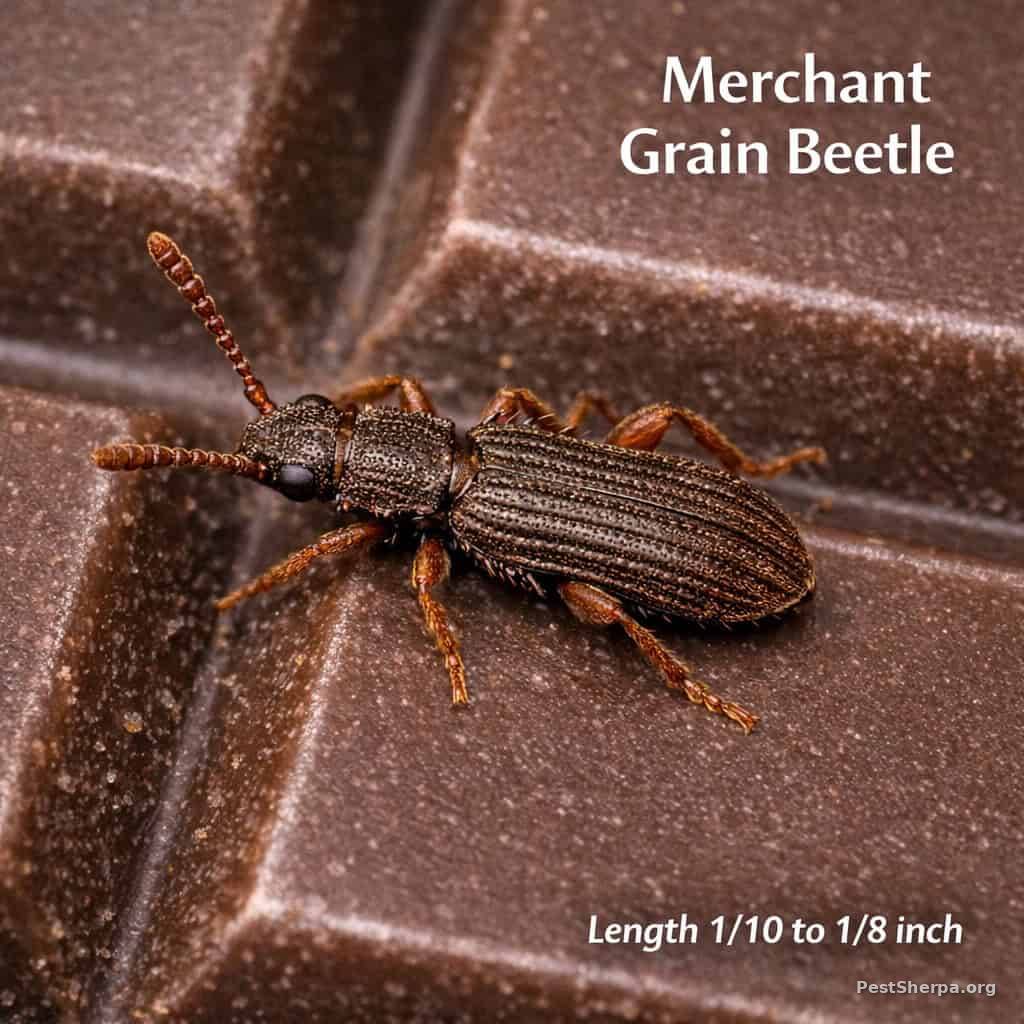
Merchant grain beetles are small, flattened pantry beetles that develop in stored foods such as cereal products, oats, flour, cake mixes, pasta, nuts, dried fruit, coconut, pet food, birdseed, and other dry goods. They are closely related to sawtoothed grain beetles, and the two can be difficult to tell apart without magnification.
Finding one beetle does not always mean every food item is infested. Repeated sightings, beetles inside packages, or beetles appearing in several pantry areas usually mean there is an infested product or food residue nearby. The most effective response is to identify the beetle, inspect stored foods carefully, remove infested items, clean hidden food debris, and protect remaining products in tight containers.
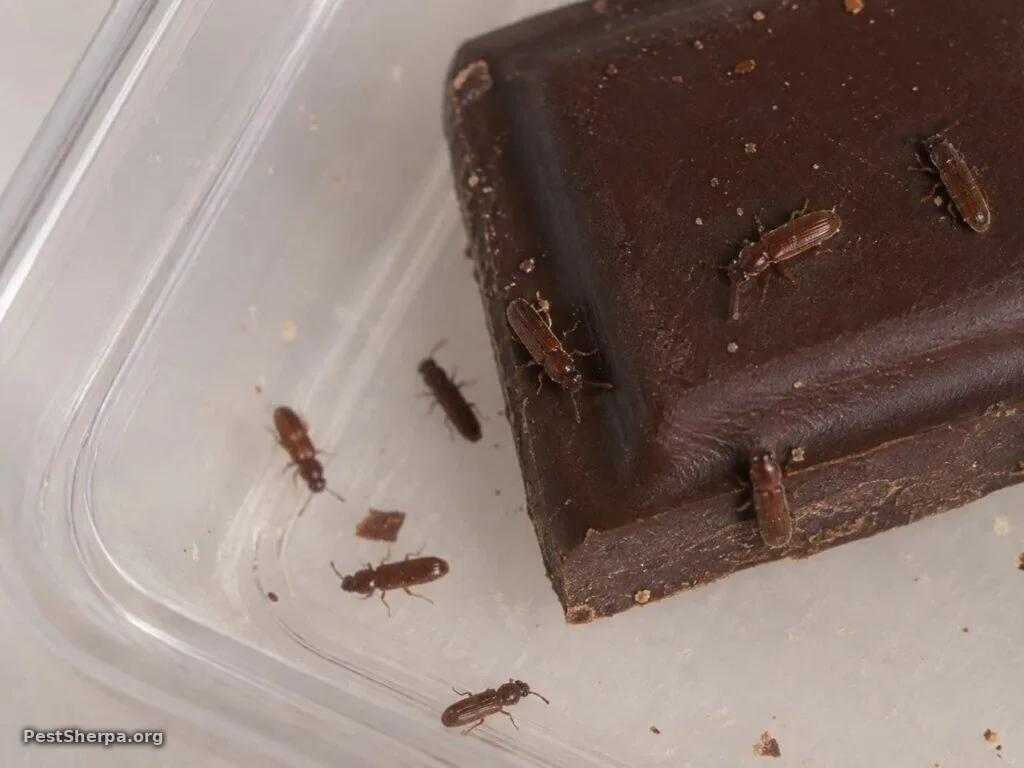
Merchant grain beetle adult on stored chocolate showing narrow flattened brown body.
TL;DR
Merchant grain beetles are stored-product pests. They are usually introduced in infested dry goods or spread through pantry shelves, cardboard seams, food dust, pet food, birdseed, and poorly sealed containers.
- Best first step: inspect dry foods, especially older packages and high-oil products such as nuts, oats, bran, baking chocolate, coconut, and birdseed.
- Main fix: remove infested products, vacuum shelves and cracks, discard vacuum contents outside, and store clean foods in sealed containers.
- Do not rely on sprays alone: adult beetle control will not solve the problem if the infested product remains.
- Professional help may be worth considering: when activity continues after a thorough cleanout, when multiple rooms or storage areas are involved, or when a food-handling business is affected.
Quick Navigation
- Quick Identification
- What Are Merchant Grain Beetles?
- Merchant Grain Beetle vs. Sawtoothed Grain Beetle
- Why Merchant Grain Beetles Suddenly Appear
- Foods Commonly Infested
- Signs of Infestation
- Source Investigation Checklist
- What To Do
- What Does Not Work
- Life Cycle and Seasonal Context
- Health and Food Safety
- When Professional Help May Be Needed
- Lookalikes and Related Pantry Pests
- FAQs
- References
Quick Identification
| Feature | Merchant Grain Beetle Clue |
|---|---|
| Size | Very small, usually about 2.5 to 3 millimeters long |
| Color | Brown to reddish brown |
| Body shape | Narrow, flat, and able to move into tight package seams and shelf cracks |
| Thorax | Six saw-like projections on each side behind the head |
| Where found | Pantry shelves, food packages, cardboard seams, pet food, birdseed, or stored dry goods |
| Common confusion | Looks very similar to the sawtoothed grain beetle |
Because merchant grain beetles are tiny, a hand lens or clear close-up photo can help. If the beetles are coming from stored foods, the exact species may matter less than finding and removing the product producing them. If it is small dark beetle with saw edges next to the head and it is infesting fatty foods like oily seeds, chocolate, or spilled oil, it is likely a merchant grain beetle. A state extension or pest control technician can identify it if needed.
What Are Merchant Grain Beetles?
The merchant grain beetle, Oryzaephilus mercator, is a small beetle in the family Silvanidae. It is part of a larger group called stored-product pests, which includes insects that feed, develop, or reproduce in stored foods and dry pantry goods.
Despite the name, merchant grain beetles are not usually the pest that chews into hard, intact grain kernels. They are more often associated with processed foods, broken grain, grain-based products, high-oil foods, and food debris. Their flattened bodies allow them to move through small openings in packaging and storage areas.
In homes, the problem is usually a pantry source. In grocery stores, warehouses, food-storage rooms, and food-processing environments, the concern can be broader because beetles may spread through inventory, shelving, equipment seams, spilled food, and packaged goods.
Merchant Grain Beetle vs. Sawtoothed Grain Beetle
Merchant grain beetles and sawtoothed grain beetles look so similar that they are often grouped together during routine pantry inspections. Both are small, flat, brown beetles with saw-like projections on the thorax. The pest control technician is trained to identify both pests.
| Trait | Merchant Grain Beetle | Sawtoothed Grain Beetle |
|---|---|---|
| Scientific name | Oryzaephilus mercator | Oryzaephilus surinamensis |
| Appearance | Small, flat, brown, with saw-like thorax projections | Small, flat, brown, with saw-like thorax projections |
| Eyes and head | Typically larger eyes and a narrower area behind the eyes | Typically smaller eyes and a wider area behind the eyes |
| Flight | Capable of flight | Generally does not fly |
| Food tendency | Often associated with oily or higher-fat products such as nuts and coconut, but also many grain products | Often associated with grain-based foods and broken grain products |
| Control approach | Find and remove infested food, clean residues, improve storage | Find and remove infested food, clean residues, improve storage |
For most homeowners, separating the two species is less important than confirming that the beetles are coming from stored foods. For identification support, compare this pest with the sawtoothed grain beetle guide.
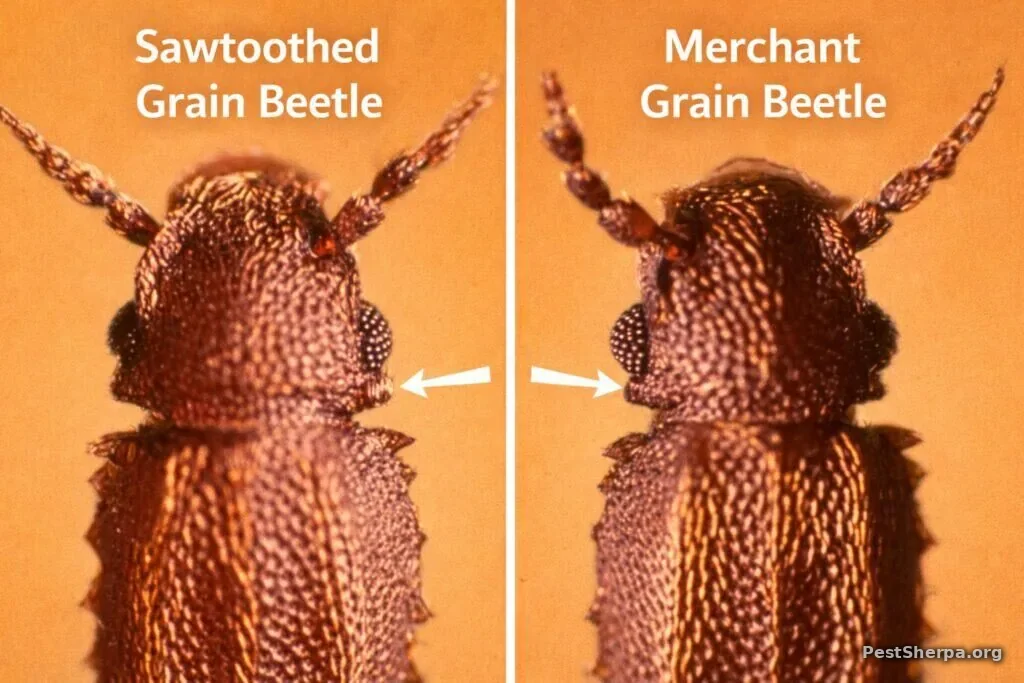
While difficult to distinguish without a hand lens or stereoscope to magnify, both insects are stored product pests requiring action.
Why Merchant Grain Beetles Suddenly Appear
Merchant grain beetles often seem to appear suddenly because adults may emerge from an overlooked food source after larvae have already been developing inside or near the product. A sealed-looking package can still be involved if insects were already present in the product, if packaging has tiny openings, or if beetles entered through folds, seams, or loose closures.
| What You Notice | Most Likely Meaning |
|---|---|
| One beetle on a counter or shelf | May be a stray adult or an early clue |
| Several beetles in the pantry | Possible infested package or food debris nearby |
| Beetles inside one food package | That product is likely the source |
| Beetles in several cabinets | Multiple products, spilled food, or spreading adults may be involved |
| Repeated activity after cleaning | A hidden source may have been missed |
Expert Insight: In pantry beetle problems, the adult insects are often only the visible symptom. The source is usually an infested product, spilled food, or food dust hidden in cracks, seams, or storage containers.
Foods Commonly Infested
Merchant grain beetles can develop in many dry stored products, especially processed foods and products with broken grain or higher oil content.
- Oats, bran, rolled oats, puffed rice, and brown rice
- Flour, cornmeal, cake mixes, baking mixes, and pancake mixes
- Cereal, crackers, cookies, pasta, macaroni, and noodles
- Nuts, coconut, candy with nuts, chocolate, and high-oil foods
- Dried fruit, seeds, spices, yeast, and dried pantry goods
- Pet food, birdseed, and animal feed
They are less likely to begin in hard, undamaged grain kernels. However, they may feed in broken grain, processed foods, grain dust, or products previously damaged by other insects.
Signs of Infestation
Look for clues in and around stored dry goods rather than only where adult beetles are seen crawling.
- Small brown beetles crawling on pantry shelves or counters
- Beetles inside cereal, flour, nuts, pet food, birdseed, or baking mixes
- Larvae, cast skins, insect fragments, or fine debris in stored foods
- Food dust collecting in shelf corners, cracks, cabinet seams, or under liners
- Repeated beetle sightings after a single product was discarded
Infested food should not be eaten. When in doubt, discard questionable products, especially if insects, larvae, webbing, shed skins, clumping, or contamination are visible.
Merchant Grain Beetle Source Investigation Checklist
Use a systematic inspection so one missed package does not restart the problem.
Step 1: Empty the Problem Area
Remove all dry goods from the cabinet, pantry shelf, drawer, or storage bin where beetles have been seen. Check the shelf above and below as well.
Step 2: Inspect High-Risk Foods First
Start with older packages, opened products, nuts, oats, bran, cereals, baking mixes, pet food, birdseed, dried fruit, coconut, and products stored in cardboard, paper, or thin plastic.
Step 3: Check Package Seams and Lids
Look along folded cardboard seams, loose bag closures, jar threads, container lids, and the bottoms of boxes. Small beetles may hide where food dust collects.
Step 4: Inspect Non-Food Sources
Do not stop at human food. Pet food, birdseed, rodent bait, decorative corn, dried flowers, craft seeds, and forgotten bulk goods can also support stored-product insects.
Step 5: Clean Cracks and Hidden Residues
Vacuum shelf cracks, corners, peg holes, drawer tracks, floor edges, and areas beneath shelf liners. Discard vacuum contents outside after cleaning.
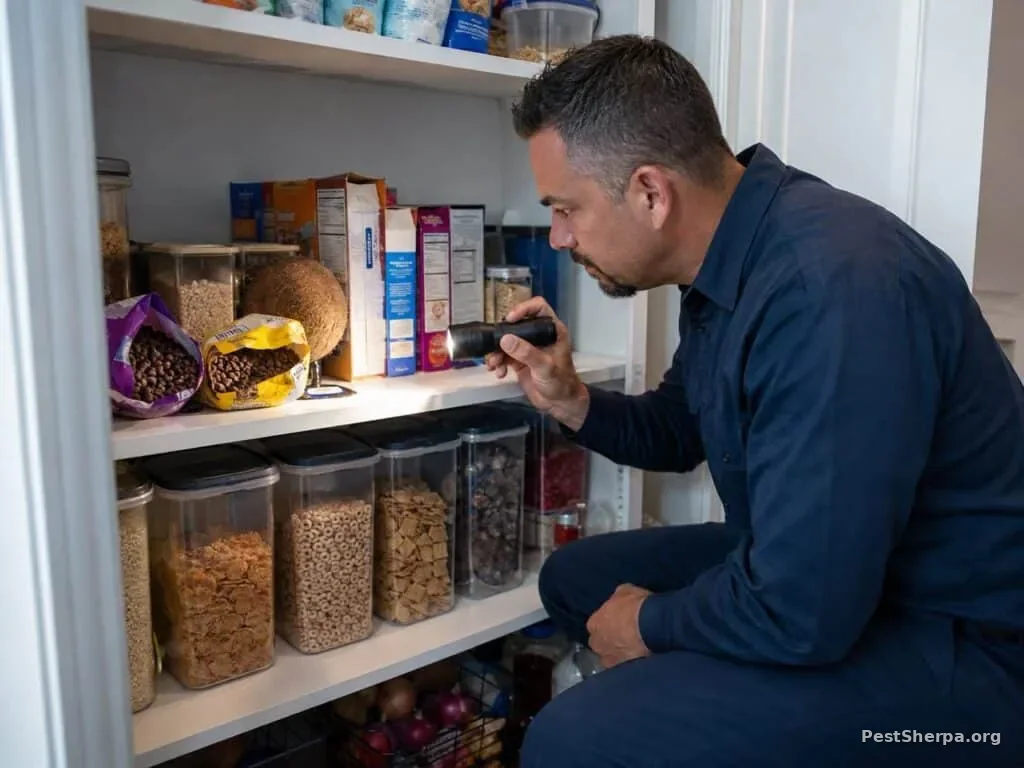
Pantry inspection for merchant grain beetles in open and even sealed food packages and shelf cracks.
What To Do
1. Confirm You Are Dealing With a Pantry Beetle
Small brown beetles in dry foods are often stored-product pests. Compare body shape, size, and location. If the insect is not in stored food or dry goods, consider other beetles or occasional invaders.
2. Remove Infested Products
Seal infested products in a bag before carrying them through the home. Dispose of them outdoors. Avoid shaking packages, which can spread insects and food debris.
3. Vacuum Thoroughly
Vacuum shelves, cracks, corners, drawers, pantry floors, container exteriors, and nearby storage areas. Remove shelf liners if food dust or insects may be underneath.
4. Store Clean Foods in Tight Containers
Use glass, metal, or durable plastic containers with tight-fitting lids. Thin bags, loose clips, and folded cardboard flaps may not stop small pantry beetles from entering or escaping.
5. Rotate Inventory
Use older dry goods first and avoid keeping susceptible foods for long periods. Labeling purchase dates can help prevent forgotten packages from becoming sources.
6. Monitor for Remaining Activity
After cleaning, a few adults may still be seen for a short time. Ongoing or increasing activity usually means a source was missed.
What Does Not Work
- Only spraying visible beetles: this does not remove eggs, larvae, or the infested product.
- Keeping questionable food: a single overlooked package can keep producing beetles.
- Cleaning only the shelf surface: food dust in seams, cracks, and shelf peg holes can support pests.
- Ignoring pet food and birdseed: these are common stored-product pest sources.
- Using foggers in food storage areas: foggers do not solve the source problem and can create unnecessary pesticide exposure concerns.
Pesticides are not always necessary for pantry beetles. If any pesticide is used in or near food-storage areas, read and follow the product label, remove or protect food and food-contact items as directed, avoid treating food or dishes, and keep children and pets away from treated areas until the label allows reentry.
Life Cycle and Seasonal Context
Merchant grain beetles develop through complete metamorphosis: egg, larva, pupa, and adult. Females lay eggs in or near suitable food. Larvae feed within the food material, then pupate before becoming adults.
Development is faster in warm conditions and slower in cool or unfavorable conditions. Under favorable indoor conditions, development from egg to adult can occur in roughly a month, which is why pantry activity can build quickly when a food source remains in place.
Indoor infestations can occur at any time of year because pantries and storage rooms provide stable temperatures and food. Warm storage areas, older inventory, and accumulated food dust increase the chance of population growth.
Health and Food Safety
Merchant grain beetles are not known for biting, stinging, or damaging structures. The main issue is food contamination. Infested products may contain live insects, larvae, shed skins, fragments, waste, or damaged food material.
For home pantries, discard visibly infested foods and clean storage areas before replacing products. In commercial, grocery, warehouse, or food-processing settings, follow facility food-safety procedures, documentation requirements, and applicable regulatory guidance.
When Professional Help May Be Needed
Many small home pantry infestations can be resolved by finding and removing the source. Professional help may be worth considering when the source cannot be found, beetles keep appearing after a full cleanout, activity involves multiple rooms or storage areas, or a commercial food-handling environment is affected.
A professional inspection may focus on overlooked stored foods, product movement, shelving, cracks, equipment seams, wall voids near storage areas, and monitoring to confirm whether activity is declining.
Lookalikes and Related Pantry Pests
Several pantry pests can appear in the same cabinets or dry goods. Identification helps narrow the source.
| Pest | How It Differs | Common Source Clue |
|---|---|---|
| Sawtoothed Grain Beetle | Nearly identical; usually separated by eye/head features and flight ability | Grain products, cereal, pasta, flour, and processed dry goods |
| Red Flour Beetle | Small reddish-brown beetle without saw-like thorax projections | Flour, cereal, crackers, cake mixes, spices, and damaged grain products |
| Warehouse Beetle | Adults are more oval; larvae are hairy and can be a food-contamination concern | Stored foods, pet food, dead insects, dried materials, and warehouse products |
| Indianmeal Moth | Adult is a moth, not a beetle; larvae may leave webbing in food | Cereal, grain products, nuts, dried fruit, birdseed, and pet food |
| Drugstore Beetle or Cigarette Beetle | Small rounded or cylindrical brown beetles; head may appear tucked down from above | Spices, dried plant material, tobacco products, pet food, dried foods, and pantry goods |
| Weevils | Often have a snout-like head; some develop inside whole kernels | Whole grains, rice, corn, seeds, and stored grain products |
Frequently Asked Questions
Do merchant grain beetles mean my pantry is dirty?
No. Pantry beetles are often brought in with infested products or spread from dry goods that were stored too long. Good sanitation helps control them, but their presence does not automatically mean the home is dirty.
Can merchant grain beetles get into sealed packages?
They can move through tiny gaps, folds, loose closures, cardboard seams, and imperfect packaging. They may also already be inside a product before it is stored at home.
Do merchant grain beetles fly?
Yes. Merchant grain beetles have well-developed wings and can fly, which helps them disperse from one storage area to another.
Should I throw away every dry food in the pantry?
Not always. Start with a careful inspection. Discard infested or questionable products, especially older opened foods and items with insects, larvae, fragments, clumping, or debris. Clean items can be moved into tight containers after the storage area is vacuumed and cleaned.
Will merchant grain beetles go away on their own?
They may decline if the source is removed or exhausted, but waiting can allow them to spread into additional products. Finding and removing the source is the most reliable step.
Are merchant grain beetles dangerous?
They are not known for biting or stinging people. The concern is contamination of stored food, not direct injury.
References
- NC State Extension: Common Pantry Pests and their Management
- UC Statewide IPM Program: Pantry Pests
- Canadian Grain Commission: Merchant Grain Beetle
- UF/IFAS Entomology and Nematology: Merchant Grain Beetle, Oryzaephilus mercator
- LSU AgCenter: Secondary Pests of Stored Product
This article was written by Greg Baumann, founder of Pest Sherpa, and reflects more than 40 years of professional pest management experience.
About the Author

Greg Baumann | Pest Control Expert
Greg Baumann is the founder of Pest Sherpa and a Pest Control Expert with more than 40 years of professional pest management experience. His articles combine decades of field experience, technical expertise, and science-based guidance to help homeowners identify pests correctly, understand real-world risks, and make informed pest management decisions.
Mission: Identify the pest. Understand the risk. Stop the problem. Prevent the comeback. Know when it’s time to call a professional.