
Indianmeal Moths: Identification, Pantry Sources, and What to Do
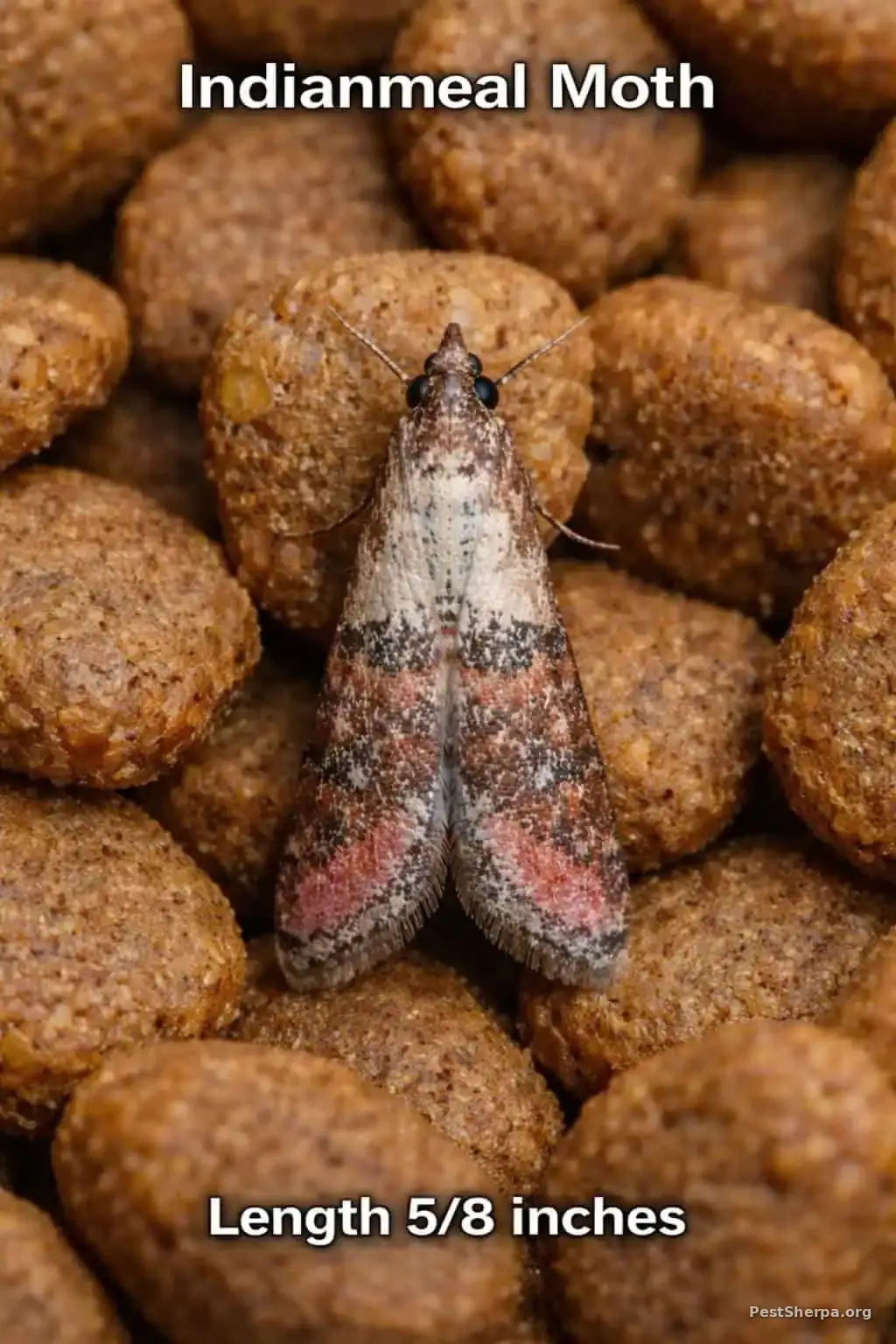
The Indianmeal moth (Plodia interpunctella) is a common pantry and stored-food pest. In homes, it is usually found around dry goods such as cereal, flour, rice, pasta, nuts, dried fruit, bird seed, and pet food. The adult moths are the stage most people notice, but the larvae are the stage that damages and contaminates food with feeding, silk webbing, frass, and shed skins.
Seeing one moth does not always mean a widespread infestation. Repeated sightings, moths appearing near pantries or ceilings, webbing inside packages, or small caterpillars crawling away from food usually means a source needs to be found and removed. This guide explains how to identify Indianmeal moths, inspect likely foods, avoid common mistakes, and reduce the chance of the problem returning.
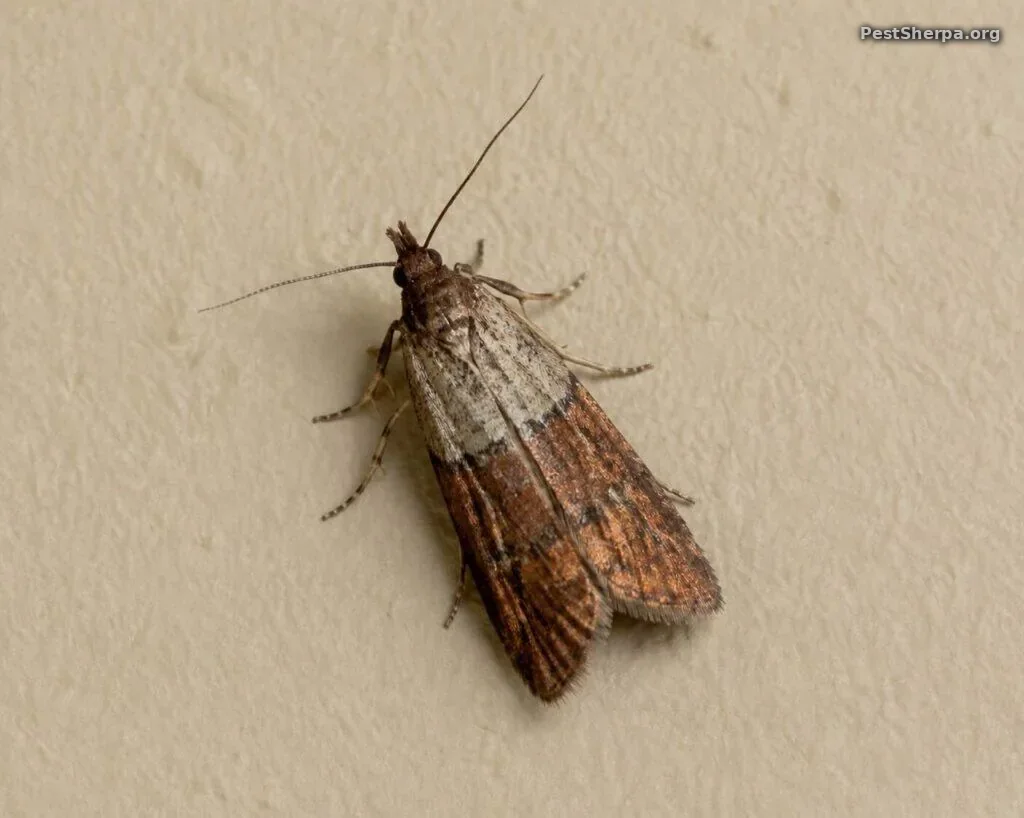
Adult Indianmeal moth with two-toned wings resting on a surface.
TL;DR
Indianmeal moths are pantry moths. The adult moths do not damage food, but their larvae feed in dry stored foods and leave silk webbing, clumps, debris, and contamination. The most effective first step is to find the infested product, discard or otherwise manage it safely, vacuum shelves and cracks, and store remaining dry goods in tightly sealed containers.
Pheromone traps can help confirm and monitor activity, but traps alone usually do not solve the problem because they do not remove larvae hidden in food or pupae tucked away in cabinet seams, shelf holes, ceilings, or nearby cracks.
Quick Navigation
- Quick ID
- Identification
- What Indianmeal Moths Mean in a Home
- Signs of Infestation
- High-Risk Foods
- Source Investigation Checklist
- Life Cycle and Behavior
- What To Do
- What Does Not Work
- Prevention
- When Professional Help May Be Worth Considering
- Lookalikes and Related Pantry Pests
- Frequently Asked Questions
- References
Quick ID
| Feature | Indianmeal Moth Clue |
|---|---|
| Adult appearance | Small moth with pale gray or tan inner wings and coppery reddish-brown outer wings |
| Size | Adults are small, with a wingspan around 5/8 inch |
| Larvae | Creamy white, yellowish, pinkish, or greenish caterpillars with brown heads |
| Food signs | Silk webbing, clumped food, frass, cast skins, larvae, or small holes in packaging |
| Common rooms | Pantries, kitchens, laundry rooms, garages, closets with pet food, and storage areas |
| Key meaning | A food source or nearby pupation site should be investigated |
Identification: What Indianmeal Moths Look Like
Adult Indianmeal moths are usually noticed flying in kitchens, resting on walls, or moving near ceilings. Their most useful identifying feature is the two-toned forewing pattern. The inner part of the wing is pale gray, tan, or buff, while the outer part is coppery to reddish brown. When the moth is resting, the wings fold over the body and create a narrow, roof-like shape.
The larvae are small caterpillars rather than maggots. They may be creamy white, yellowish, pinkish, or greenish depending partly on food source, and they have a darker head capsule. Larvae are the damaging stage because they feed directly in stored products and produce silk webbing that can mat food particles together.
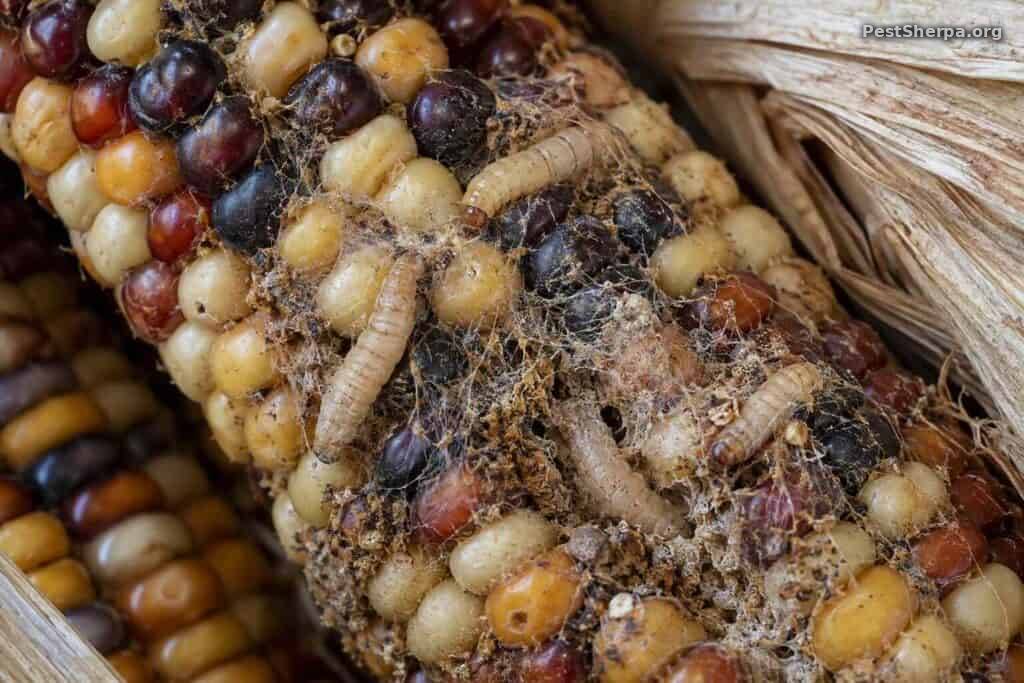
Indianmeal moth larva and silk webbing in dried holiday corn decoration.
What Indianmeal Moths Mean in a Home
Indianmeal moths usually mean there is, or recently was, an infested dry food product nearby. The source may be obvious, such as an open bag of cereal, or easy to miss, such as bird seed in a garage, old pet treats in a closet, decorative dried corn, forgotten nuts, or a rarely used baking mix.
| What You See | What It Usually Means | Best Next Step |
|---|---|---|
| One adult moth | Possible hitchhiker or early sign | Inspect nearby dry goods |
| Several adults over multiple days | Likely active or recent source | Inspect all pantry foods, pet food, and bird seed |
| Larvae in food | Confirmed infestation | Discard or safely manage infested product and clean shelves |
| Larvae crawling on walls or ceilings | Mature larvae are leaving food to pupate | Search nearby cracks, shelf holes, cabinet corners, and ceiling edges |
| Moths continue after food is removed | Hidden pupae or missed products may remain | Reinspect, vacuum, monitor, and check overlooked items |
Signs of Infestation
Indianmeal moth infestations often start inside a package and may not be obvious until adults emerge. Look for these clues:
- Small moths flying in the kitchen, pantry, storage room, or near ceilings
- Silk webbing in food, package seams, corners, or under lids
- Food particles stuck together in clumps
- Small caterpillars inside packages or crawling on walls and ceilings
- Cast skins, frass, or fine debris in stored foods
- Tiny holes in thin plastic bags, paperboard boxes, or inner liners
- Cocoons or pupae in shelf peg holes, cabinet joints, corners, or nearby cracks
Larvae may also be found away from the food source after they finish feeding. Finding larvae on ceilings or upper walls often means they are looking for a protected place to pupate, not that the ceiling itself is the food source.
High-Risk Food Products
Indianmeal moths can develop in many dry plant-based and grain-based materials. Inspect anything that has been stored for a long time, especially if it is open, lightly sealed, or kept in paper, cardboard, or thin plastic packaging.
| High-Risk Item | Where To Look |
|---|---|
| Cereal, oats, flour, cornmeal, rice, pasta, and baking mixes | Package seams, inner bags, corners, and shelf debris |
| Nuts, seeds, trail mix, dried fruit, chocolate, and candy | Old packages, gift baskets, holiday storage, and back pantry shelves |
| Dry pet food and pet treats | Garages, laundry rooms, closets, and feeding stations |
| Bird seed and wildlife feed | Garages, sheds, basements, and storage bins |
| Decorative dried corn, seed pods, and natural craft items | Holiday bins, wreaths, centerpieces, and stored decorations |
| Spices, herbs, dried peppers, and powdered products | Rarely used containers and older pantry items |
Other stored-product insects can infest some of the same foods. For related pantry pest comparisons, see the Pest Sherpa guides to sawtoothed grain beetles, red flour beetles, merchant grain beetles, and warehouse beetles.
Indianmeal Moth Source Investigation Checklist
Step 1: Start Where Moths Are Seen Most Often
Inspect the pantry, kitchen cabinets, shelves above appliances, and any nearby storage. Adult moths may fly away from the source, but repeated activity in one room gives you a useful starting point.
Step 2: Inspect All Dry Foods, Not Just Open Packages
Check unopened packages too. Larvae may enter or exit thin packaging, and infested products can arrive from stores, warehouses, or long-term storage before being noticed at home.
Step 3: Look Beyond Human Food
Do not stop at cereal and flour. Pet food, bird seed, rodent food, livestock feed, dried flowers, natural decorations, and forgotten food in garages or closets are common overlooked sources.
Step 4: Check Pupation Sites
Mature larvae often leave the food before pupating. Use a flashlight to check shelf peg holes, cabinet seams, shelf brackets, ceiling corners, cracks behind trim, and the undersides of shelves.
Step 5: Vacuum Carefully
Vacuum crumbs, webbing, larvae, cocoons, and debris from shelves and cracks. Empty the vacuum contents promptly into an outdoor trash container so collected insects are not left inside the home.
Life Cycle and Behavior
Indianmeal moths have complete metamorphosis: egg, larva, pupa, and adult. Females lay eggs on or near suitable foods. After hatching, larvae feed in the product, produce silk, and contaminate the material around them. When mature, larvae often wander away from the food to find a protected pupation site.
Warm conditions speed development, while cooler conditions slow it. This is why pantry moth problems may seem to increase during warm months or in heated indoor areas. Adults do not feed on pantry foods; their main role is reproduction and dispersal.
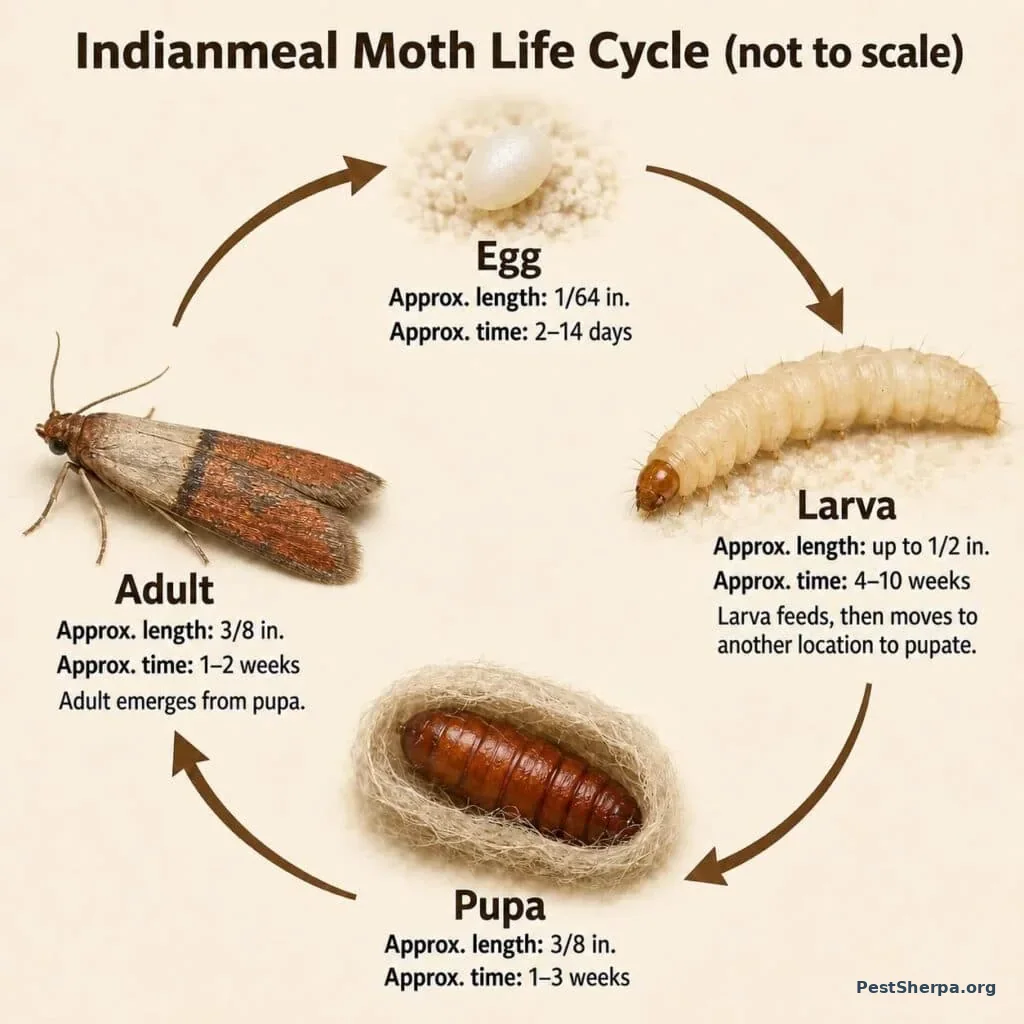
Indianmeal moth life cycle from egg to larva, pupa, and adult.
What To Do About Indianmeal Moths
1. Confirm the Pest
Check for the two-toned adult wing pattern and for caterpillar-like larvae in dry foods. Indianmeal moths are pantry pests, not fabric pests, so the inspection should focus on stored food and food-like materials rather than clothing.
2. Find and Remove Infested Products
Inspect dry goods closely. Products with visible larvae, webbing, clumping, frass, or heavy contamination should generally be discarded in sealed trash and removed from the home. When in doubt about food safety, do not eat the product.
3. Clean the Storage Area
Remove shelf liners if they hide crumbs or cocoons. Vacuum shelves, cracks, corners, shelf peg holes, and cabinet joints. Wipe surfaces after vacuuming. Focus on physical removal of food debris and insects rather than relying on sprays in food-storage areas.
4. Use Traps as Monitors, Not the Whole Solution
Pheromone traps can help show whether adult male moths are still present and where activity is strongest. They are useful monitoring tools, but they do not remove eggs, larvae, infested food, or hidden pupae.
5. Protect Uninfested Food
Move susceptible dry goods into tightly sealed glass, metal, or heavy-duty plastic containers. Thin bags and cardboard boxes are not reliable long-term protection once pantry pests are active.
6. Be Careful With Pesticides Around Food
Pesticides are not always needed for Indianmeal moths in homes. Avoid applying insecticides directly to food, food-contact surfaces, dishes, utensils, or open pantry goods. If any pesticide is used, read and follow the label exactly, and pay close attention to food-storage, child, pet, ventilation, and surface-contact cautions.
What Does Not Work
- Only killing adult moths: Adults are visible, but larvae in food are the main source.
- Using pheromone traps alone: Traps help monitor adults but do not clean out infested food.
- Spraying pantry shelves without inspection: Sprays do not fix contaminated food or hidden pupae and may create unnecessary food-area exposure.
- Ignoring pet food and bird seed: These are common sources and are often stored outside the kitchen.
- Assuming the problem is gone immediately: Some adults may still emerge from hidden pupation sites after the main source is removed.
Prevention
Long-term prevention depends on storage, rotation, and inspection. Buy dry goods in amounts you can use within a reasonable time. Inspect packages before storing them, especially bulk foods, bird seed, pet food, and older items from garages or storage rooms.
- Store dry foods in tightly sealed glass, metal, or heavy-duty plastic containers.
- Use older products first and avoid leaving forgotten packages in the back of shelves.
- Clean crumbs and spilled grain from shelves, drawers, pantries, and under appliances.
- Keep pet food, bird seed, and animal feed sealed and inspect them regularly.
- Check natural decorations such as dried corn, seed pods, and wreaths before storing them.
- Consider using pheromone traps as early-warning monitors in areas with past problems.
When Professional Help May Be Worth Considering
Many small pantry moth problems can be improved by finding the source, discarding contaminated items, cleaning thoroughly, and improving storage. Professional help may be worth considering when the source cannot be found, moths continue for several weeks after a thorough cleanup, activity involves a large storage area, or the problem is in a food-handling, retail, warehouse, or multi-unit setting.
A professional inspection may help identify hidden sources, overlooked pupation sites, or conditions that allow stored-product pests to keep returning. In food-handling environments, any treatment decisions should be made carefully and in compliance with applicable labels, sanitation requirements, and facility rules.
Lookalikes and Related Pantry Pests
Not every small moth or pantry insect is an Indianmeal moth. Use appearance, food source, and damage pattern together.
| Pest or Group | How It Differs | Useful Comparison |
|---|---|---|
| Clothes moths | Associated with wool, fur, feathers, and fabrics rather than pantry foods | Check closets and textiles if damage is on fabric |
| Sawtoothed grain beetles | Small, flattened beetles found in dry stored foods | Common in cereal, flour, pasta, and packaged foods |
| Red flour beetles | Small reddish beetles rather than moths | Often associated with flour, meal, and processed grain products |
| Merchant grain beetles | Small beetles that can infest packaged dry foods | Often confused with other stored-product beetles |
| Warehouse beetles | Beetle larvae may be hairy and can be associated with stored foods | Important comparison for stored-product pest inspection |
| Fruit flies / vinegar flies | Small flies, not moths, usually associated with fermenting fruit, drains, or residues | Useful if insects are tiny flies around produce or sinks |
Frequently Asked Questions
Are Indianmeal moths dangerous?
Indianmeal moths are mainly a food-contamination pest. They do not bite or sting. The main concern is that larvae, webbing, frass, and shed skins can contaminate stored foods. Discard heavily infested or questionable products rather than eating them.
Why are larvae crawling on my ceiling?
Mature larvae often leave the food source and crawl to walls, ceilings, cracks, or cabinet corners to pupate. This does not necessarily mean the ceiling is the source; it often means the original food source is nearby or was recently nearby.
Do pheromone traps get rid of Indianmeal moths?
Pheromone traps can help detect and monitor adult male moths, but they usually do not eliminate an infestation by themselves. You still need to find and remove infested food and clean hidden debris and pupation sites.
Can Indianmeal moths get into unopened food?
They can be present in products before purchase, and larvae may be able to enter or exit thin packaging. Paper, cardboard, and light plastic are not the same as a tight glass, metal, or heavy-duty plastic container.
How long will pantry moths continue after cleanup?
Activity should decline after the source is removed and the area is cleaned, but a few adults may still appear if larvae had already left the food and pupated nearby. Continued activity over several weeks usually means a source was missed or new products are being infested.
References
- University of California Statewide IPM Program: Pantry Pests
- Oklahoma State University Extension: Indianmeal Moth (Plodia interpunctella)
- Virginia Cooperative Extension: Indian Meal Moth
- University of Minnesota Extension: Pantry Pests: Insects Found in Stored Food
- Purdue Extension: Indianmeal Moth, Plodia interpunctella
This article was written by Greg Baumann, founder of Pest Sherpa, and reflects more than 40 years of professional pest management experience.
About the Author

Greg Baumann | Pest Control Expert
Greg Baumann is the founder of Pest Sherpa and a Pest Control Expert with more than 40 years of professional pest management experience. His articles combine decades of field experience, technical expertise, and science-based guidance to help homeowners identify pests correctly, understand real-world risks, and make informed pest management decisions.
Mission: Identify the pest. Understand the risk. Stop the problem. Prevent the comeback. Know when it’s time to call a professional.