
Black Carpet Beetles: Identification, Damage, and What to Do
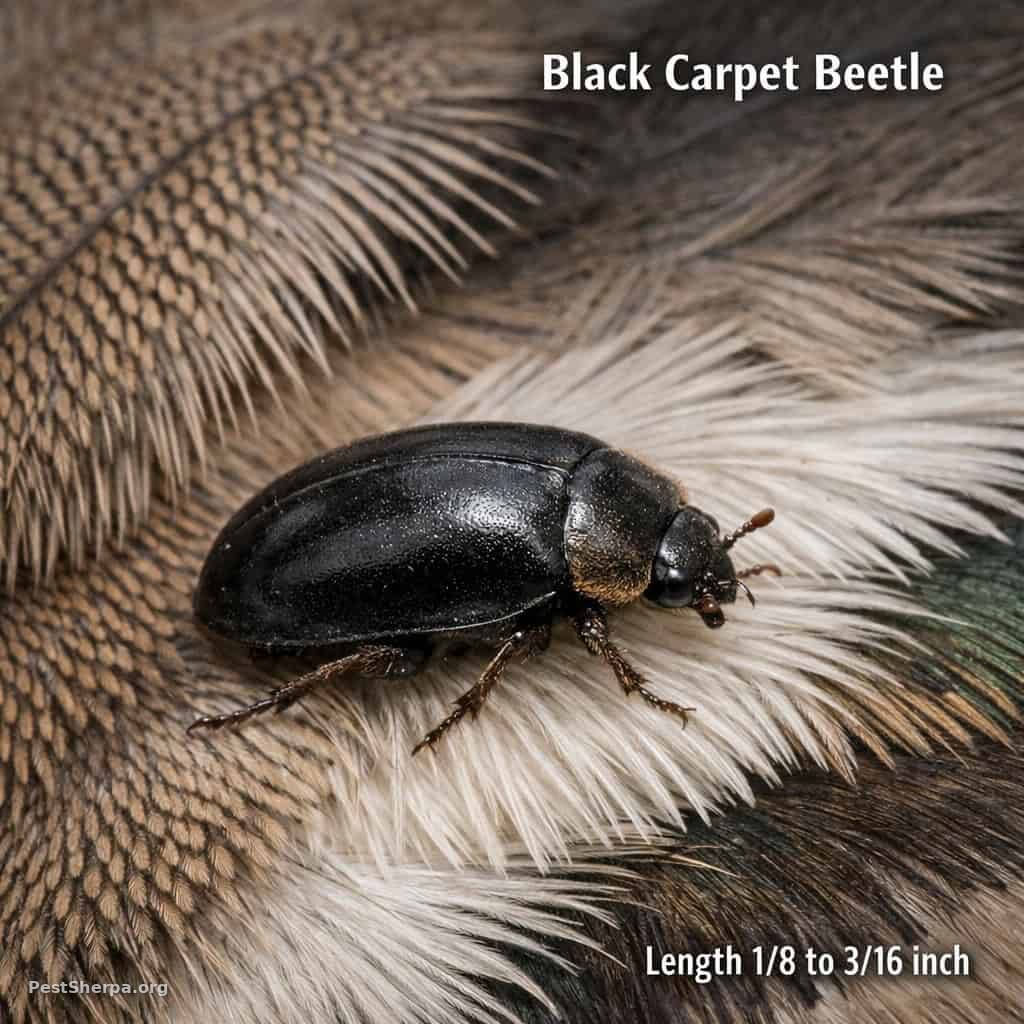
Finding small black beetles, bristly larvae, or strange shed skins near rugs, closets, baseboards, stored clothing, pet areas, or pantry items can be confusing. Black carpet beetles are not a sign that your home is dirty, and the adults usually are not the stage causing damage. The real concern is the larval stage, which can feed quietly on wool, fur, feathers, pet hair, lint, dead insects, stored animal products, and sometimes certain dry foods. This guide helps you identify black carpet beetles, understand what their presence usually means, inspect likely sources, avoid common mistakes, and choose practical next steps.
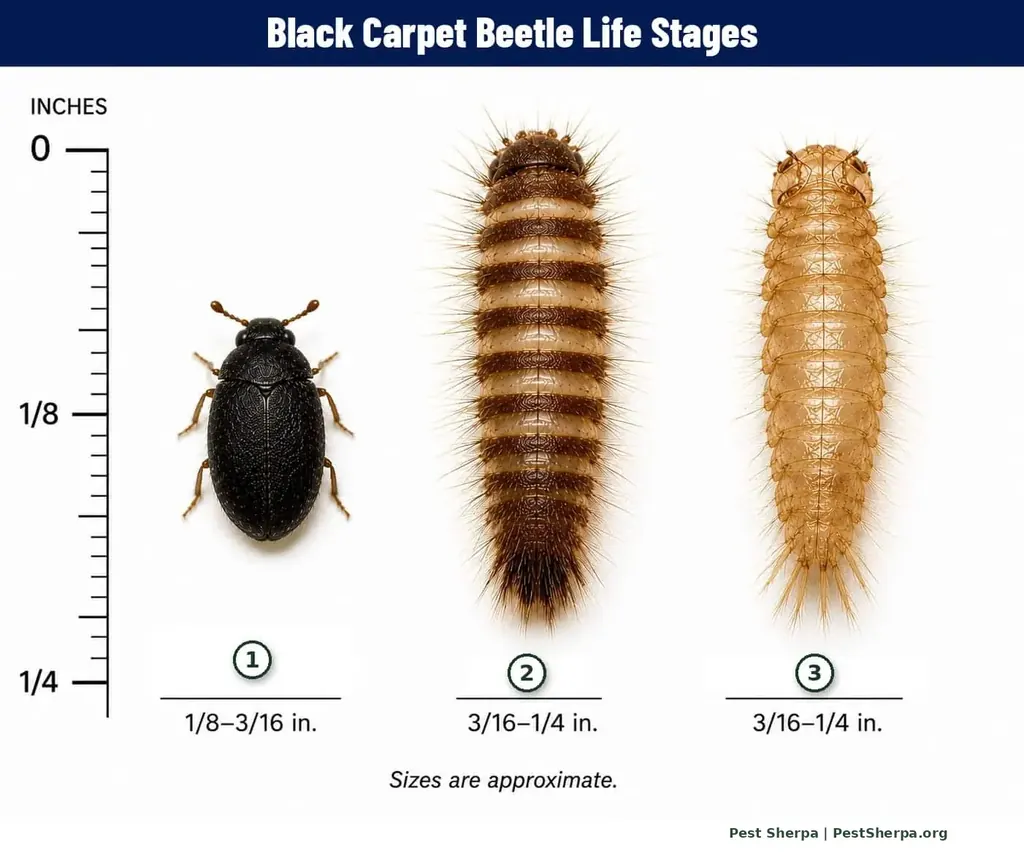
Which stage do you see? Match the number:
- Adult (Attagenus unicolor): 1/8 to 3/16 inch, oval, black to dark brown beetle.
- Larva: 3/16 to 1/4 inch, carrot-shaped and banded golden brown to dark brown, with a long tuft of hairs at the rear.
- Cast larval skin: 3/16 to 1/4 inch, a hollow, papery, light tan shed skin left behind as the larva grows.
Adult black carpet beetle, larva, and shed larval skin shown side by side for identification.
TL;DR
If you are seeing a few small black beetles at windows, they may be adult black carpet beetles that entered from outdoors or emerged indoors and moved toward light. The bigger concern is finding larvae, shed skins, or irregular damage to wool, rugs, stored clothing, furs, feathers, taxidermy, pet hair accumulations, dry pet food, bird seed, cereals, or other stored products.
The most useful first step is not spraying visible beetles. It is finding the larval food source, removing or cleaning infested items, vacuuming hidden debris, and protecting vulnerable materials in sealed storage.
Professional help may be worth considering when larvae or damage appear in multiple rooms, the source cannot be found, valuable textiles or collections are involved, insects continue after cleaning, or pesticide-sensitive areas such as child rooms, pet areas, schools, food-handling areas, museums, or archives are involved.
Quick Navigation
- What Black Carpet Beetles Mean in Your Home
- Quick Identification
- What You See / What It Usually Means
- Quick Assessment: How Serious Is It?
- Where To Inspect
- Why Black Carpet Beetles Suddenly Appear
- Seasonal Activity and Life Cycle
- Common Food Sources, Hiding Places, and Entry Points
- What To Do
- What Does Not Work
- How Long Will It Last?
- Health, Damage, Sanitation, and Safety Concerns
- When Professional Help May Be Needed
- Lookalikes and Common Misidentifications
- Frequently Asked Questions
- References
What Black Carpet Beetles Mean in Your Home
The black carpet beetle (Attagenus unicolor) is a dermestid beetle, a group of insects that commonly feed on dried animal materials, stored products, and organic debris. Adults are the small dark beetles people often notice near windows. Larvae are the bristly, carrot-shaped stage that causes most fabric and stored-product damage.
A single adult beetle does not automatically mean a serious infestation. Repeated adult sightings, larvae, shed skins, or new damage to susceptible materials are stronger signs that larvae are developing somewhere indoors.
Important distinction: adults may feed on pollen and nectar outdoors, but larvae feed on indoor food sources such as wool, fur, feathers, pet hair, lint, dead insects, stored animal products, and sometimes dry pantry or pet-food items.
Quick Identification: What Black Carpet Beetles Look Like
Black carpet beetles are often missed because the adults are small and the larvae hide in dark, undisturbed places.
- Adult: small, oval to slightly elongated beetle, usually dark brown to black, about 1/8 to 3/16 inch long.
- Larva: elongated, carrot-shaped or cigar-shaped, brown to dark brown, covered with short stiff hairs, with a noticeable tuft of longer hairs at the rear.
- Shed skins: dry, bristly, larva-shaped skins left behind after molting. These are often mistaken for dead insects or live larvae.
- Damage: irregular holes, surface grazing, thinning, bare patches in fur, or damaged stored food products.
- Typical locations: carpet edges, closets, wool storage, under furniture, pet resting areas, baseboards, air returns, attics, crawlspaces, pantry shelves, and stored boxes.
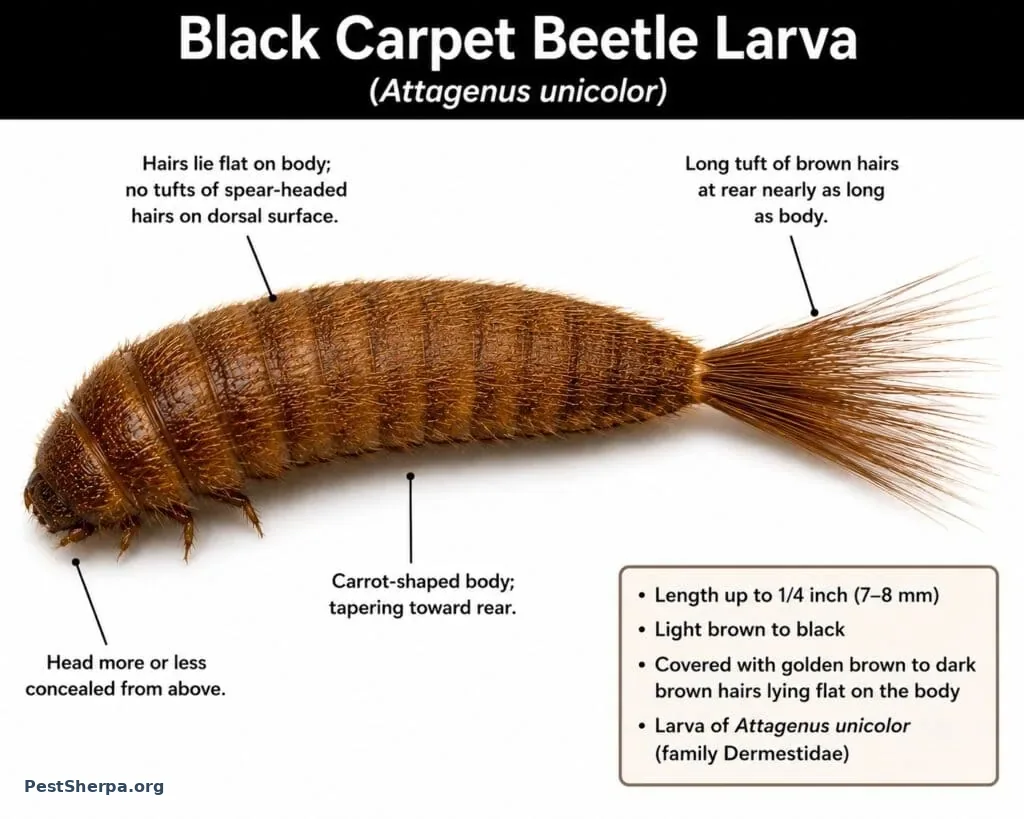
Black carpet beetle larva showing tapered body and long rear hair tuft.
Black Carpet Beetle Diagnostic Guide
| What You See | What It Usually Means | What To Check Next |
|---|---|---|
| One adult beetle on a windowsill | May have entered from outdoors or emerged indoors | Check nearby windows, flowers, and lighted areas; keep watching for larvae or shed skins |
| Several adult beetles over multiple days | Possible indoor source or repeated outdoor entry | Inspect carpet edges, closets, stored fabrics, pet areas, attic spaces, and pantry goods |
| Bristly larvae crawling near baseboards | Larvae are developing nearby or moving away from a food source | Inspect cracks, carpet edges, under furniture, pet hair accumulations, and stored items |
| Shed larval skins | Larvae have been feeding and molting in that area | Search immediately around the skins for wool, lint, hair, dead insects, or food debris |
| Irregular holes in wool, fur, felt, silk, or feather items | Larval feeding is likely | Inspect folds, seams, stored boxes, closets, rugs, and nearby debris |
| Small beetles in dry pet food, bird seed, cereal, grain, nuts, or spices | Could be black carpet beetles or another stored-product pest | Inspect all nearby pantry products and compare with lookalikes below |
| Itchy skin irritation with no biting insect found | Carpet beetle larval hairs or shed skins may be one possible irritant, but other causes are possible | Look for larvae and shed skins; consider medical advice for persistent symptoms |
Quick Assessment: How Serious Is It?
| Situation | Likely Severity | Suggested Next Step |
|---|---|---|
| One or two adults at a window and no larvae, skins, or damage | Low | Remove the beetles, repair obvious entry points, and monitor |
| Adults appear repeatedly in spring or early summer | Low to moderate | Inspect for indoor larval sources and check window screens, vents, and cut flowers |
| Larvae or shed skins found in one closet, rug edge, or storage box | Moderate | Isolate the source, clean thoroughly, vacuum cracks and edges, and protect nearby items |
| Damage found on multiple wool, fur, feather, felt, or silk items | Moderate to high | Inspect all vulnerable materials and consider expert identification before using pesticides |
| Larvae found in several rooms or activity continues after cleaning | High | Look for hidden sources such as attic nests, wall void debris, pet hair, dead insects, stored boxes, or pantry items |
| Infestation involves museum items, taxidermy, heirlooms, pianos, archives, or commercial storage | High | Use careful inspection, preservation-safe handling, monitoring, and professional or conservation guidance when needed |
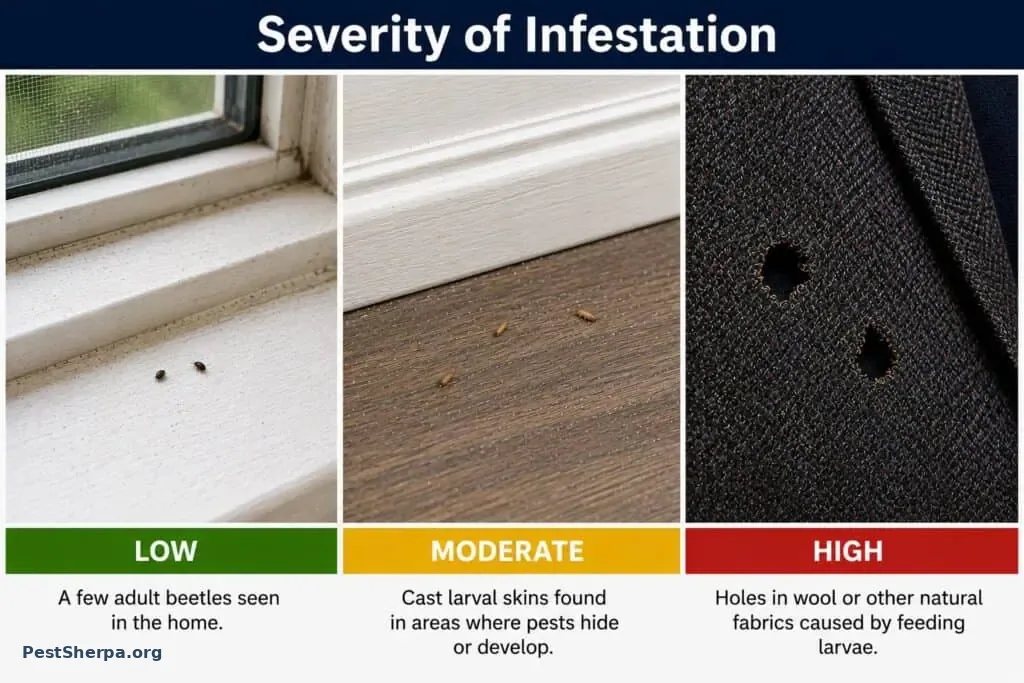
Black carpet beetle severity guide comparing adult beetles, larvae, shed skins, and fabric damage.
Where To Inspect for Black Carpet Beetles
Black carpet beetle inspections should focus on food sources, not just the places where adults are seen. Adults often move toward light, so a windowsill may be the place you notice them rather than the place where larvae are feeding.
Closets and Stored Clothing
- Wool suits, sweaters, coats, blankets, scarves, rugs, and felt items
- Silk, fur, leather, feathers, down, taxidermy, and natural-bristle brushes
- Stored boxes, garment bags, cedar chests, and rarely opened drawers
- Items with food stains, perspiration, urine, body oils, pet hair, or lint
Carpet Edges, Baseboards, and Furniture
- Edges of wool rugs and carpets, especially under heavy furniture
- Cracks along baseboards, molding, thresholds, and floor edges
- Upholstered furniture seams, undersides, cushions, and dust covers
- Accumulations of lint, hair, crumbs, dead insects, and dust in undisturbed areas
Pet Areas
- Pet beds, blankets, scratching posts, crates, kennels, and feeding stations
- Hair and lint under couches, beds, radiators, and furniture where pets rest
- Dry pet food, treats, bird seed, animal feed, and spilled food around storage bins
Attics, Crawlspaces, Garages, and Utility Areas
- Old bird, rodent, bee, or wasp nests where larvae may feed on hair, feathers, dead insects, or organic debris
- Stored rugs, clothing, upholstered furniture, holiday decorations, and cardboard boxes
- Air returns, duct openings, utility chases, and wall void access points where lint and dead insects accumulate
- Dead insects collected in light fixtures, window tracks, basements, garages, and sill plates
Pantry and Stored Products
- Cereal, grains, flour, nuts, seeds, spices, dry pet food, bird seed, and animal feed
- Packages with torn seams, loose lids, cardboard folds, or old product residue
- Shelf cracks and corners where food dust accumulates
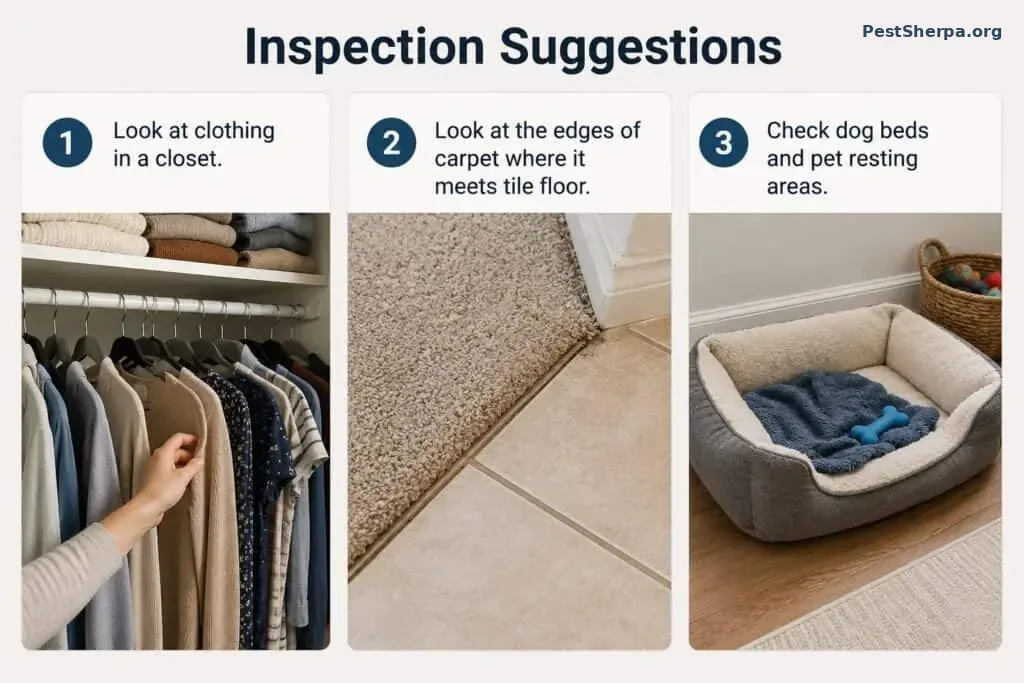
IHome inspection map showing common black carpet beetle hiding places and food sources.
Why Black Carpet Beetles Suddenly Appeared
Black carpet beetles can seem to appear suddenly even when larvae have been hidden for months. Common reasons include:
- Adults emerged from a hidden larval source and moved toward windows or lights.
- Stored wool, fur, feathers, pet bedding, or dry foods were moved, disturbing larvae or exposing damage.
- Seasonal adult activity increased, especially when adults are flying outdoors and entering through gaps, screens, doors, vents, or open windows.
- Cut flowers or outdoor materials were brought indoors, occasionally carrying adult beetles.
- Hidden animal nests or dead insects accumulated nearby, especially in attics, wall voids, crawlspaces, chimneys, garages, or light fixtures.
- Long-stored items became vulnerable because they were undisturbed, soiled, dusty, or stored in loosely sealed boxes.
A sudden adult outbreak does not always mean the source is in the same room. Adults can crawl or fly away from the larval feeding area before being noticed.
Seasonal Activity and Life Cycle
Black carpet beetles develop through egg, larva, pupa, and adult stages. The larval stage is the damaging stage and may last months under common indoor conditions. Development time varies with temperature, humidity, food quality, and how often larvae are disturbed.
Adults are more likely to be noticed near windows, lights, or flowers. Indoors, their main importance is that females can place eggs near suitable larval food sources. Outdoors, adults may visit flowers for pollen and nectar.
Because the larval stage can be prolonged, an infestation may continue even after visible adult beetles are removed. This is why source removal, cleaning, storage protection, and follow-up inspection matter more than simply killing adult beetles at the window.
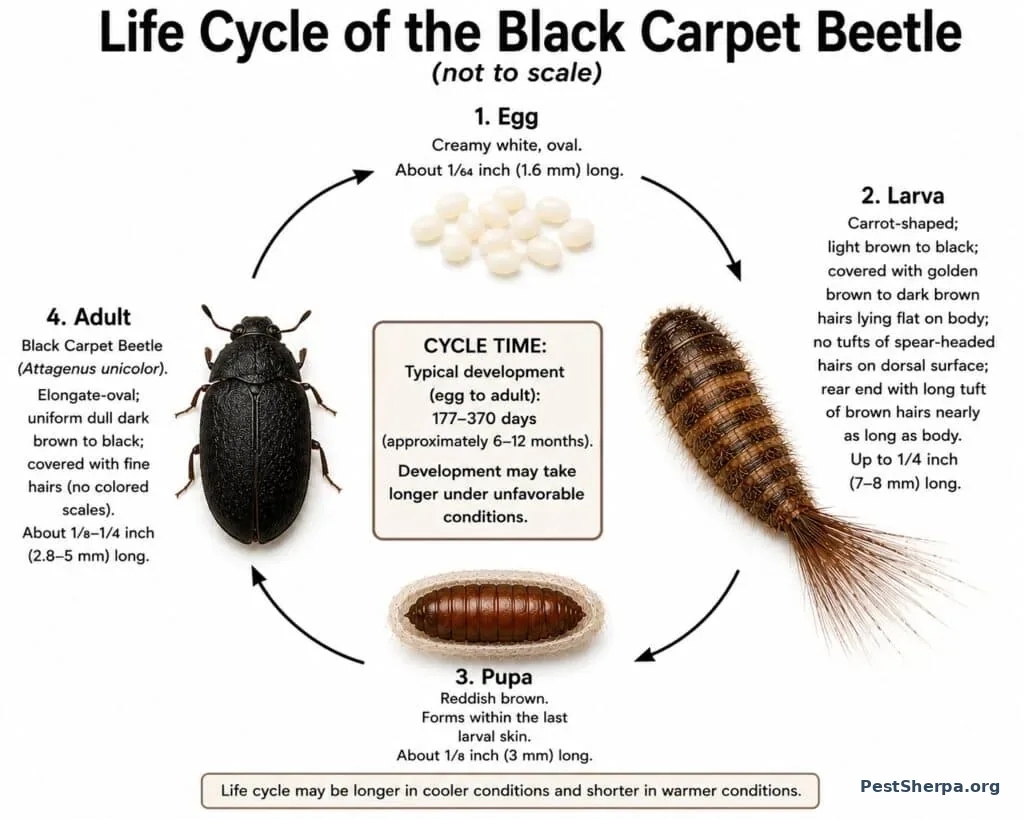
Black carpet beetle life cycle showing egg, larva, pupa, and adult stages.
Common Food Sources, Hiding Places, and Entry Points
Common Larval Food Sources
- Wool rugs, wool carpet, wool clothing, felt, and wool-blend items
- Fur, feathers, down, silk, leather, mounted animals, taxidermy, and preserved specimens
- Pet hair, human hair, lint, dust, dead insects, and spider remains
- Bird, rodent, bee, wasp, or other animal nests in or near the structure
- Dry pet food, bird seed, cereals, grains, nuts, spices, and other stored products in some infestations
- Synthetic fabrics that are blended with wool or contaminated with food stains, perspiration, urine, oils, or animal fibers
Common Hiding Places
- Under heavy furniture and along carpet edges
- Inside storage boxes, closets, drawers, and cedar chests
- Behind baseboards and inside floor cracks
- Inside upholstered furniture and beneath cushions
- Near pet beds, pet feeding areas, and lint accumulations
- Attics, crawlspaces, garages, wall voids, duct openings, and utility chases
Common Entry Points
- Open doors and windows
- Damaged window screens
- Vents, eaves, soffits, and utility penetrations
- Gaps around doors, thresholds, and exterior trim
- Infested rugs, furniture, clothing, taxidermy, stored foods, pet food, or secondhand items brought indoors
What To Do About Black Carpet Beetles
1. Confirm the Pest
Save a specimen if possible. Place an adult, larva, or shed skin in a small container or sealed bag for closer inspection. Identification matters because carpet beetles, clothes moths, pantry beetles, bed bugs, fleas, and other household pests require different responses.
2. Search for the Larval Source
Start where larvae, shed skins, or damage were found, then expand outward. Inspect the room above, below, and beside the activity when possible. A larval source may be a wool rug edge, a box of stored clothing, a pet bed, old bird seed, dead insects in a light fixture, or a hidden nest in an attic or wall void.
3. Remove, Clean, or Isolate Infested Items
Discard heavily damaged low-value items in sealed trash bags. For salvageable items, use cleaning methods appropriate for the material, such as laundering, dry cleaning, careful vacuuming, or sealed isolation. Delicate, historic, or valuable materials may need conservation-safe handling.
4. Vacuum Hidden Debris Thoroughly
Use a crevice tool along baseboards, carpet edges, closets, drawers, upholstered furniture, pet areas, cracks, and under heavy furniture. Vacuuming removes larvae, shed skins, eggs, lint, hair, food debris, and dead insects. Empty the vacuum contents outdoors or seal and discard the bag after cleaning infested areas.
5. Protect Vulnerable Materials
- Clean wool, fur, feathers, and natural-fiber items before storing them.
- Use sealed bins, garment bags, or tight containers for vulnerable textiles.
- Store dry pet food, bird seed, grains, and cereals in tight containers rather than loose bags or cardboard boxes.
- Inspect stored items periodically instead of leaving them undisturbed for long periods.
6. Reduce Outdoor Entry and Hidden Sources
- Repair screens and door gaps.
- Seal obvious utility openings, soffit gaps, and exterior cracks where practical.
- Remove old bird, rodent, bee, or wasp nests when it is safe and legal to do so.
- Clean dead insects from light fixtures, window tracks, attics, garages, and basements.
- Inspect cut flowers and outdoor items before bringing them indoors.
7. Use Monitoring Before and After Cleanup
Sticky traps can help show where beetles are active, but traps rarely solve the infestation by themselves. Place monitoring traps near suspected sources, not just at windows, and check them over time to see whether activity is declining.
8. Use Pesticides Carefully, If They Are Needed
Many black carpet beetle problems improve through identification, source removal, cleaning, and storage protection. If a pesticide is considered, use only products labeled for the pest and the exact location being treated. Read and follow the label directions, precautions, re-entry instructions, and restrictions. Do not treat clothing, bedding, toys, pet beds, food areas, or sensitive materials unless the label specifically allows that use.
What Does Not Work
| Common Mistake | Why It Usually Fails |
|---|---|
| Spraying only the adult beetles at windows | Adults are often away from the larval feeding source |
| Using foggers or bug bombs | They may not reach larvae hidden inside cracks, textiles, furniture, stored items, or wall voids |
| Relying on cedar alone | Cedar storage may help protect clean items, but it does not reliably eliminate an active hidden infestation |
| Using mothballs incorrectly in open rooms or drawers | Mothballs are pesticides and must only be used according to their label; open-room use can create unnecessary exposure risks |
| Ignoring pet hair, lint, and dead insects | These materials can support larvae even when no damaged clothing is obvious |
| Throwing away one damaged item without inspecting nearby materials | Larvae may be feeding in more than one nearby source |
| Assuming every skin irritation is a bite | Carpet beetles do not bite, and rash-like symptoms can have many causes |
How Long Will Black Carpet Beetles Last?
How long activity lasts depends on whether larvae still have food.
| Situation | Typical Pattern |
|---|---|
| One or two adults entered from outdoors | Activity may stop after the adults are removed and entry points are addressed |
| A small source is found and cleaned | Activity should decline, though a few remaining adults or larvae may still appear during follow-up |
| A hidden food source remains | Larvae can continue feeding, molting, and producing adults |
| Stored items are infested | Activity can persist as long as vulnerable materials remain undisturbed and accessible |
| Multiple rooms or voids are involved | Control may take longer because inspection and source removal are more complicated |
Because larvae can remain hidden, follow-up inspections are important. Recheck cleaned areas, nearby storage, and monitoring traps after the first cleanup.
Health, Damage, Sanitation, and Safety Concerns
Do Black Carpet Beetles Bite?
Black carpet beetles do not bite or sting people. However, larvae, shed skins, insect fragments, and dust from infested materials may irritate some sensitive individuals. Rash-like symptoms should not be assumed to be bites without evidence of a biting pest.
What Damage Do They Cause?
Larvae can damage wool, fur, feathers, silk, felt, taxidermy, natural history specimens, stored animal products, and some dry stored foods. Damage often appears as irregular holes, bare patches, thinning, or surface grazing. In pantry or pet-food situations, the concern is contamination rather than structural damage.
Children, Pets, and Pesticide Safety
Cleaning and source removal should come before pesticide use whenever practical. If a pesticide is used, keep children, pets, toys, food, dishes, and pet bowls away from treated areas according to the label. Follow all label directions for where the product may be used, how the area should be prepared, and when people and pets may re-enter.
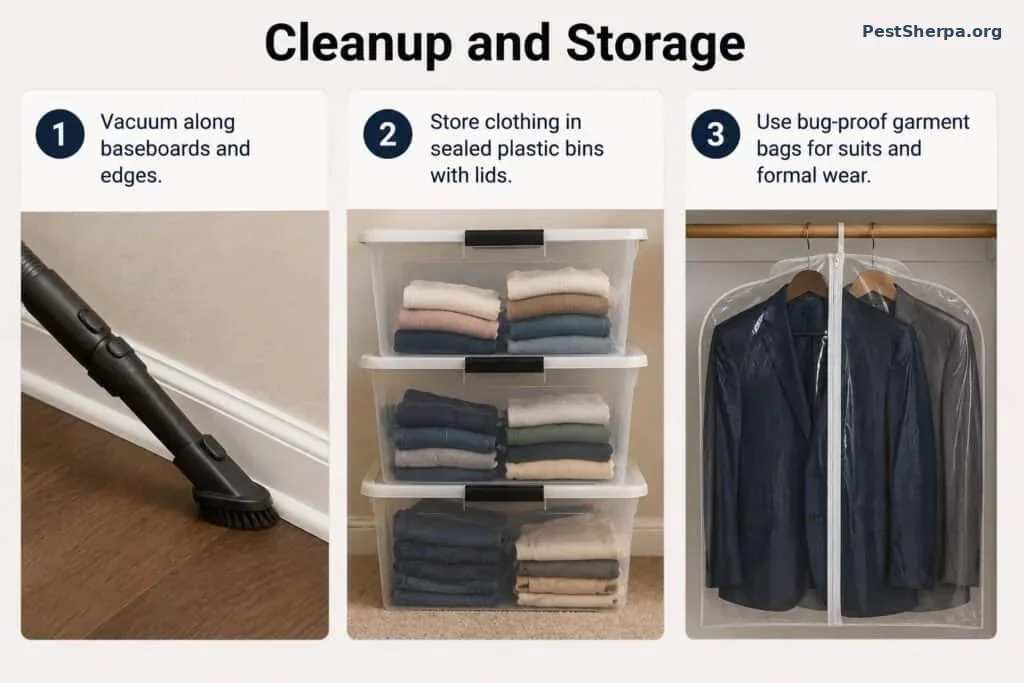
Black carpet beetle prevention steps showing vacuuming, sealed storage, and protected wool clothing.
When Professional Help May Be Needed
Professional pest identification or inspection may be useful when the source is unclear, damage continues, or the infestation involves sensitive materials or spaces. This is not because every black carpet beetle sighting is an emergency. It is because the larvae can hide in places that are easy to miss.
- Larvae or shed skins keep appearing after thorough cleaning
- Damage is found in multiple rooms, closets, rugs, furniture pieces, or storage areas
- The suspected source may be in an attic, crawlspace, wall void, duct area, chimney, or old animal nest
- Valuable wool, fur, taxidermy, museum, archive, piano, or collection materials are involved
- The site is a school, childcare space, healthcare area, food-handling area, warehouse, museum, library, or shared housing building
- Pesticide use is being considered in a home with children, pets, asthma concerns, allergies, or sensitive occupants
- The insect may actually be a different pest, such as clothes moths, pantry beetles, bed bugs, fleas, or another dermestid species
Lookalikes and Common Misidentifications
Correct identification prevents wasted effort. Black carpet beetle larvae can be confused with other carpet beetles, clothes moth larvae, pantry pests, or even signs of biting pests.
| Possible Lookalike | How It Differs | Why It Matters |
|---|---|---|
| Varied Carpet Beetle | Adults are mottled with pale, brown, yellow, or white scales rather than uniformly black | Management is similar, but identification helps locate likely sources |
| Furniture Carpet Beetle | Adults are mottled and more rounded; larvae differ in shape and hair pattern | Often associated with similar fabrics, furniture, and stored materials |
| Common Carpet Beetle | Adults have patterned scales rather than a solid black appearance | Often confused with other carpet beetles in homes |
| Clothes Moth Larvae | Moth larvae are caterpillar-like and may produce webbing or cases; adult moths are not beetles | Clothes moth management focuses heavily on infested woolens and stored textiles |
| Sawtoothed Grain Beetle | Small, flat, brown pantry beetle with saw-like projections near the thorax | Usually points to pantry products rather than wool or pet hair sources |
| Merchant Grain Beetle | Very similar to sawtoothed grain beetle and associated with stored foods | Pantry inspection and product disposal become the priority |
| Bed Bugs or Fleas | These are biting pests; carpet beetles do not bite | Skin irritation alone is not enough to identify the pest |
Frequently Asked Questions
Are black carpet beetles dangerous?
They are mainly fabric, collection, and stored-product pests. They do not bite or sting, but larvae, shed skins, and insect debris may irritate some sensitive people, and infested food products should be discarded.
Do black carpet beetles mean my house is dirty?
No. They can occur in clean homes when suitable food sources are present. Long-stored wool, pet hair, lint, dead insects, bird nests, old animal materials, or dry stored foods can support larvae even when normal housekeeping is good.
Why do I keep finding adult beetles at the window?
Adults are attracted to light. The window may be where they are trying to leave, not where larvae are feeding. Inspect the surrounding room, adjacent rooms, closets, carpet edges, pet areas, attic spaces, and stored goods.
What is the most damaging stage?
The larval stage causes most damage. Adult beetles are usually noticed first, but larvae are the stage that feeds on susceptible materials.
Can black carpet beetles live in beds?
They are not bed bugs and do not feed on people. However, larvae may occur near beds if there is pet hair, lint, wool blankets, feather items, dead insects, or other suitable food sources nearby.
Do black carpet beetles eat synthetic carpets or clothes?
Clean synthetic materials are generally less attractive. Larvae are more likely to feed on wool blends, animal fibers, or synthetic items contaminated with food stains, perspiration, urine, body oils, pet hair, lint, or animal fibers.
Should I throw away all my clothes?
No. Focus on inspection and source removal. Heavily damaged low-value items may be discarded, but many items can be cleaned, isolated, protected, or handled according to the care label or with professional textile guidance.
Will vacuuming get rid of black carpet beetles?
Vacuuming is one of the most important steps, but it works best when combined with finding the source, cleaning or removing infested items, protecting stored materials, and following up. Vacuuming only open floor areas may miss larvae hidden in cracks, furniture, closets, or stored goods.
Do mothballs work for black carpet beetles?
Mothballs are pesticides and should not be used casually in open rooms, closets, or drawers. They must be used only according to the product label, typically in tightly sealed containers when allowed. They are not a substitute for finding and removing the larval source.
When should I suspect a hidden attic or wall source?
Consider hidden sources when adults or larvae keep appearing in the same area, when no closet or rug source is found, or when there are old bird nests, rodent nests, dead insects, pet hair, or stored materials in attics, crawlspaces, chimneys, garages, or wall voids.
Bottom Line
Black carpet beetle control starts with identification and source investigation. Adult beetles at windows are clues, but larvae, shed skins, and damaged materials reveal where the real problem is. The best results usually come from finding the larval food source, cleaning thoroughly, protecting vulnerable textiles and stored products, reducing entry points, and using pesticides only when they are appropriate, labeled, and applied safely.
References
Species-Specific References
- UF/IFAS Extension Featured Creatures: Black Carpet Beetle, Attagenus unicolor (Brahm)
- University of California Statewide IPM Program: Carpet Beetles
- Rutgers New Jersey Agricultural Experiment Station: Carpet Beetles
- University of Maryland Extension: Carpet Beetles
- U.S. Fish & Wildlife Service / ITIS: Black Carpet Beetle (Attagenus unicolor) Taxonomic Profile
This article was written by Greg Baumann, founder of Pest Sherpa, and reflects more than 40 years of professional pest management experience.
About the Author

Greg Baumann | Pest Control Expert
Greg Baumann is the founder of Pest Sherpa and a Pest Control Expert with more than 40 years of professional pest management experience. His articles combine decades of field experience, technical expertise, and science-based guidance to help homeowners identify pests correctly, understand real-world risks, and make informed pest management decisions.
Mission: Identify the pest. Understand the risk. Stop the problem. Prevent the comeback. Know when it’s time to call a professional.