
Varied Carpet Beetles: Identification, Damage, and What to Do
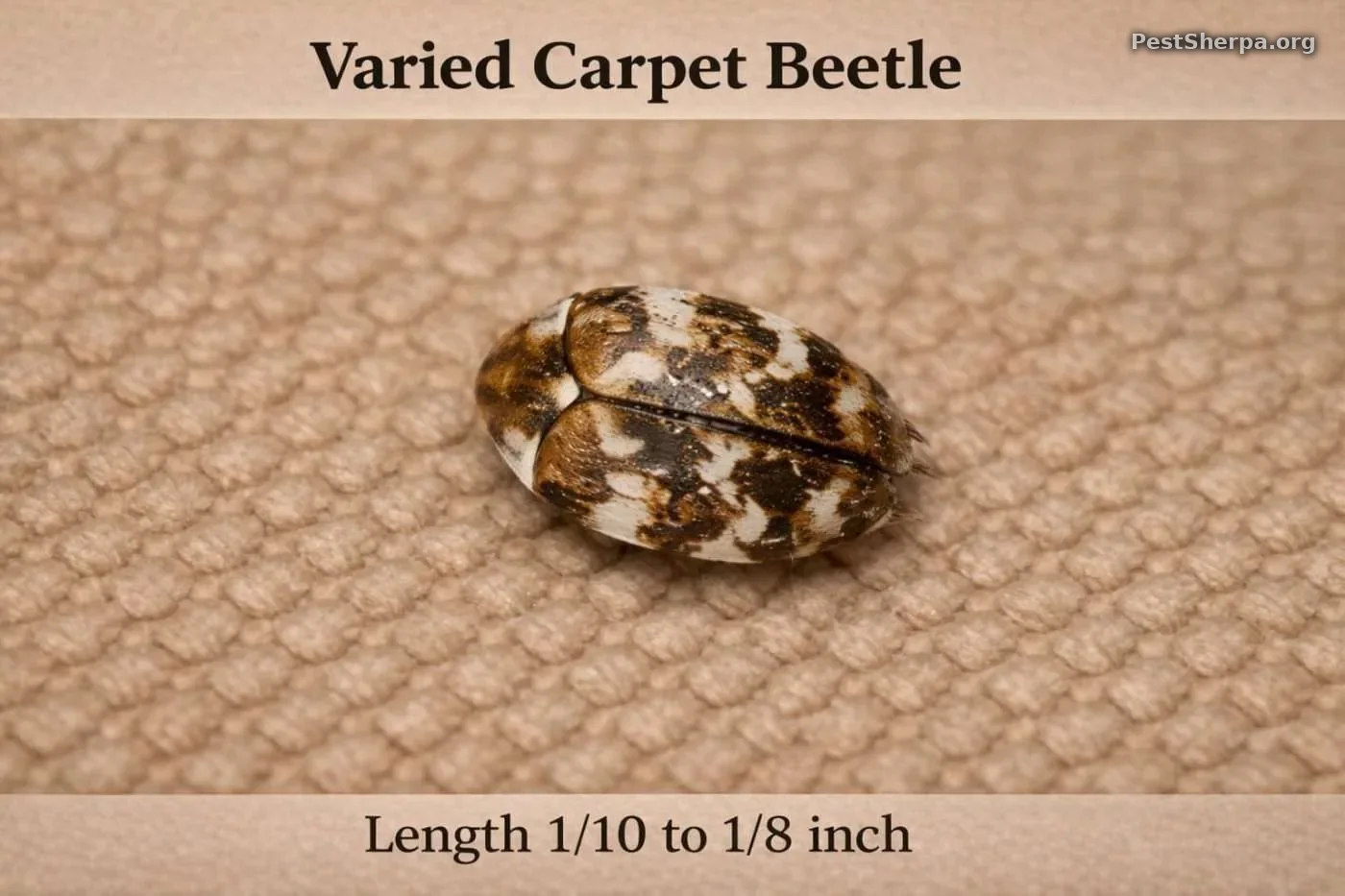
The varied carpet beetle (Anthrenus verbasci) is a small, rounded carpet beetle whose larvae can damage wool, fur, feathers, silk, leather, taxidermy, insect collections, and other animal-based materials. Adults are often noticed first because they fly to windows and lights, but the hidden larvae are the stage that feeds on fabrics and debris.
A few adults near a window do not automatically mean a serious infestation. Repeated sightings, shed larval skins, damaged woolens, larvae in closets, or beetles emerging from stored items are stronger clues that larvae are developing somewhere indoors.
This guide explains how to identify varied carpet beetles, where to inspect, what damage means, how to reduce the source, and when professional help may be worth considering.
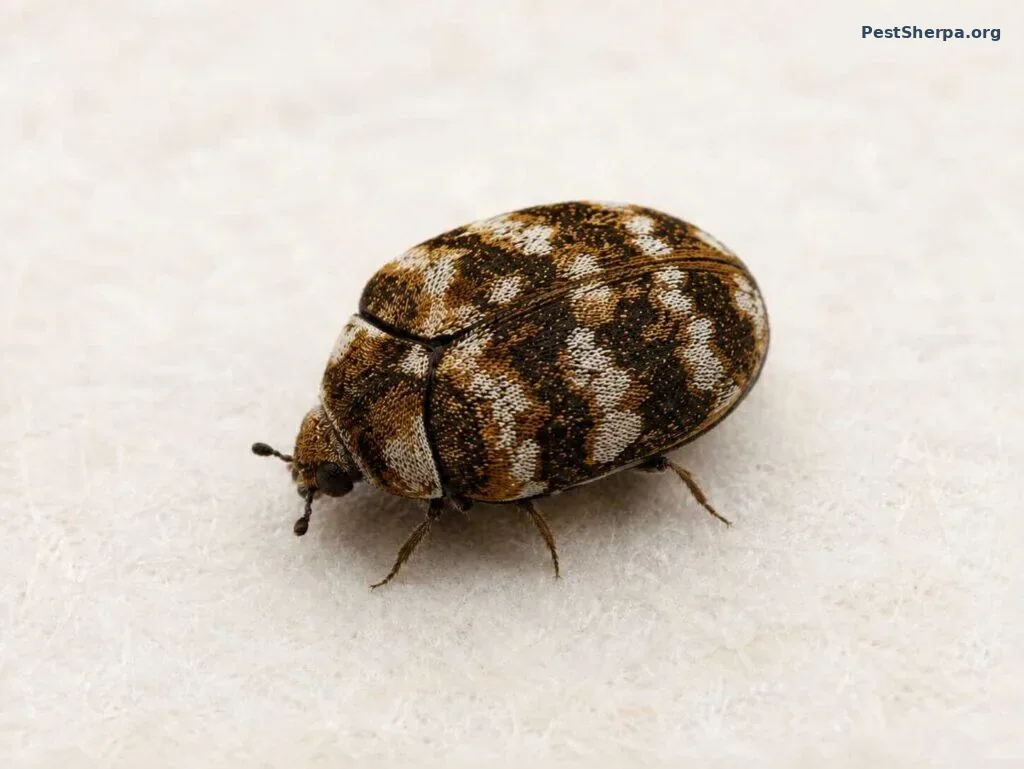
Adult varied carpet beetle showing mottled white, brown, and yellow scales.
TL;DR
- Adults: Small, round beetles, usually about 1/8 inch long, with mottled white, tan, yellow, brown, and black scales.
- Larvae: Small, bristly, brownish larvae with hairs and shed skins often found near damaged materials.
- Main damage: Larvae feed on wool, fur, feathers, silk, leather, dead insects, pet hair, lint, and some stored or soiled materials.
- Best first step: Find and remove the source, then vacuum carefully along edges, baseboards, closets, vents, stored textiles, and under furniture.
- Pesticides: Not always necessary. If used, follow the label exactly and avoid treating clothing, bedding, food-contact surfaces, drains, or areas accessible to children and pets unless the label specifically allows it.
Quick Navigation
- Identification
- Signs of Activity
- Biology and Life Cycle
- Where To Inspect
- Damage
- What To Do
- What Does Not Work Well
- How Long Activity Lasts
- Long-Term Prevention
- When Professional Help May Be Needed
- Lookalikes
- FAQs
- References
Identification: What Varied Carpet Beetles Look Like
Adult varied carpet beetles are small, oval to round beetles. When the scales are intact, the wing covers have a mottled pattern of white, yellowish, tan, brown, and dark markings. Older adults may look darker if the scales have rubbed off.
- About 1/8 inch long
- Rounded, dome-shaped body
- Mottled or calico-like pattern when scales are present
- Able to fly
- Often seen at windows, lights, or on interior walls in spring or warm weather
Larvae
The larvae are the damaging stage. They are small, brownish, bristly, and often hidden in dark areas. Mature larvae are roughly 3/16 inch long and may look like tiny hairy, tapered broader toward the rear with conspicuous hair tufts. Shed skins are often easier to find than live larvae.
- Small, tan to brown body
- Dense hairs or bristles
- Usually found in dark, undisturbed areas
- May leave shed skins and small fecal material near feeding sites
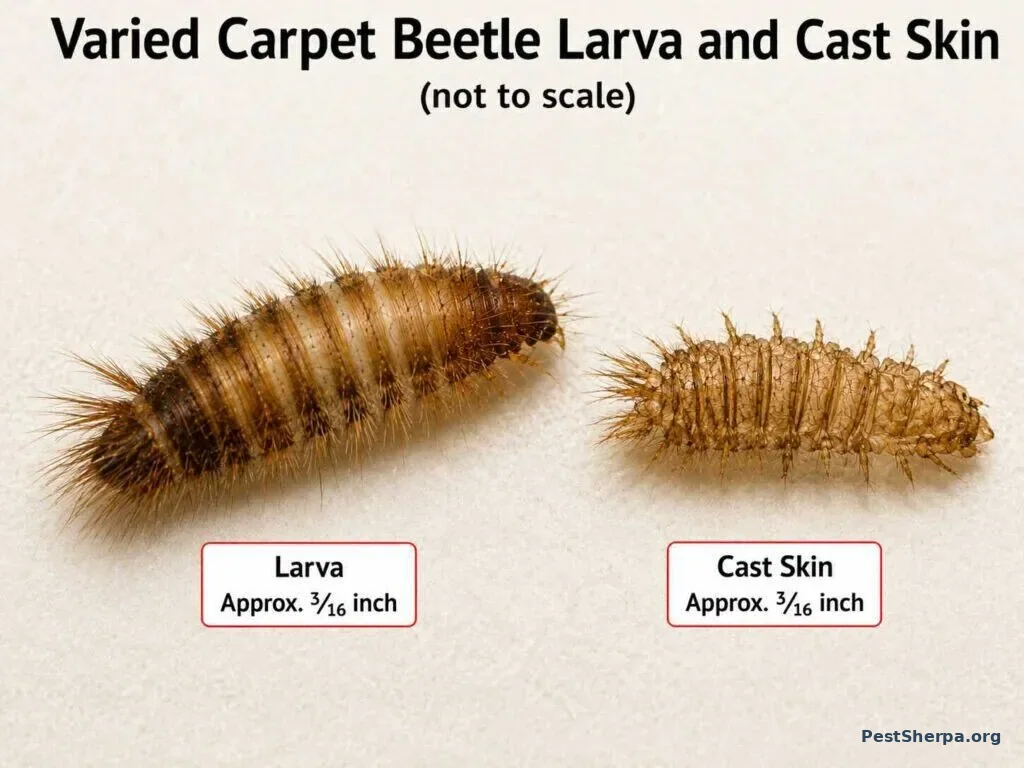
Varied carpet beetle larva and shed skin found near fabric damage.
Signs of Varied Carpet Beetle Activity
Adult beetles are often the first visible clue, but the most useful evidence is usually found where larvae feed or molt.
| What You Find | What It May Mean |
|---|---|
| One adult beetle near a window | Could be an outdoor beetle that wandered inside |
| Adults appearing repeatedly indoors | Possible indoor breeding source |
| Shed larval skins | Larvae have been developing nearby |
| Irregular holes or grazed areas on wool, fur, or feathers | Possible larval feeding damage |
| Larvae in closets, under furniture, or along baseboards | Likely food source in or near that area |
| Activity near vents, attics, chimneys, or wall voids | Possible animal nest, dead insects, pet hair, lint, or debris source |
Expert Insight: The adult beetle is often just the clue. The real task is finding the larval food source.
Biology and Life Cycle
Varied carpet beetles go through complete metamorphosis: egg, larva, pupa, and adult.
- Eggs are laid near suitable food.
- Larvae hatch and feed in concealed areas. This is the stage that causes damage.
- Pupae develop in protected places, sometimes in or near the last larval skin.
- Adults emerge, fly well, and often move toward sunlight, windows, or outdoor pollen sources.
Development time varies with temperature, humidity, food quality, and disturbance. Larvae may develop for several months and, under some conditions, longer. This is why carpet beetle problems can seem to continue even after the first visible adults are removed.
Adult varied carpet beetles do not chew holes in clothing or rugs. Adults are associated with pollen, nectar, and reproduction. Larvae are the fabric-feeding stage.
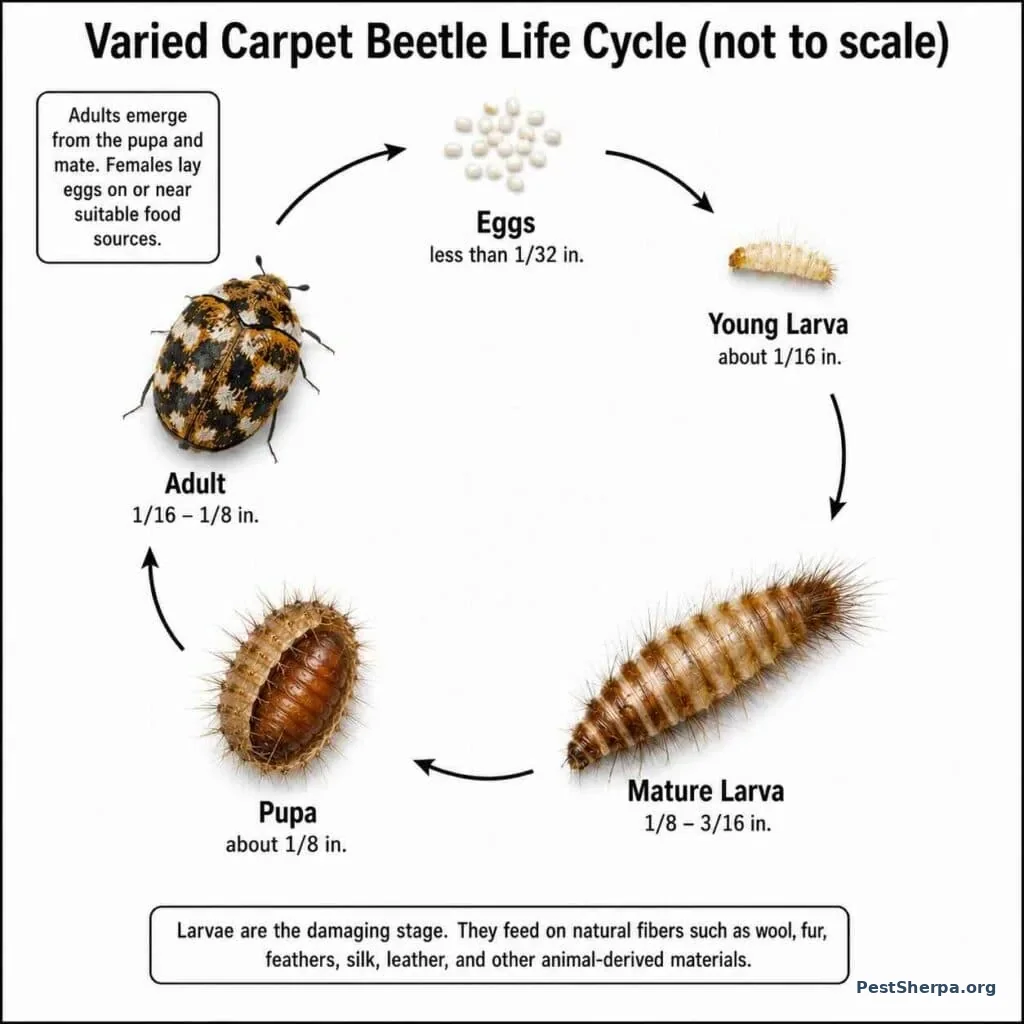
Varied carpet beetle life cycle from egg to larva, pupa, and adult.
Where To Inspect for Varied Carpet Beetles
Inspection should focus on dark, undisturbed areas where larvae can feed without being noticed. Do not stop after checking the first damaged sweater or rug. The source may be several feet away or hidden in another room.
| Inspection Area | What To Look For |
|---|---|
| Closets and storage bins | Wool clothing, fur trim, feather items, old blankets, shed skins, larvae |
| Rug and carpet edges | Damage under furniture, along baseboards, and on rug undersides |
| Upholstered furniture | Natural fiber padding, pet hair, lint, dead insects, shed skins |
| Baseboards and floor edges | Lint, pet hair, food crumbs, dead insects, larvae |
| Air vents and ducts | Lint, hair, insect debris, dust buildup |
| Attics, chimneys, eaves, and wall voids | Bird nests, rodent nests, wasp nests, dead insects, animal hair |
| Museum, hobby, or collection storage | Taxidermy, insect collections, feathers, hides, wool, natural history specimens |
| Pantry or craft storage | Stored grain, seeds, spices, dried plant materials, wool yarn, felt, natural fibers; these are secondary/occasional food sources |
Carpet beetle larvae can survive on overlooked organic debris, including lint, pet hair, dead insects, and animal nesting material. That is why a clean-looking room can still have a hidden source.
Damage Caused by Varied Carpet Beetle Larvae
Larvae feed on animal-based materials and some soiled materials. Clean synthetic fabrics are not typical food, but blends or soiled fabrics may be damaged if they contain food residue, sweat, urine, hair, or animal-derived fibers.
- Wool rugs, carpets, clothing, and blankets
- Fur, feathers, down, taxidermy, and hides
- Silk, leather material components including glues etc., felt, and natural fiber padding
- Dead insects, insect collections, and natural history specimens
- Pet hair, lint, and organic dust in hidden areas
- Some stored grains, seeds, spices, or dry foods in certain situations
Damage often appears as irregular holes, thinned patches, clipped fibers, or grazed surfaces. Shed skins near damaged materials are a strong carpet beetle clue because clothes moths are more likely to leave webbing.
For pantry-focused beetle activity, also compare with stored product pests such as the warehouse beetle, merchant grain beetle, and sawtoothed grain beetle.
What To Do About Varied Carpet Beetles
1. Confirm the Pest
Try to collect one adult, larva, or shed skin in a small container or clear bag. Identification matters because carpet beetles, clothes moths, pantry beetles, and other household insects require different inspection patterns.
2. Find the Source
Inspect the areas listed above. Start near damaged materials, then expand outward to baseboards, under furniture, closets, air returns, attics, chimneys, and any place where hair, lint, dead insects, or animal nesting material can collect.
3. Remove or Clean Infested Materials
Wash, dry clean, freeze, heat in dryer in a cloth bag, or discard infested items depending on the material and care label. Valuable textiles, taxidermy, antiques, and museum items may need conservation-safe guidance before cleaning or treatment.
4. Vacuum Thoroughly
Vacuum slowly along carpet edges, baseboards, closet floors, rug undersides, upholstered furniture seams, cracks, vents, and under heavy furniture. Empty the vacuum contents outdoors when possible so larvae and shed material are removed from the home.
5. Reduce Adult Entry
Repair screens, seal gaps around doors and windows, and check cut flowers or outdoor items before bringing them inside. Adults can fly in from outdoors, especially when flowering plants are nearby.
6. Use Monitoring Carefully
Sticky traps can help show where adults are active, especially near windows and suspected rooms. Traps are useful for monitoring, but they do not remove the hidden larval source by themselves.
7. Be Careful With Pesticides
Insecticides are not always necessary and should not replace source removal and cleaning. If a pesticide is used, read and follow the entire label. Avoid treating clothing, bedding, food-contact areas, drains, toys, pet bedding, or ventilation openings unless the label specifically allows that use. Keep children, pets, food, and dishes away from treated areas until the label says it is safe.
What Does Not Work Well
- Only killing adults at windows: Adults are visible, but larvae are usually hidden elsewhere.
- Spraying damaged clothing: Clothing and bedding should be cleaned according to care labels, not sprayed unless a product label specifically allows that use.
- Ignoring lint and pet hair: Larvae can survive on debris even when no obvious wool item is nearby.
- Relying on cedar or repellents alone: Repellents do not replace inspection, cleaning, and sealed storage.
- Using foggers as a shortcut: Foggers rarely reach all hidden larval feeding sites and may create unnecessary pesticide exposure.
How Long Will Varied Carpet Beetles Last?
Activity depends on whether the larval source has been found and removed.
- One adult: May be a short-term outdoor entry.
- Source removed: Activity should decline as remaining adults die or are removed but beware that larvae may continue to develop nearby.
- Hidden source remains: Adults and larvae may continue appearing over time.
- Stored items involved: Activity can persist until all infested boxes, garments, rugs, or specimens are inspected.
Because larvae may develop slowly, a brief follow-up inspection is useful after cleaning. Watch for new shed skins, fresh damage, or new adults at windows.
Long-Term Prevention
- Vacuum carpet edges, baseboards, closets, under furniture, and upholstered furniture seams regularly.
- Clean woolens and animal-fiber items before long-term storage.
- Store vulnerable items in sealed containers or garment bags after they are clean and dry.
- Inspect stored clothing, blankets, rugs, taxidermy, and natural history collections periodically.
- Remove old bird nests, wasp nests, rodent nesting material, dead insects, and animal debris when safe and accessible.
- Repair screens and reduce gaps where adults can enter.
- Check cut flowers, secondhand textiles, used furniture, and stored boxes before bringing them into living areas.
When Professional Help May Be Needed
Professional help may be worth considering when the source cannot be found, damage is widespread, valuable items are involved, or activity appears to be coming from attics, wall voids, vents, chimneys, commercial storage, museums, or collection areas.
A careful inspection should focus on source location, cleaning priorities, exclusion, and whether any targeted treatment is appropriate. Treating visible adults alone is usually not enough.
Lookalikes and Common Misidentifications
Several beetles can be confused with varied carpet beetles. Identification matters because the source and damaged materials can differ.
| Pest | How It Differs |
|---|---|
| Black Carpet Beetle | Adult is darker and more elongated; larvae are longer and tapered with a hair tuft. |
| Furniture Carpet Beetle | Similar small Anthrenus carpet beetle with different scale pattern and related fabric-feeding habits. |
| Clothes Moths | May leave webbing or cases; adults are moths, not hard-bodied beetles. |
| Warehouse Beetle | Stored product beetle associated more strongly with dry foods and stored products. |
| Merchant Grain Beetle | Flatter, more elongated pantry beetle found around grains and packaged foods. |
| Sawtoothed Grain Beetle | Small pantry beetle with a narrow body and saw-like projections along the thorax. |
Frequently Asked Questions
Do adult varied carpet beetles damage clothes?
No. The larvae are the stage that damages fabrics and other materials. Adults are usually noticed because they move toward windows and light.
Does one varied carpet beetle mean I have an infestation?
Not necessarily. One adult may have flown in from outdoors. Repeated adults, larvae, shed skins, or fabric damage are stronger signs of an indoor source.
Why are varied carpet beetles on my windowsill?
Adults are attracted to light and often move toward windows after emerging indoors. The window is usually not the source; it is where adults are trying to exit.
What should I inspect first?
Start with damaged items, nearby closets, rug edges, baseboards, under furniture, air vents, and stored woolens or animal-fiber materials. Then inspect attics, chimneys, and areas with old nests or dead insects if activity continues.
Can carpet beetle larvae irritate skin?
Some people may experience irritation from contact with larval hairs or shed skins. Carpet beetles do not bite people, but cleaning up shed skins and debris can reduce exposure.
Can I just spray for carpet beetles?
Spraying without finding the source often fails. Cleaning, source removal, laundering or dry cleaning vulnerable items, vacuuming, and sealed storage are usually more important than treating visible adults.
References
- UC Statewide IPM Program: Carpet Beetles
- University of Kentucky Entomology: Carpet Beetles
- University of Maryland Extension: Carpet Beetles
- Rutgers NJAES Cooperative Extension: Carpet Beetles
- MuseumPests.net: Varied Carpet Beetle Fact Sheet
This article was written by Greg Baumann, founder of Pest Sherpa, and reflects more than 40 years of professional pest management experience.
About the Author

Greg Baumann | Pest Control Expert
Greg Baumann is the founder of Pest Sherpa and a Pest Control Expert with more than 40 years of professional pest management experience. His articles combine decades of field experience, technical expertise, and science-based guidance to help homeowners identify pests correctly, understand real-world risks, and make informed pest management decisions.
Mission: Identify the pest. Understand the risk. Stop the problem. Prevent the comeback. Know when it’s time to call a professional.