
Australian Cockroaches: Identification, Signs, and What to Do
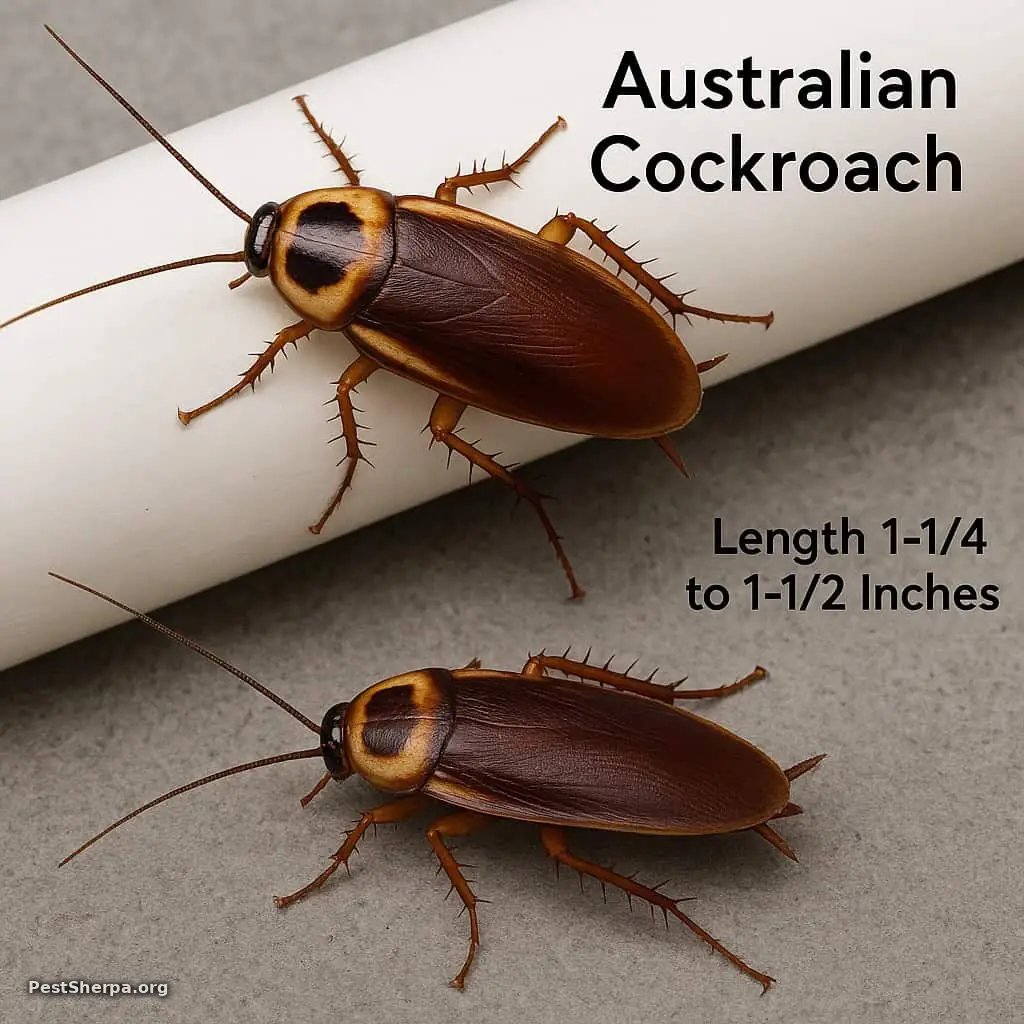
Seeing a large reddish-brown cockroach indoors can be unsettling, especially when it looks similar to an American cockroach or “palmetto bug.” Australian cockroaches usually live outdoors. They move into buildings when warmth, moisture, food, or shelter becomes available. A single adult near a door or window may be an occasional invader. Repeated sightings, nymphs, egg capsules, or activity in kitchens, bathrooms, basements, greenhouses, or utility areas are different. They can mean a nearby harborage (hiding spot) or breeding site needs attention.
This guide explains how to identify Australian cockroaches and what their presence usually means. It also covers where to inspect, what conditions attract them, what steps help, and when a professional evaluation may be worth considering.
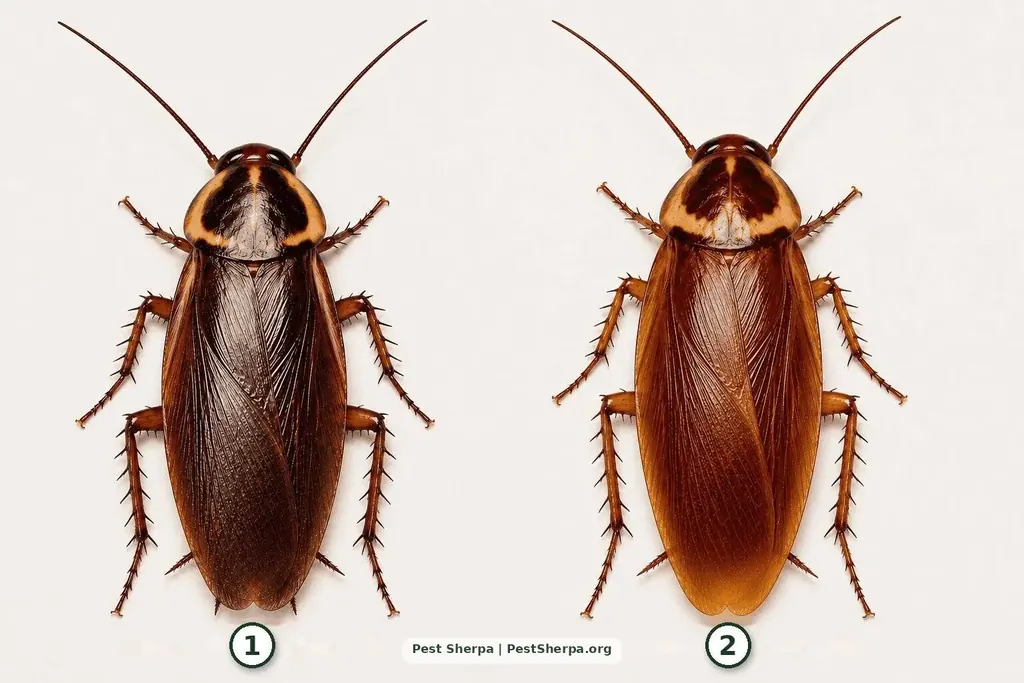
Which one did you find? Match the number:
- Australian cockroach: sharp, bright yellow edge around the head shield and pale streaks along the front edges of the wings.
- American cockroach: slightly larger, with a fainter, blurry pale band behind the head and no wing streaks.
Adult Australian cockroach showing pale yellow wing margins and yellow border behind the head.
TL;DR
Australian cockroaches are large, reddish-brown cockroaches that are often mistaken for American cockroaches. The most useful ID clues are the pale yellow edges along the forewings and the yellow border around the pronotum. The pronotum is the shield-like area just behind the head.
They usually live outdoors in warm, damp places such as mulch, leaf litter, woodpiles, tree bark, compost, irrigated landscaping, and greenhouse environments. Indoors, they are most likely to appear in damp or warm areas such as basements, bathrooms, utility rooms, boiler rooms, crawlspaces, kitchens, and plumbing voids.
One adult may simply have wandered in. Repeated sightings, nymphs, egg capsules, daytime activity, or roaches in several rooms call for a closer inspection. Check for moisture, organic debris, entry points, and hidden harborage.
The most effective approach combines identification, monitoring, fixing moisture, sanitation, reducing outdoor habitat, exclusion (sealing entry points), and targeted control when needed.
Quick Navigation
- What Are Australian Cockroaches?
- What Their Presence Usually Means
- Quick Identification
- Quick Assessment and Severity Table
- Signs of Activity
- Where To Check
- Preferred Habitat and Behavior
- Seasonal Activity and Life Cycle
- Why They Suddenly Appeared
- Common Sources, Attractants, and Entry Points
- What To Do
- What Does Not Work
- How Long It May Last
- Health, Sanitation, and Pesticide Safety
- When Professional Help May Be Needed
- Lookalikes and Common Misidentifications
- FAQ
- References
What Are Australian Cockroaches?
The Australian cockroach (Periplaneta australasiae) is a large, reddish-brown cockroach species often mistaken for the American cockroach (Periplaneta americana). Some newer taxonomic resources may list this species as Validiblatta australasiae, but many pest management and university extension references still use Periplaneta australasiae.
Australian cockroaches are considered peridomestic cockroaches. That means they usually live outdoors but may enter buildings when conditions around a structure are favorable or when outdoor conditions push them inside. Warmth, moisture, decaying organic material, mulch, greenhouse conditions, plumbing voids, and protected foundation areas can all contribute to activity.
Despite the common name, this species is believed to have come from outside Australia. It is now widespread in tropical and subtropical regions. In the United States, it is most common in warm southern and coastal areas. In cooler climates, it may survive inside heated buildings, greenhouses, boiler rooms, and other warm, damp spaces.
Like other cockroaches, Australian cockroaches develop through gradual metamorphosis: egg capsule, nymph, and adult.
What Australian Cockroaches Usually Mean
Australian cockroaches are often more important as a clue than as a single visible insect. The adult roach you see may be coming from a damp outdoor harborage or an entry gap. It may also be coming from a crawlspace, a greenhouse, a basement, or a warm utility area.
| What You See | What It Usually Means |
|---|---|
| One large reddish-brown roach near a door, garage, patio, or window | Possible outdoor invader; inspect nearby entry points and exterior harborage |
| Several large roaches over multiple nights | Likely nearby harborage, moisture source, or repeated entry route |
| Nymphs indoors | Reproduction may be occurring nearby or indoors in a warm, damp protected area |
| Egg capsules in cracks, cabinets, greenhouses, or utility areas | Established activity is more likely than a single accidental entry |
| Daytime sightings | Population may be larger, harborage may be disturbed, or hiding areas may be overcrowded |
| Activity after heavy rain or drought | Outdoor roaches may be moving because harborage was flooded or moisture became scarce |
| Activity around potted plants or greenhouse benches | Warm, damp plant environments or organic debris may be supporting them |
Consumer takeaway: Do not assume every large roach indoors is the same problem. Australian cockroaches often point to moisture, outdoor habitat, warm utility areas, or greenhouse conditions. That is a different problem from the indoor infestations linked to German cockroaches.
Quick Identification: What Australian Cockroaches Look Like
Correct identification matters because different cockroach species need different inspection and control plans. A large outdoor-associated cockroach is handled differently from a small indoor-breeding German cockroach infestation.
Adult Australian cockroaches are about 1 1/4 to 1 3/8 inches long, reddish-brown to dark brown, and have fully developed wings. Both males and females have wings, and adults may glide or make short flights in warm, humid conditions.
Key Identification Features
- Large, reddish-brown to dark-brown body
- Pale yellow or yellow-orange margins along the outer edges of the forewings
- Yellow border around the pronotum, the shield-like plate behind the head
- Fully developed wings that extend over the abdomen
- Long antennae and spiny legs
- Nymphs are wingless and may show pale yellow spots or markings on the abdomen
Females produce brown egg capsules called oothecae. These capsules may be attached in cracks, crevices, or protected areas. Development from egg to adult is strongly affected by temperature, moisture, food availability, and whether the environment remains warm enough for normal growth.
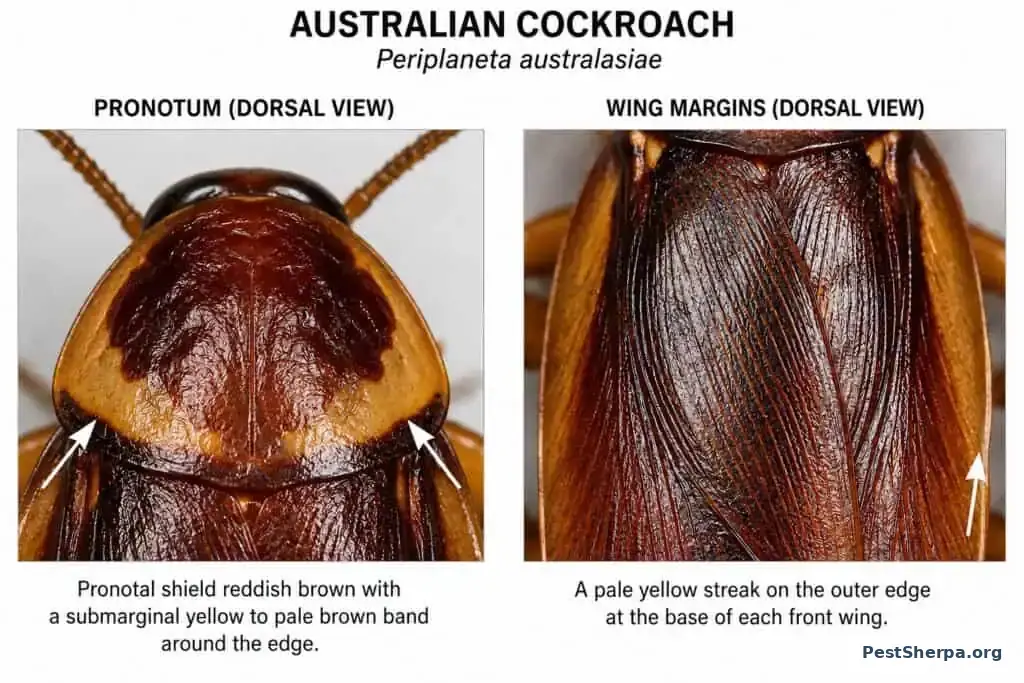
Close-up of Australian cockroach yellow pronotum border and pale yellow forewing margins.
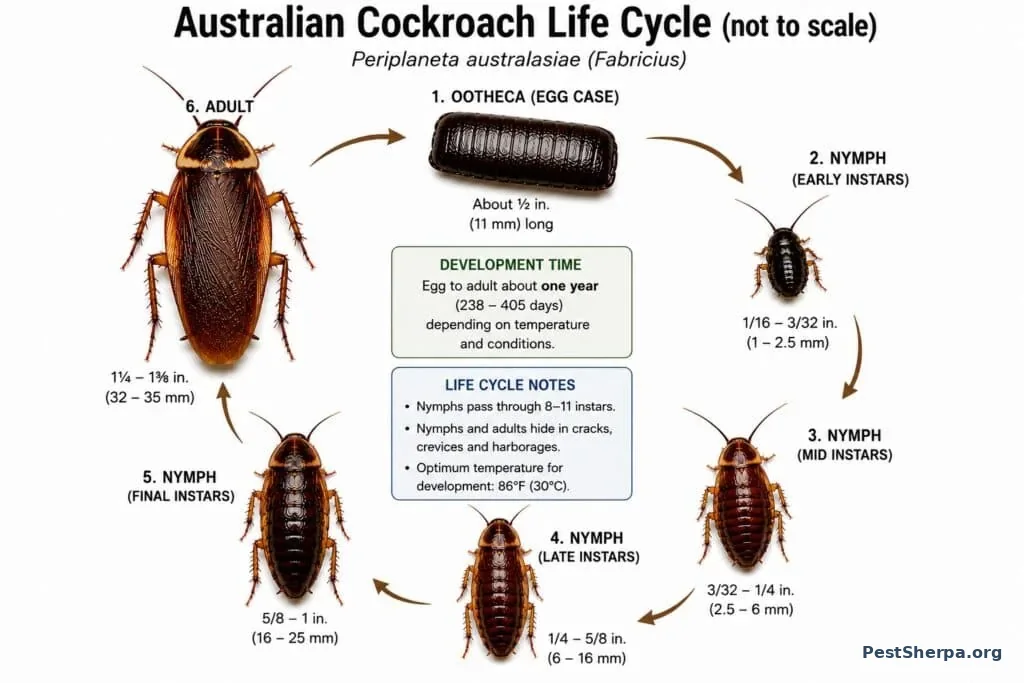
Australian cockroach egg capsule, nymph, and adult life stages
Quick Assessment: How Serious Is It?
Use this table to decide whether you are likely dealing with a minor occasional invader or a more established problem that needs a deeper inspection.
| Situation | Likely Concern Level | What To Check First |
|---|---|---|
| One adult near an exterior door, garage, patio, or window | Low | Door sweep, screen gaps, porch lights, mulch, leaf litter, and foundation cracks |
| Several adults seen at night over a week or two | Moderate | Exterior harborage, moisture, plumbing penetrations, crawlspace vents, and utility areas |
| Roaches in bathrooms, basement, laundry room, or utility room | Moderate to high | Leaks, condensation, floor drains, sump area, water heater area, and wall voids |
| Nymphs or egg capsules found indoors | High | Warm, damp harborages, cracks, cabinets, plant containers, greenhouse areas, and nearby food sources |
| Daily sightings or daytime activity | High | Hidden population, crowded harborage, exterior-to-interior movement, or disturbed hiding areas |
| Activity in a food business, healthcare facility, school, or multi-unit building | Higher priority | Sanitation, monitoring records, utility chases, shared walls, plumbing, and coordinated building-wide conditions |
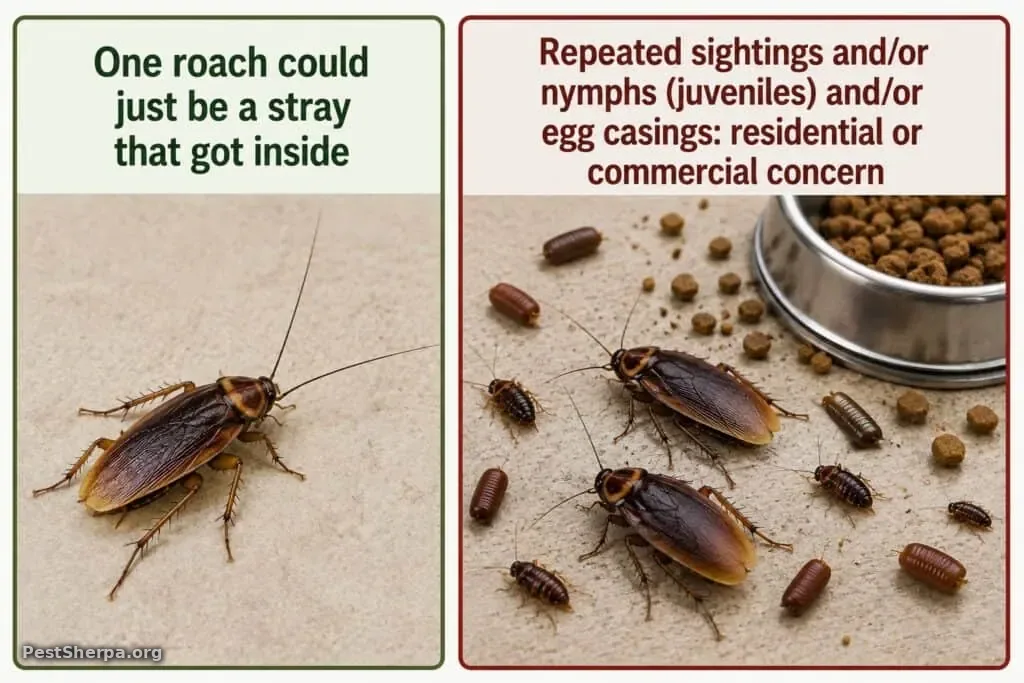
Australian cockroach severity guide from occasional invader to established activity
Signs of Australian Cockroach Activity
Early detection is easier when you know what to look for. Australian cockroaches are mostly nocturnal, so daytime inspections may miss the main activity unless you check protected hiding places.
- Live adult cockroaches seen at night
- Nymphs hiding in damp cracks, greenhouse areas, plant containers, basements, or utility spaces
- Brown egg capsules in cracks, crevices, under bark, behind stored items, or around warm damp areas
- Droppings that may look like coarse pepper, dark specks, or small pellets
- Shed skins from developing nymphs
- Musty odor when populations are heavy or debris accumulates
- Activity near drains, plumbing penetrations, sump pumps, boiler rooms, and crawlspace access points
- Exterior activity around mulch, leaf litter, woodpiles, irrigation boxes, compost, and foundation plantings
Sticky traps placed along walls can help determine whether activity is isolated to one entry point or spread across several areas.
Where To Check: Source Investigation Guide
Australian cockroach control often depends on finding the warm, damp, protected conditions that are supporting them. Start outside, then follow likely entry routes indoors.
Outside the Home
- Mulch beds touching or nearly touching the foundation
- Leaf litter under shrubs, decks, steps, and porch edges
- Woodpiles, lumber, cardboard, and stored items near walls
- Compost piles and decaying organic debris
- Loose tree bark, palm debris, and dense groundcover
- Irrigation boxes, valve boxes, hose bibs, and damp soil near foundations
- Cracks around doors, garage thresholds, foundation vents, and utility penetrations
- Porch lights and exterior lighting that may attract nighttime insect activity near entry points
Inside the Home
- Under sinks and around plumbing penetrations
- Behind refrigerators, dishwashers, washing machines, and water heaters
- Bathrooms, laundry rooms, basements, utility rooms, and boiler rooms
- Floor drains, sump pump areas, crawlspace access points, and damp storage areas
- Greenhouses, sunrooms, atriums, plant rooms, and interior landscaping beds
- Cabinet voids, wall voids, pipe chases, and electrical conduits
- Cardboard storage, pet food storage, recycling, and trash areas
Inspection tip: Place sticky traps along wall edges, behind appliances, near plumbing, and at suspected entry points. Number the traps and check them for several nights. The trap with the highest activity often points toward the source or travel route.
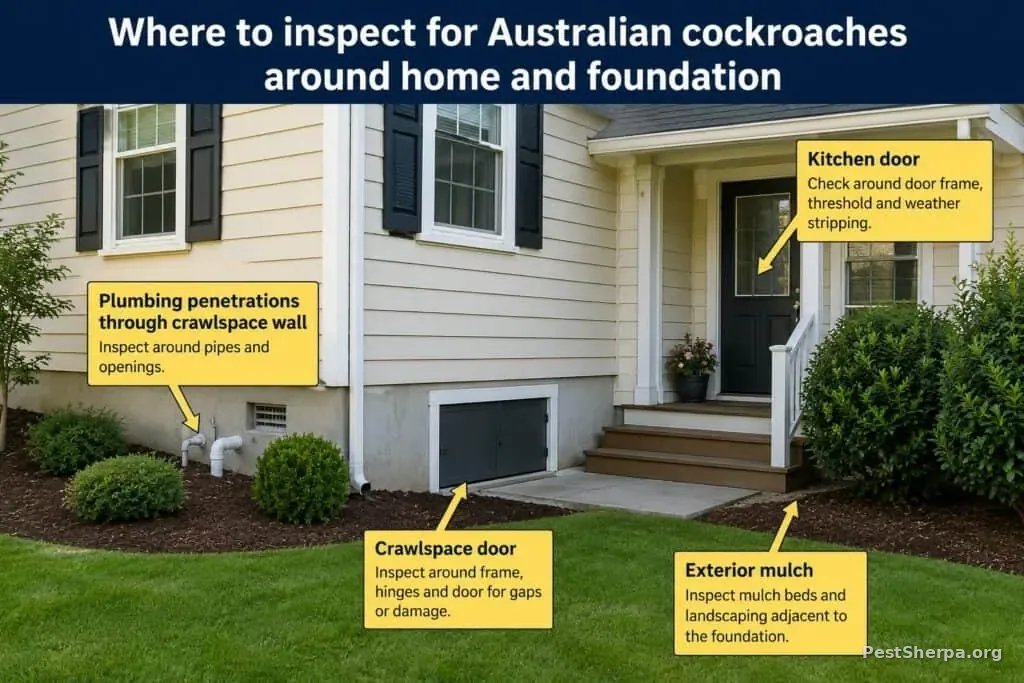
Where to inspect for Australian cockroaches around a home and foundation
Preferred Habitat and Behavior
Australian cockroaches prefer warm, humid, sheltered environments. Outdoors, they feed and hide around decaying organic material, bark, leaf litter, mulch, compost, and other moisture-rich areas. Indoors, they are most likely to persist where warmth and moisture are available.
Common Outdoor Harborage Areas
- Mulch beds
- Leaf litter
- Compost piles
- Woodpiles
- Tree bark and palm debris
- Greenhouses and nurseries
- Dense vegetation near foundations
- Landscape voids, irrigation boxes, and damp foundation edges
Common Indoor Harborage Areas
- Basements and crawlspaces
- Utility rooms and boiler rooms
- Kitchens, especially behind appliances and under sinks
- Bathrooms and laundry rooms
- Plumbing voids, wall cavities, and pipe chases
- Sump pump enclosures and floor drain areas
- Greenhouses, interiorscapes, atriums, and potted plant areas
In larger buildings, Australian cockroaches may move through pipe chases, mechanical rooms, utility corridors, steam tunnels, and wall voids. Their climbing ability allows them to move vertically when structural pathways are available.
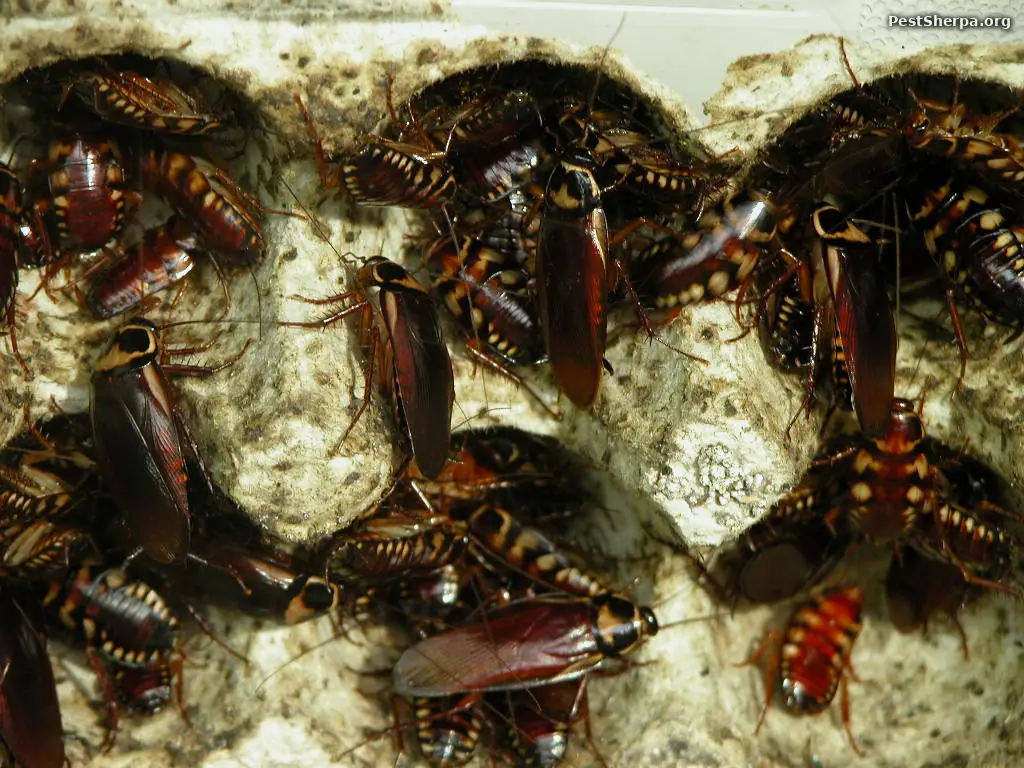
Seasonal Activity and Life Cycle
Australian cockroach activity is usually highest during warm, humid weather. In southern climates, activity may continue year-round. In cooler regions, sightings are more likely to involve heated buildings, greenhouses, boiler rooms, plant rooms, and other protected warm environments.
The life cycle includes egg capsule, nymph, and adult. Females produce egg capsules, and nymphs hatch as small wingless cockroaches. Nymphs gradually molt and develop wing pads before becoming adults. Development can take many months, especially when conditions are cooler or food and moisture are limited.
Breeding depends heavily on warmth and moisture. So numbers often rise after stretches of humid weather, irrigation, rainfall, or greenhouse activity.
Why Australian Cockroaches Suddenly Appeared
A sudden increase does not always mean the roaches started indoors. Many Australian cockroach problems begin outside and become noticeable when conditions change.
- Heavy rain: flooded mulch, leaf litter, or ground harborage may force roaches toward drier shelter.
- Drought: roaches may move indoors or closer to plumbing in search of moisture.
- New mulch or landscaping: fresh organic material can create damp shelter near the foundation.
- Irrigation changes: overwatered beds, leaking hoses, or damp valve boxes can support outdoor populations.
- Moved potted plants: roaches or egg capsules may be carried indoors with plants, pots, or plant debris.
- Warm utility conditions: boiler rooms, water heaters, pipe chases, and heated basements can support activity even when outdoors is cooler.
- Entry points opened: damaged door sweeps, loose screens, foundation gaps, and utility penetrations can allow repeated entry.
- Nearby disturbance: yard cleanup, construction, renovations, or movement of stored materials may disturb harborage.
Common Sources, Attractants, and Entry Points
Australian cockroaches are attracted to the same core conditions most cockroaches need: moisture, shelter, warmth, and food. The source is often not one single object but a combination of damp habitat and easy access.
| Condition | Why It Matters | Where To Look |
|---|---|---|
| Moisture | Supports survival, nymph development, and activity | Leaks, condensation, irrigation, floor drains, sump areas, damp crawlspaces |
| Organic debris | Provides food and shelter | Mulch, compost, leaf litter, bark, palm debris, woodpiles |
| Warmth | Allows activity and development in cooler weather | Boiler rooms, utility rooms, greenhouses, water heater areas, plant rooms |
| Food residue | Can support indoor activity once roaches enter | Grease, crumbs, pet food, trash, recycling, unsealed pantry items |
| Exterior entry gaps | Allow repeated indoor sightings | Door sweeps, garage thresholds, screens, foundation cracks, utility penetrations |
| Hidden voids | Provide protected travel routes and harborage | Wall voids, plumbing chases, crawlspaces, cabinets, conduits |
Related Pest Sherpa guides: For broader identification help, see the Cockroach Guide. If you are comparing large roaches, the American Cockroach Guide and Palmetto Bug Guide may also help.
What To Do About Australian Cockroaches
Start with inspection and conditions, not just killing the visible roach. The most durable results come from reducing the habitat and entry routes that keep producing sightings.
1. Confirm the Species
Use the yellow wing margins and yellow pronotum border as your main identification clues. If possible, photograph the roach from above or capture one in a clear container for comparison. Do not assume every large reddish-brown cockroach is an American cockroach.
2. Use Sticky Traps for Monitoring
Place sticky traps along walls, behind appliances, under sinks, near floor drains, in basements, near exterior doors, and beside suspected entry points. Check them for several nights. The pattern of captures can show whether roaches are entering from outside, using a plumbing route, or concentrating near a hidden damp area.
3. Correct Moisture Problems
- Repair plumbing leaks.
- Correct condensation around pipes, water heaters, and appliances.
- Improve ventilation in crawlspaces, basements, laundry rooms, and plant rooms.
- Fix irrigation leaks and avoid keeping foundation beds constantly wet.
- Remove standing water from saucers under potted plants where possible.
4. Reduce Exterior Harborage
- Pull mulch back from direct contact with the foundation.
- Remove leaf litter, palm debris, and decaying organic material near entry points.
- Store firewood and lumber away from the building and off the ground when practical.
- Thin dense vegetation touching exterior walls.
- Keep compost and yard waste away from doors, windows, and foundation vents.
5. Improve Exclusion
- Install or repair door sweeps.
- Repair window screens and crawlspace vent screens.
- Seal gaps around pipes, wires, conduits, and utility penetrations.
- Close cracks around garage thresholds, foundation edges, and exterior trim.
- Use weather stripping where doors do not seal tightly.
6. Clean and Remove Food Sources
- Store food and pet food in sealed containers.
- Empty trash and recycling regularly.
- Clean grease and food residue behind appliances and under cabinets.
- Reduce cardboard clutter, especially in damp storage areas.
- Vacuum droppings, shed skins, and debris using appropriate filtration when allergy concerns exist.
7. Use Targeted Products Carefully When Needed
If pesticide products are used, choose products labeled for cockroaches and for the specific site where they will be applied. Follow the label exactly, keep products away from children and pets, and avoid applying outdoor-only products indoors. Baits, dusts, and crack-and-crevice products work best when placed where cockroaches actually travel and hide, not sprayed broadly across open surfaces.
Take extra care with pesticide decisions in multi-unit buildings, schools, healthcare settings, food-handling areas, or homes with breathing sensitivities. Base those decisions on inspection, not guesswork.
What Does Not Work Well
Many cockroach problems persist because the visible roaches are treated while the moisture, harborage, and entry routes remain unchanged.
- Bug bombs or foggers as the main solution: Foggers may miss hidden cockroaches in cracks, voids, mulch, crawlspaces, and utility areas. They can also create safety risks if misused.
- Spraying only the visible roaches: Killing a few adults does not remove egg capsules, nymphs, or outdoor harborage.
- Ignoring moisture: Leaks, condensation, damp mulch, and overwatered landscaping can keep attracting or supporting activity.
- Using the wrong species plan: Australian cockroaches are not managed exactly like German cockroaches, which usually breed indoors in kitchens and bathrooms.
- Overusing repellents: Heavy repellent spraying may scatter cockroaches into deeper voids or adjacent areas without solving the source.
- Using outdoor products indoors: This can create unnecessary exposure risks and may violate label directions.
- Relying on traps alone: Sticky traps are useful for monitoring, but they rarely solve the source by themselves.
How Long Will Australian Cockroaches Last?
The timeline depends on whether you are seeing occasional invaders or a supported population.
| Situation | Expected Pattern |
|---|---|
| One accidental adult indoors | May be a short-lived event if entry points are corrected |
| Outdoor harborage remains close to the foundation | Sightings may continue during warm, wet, or stressful outdoor conditions |
| Moisture and food sources indoors remain available | Activity may persist and nymphs may develop in protected areas |
| Source corrected and entry points sealed | Activity often declines as remaining roaches are trapped, removed, or die off |
| Greenhouse, plant room, or warm utility area involved | Activity may continue until organic debris, moisture, and hiding places are reduced |
There is no reliable one-size-fits-all timeline. If the source remains, roaches can continue appearing. If moisture, shelter, food, and entry points are corrected, activity usually becomes easier to monitor and reduce.
Health, Sanitation, and Pesticide Safety Concerns
Australian cockroaches are not aggressive insects and are not known for biting people. The main concerns are sanitation, allergens, and the conditions that let cockroaches travel through unsanitary areas. From there, they can enter kitchens, storage areas, bathrooms, or utility spaces.
Cockroaches can contaminate surfaces through droppings, regurgitation, shed skins, body contact, and movement through decaying material or waste. Cockroach allergens from feces, saliva, shed skins, and body fragments can worsen allergies or asthma in sensitive people. Children and people with breathing conditions are especially at risk.
Sanitation and Allergy-Sensitive Cleanup
- Wear gloves when cleaning droppings, dead roaches, or contaminated debris.
- Use a vacuum with strong filtration where allergen exposure is a concern.
- Clean food-contact surfaces after cockroach activity is found.
- Store food, pet food, and pantry items in sealed containers.
- Keep pesticide products locked away from children and pets.
- Read and follow all label directions before using any pesticide product.
Because cockroach allergens can become part of household dust, simply killing roaches is not always enough. Removing droppings, shed skins, dead insects, and contaminated dust can be important in sensitive households.
When Professional Help May Be Needed
Professional help may be worth considering when the source is hidden, the building is complex, or there are safety, health, or sanitation concerns. This is especially true when repeated sightings continue after basic moisture correction, cleaning, and exclusion efforts.
- Australian cockroaches are seen daily or in multiple rooms.
- Nymphs or egg capsules are found indoors.
- Activity is linked to a crawlspace, boiler room, wall void, utility chase, greenhouse, or commercial kitchen.
- Sticky traps show ongoing captures but the source is not obvious.
- The property is a multi-unit building where roaches may move between units or shared utility areas.
- The setting involves food handling, healthcare, child care, schools, or highly sensitive occupants.
- Pesticide-sensitive people, children, pets, aquariums, or indoor plants make product selection more complicated.
A good inspection should focus on species identification, moisture, harborage, entry points, monitoring, and targeted treatment only where it is appropriate.
Lookalikes and Common Misidentifications
Australian cockroaches are most often confused with other large reddish-brown or outdoor-associated cockroaches. The yellow wing margins are the key feature to look for.
| Pest | How It Differs From Australian Cockroach | Why It Matters |
|---|---|---|
| American Cockroach | Usually larger; has a yellowish pronotum border but lacks the same pale yellow margins along the forewings | Often associated with sewers, drains, basements, and commercial facilities |
| Smokybrown Cockroach | More uniformly glossy mahogany-brown without yellow forewing margins | Often tied to trees, attics, gutters, and outdoor-to-indoor movement |
| German Cockroach | Much smaller; tan to light brown with two dark stripes behind the head | Usually an indoor-breeding kitchen/bathroom pest requiring a different control plan |
| Oriental Cockroach | Darker, shinier, and less winged in appearance; often found in damp lower areas | Moisture and exterior entry are important, but identification features differ |
| Turkestan Cockroach | Males are tan with pale margins; females are darker with reduced wings | Often outdoor-associated and attracted to lights in some regions |
| Cuban Cockroach | Bright green when adult; nymphs can look different from large reddish Periplaneta species | Usually outdoor and attracted to lights; not managed like Australian cockroaches in mulch and damp landscaping |
| Brownbanded Cockroach | Small cockroach with lighter bands across body or wings | Can infest drier indoor areas and is not managed like a large peridomestic roach |
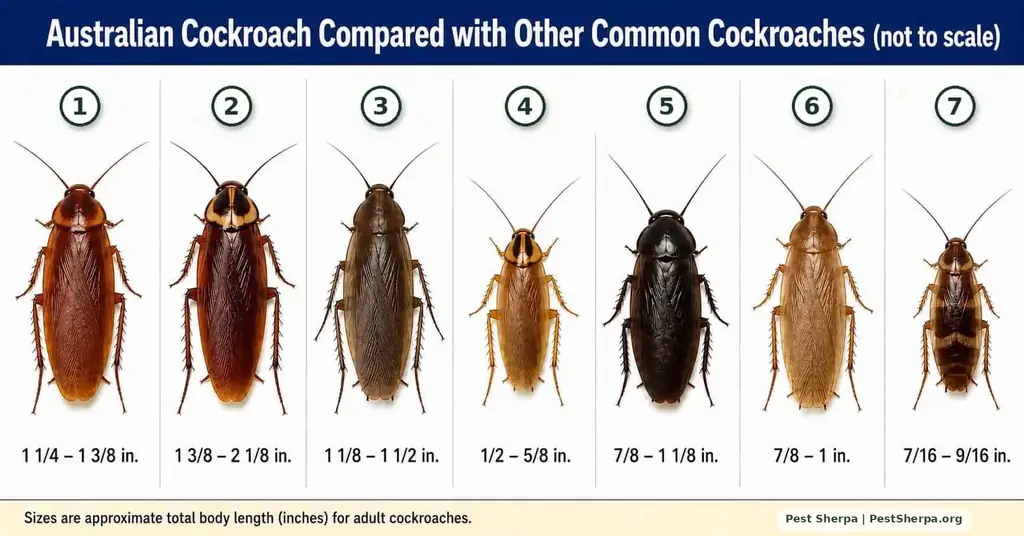
Which one did you find? Match the number:
- Australian cockroach: reddish-brown with a bright pale band around the head shield and pale yellow streaks on the front edges of the wings.
- American cockroach: the largest, reddish-brown with a yellowish figure-8 pattern behind the head.
- Smokybrown cockroach: uniform dark smoky brown with no pale markings.
- German cockroach: small and tan with two dark stripes behind the head.
- Oriental cockroach: shiny black to dark brown with short wings.
- Turkestan cockroach: pale tan to light brown, slender, with a smooth uniform color.
- Brownbanded cockroach: small with pale bands across the wings and body.
Australian cockroach compared with American, Smokybrown, German, Oriental, Turkestan, and Brownbanded cockroaches
FAQ: Australian Cockroach Questions
Does one Australian cockroach mean I have an infestation?
Not necessarily. One adult near a door, garage, patio, or window may have entered from outdoors. Repeated sightings, nymphs, egg capsules, or daytime activity are stronger signs that a nearby harborage or indoor source should be investigated.
How can I tell an Australian cockroach from an American cockroach?
Look for the pale yellow or yellow-orange margins along the outer edges of the forewings. Australian cockroaches also have a yellow border around the pronotum. American cockroaches can look similar, but they do not have the same pale wing-edge markings.
Can Australian cockroaches fly?
Adults have fully developed wings and may glide or make short flights, especially in warm, humid conditions. Many sightings still involve crawling rather than sustained flight.
Do Australian cockroaches live indoors?
They are usually outdoor-associated, but they can persist indoors where conditions are warm, damp, protected, and near food. Greenhouses, boiler rooms, basements, plant rooms, utility rooms, and plumbing voids are common indoor concern areas.
Why am I seeing them after rain?
Heavy rain can flood mulch, leaf litter, crawlspace edges, and other outdoor harborage areas. Roaches may move toward drier shelter, including garages, basements, door thresholds, and wall gaps.
Why am I seeing them during drought?
Drought can reduce outdoor moisture. Roaches may move toward irrigation, plumbing, condensation, bathrooms, utility rooms, and other reliable water sources.
Are Australian cockroaches dangerous?
They are not dangerous in the way biting or stinging pests can be. The concern is sanitation and allergens. Cockroaches can contaminate surfaces and contribute to allergy or asthma triggers through droppings, shed skins, saliva, and body fragments.
Do bug bombs work for Australian cockroaches?
Bug bombs and foggers are rarely a complete solution because they may not reach roaches hidden in cracks, wall voids, mulch, crawlspaces, or utility areas. They also create avoidable exposure risks if used incorrectly. Inspection, moisture correction, harborage reduction, exclusion, monitoring, and targeted treatment are usually more useful.
Can Australian cockroaches come in with plants?
Yes. Potted plants, plant debris, greenhouse materials, and moist organic media can move roaches or egg capsules indoors. Inspect pots, saucers, soil surfaces, and plant storage areas when sightings begin after bringing plants inside.
Are Australian cockroaches the same as palmetto bugs?
“Palmetto bug” is a casual name used for several large cockroaches, especially in the southern United States. Depending on location, people may use it for American, smokybrown, Florida woods, or other large roaches. Identification should be based on body markings rather than the nickname.
What is the fastest way to reduce sightings?
Find the source pattern. Use sticky traps and inspect outdoor mulch and moisture. Seal obvious entry points, remove leaf litter and debris near the foundation, fix leaks, and clean food residues. Killing visible roaches without correcting conditions usually gives temporary results.
References
Species-Specific References
- University of Florida IFAS Extension: Australian Cockroach, Periplaneta australasiae Fabricius
- NC State Extension: Australian Cockroach in Interiorscapes
- Cockroach Species File: Validiblatta australasiae Taxonomy
- BugGuide: Australian Cockroach, Validiblatta australasiae
General Cockroach Management and Safety References
- University of California Agriculture and Natural Resources Statewide IPM Program: Cockroaches
- U.S. Environmental Protection Agency: Cockroaches and Schools
- National Pesticide Information Center: Reading Pesticide Labels
Bottom Line
Australian cockroaches are large outdoor-associated cockroaches that enter or persist in buildings when warm, damp, sheltered conditions are available. The yellow wing margins and yellow pronotum border are the most useful identification clues. For most consumers, the best next step is not simply spraying the visible roach. Focus on confirming identification and finding moisture and harborage. Then reduce outdoor debris, seal entry points, monitor with sticky traps, clean up sanitation sources, and use targeted control only when appropriate.
This article was written by Greg Baumann, founder of Pest Sherpa, and reflects more than 40 years of professional pest management experience.
About the Author

Greg Baumann | Pest Control Expert
Greg Baumann is the founder of Pest Sherpa and a Pest Control Expert with more than 40 years of professional pest management experience. His articles combine decades of field experience, technical expertise, and science-based guidance to help homeowners identify pests correctly, understand real-world risks, and make informed pest management decisions.
Mission: Identify the pest. Understand the risk. Stop the problem. Prevent the comeback. Know when it’s time to call a professional.