
Dark-eyed Vinegar Flies (Drosophila repleta): ID and Control
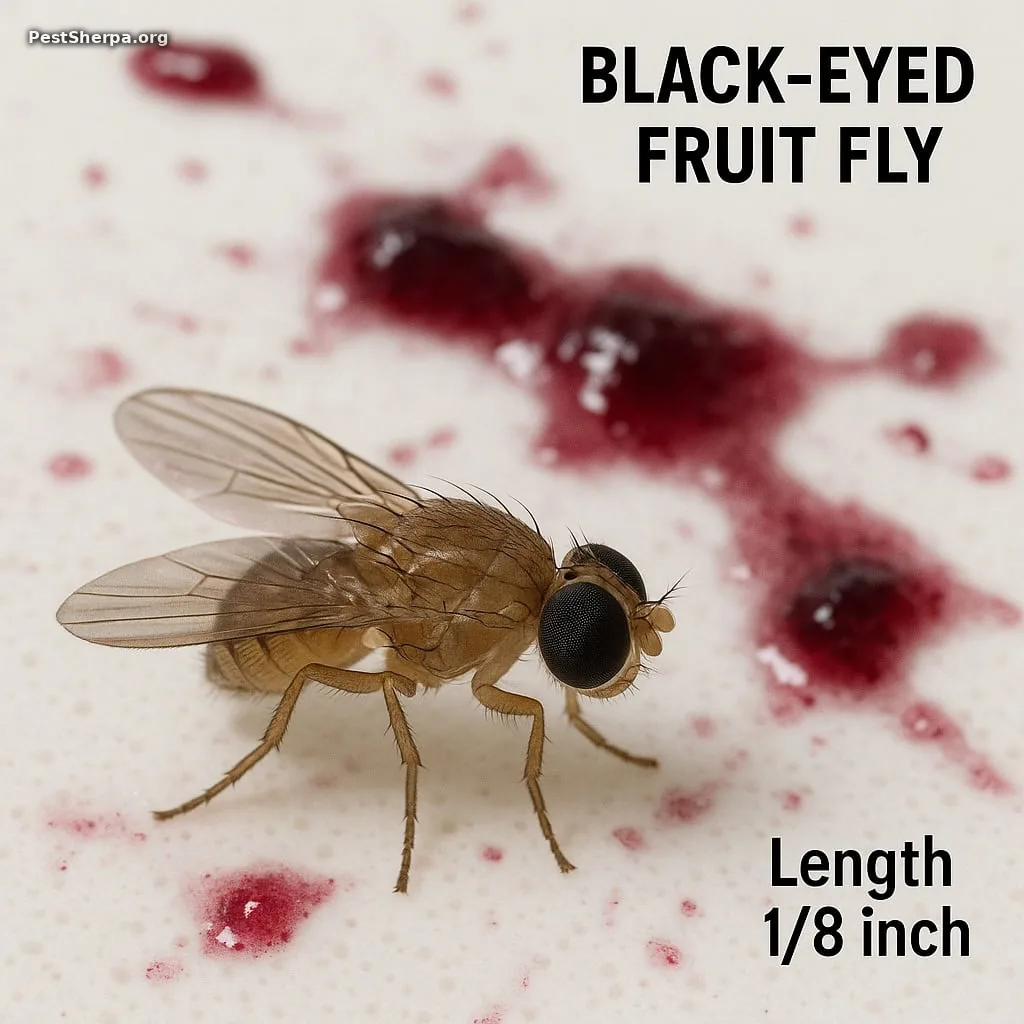
Dark eyed fruit flies (dark-eyed vinegar flies, sometimes informally called black-eyed fruit flies) are small indoor flies that persist around drains, beverage areas, trash, recycling, damp cleaning tools, and hidden wet organic film. Eyes are actually very dark red, and they are easy to confuse with common pale or red-eyed vinegar flies, moth flies, fungus gnats, and phorid flies, but the source investigation is often different. This guide explains how to identify dark-eyed fruit flies, where drain-associated fruit flies breed, what usually does not work, and which next steps help most.
While there are several types of similar small flies with dark eyes, this article is specific to Drosophila repleta, the name commonly used in pest-management, extension, and food-service small-fly literature. In some diagnostic settings, specimens may be reported as the Drosophila repleta species group because close relatives can require expert examination.
TL;DR: Dark Eyed Fruit Flies vs Common Vinegar Flies
Dark-eyed vinegar flies (Drosophila repleta-type) are small tan to brown flies with dark red to brown eyes. Unlike the common pale or bright red-eyed vinegar fly tied to ripe fruit bowls, dark eyed fruit flies hang around drains, beer lines, organic film, beverage stations, mop areas, trash, recycling, and moisture beneath equipment.
| Quick ID | Dark-eyed fruit / vinegar fly | Common pale vinegar / fruit fly |
|---|---|---|
| Eyes / look | Dark red, brown, or black-looking; often slightly larger | Often bright red eyes; pale tan body |
| Where they hang | Drains, beer lines, organic film, bars, trash, mop sinks | Fruit bowls, produce, sweet fermenting spills |
| Fix focus | Clean wet organic buildup and moisture niches | Remove fermenting fruit and sweet liquids |
Traps may reduce adult flies, but they rarely solve the problem by themselves. Find and remove the larval breeding source. Do not conflate these with fuzzy moth flies / drain flies or plant-associated fungus gnats.
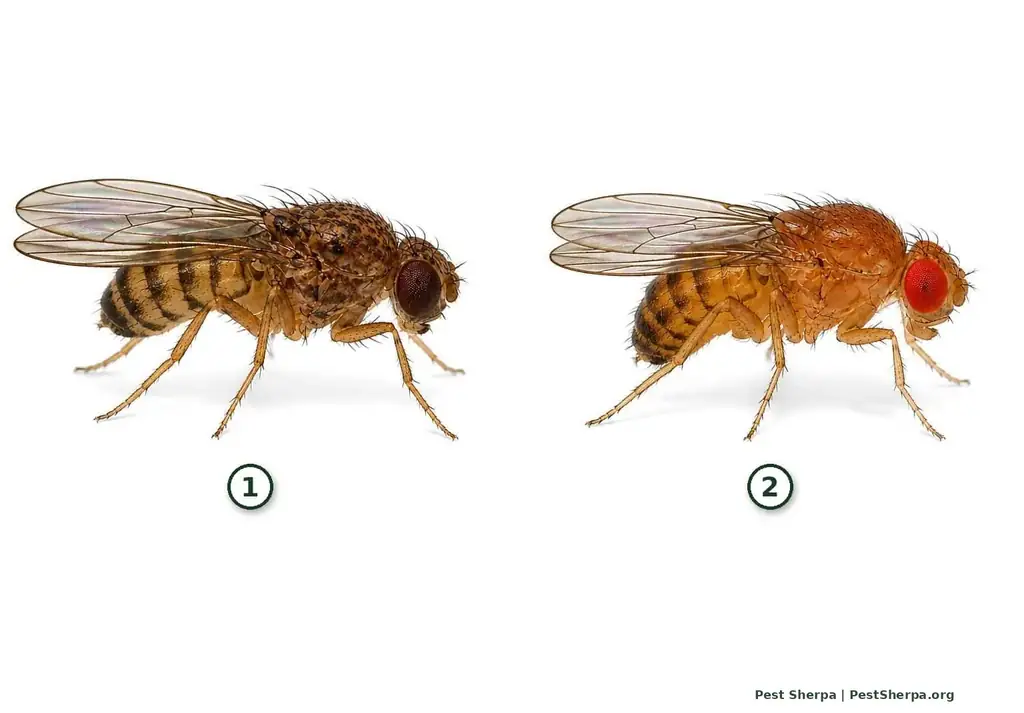
Which one do you see? Match the number:
- Dark-eyed vinegar fly: dark red to brown eyes and a darker, speckled thorax.
- Common vinegar fly (fruit fly): bright red eyes and a lighter tan to orange body.
Dark-eyed vinegar fly compared with common red-eyed vinegar fly for identification.
Quick Navigation
- Identification
- What Dark-Eyed Vinegar Flies Mean Indoors
- Source Investigation Checklist
- Where They Breed
- Life Cycle and Population Growth
- Why They Appear in Clean Facilities
- Sanitation and Health Context
- What To Do
- What Usually Does Not Work
- How Long They Last
- When Professional Help May Be Worth Considering
- Lookalikes and Common Misidentifications
- Frequently Asked Questions
- References
Identification: What Dark-Eyed Vinegar Flies Look Like
Dark-eyed vinegar flies are small flies in the family Drosophilidae. Adults are usually tan, yellowish brown, or light brown with clear wings and dark red to what might appear brown eyes. The thorax has dark speckles or mottling on the upper thorax. Many people will not be able to see this detail without magnification. They are commonly described as slightly larger and darker-eyed than the common red-eyed vinegar fly, although size and color alone are not always enough for confident identification.
- Size: small, usually only a few millimeters long
- Eyes: dark red, brownish, or black-looking compared with bright red-eyed vinegar flies
- Body: tan to brown, compact, and not fuzzy
- Wings: clear, held flat or slightly spread when resting
- Typical indoor behavior: hovering near drains, sinks, bars, beverage stations, trash, recycling, damp floors, or windows after emerging indoors
For broader fly comparison, see the Pest Sherpa fly identification guide.
| Feature | Dark-Eyed Vinegar Fly | Common Red-Eyed Vinegar Fly |
|---|---|---|
| Eye color | Dark red, brown, or black-looking | Often bright red |
| Common source clue | Wet organic buildup, drains, beverage residue, trash, recycling, mop areas, vertical surfaces | Ripe fruit, fermenting fruit, produce, sweet liquids |
| Control focus | Find hidden wet organic residue | Remove fermenting food and spilled liquids |
| Trap usefulness | Useful for monitoring adults, not source removal | Useful for adults, still requires removing source |
Dark-eyed vinegar flies can be difficult to confirm from a quick glance. If the fly is fuzzy, moth-like, humpbacked, or crawling more than flying, compare it with the lookalikes section before assuming it is a vinegar fly.
What Dark-Eyed Vinegar Flies Mean Indoors
A few flies may be a short-lived issue if the source is temporary, such as a spill, dirty recycling container, or forgotten food residue. Repeated sightings usually mean a breeding site is still present.
| What You See | What It Usually Means | Best First Check |
|---|---|---|
| One or two small flies | Possible outdoor entry or small temporary source | Fruit bowl, trash, recycling, sink area |
| Several flies daily | Possible active breeding source | Drains, garbage disposal, mop bucket, beverage residue |
| Flies near a bar, soda station, or coffee area | Fermenting liquid or organic buildup likely | Drip trays, floor mats, cracks, floor drains |
| Flies near multiple drains | Biofilm, plumbing, or sanitation buildup may be involved | Drain walls, overflow openings, floor drains |
| Flies persist after traps | Larvae are still developing somewhere | Hidden wet organic material |
Key point: Adult flies are the symptom. Wet organic residue is often the source.
Dark-Eyed Vinegar Fly Source Investigation Checklist
Step 1: Start Where Adults Are Most Active
Look for adults near lights, windows, sinks, drains, trash, recycling, beverage stations, and damp floor areas. Adults may move toward light after emerging, so the window may not be the source. If flies are repeatedly found at windows, this related Q&A may help: why flies keep appearing near windows.
Step 2: Check Drains and Plumbing Fixtures
Inspect for organic material in or near sink drains, floor drains, bar drains, overflow openings, garbage disposals, dishwasher areas, and floor joints. Look for black or brown organic slime, sour odors, trapped debris, slow drainage, or residue on the sides of drain openings.
Step 3: Look Below and Behind Equipment
Check beneath refrigerators, dishwashers, prep tables, beverage machines, floor mats, shelving, trash stations, and recycling areas. Small amounts of wet residue can be enough to support development.
Step 4: Inspect Cleaning Tools
Wet mop heads, mop buckets, floor scrubber reservoirs, damp towels, and cleaning cloths can hold moisture and residue overnight. Empty, rinse, and dry them between uses.
Step 5: Check Trash, Recycling, and Beverage Residue
Inspect trash can bottoms, liners, recycling bins, bottle returns, soda syrup areas, beer taps, wine spills, coffee stations, fruit waste, and compost containers. Rinse containers and remove sticky residue instead of only replacing the bag.
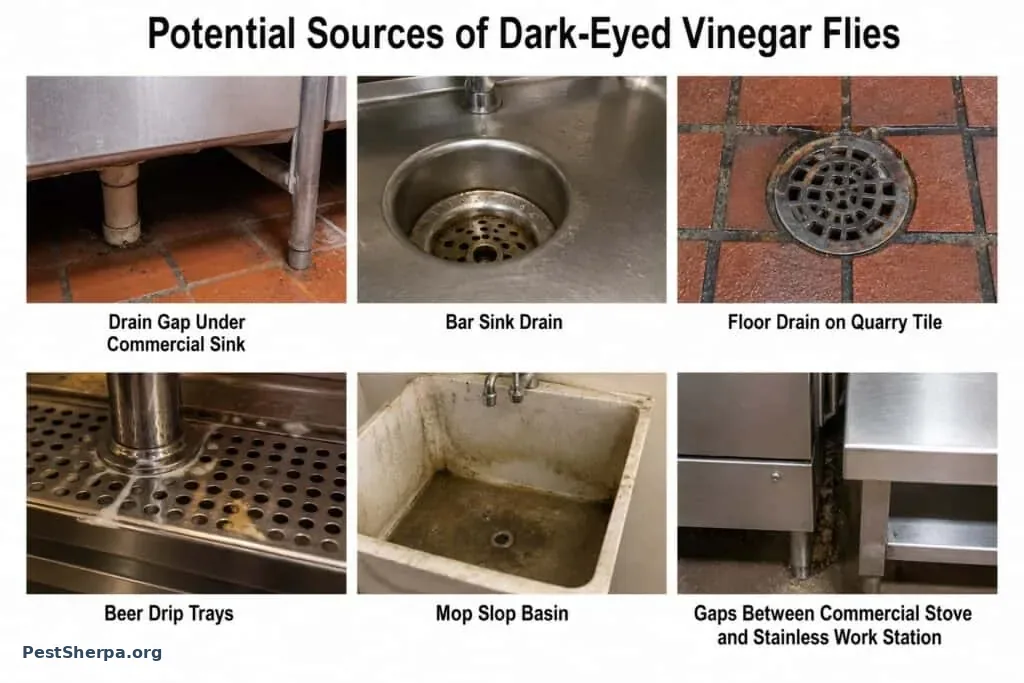
Dark-eyed vinegar fly source inspection map for drains, beverage areas, trash, and mop storage where organic build up may be present.
Where Dark-Eyed Vinegar Flies Breed
Dark-eyed vinegar flies develop in moist, fermenting, decaying organic material. In homes, this may be a dirty drain, garbage disposal, trash container, recycling bin, or damp forgotten cleaning item. In restaurants, bars, grocery stores, and commercial kitchens, sources may be more hidden and spread across multiple sanitation zones.
- Sink drains and floor drains
- Organic slime inside drain pipes and overflow channels
- Garbage disposals and food residue under splash guards
- Trash containers, trash liners, and liquid at the bottom of bins
- Recycling bins with soda, beer, wine, juice, or syrup residue
- Bar drip trays, soda stations, coffee stations, and beverage lines
- Wet mop heads, mop buckets, damp towels, and floor scrubbers
- Food debris and moisture beneath appliances or heavy equipment
- Cracked grout, damaged flooring, floor-wall gaps, and poorly draining floor areas
- Plumbing leaks, condensation, and hidden wet voids
Drain interiors are common sources because residue can accumulate on pipe walls. However, not every small fly at a drain is a vinegar fly. Fuzzy, moth-like flies are more likely to be moth flies, drain flies, filter flies, or sewer flies.
Life Cycle and Population Growth
Dark-eyed vinegar flies undergo complete metamorphosis: egg, larva, pupa, and adult. Females place eggs on suitable fermenting or decaying organic material. Larvae feed in the moist residue, pupate near the source, and adults emerge to mate and continue the cycle.
- Egg: laid on moist organic residue
- Larva: feeds on microbes, yeasts, and decomposing material
- Pupa: develops near the breeding source
- Adult: searches for food, moisture, and new breeding sites
The exact development time varies with temperature, food quality, and moisture. Warm indoor areas with steady organic residue can support overlapping generations, which is why a small sanitation problem can turn into repeated adult sightings.
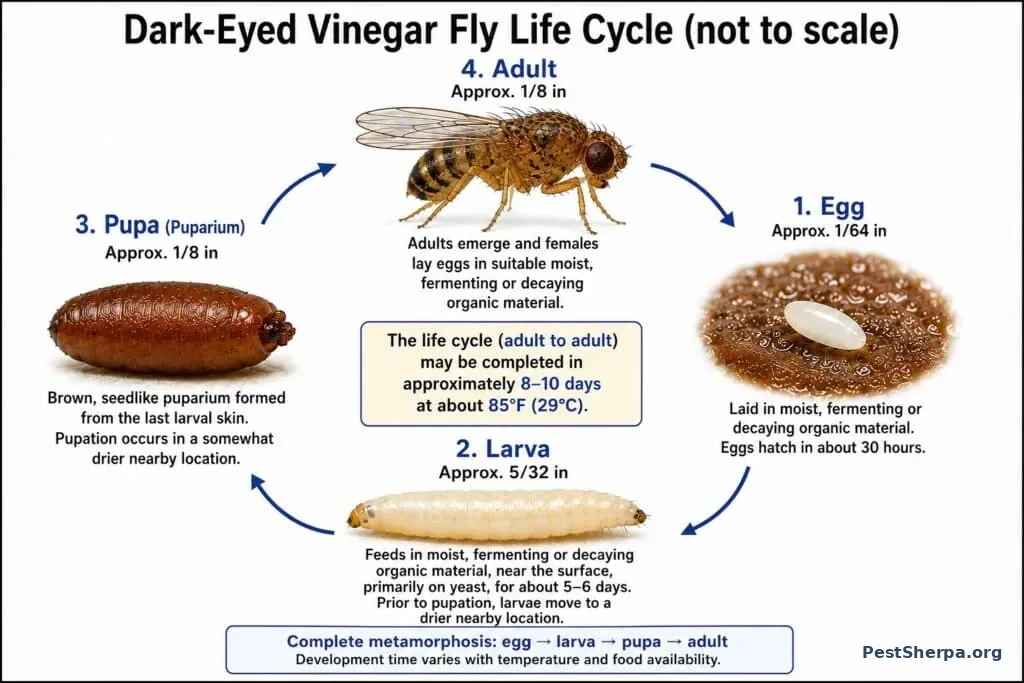
Dark-eyed vinegar fly life cycle from egg to adult if there is sufficient wet organic buildup.
Why Dark-Eyed Vinegar Flies Appear in Clean Facilities
Many people assume vinegar flies only occur where food is left exposed. Dark-eyed vinegar flies can persist even when visible counters and floors look clean because their breeding sites are often hidden.
- Residue inside drains is not removed by wiping counters.
- Food and beverage spills can settle beneath mats, equipment, and floor edges.
- Wet cleaning tools can hold enough residue and moisture to support flies.
- Trash and recycling containers may look empty but still hold residue in seams and bottoms.
- Cracked tile, damaged grout, and floor-wall gaps can trap organic material.
That is why the solution is usually not “clean more” in a general way. The better approach is to find the specific wet organic source and remove it thoroughly.
Sanitation and Health Context
Dark-eyed vinegar flies do not bite or sting. The concern is sanitation. Like other small flies associated with decaying organic material, they may move between residue, drains, trash, food-contact areas, and prepared-food spaces.
In homes, this usually means reducing contamination opportunities by removing sources, cleaning food-contact surfaces, covering food, and keeping trash and recycling cleaner. In food-service or food-handling settings, repeated small-fly activity deserves closer attention because sanitation, inspection, and customer-confidence issues may be involved.
For a broader safety discussion, see are flies dangerous?
What To Do About Dark-Eyed Vinegar Flies
1. Confirm You Are Dealing With a Small Vinegar Fly
Compare the fly with lookalikes. Dark-eyed vinegar flies are smooth-bodied and compact, not fuzzy like drain flies and not strongly humpbacked like phorid flies.
2. Use Traps as Monitors, Not the Main Solution
Sticky cards, small-food fly traps, and light traps can help show where adults are most active. They do not remove eggs, larvae, pupae, or the wet material supporting development.
3. Remove Wet Organic Material
Physically clean drain openings, garbage disposal splash guards, trash containers, recycling bins, beverage residue, mop buckets, and equipment edges. In many cases, brushing, scraping, rinsing, drying, and removing trapped debris matter more than adding a product.
4. Correct Moisture Problems
Repair leaks, improve drainage, reduce condensation, dry mop heads, empty buckets, and keep floor areas from staying wet overnight.
5. Recheck After Cleaning
Adult activity may continue briefly after cleaning because pupae can still emerge. If new adults continue for more than several days, or if activity shifts to a new area, inspect again for a missed source.
What Usually Does Not Work
Vinegar Traps Alone
Vinegar traps may catch adults, but they do not remove larvae developing in drains, residue, garbage, or hidden wet buildup.
Spraying Adults Without Removing the Source
Sprays may temporarily reduce visible adults, but they rarely solve the source problem. Avoid spraying food-contact surfaces, drains, dishes, utensils, food-prep areas, or ventilation openings. Always read and follow the label for any pesticide product. This Q&A gives a practical overview: do fly sprays actually work?
Only Wiping Visible Surfaces
Countertops can be clean while the actual source remains inside a drain, below equipment, under a floor mat, inside a trash container seam, or behind a splash guard.
Ignoring Structural Moisture
If a leak, slow drain, damaged floor, or trapped moisture problem remains, fly activity can return even after a thorough cleaning.
How Long Will Dark-Eyed Vinegar Flies Last?
How long they last depends on whether the breeding source remains.
| Situation | Likely Pattern |
|---|---|
| Single temporary source removed | Adults usually decline after existing flies are captured or die |
| Drain or trash residue partly cleaned | Activity may drop, then return |
| Hidden wet source remains | Adults continue emerging |
| Commercial kitchen or bar with multiple sources | Activity may shift between zones until all sources are addressed |
If flies are still appearing after a careful source-removal effort, assume something was missed rather than assuming the trap failed.
When Professional Help Is Best
Professional help may be useful when the source is hard to find, the issue keeps returning, or the setting requires a higher level of documentation and sanitation control.
- Flies persist after cleaning drains, trash, recycling, and damp areas
- Adults are appearing in several rooms or several areas of a facility
- Activity is centered around plumbing, floor drains, or possible leaks
- The infestation is in a restaurant, bar, grocery store, hospital, school, or food-handling area
- Species identification is uncertain
- Moisture damage, damaged flooring, or structural sanitation voids are suspected
For related guidance, see when professional help may be useful for flies.
Lookalikes and Common Misidentifications
Correct identification matters because different small flies develop in different materials. A trap full of tiny flies does not always mean the same source is involved.
| Lookalike | How It Differs | Common Source Clue |
|---|---|---|
| Common vinegar flies / fruit flies | Often bright red-eyed and strongly tied to ripe or fermenting fruit | Fruit bowls, produce, sweet liquids, fermented foods |
| Drain flies / moth flies | Fuzzy, moth-like, broad wings, weak flight | Drain slime, sewer line issues, organic sludge |
| Phorid flies | Humpbacked profile, quick running behavior, erratic movement | Decaying organic matter, plumbing leaks, sewage, dead organic material |
| Fungus gnats | More delicate, mosquito-like, often around plants | Overwatered houseplants, damp potting mix |
| House flies | Much larger, gray, stronger flying | Garbage, animal waste, outdoor entry, sanitation sources |
For a practical comparison of two common small-fly problems, see the difference between fruit flies and drain flies.
Frequently Asked Questions
Are dark-eyed vinegar flies the same as fruit flies?
They are a type of vinegar fly often grouped with fruit flies, but their source clues can differ. Common red-eyed vinegar flies are often tied to fruit and sweet fermenting materials. Dark-eyed vinegar flies are frequently tied to wet organic buildup in drains, beverage areas, trash, recycling, and damp sanitation zones.
Do dark-eyed vinegar flies come from drains?
They can develop in organic buildup associated with drains, but drains are not the only source. Also inspect garbage disposals, recycling bins, beverage residue, mop buckets, floor mats, equipment gaps, and damp food debris.
Do vinegar traps get rid of dark-eyed vinegar flies?
Traps can reduce adults and help show where flies are active. They do not remove eggs, larvae, pupae, or the wet organic material where flies are developing.
Why do they keep coming back after I clean?
The most common reason is that the actual breeding material was not fully removed. It may be inside a drain, under equipment, below a mat, in a trash or recycling container seam, behind a splash guard, or in a damp structural gap.
Are dark-eyed vinegar flies dangerous?
Dark-eyed vinegar flies do not bite or sting. Their significance is primarily sanitary. Fruit flies associated with decaying organic matter can mechanically transfer microorganisms from contaminated substrates to food or food-contact surfaces. Their presence does not prove that foodborne illness has occurred, but persistent activity in food-handling areas warrants prompt source removal and sanitation correction.
Should I pour bleach or pesticide into the drain?
Do not pour pesticides into drains unless the product label specifically allows that use. Bleach and quick rinses may not remove the physical buildup where larvae develop. Mechanical cleaning and source removal are usually more important. Use any cleaning or pesticide product only according to its label and keep children, pets, food, dishes, and food-contact surfaces protected.
Why do traps fail for dark eyed fruit flies?
Traps catch some adults but leave eggs and larvae in wet organic film. If the breeding site remains, new adults keep emerging. Use traps as monitors while you clean drains, mats, beverage lines, and trash seams.
Is this a drain problem or a fruit bowl problem?
Fruit bowls usually point to common vinegar flies. Persistent activity at sinks, floor drains, bars, and damp sanitation zones points more toward dark-eyed, drain-associated fruit flies even if a fruit bowl is present. Check both, then follow the adults to the wettest organic residue.
Restaurant vs home: is the approach different?
The biology is the same. Restaurants and bars often have more floor drains, beer lines, grease film, and night cleaning tools, so source hunts run longer. Homes usually start with kitchen drains, disposals, recycling, and under-sink moisture. In both places, adult spray-downs without source removal fail.
References
- Oregon State University Extension: Integrated Pest Management of Nonbiting Flies in Schools
- Cornell NYS IPM: Fruit Flies of a Different Eye Color
- LSU AgCenter: Drosophila spp., Vinegar and Pomace Flies
- University of Maine Cooperative Extension / eXtension: Flies: Drain Flies, Fruit Flies, Fungus Gnats
- Northeastern IPM Center: Fruit Flies / Vinegar Flies
- University of California Statewide IPM Program: Fruit Flies
- Florida Entomologist: Trapping Drosophila repleta Using Color and Volatiles
- Journal of Food Protection: Fruit Flies as Potential Vectors of Foodborne Illness
- NCBI Taxonomy: Drosophila repleta
This article was written by Greg Baumann, founder of Pest Sherpa, and reflects more than 40 years of professional pest management experience.
About the Author

Greg Baumann | Pest Control Expert
Greg Baumann is the founder of Pest Sherpa and a Pest Control Expert with more than 40 years of professional pest management experience. His articles combine decades of field experience, technical expertise, and science-based guidance to help homeowners identify pests correctly, understand real-world risks, and make informed pest management decisions.
Mission: Identify the pest. Understand the risk. Stop the problem. Prevent the comeback. Know when it’s time to call a professional.