
House Flies: Identification, Sources, Health Risks, and What to Do
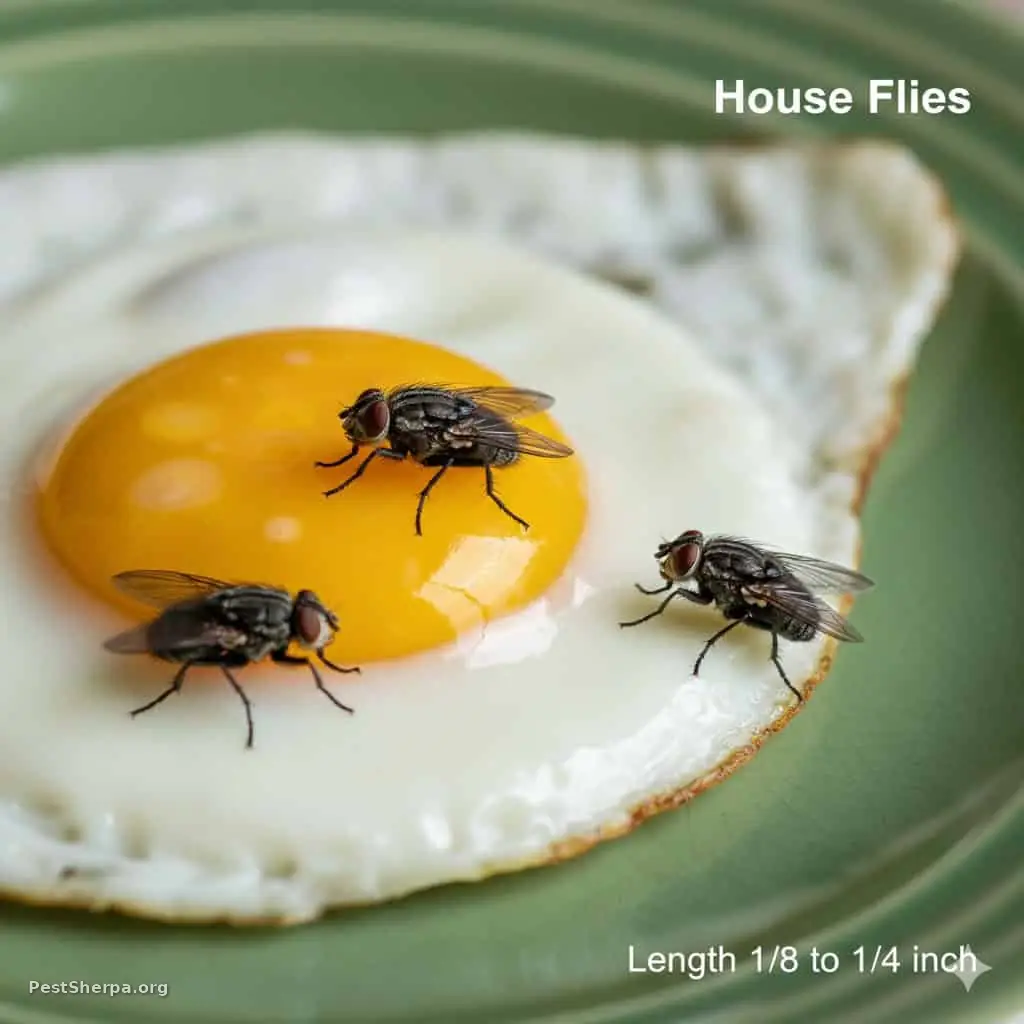
The house fly (Musca domestica) is one of the most familiar flies found around homes, restaurants, animal areas, dumpsters, and other places where food waste or moist organic material is present. A single fly indoors may simply have slipped in through a door or damaged screen. Repeated sightings, flies gathering at windows, or flies appearing near trash, pet waste, drains, animal areas, or food-handling spaces usually mean there is a nearby attraction or breeding source that needs to be found.
House flies do not bite or damage structures, but they matter because they move between garbage, manure, decaying material, and human food or surfaces. This guide explains how to identify house flies, what their presence may mean, where to look for breeding sources, what helps, what usually does not, and when professional help may be worth considering.
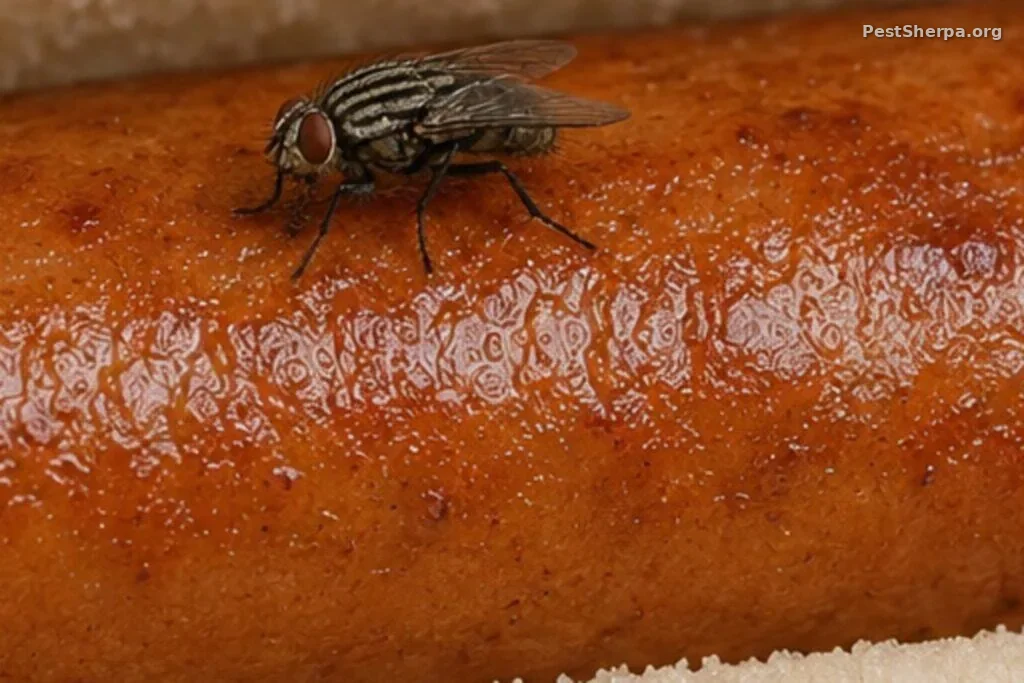
Adult house fly showing gray body, dark red-brown eyes, clear wings, and dark stripes on the thorax invading a picnic to taste a hot dog.
TL;DR
House flies are gray, medium-sized flies with reddish eyes and four dark stripes on the thorax. They breed in moist organic material such as garbage, manure, pet waste, spilled food, decaying vegetation, and soiled animal bedding. The most effective control step is usually finding and removing the breeding or attraction source, not spraying every adult fly you see.
One house fly indoors is usually not enough to prove an infestation. Several flies every day, flies near trash or food areas, maggots, or repeated activity after cleaning often means a source has been missed.
Quick Navigation
- What House Flies Mean in Your Home
- Identification
- House Fly vs Lookalikes
- Biology and Life Cycle
- Source Investigation Checklist
- Why House Flies Suddenly Appear
- Why House Flies Gather at Windows
- Can House Flies Make People Sick?
- What To Do
- What Usually Does Not Work
- How Long House Fly Problems Last
- When Professional Help May Be Worth Considering
- Frequently Asked Questions
- References
What House Flies Mean in Your Home
House flies are often a symptom of a sanitation, waste, entry, or nearby outdoor source issue. The adult flies are the visible part of the problem, but the source producing or attracting them is usually more important.
| What You See | What It Usually Means | First Place To Check |
|---|---|---|
| One house fly indoors | May have entered from outside | Open doors, windows, screens, and nearby trash |
| Several flies daily | Possible attraction or breeding source | Kitchen waste, pet areas, garbage, and outdoor bins |
| Flies near food or trash | Food residue or waste source likely | Trash cans, recycling, floor drains, food spills, and dumpsters |
| Maggots | Active breeding source nearby | Moist organic material, garbage, manure, pet waste, or spoiled food |
| Flies gathering at windows | Adults may be trying to leave after entering or emerging indoors | Nearby rooms, ceiling voids, attic access, and sunny windows |
Practical takeaway: Do not judge the problem only by the number of adult flies. A small number of adults can come from outside, while a hidden source can keep producing flies even after repeated cleaning or trapping.
Identification: What House Flies Look Like
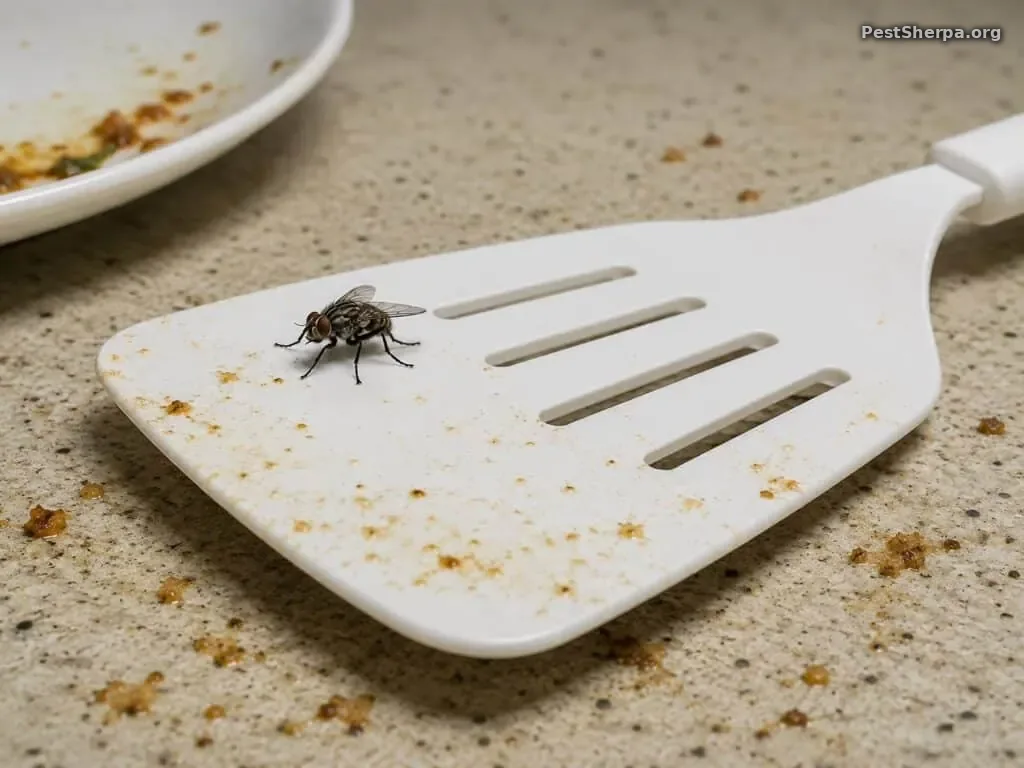
Adult house flies are gray to dark gray flies, usually about 1/8 to 1/4 inch long. The most useful field marks are the four narrow, dark lengthwise stripes on the thorax, large reddish compound eyes, clear wings, and sponging mouthparts. They are active, quick-moving flies and commonly land on walls, ceilings, counters, food surfaces, trash containers, and windows.
- Gray body, not metallic green or blue
- Four dark stripes on the thorax
- Large reddish eyes
- One pair of clear wings
- Sponging mouthparts instead of biting mouthparts
- Often active during daylight and around food, waste, or warm sunny windows
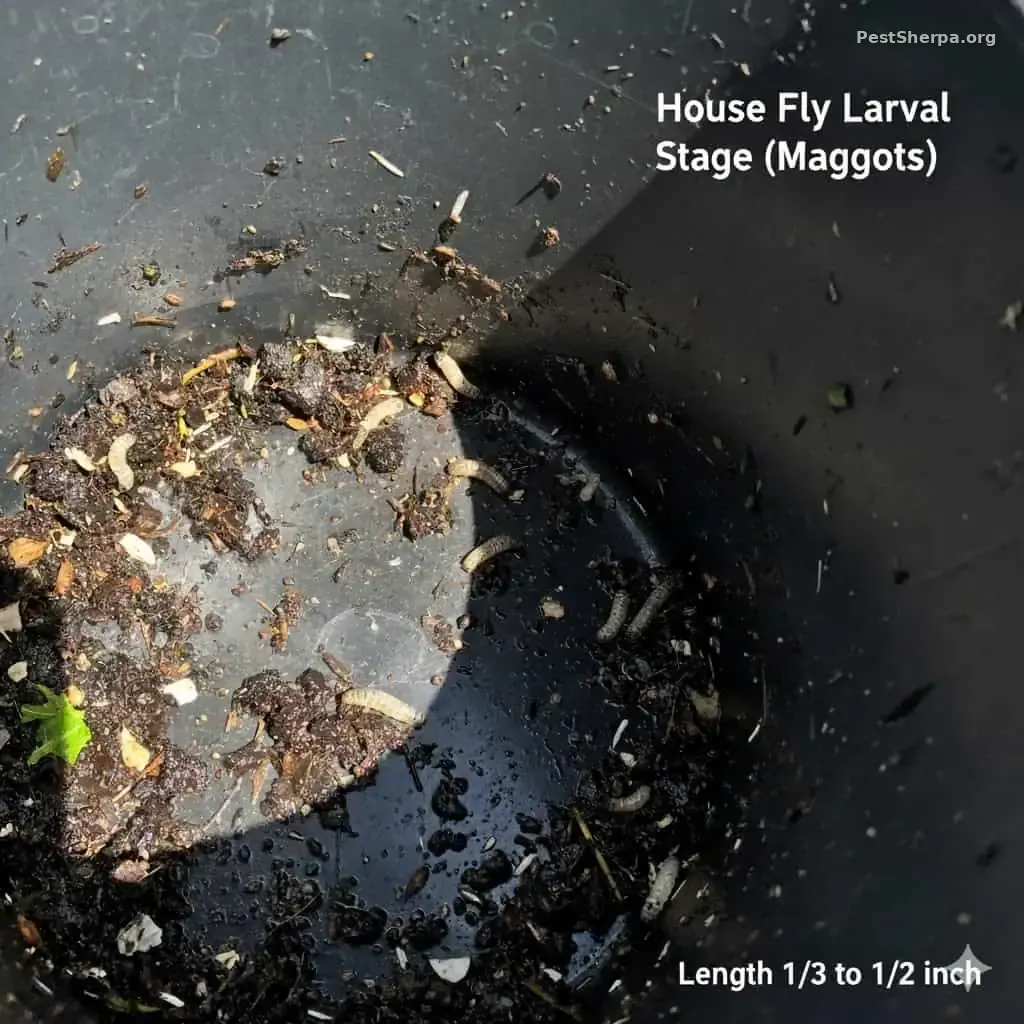
The immature stages are usually hidden inside the breeding material. Larvae, commonly called maggots, are pale, legless, tapered, and found in moist organic material. The pupal stage develops inside a hardened brown puparium, often in a drier area near the larval food source.
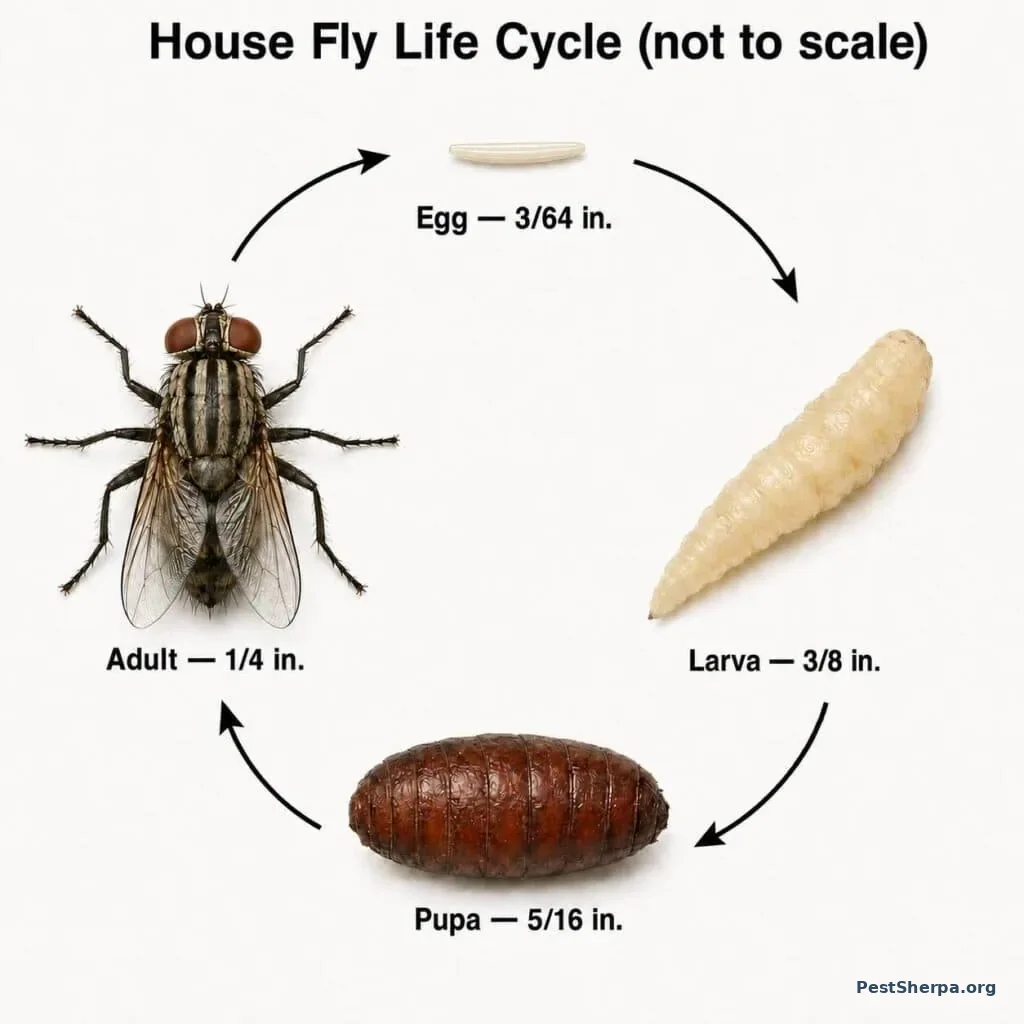
House fly life cycle showing adult fly, pale larva, and brown pupa.
House Fly vs Lookalikes and Common Misidentifications
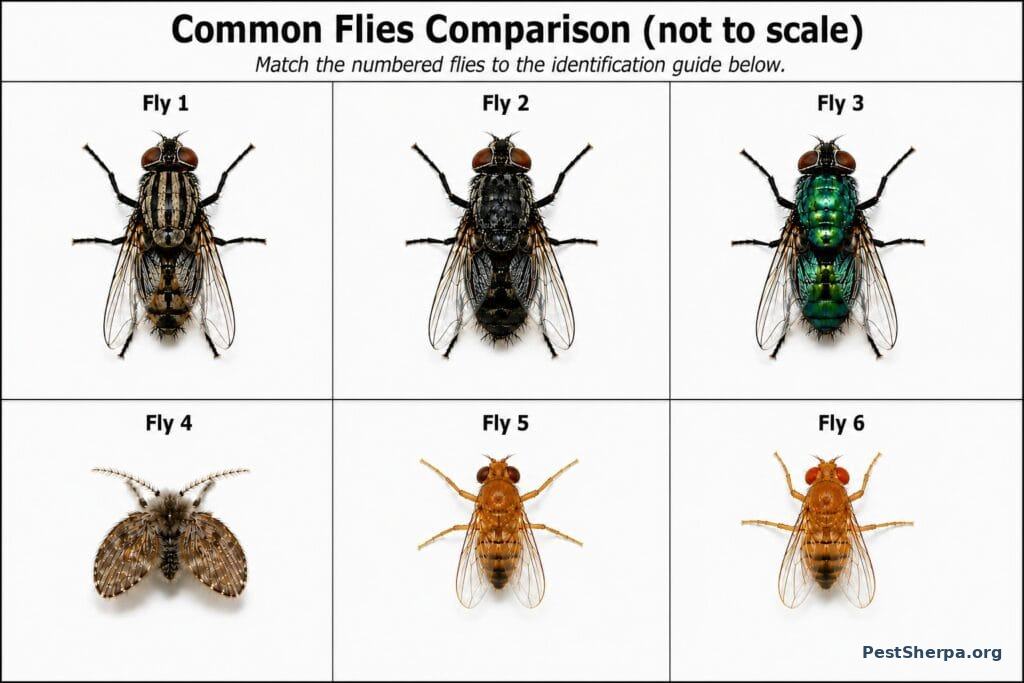
Correct identification matters because different flies usually point to different sources. A house fly problem often starts with garbage, manure, pet waste, food residue, or other moist organic material. Other flies may point toward drains, fruit, dead animals, or overwintering sites.
| Fly | How It Differs | Common Source Clue |
|---|---|---|
| House fly | Gray fly with four dark thorax stripes | Garbage, manure, pet waste, food residue, and moist organic material |
| Green bottle fly | Metallic green or blue-green blow fly | Dead animals, garbage, pet waste, carrion, and decomposition |
| Cluster fly | Duller, slower fly often found around windows in cooler seasons | Overwintering indoors; not usually a garbage source |
| Drain fly | Small, fuzzy, moth-like fly | Organic buildup in drains, wet slime, or plumbing areas |
| Vinegar fly, often called a fruit fly | Tiny fly, often tan or brownish, commonly around fruit or fermenting material | Overripe fruit, residues, recycling, bottles, cans, and fermenting liquids |
| General fly guide | Useful when the fly does not match one obvious type | Helps compare size, behavior, and likely breeding sources |
Biology and Life Cycle
House flies undergo complete metamorphosis: egg, larva, pupa, and adult. In warm conditions with suitable food and moisture, development can be fast enough for populations to build quickly. This is why a missed source can lead to repeated adult fly activity within a short period.
Female house flies lay egg clusters in moist organic material. Common breeding materials include fresh manure, garbage, food waste, spoiled feed, decaying vegetation, and other damp materials rich in organic matter. Larvae feed in the material, then move to a somewhat drier nearby area to pupate. Adults emerge from the pupal stage and begin searching for food, moisture, mates, and light.
| Life Stage | Where It Is Usually Found | What It Means for Control |
|---|---|---|
| Egg | Moist organic material | Source removal is the key step |
| Larva | Garbage, manure, pet waste, spoiled food, or other damp organic material | Maggots confirm an active breeding site |
| Pupa | Drier areas near the larval source | Adults may still emerge after the wet source is removed |
| Adult | Walls, ceilings, windows, food areas, trash areas, and outdoor surfaces | Traps and vacuuming help reduce adults but do not replace source control |
House Fly Source Investigation Checklist
Start with the places that combine food, moisture, warmth, and organic residue. House flies do not need a complicated source. A dirty trash container, unsealed garbage bag, pet waste area, or forgotten food spill can be enough.
Step 1: Check Indoor Food and Waste Areas
- Kitchen trash cans and liners
- Food scraps under appliances
- Recycling bins with residue
- Pet feeding areas
- Forgotten produce, meat scraps, or spilled liquids
Step 2: Check Outdoor Trash and Sanitation Sources
- Outdoor garbage cans and lids
- Dumpsters or shared trash areas
- Compost piles, especially if food scraps are exposed
- Pet waste in yards, kennels, or runs
- Animal bedding, spilled feed, or manure
Step 3: Check Entry Points
- Torn screens
- Doors left open during warm weather
- Gaps around doors, windows, vents, and utility openings
- Attached garages with trash, pet food, or recycling
Step 4: Look for Larvae or Pupae
Maggots usually mean the breeding source is close. Pupae may be in drier cracks, edges, or nearby protected spots. Use gloves, avoid direct contact with contaminated material, and wash hands and tools after cleanup.
Why House Flies Suddenly Appear
House flies can seem to appear suddenly because several adults may emerge from the same breeding source around the same time. Warm weather speeds development, and a source that was overlooked for several days can produce noticeable adult activity.
Common reasons for sudden house fly activity include:
- Trash held too long or stored without a tight lid
- Food residue in recycling containers
- Pet waste, kennels, litter areas, or animal bedding
- Manure or animal areas near the home
- Warm weather after a period of waste buildup
- Open doors or damaged screens during high outdoor fly activity
- Nearby dumpsters, restaurants, farms, compost, or shared trash areas
For a broader diagnostic guide, see why flies may suddenly appear in a house.
Why House Flies Gather at Windows
Adult flies often move toward light. If house flies are gathering at one sunny window, the window may not be the source. It may simply be where flies are trying to exit after entering from outdoors or after emerging from a nearby indoor source.
Check the room, nearby trash, attic access, ceiling edges, wall void clues, nearby exterior trash, and screens around that window. More detail is available in the related Q&A on why flies keep showing up near windows.
Can House Flies Make People Sick?
House flies do not bite or sting. The concern is contamination. They can move between unsanitary material and human food, dishes, counters, utensils, wounds, or other sensitive surfaces. Organisms can be carried on the body, legs, mouthparts, or in material deposited while feeding or resting.
This does not mean every house fly sighting will cause illness. It does mean house flies should be taken seriously in kitchens, restaurants, schools, healthcare settings, animal areas, and homes with repeated fly activity. Food-contact surfaces should be cleaned, exposed food should be discarded when contaminated, and breeding sources should be removed promptly.
For a general consumer overview, see are flies dangerous?
What To Do About House Flies
1. Confirm the Fly Type
Compare the fly with the identification features above. If it is metallic green, fuzzy, tiny, or unusually sluggish, it may not be a house fly. The correct source search depends on the correct fly.
2. Remove Breeding and Attraction Sources
Sanitation is the foundation of house fly control. Empty trash often, wash cans when residue builds up, keep lids tight, rinse recycling, clean food spills, remove pet waste, and manage animal bedding or manure so it does not stay moist and attractive.
More source clues are covered in what attracts house flies?
3. Reduce Adult Flies Safely
- Use a vacuum for visible adults, then empty it outdoors or into a sealed bag.
- Use sticky traps or light traps where appropriate, especially for monitoring.
- Keep traps away from food preparation surfaces.
- Clean food-contact surfaces after fly activity.
4. Improve Exclusion
- Repair window and door screens.
- Install or repair door sweeps.
- Seal gaps around doors, vents, and utility penetrations.
- Keep doors closed when outdoor fly activity is high.
5. Use Pesticides Carefully, If Needed
Pesticides are not always necessary for house flies, and they rarely solve a breeding-source problem by themselves. If using any fly spray, bait, or other product, read and follow the label, keep products away from children and pets, avoid contaminating food or food-contact surfaces, and do not apply products to drains, vents, dishes, counters, or animal areas unless the label specifically allows that use.
For more context, see do fly sprays actually work?
What Usually Does Not Work
- Only killing adult flies: More adults can emerge if the breeding source remains.
- Using bug bombs as the first response: Foggers do not remove garbage, manure, pet waste, or food residue sources.
- Spraying randomly: Unfocused spraying can miss the real issue and may create unnecessary exposure risks.
- Ignoring outdoor sources: Trash bins, dumpsters, animal areas, and pet waste outside can keep sending flies indoors.
- Treating every fly problem like a drain problem: Drain cleaning helps drain flies, but house flies usually point to broader organic waste or entry sources.
How Long House Fly Problems Last
The timeline depends on whether the source is found. If a few flies entered from outside, activity may be brief. If a breeding source remains, flies can continue appearing. If the source is removed, adults may still be noticed for a short period as existing pupae finish development, but activity should decline when no new larvae are being produced.
| Situation | Expected Pattern |
|---|---|
| One or two flies entered from outside | Usually short-lived once entry points are corrected |
| Trash or food residue source removed | Activity should decline as adults are removed and no new larvae develop |
| Outdoor source remains nearby | Flies may continue entering, especially in warm weather |
| Hidden breeding source remains | Adult flies may continue or recur in waves |
When Professional Help May Be Worth Considering
Many small house fly problems can be improved with sanitation, exclusion, and source removal. Professional help may be worth considering when the source is not obvious, the activity keeps returning, flies are affecting a food-handling or healthcare setting, or the problem involves animal facilities, dumpsters, manure, or shared waste areas that require a broader inspection plan.
- Several flies appear every day after cleaning.
- Maggots are present and the source is unclear.
- Flies are recurring in a restaurant, school, healthcare area, or commercial kitchen.
- Outdoor dumpsters, animal areas, or neighboring sources may be involved.
- You need help distinguishing house flies from blow flies, drain flies, fruit flies, or cluster flies.
For more practical guidance, see when professional help may be appropriate for flies.
Frequently Asked Questions
Does one house fly mean I have an infestation?
No. One house fly may have entered through a door, window, garage, or damaged screen. Repeated sightings, several flies per day, or maggots are stronger signs that a source is present.
Where do house flies come from indoors?
They may enter from outside or develop from eggs laid in moist organic material. Common indoor or nearby sources include trash, food residue, pet waste, recycling residue, animal bedding, and spoiled food.
Are house flies the same as fruit flies?
No. House flies are larger gray flies with dark thorax stripes. Fruit flies, more accurately called vinegar flies in many household situations, are much smaller and often develop around fermenting fruit, liquids, bottles, cans, and residues.
Why are house flies on my windows?
They often move toward light. A window full of flies may be an exit point, not the source. Inspect the room, nearby trash or food sources, attic or wall clues, and screens around that window.
Do house flies bite?
No. House flies have sponging mouthparts and do not bite. If you are being bitten by a fly, consider other flies such as stable flies, mosquitoes, biting midges, or other biting insects.
Will fly spray solve the problem?
Fly sprays may reduce some adult flies when used according to the label, but they do not remove the breeding source. Sanitation, source removal, exclusion, and monitoring are usually more important for lasting improvement.
References
- LSU AgCenter: Musca domestica, House Fly (Diptera: Muscidae)
- University of Minnesota Extension: Flies
- Purdue Extension: Filth Flies: House, Blow, Bottle, Soldier and Flesh Flies
- Journal of Integrated Pest Management: House Fly Biology, Pest Status, Current Management Prospects, and Research Needs
- BMC Public Health / PubMed Central: A Systematic Review of Human Pathogens Carried by the Housefly
This article was written by Greg Baumann, founder of Pest Sherpa, and reflects more than 40 years of professional pest management experience.
About the Author

Greg Baumann | Pest Control Expert
Greg Baumann is the founder of Pest Sherpa and a Pest Control Expert with more than 40 years of professional pest management experience. His articles combine decades of field experience, technical expertise, and science-based guidance to help homeowners identify pests correctly, understand real-world risks, and make informed pest management decisions.
Mission: Identify the pest. Understand the risk. Stop the problem. Prevent the comeback. Know when it’s time to call a professional.