
Do Green Bottle Flies Bite? Life Cycle, ID, and Control
Short answers first: green bottle flies do not usually bite people, and their life cycle moves through egg, larva (maggot), pupa, and adult stages. That shiny metallic green fly is usually a green bottle fly, a blow fly in the genus Lucilia. Sudden outbreaks often point to a nearby decay source such as a dead animal, garbage, or pet waste. This guide covers identification, what their presence may mean, and what actually stops them.
Do green bottle flies bite?
Short answer: no. Green bottle flies do not bite people the way mosquitoes or stable flies do. These metallic blow flies, often Lucilia sericata (also placed in Phaenicia), have sponging, lapping mouthparts. They cannot pierce skin. The usual household concern is annoyance plus sanitation: adults are associated with decay sources, not blood-feeding. UC IPM notes that blow flies, like house flies, have sponging mouthparts and do not bite or feed on blood.
Adults take nectar and fluids from decaying organic matter. They may land on skin. A landing is not a bite. Virginia Cooperative Extension states that adult blow flies, including greenbottle flies (Lucilia spp.), do not bite humans or animals. They feed on liquids from rotting garbage, carrion, and dung.
Maggots of this group develop in carrion and, uncommonly, on necrotic tissue (myiasis). That is larval feeding, not an adult bite, and it is uncommon in typical homes. The usual household issue is filth-fly hygiene: adults can move bacteria from garbage, pet waste, or a carcass onto food and surfaces.
TL;DR
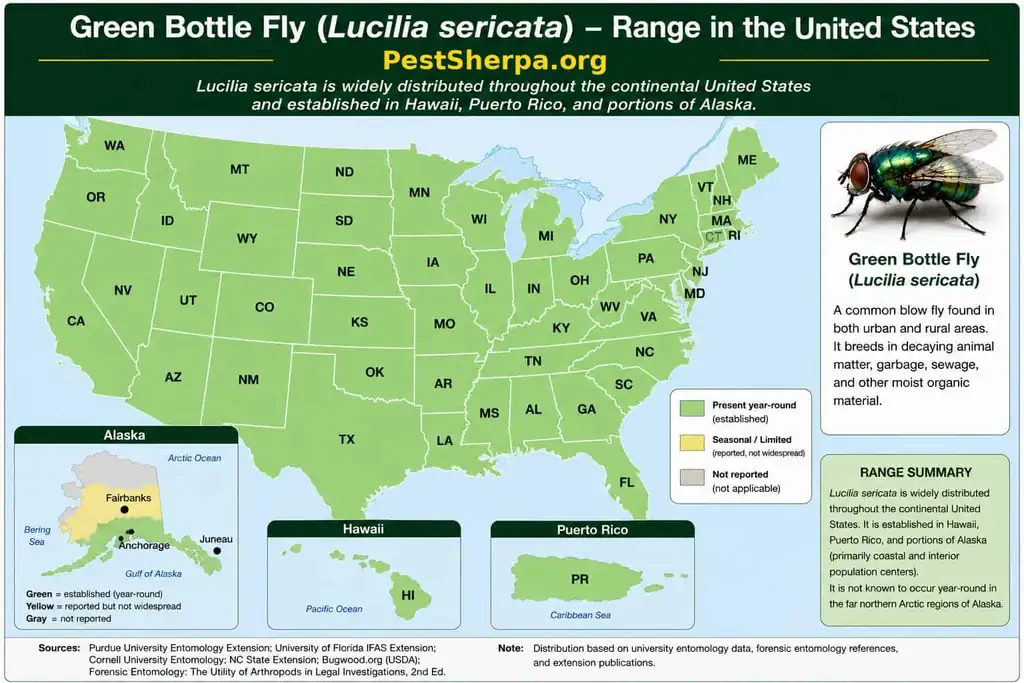
That shiny metallic green fly (or bronze one) people call a green metallic fly, greenbottle, or “green house fly” is usually a green bottle fly, a blow fly in Lucilia. Common green bottle fly (Lucilia sericata) adults look metallic green because of their cuticle color, not because they are painted house flies. One or two may have wandered in from outside. Watch for repeated sightings, dozens of flies at once, flies gathering at one window, or flies with a foul odor. Those usually mean there is a breeding source nearby.
Common sources include dead rodents, dead birds, dead squirrels, garbage, compost, pet waste, forgotten traps, and other decomposing organic material.
The most effective solution is finding and removing the source, not fogging alone.
Names you may hear: green bottle fly, greenbottle, blow fly, metallic green fly, common green bottle fly (Lucilia sericata). Tiny green flies on plants or windows are often a different pest. See the look-alike notes below before assuming every small green fly is a green bottle.
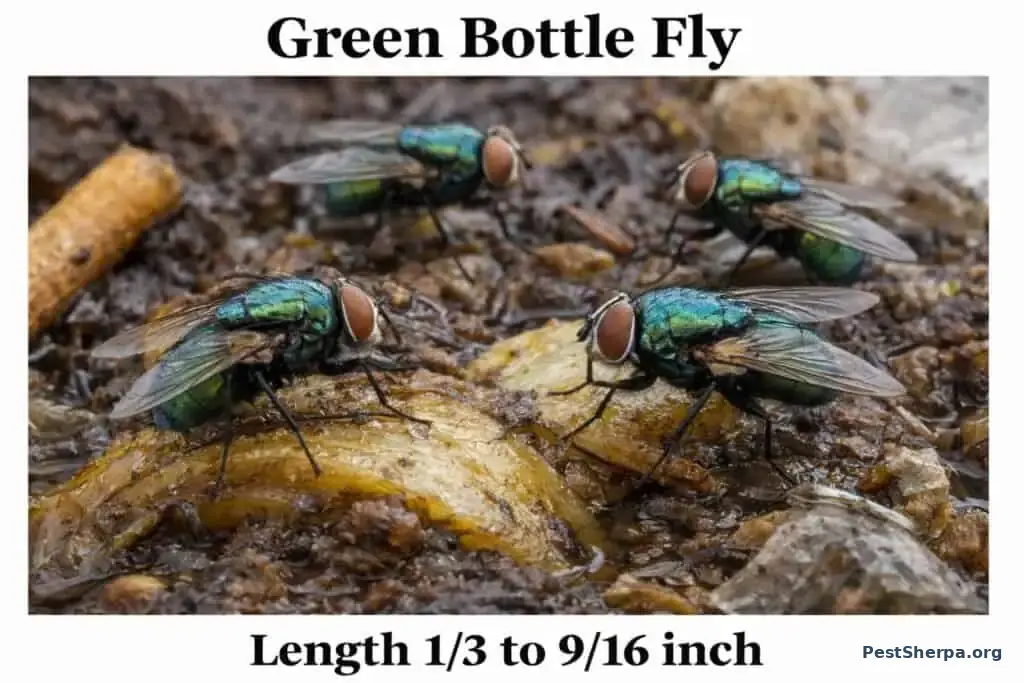
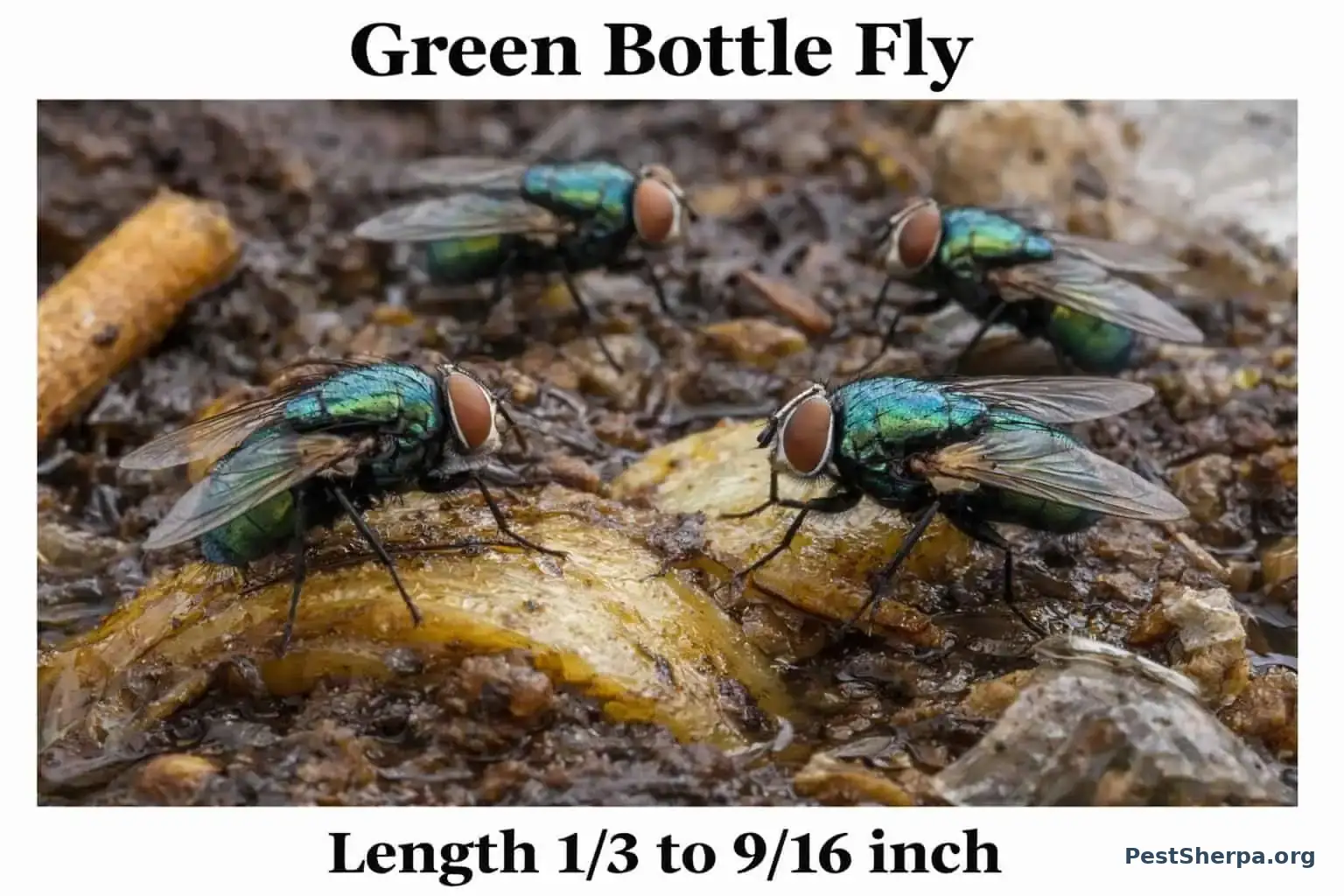
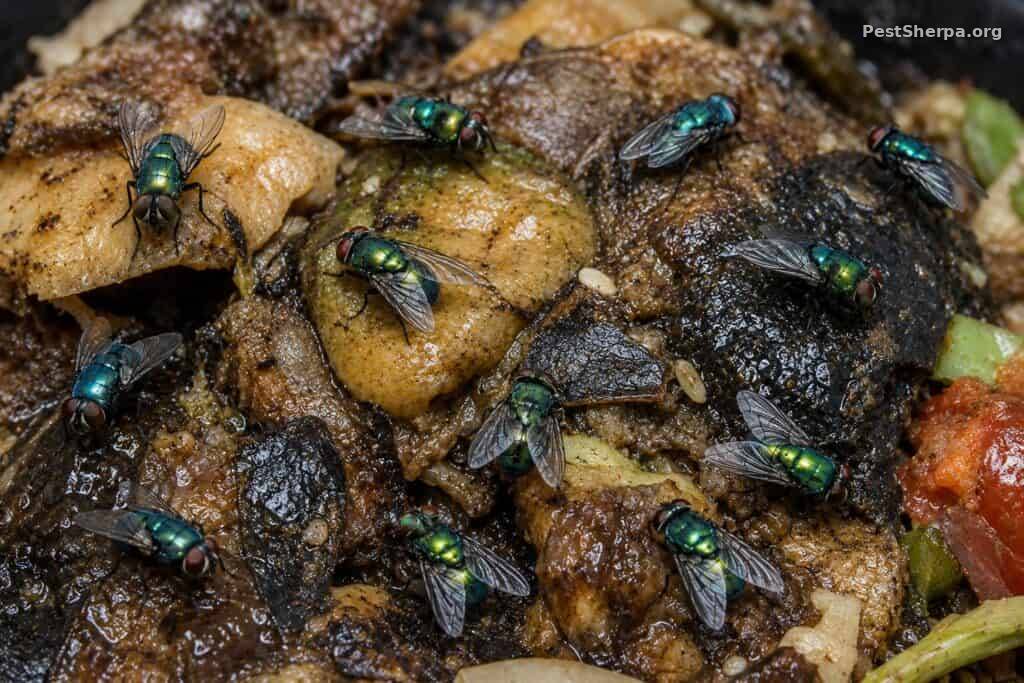
Green bottle fly showing typical green shiny or metallic appearance.
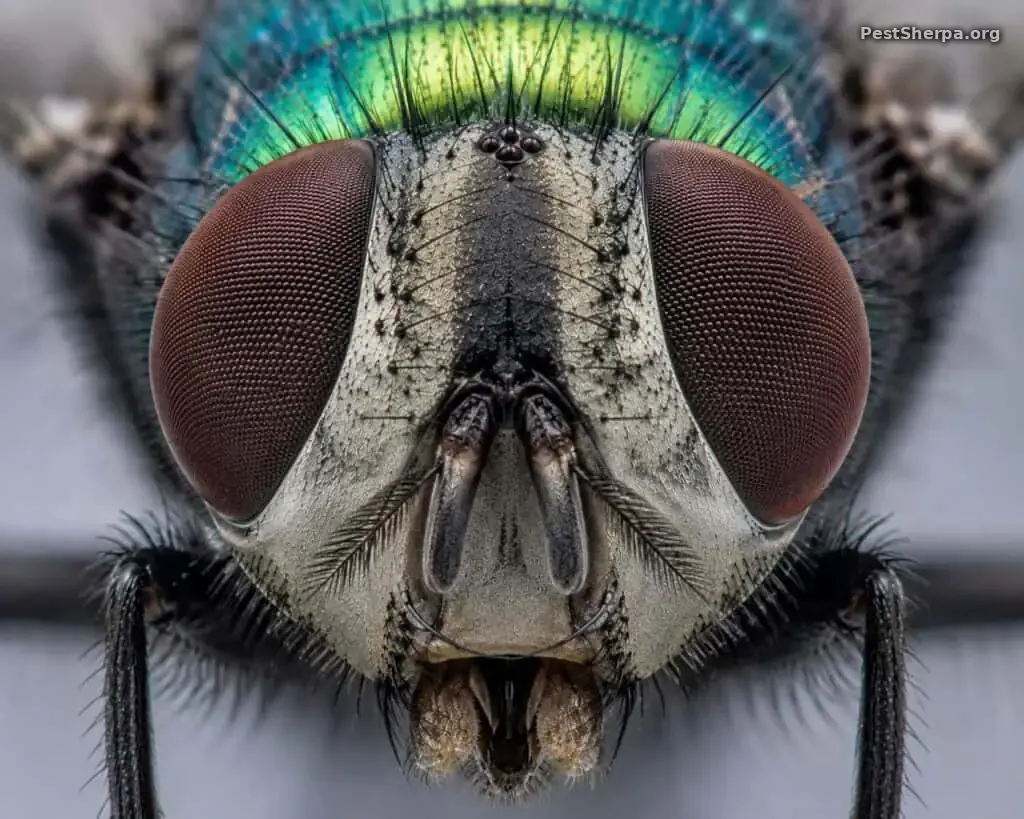
Closeup of the Green Bottle Fly. It is very frightening up close but the filth that they transport is the biggest concern.
Quick Navigation
- Do Green Bottle Flies Bite?
- What Green Bottle Flies Mean in Your Home
- Identification
- Do I Have a Dead Animal?
- Green Bottle Fly Source Investigation Checklist
- Why Do Green Bottle Flies Suddenly Appear?
- Why Are Green Bottle Flies Gathering at My Windows?
- If You Recently Had a Rodent Problem
- The 5 Most Common Sources of Green Bottle Flies
- What To Do
- What Doesn’t Work
- How Long Will Green Bottle Flies Last?
- Are Green Bottle Flies Harmful?
- When To Call a Pro
- Lookalikes and Common Misidentifications
- Frequently Asked Questions
- References
What Green Bottle Flies Mean in Your Home
Green bottle flies are often more important as a clue than as a pest.
The adult flies are what you see. The source producing them is usually the real issue.
| What You See | What It Usually Means |
|---|---|
| One fly | May have entered from outdoors |
| Several flies | Possible nearby breeding source |
| Sudden outbreak | Likely breeding source |
| Flies plus odor | Dead animal or decomposition likely |
| Maggots | Active breeding source nearby |
Expert Insight: Green bottle flies are often indicators rather than the primary problem. In many homes, removing the source solves the infestation faster than insecticides.
Identification: What Green Bottle Flies Look Like
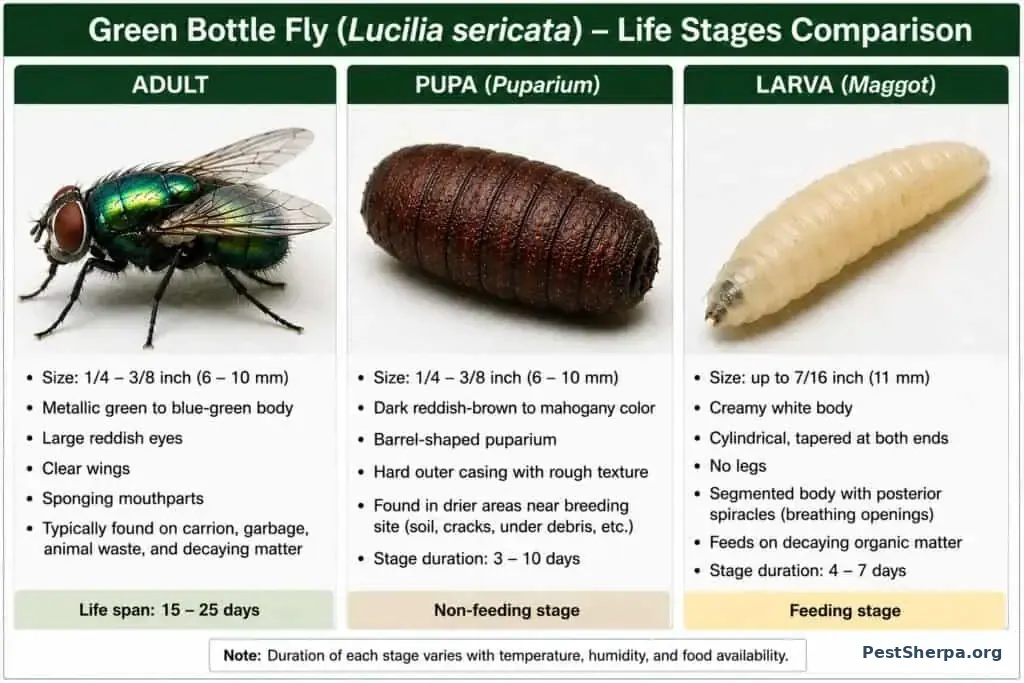
Life stages of Green Bottle Flies (not to scale). Eggs not shown as they are rarely observed.
Green bottle flies are metallic green blow flies in the family Calliphoridae.
- Metallic green or blue-green body
- Medium-sized fly
- Large red eyes
- Clear wings
- Strong buzzing flight
- Often gather at windows
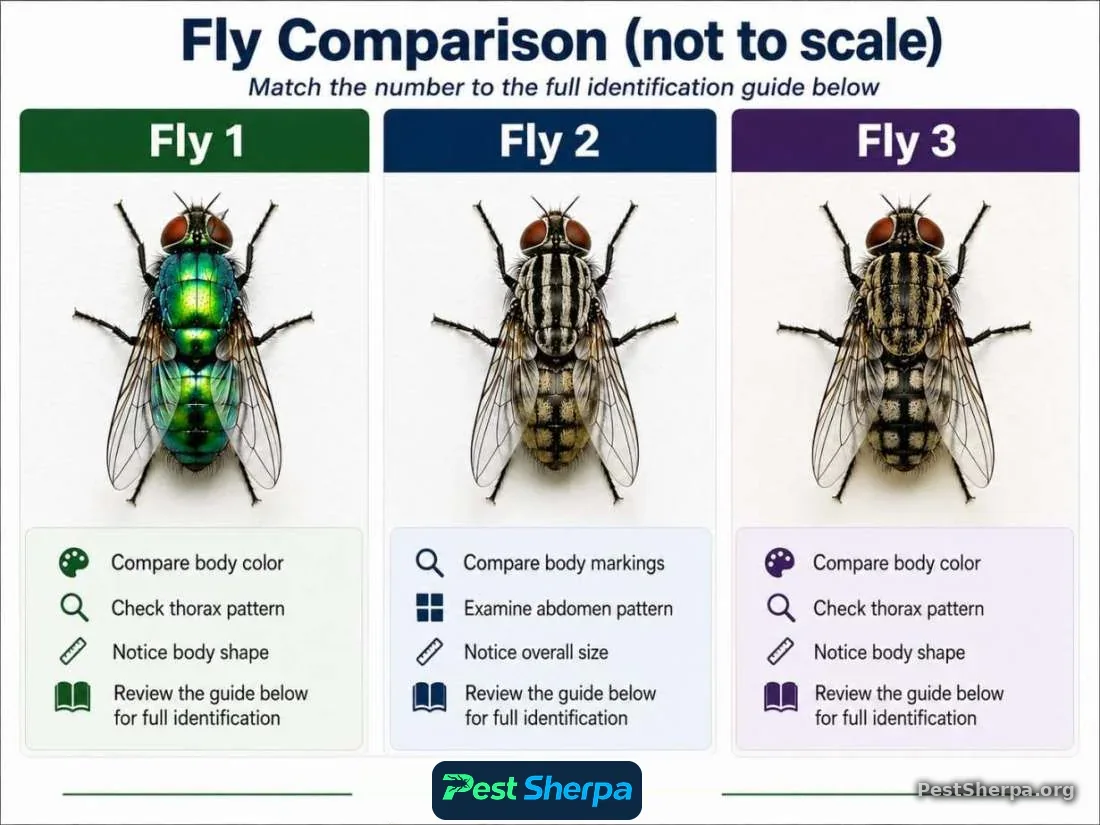
Fly Identification Answers
Match the numbered flies in the comparison image with the descriptions below. Look at body color, thorax markings, abdomen pattern, size, and behavior before making an identification.
Fly 1: Green Bottle Fly
Lucilia sericata
- Metallic green or blue-green body
- Large reddish compound eyes
- Clear wings and a shiny abdomen
- Often associated with carrion, animal waste, garbage, or decaying organic material
Key clue: The brilliant metallic green coloration separates this fly from the other two.
Fly 2: House Fly
Musca domestica
- Gray thorax with four dark longitudinal stripes
- Yellowish-gray abdomen with darker markings
- Sponging mouthparts rather than biting mouthparts
- Common around garbage, manure, food waste, and buildings
Key clue: Look for four dark stripes running lengthwise along the upper thorax. A dull gray house fly is not “house fly green.” If the fly looks shiny metallic green or bronze, you are usually in green bottle / blow fly territory, not Musca domestica.
Fly 3: Cluster Fly
Pollenia rudis
- Dull gray or dark body rather than metallic coloration
- Golden or yellowish hairs on the thorax
- Gray-and-black checkered abdomen
- Often gathers around windows, attics, wall voids, and upper floors during cooler weather
Key clue: Cluster flies move sluggishly indoors and have fine golden hairs behind the head and across the thorax.
The larvae are pale maggots that develop in decomposing organic material.
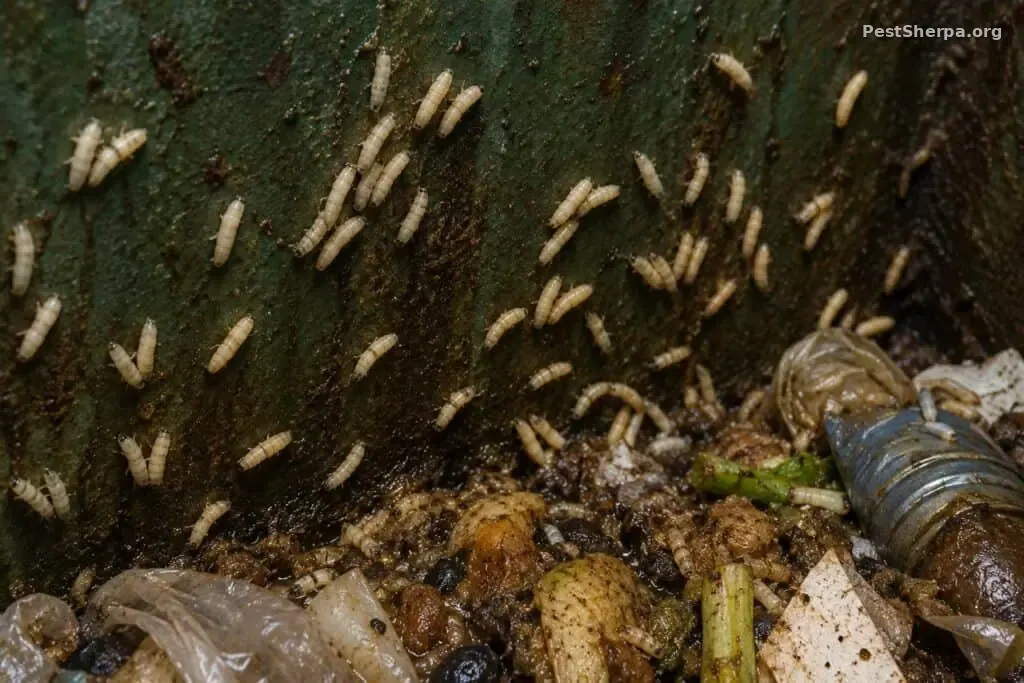
Maggots (larvae) in rotting material. Mature larvae reach about 1/2 to 3/4 inch.
Do I Have a Dead Animal? Quick Assessment
Many homeowners arrive here because they suspect something died inside the home.
| Sign | Dead Animal Likelihood |
|---|---|
| One fly | Low |
| Several flies daily | Moderate |
| Sudden outbreak | High |
| Flies plus odor | Very High |
| Flies after rodent control | Very High |
| Maggots near walls | Very High |
Green Bottle Fly Source Investigation Checklist
Step 1: Do You Smell Decay?
If yes, inspect attic, crawlspace, wall voids, garage, fireplace, and chimney areas.
Step 2: Have You Had Rodent Activity?
Inspect traps, bait stations, attics, crawlspaces, and utility penetrations.
Step 3: Are Flies Concentrated in One Room?
If yes, inspect the surrounding walls, ceiling, attic above, and crawlspace below.
Step 4: Are Maggots Present?
If yes, active breeding is likely nearby.
Step 5: Check Common Sources
- Trash containers
- Pet waste
- Compost
- Rodent traps
- Dead wildlife
- Garages
- Attics
- Crawlspaces
Seasonal Activity and Life Cycle
Green bottle flies are most active during warm weather. Their life cycle includes egg, larva (maggot), pupa, and adult stages. Eggs are rarely noticed on homeowner inspections. Larvae are pale maggots that develop in decomposing organic material and grow to about 1/2 to 3/4 inch before they pupate.
Adults often appear suddenly because many flies emerge from the same source within a short period. If you are seeing repeated adults indoors, look for the breeding source first rather than relying on sprays alone.
Why Do Green Bottle Flies Suddenly Appear?
Common causes include:
- Dead rodents
- Dead birds
- Dead squirrels
- Garbage
- Pet waste
- Compost
- Outdoor carcasses
Why Are Green Bottle Flies Gathering at My Windows?
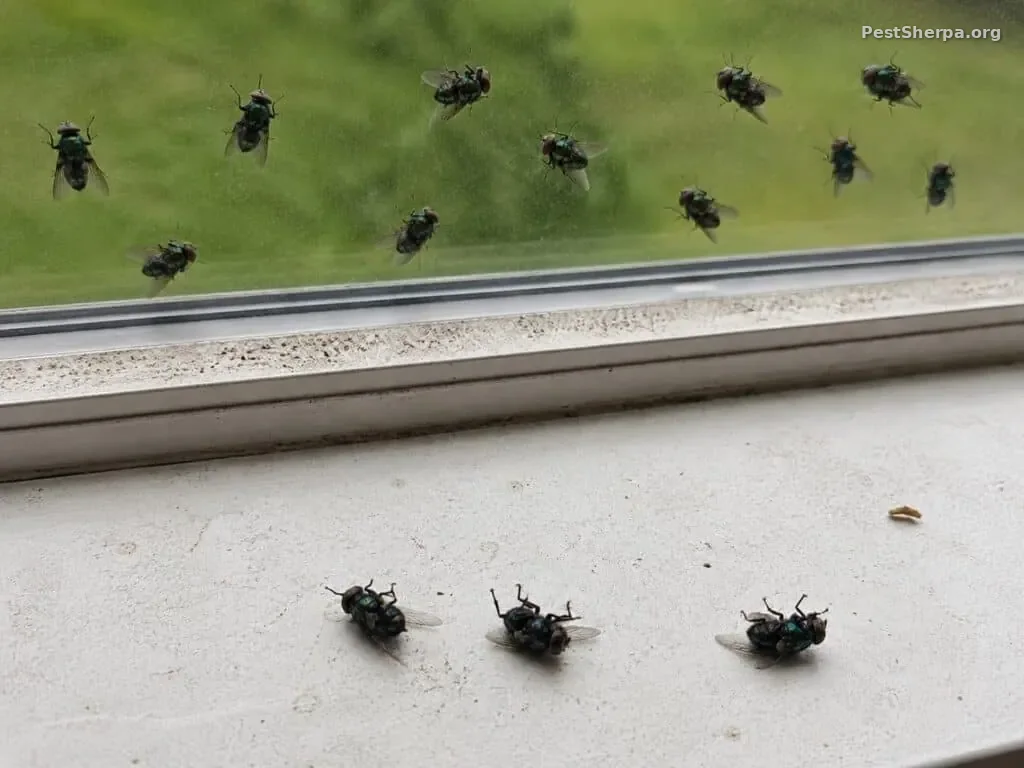
Adults that emerge indoors move toward light.
The window is usually not the source. It is often simply where the flies are trying to leave.
If You Recently Had a Rodent Problem
Green bottle fly outbreaks often occur after rodent infestations, trapping programs, or baiting efforts.
- Inspect attics
- Inspect crawlspaces
- Inspect garages
- Check trap locations
- Inspect utility penetrations
The Five Most Common Sources of Green Bottle Flies
1. Dead Animals
Most important source when many flies suddenly appear indoors.
2. Garbage
Especially meat scraps and food residue.
3. Pet Waste
Dog waste and animal bedding can attract blow flies.
4. Compost
Particularly compost containing animal products.
5. Outdoor Carcasses
Dead animals near the home can still produce indoor fly activity.
Green Bottle Fly Diagnostic Guide
| Observation | Most Likely Explanation |
|---|---|
| One fly | Outdoor entry |
| Many flies | Breeding source |
| Odor plus flies | Dead animal likely |
| Maggots | Active breeding source |
What To Do
1. Confirm Identification
Before you tear into a wall, make sure you are dealing with a blow fly. Green bottle flies are shiny metallic green to copper green, about 1/3 inch across, with large reddish eyes and clear wings (see Identification). A dull gray fly with four dark stripes on its back is a house fly, and a sluggish gray fly with golden hairs at an upper-floor window in cool weather is usually a cluster fly. Those point to different sources and different fixes. [UF/IFAS]
One caution if you live in or travel through the Texas and New Mexico screwworm zones: do not try to identify flies around animals yourself. APHIS says there is no need to look for screwworm flies at all; check animals for wounds with maggots and call your veterinarian or state animal health office. My New World screwworm guide covers the current situation. [APHIS]
2. Locate the Source
Indoors, green bottle flies almost always mean something is rotting nearby. Purdue Extension notes that blow and bottle flies found inside are usually breeding in dead rodents in wall voids or ceilings, or in rodent traps and glue boards that were not checked. Virginia Cooperative Extension adds that homeowners often find them when mature maggots crawl away from a dead mouse or bird in a wall or chimney to pupate. [Purdue] [Virginia Cooperative Extension]
- Follow the flies. Note which room has the most flies, then check the walls, ceiling, attic above, and crawlspace below that room.
- Follow your nose. A sweet, rotten odor that is strongest in one spot usually marks the carcass.
- Check every trap and bait station you or a pest company set, including ones in the attic, garage, and crawlspace.
- Look for wandering maggots or pupae. Pale maggots on the floor along a baseboard, or small brown capsules (pupae) nearby, point to the source wall.
- Check outside, too. Garbage cans, pet waste, compost, and dead animals near doors and windows can all produce flies that find their way in.
The Source Investigation Checklist above walks through these questions in order.
3. Remove the Source
- Dead animal you can reach: wear rubber or plastic gloves, spray the carcass and the area around it with a disinfectant or a fresh bleach solution and let it soak for 5 minutes (or per the label), bag it with any used trap, and put it in a covered outdoor garbage can. Wash gloved hands, remove the gloves, and wash again with soap and warm water. [CDC: rodent cleanup]
- Dead animal inside a wall or ceiling: if the flies and odor point to a void you cannot open cleanly, this is the time to bring in a pro (see When To Call a Pro).
- Garbage: bag household garbage and pet waste and seal the bag before it goes in the outdoor can, keep a tight-fitting lid on the can, and set it out for pickup at least once a week even if it is not full. UC IPM notes garbage that sits for more than a week is likely to produce blow flies. Wash the cans out with soap and water. Virginia Cooperative Extension notes boiling water kills maggots in garbage cans. [UC IPM] [Virginia Cooperative Extension]
- Pet waste and compost: pick up dog waste promptly and keep meat scraps out of open compost near the house.
- After the source is gone: vacuum up any maggots and pupae you find. If flies keep appearing after that, look for a second source.
4. Reduce Existing Adults
Once the source is gone, the adults already in the house are the easy part. A flyswatter or a vacuum handles small numbers. UC IPM notes that hanging sticky fly ribbons do not work well on blow flies, which do not usually rest on vertical surfaces, and that odor-baited traps should go outdoors and away from the house because of their smell. Virginia Cooperative Extension adds that light traps may be useful outdoors but can pull in flies from a wider area. [UMN Extension] [UC IPM] [Virginia Cooperative Extension]
- Vacuum
- Flyswatter for a few flies
- Odor-baited traps placed outdoors, away from doors
- Light traps outdoors only, used with care
5. Improve Exclusion
Most flies found indoors came from outside, so tight screens and sealed gaps are your first line of defense. [UC IPM] [Purdue]
- Repair screens
- Install door sweeps
- Seal gaps around windows, doors, and utility lines
What Doesn’t Work
- Bug bombs
- Excessive spraying
- Endless sticky traps
- Drain treatments for non-drain flies
Adult fly control rarely solves the problem by itself.
How Long Will Green Bottle Flies Last?
- Outdoor entry: often short-lived
- Source removed: activity declines
- Source remains: flies continue
- Hidden carcass: activity may occur in waves
Are Green Bottle Flies Harmful?
They do not bite (see Do green bottle flies bite? above), and they are not blood-feeding disease vectors like mosquitoes. The concern is contamination. Like house flies, blow flies are strongly attracted to garbage and feces and may carry disease agents from them onto human food. Keep food covered or sealed when flies are around. [UC IPM] [Virginia Cooperative Extension]
A sudden burst of metallic green flies is also a clue that a dead animal, a trash problem, or pet waste is close by. Fix the source first; sprays alone rarely solve an indoor breeding event.
When To Call a Pro
- Odor present but source unknown
- Flies emerging from walls
- Maggots indoors
- Suspected hidden carcass
- Commercial or food-handling facilities
Similar Pests and Common Misidentifications
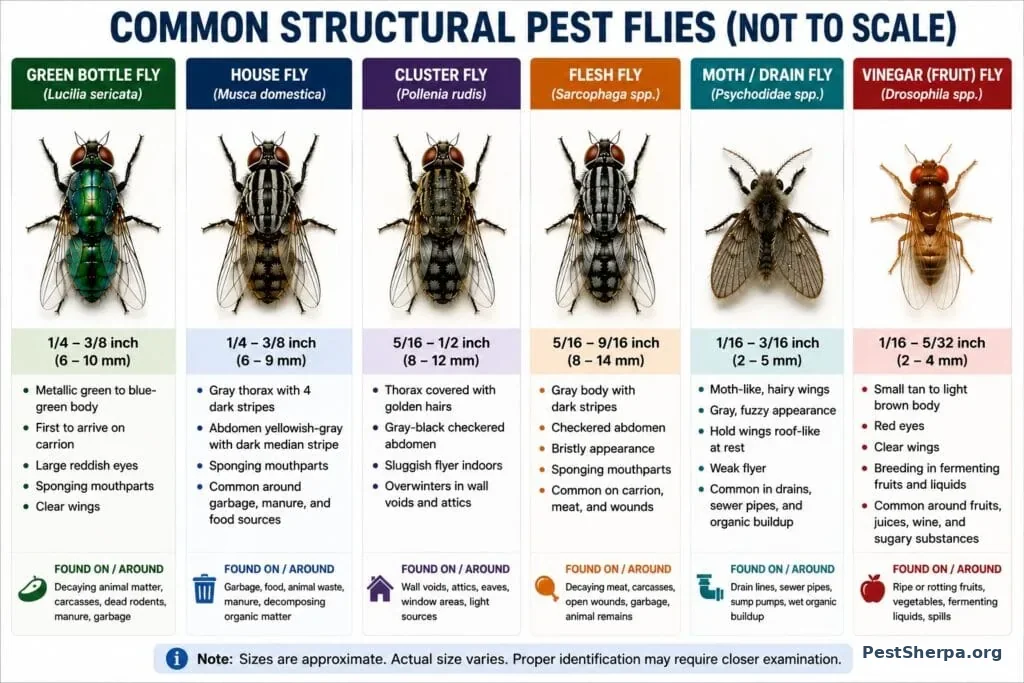
Six commonly encountered flies; compare appearance, compare size, compare habits.
Searches for “house fly green” usually mix two different insects: the dull gray house fly and the metallic green bottle fly. Tiny or little green flies on houseplants or damp windows are often not green bottles at all. They may be fungus gnats or other small flies. Do not treat every tiny green fly as a green bottle blow fly.
| Pest | Key Difference |
|---|---|
| House Fly | Dull gray with thorax stripes, not metallic green |
| Cluster Fly | Dull gray and sluggish |
| Fungus Gnats | Much smaller; often around plants or moist soil, not carrion blow flies |
| Drain Fly (aka Moth Fly) | Small and fuzzy |
| Fruit Fly | Tiny and associated with fruit |
| Pest Sherpa Professional Fly Guide | Professional Guide to Common Flies |
Frequently Asked Questions
Why do green bottle flies suddenly appear?
Many adults often emerge from the same breeding source at once.
Does one green bottle fly mean I have a dead animal?
No. One fly may simply have entered from outside.
Why are they at my windows?
Adults move toward light after emerging indoors.
Will they go away on their own?
Sometimes, but only after the source is exhausted or removed.
Are green bottle flies dangerous?
They are not blood-feeding disease vectors like mosquitoes. The practical risk is filth-fly contamination and the clue that decaying organic matter may be nearby. Source removal and sanitation matter more than panic.
Why are some flies metallic green?
Green bottle blow flies have a naturally metallic green or bronze body. That shine is part of their identification, not a house fly that turned green.
Green fly vs house fly: how do I tell?
House flies are dull gray with four dark thorax stripes. Green bottle flies are shiny metallic green or bronze. If you are seeing tiny green flies on plants, check fungus gnats before assuming green bottles.
When should I call a pro?
Call for help when flies keep returning after cleanup, you smell decay but cannot find the source, maggots appear indoors, or the problem follows a rodent event and may involve wall or attic voids.
References
- UF/IFAS Extension: Common Green Bottle Fly or Sheep Blow Fly (Lucilia sericata)
- Purdue Extension: Filth Flies: House, Blow, Bottle, Soldier and Flesh Flies
- University of Minnesota Extension: Flies
- University of Maine Cooperative Extension: Blow Flies and Flesh Flies
- Illinois Department of Public Health: House Fly and Other Filth Flies Prevention and Control
This article was written by Greg Baumann, founder of Pest Sherpa, and reflects more than 40 years of professional pest management experience.
About the Author

Greg Baumann | Pest Control Expert
Greg Baumann is the founder of Pest Sherpa and a Pest Control Expert with more than 40 years of professional pest management experience. His articles combine decades of field experience, technical expertise, and science-based guidance to help homeowners identify pests correctly, understand real-world risks, and make informed pest management decisions.
Mission: Identify the pest. Understand the risk. Stop the problem. Prevent the comeback. Know when it’s time to call a professional.