
Honey Bees: Identification Around Homes and What to Do
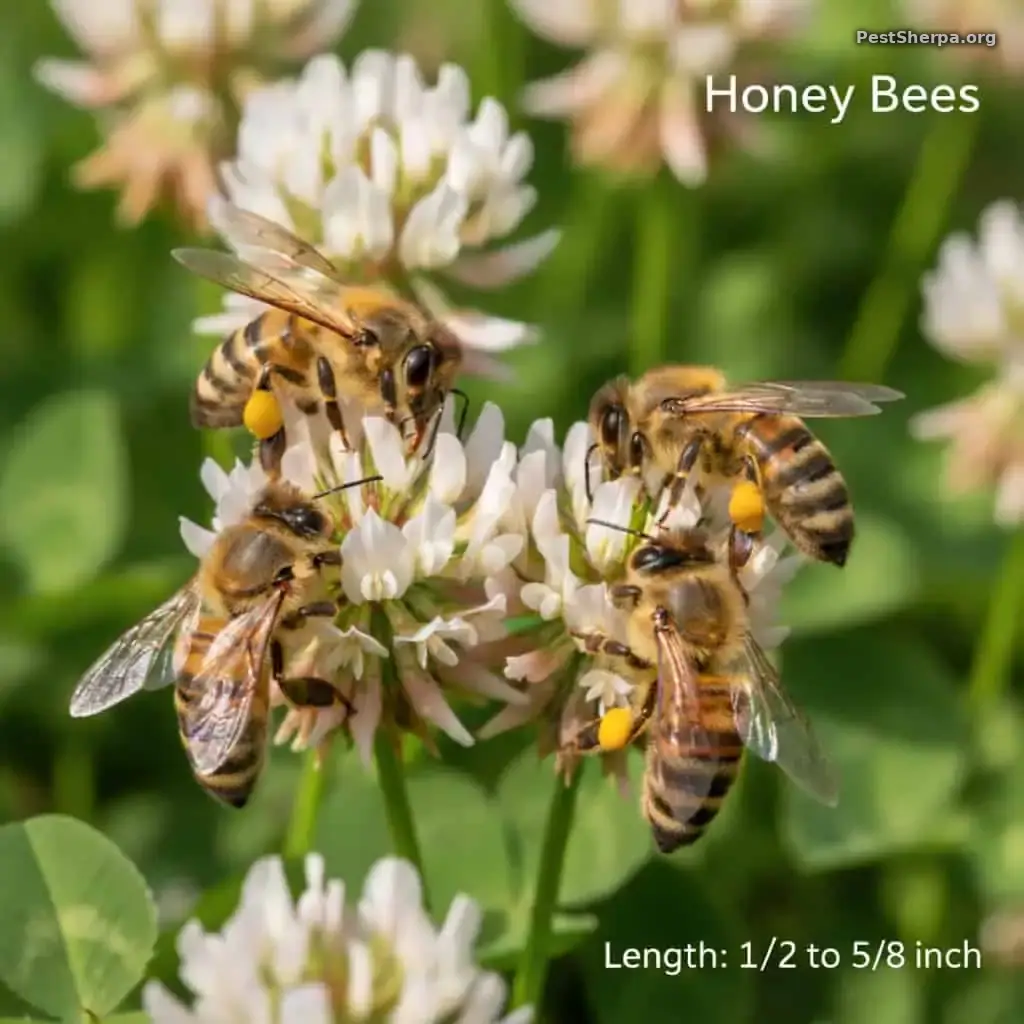
Updated for accuracy: Honey bees are valuable pollinators, but they can still become a real home problem when a swarm settles into a wall, attic, chimney, soffit, or other structural void. The right first question is not “How do I kill them?” It is “Am I looking at a temporary swarm or an established colony inside the structure?”
TL;DR
- Most useful ID clue: a medium-sized, somewhat fuzzy bee with brown-to-golden banding and a hairy thorax. Workers may also carry pollen on their hind legs.
- Big homeowner distinction: a swarm hanging in a cluster on a branch, fence, or wall is often temporary. A steady stream of bees entering and exiting the same gap in a building points more toward an established colony.
- What honey bees usually mean: not a wood-destroying pest, but potentially a sting risk near people and a serious cleanup issue if they build comb inside a structure.
- What usually works: keep people back, identify the insect correctly, and get experienced help for bees established in walls, attics, chimneys, soffits, or other voids.
- What wastes effort: spraying a resting swarm without a plan, sealing an active entry hole while bees and comb remain inside, or assuming every large bee is a honey bee.
- When urgency goes up: the colony is in the structure, people are getting stung, someone in the home has a sting allergy, or the behavior seems unusually defensive.
Jump to: Identification Why It Matters What To Do When To Call a Pro Similar Pests References
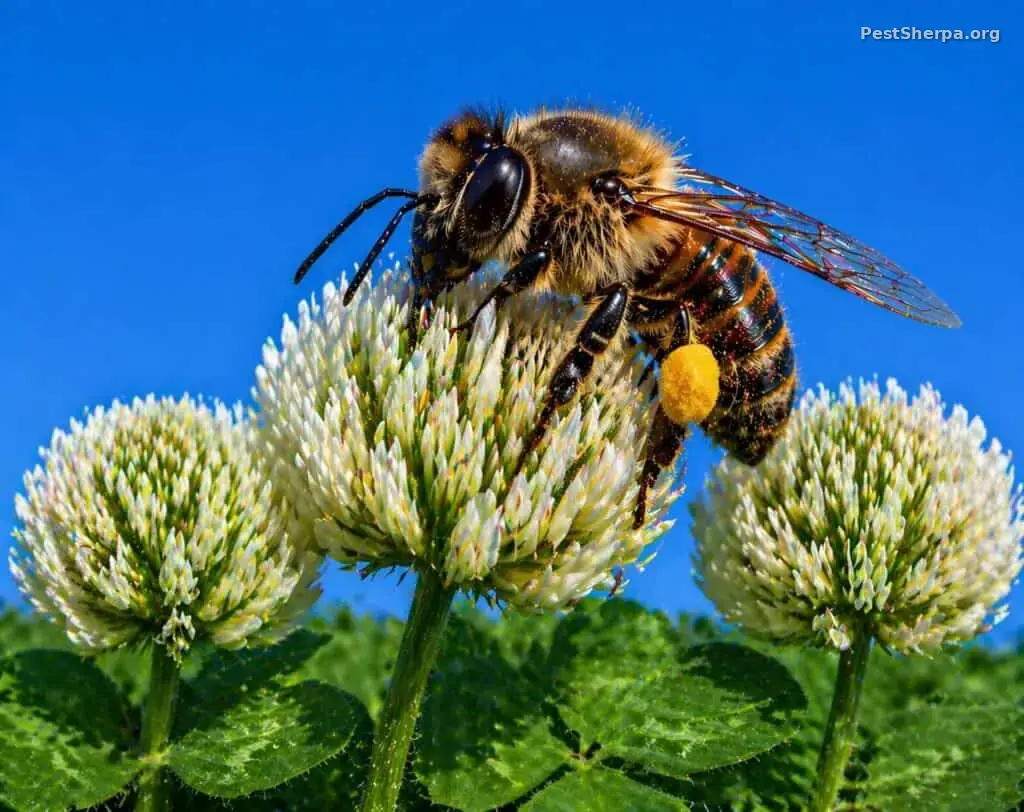
Honey bees are usually medium-sized, fuzzy, and brown-to-golden with darker abdominal bands.
Identification
Honey bees (Apis mellifera) are usually about 1/2 to 5/8 inch long, with a hairy thorax, brown-to-golden coloration, and darker abdominal banding. Workers have pollen baskets on the hind legs that may be visibly packed with yellow or orange pollen when they return to the nest. They are slimmer than bumblebees and fuzzier than yellowjackets.
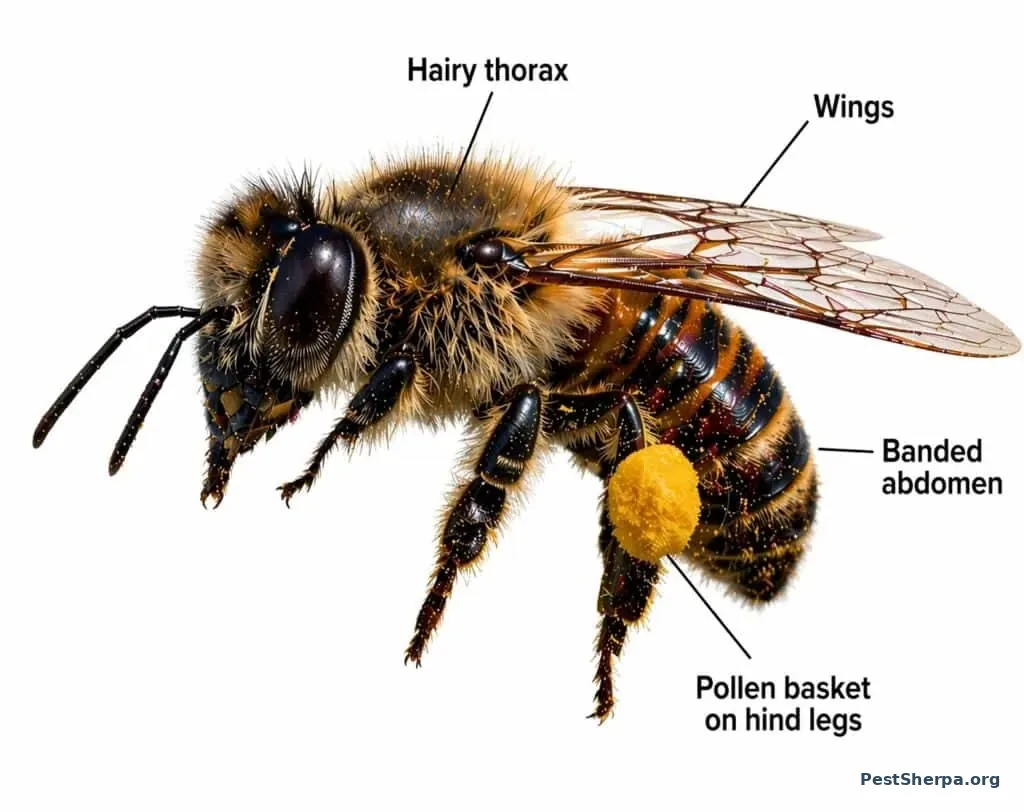
Look for a fuzzy thorax, brown-to-golden banding, and pollen carried on the hind legs.
What it looks like
- Medium-sized bee, usually around 1/2 inch long
- Brown, amber, or golden-brown with darker abdominal bands
- Hairy thorax and generally hairy body compared with wasps
- Two pairs of clear wings
- Workers may have obvious pollen loads on the hind legs
Where homeowners usually notice them
- Flowering plants, vegetable gardens, herbs, and fruit trees
- Water sources such as birdbaths, hose leaks, and damp soil
- Clusters hanging from branches, shrubs, fences, or exterior walls during swarming
- Steady flight in and out of wall gaps, soffits, rooflines, vents, chimneys, or siding openings when a colony has established inside a structure
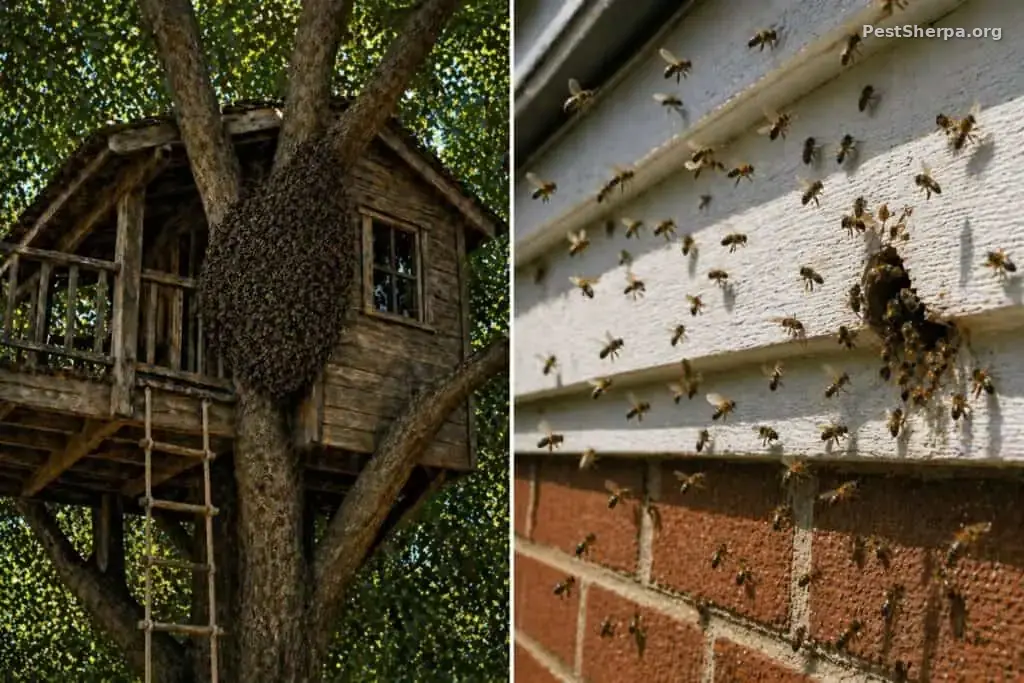
A hanging swarm is often temporary; repeated flight into the same structural gap points more toward an established colony.
What confirms the ID
- A somewhat fuzzy bee rather than a smooth, wasp-like insect
- Pollen carried on hind legs by workers
- A temporary exposed cluster of many bees during swarming, or repeated flight to a single structural entry point if a colony is established
- Wax comb and honey if a structural colony is opened during removal
What commonly misleads homeowners
- Bumblebees: more rounded and densely fuzzy, usually with smaller annual colonies. See bumblebees
- Carpenter bees: large bees with a shiny, mostly hairless black abdomen that bore round holes into wood. See carpenter bees
- Yellowjackets: smoother, brighter yellow-and-black wasps with a narrow “wasp waist” and no pollen baskets. See yellowjackets
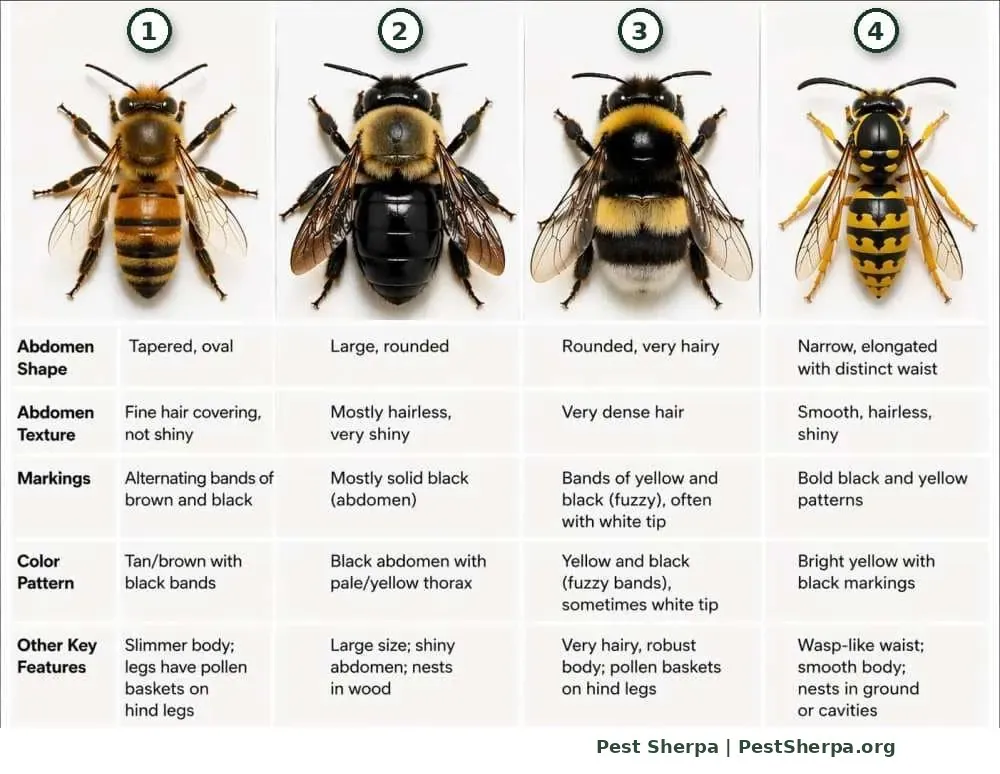
Which one do you see? Match the number:
- Honey bee: smaller and banded: tapered oval abdomen with fine hair, alternating brown and black bands, pollen baskets on the hind legs.
- Carpenter bee: large and shiny black: large rounded, mostly hairless abdomen with a pale yellow thorax. Nests in wood.
- Bumblebee: fuzzy and rounded: very dense hair with yellow and black bands, often a white tip, pollen baskets on the hind legs.
- Yellowjacket: sleek and smooth: narrow abdomen with a distinct waist and bold yellow and black patterns. Nests in the ground or cavities.
Honey bees are commonly confused with bumblebees, carpenter bees, and yellowjackets.
Important reality check: not every mass of bees requires immediate treatment. A swarm resting on a branch or wall is often temporary. A long-term stream of bees using the same opening in a building is a different situation and deserves faster action.
Why It Matters
For most homeowners, honey bees are a mixed concern:
- Beneficial pollinator: they are not “bad bugs” in the usual sense and are important to agriculture and landscapes.
- Sting risk: most honey bees are defensive rather than randomly aggressive, but colonies near doors, play areas, patios, or walkways can become a safety issue.
- Structural cleanup issue: they do not eat wood like termites or excavate galleries like carpenter bees, but colonies in wall voids can leave behind honey, wax, dead bees, and staining if not removed properly.
- Health concern for some people: anyone with a sting allergy raises the urgency level.
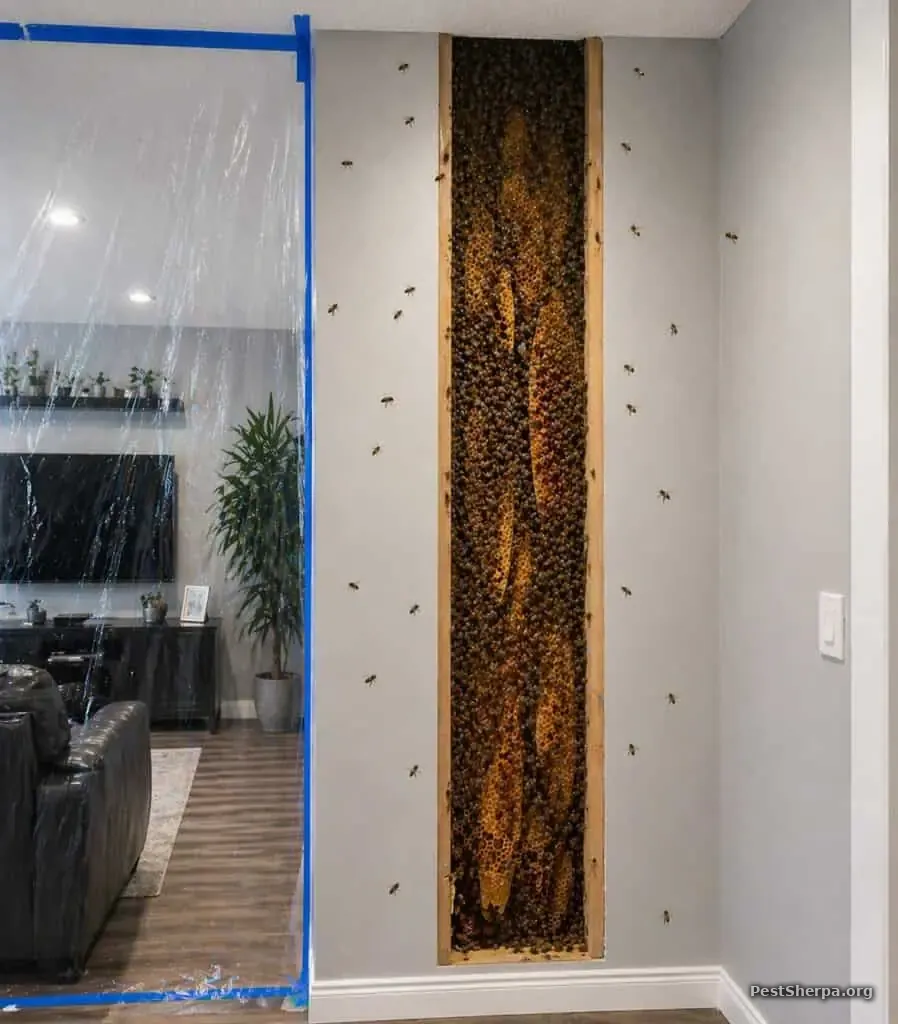
Structural colonies can leave behind comb, honey, staining, and secondary pest issues if removal is incomplete.
The biggest homeowner mistake is treating honey bees like a standard nuisance wasp problem. With bees in a structure, the issue is often not just the insects. It is the comb, honey, residue, and re-entry risk left behind if the job is done halfway.
Regional note: in some parts of the South and Southwest, Africanized honey bee concerns make behavior more important than appearance. Visual ID alone is not reliable for separating Africanized and European honey bees, so unusually defensive colonies deserve extra caution.
What To Do
1. First decide: swarm or established colony?
- Likely swarm: a hanging cluster on a branch, shrub, fence, or wall with no obvious wax nest yet. These are often temporary.
- Likely established colony: repeated traffic into the same gap in siding, soffit, roofline, chimney, vent area, or wall void over time.
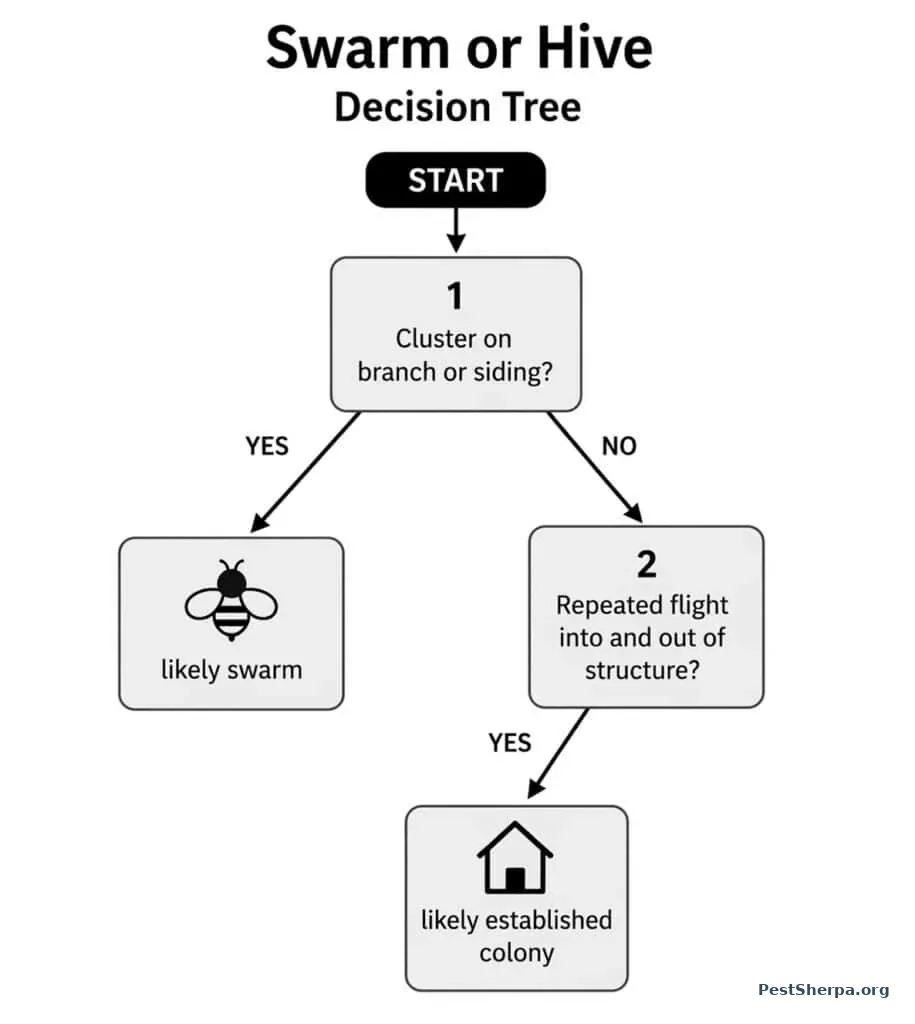
The first decision for your next step is whether you are seeing a temporary swarm or a colony established in the structure.
2. Keep distance and reduce disturbance
- Keep children, pets, and foot traffic away from the area.
- Do not throw water, hit the cluster, or use a hose to knock bees down.
- Do not block the entry point if bees are already living inside a void.
3. Do not seal an active entry hole too early
Sealing a wall or soffit gap while bees, wax, and honey are still inside can make the problem worse. Bees may try to find another way out into the living space, and abandoned comb and honey can later leak, stain, ferment, or attract other pests.
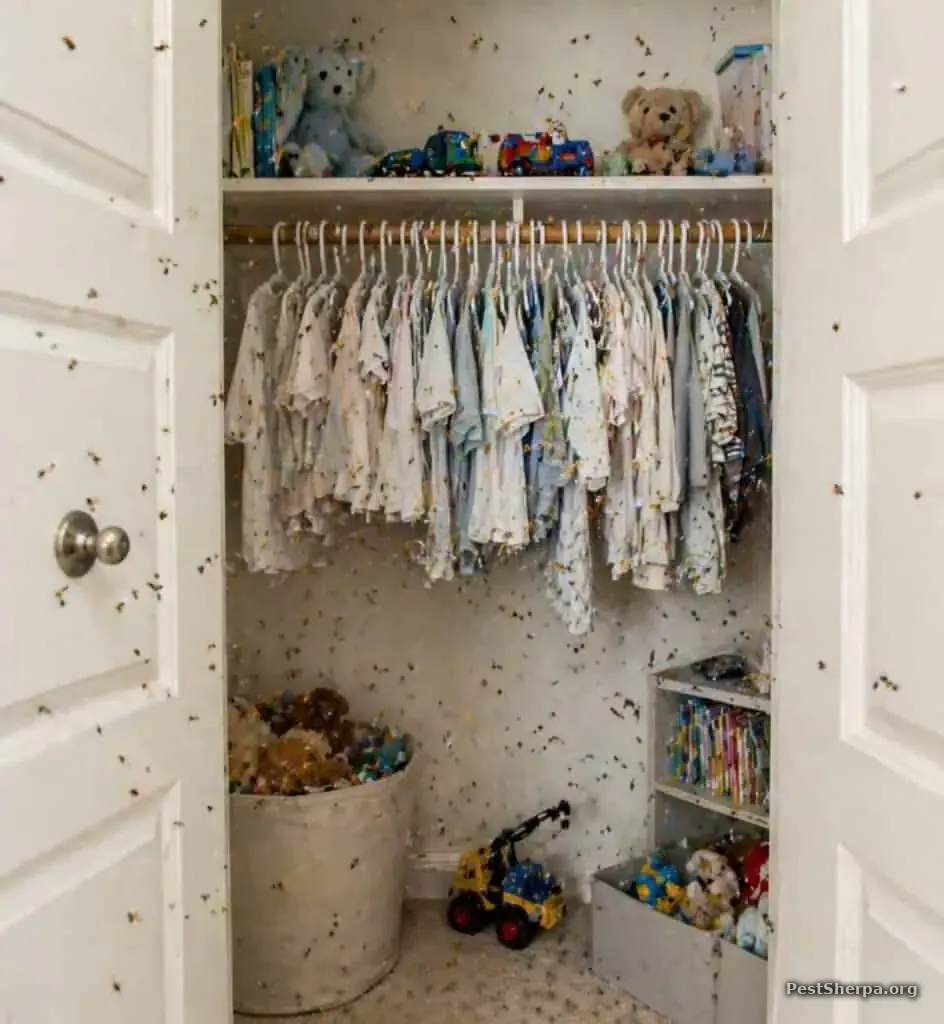
Unhappy consequence of sealing entrance to hive from outside too soon: bees forced to find exit and found a route into a child’s closet. Sealing an active entry hole too early can trap bees, leave comb behind, and make the situation worse.
4. Do not assume a spray solves the real problem
Broad spraying is often wasted effort with honey bees in structures. Even if adult bees are killed, the remaining comb and honey can still create odor, staining, seepage, and secondary pest problems. The right solution often includes removal of the colony materials and repair of the entry point.
5. Correct the conditions that allowed nesting
- Repair gaps around soffits, fascia, vents, roof intersections, chimneys, and siding joints
- Screen or repair openings where practical and code-appropriate
- Address recurring structural void access after removal is complete
- Inspect nearby exterior cavities that could attract future swarms
6. Know what is often wasted effort
- Treating a swarm as if it were already a permanent hive
- Sealing an active bee entry before cleanup
- Relying on one visible surface treatment when the comb is hidden inside the structure
- Guessing at the insect instead of comparing it against bumblebees, carpenter bees, and yellowjackets
When To Call a Pro
Call an experienced professional promptly when:
- Bees are entering and exiting the same structural gap
- The colony appears to be in a wall, attic, chimney, soffit, eave, or roofline
- Anyone nearby has a history of severe sting reactions
- Bee activity is near doors, windows, walkways, play areas, or pet areas
- The bees seem unusually defensive or pursue people farther than expected
- You are not sure whether you are dealing with honey bees, bumblebees, carpenter bees, or yellowjackets
- A previous attempt left bee activity, comb, honey leakage, odor, or staining behind
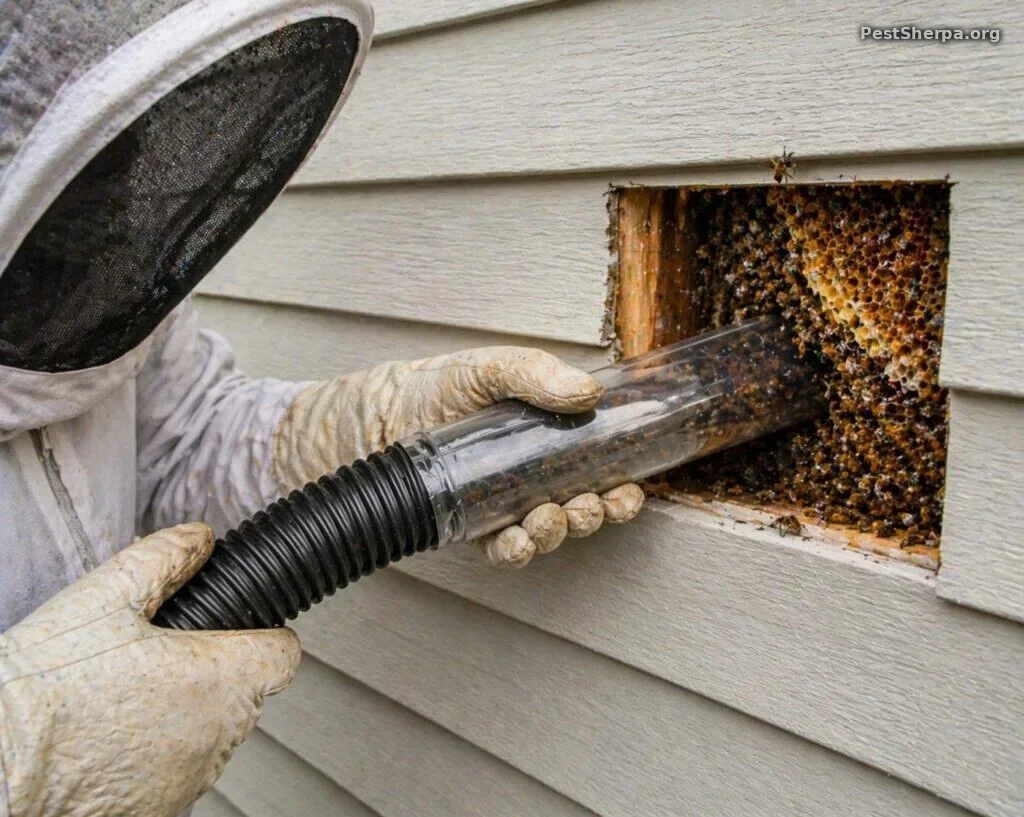
Structural honey bee work often requires safe access, full removal of colony materials including honey, and exclusion repairs afterward.
For many homeowners, the right escalation path is not generic “pest control.” It is someone experienced with bee removal, structural access, cleanup, and exclusion. If you are unsure how serious the situation is, use Ask the Sherpa or compare your insect with related guides in the Pest Guides hub. Your pest control company can work with a bee expert or hobbyist (apiarist) who will remove bees safely and move them to a new home. Some areas are reluctant to move bees due to a mite affecting bees which might infect other hives. The best approach after your pest control company evaluates the situation is to contact either a local apiary society or you county or university extension who might be able to put you in touch with a local beekeeper. Only as a last resort should bees be destroyed.
Similar Pests / Misidentification Comparison
Honey bees vs. bumblebees
- Honey bees: slimmer, more uniformly brown/golden, large perennial colonies, often cavity-nesting
- Bumblebees: rounder, fuzzier, often black and yellow with a heavier look, usually smaller annual colonies
Related guide: Bumblebees: Biology, Identification & Professional Management
Honey bees vs. carpenter bees
- Honey bees: hairy, social, gather pollen, build wax comb
- Carpenter bees: shiny black abdomen, solitary nesting behavior, round holes in exposed wood
Related guide: Carpenter Bees: How to Identify Them, When They Matter, and What Actually Helps
Honey bees vs. yellowjackets
- Honey bees: fuzzier body, pollen baskets, usually less sleek and wasp-like
- Yellowjackets: smoother body, brighter yellow-and-black pattern, narrow waist, more scavenging around trash and food
Related guide: Yellowjackets: Identification, Biology, Habits, and Professional Control
References
Key points in this guide are supported by the following live sources:
- NC State Extension: Frequently Asked Questions About Removing Honey Bees From Structures
- Iowa State University Extension: What to Do When You See a Honey Bee Swarm
- Mississippi State University Extension: Prevention and Treatment of Nuisance Honey Bees Around Your Home
- Utah State University Extension: Africanized Honey Bees
- UF/IFAS: Differences Between European and African Honey Bees
- Purdue Extension: Stinging Insects and Medical Risk
- University of Maine Cooperative Extension: Understanding Native Bees
This article was written by Greg Baumann, founder of Pest Sherpa, and reflects more than 40 years of professional pest management experience.
About the Author

Greg Baumann | Pest Control Expert
Greg Baumann is the founder of Pest Sherpa and a Pest Control Expert with more than 40 years of professional pest management experience. His articles combine decades of field experience, technical expertise, and science-based guidance to help homeowners identify pests correctly, understand real-world risks, and make informed pest management decisions.
Mission: Identify the pest. Understand the risk. Stop the problem. Prevent the comeback. Know when it’s time to call a professional.