
Yellowjackets: Identification, Nests, Sting Risk, and What To Do
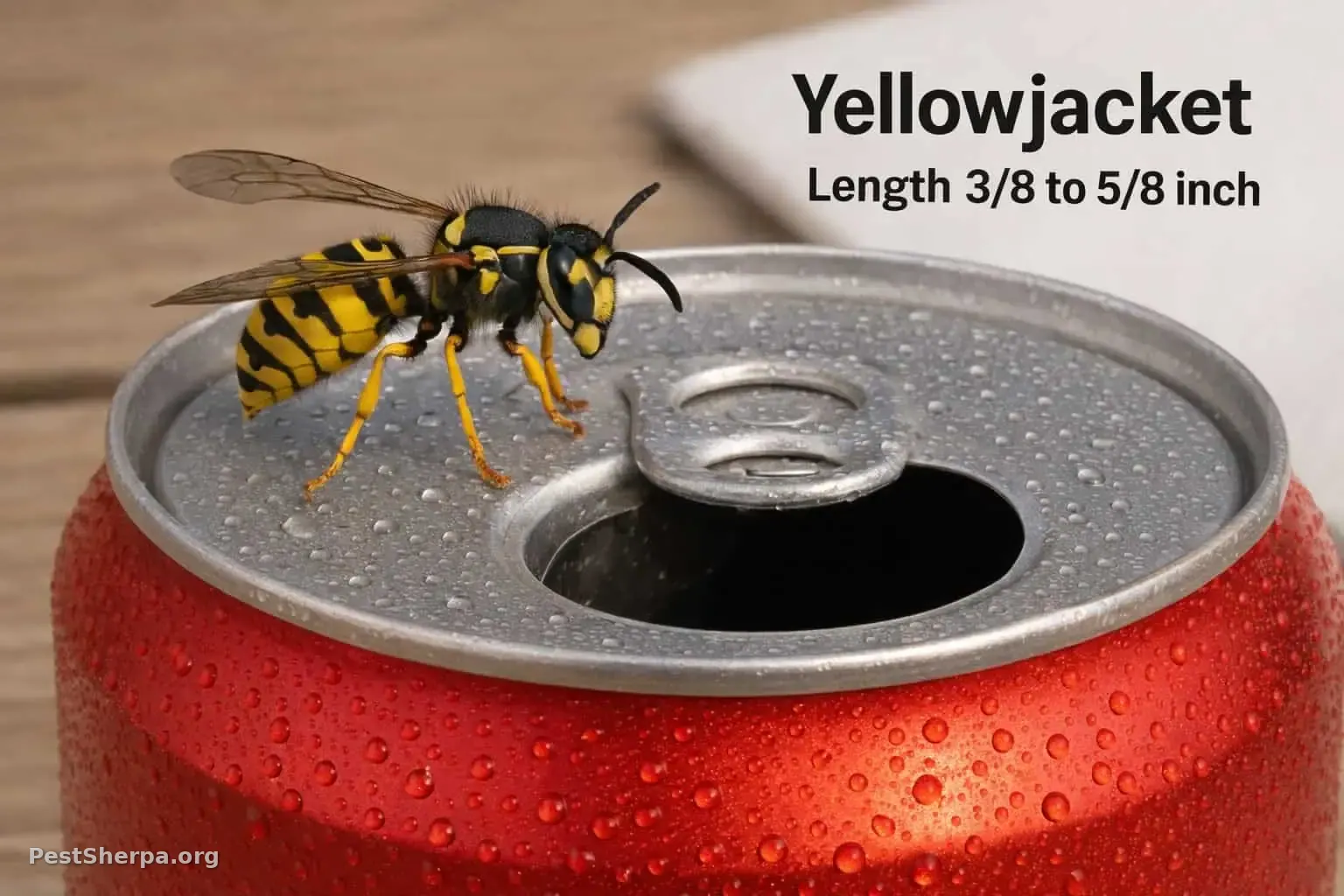
Yellowjackets are social wasps that occur throughout much of North America. They help control other insects, but they can become a serious nuisance when colonies develop near doors, patios, lawns, playgrounds, trash areas, decks, sheds, wall voids, or other places people regularly use.
Most yellowjacket issues in temperate regions are seasonal. Activity often becomes more noticeable from mid-summer into fall as colonies grow larger and workers search for protein, sweets, garbage, fallen fruit, and other food sources. A few foraging wasps around a picnic table do not always mean there is a nest on the property, but steady traffic to and from the same hole, crack, shrub, or building void is a stronger warning sign.
This guide explains yellowjacket identification, nesting behavior, sting risk, source investigation, prevention, and safer next steps so you can decide whether the situation can be monitored, corrected with sanitation and exclusion, or should be evaluated by a trained pest management professional.
TL;DR
Yellowjackets are smooth social wasps that may nest underground, in cavities, in structural voids, or, depending on species, in aerial paper nests in shrubs, trees, or on buildings. They are frequently confused with honey bees, bumble bees, paper wasps, bald-faced hornets, and cicada killer wasps.
The biggest concern is usually the nest, not a single wasp. Yellowjackets can defend a colony vigorously and can sting more than once. Do not poke, flood, burn, seal, or spray into an active nest opening without understanding the risk.
Foraging yellowjackets can often be reduced by sealing trash, removing fallen fruit, cleaning outdoor eating areas, and limiting sweet or protein-rich food sources. An active nest near people, pets, children, allergic individuals, or building interiors may require professional evaluation.
Quick Navigation
- What Yellowjackets Mean Around Your Home
- Yellowjacket Identification
- Yellowjackets vs Bees, Paper Wasps, Hornets, and Lookalikes
- Nesting Habits and Common Nest Locations
- Life Cycle and Seasonal Activity
- Why Yellowjackets Are Attracted to People, Food, and Trash
- Nest Defense and Sting Risk
- Yellowjacket Source Investigation Checklist
- What To Do If You Find Yellowjackets
- What Not To Do
- Prevention Steps
- How Long Yellowjacket Problems Last
- When Professional Help May Be Needed
- Frequently Asked Questions
- References
What Yellowjackets Mean Around Your Home
Yellowjackets around a home can mean several different things. The meaning depends on how many you see, where they are active, and whether they are flying in a repeated pattern.
| What You See | What It May Mean | Suggested Next Step |
|---|---|---|
| One yellowjacket outdoors | Normal foraging activity | Monitor and reduce food attractants |
| Several wasps around food or trash | Foraging from a nearby colony | Seal trash, clean food residue, cover drinks and food |
| Steady traffic into a ground hole | Likely underground nest | Avoid the area and mark it from a distance |
| Wasps entering a wall gap, soffit, or attic opening | Possible structural void nest | Do not seal the opening while activity is present |
| Wasps defending a shrub, log, railroad tie, or landscape feature | Possible hidden nest or entrance nearby | Stop mowing or trimming nearby until assessed |
| Indoor yellowjackets near windows or lights | Possible entry from a wall void, attic, chimney, or open door | Look for a repeated entry point and avoid disturbing it |
Key point: A yellowjacket problem is usually solved by locating the nest or reducing the food source that is attracting foragers. Spraying random flying wasps rarely solves the underlying issue.
Yellowjacket Identification: What Do They Look Like?
Yellowjackets are wasps in the family Vespidae. North American yellowjackets are primarily species in the genera Vespula and Dolichovespula. Several species occur in North America, including ground-nesting yellowjackets, German yellowjackets, aerial yellowjackets, and related black-and-white forms such as bald-faced hornets.
Worker yellowjackets are usually about 3/8 to 5/8 inch long, depending on species and caste. Queens are larger than workers. Color patterns vary, but most familiar yellowjackets have a smooth black-and-yellow body with crisp banding.
Common identification traits include:
- Smooth, shiny body with relatively little hair
- Bold yellow and black markings on the abdomen
- Compact body shape compared with many paper wasps
- Wings folded lengthwise over the body when resting
- Fast, direct flight around food, trash, lawns, shrubs, or nest entrances
- Repeated traffic into the same ground hole, crack, wall opening, shrub, or cavity when a nest is present
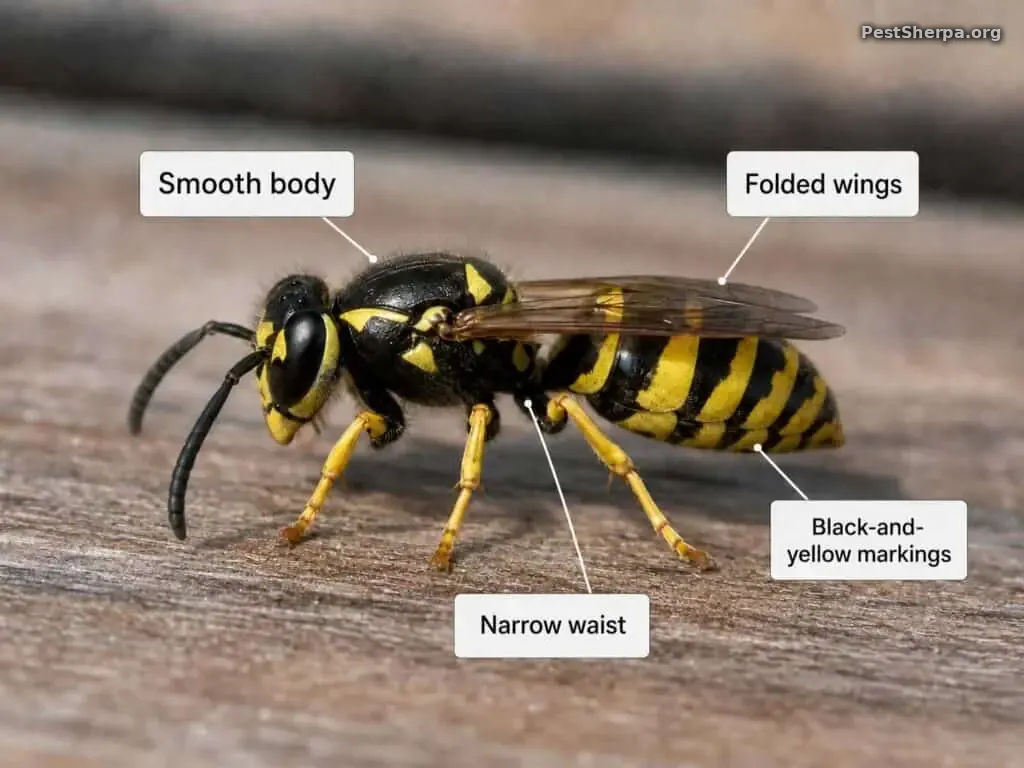
Yellowjacket identification showing smooth body, black and yellow bands, folded wings, and compact legs.
Yellowjackets vs Bees, Paper Wasps, Hornets, and Lookalikes
Yellowjackets are often mistaken for bees or other wasps. Correct identification matters because behavior, nesting sites, risk, and management choices can be different. For a broader comparison, see the bee and wasp identification guide.
| Insect | How It Differs From Yellowjackets | Common Nesting or Activity Clue |
|---|---|---|
| Honey Bees | Fuzzier, more golden-brown, often seen on flowers; workers usually do not have the same shiny wasp-like body | May nest in cavities; swarms may cluster temporarily |
| Bumblebees | Much hairier and heavier-bodied; often black and yellow but fuzzy rather than shiny | Often use old rodent burrows, grass, insulation, or sheltered cavities |
| Paper Wasps | Slender body with long legs that often hang below them in flight | Open, umbrella-like paper combs under eaves, railings, fixtures, or sheltered objects |
| Bald-Faced Hornets | Black-and-white social wasps; technically closely related to yellowjackets, despite the common name “hornet” | Large gray paper nests often in trees, shrubs, or on buildings |
| European Hornets | Larger than yellowjackets, with brownish-red and yellow markings | Often nest in hollow trees, wall voids, attics, or other cavities |
| Cicada Killer Wasps | Much larger solitary wasps; females can sting but they do not defend a large social colony like yellowjackets. | Burrows in dry, bare, or sandy soil |
| Carpenter Bees | Robust bees, often with a shiny black abdomen and fuzzy thorax | Round holes in wood, hovering males, and coarse sawdust-like frass |
Common confusion: Ground-nesting yellowjackets are sometimes called “ground bees,” but they are wasps, not bees. If the insects are smooth, black-and-yellow, defensive around a ground hole, and coming and going quickly, yellowjackets are more likely than bees.
Yellowjacket Nesting Habits and Common Nest Locations
Yellowjackets build nests from chewed wood fibers mixed with saliva, creating a gray or tan paper-like material. The nest contains layers of brood cells surrounded by a protective envelope. Depending on species and available cavities, nests may be underground, above ground, or inside structures.
Underground Nests
Many yellowjacket problems involve nests hidden in the ground. These nests may use existing cavities rather than starting from an open exposed surface.
- Abandoned rodent burrows
- Holes in lawns or turf
- Voids beneath landscape timbers or rocks
- Root cavities near trees or shrubs
- Rotted logs, stumps, or soil pockets in wooded edges
The entrance may look like a small hole with wasps flying in and out. The nest itself may not be visible.
Above-Ground and Structural Nests
Some yellowjackets, especially Dolichovespula species, build aerial nests in shrubs, trees, or on structures, while other species use enclosed cavities such as walls, attics, hollow trees, or soffits. in protected voids. Possible sites include:
- Wall voids
- Attics and soffits
- Crawlspaces
- Hollow porch columns or railings
- Sheds, barns, garages, or storage buildings
- Dense shrubs or hedges
- Tree cavities, logs, or branches
Important: If yellowjackets are entering a wall, soffit, or attic opening, do not seal the opening while the colony is active. Trapped wasps may move deeper into the structure and can sometimes emerge indoors.
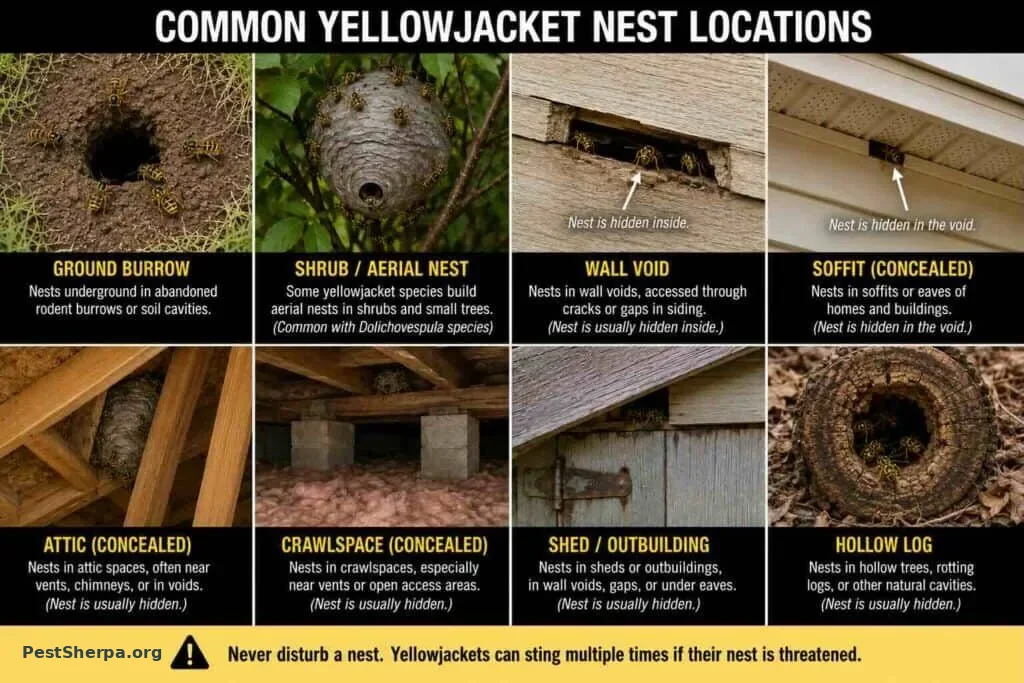
Common yellowjacket nest locations around a home including ground holes, shrubs, wall voids, soffits, attics, and logs.”
Life Cycle and Seasonal Activity
Yellowjackets are social insects. A typical seasonal colony includes a queen, female workers, developing larvae, and reproductive males and queens produced later in the season.
In many temperate areas, only fertilized queens survive winter. In spring, a queen starts a small nest, lays eggs, and feeds the first larvae. After the first workers mature, they take over foraging, nest expansion, larval feeding, and colony defense while the queen focuses on egg laying.
Colonies grow through summer. By late summer and fall, there may be hundreds or thousands of workers, depending on species, weather, food availability, and region. This is often when people notice more yellowjackets at trash cans, outdoor meals, fruit trees, patios, and lawns.
Late in the season, colonies produce new queens and males. After mating, the new queens seek protected overwintering sites. In colder areas, the old colony usually dies as temperatures decline. In warmer regions, unusual or perennial colony survival may occur, so regional conditions matter.
| Season | What Is Happening | What Homeowners May Notice |
|---|---|---|
| Spring | Queens start small nests | Occasional wasps, small early nests, low worker numbers |
| Early summer | Workers begin expanding the colony | More foraging and repeated traffic near nest sites |
| Late summer | Colony size increases | More activity around food, garbage, lawns, and outdoor gatherings |
| Fall | Reproductives are produced; worker behavior may be more noticeable | Increased scavenging, nuisance activity, and nest-defense encounters |
| Winter | Most seasonal colonies die in colder regions; queens overwinter | Inactive old nests in many regions, though local climate can change outcomes |
Why Yellowjackets Are Attracted to People, Food, and Trash
Yellowjackets are both predators and scavengers. Workers hunt other insects for protein to feed developing larvae, but they also scavenge human food and garbage. Adult workers often seek sugary liquids for energy.
Common attractants include:
- Open trash cans and dumpsters
- Food residue on outdoor tables, grills, counters, and patios
- Meat scraps, fish, pet food, and other protein sources
- Soda, juice, sports drinks, beer cans, and sweet beverages
- Fallen fruit under trees
- Compost with food scraps
- Outdoor events, picnic areas, schoolyards, parks, and food service areas
Late-season yellowjacket activity around people often reflects food searching, not necessarily a nest directly under the table. However, if the same wasps are repeatedly flying to one hole, crack, shrub, or wall opening, a nest is more likely.
Nest Defense and Sting Risk
Yellowjackets can sting when disturbed, and colonies can respond defensively if a nest is threatened. Unlike honey bees, yellowjackets do not lose the stinger after one sting, so a single worker can sting more than once.
The highest-risk situations usually involve accidental nest disturbance, such as mowing over a ground nest, trimming a shrub with a hidden nest, moving a log or landscape timber, opening a wall void, or trying to treat a nest at close range.
Most stings cause localized pain, redness, itching, or swelling. Some people can have severe allergic reactions. Seek emergency medical help right away for signs such as trouble breathing, throat or tongue swelling, dizziness, fainting, widespread hives, chest tightness, or other symptoms of a serious allergic reaction.
Children, pets, older adults, workers, people with known sting allergies, and anyone who may not be able to leave the area quickly need extra caution around active nests.
Yellowjacket Source Investigation Checklist
Use this checklist from a safe distance. Do not stand over a suspected nest opening, block the opening, or shine a bright light directly into an active entrance at close range.
Step 1: Watch Flight Patterns
Stand back and look for wasps flying along the same route. A repeated “in-and-out” pattern is more important than random foraging.
Step 2: Check Ground-Level Areas
Look for traffic around lawn holes, rodent burrows, tree roots, landscape timbers, railroad ties, stone borders, mulch beds, and rotted logs.
Step 3: Check Structural Openings
Look for yellowjackets entering gaps around soffits, fascia, siding, vents, attic openings, porch columns, wall penetrations, utility lines, and crawlspace openings.
Step 4: Check Shrubs and Dense Vegetation
A hidden nest may be inside a hedge, shrub, vine-covered fence, or low branch. Avoid trimming vegetation if wasps are repeatedly entering it.
Step 5: Look for Food Sources
If yellowjackets are mainly around people, patios, or trash, inspect for open garbage, fallen fruit, food residue, pet food, compost, and beverage containers.
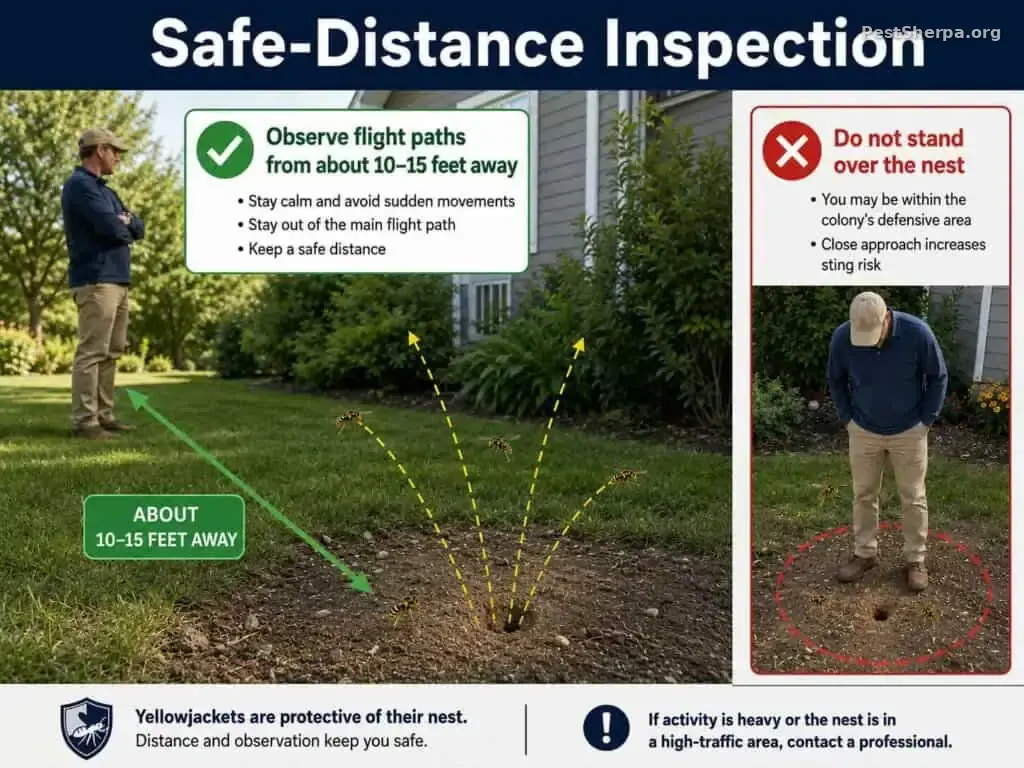
Safe yellowjacket nest inspection from a distance by watching repeated flight paths.
What To Do If You Find Yellowjackets
The right response depends on whether you are seeing foragers or an active nest.
If Yellowjackets Are Foraging Around Food or Trash
- Keep trash and recycling containers tightly closed.
- Rinse sticky cans and bottles before placing them in bins.
- Cover food and drinks outdoors.
- Use clear cups or lids so wasps are not hidden inside drink containers.
- Remove fallen fruit promptly.
- Clean grills, outdoor counters, and picnic tables after use.
- Move trash containers away from doors, patios, and play areas when practical.
If You Find a Nest Away From People
If the nest is far from people, pets, entrances, play areas, and work areas, it may be possible to leave it alone and avoid the area until the colony naturally declines. This depends on region, season, and risk tolerance.
If You Find a Nest Near Human Activity
If the nest is near a door, walkway, patio, school area, business entrance, lawn that must be mowed, playground, pet area, or location used by someone with a sting allergy, avoid disturbing it and consider professional evaluation.
If Yellowjackets Are Entering a Wall or Attic
Do not seal the opening while wasps are active. Sealing can trap the colony and may force wasps into living areas. Note the entrance location from a distance and avoid tapping, drilling, cutting, or spraying into the void.
What Not To Do
Some common responses can make a yellowjacket problem more dangerous or harder to solve.
- Do not pour gasoline, kerosene, bleach, or other household chemicals into nests. This is dangerous, can contaminate soil or water, and is not a safe pest control method.
- Do not burn nests. Fire can spread, damage structures, and trigger defensive wasp activity.
- Do not flood nests without understanding the risk. Water may not reach the colony and can cause wasps to leave aggressively.
- Do not seal a wall, soffit, or ground opening while wasps are using it. This can redirect activity into unintended areas.
- Do not swat at individual wasps near food. Move calmly, cover food, and remove attractants instead.
- Do not rely on random spraying of flying wasps. Killing a few workers does not remove the colony.
- Do not use foggers or indoor aerosol products for hidden wall nests. Misuse can create exposure risks and may not reach the nest.
If any pesticide is used, read and follow the product label exactly. Keep people, pets, food, dishes, toys, and water sources away from treated areas as directed by the label. Avoid off-label use, mixing products, or applying pesticides into vents, drains, food areas, or occupied voids unless the label specifically allows that use.
Prevention Steps for Homeowners
Prevention focuses on reducing food sources and limiting access to nesting voids before colonies are present. It will not instantly eliminate an established nest, but it can reduce foraging pressure and future nesting opportunities.
- Keep garbage and recycling lids closed tightly.
- Clean food residue from outdoor tables, grills, counters, and trash areas.
- Remove fallen fruit from lawns, patios, sidewalks, and garden beds.
- Keep compost managed and avoid exposed meat, dairy, or oily food scraps.
- Repair torn screens and door sweeps.
- Seal gaps around siding, soffits, fascia, utility penetrations, and vents when no active colony is present.
- Fill abandoned rodent burrows and soil voids when they are not occupied by wasps or other wildlife.
- Inspect playground equipment, sheds, porch railings, and outdoor storage areas before peak yellowjacket season.
- Use caution when mowing, trimming, or moving landscape materials in late summer and fall.
How Long Yellowjacket Problems Last
How long activity lasts depends on whether you are dealing with foragers, an active seasonal nest, or a structural nest.
| Situation | Typical Pattern |
|---|---|
| Foragers attracted to trash or food | Activity may drop quickly after food sources are removed |
| Small early-season nest | Activity may increase as workers mature unless the nest is addressed or avoided |
| Large late-season nest | Activity may remain high until weather, food availability, or nest management changes |
| Old inactive nest in many cold-winter areas | Often not reused the next year, though the structure may still contain old paper material |
| Warm-region or protected structural nest | Local climate and nest protection may affect survival and duration |
If activity is declining with cold weather and the nest is far from people, waiting may be reasonable in some regions. If activity is near people or indoors, waiting may not be appropriate.
When Professional Help May Be Needed
Yellowjacket nests can be difficult and risky to handle because the nest may be hidden underground, inside a wall void, in a ceiling, or deep in vegetation. Professional help may be worth considering when the chance of disturbance or stings is high.
Consider professional evaluation when:
- The nest is near a door, walkway, patio, deck, playground, school area, or pet area.
- Someone nearby has a known sting allergy or a history of severe reactions.
- Yellowjackets are entering a wall, soffit, attic, crawlspace, or other structural void.
- Wasps are emerging indoors.
- The nest entrance is hard to see, hard to reach, or located where escape would be difficult.
- Mowing, landscaping, maintenance, or repairs must occur near the nest.
- Previous attempts did not reduce activity.
- The property is a food-handling, healthcare, school, rental, or commercial setting where risk management requirements may be different.
A trained pest management professional can help confirm the insect, locate the entrance, assess risk, and choose a targeted approach that fits the site and label requirements.
Frequently Asked Questions
Does one yellowjacket mean there is a nest on my house?
No. One yellowjacket may simply be foraging. Repeated traffic into the same hole, crack, shrub, or wall opening is a stronger sign that a nest is nearby.
Why are yellowjackets worse in late summer and fall?
Colonies are often larger later in the season, and workers spend more time searching for food. That is why yellowjackets may become more noticeable around trash, outdoor meals, fruit trees, and beverage containers.
Are yellowjackets bees?
No. Yellowjackets are wasps. They are smoother and less hairy than bees and are more likely to scavenge meat, sweets, and garbage around human activity.
Can yellowjackets sting more than once?
Yes. Yellowjackets can sting multiple times because they do not lose the stinger the way honey bees typically do.
Should I plug the hole where yellowjackets are entering?
No, not while the nest is active. Blocking an active opening can redirect wasps, especially when the nest is in a wall, attic, soffit, or crawlspace. Wait until the colony is inactive or have the situation evaluated.
Do yellowjackets reuse the same nest next year?
In many colder regions, old social wasp nests are not reused after the seasonal colony dies. However, regional climate, species, and protected nesting sites can affect outcomes, so persistent or warm-region activity should be assessed locally.
Will traps solve a yellowjacket nest?
Traps may reduce some foraging workers, but they do not always eliminate the colony. They are most useful as part of a broader approach that includes sanitation, locating nest entrances, and reducing attractants.
What should I do if someone is stung?
Move away from the nest area to avoid more stings. Monitor for severe allergic symptoms such as trouble breathing, throat swelling, dizziness, fainting, or widespread hives. Seek emergency medical help right away if a serious reaction is suspected.
References
- Cornell Integrated Pest Management: Yellowjackets and Baldfaced Hornets
- University of Maryland Extension: Social Wasps: Yellowjackets, Hornets, and Paper Wasps
- North Carolina State Extension: Yellowjackets in the Landscape
- North Carolina State Extension: Non-Honey Bee Stinging Insects in North Carolina
- University of Minnesota Extension: Wasps and Bees
- University of California Agriculture and Natural Resources IPM: Yellowjackets and Other Social Wasps
- University of Kentucky Entomology: Yard Wasps
- CDC/NIOSH: Insects and Scorpions at Work
This article was written by Greg Baumann, founder of Pest Sherpa, and reflects more than 40 years of professional pest management experience.
About the Author

Greg Baumann | Pest Control Expert
Greg Baumann is the founder of Pest Sherpa and a Pest Control Expert with more than 40 years of professional pest management experience. His articles combine decades of field experience, technical expertise, and science-based guidance to help homeowners identify pests correctly, understand real-world risks, and make informed pest management decisions.
Mission: Identify the pest. Understand the risk. Stop the problem. Prevent the comeback. Know when it’s time to call a professional.