
European Hornets: Identification, Nests, Risks, and What To Do
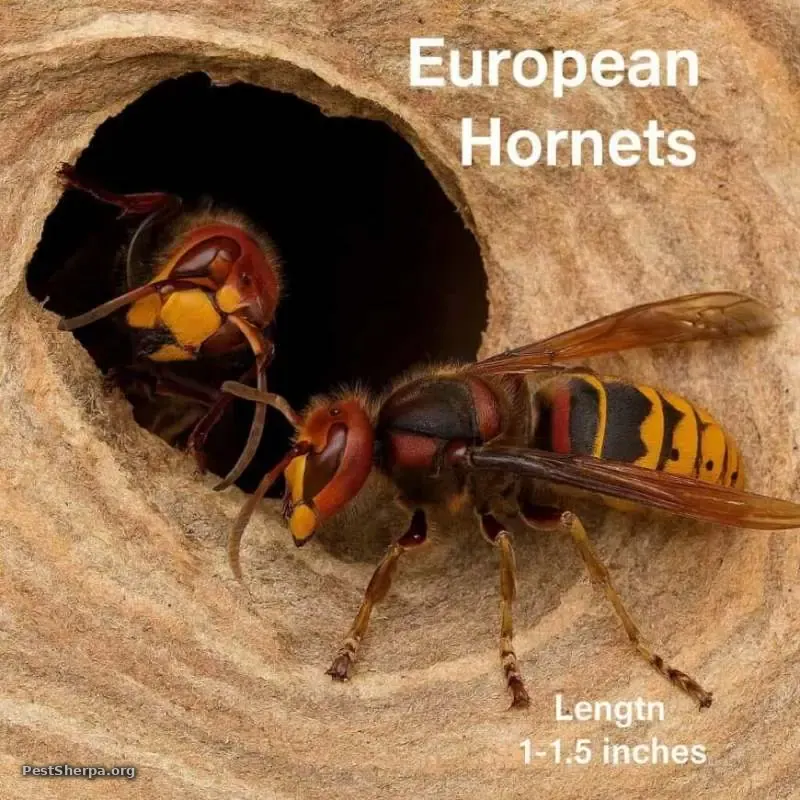
The European hornet (Vespa crabro) is a large social wasp that often alarms homeowners because of its size, loud flight, nighttime activity, and tendency to nest in hidden spaces. This guide explains how to identify European hornets, what their activity usually means, how to compare them with similar wasps and hornets, what to avoid, and when a hidden nest may require careful evaluation.
Important: European hornets can sting, and nests should not be disturbed. Most problems happen when people accidentally get too close to a nest in a wall void, attic, hollow tree, shed, soffit, or other protected space.
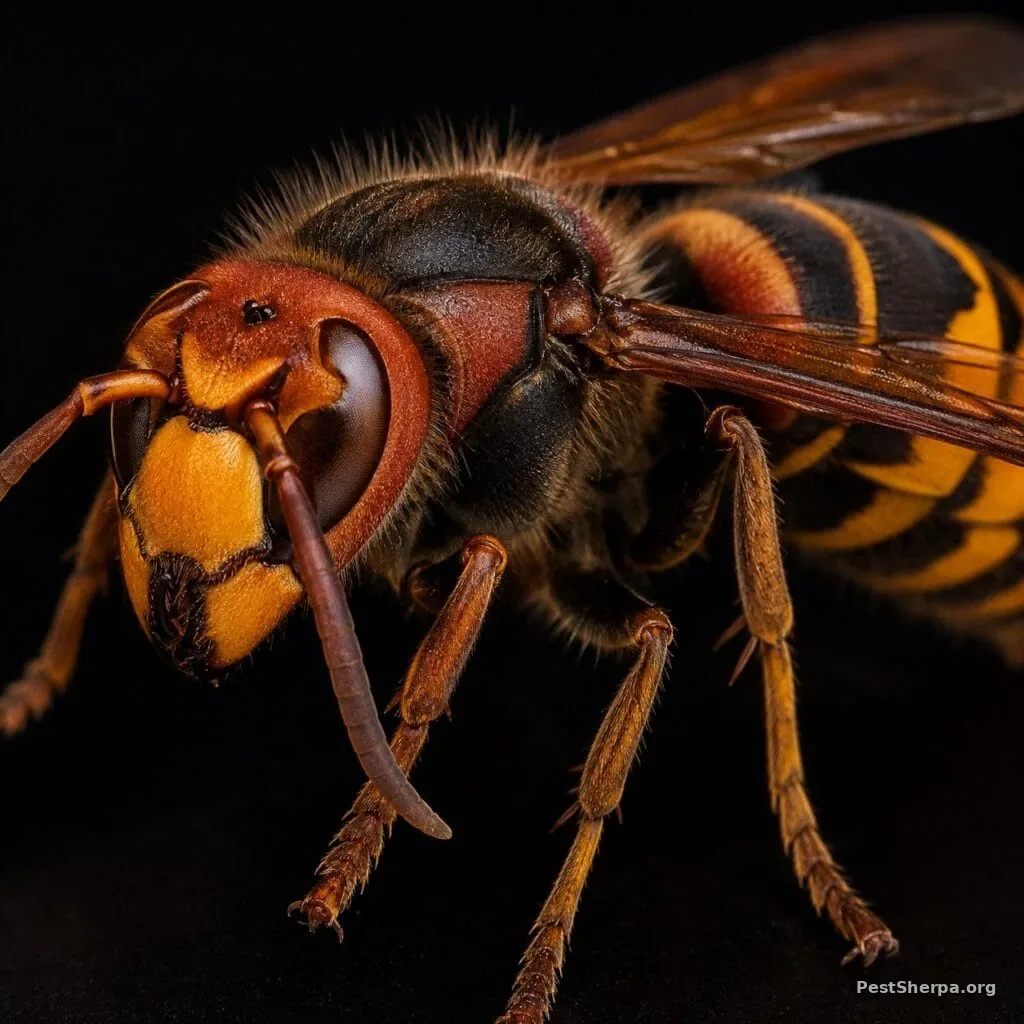
European hornet adult showing reddish-brown thorax, yellow face, and yellow-brown abdomen.
TL;DR
European hornets are large yellow-and-brown social wasps that usually nest in protected cavities such as hollow trees, attics, wall voids, sheds, barns, and soffits. They are not usually aggressive while foraging away from the nest, but they can defend a colony if the nest is disturbed.
Nighttime activity around lights, repeated hornet traffic into one opening, buzzing inside a wall, or hornets entering living areas can suggest a nest nearby. Avoid sealing entry holes while hornets are active because that can redirect them indoors. Keep people and pets away from the flight path, reduce nearby lighting when practical, and use caution around hidden nest sites.
Quick Navigation
- Identification
- Quick ID Table
- What European Hornet Activity Means
- Where European Hornets Nest
- Life Cycle and Seasonal Behavior
- Why European Hornets Fly at Night
- Bark Stripping and Tree Damage
- Sting Risk and Safety
- What To Do
- What Not To Do
- Prevention and Long-Term Management
- Lookalikes and Common Misidentifications
- Frequently Asked Questions
- References
Description and Identification
The European hornet (Vespa crabro) is the largest established social wasp commonly encountered in much of eastern North America. It is native to Europe and parts of Asia and was introduced into North America in the 1800s. In the United States, it is most often associated with wooded residential areas, older trees, outbuildings, and structures with protected voids.
Adult European hornets are large, robust wasps. Workers are commonly around 1 inch long, while queens can be larger. Their most useful identifying features are a reddish-brown head and thorax, yellow face, amber-tinted wings, and a yellow abdomen with brown or black markings.
European hornets are often mistaken for yellowjackets, bald-faced hornets, cicada killer wasps, or invasive hornets mentioned in news reports. Size alone is not enough for identification. Focus on the reddish-brown thorax, yellow face, heavy body shape, nighttime activity, and the habit of nesting in enclosed cavities.
For a broader comparison of stinging insects, see the bee and wasp identification guide.
Quick ID Table
| Feature | European Hornet | Why It Matters |
|---|---|---|
| Body size | Large, bulky social wasp | Often larger than yellowjackets, but size alone is not enough |
| Color | Reddish-brown thorax, yellow face, yellow-brown abdomen | Helps separate it from black-and-white bald-faced hornets |
| Wings | Often amber or lightly tinted | Useful close-range visual clue from a safe distance or photo |
| Activity | Can fly at night and is attracted to lights | Nighttime window or porch-light activity is a strong clue |
| Nesting | Usually in hollow trees, wall voids, attics, sheds, barns, soffits, or other protected cavities | Hidden nests can be difficult to locate safely |
| Temperament | Usually not aggressive away from the nest, but defensive near the colony | Sting risk increases when the nest is disturbed |
Expert Insight: A large wasp at a porch light at night is not automatically a sign of an infestation, but repeated activity at the same exterior gap, soffit, attic vent, or tree cavity deserves closer observation from a safe distance.
What European Hornet Activity Means Around a Home
European hornets can be seen foraging for insects, tree sap, ripe fruit, and other sugary materials. A single hornet outdoors may simply be hunting or feeding. A steady stream of hornets moving in and out of the same opening is more meaningful because it may indicate a nest entrance.
| What You See | What It May Mean | Best Next Step |
|---|---|---|
| One hornet outdoors | Foraging or attracted to light | Observe from a distance; do not swat near food or people |
| Several hornets at porch lights | Light attraction, especially in warm months | Reduce unnecessary lighting and check for repeated entry points |
| Hornets entering one hole or gap | Possible nest entrance | Keep away and monitor from a safe distance |
| Buzzing inside a wall or ceiling | Possible hidden nest in a void | Avoid drilling, banging, sealing, or opening the void |
| Hornets appearing indoors repeatedly | Possible interior access from a void or exterior opening | Close interior doors, use caution, and investigate the source carefully |
| Bark stripped from shrubs or small branches | Hornets may be collecting sap or wood fibers | Check nearby trees, shrubs, and structures for hornet activity |
Where European Hornets Nest
European hornets build paper-like nests by chewing weathered wood fibers and mixing them with saliva. Unlike bald-faced hornets, which commonly build visible aerial paper nests, European hornets usually choose enclosed or protected locations.
- Hollow trees
- Tree cavities and large landscape voids
- Wall voids
- Attics
- Soffits and roofline gaps
- Barns, sheds, and outbuildings
- Occasionally other protected cavities around structures
Because the nest may be hidden, homeowners often notice hornets before they see the nest itself. Common clues include repeated traffic at one opening, nighttime hornets around a specific wall or window, or buzzing from a ceiling or wall void.
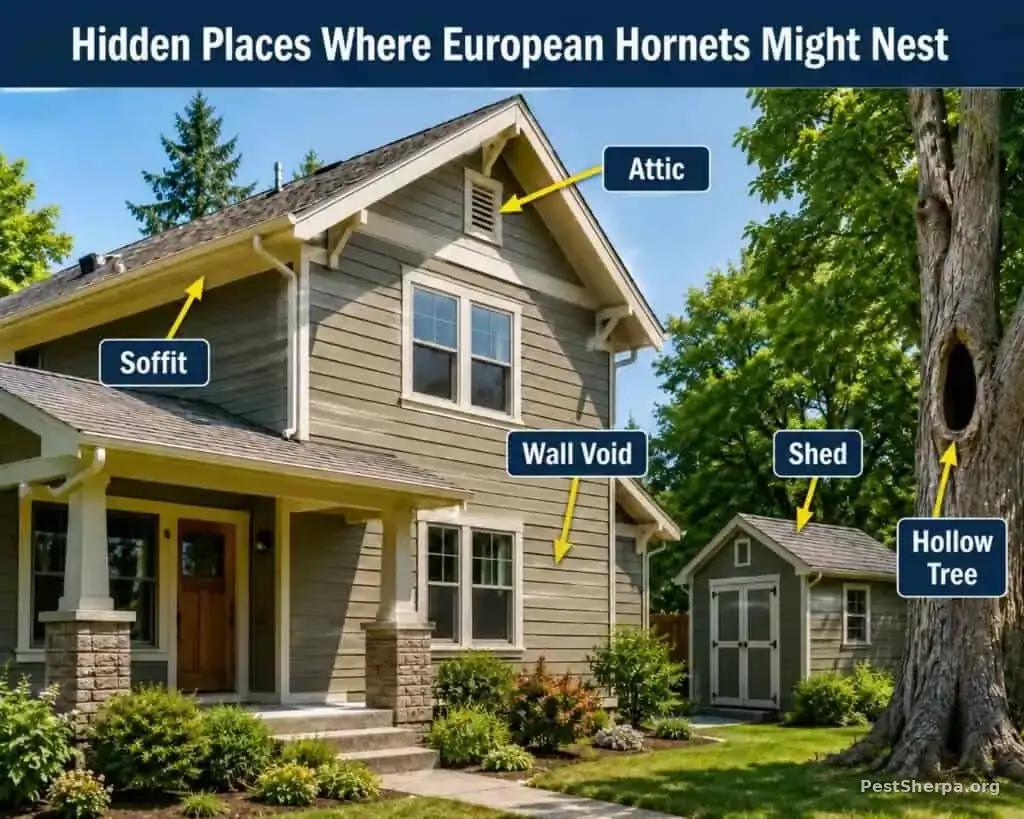
Diagram of common European hornet nest locations around a home.
Life Cycle and Seasonal Behavior
The European hornet life cycle follows a seasonal pattern. Fertilized queens overwinter in protected places and emerge in spring. A queen selects a nest site, begins a small paper nest, lays eggs, and cares for the first larvae until the first workers mature.
Once workers are present, they take over foraging, nest expansion, and larval care. The queen then focuses on egg-laying. Colonies grow through summer and are usually most noticeable in late summer and early fall when worker numbers are highest.
In late summer or fall, the colony produces males and new queens. After mating, fertilized new queens look for sheltered overwintering sites. The original colony declines as cold weather arrives, and the old nest is abandoned. European hornet nests are not reused the next year, although the same structure or tree may remain attractive if entry points or cavities are still available.
| Season | Typical Activity | What Homeowners May Notice |
|---|---|---|
| Spring | Queens emerge and start nests | Occasional large hornets exploring cavities |
| Early summer | First workers develop | Low to moderate activity near a nest site |
| Late summer | Colony grows rapidly | More hornets, stronger flight paths, more nighttime sightings |
| Fall | New queens and males are produced; old colony declines | Peak concern near established nests; activity fades with cold weather |
| Winter | Old colony is inactive; fertilized queens overwinter separately | Old nests are abandoned, but structural gaps may remain |
Why European Hornets Fly at Night
European hornets are unusual among common social wasps because they may remain active after dark. They are attracted to lights on porches, windows, garages, and other exterior areas. This can make them seem more aggressive than they are, especially when they repeatedly strike lighted glass or hover near doors.
When hornets gather at lights, the light is usually an attractant rather than the nest itself. However, if many hornets repeatedly approach the same soffit, attic vent, wall opening, or roofline gap, look for a consistent flight path from a safe distance during daylight.
- Turn off unnecessary exterior lights near the activity area when safe and practical.
- Keep windows and doors closed near active hornet traffic.
- Repair torn screens after activity is resolved.
- Avoid standing directly under lights where hornets are flying.
Bark Stripping and Tree Damage
European hornets may strip bark from small branches or shrubs. This behavior can be connected to sap feeding and gathering wood fibers for nest construction. Damage is often noticed on lilac, birch, ash, and other landscape plants, although plant associations can vary by region.
Bark stripping does not always mean a nest is in the plant being damaged. Hornets may travel from a nearby nest to collect sap or fiber. If bark damage is found, check nearby hollow trees, soffits, sheds, and other protected cavities for repeated hornet traffic from a safe distance.
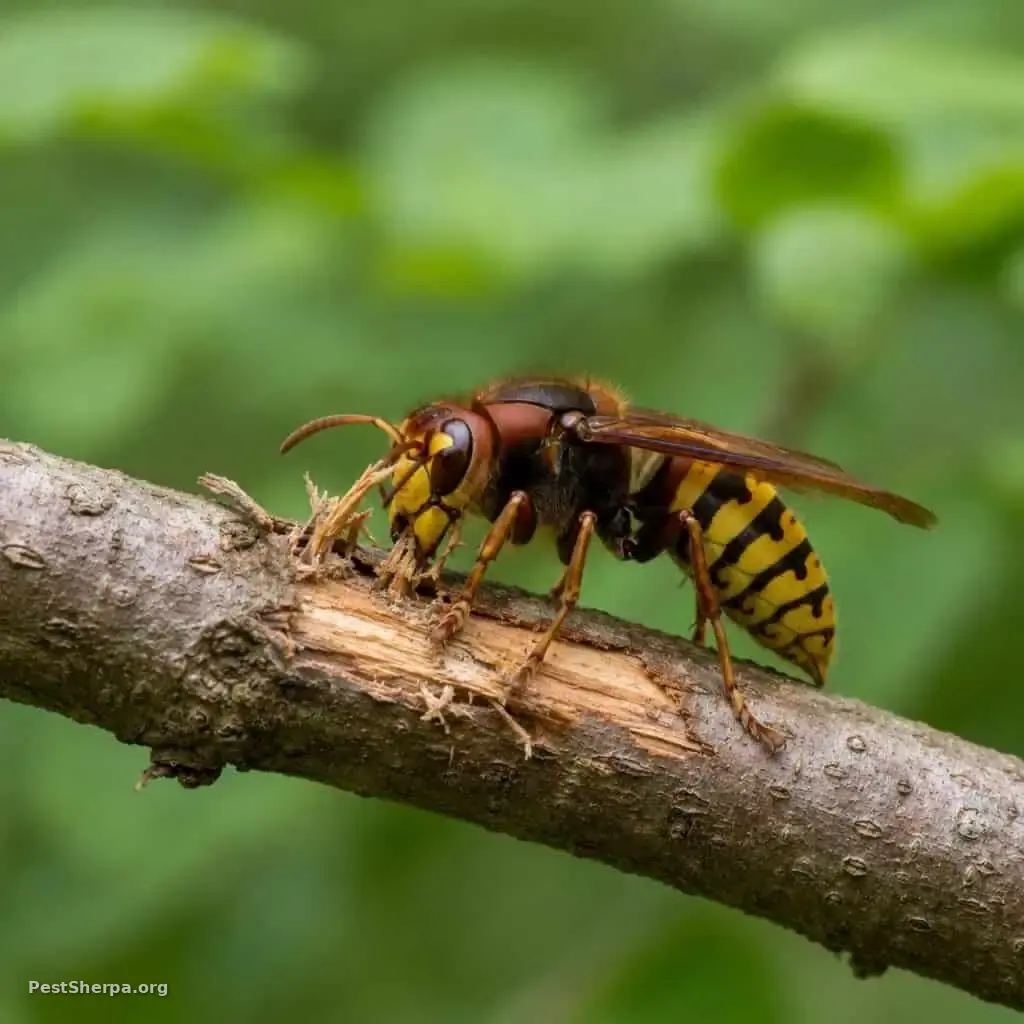
European hornet seek small branches to strip bark to build nest and to feed
Sting Risk and Safety
European hornets can sting and can sting more than once. Stings are painful, and people with venom allergies or unusual reactions should seek medical guidance promptly. Multiple stings, stings in the mouth or throat, breathing difficulty, swelling away from the sting site, dizziness, or other systemic symptoms should be treated as urgent medical concerns.
European hornets are usually less likely to sting when they are away from the nest and simply foraging. Risk increases when the nest is disturbed, when people mow or trim near a hidden nest, when a wall void is opened, or when an active entry hole is blocked.
Keep children, pets, and bystanders away from known flight paths. Do not throw objects at nests, spray randomly into wall openings, or attempt to remove a nest from a ladder without proper training and protective equipment.
What To Do If You Suspect European Hornets
1. Confirm the Identification
Use size, coloration, body shape, and behavior together. European hornets are large, reddish-brown and yellow, and commonly nest in enclosed cavities. If the insect is black and white, compare it with bald-faced hornets. If it is a very large solitary wasp flying low over lawns in summer, compare it with cicada killer wasps.
2. Look for the Flight Path From a Safe Distance
Do not stand close to the suspected nest entrance. Instead, watch from a safe distance during daylight and look for repeated hornet movement into one gap, crack, tree cavity, attic vent, soffit, or outbuilding.
3. Reduce Avoidable Attractants
- Turn off unnecessary exterior lights near the activity area at night.
- Clean up fallen fruit where hornets are feeding.
- Keep trash containers closed.
- Avoid leaving sugary drinks, fruit, or food scraps outdoors.
- Keep people and pets away from the flight path.
4. Use Caution With Indoor Hornets
If a hornet gets indoors, isolate the room when possible, keep people and pets away, and avoid swatting with bare hands. A single indoor hornet may have entered through a door or window. Repeated indoor hornets, especially near the same wall or window, may indicate a hidden route from a nest void.
5. Consider Professional Help When the Nest Is Hidden or Close to People
Professional help may be worth considering when hornets are entering a wall void, attic, soffit, ceiling, high roofline, hollow tree near activity areas, or any place where people could be stung during inspection or repair. Hidden nests are easy to disturb accidentally, and sealing or opening the wrong area can make the problem worse.
What Not To Do
- Do not seal an active entry hole while hornets are still using it.
- Do not drill into, cut into, or open a wall or ceiling where buzzing is heard.
- Do not spray blindly into electrical fixtures, vents, chimneys, or wall voids.
- Do not use indoor foggers or bug bombs as a substitute for locating the nest.
- Do not stand at the nest entrance to take close photos.
- Do not allow children or pets to play near a known flight path.
If any pesticide is used, read and follow the product label exactly. Avoid off-label applications, protect children and pets, keep pesticides away from food-contact surfaces, and use extra caution around vents, drains, electrical openings, and indoor air spaces.
Prevention and Long-Term Management
Prevention focuses on reducing nesting opportunities and limiting attractants. Because European hornets prefer protected cavities, routine exterior maintenance can reduce the chance that queens find suitable nesting sites in spring.
- Repair damaged soffits, fascia, siding, trim, and roofline gaps.
- Screen attic vents and other openings with appropriate pest-resistant materials.
- Keep shed and barn gaps repaired where practical.
- Remove fallen fruit and keep trash lids tight.
- Use exterior lighting only where needed, especially near known hornet activity.
- Monitor hollow trees and landscape cavities near patios, play areas, and walkways.
Do not seal openings during active hornet traffic. Structural exclusion is safest after the colony is inactive or after the nest issue has been resolved.
Lookalikes and Common Misidentifications
European hornets are commonly confused with several other large wasps and bees. Use the table below to narrow the comparison.
| Lookalike | How It Differs | Helpful Comparison |
|---|---|---|
| Yellowjackets | Usually smaller, sharper yellow-and-black pattern, often associated with ground nests or structural voids | European hornets are larger and more reddish-brown |
| Bald-faced hornets | Black with white markings; often build visible gray aerial nests | European hornets are yellow-brown and usually nest in protected cavities |
| Cicada killer wasps | Large solitary wasps that nest in soil and hunt cicadas | European hornets are social wasps with colony nests |
| Honey bees | Hairier, more compact, usually less wasp-like; important pollinators | European hornets are smoother, larger, and predatory wasps |
| Carpenter bees | Large bees with robust bodies, often seen hovering near wood | European hornets have a wasp waist and social nest behavior |
| Yellow-legged hornet | An invasive hornet of concern in limited areas; reporting guidance depends on state agriculture agencies | Do not assume every large hornet is invasive; compare markings and local reports |
| Northern giant hornet | Much larger; not broadly established in the eastern United States | European hornets are the common large true hornet in many eastern areas |
Note: If you suspect a regulated invasive hornet, follow your state agriculture department’s reporting instructions and avoid disturbing the insect or nest.
Frequently Asked Questions
Are European hornets aggressive?
They are usually not aggressive while foraging away from the nest, but they can defend a colony if the nest is disturbed. Hidden nests in walls, attics, hollow trees, and soffits create risk because people may get too close without realizing it.
Why are European hornets flying at my lights at night?
European hornets may remain active after dark and are attracted to artificial lights. If the activity is only at the light, the light may be the attractant. If hornets repeatedly enter a nearby gap, soffit, attic vent, or tree cavity, a nest may be nearby.
Does one European hornet mean there is a nest in my house?
No. One hornet may be foraging or may have been attracted by light. Repeated hornets entering the same opening, buzzing in a wall, or multiple hornets appearing indoors are stronger clues of a nest or hidden access route.
Should I seal the hole where hornets are entering?
Do not seal an active hornet entrance while the colony is still using it. Blocking the opening can trap hornets inside a wall or redirect them into living areas. Exclusion repairs are safer after the colony is inactive or after the nest issue has been resolved.
Do European hornets reuse the same nest?
The old colony declines when cold weather arrives, and the abandoned nest is not reused the next year. However, the same building gap, hollow tree, or protected cavity may remain attractive to future queens if it is not repaired or excluded.
Can European hornets damage trees?
They may strip bark from small branches to access sap or gather wood fibers. This can be noticeable on ornamental plants. Bark stripping does not always mean the nest is in that plant, so check nearby cavities and structures from a safe distance.
When is professional help worth considering?
Professional evaluation may be worth considering when the nest is hidden in a wall, attic, soffit, high roofline, hollow tree near people, or any location where inspection or treatment could trigger stings. It is also worth considering when hornets are entering living spaces or when the nest location is uncertain.
References
- Penn State Extension: European Hornet
- Virginia Cooperative Extension: European Hornet
- NC State Extension Publications: European Hornets
- Ohio State University Extension Ohioline: European Hornets and Look-Alikes
This article was written by Greg Baumann, founder of Pest Sherpa, and reflects more than 40 years of professional pest management experience.
About the Author

Greg Baumann | Pest Control Expert
Greg Baumann is the founder of Pest Sherpa and a Pest Control Expert with more than 40 years of professional pest management experience. His articles combine decades of field experience, technical expertise, and science-based guidance to help homeowners identify pests correctly, understand real-world risks, and make informed pest management decisions.
Mission: Identify the pest. Understand the risk. Stop the problem. Prevent the comeback. Know when it’s time to call a professional.