
Cicada Killer Wasps: Identification, Burrows, and Sting Risk
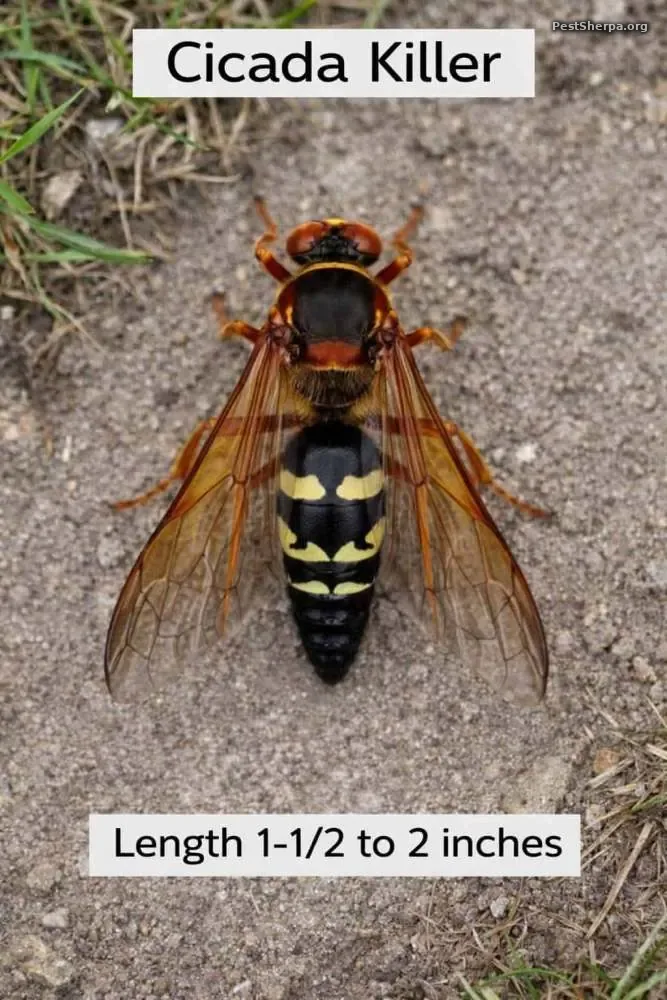
Cicada killer wasps (Sphecius speciosus) are large solitary wasps that often appear around lawns, gardens, sidewalks, sandy soil, and landscape beds in summer. Their size, loud flight, and yellow-and-black markings can be alarming, but cicada killers are not the same as yellowjackets or hornets. Most sightings are seasonal nuisance issues rather than a sign of a dangerous nest.
This guide will help you identify cicada killer wasps, understand what their burrows mean, compare them with common wasp lookalikes, assess sting risk, reduce nesting conditions, and decide when additional help may be worth considering.
TL;DR
Cicada killer wasps are large ground-nesting solitary wasps. Females dig burrows in loose, sunny, well-drained soil and provision those burrows with cicadas for their larvae. Males may fly aggressively around nesting areas, but males cannot sting. Females can sting, but they usually do so only when handled, stepped on, trapped in clothing, or directly disturbed.
Most cicada killer activity peaks in summer and fades naturally. The best long-term prevention is reducing bare, loose, sandy soil and maintaining dense turf or planted ground cover. Insecticides are often unnecessary and should only be considered carefully, especially around children, pets, pollinators, and play areas.
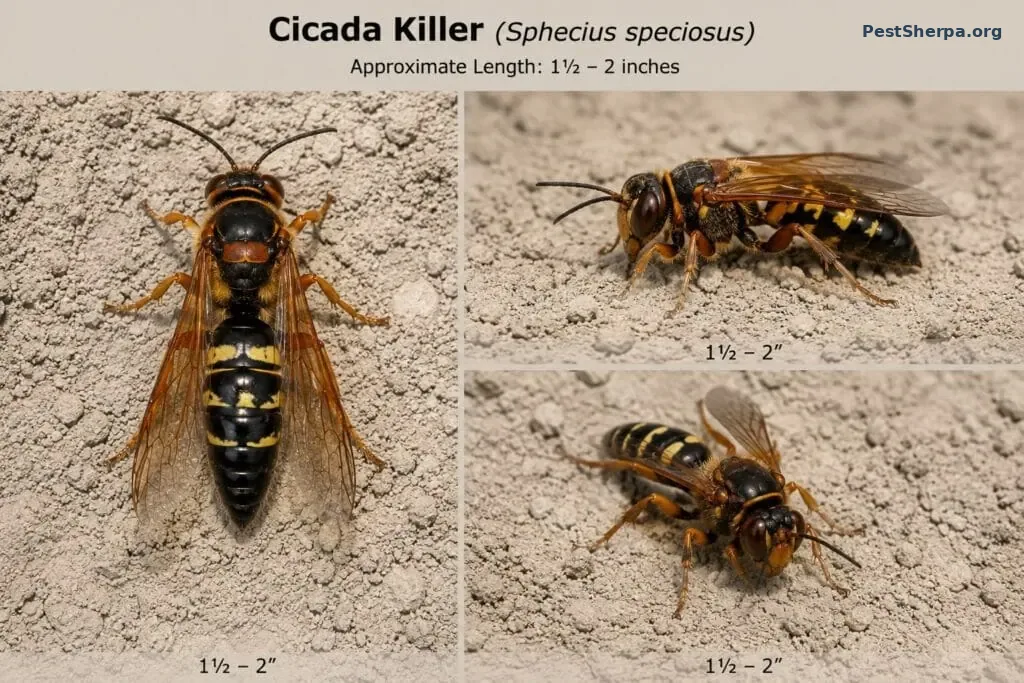
Adult cicada killer wasp on soil near a ground burrow.
Quick Navigation
- Quick Identification
- What Cicada Killers Mean in Your Yard
- Sting Risk and Behavior
- Where Cicada Killers Nest
- Life Cycle and Seasonal Activity
- Yard Investigation Checklist
- What To Do
- What Does Not Work Well
- Lookalikes and Misidentifications
- When Professional Help May Be Needed
- Frequently Asked Questions
- References
Quick Identification
Cicada killers are among the largest wasps many homeowners notice in North America. They are usually seen flying low over sunny lawns, hovering near bare soil, or entering a ground burrow with loose soil around the opening.
| Feature | What To Look For |
|---|---|
| Size | Large wasp, often about 1.5 to nearly 2 inches long |
| Color | Reddish-brown to dark head and thorax, black abdomen with yellow markings |
| Wings | Amber, orange, or smoky-looking wings |
| Behavior | Low hovering flight over soil, burrow digging, cicada hunting |
| Nest | Individual ground burrow with loose excavated soil near the entrance |
| Social structure | Solitary; many females may nest near each other, but they do not form a social colony |
Cicada killers belong to the order Hymenoptera, the same insect order that includes bees, ants, and wasps. Current taxonomic references commonly place Sphecius speciosus in the family Crabronidae, although older or alternative classifications may place some related groups differently. For general wasp comparison, see the Pest Sherpa bee and wasp guide.
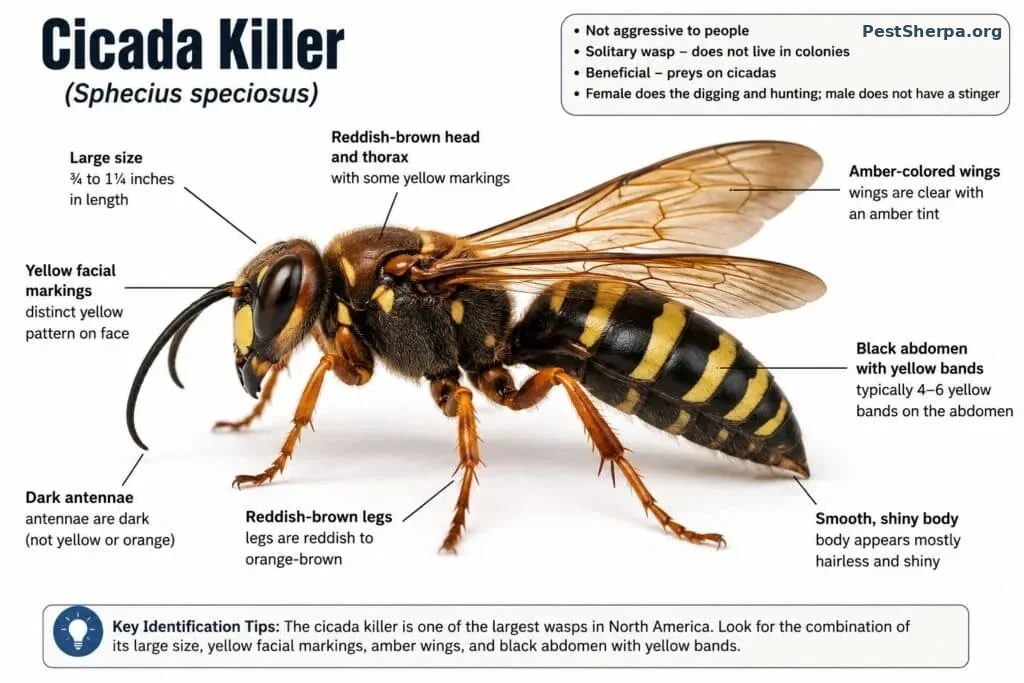
ICicada killer wasp identification features including yellow abdominal bands and amber wings.
What Cicada Killers Mean in Your Yard
Cicada killers usually mean your yard has a combination of cicadas, sunny exposure, and soil that is easy for females to dig. They do not eat wood, damage buildings, feed on turfgrass, or form a large defensive colony like many social wasps.
The adult wasps are the visible stage. The nesting conditions are usually the reason they keep returning to the same area.
| What You See | What It Usually Means |
|---|---|
| One large wasp flying over the lawn | Normal summer activity; may be a male patrolling or a female searching for a nest site |
| Several wasps in one sunny patch | Multiple females may be nesting in favorable soil |
| Loose soil mounds near holes | Females are excavating burrows |
| Wasps carrying cicadas | Females are provisioning larval chambers |
| Activity near a playground or walkway | Mostly a nuisance, but avoidance and habitat changes may be helpful |
Expert Insight: A cicada killer burrow is not the same as a yellowjacket nest. A yellowjacket nest may contain many defensive workers, while a cicada killer burrow belongs to a solitary female. If you are comparing stinging insects, review the yellowjacket guide before deciding how to respond.
Sting Risk and Behavior
Cicada killer wasps look intimidating, but their behavior is different from colony-defending wasps. Most people are approached by males, which may hover, patrol, or investigate movement near nesting areas. Males cannot sting.
Females can sting because they use a stinger to paralyze cicadas. However, female cicada killers are not usually defensive around burrows in the way yellowjackets, hornets, or paper wasps may be around a social nest. Stings are more likely if a female is handled, trapped, stepped on barefoot, or pressed against skin.
| Situation | Risk Level | Practical Response |
|---|---|---|
| Adult flying near lawn | Low | Observe from a distance and avoid swatting |
| Male patrolling near a burrow | Low | Remember that males cannot sting |
| Female entering or leaving burrow | Low to moderate | Do not handle, trap, or step directly on the wasp |
| Burrows in a sandbox or play area | Higher nuisance concern | Limit use temporarily and modify the habitat |
| Known severe sting allergy | Personal medical concern | Use extra caution and follow medical advice from a qualified clinician |
Where Cicada Killers Nest
Female cicada killers prefer areas where digging is easy. The most attractive sites are usually sunny, open, bare, sandy, or sparsely vegetated. A single yard may attract several females if the soil conditions are ideal.
- Thin or sparse turf
- Sandy soil patches
- Edges of sidewalks, driveways, patios, and retaining walls
- Landscape beds with exposed soil
- Sunny slopes or banks
- Playground sand, volleyball courts, and sandboxes
- Areas near cicada host trees
The loose mound at the entrance is excavated soil. Cicada killers do not create mud tubes, chew structural wood, or tunnel through buildings.
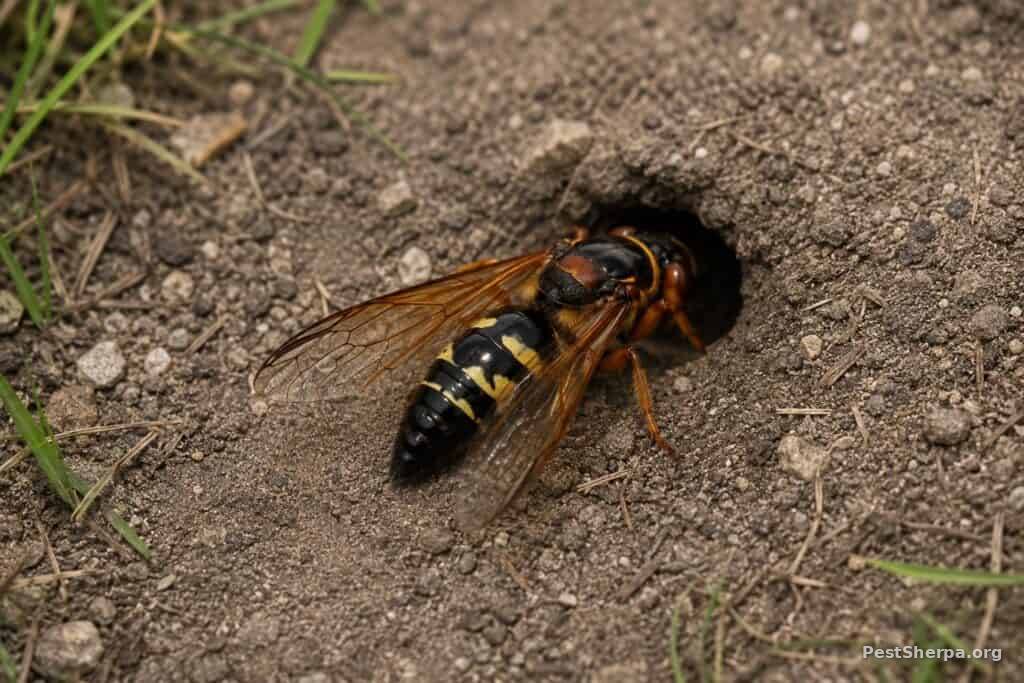
Cicada killer wasp burrow entrance with loose excavated soil in a sunny lawn.
Life Cycle and Seasonal Activity
Cicada killers have complete metamorphosis: egg, larva, pupa, and adult. Adult activity is usually concentrated in summer, commonly around June, July, and August depending on the region and weather.
Adult Emergence
Males often emerge first and begin patrolling areas where females are likely to nest. Their hovering and chasing behavior is mostly territorial and mating-related.
Nest Construction
After mating, females dig underground tunnels with side chambers. Each chamber is provisioned for one developing larva. The amount of loose soil around the entrance can make the activity look more dramatic than it is.
Cicada Hunting
Female cicada killers capture cicadas, sting them to immobilize them, and carry them back to the burrow. Because cicadas are heavy, a female may climb a tree, fence, shrub, or other object before gliding partway back toward the nest.
Larval Development
The female lays an egg on the cicada in the brood chamber. The larva feeds on the provisioned cicada, later forms a cocoon, and remains underground through the colder part of the year. In most areas, cicada killers have one generation per year.
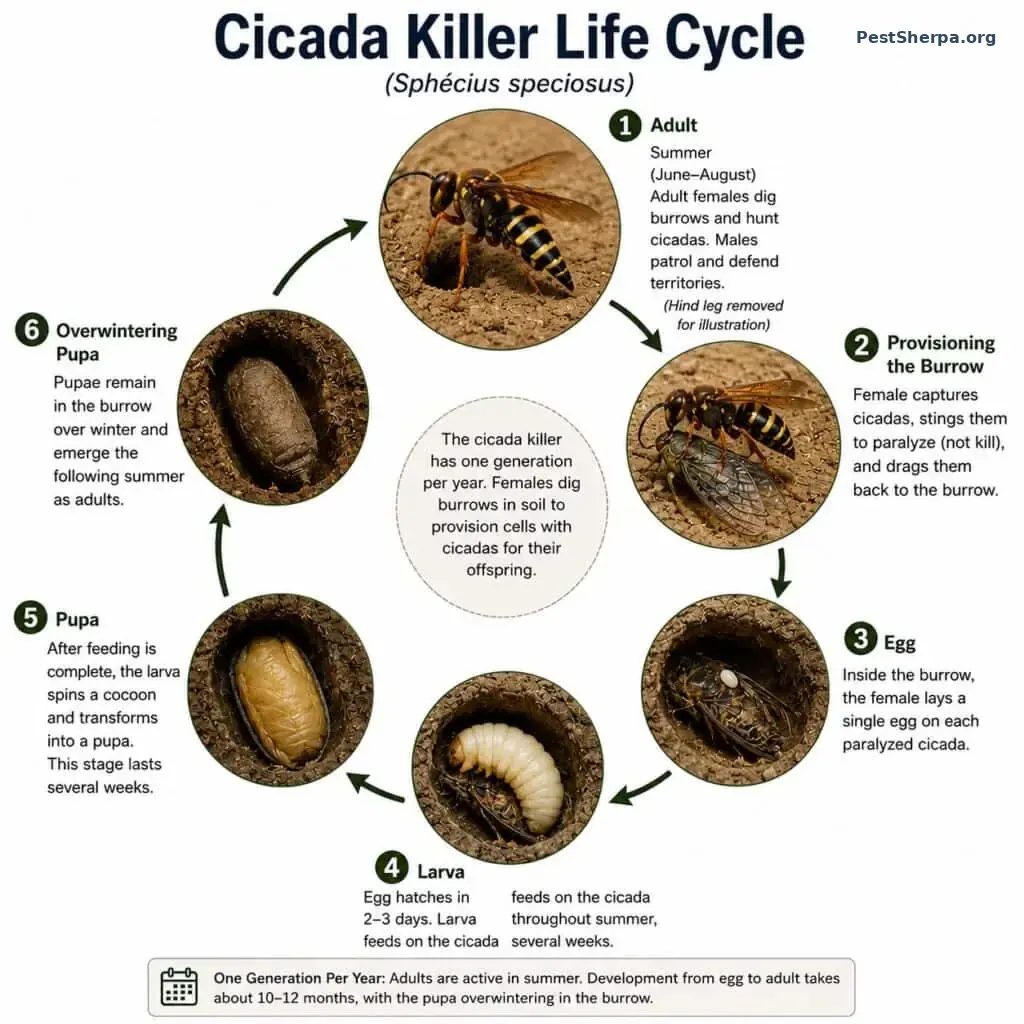
Cicada killer wasp life cycle from adult burrow digging to larval development underground.
Yard Investigation Checklist
Before taking action, inspect the site calmly. The goal is to confirm that the insect is a cicada killer and identify why that particular spot is attractive.
Step 1: Confirm the Insect
Look for a very large wasp with yellow abdominal markings, amber wings, and ground-focused flight. If the insect is smaller, repeatedly entering a single hole with many other wasps, or strongly defensive, consider yellowjackets or another social wasp instead.
Step 2: Find the Burrows
Look for openings in bare or thin turf with loose soil pushed out around the entrance. Do not place your hands near active holes.
Step 3: Map the Activity Area
Note whether burrows are in a low-use area, walkway edge, sandbox, patio border, playground, sports area, or high-traffic lawn. The location matters more than the wasps themselves.
Step 4: Identify Soil Conditions
Check for bare soil, sandy patches, poor turf density, dry soil, slope exposure, and sparse ground cover. These are the conditions that make repeat nesting more likely.
Step 5: Decide Whether Action Is Needed
Many yards can tolerate a few cicada killers for a few weeks. Action is more reasonable when burrows are in play areas, where people walk barefoot, where soil mounds interfere with use, or where identification is uncertain.
What To Do
1. Avoid Swatting and Disturbing Burrows
Swatting, stepping on wasps, flooding holes, or poking burrows can increase the chance of accidental contact. If the activity is in a low-use area, observation is often the safest choice.
2. Improve Turf Density
Dense turf makes soil harder for females to access. Overseeding, correcting bare patches, improving irrigation practices, and maintaining healthy grass can reduce attractive nesting habitat over time.
3. Cover Bare Soil
In landscape beds, use mulch, dense plantings, or ground cover to reduce exposed soil. In sandy recreational areas, frequent disturbance or temporary covering may discourage nesting, especially before the site becomes heavily active.
4. Manage High-Traffic Areas
If burrows are in a sandbox, play area, or barefoot traffic area, limit access temporarily, mark the area, and focus on habitat modification. Pesticide use where children play is generally a poor first choice.
5. Use Pesticides Cautiously, If At All
Pesticides are not always necessary for cicada killers. If a pesticide is considered, read and follow the label, use only products labeled for the site and pest situation, and keep children, pets, food items, pollinator-attractive blooms, and water sources in mind. Avoid off-label use, excessive spraying, and treatments in sandboxes or play areas unless the label specifically allows the use and the risk has been carefully considered.
What Does Not Work Well
- Swatting at hovering males: Males cannot sting, and swatting may lead to more panic than benefit.
- Spraying every large wasp in the yard: This does not correct the loose, sunny soil conditions attracting nesting females.
- Ignoring bare soil year after year: The same suitable areas may attract new females in future summers.
- Assuming every large wasp is a hornet: Cicada killers are solitary wasps, not hornets. Misidentification can lead to unnecessary concern or unsafe control attempts.
- Using pesticides in children’s play areas without careful label review: Habitat modification is usually a safer first step in sandboxes and playgrounds.
Lookalikes and Common Misidentifications
Cicada killers are often mistaken for hornets because they are large and boldly marked. Behavior is usually the easiest clue: cicada killers are ground-nesting solitary wasps that hunt cicadas, while many hornets and yellowjackets are social wasps that defend a colony.
| Lookalike | How It Differs | Helpful Link |
|---|---|---|
| Yellowjacket | Smaller social wasp; may defend a colony nest aggressively | Yellowjackets |
| European hornet | Large social hornet; different nesting behavior and colony structure | European hornets |
| Bald-faced hornet | Black-and-white social wasp that makes aerial paper nests | Bald-faced hornets |
| Carpenter bee | Large bee that often hovers near wood; males cannot sting | Carpenter bees |
| Other solitary wasps | May dig or use mud nests but usually hunt different prey | Bee and wasp guide |
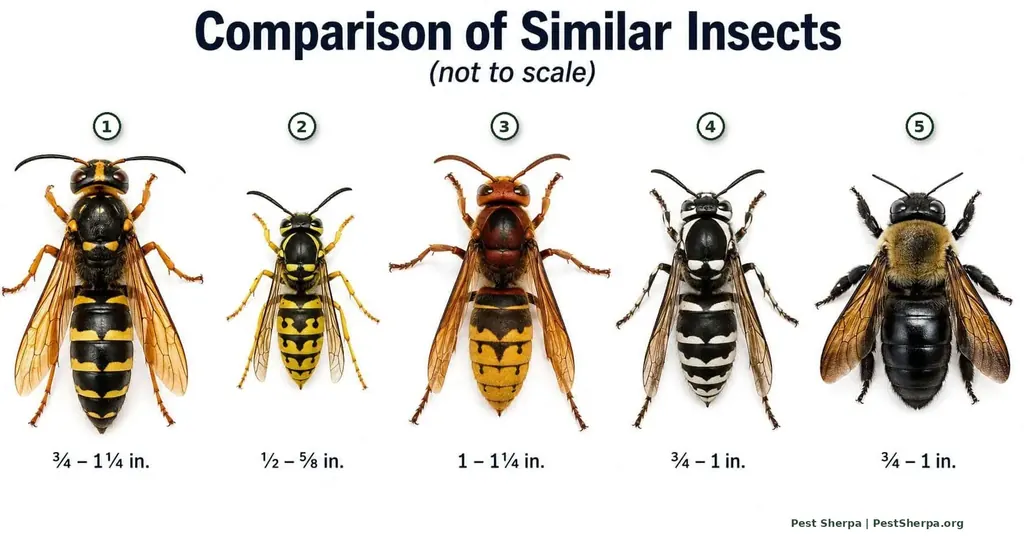
Which one do you see? Match the number:
- Cicada killer: 3/4 to 1 1/4 inches, large black and yellow wasp with amber wings.
- Yellowjacket: 1/2 to 5/8 inch, small, bright yellow and black.
- European hornet: 1 to 1 1/4 inches, reddish-brown head and thorax with a yellow and brown abdomen.
- Bald-faced hornet: 3/4 to 1 inch, black with white markings.
- Carpenter bee: 3/4 to 1 inch, robust, with a fuzzy yellow thorax and a shiny black abdomen.
Comparison of cicada killer wasp with yellowjacket, European hornet, bald-faced hornet, and carpenter bee.
When Professional Help May Be Needed
Most cicada killer situations can be handled with identification, avoidance, and habitat changes. Professional help may be worth considering when the insect identification is uncertain, activity is in a sensitive location, or someone in the household has a known serious sting allergy and the nesting area cannot be avoided.
- Large wasps are entering a wall void, attic, or structural gap instead of individual soil burrows
- Wasps are strongly defensive and multiple insects respond when the area is approached
- Burrows are concentrated in a school, daycare, playground, sports field, or public walkway
- Repeated annual nesting occurs in the same high-use area despite habitat changes
- You cannot confidently distinguish cicada killers from yellowjackets, hornets, or another stinging insect
Frequently Asked Questions
Are cicada killer wasps dangerous?
They can look dangerous because of their size, but they are usually a low-risk nuisance when left alone. Males cannot sting. Females can sting but are not usually defensive unless handled or directly disturbed.
Do cicada killers live in colonies?
No. They are solitary wasps. Many females may nest in the same favorable area, but each female digs and provisions her own burrow.
Why are cicada killers digging holes in my lawn?
Females dig burrows to create chambers for their young. Loose, sandy, sunny, sparsely vegetated soil is especially attractive.
Will cicada killers damage my house?
No. Cicada killers do not eat wood, damage structures, or nest inside wood. Their nuisance impact is usually loose soil around burrows in lawns or landscape beds.
Should I plug cicada killer holes?
Plugging individual holes usually does not correct the reason females chose the site. Long-term prevention works better when bare soil is covered, turf is thickened, or the site is made less suitable for digging.
Do cicada killers help the environment?
Yes. They are native predatory wasps that hunt cicadas and are part of the seasonal insect community. In low-use areas, they can often be left alone.
How long will cicada killers stay active?
Adult activity is seasonal and usually lasts for a limited summer window. Exact timing depends on region, weather, soil conditions, and cicada availability.
Are cicada killers the same as murder hornets?
No. Cicada killers are native solitary wasps. They are frequently confused with large hornets because of their size, but their biology and risk profile are different.
References
- University of Kentucky Entomology: Cicada Killer Wasps
- University of Maryland Extension: Cicada Killer Wasps
- University of Minnesota Extension: Wasps Are a Gardener’s Friend
- University of Minnesota Extension: Cicada Killer
- USDA APHIS Identification Technology Program: Sphecius speciosus
- GBIF: Sphecius speciosus (Drury, 1773)
This article was written by Greg Baumann, founder of Pest Sherpa, and reflects more than 40 years of professional pest management experience.
About the Author

Greg Baumann | Pest Control Expert
Greg Baumann is the founder of Pest Sherpa and a Pest Control Expert with more than 40 years of professional pest management experience. His articles combine decades of field experience, technical expertise, and science-based guidance to help homeowners identify pests correctly, understand real-world risks, and make informed pest management decisions.
Mission: Identify the pest. Understand the risk. Stop the problem. Prevent the comeback. Know when it’s time to call a professional.