
Roof Rats: Identification, Signs, Damage, Cleanup, and What To Do

Roof rats (Rattus rattus) are slender, climbing rats that often use trees, vines, utility lines, roof edges, attics, soffits, and wall voids. They are also called black rats or ship rats. In homes, roof rats matter less because they are “up high” and more because they can contaminate food, damage materials by gnawing, and leave droppings or urine in hidden spaces.
This guide explains how to identify roof rats, how to tell them apart from Norway rats and mice, what their signs usually mean, where to inspect, what helps, what does not help, and when professional help may be worth considering.
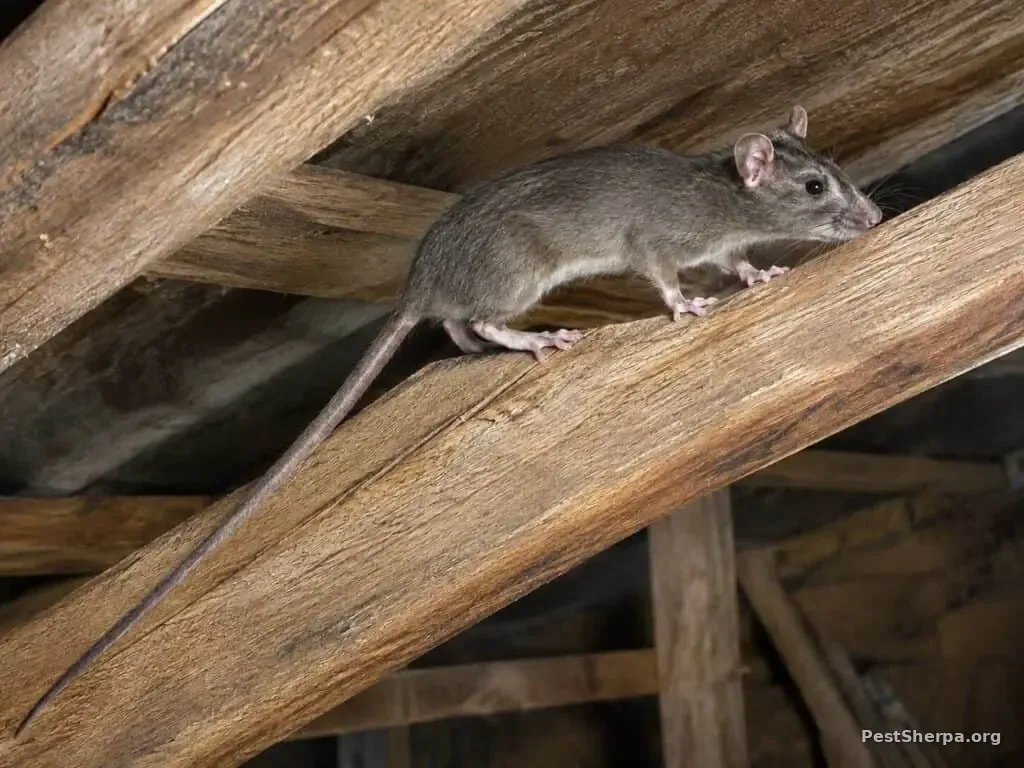
Roof rat with slender body and long tail on attic structural wood.
TL;DR
If you hear scratching in the attic or ceiling at night, find pointed rat droppings, see gnaw marks on stored food or wiring, or notice dark rub marks along beams or pipes, roof rats are possible. One sign by itself does not confirm an infestation, but repeated signs in attics, garages, rooflines, trees, or food-storage areas deserve a careful inspection.
The most effective roof rat management usually combines identification, source investigation, exclusion, sanitation, trapping or other targeted control, and safe cleanup. Pesticides are not always necessary, and rodent baits require special caution around children, pets, wildlife, food areas, and dead rodents.
Quick Navigation
- What Roof Rats Are
- Quick ID
- Identification
- Signs of Roof Rats
- Where Roof Rats Live and Travel
- Food, Water, and Attractants
- Damage and Health Concerns
- Source Investigation Checklist
- What To Do
- What Does Not Work Well
- Cleanup and Safety
- When Professional Help May Be Needed
- Lookalikes
- FAQs
- References
What Roof Rats Are
Roof rats are commensal rodents, meaning they often live near people and use the food, water, shelter, and travel routes that human environments provide. They are especially associated with warmer regions, coastal areas, urban neighborhoods, orchards, dense landscaping, and structures with accessible rooflines.
The name “roof rat” is useful, but it can be misleading. Roof rats commonly move and nest above ground, but they may also use dense shrubs, debris, stacked materials, ground cover, sheds, garages, crawlspaces, and other sheltered areas if conditions are favorable.
Expert Insight: Roof rats are often detected by signs before anyone sees the animal. Nighttime sounds, droppings, gnaw marks, food damage, and greasy travel marks usually matter more than a single brief sighting.
Quick ID: Roof Rat vs. Norway Rat vs. House Mouse
| Feature | Roof Rat | Norway Rat | House Mouse |
|---|---|---|---|
| Body shape | Slender and agile | Heavier and more robust | Small and delicate |
| Tail | Usually longer than head and body combined | Usually shorter than head and body combined | About as long as the body |
| Muzzle | Pointed | Blunt | Pointed |
| Ears | Large | Smaller | Large for body size |
| Common travel areas | Elevated routes, rafters, wires, trees, rooflines | Ground level, burrows, foundations, sewers, lower voids | Wall voids, kitchens, storage areas, clutter |
| Droppings | About 1/4 to 1/2 inch, often spindle or banana shaped and pointed at the ends | Larger, often blunter at the ends | Much smaller, rice-like pellets |
For comparison, see the Pest Sherpa Norway rat guide and house mouse guide.
Identification: What Roof Rats Look Like
Adult roof rats are usually dark brown, grayish brown, or blackish above with a lighter underside. Body color can vary, so shape and proportions are more useful than color alone.
- Slender body
- Pointed muzzle
- Large ears and eyes compared with Norway rats
- Long, thin, scaly tail that is usually longer than the head and body combined
- Strong climbing ability
- Mostly nocturnal activity
A simple field clue is tail length. When the tail is gently compared with the body length, a roof rat’s tail usually reaches past the nose, while a Norway rat’s tail usually does not. Do not handle live or dead rodents bare-handed.
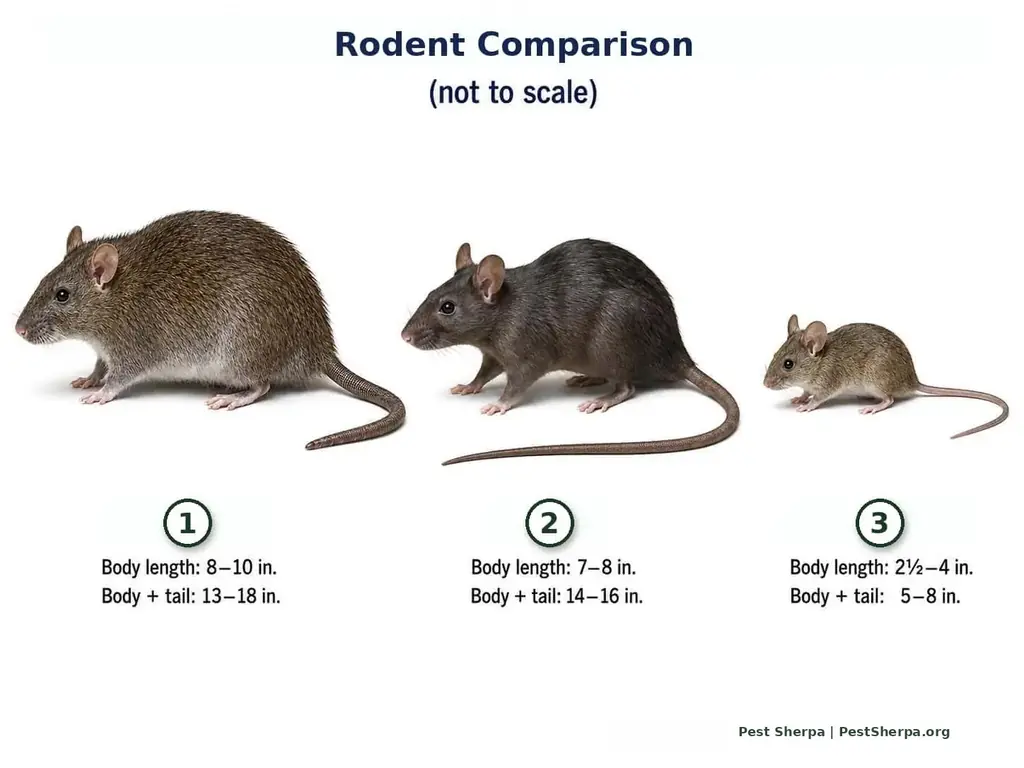
Which one did you find? Match the number:
- Norway rat: the largest and heaviest, with a blunt nose, small ears and a tail shorter than its body.
- Roof rat: slimmer and darker, with large ears and a tail longer than its body.
- House mouse: small, 2 1/2 to 4 inch body, with large ears for its size.
Roof rat compared with Norway rat and house mouse.
Signs of Roof Rats
Roof rats are cautious and often stay hidden. Look for patterns rather than relying on one clue.
| Sign | What It May Mean | Where To Look |
|---|---|---|
| Scratching or scurrying at night | Rodent movement in a void or attic | Attic, ceiling, soffit, wall void, garage |
| Pointed droppings about 1/2 inch long | Possible roof rat activity | Attic insulation, shelves, beams, pantry, garage edges |
| Gnaw marks | Rats are wearing down teeth or accessing food/shelter | Stored food, plastic bins, wiring, wood, insulation, pipes |
| Dark rub marks | Repeated travel along the same route | Pipes, rafters, walls, beams, fence tops |
| Damaged fruit or nuts | Outdoor feeding activity | Citrus, avocado, nut trees, fallen fruit areas |
| Nesting material | Possible shelter site | Attics, wall voids, storage boxes, dense vegetation |
Fresh signs near food, water, warmth, or shelter are more important than old signs in a rarely used area. If you are unsure whether droppings are new, photograph the area, clean safely, and monitor for new droppings.
Where Roof Rats Live and Travel
Roof rats often use elevated travel routes. Outdoors, they may move through trees, vines, shrubs, fences, utility lines, and roof edges. Indoors, they may travel through attics, soffits, wall voids, ceiling cavities, storage spaces, and utility chases.
Common indoor and structural areas include:
- Attics and rafters
- Roof voids and soffits
- Wall voids and ceiling cavities
- Garages and storage rooms
- Utility penetrations and pipe chases
- Suspended ceilings in commercial buildings
Common outdoor areas include:
- Dense shrubs, ivy, vines, and ground cover
- Fruit and nut trees
- Woodpiles, debris piles, and stacked materials
- Sheds, barns, and outdoor storage areas
- Compost, pet feeding areas, and garbage storage areas
Vegetation touching the roof can act like a bridge. Trimming branches and vines away from the structure can reduce access, but tree removal alone is usually not a complete solution if food, shelter, and entry points remain. Trimming six feet away from the structure is a good target.
Food, Water, and Attractants
Roof rats are flexible feeders, but they often use plant-based foods when available. They may feed on fruits, nuts, seeds, grains, pet food, birdseed, livestock feed, garbage, stored foods, and food residues.
In yards and around homes, common attractants include:
- Fallen fruit or nuts
- Pet food left out overnight
- Birdseed under feeders
- Unsealed garbage
- Compost with food scraps
- Stored pantry goods in chewable packaging
- Cluttered storage areas that provide hiding places
Metal containers with tight-fitting lids are better than thin plastic or cardboard for foods that rodents can chew through.
Biology and Activity Pattern
Roof rats are mostly active at night. That is why many people first notice them as scratching, thumping, or light running sounds in ceilings or walls after dark.
When food, water, and shelter are available, roof rat populations can grow quickly. A small number of rats can become a larger problem if entry points, nesting sites, and food sources are not addressed. This is why inspection and exclusion are just as important as removing individual rats.
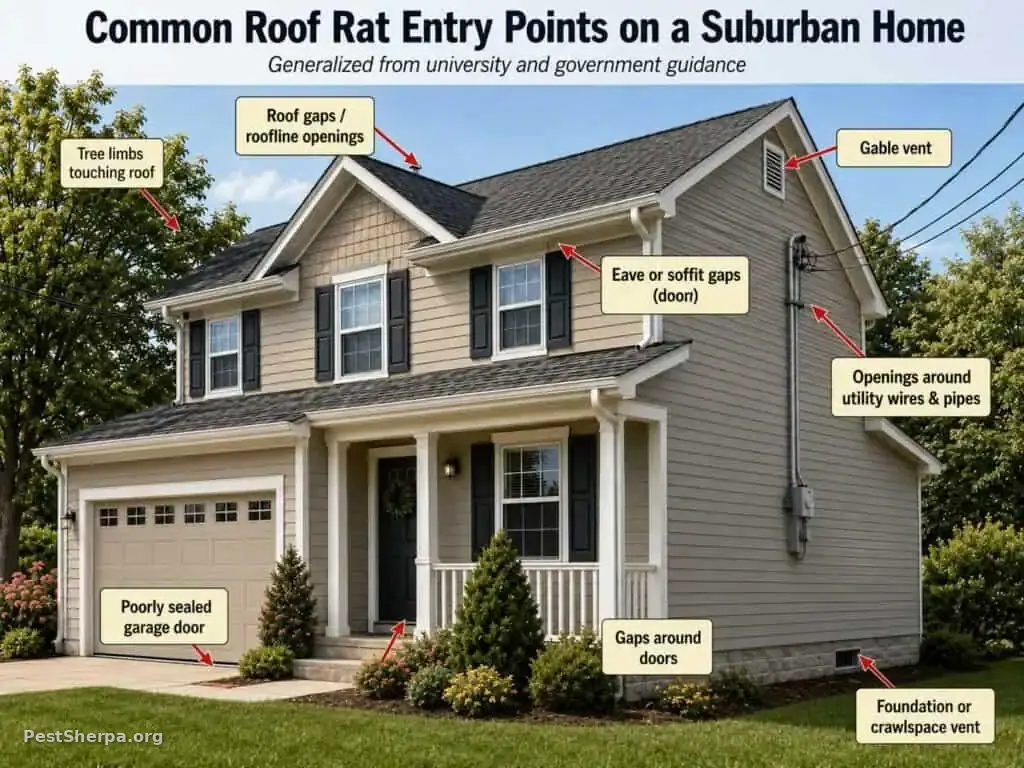
Common roof rat travel routes into attic and roofline openings.
Damage and Health Concerns
Roof rats can damage buildings, stored goods, and food-handling areas. Their gnawing may affect wood, plastic, insulation, screens, stored products, and electrical wiring. Damaged wiring should be evaluated carefully because electrical hazards are possible.
Sanitation is also a concern. Rodents can contaminate food, storage surfaces, and hidden spaces with droppings, urine, hair, nesting material, and dead rodents. Avoid sweeping or vacuuming dry droppings because dust from rodent-contaminated material can create avoidable exposure risk.
For more background on rodent-related disease concerns, see Pest Sherpa’s hantavirus disease prevention guide. Health risks vary by region, rodent species, exposure level, and cleanup method, so avoid assuming every sighting means a specific disease threat.
Roof Rat Source Investigation Checklist
Step 1: Confirm the Rodent Type
Compare tail length, body shape, droppings, travel height, and damage pattern. Roof rats are commonly confused with Norway rats, young rats, house mice, and outdoor mice.
Step 2: Listen and Map Activity
Note where and when sounds occur. Nighttime activity in an attic, soffit, or ceiling often points to elevated travel routes. Mark rooms, walls, and ceiling areas where sounds repeat.
Step 3: Inspect Entry Points
Inspect roof edges, soffits, attic vents, gable vents, plumbing and utility penetrations, gaps under flashing, damaged screens, garage doors, and holes around pipes or cables. Roof rats can use surprisingly small openings.
Step 4: Check Food and Water Sources
Look for pet food, birdseed, fruit, nuts, garbage, compost, stored foods, water sources, and cluttered storage that supports nesting.
Step 5: Look for Travel Routes
Follow rub marks, droppings, gnaw marks, damaged fruit, and repeated sounds. Roof rats often reuse the same protected routes.
What To Do About Roof Rats
1. Identify the Pest Before Acting
Do not assume every rodent is a roof rat. Control strategy changes depending on whether the problem is roof rats, Norway rats, mice, deer mice, or pack rats/woodrats.
2. Reduce Food Sources
- Pick up fallen fruit and nuts regularly.
- Bring pet food indoors at night.
- Store birdseed, pet food, and pantry goods in rodent-resistant containers.
- Secure garbage lids.
- Reduce spilled feed around outdoor storage areas.
3. Reduce Shelter and Climbing Access
- Trim branches and vines away from the roofline where practical.
- Thin dense vegetation near walls and foundations.
- Remove debris piles, unused boxes, and stacked clutter.
- Store materials off the ground when possible.
4. Seal Entry Points
Exclusion is essential. Seal openings with durable, rodent-resistant materials. Pay close attention to roofline gaps, vents, soffits, utility openings, damaged screens, and spaces around pipes or cables. Avoid sealing animals inside active voids without a plan to remove them.
5. Use Targeted Control and Monitoring
Traps, monitoring devices, and other control tools work best when placed along active travel routes rather than randomly in the middle of open rooms. Roof rats may avoid new objects at first, so placement, patience, and monitoring matter.
If rodent bait is used, read and follow the label, keep bait away from children and pets, use appropriate bait stations, and plan for safe disposal of dead rodents. Rodenticides can pose risks to pets, wildlife, and non-target animals, especially if used carelessly.
What Does Not Work Well
- Only trapping one visible rat while leaving entry points open
- Removing trees while leaving food, garbage, and gaps available
- Using poison without reading the label or considering pets and wildlife
- Relying on repellents while the structure still provides food and shelter
- Cleaning dry droppings with a broom or vacuum
- Sealing holes without checking whether animals are still inside
For a related practical question, see Pest Sherpa’s Q&A on whether ultrasonic repellents work.
Cleanup and Safety
Do not sweep or vacuum dry droppings, urine, or nesting material. Ventilate enclosed areas before cleanup when possible. Wear gloves, wet contaminated material with an appropriate disinfectant, follow product label directions, wipe up with disposable towels, bag waste, and wash hands after removing gloves.
Use extra caution in attics, crawlspaces, sheds, barns, garages, and other spaces with heavy rodent evidence. Contaminated insulation, air ducts, or difficult voids may require specialized help. Dead rodents should be handled with gloves and disposed of safely according to local guidance.
Keep children, pets, and food-preparation items away from contaminated areas until cleanup is complete.
When Professional Help May Be Needed
Professional help may be worth considering when the problem involves hidden voids, repeated entry, uncertain identification, sanitation risk, electrical damage, inaccessible attics or crawlspaces, commercial kitchens, food-handling areas, or heavy droppings.
- You hear repeated attic or wall activity at night.
- Droppings return after cleanup.
- You cannot find the entry point.
- There may be rodents in vents, ducts, or insulation.
- There is evidence of chewed wiring.
- Children, pets, or food areas could be exposed.
- DIY trapping or exclusion has not stopped the signs.
Lookalikes and Common Misidentifications
| Possible Lookalike | How It Differs | Helpful Link |
|---|---|---|
| Norway rat | Bulkier body, blunter muzzle, smaller ears, tail usually shorter than head and body combined, often more ground-associated | Norway rat guide |
| House mouse | Much smaller droppings and body size; often lives indoors near kitchens, storage, and wall voids | House mouse guide |
| Deer mouse | Often associated with outdoor entry and two-toned body coloration; important for health-risk context in some regions | Deer mice guide |
| Pack rat or woodrat | May collect objects and build bulky nests; more common in some outdoor or semi-rural settings | Pack rats/woodrats guide |
| Squirrel | Often active during the day, may make louder rolling or chewing sounds, and often enters through roofline openings |
Frequently Asked Questions
Are roof rats only found in roofs?
No. Roof rats often use elevated areas, but they can also nest in dense vegetation, debris, storage areas, sheds, garages, and other protected places.
Does one roof rat mean an infestation?
Not always. One sighting or one sound may be limited activity, but repeated droppings, gnawing, rub marks, food damage, or nighttime sounds suggest a larger issue that needs inspection.
How do roof rats get into attics?
They may use branches, vines, utility lines, fences, pipes, rough walls, roof edges, vents, soffits, and small gaps around utilities. Vegetation touching the structure can make access easier.
What do roof rat droppings look like?
Roof rat droppings are typically dark, about 1/2 inch long, and often pointed at the ends. Do not handle droppings bare-handed or clean them dry with a broom or vacuum.
Will trimming trees solve a roof rat problem?
Trimming branches and vines away from the home can reduce access, but it usually does not solve the problem by itself. Food, shelter, open gaps, and nesting sites also need attention.
Are rodent baits always needed?
No. Many situations rely first on identification, exclusion, sanitation, trapping, and monitoring. If bait is used, follow the label exactly and protect children, pets, wildlife, and food areas.
Where do roof rats go in winter?
Roof rats prefer warmer niches. In colder climates they are more likely to move indoors into attics, wall voids, and food buildings. They are excellent climbers and often the harder of the two pest rats to find and control. Winter does not force them into a seasonal shutdown. Keep attic and roof-line entries sealed, trim climbing access where practical, and inspect for noises and droppings in upper voids. See also: Where do rats go in winter?
References
- University of Arizona Cooperative Extension: How to Identify and Discourage Roof Rats
- UC Statewide IPM Program: Roof Rats
- Cornell Integrated Pest Management: Mouse and Rat Biology and Behavior
- NC State Extension: Surveillance and Management of Common Structure-Invading Rats
- Centers for Disease Control and Prevention: How to Clean Up After Rodents
- National Pesticide Information Center: Rodenticides
This article was written by Greg Baumann, founder of Pest Sherpa, and reflects more than 40 years of professional pest management experience.
About the Author

Greg Baumann | Pest Control Expert
Greg Baumann is the founder of Pest Sherpa and a Pest Control Expert with more than 40 years of professional pest management experience. His articles combine decades of field experience, technical expertise, and science-based guidance to help homeowners identify pests correctly, understand real-world risks, and make informed pest management decisions.
Mission: Identify the pest. Understand the risk. Stop the problem. Prevent the comeback. Know when it’s time to call a professional.