
House Mice: Identification, Droppings, Risks, and Control

House Mouse Identification, Risks, and What To Do
The house mouse (Mus musculus) is one of the most common rodents found in and around homes. Its small size, ability to use tiny gaps, quick breeding, and habit of nesting near food and shelter make it a persistent indoor pest. A single mouse sighting does not always mean a large infestation, but repeated sightings, fresh droppings, scratching sounds, gnaw marks, or activity in food-storage areas should be taken seriously.
This guide explains how to identify house mice, how to tell mouse evidence from rat or deer mouse evidence, where mice usually enter and nest, what health and property concerns matter most, and which practical next steps are safest and most effective.

House mouse near an indoor wall showing small body, pointed snout, large ears, and long tail.
TL;DR
House mice are small grayish-brown rodents with pointed noses, large ears, small dark eyes, and tails about as long as the body. The most common signs are small droppings, gnaw marks, scratching sounds at night, shredded nesting material, and food packaging damage.
The most effective mouse control is usually a combination of inspection, sealing entry points, removing food access, trapping, safe cleanup, and ongoing monitoring. Sprays, ultrasonic repellents, and random trap placement rarely solve the underlying issue. Rodenticides are not always necessary and must be used only according to the label, with special care around children, pets, wildlife, food, and stored household items.
Quick Navigation
- Identification
- Mouse, Rat, or Deer Mouse?
- Signs of Mouse Activity
- Where House Mice Enter Homes
- Nesting and Feeding Habits
- Biology and Reproduction
- Health and Property Risks
- What To Do
- What Does Not Work Well
- Safe Cleanup Notes
- When Professional Help May Be Worth Considering
- Frequently Asked Questions
- References
Identification: What House Mice Look Like
Accurate identification matters because mouse control, rat control, and wildlife exclusion are not identical. House mice are small rodents that usually stay close to food, shelter, and wall edges once indoors.
| Feature | House Mouse Clue |
|---|---|
| Body length | Usually about 2 1/2 to 4 inches, not including the tail |
| Tail | Thin, scaly, sparsely haired, and roughly as long as the body |
| Color | Usually dusty gray to brownish-gray with a lighter belly |
| Head | Pointed snout with prominent rounded ears |
| Eyes | Small, dark, and bead-like |
| Typical indoor behavior | Runs along walls, behind objects, and near stored food or nesting material |
Mouse Droppings
Droppings are often the first evidence people notice. House mouse droppings are usually small, dark, and rod-shaped with pointed or tapered ends. See also: How do I identify mouse droppings?
- Typical size: about 1/8 to 1/4 inch long
- Common locations: drawers, cabinets, pantry corners, under sinks, behind appliances, along baseboards, and near pet food
- Meaning: fresh droppings after cleanup usually mean activity is still occurring
Safety note: Do not sweep or vacuum rodent droppings, urine, or nesting material. See the safe cleanup notes below before disturbing rodent evidence.
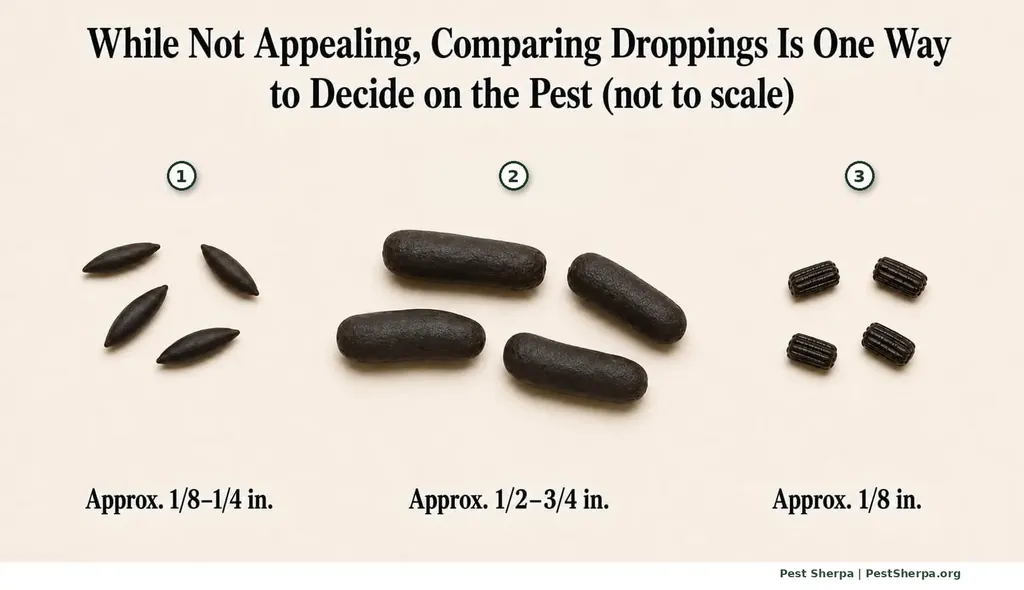
Which droppings do you see? Match the number:
- House mouse: about 1/8 to 1/4 inch, small and pointed at the ends, like dark rice grains.
- Norway rat: about 1/2 to 3/4 inch, large and capsule-shaped with blunt ends.
- American cockroach: about 1/8 inch, blunt and cylindrical with ridges along the sides.
Mouse, Rat, or Deer Mouse?
House mice are often confused with young rats or with deer mice. The difference matters because entry points, health concerns, nesting locations, and trap placement can differ.
| Rodent | Key Clues | Why It Matters |
|---|---|---|
| House mouse | Small body, large ears, pointed snout, tail about body length, small tapered droppings | Often nests indoors near food, clutter, insulation, or stored items |
| Deer mouse | Often has a sharper two-tone pattern, with brownish upper body and white underside | More often associated with sheds, garages, cabins, rural structures, and certain hantavirus concerns |
| Norway rat | Much larger, heavy-bodied, blunt nose, larger droppings | Often burrows, uses lower structural gaps, and requires larger traps and different placement |
| Roof rat | Larger than a mouse, long tail, more slender than Norway rat | Often uses trees, roofs, attics, vines, and upper entry points |
Signs of Mouse Activity
Mouse problems are usually confirmed by patterns of evidence, not by one clue alone. Look for signs in quiet areas near food, warmth, clutter, or wall edges.
- Droppings: especially in drawers, cabinets, pantries, under sinks, and along walls
- Gnaw marks: on food packaging, wood, plastic, stored goods, or utility areas
- Scratching or scurrying sounds: often heard at night in walls, ceilings, cabinets, or attic spaces
- Shredded nesting material: paper, cloth, insulation, cardboard, or other soft material
- Grease or smudge marks: along repeated travel routes near walls or openings
- Food damage: torn bags, chewed boxes, missing pet food, or scattered crumbs
- Odor: a persistent musky smell can develop where activity is heavy
Quick diagnostic tip: After safe cleanup, monitor the same areas for new droppings. New evidence helps separate an old, inactive problem from ongoing mouse activity.
Where House Mice Enter Homes
House mice can use very small openings. A practical inspection should focus on gaps around the foundation, doors, utility lines, vents, siding, crawlspace openings, garages, and roofline transitions.
| Entry Area | What To Check |
|---|---|
| Exterior doors | Gaps under doors, damaged sweeps, garage door corners, and weatherstripping |
| Foundation | Cracks, expansion joints, missing mortar, crawlspace vents, and gaps where siding meets the foundation |
| Utility penetrations | Openings around pipes, wires, cable lines, condensate lines, and HVAC connections |
| Vents and screens | Damaged crawlspace vents, attic vents, dryer vent gaps, and torn screens |
| Garage and storage areas | Door corners, cluttered shelving, stored seed, pet food, birdseed, and cardboard boxes |
| Attic and roofline | Soffit gaps, roof-wall intersections, fascia gaps, and openings near overhanging branches |

Common house mouse entry points around a home including utility gaps, vents, doors, foundation cracks, and garage door gaps.
Nesting and Feeding Habits
House mice usually nest in hidden, quiet spaces close to food and warmth. Indoors, they often move along edges rather than crossing open rooms.
Common Nesting Sites
- Wall voids
- Attic insulation
- Behind or under appliances
- Inside stored boxes
- Garage shelving and clutter
- Basements, crawlspaces, and utility rooms
- Cabinets near food, pet food, or water sources
Common Food Sources
House mice are opportunistic feeders. Seeds and grains are attractive, but mice may feed on many foods available indoors.
- Crumbs on counters, floors, and under appliances
- Unsealed pantry goods
- Pet food and birdseed
- Garbage and food residue
- Stored seed, grain, or animal feed in garages and sheds
Removing food access does not instantly remove mice, but it makes trapping and monitoring more effective and reduces the attraction for future activity.
Biology and Reproduction
House mouse populations can grow quickly when food, shelter, and nesting space are available. Indoors, they may remain active throughout the year because homes provide stable temperatures and reliable resources.
| Biology Factor | Why It Matters |
|---|---|
| Early maturity | Young mice can begin breeding within weeks under favorable conditions |
| Short gestation | Litters can be produced quickly |
| Multiple litters | One established pair can lead to a larger problem if food, nesting, and access remain |
| Year-round indoor activity | Cold weather does not end indoor mouse problems |
| Small home range | Evidence usually points toward nearby shelter, food, or entry points |
For related seasonal context, see Now That the Weather Is Warmer, Will Mice Leave My Basement?
Health and Property Risks
House mice are not just a nuisance. Their droppings, urine, nesting material, food contamination, and gnawing can create health, sanitation, and property concerns.
Health and Sanitation Concerns
- Food contamination: mice may contaminate food, food-contact surfaces, drawers, and storage areas with droppings or urine.
- LCMV: house mice are an important concern for lymphocytic choriomeningitis virus exposure, especially where wild mice or infected pet rodents are involved.
- Allergens: mouse urine, dander, and particles can contribute to indoor allergy and asthma concerns.
- Cleanup risk: unsafe cleanup can stir contaminated dust into the air.
For broader rodent-related disease context, see Hantavirus Disease Prevention: Rodent Identification, Biology, Habits, and Control.
Property Damage
Mice gnaw frequently. Damage may be minor at first, but activity in hidden areas can become expensive if it affects wiring, insulation, stored items, or food inventory.
- Chewed food packages
- Damaged insulation
- Gnawed wood, plastic, cardboard, or stored goods
- Contaminated drawers, cabinets, and shelving
- Possible wire damage in hidden areas
What To Do About House Mice
The most reliable approach is integrated pest management: identify the rodent, inspect for evidence, remove food access, seal entry points, use targeted traps, clean safely, and monitor for new activity.
1. Confirm the Rodent
Check droppings, body size, tail length, nesting material, and where the evidence appears. If the rodent may be a rat, deer mouse, squirrel, or other wildlife, do not assume mouse tactics will be enough.
2. Inspect Before Placing Traps
Look for droppings, gnaw marks, rub marks, shredded nesting material, pet food, birdseed, and gaps. Focus on kitchens, pantries, garages, basements, attics, crawlspaces, utility rooms, and exterior entry points.
3. Remove Food and Shelter Access
- Store pantry foods, pet food, birdseed, and animal feed in sealed containers.
- Clean crumbs and food residue under appliances and furniture.
- Empty trash regularly and use tight-fitting lids.
- Reduce cardboard, fabric, and paper clutter that can become nesting material.
- Do not leave pet food out overnight when mouse activity is suspected.
4. Seal Entry Points
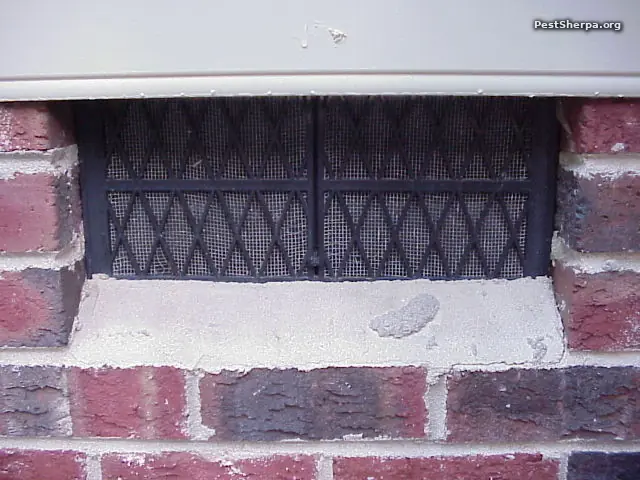
Exclusion is essential for long-term control. Seal openings with durable materials mice cannot easily gnaw through, such as metal mesh, hardware cloth, sheet metal, mortar, concrete, or appropriate sealants used with rodent-resistant backing materials. Foam alone is often not enough for active rodent entry points.
- Install or repair door sweeps.
- Seal utility gaps around pipes, wires, and HVAC lines.
- Repair damaged screens, vents, and crawlspace covers.
- Close garage door corner gaps.
- Inspect roofline, soffit, fascia, and attic access points when evidence is overhead.
5. Use Traps Strategically
Traps work best when placed where mice already travel. Random placement in the middle of open rooms is usually less effective.
- Place traps along walls, behind objects, and near fresh evidence.
- Use enough traps for the amount of activity observed.
- Keep traps out of reach of children and pets.
- Check traps regularly and dispose of captured rodents safely.
- Continue monitoring after captures stop to confirm activity has ended.
Glue boards raise humane and non-target concerns and may not be appropriate in many homes. If they are used, placement should avoid children, pets, wildlife, and areas where non-target animals may contact them.
6. Be Careful With Rodenticides
Rodenticides are not always necessary for a mouse problem. When any pesticide or rodenticide is used, read and follow the label exactly. Keep products away from children, pets, food, food-preparation surfaces, drains, vents, and wildlife access. Use only products labeled for the site and situation, and avoid placing bait where rodents may move it into unsafe areas.
Dead rodents should be removed promptly when found. This reduces odor, fly activity, and potential exposure for pets or scavenging wildlife.
7. Monitor for New Evidence
After cleanup and control steps, watch for new droppings, fresh gnawing, new sounds, or food damage. If new evidence appears, repeat the inspection and look for missed entry points or hidden food sources.
What Does Not Work Well
Mouse control often fails when it focuses only on the visible mice and ignores why they entered and where they are surviving.
- Ultrasonic repellents: these should not be relied on as the main control method.
- Random trap placement: traps away from travel routes may miss active mice.
- Foam-only sealing: mice can gnaw through many soft sealants if no rodent-resistant backing is used.
- Only cleaning the droppings: cleanup is important, but it does not stop entry or nesting.
- Spraying baseboards: insecticide sprays are not a mouse-control solution.
- Ignoring exterior gaps: indoor trapping alone may not prevent repeat activity.
For more on repellents, see Do Ultrasonic Repellents Work?
Safe Cleanup Notes for Mouse Droppings and Nesting Material
Rodent cleanup should be handled carefully. Avoid dry sweeping or vacuuming droppings, urine, or nesting material because this can stir contaminated particles into the air.
- Ventilate the area before cleanup when practical.
- Wear rubber or plastic gloves.
- Wet droppings and nesting material with an appropriate disinfectant before removal.
- Use disposable towels or similar materials rather than sweeping dust into the air.
- Wash hands after cleanup, even if gloves were worn.
- Use extra caution in heavy infestations, enclosed spaces, cabins, sheds, garages, or areas with unknown rodent species.
Follow current public health guidance for rodent cleanup, especially when droppings are heavy, the structure has been closed for a long time, or deer mice or other wild rodents may be involved.
When Professional Help May Be Worth Considering
Many minor mouse issues can be investigated with careful inspection, exclusion, sanitation, trapping, and safe cleanup. Professional help may be worth considering when the problem is persistent, widespread, risky, or difficult to locate.
- Fresh droppings continue after cleanup and trapping.
- Scratching sounds are coming from walls, ceilings, or inaccessible voids.
- Entry points are hard to find or difficult to seal safely.
- Rodent activity is occurring in a food-handling, healthcare, school, child care, or multi-unit housing setting.
- There are children, pets, immunocompromised occupants, or significant allergy/asthma concerns.
- Rodenticides are being considered and there is concern about label compliance, non-target exposure, or carcass removal.
- The evidence may involve rats, deer mice, squirrels, or other wildlife instead of house mice.
Frequently Asked Questions
Does one mouse mean I have an infestation?
Not always. One mouse may have entered recently, especially during weather changes or when a door or garage was open. However, one mouse plus droppings, gnaw marks, food damage, scratching sounds, or repeated sightings suggests ongoing activity that should be investigated. See also: What are the first signs of mice, and how do I keep them out?
How small of a gap can a house mouse use?
A practical rule is to inspect and seal gaps about 1/4 inch or larger. Young or motivated mice may use surprisingly small openings, especially around doors, utility penetrations, vents, and foundation joints.
Why do I hear scratching at night?
House mice are usually most active at night. Scratching or scurrying sounds in walls, ceilings, cabinets, or attics can indicate movement, nesting, or gnawing. The sound location can help guide inspection, but sound can travel through voids and may not mark the exact nest location.
Will mice leave when the weather gets warm?
Not necessarily. If indoor conditions provide food, shelter, and nesting space, mice may remain active indoors even when outdoor weather improves. See Now That the Weather Is Warmer, Will Mice Leave My Basement?
Can I vacuum mouse droppings?
No. Dry sweeping or vacuuming rodent droppings, urine, or nesting material can stir contaminated particles into the air. Wet cleanup methods and current public health guidance are safer.
Are rodenticides required?
No. Many mouse problems can be addressed with inspection, exclusion, sanitation, trapping, cleanup, and monitoring. If rodenticides are used, they must be used only according to the label and placed where children, pets, wildlife, food, and non-target animals cannot access them.
What is the biggest mistake people make with mice?
The biggest mistake is treating mice as only a trapping problem. Traps may reduce the current activity, but missed entry points, stored food, pet food, clutter, and unsafe cleanup can allow the problem to continue or return.
Can mice get into a pantry without chewing holes in the wall?
Yes. Most interior doors have gaps underneath because there is usually no need for a tight fitting interior door. That gap is enough for a mouse to walk in. Many people assume mice chewed unseen holes through the wall, but most just walk under the door. A pantry is ideal for them: little traffic, dark, plenty of places to hide, and nearby pet water dishes make water easy. Mice need food, water, and harborage, and pantries often supply all three. For homeowner steps, see how to keep mice out of the pantry.
Should I store opened pasta, rice, or chocolate bags in plastic bins?
Yes. Leaving unsealed bags or unprotected food gives mice a food source that takes little effort. It is common to grab a snack and put the opened bag back on the shelf. A chocolate chip bag, a bag of beans, or a rice or pasta bag can easily be gnawed open. Store those opened dry goods in durable plastic bins so mice cannot reach the food with a quick chew. If you already found mice in the pantry, see what to do if you find mice in your pantry.
Can grass seed or pet food in the garage pull mice toward the house?
Yes. Many garage doors have large gaps underneath, and the big door opens several times a day or night. Do not store pet food, grass seed, or other food items unless they are in a closed container such as a plastic bin or a small can with a lid. Also inspect the door from the garage into the house. Outer defenses still matter too: tight door sweeps and sealing any hole larger than the diameter of a pen greatly reduce entry.
References
- UC IPM: House Mouse
- Cornell CALS Integrated Pest Management: Mouse and Rat Biology and Behavior
- University of Missouri Extension: Controlling House Mice
- Centers for Disease Control and Prevention: How to Clean Up After Rodents
- Centers for Disease Control and Prevention: About Lymphocytic Choriomeningitis
- U.S. Environmental Protection Agency: Safely Use Rodent Bait Products
This article was written by Greg Baumann, founder of Pest Sherpa, and reflects more than 40 years of professional pest management experience.
About the Author

Greg Baumann | Pest Control Expert
Greg Baumann is the founder of Pest Sherpa and a Pest Control Expert with more than 40 years of professional pest management experience. His articles combine decades of field experience, technical expertise, and science-based guidance to help homeowners identify pests correctly, understand real-world risks, and make informed pest management decisions.
Mission: Identify the pest. Understand the risk. Stop the problem. Prevent the comeback. Know when it’s time to call a professional.