
How do I identify mouse droppings?
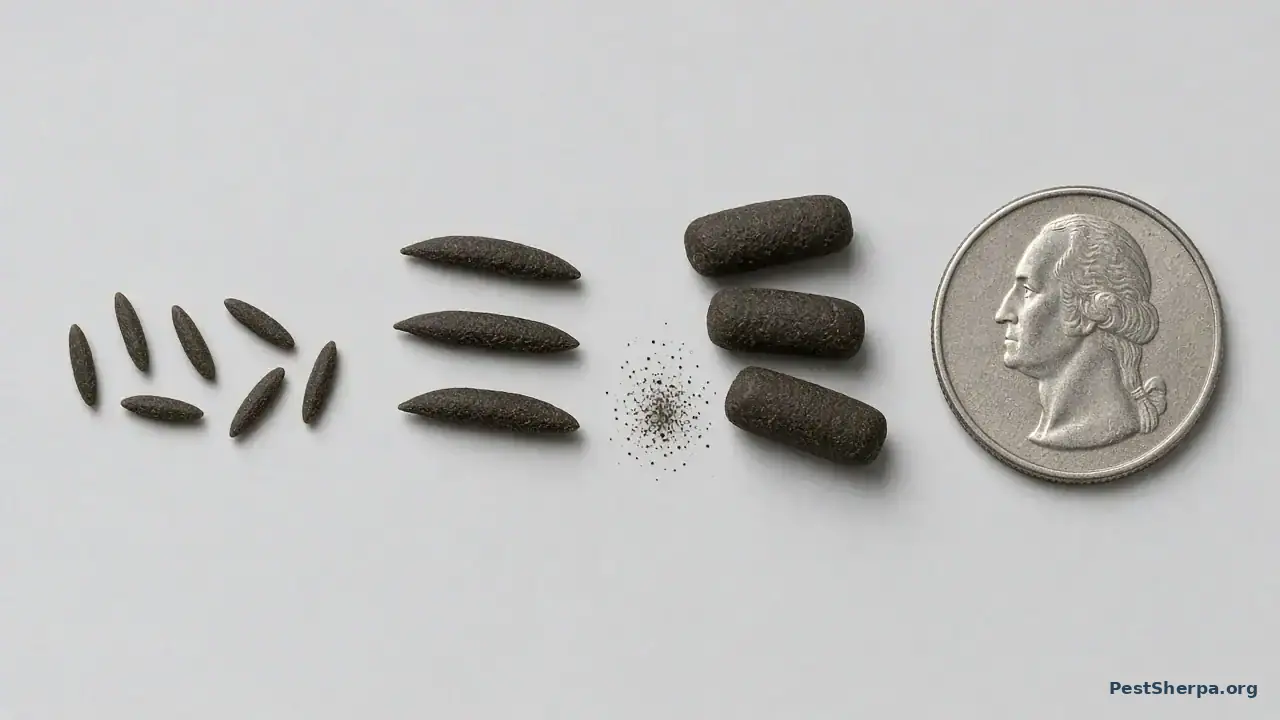
Short answer: House mouse droppings are dark, pointed on both ends, and about 1/8 to 1/4 inch long. Norway rat droppings are larger (about 1/2 to 3/4 inch) with blunt ends. Roof rat droppings are about 1/2 inch, blunt or slightly pointed. Never touch droppings bare-handed. Soft means fresher; hard means older. Clean with CDC wet methods, then trap and seal entries.
What house mouse droppings look like
There are many mouse species, but the house mouse is the one most people deal with indoors. Droppings are dark and pointed on both ends, about 1/8 to 1/4 inch long. Where mice congregate you will often see multiple pellets (usually scattered singles, not neat piles). On a runway with light traffic you may only find a few.
Mouse vs rat droppings
- House mouse: 1/8 to 1/4 inch, pointed ends.
- Norway rat: 1/2 to 3/4 inch, blunt ends, darker and thicker.
- Roof rat: about 1/2 inch, blunt or slightly pointed.
Size and end shape are the practical homeowner clues. If you are unsure, photograph next to a coin and compare with the house mouse guide.
Fresh or old?
Do not touch rodent droppings with bare hands. Use cardboard or a disposable stick. Fresh droppings are soft and may stick; old ones are hard. Fresh or old, treat them as a reason to clean safely and start control.
Where you usually find them
House mice are commensal rodents. They “share the table” with people. Common places: kitchen cabinets and under sinks, under refrigerators and stoves, near pet bowls, pantries, garage floors (especially near grass seed), basements, and crawlspaces. If those clues showed up in the pantry, see What should I do if I find mice in my pantry?.
Other signs and what to do
Also watch for gnawed food packages, a pungent urine smell, droppings in insulation, and slight rub marks along walls. When it is time to clean, do not dry-sweep. Follow CDC wet cleanup with gloves and respiratory protection. For control, snap traps or multi-catch traps are usually better indoor choices than bait as the primary tool. Seal entries: if a pencil fits through a hole, a mouse can too. Door sweeps, steel wool around pipe penetrations, and foundation caulk help.
Related guides
- House Mouse Guide
- Rodent Guide
- Hantavirus Prevention and Rodent Identification
- More Ask the Sherpa Q&A
References
- CDC: How to Clean Up After Rodents
- UC IPM: House Mouse
- University of Georgia Extension: Rats and Mice: Get Them Out of Your House and Yard
This article was written by Greg Baumann, founder of Pest Sherpa, and reflects more than 40 years of professional pest management experience.
About the Author

Greg Baumann | Pest Control Expert
Greg Baumann is the founder of Pest Sherpa and a Pest Control Expert with more than 40 years of professional pest management experience. His articles combine decades of field experience, technical expertise, and science-based guidance to help homeowners identify pests correctly, understand real-world risks, and make informed pest management decisions.
Mission: Identify the pest. Understand the risk. Stop the problem. Prevent the comeback. Know when it’s time to call a professional.