
Velvety Tree Ants: Identification, Nesting, Bites, and Control
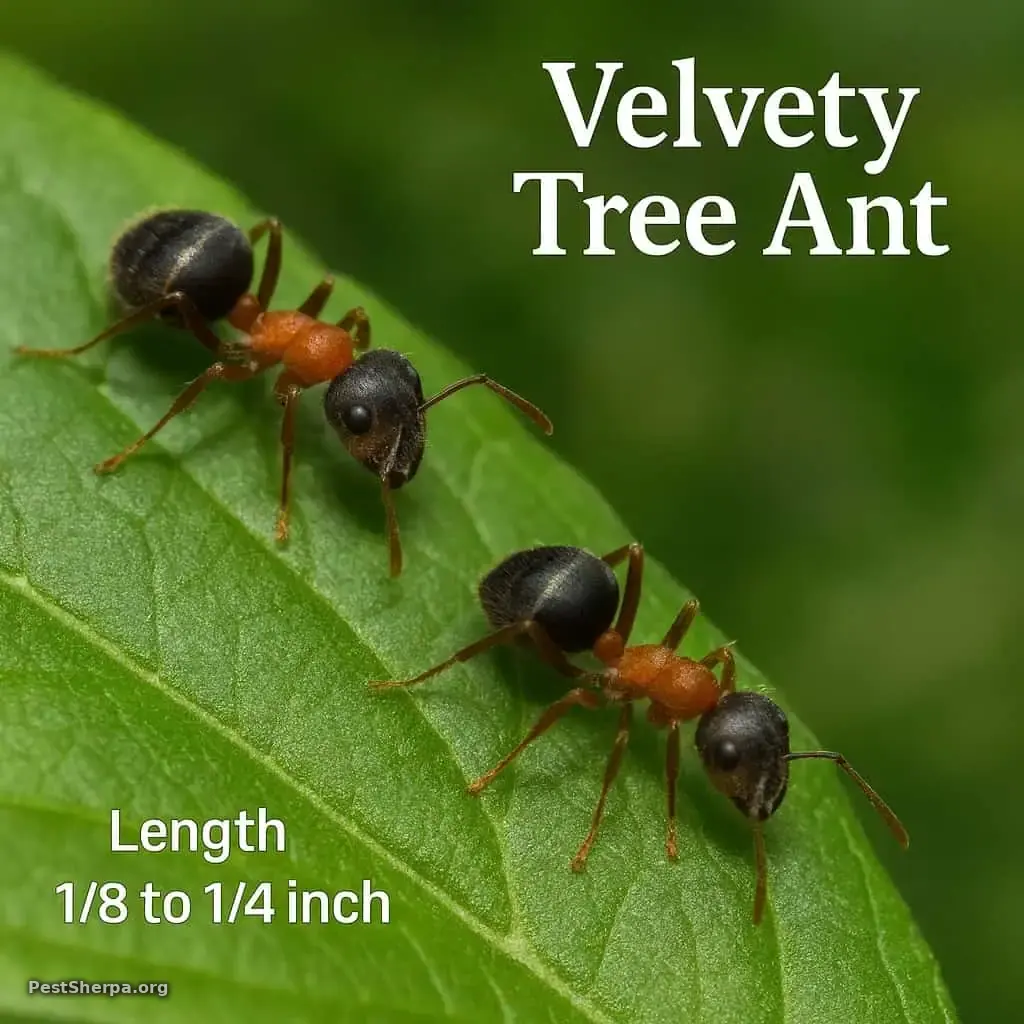
The velvety tree ant, Liometopum occidentale, is a native western ant that usually lives outdoors in trees, logs, stumps, and decaying wood. It becomes a household concern when workers trail into buildings for sweets, moisture, or other food, or when ants use wall voids, or when ants excavate wood or insulation and establish temporary nesting or resting sites within wall voids.
These ants can be alarming because they form large trails, give off a strong odor when disturbed, and can bite defensively. They do not eat wood the way termites do, but they may tunnel in softened wood or insulation, especially where moisture or decay already exists. Correct identification matters because velvety tree ants are often mistaken for carpenter ants.
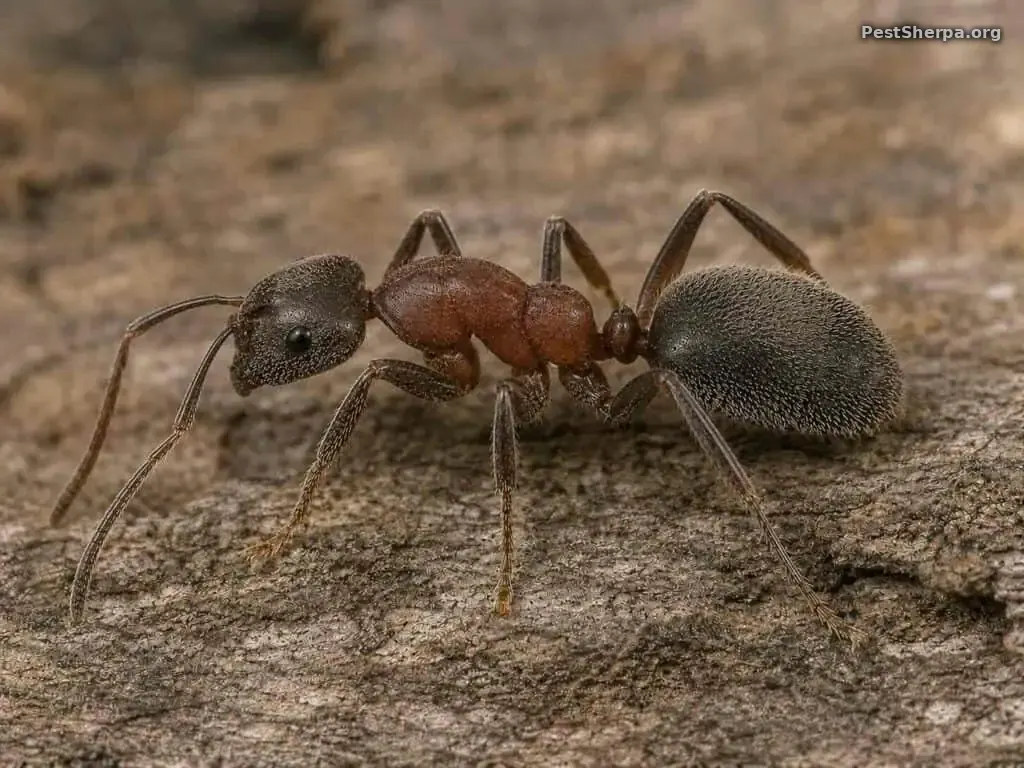
Velvety tree ant worker showing dark head, reddish thorax, and black velvety gaster (abdomen).
TL;DR
Velvety tree ants are usually outdoor ants associated with mature trees, logs, loose bark, and decaying wood. A few indoor workers may be foragers, but repeated trails, odor, biting ants, or activity from walls can point to a nearby outdoor colony, structural nesting or resting site, access route, or occasionally a moisture/wood-decay problem.
The best first step is not broad indoor spraying. Trace the trails, inspect nearby trees and wood, reduce moisture, trim branches touching the structure, manage honeydew-producing plant pests, and seal access points. If ants are coming from wall voids, insulation, or damaged wood, a deeper inspection may be needed.
Quick Navigation
- Quick ID Guide
- What Velvety Tree Ants Mean in Your Home
- Velvety Tree Ant Identification
- Habitat and Nesting Behavior
- Food Sources and Foraging Trails
- Do Velvety Tree Ants Damage Wood?
- Inspection Checklist
- What To Do
- What Does Not Work Well
- How Long Activity May Last
- Bites, Odor, and Safety Notes
- Lookalikes and Similar Ants
- Frequently Asked Questions
- References
Quick ID Guide
| Feature | What To Look For |
|---|---|
| Color | Dark brown to black head, yellowish red to reddish brown thorax, dark velvety abdomen |
| Size | Workers vary in size, roughly 1/8 to 1/4 inch long |
| Body shape | Single petiole node and a smooth, rounded thorax when viewed from the side |
| Odor | Strong, unpleasant odor when disturbed or crushed |
| Behavior | Fast trails on trees, fences, exterior walls, utility lines, and sometimes inside buildings |
| Defense | Can bite; workers may swarm out aggressively when a nest or trail is disturbed and may release an alarm pheromone (scent) containing acetic, butyric, and isovaleric acids with an odor of rancidity or vinegar. |
For broader ant comparisons, see the ant identification guide.
What Velvety Tree Ants Mean in Your Home
Velvety tree ants indoors usually mean one of three things: outdoor foragers found a food source, ants are using branches or utility lines as a bridge into the structure, or a nearby colony is using a sheltered void as a temporary nesting or resting site.
| What You See | What It May Mean |
|---|---|
| One or two ants indoors | Possible scouts or accidental entry |
| Repeated trails to sweets, pet food, or moisture | Foraging route from an outdoor colony |
| Ants trailing from a tree to the roofline | Tree branches, vines, wires, or shrubs may be acting as access bridges |
| Ants emerging from a wall, ceiling, window frame, or insulation | Possible nesting or resting site within the structure |
| Strong odor plus biting ants | Velvety tree ants or another odorous defensive ant should be considered |
| Wood damage, damp wood, or insulation disturbance | Moisture or decay may be supporting nesting activity; do not assume termite damage without inspection |
Expert Insight: The ants you see inside may be only a small part of a larger outdoor colony. Long-term correction usually depends on finding the trails, nesting conditions, and access points rather than only killing visible workers indoors.
Velvety Tree Ant Identification
Velvety tree ant workers have a distinctive two-toned appearance. The head is dark brown to nearly black, the mesosoma (mid-segment) is reddish brown to lighter brown or yellowish, and the gaster is dark and velvety. Workers are polymorphic, meaning different workers in the same colony can be different sizes.
When viewed from the side, velvety tree ants have a single node between the thorax and abdomen and a smooth, rounded thorax profile. They do not have a stinger, but they can bite and release strong defensive odors.
They are often confused with carpenter ants because both may be associated with wood and both can have larger workers. Carpenter ants are usually larger overall and have a different body profile. Under magnification, carpenter ants have a circle of hairs around the acidopore (hind) at the tip of the gaster, whereas velvety tree ants lack that circle of hairs and have a slit-shaped terminal opening. If the ants are large, dark, and coming from wood, compare them carefully with the carpenter ant guide.
Habitat and Nesting Behavior
Velvety tree ants are strongly tied to trees and wooded environments. Outdoors, nests are commonly associated with tree hollows, stumps, logs, fallen timber, rocks, and decaying wood. Around homes, they may use firewood piles, landscape timbers, old lumber, tree cavities, and other sheltered wood sources.
Indoor activity is often connected to an outdoor colony, but these ants can use wall voids, insulation, damp wood, or other protected spaces when conditions are favorable. Structural activity should prompt inspection of wood condition and moisture because decay or softened materials may facilitate excavation, although velvety tree ants can also excavate sound structural wood and insulation.
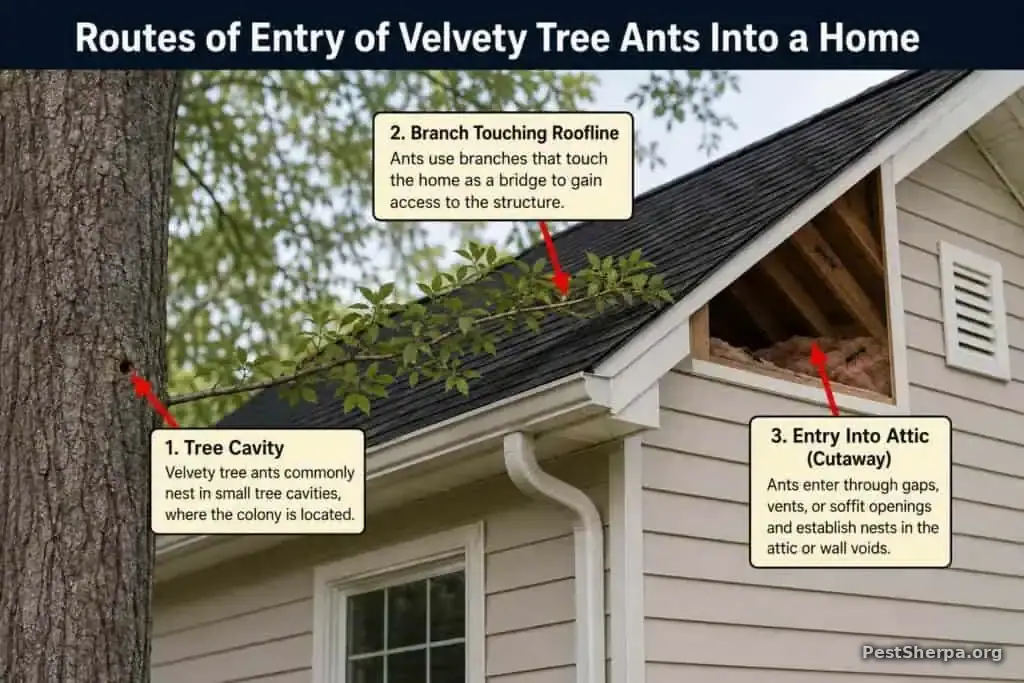
Velvety tree ant trail from tree cavity to roofline and wall void.
Food Sources and Foraging Trails
Velvety tree ants feed on a mix of sweet and protein-based foods. Outdoors, honeydew from aphids, mealybugs, and scale insects is one of their most important food sources. Workers may protect these sap-feeding insects while harvesting honeydew, which can increase ant activity on trees and shrubs.
They also feed on live insects, dead insects, and other scavenged material. Indoors they may forage for sweets, food residues, insects, and other accessible food sources. Trails can appear on tree trunks, fences, siding, foundation edges, rooflines, and utility lines.
Do Velvety Tree Ants Damage Wood?
Velvety tree ants do not consume wood like termites. However, they can excavate wood and insulation to create nesting or resting spaces. Damp or decayed wood may be especially susceptible, but moisture is not required for structural excavation. That makes wood-condition inspection important.
Finding these ants in or near wood should not automatically be treated as proof of termite activity. It should trigger a careful inspection for moisture, decay, galleries, insulation disturbance, exterior tree contact, and nearby nesting material.
For comparison with other wood-associated pests, see acrobat ants and carpenter ants.
Velvety Tree Ant Inspection Checklist
1. Follow the Trail
Watch where the workers go instead of only treating where you see them. Trails may lead to a tree, stump, log pile, fence, utility line, roof edge, window frame, or wall void.
2. Inspect Trees and Wood Near the Structure
- Tree hollows and cavities
- Loose bark
- Dead limbs
- Stumps and logs
- Firewood stacks
- Landscape timbers
- Old lumber or stored boards
3. Look for Access Bridges
Check branches, vines, shrubs, fences, and utility lines touching or nearly touching the building. These routes can let ants bypass foundation barriers and enter at rooflines, vents, siding gaps, and windows.
4. Check Structural Voids and Moisture-Prone Areas
- Window and door frames
- Wall voids near plumbing
- Insulation near leaks
- Crawlspace rim joists
- Roof leaks and eaves
- Deck connections and damp trim
5. Check Plants for Honeydew Sources
Look for aphids, soft scales, mealybugs, sticky leaves, black sooty mold, or heavy ant activity on trees and shrubs. Honeydew-producing insects can support large ant trails near a home.
What To Do
Confirm the Ant
Use color, size variation, odor, body shape, and trail behavior to narrow the identification. If the ants are too small to identify clearly, collect a few specimens in a sealed container or take close, well-lit photos. Under magnification such as a hand lens or magnifying glass, look for the absence of the ring of hairs around the tip of the gaster (abdomen) that is characteristic of carpenter ants.
Remove or Reduce Nesting Conditions
- Remove dead wood, loose bark, and unnecessary lumber close to the structure.
- Store firewood away from the building and off the ground when practical.
- Repair leaks and correct drainage problems that keep wood damp.
- Replace severely decayed wood when it is part of the structure.
Interrupt Trails Into the Building
- Trim branches and shrubs away from roofs, siding, windows, and utility penetrations.
- Seal cracks, gaps, and openings after active trails are understood.
- Repair damaged screens, door sweeps, and exterior trim gaps.
- Clean up indoor sweets, grease, pet food, and moisture sources that keep trails active.
Manage Honeydew-Producing Plant Pests
If ant trails are heavy on trees or shrubs, inspect for aphids, scales, and mealybugs. Managing honeydew-producing insects may reduce an important food source and associated ant activity.
Use Pesticides Carefully, If They Are Needed
Pesticides are not always necessary. When ant products are used, choose products labeled for the ant problem and the treatment location, read and follow the label, keep any products used away from children, pets, food, dishes, and food-preparation surfaces, and avoid applying products into drains, vents, or electrical areas unless the label specifically allows it.
For persistent activity, targeted control near trails, entry points, and nesting areas is usually more useful than repeated indoor spot spraying alone.
What Does Not Work Well
- Crushing ants as the main strategy: this can create odor and does not address the colony.
- Only spraying visible indoor ants: workers may be replaced quickly if the outdoor colony and access route remain.
- Ignoring trees and shrubs: outdoor trails are often the clue that explains indoor activity.
- Sealing one gap before inspection: ants may simply shift activity to another opening.
- Assuming every wood-associated ant is a termite problem: inspect carefully before choosing a response.
How Long Activity May Last
There is no fixed timeline for elimination because activity depends on colony location, food resources, structural use, and access routes. A trail from a nearby tree or outdoor nesting site may continue until the access route, honeydew source, or nesting condition is corrected. Activity from a wall void or damp structural area can last longer and may recur if moisture and access points remain.
| Situation | Likely Pattern |
|---|---|
| One or two indoor ants | May stop after cleaning and exclusion |
| Outdoor trail to roofline | Often continues until branches or access routes are corrected |
| Ants on honeydew-covered plants | May persist while aphids, scales, or mealybugs remain active |
| Ants emerging from wall voids | May require deeper inspection for moisture, insulation, or nesting material |
Bites, Odor, and Safety Notes
Velvety tree ants can bite, and disturbed workers may release strong-smelling defensive secretions. Most encounters are nuisance events, but bites can be painful. Avoid handling workers barehanded, and keep children and pets away from active trails or disturbed nests.
If ants are active around food areas, clean surfaces, store food in sealed containers, and remove visible workers with a vacuum or damp disposable towel. Do not apply insecticides to food-contact surfaces, dishes, toys, pet bowls, or areas where residues could contaminate food.
Lookalikes and Similar Ants
Several ants can be confused with velvety tree ants because they trail indoors, nest near structures, produce odor, or use wood voids. Identification is especially important before treating wood-associated ants.
| Ant | How It Differs | Why It Matters |
|---|---|---|
| Carpenter ants | Usually larger; tip of gaster has a circular opening surrounded by hairs, unlike the slit-like opening without a surrounding hair ring in velvety tree ants. | Wood association can make the two easy to confuse |
| Odorous house ants | Smaller, more uniform in color, and commonly associated with indoor trailing | Both can produce noticeable odors when crushed |
| Acrobat ants | Heart-shaped abdomen often raised when disturbed | May also use damp or damaged wood voids |
| Argentine ants | Smaller, uniform brown ants with very persistent trails | Common honeydew-feeding ant in many western landscapes |
| Pharaoh ants | Very small yellowish indoor ants | Indoor control choices differ greatly; avoid misidentification |
Frequently Asked Questions
Are velvety tree ants dangerous?
They are mainly nuisance pests, but they can bite and may release strong-smelling defensive secretions when disturbed. Avoid disturbing nests or handling workers with bare hands.
Do velvety tree ants eat wood?
No. They do not consume wood like termites. They may excavate wood and insulation to create nesting or temporary resting spaces. Damp or deteriorated wood can warrant additional inspection, but structural excavation is not limited to decayed wood.
Why are velvety tree ants coming from a tree into my house?
The tree may contain a nest, honeydew-producing insects, or a trail route. Branches touching the roof or siding can give ants direct access to the structure.
Will indoor spraying solve the problem?
Indoor spraying alone may not solve a velvety tree ant problem if the colony, food source, or access route is outside. Inspection and correction of trails, wood, moisture, and vegetation are usually more important.
Are velvety tree ants the same as carpenter ants?
No. They are different ants, but they can be confused because both may be associated with wood and larger workers. Compare body size, color pattern, odor, thorax shape, and nesting behavior before choosing a response.
When might professional help be worth considering?
Professional help may be worth considering when ants are emerging from walls, insulation, or ceilings; when there is suspected moisture-damaged wood; when trails are extensive and difficult to trace; or when biting ants are active in a high-use indoor area. A careful inspection can help determine whether the issue is mostly outdoor foraging, an indoor void, or a wood or moisture-related problem.
References
- Utah State University Extension: Velvety Tree Ant
- Oregon State University Extension: Integrated Pest Management for Ants in Schools
- Washington State University Extension: Identification and Habits of Key Ant Pests of Washington
- UC Statewide IPM Program: Ants
- UC Statewide IPM Program: Managing Ants on Trees and Shrubs
- UC Riverside Urban Entomology: A Review of the Biology, Ecology and Behavior of Velvety Tree Ants of North America
- UC Riverside Urban Entomology: Food and Bait Preferences of Liometopum occidentale
This article was written by Greg Baumann, founder of Pest Sherpa, and reflects more than 40 years of professional pest management experience.
About the Author

Greg Baumann | Pest Control Expert
Greg Baumann is the founder of Pest Sherpa and a Pest Control Expert with more than 40 years of professional pest management experience. His articles combine decades of field experience, technical expertise, and science-based guidance to help homeowners identify pests correctly, understand real-world risks, and make informed pest management decisions.
Mission: Identify the pest. Understand the risk. Stop the problem. Prevent the comeback. Know when it’s time to call a professional.