
House Crickets: Identification, Chirping, and What to Do
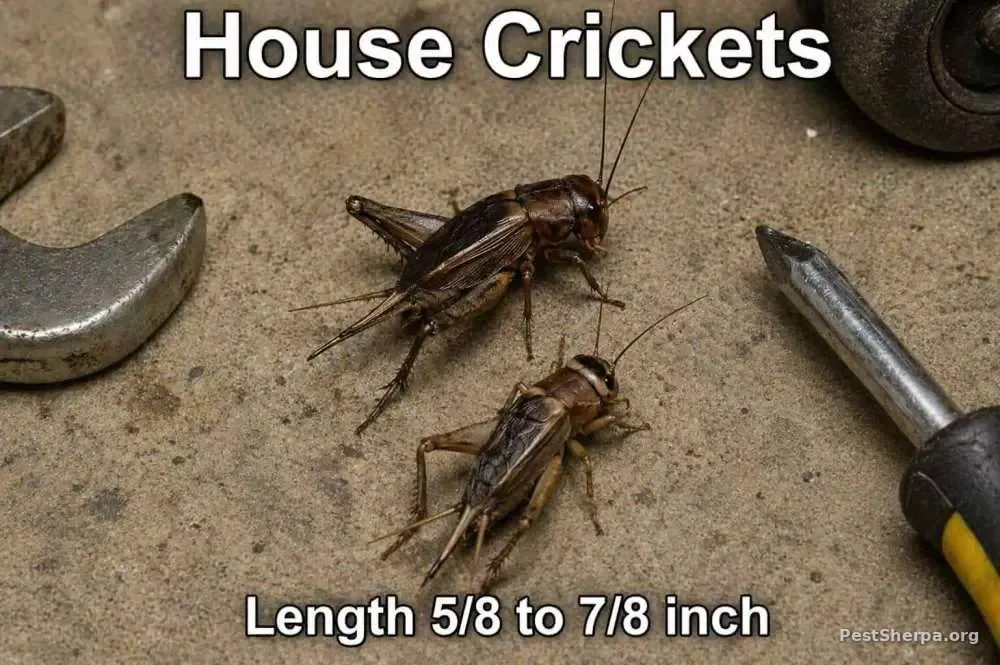
House crickets are tan, long-antennaed crickets that sometimes move into homes, garages, basements, crawl spaces, warehouses, and other warm sheltered places. The species most often called the house cricket is Acheta domesticus. Many people notice them because males produce a repeated chirping sound, especially at night.
A few house crickets indoors usually means they found a gap, open door, damaged screen, bright exterior light, or warm hiding place. Larger numbers can become a nuisance because crickets hide during the day, chirp at night, feed on crumbs and organic debris, and may chew stained fabrics or stored materials. They are not wood-destroying insects and do not damage the structure of a house.
This guide explains how to identify house crickets, what their presence means, where to look for sources, what usually attracts them indoors, and which practical steps reduce activity without overreacting.
TL;DR
House crickets are usually nuisance pests, not a sign of structural damage. Look for tan crickets with very long antennae, enlarged jumping legs, wings, and three darker bands on the head. Males chirp; females have a long, straight ovipositor at the rear.
One or two crickets may have wandered in from outdoors. Repeated nighttime chirping, crickets in several rooms, nymphs, shed skins, or fabric chewing suggests a more established indoor or near-structure source.
The most effective approach is identification, source reduction, exclusion, sanitation, moisture correction, light management, and simple removal methods such as vacuuming or sticky monitoring traps. Pesticides are not always necessary, and any pesticide used should be selected and applied according to the label.
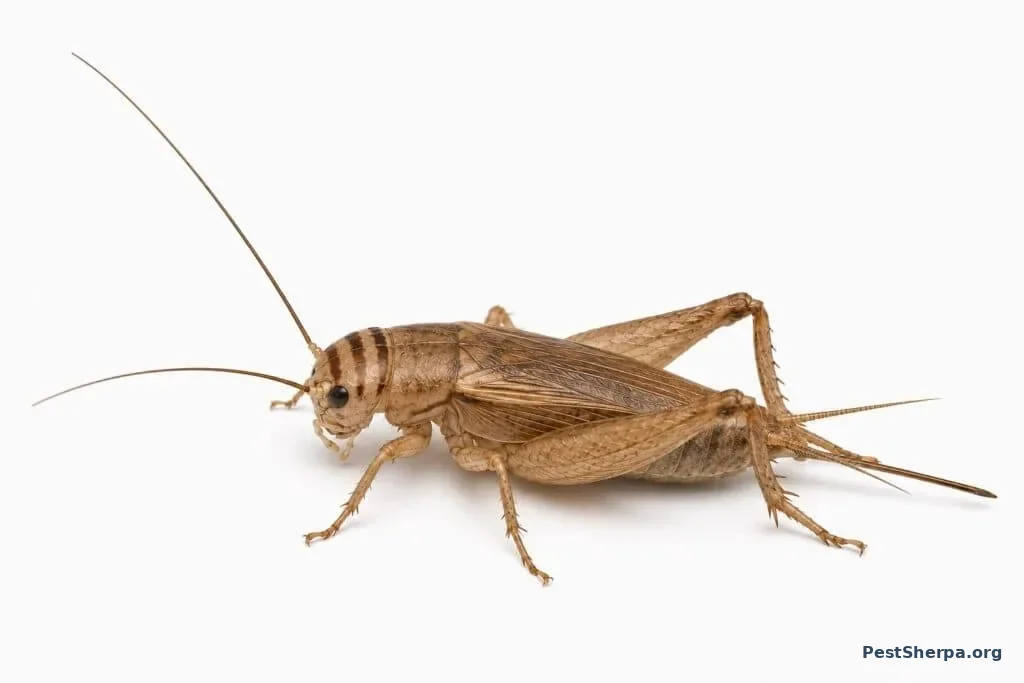
Adult house cricket showing long antennae, jumping legs, wings, and dark head bands.
Quick Navigation
- What House Crickets Mean Indoors
- Identification
- Quick Diagnostic Guide
- Habitat and Entry Points
- Life Cycle and Seasonal Activity
- Feeding and Possible Damage
- Source Investigation Checklist
- What To Do
- What Does Not Work Well
- How Long Activity May Last
- When Professional Help May Be Needed
- Lookalikes and Common Misidentifications
- Frequently Asked Questions
- References
What House Crickets Mean Indoors
House crickets are often classified as occasional invaders. That means they may live outdoors around buildings and enter when conditions make the structure attractive or easy to access. Warmth, moisture, food residues, shelter, and exterior lighting can all contribute.
A single cricket does not automatically mean there is an infestation. The pattern matters more than one sighting.
| What You Notice | What It Usually Suggests | Best First Step |
|---|---|---|
| One cricket indoors | Accidental entry | Remove it and check nearby doors, screens, and thresholds |
| Chirping from one area at night | Male cricket hiding nearby | Listen, narrow the area, then inspect under appliances, boxes, baseboards, and stored items |
| Crickets appearing near doors or garage | Outdoor entry around gaps or lights | Check weatherstripping, door sweeps, garage seals, and exterior lighting |
| Several crickets over multiple days | Nearby source or repeated entry | Inspect basement, crawl space, garage, utility room, and exterior foundation areas |
| Small nymphs indoors | Possible indoor development or eggs laid in protected moist material | Look for moisture, clutter, food debris, pet food, or stored organic material |
| Chewed fabric or paper plus crickets | Crickets may be feeding on stained or soiled materials | Inspect stored clothing, laundry, boxes, and food-contaminated items |
Key point: House crickets are usually a symptom of access, shelter, food, moisture, or lighting conditions. Solving those conditions works better than only killing the adults you see.
Identification: What House Crickets Look Like
The house cricket (Acheta domesticus) is a medium-sized cricket in the order Orthoptera and family Gryllidae. Adults are usually about 3/4 to 7/8 inch long, or roughly 19 to 22 mm.
Typical identification features include:
- Light yellowish-brown, tan, or brownish body
- Three darker transverse bands on the head between the eyes
- Very long, threadlike antennae, often longer than the body
- Enlarged hind legs built for jumping
- Wings lying flat over the body in adults
- Two slender cerci at the rear of the abdomen
- A long, straight ovipositor on females
Male and female house crickets can look similar at first glance. Females have a long ovipositor projecting from the rear of the abdomen. Males lack this structure and produce the familiar chirping sound by rubbing specialized wing structures together, a behavior called stridulation.
House crickets are sometimes confused with field crickets, which are usually darker, and camel crickets, which are hump-backed and do not have the same winged, chirping appearance as adult house crickets.
House Cricket Quick Diagnostic Guide
| Question | House Cricket Clue | What Else It Could Be |
|---|---|---|
| Is it tan or yellowish-brown? | House crickets are often tan to light brown | Field crickets are usually darker; camel crickets are often brown and hump-backed |
| Does it have very long antennae? | Long antennae are typical of crickets | Cockroach nymphs also have long antennae but do not have enlarged jumping legs |
| Does it jump strongly? | House crickets jump quickly when disturbed | Spiders, cockroaches, and silverfish move differently |
| Do you hear chirping at night? | Male crickets chirp to attract females | Some other crickets chirp too; the sound alone does not confirm species |
| Are there three darker bands on the head? | This supports house cricket identification | Field crickets are usually darker overall and lack the same tan appearance |
| Is it wingless and hump-backed? | Probably not a house cricket adult | Consider camel cricket |
Habitat and Entry Points
House crickets are associated with warm, sheltered places that provide food and moisture. Outdoors, they may occur around vegetation, mulch, leaf litter, compost, trash areas, stored materials, foundation edges, and exterior lights. Indoors, they tend to hide in quiet protected spaces during the day.
Common indoor hiding areas include:
- Basements
- Crawl spaces
- Garages
- Utility rooms
- Kitchens and food storage areas
- Under appliances
- Behind baseboards
- Storage boxes, clutter, and folded fabrics
- Warm areas near water heaters, furnaces, or laundry rooms
Common entry points include gaps under doors, damaged door sweeps, garage door gaps, torn screens, loose weatherstripping, cracks at foundations, utility penetrations, vents, and openings around pipes or cables.
Exterior lighting can also increase cricket activity near a building. Crickets attracted to lights around doors, windows, porches, and garages are more likely to find a way inside.
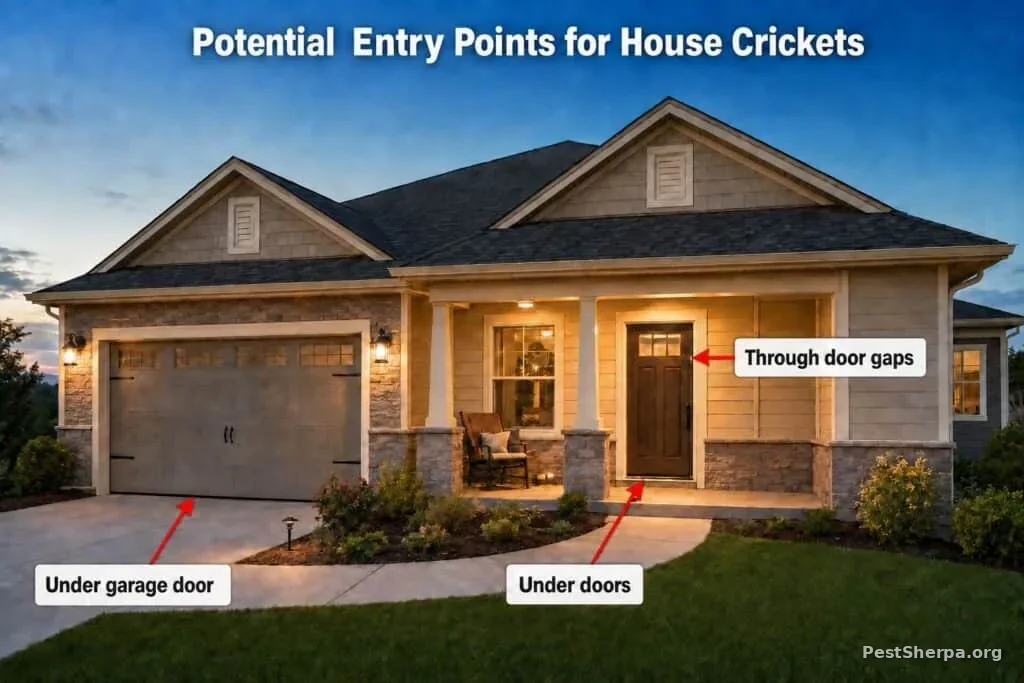
ICommon house cricket entry points around a home exterior. They can also gain entry at utility penetrations, foundation cracks, and crawlspace and basement doors.
Life Cycle and Seasonal Activity
House crickets develop by incomplete metamorphosis. Their life cycle has three stages:
- Egg
- Nymph
- Adult
Females use the ovipositor to place eggs in moist soil or another suitably moist, protected medium. In buildings where reproduction occurs, eggs may sometimes be deposited in protected cracks or crevices, particularly in basements or crawl spaces. They hatch as small, wingless versions of adults and molt several times as they grow. Adults have developed wings and reproductive structures.
Development speed depends heavily on temperature, moisture, and food. Warm indoor spaces can allow activity to continue when outdoor conditions are less favorable. In many homes, cricket problems become more noticeable in late summer or fall when outdoor conditions change and insects move toward shelter, warmth, and lights.
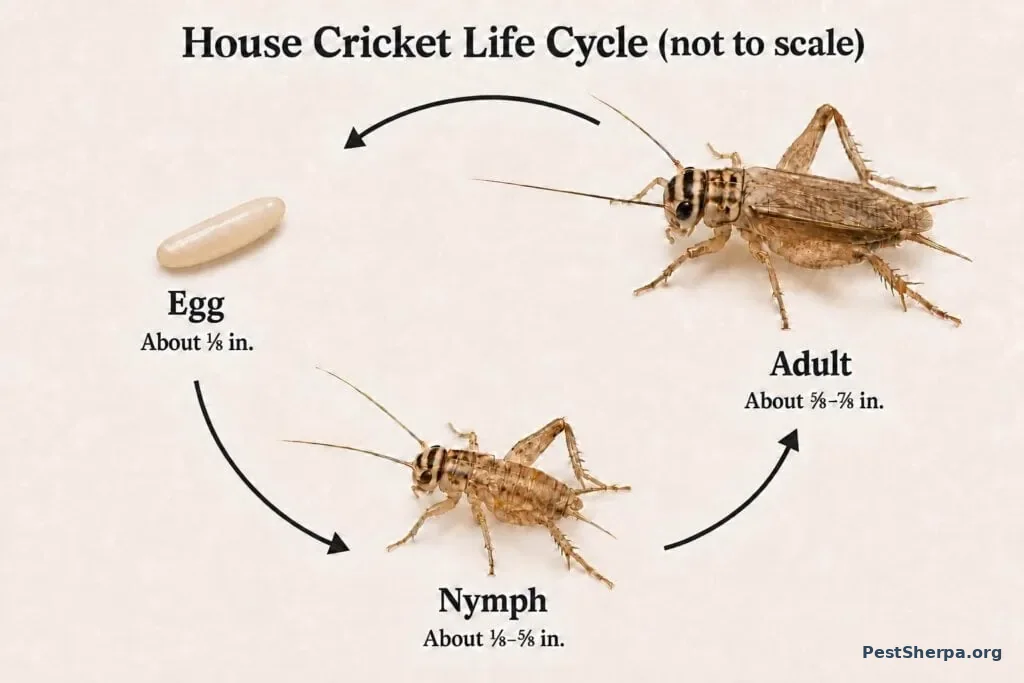
House cricket life cycle showing egg, nymph, and adult stages.
Feeding Habits and Possible Damage
House crickets are omnivorous scavengers. Outdoors and indoors, they may feed on a range of plant and animal materials, including decaying organic matter, food crumbs, spilled grain products, pet food, grease residues, dead insects, and stored materials.
Indoors, the most common issue is nuisance activity rather than major damage. However, crickets may chew on fabrics, paper, stored items, or food-contaminated materials, especially if those items are stained with perspiration, food residue, grease, or other organic material.
Fabric damage from crickets is usually irregular chewing, not the same as damage from textile pests. If you find repeated damage to wool, fur, feathers, carpets, stored clothing, or lint-heavy areas, also consider textile pests such as varied carpet beetles, black carpet beetles, or silverfish.
House Cricket Source Investigation Checklist
Use the pattern of activity to decide where to inspect first.
Step 1: Listen at Night
If chirping is the main problem, listen from room to room after dark. The sound may seem to move or echo, so check nearby baseboards, appliances, closets, storage boxes, and wall-floor edges.
Step 2: Check Warm, Hidden Areas
Inspect basements, crawl spaces, garages, utility rooms, laundry rooms, water heater areas, furnace areas, and storage closets. Look for live crickets, shed skins, small nymphs, droppings, or chewed materials.
Step 3: Look for Food Sources
Check pet food, bird seed, spilled grain, pantry debris, crumbs under appliances, trash areas, compost buckets, recycling, and food-contaminated storage materials.
Step 4: Look for Moisture and Shelter
Inspect leaky plumbing, damp crawl spaces, wet cardboard, mulch piled against foundations, leaf litter, thick vegetation, and clutter near exterior walls.
Step 5: Inspect Entry Points
Check door sweeps, thresholds, garage door seals, foundation cracks, utility penetrations, vents, screens, and gaps around doors or windows. Pay special attention to the side of the house where you see outdoor crickets or where lights stay on at night.
What To Do About House Crickets
1. Confirm the Pest
Before treating, make sure the insect is actually a house cricket. A tan cricket with long antennae, large jumping legs, wings, and darker head bands supports the identification. If the insect is dark black, hump-backed, fuzzy, flat-bodied, or not jumping, compare lookalikes before deciding what to do.
2. Remove Crickets You Can Reach
Vacuum or capture visible crickets. Empty the vacuum contents promptly if live insects are collected. Sticky monitoring traps can help show where activity is concentrated, but they should not be the only control method.
3. Reduce Food Sources
- Clean crumbs and food residues under appliances and cabinets
- Store pet food, bird seed, and grain products in sealed containers
- Remove spilled feed in garages, sheds, or storage rooms
- Empty trash and recycling regularly
- Clean grease, lint, and organic debris from hiding areas
4. Reduce Moisture and Shelter
- Fix leaks and damp areas where practical
- Improve ventilation in crawl spaces or damp storage areas when needed
- Remove wet cardboard and unnecessary clutter
- Pull mulch, leaves, wood, and debris away from the foundation
- Trim dense vegetation touching the structure
5. Improve Exclusion
- Install or repair door sweeps
- Repair torn screens
- Seal foundation cracks and gaps where appropriate
- Seal openings around pipes, cables, and utility penetrations
- Improve garage door seals and thresholds
6. Adjust Exterior Lighting
When crickets collect near doors and windows at night, reduce unnecessary exterior lighting, move bright lights away from entry points when possible, or use less attractive lighting choices. Light changes alone may not solve an indoor problem, but they can reduce the number of crickets gathering near entry points.
7. Use Pesticides Carefully, If Needed
Pesticides are not always necessary for house crickets. If a pesticide is used, read and follow the label exactly. Avoid applying products to food-contact surfaces, pet feeding areas, children’s play areas, drains, vents, or places not allowed by the label. Do not use outdoor-only products indoors. Do not mix products or increase amounts beyond label directions.
In many homes, exclusion, sanitation, moisture correction, and targeted removal solve the problem more safely and effectively than broad indoor spraying.
What Does Not Work Well
- Only spraying visible crickets: This may reduce a few adults but does not correct entry points, food, moisture, or shelter.
- Ignoring outdoor sources: Crickets around lights, mulch, garages, and foundation debris can keep entering.
- Relying only on sticky traps: Traps are useful for monitoring, but they rarely solve the source by themselves.
- Using foggers for hidden crickets: Foggers may not reach protected hiding places and can create unnecessary exposure risks when misused.
- Assuming every chirp means a large infestation: One male cricket can make a lot of noise.
- Ultrasonic devices: Claims for broad pest repellent devices are often stronger than the practical results. See Pest Sherpa’s Q&A on whether ultrasonic repellents work for additional context.
How Long Will House Cricket Activity Last?
The timeline depends on whether crickets are entering from outdoors, living in a protected indoor area, or simply hiding after a one-time entry event.
| Situation | Likely Timeline | What Helps Most |
|---|---|---|
| One cricket entered accidentally | Activity ends after removal | Remove it and check the nearest entry point |
| Several crickets entering from outdoors | May continue while lights and gaps remain | Exclusion, light changes, foundation cleanup |
| Crickets hiding in garage or basement | May continue until food, moisture, and shelter are reduced | Clean storage areas, reduce moisture, use monitoring traps |
| Nymphs or repeated activity indoors | May last longer if a protected breeding area remains | Find the source, remove debris, correct moisture, seal gaps |
When Professional Help May Be Needed
Many house cricket situations can be handled with inspection, cleaning, exclusion, and removal. Professional help may be worth considering when the source is difficult to locate, activity continues after basic corrections, or the setting requires careful pest documentation.
Consider additional help when:
- Nighttime chirping continues for weeks and you cannot locate the source
- You find many crickets in a basement, crawl space, garage, warehouse, or food storage area
- You are seeing nymphs, shed skins, or repeated activity in several rooms
- There are moisture or structural access issues that are hard to inspect
- The problem is in a commercial, food-handling, school, healthcare, or multi-unit setting
- You are unsure whether the insects are crickets, cockroaches, carpet beetles, or another pest
Lookalikes and Common Misidentifications
Several pests can be mistaken for house crickets, especially when seen quickly in a dark room or basement.
| Lookalike | How It Differs | Why It Matters |
|---|---|---|
| Field cricket | Usually darker brown to black and often associated with outdoor areas | Management focuses heavily on outdoor entry and foundation conditions |
| Camel cricket | Hump-backed, wingless-looking, long-legged, and often found in damp basements or crawl spaces | Moisture reduction is especially important |
| Cockroach nymph | Flattened body, fast running, no enlarged cricket-style jumping legs | Cockroach issues require different inspection and control steps |
| Silverfish | Flat, wingless, carrot-shaped body with three tail-like filaments | Often associated with moisture, paper, starches, and storage areas |
| Carpet beetle | Small beetles or hairy larvae, not jumping crickets | Important if fabric, wool, fur, feathers, or stored textile damage is present |
| Grasshopper or katydid | Usually plant-associated and less likely to establish indoors | Often accidental entry rather than an indoor source |
Frequently Asked Questions
Do house crickets bite?
House crickets are not considered biting or stinging pests. Their main importance indoors is nuisance activity, nighttime chirping, contamination of stored materials, and occasional chewing on stained fabrics or food-contaminated items.
Does one house cricket mean I have an infestation?
No. One cricket often means accidental entry. Repeated sightings, ongoing chirping, nymphs, or crickets in several areas are stronger clues that a source or repeated entry route exists.
Why do I hear chirping but cannot find the cricket?
Male crickets hide in cracks, gaps, under appliances, behind stored items, or near baseboards. The sound can echo, making the location hard to pinpoint. Listen at night, turn off competing noise, and inspect the area where the sound is loudest.
Why are crickets coming into my garage?
Garages often have door gaps, exterior lights, stored pet food, cardboard, clutter, and warm sheltered spaces. Improve the garage door seal, reduce clutter, store food and seed in sealed containers, and inspect the threshold and side door.
Can house crickets damage clothing?
They can chew on fabrics, especially items stained with food, perspiration, grease, or other residues. If damage continues after crickets are removed, inspect for textile pests such as carpet beetles or clothes moths.
Are pesticides required for house crickets?
Not always. Many problems improve with removal, sanitation, moisture correction, light management, and exclusion. If a pesticide is used, choose a product labeled for the site and pest, and follow all label directions and precautions.
References
- UF/IFAS Extension: House Cricket, Acheta domesticus (Linnaeus)
- Clemson Cooperative Extension: House and Field Crickets
- University of Missouri Extension: House-Invading Crickets
- Illinois Department of Public Health: Occasional Pest Invaders
- Utah State University Extension: Crickets
This article was written by Greg Baumann, founder of Pest Sherpa, and reflects more than 40 years of professional pest management experience.
About the Author

Greg Baumann | Pest Control Expert
Greg Baumann is the founder of Pest Sherpa and a Pest Control Expert with more than 40 years of professional pest management experience. His articles combine decades of field experience, technical expertise, and science-based guidance to help homeowners identify pests correctly, understand real-world risks, and make informed pest management decisions.
Mission: Identify the pest. Understand the risk. Stop the problem. Prevent the comeback. Know when it’s time to call a professional.