
How to Hire a Licensed Pest Control Company
Field notes on hiring pest control: not a ranking, not a price list, and not legal advice.
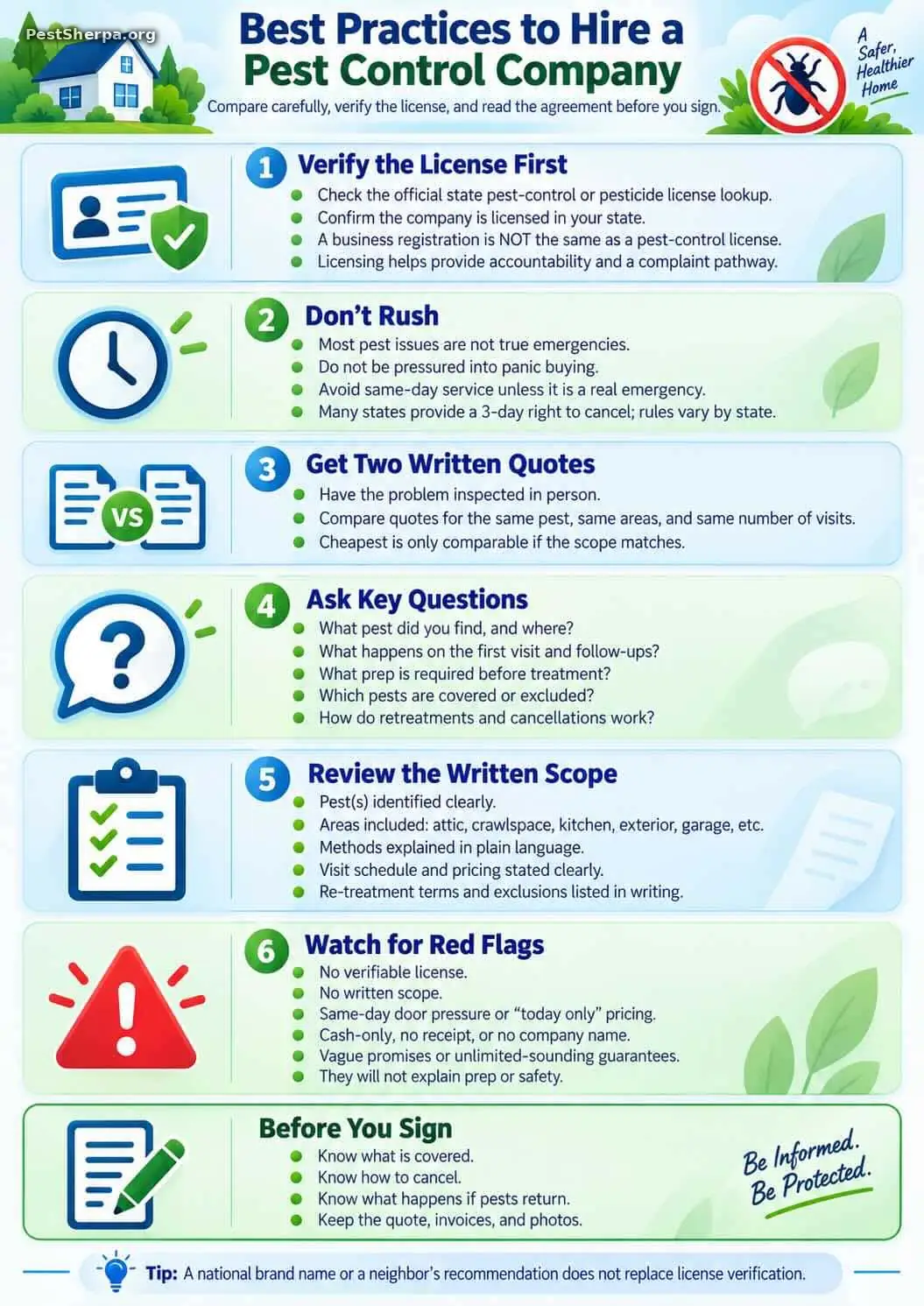
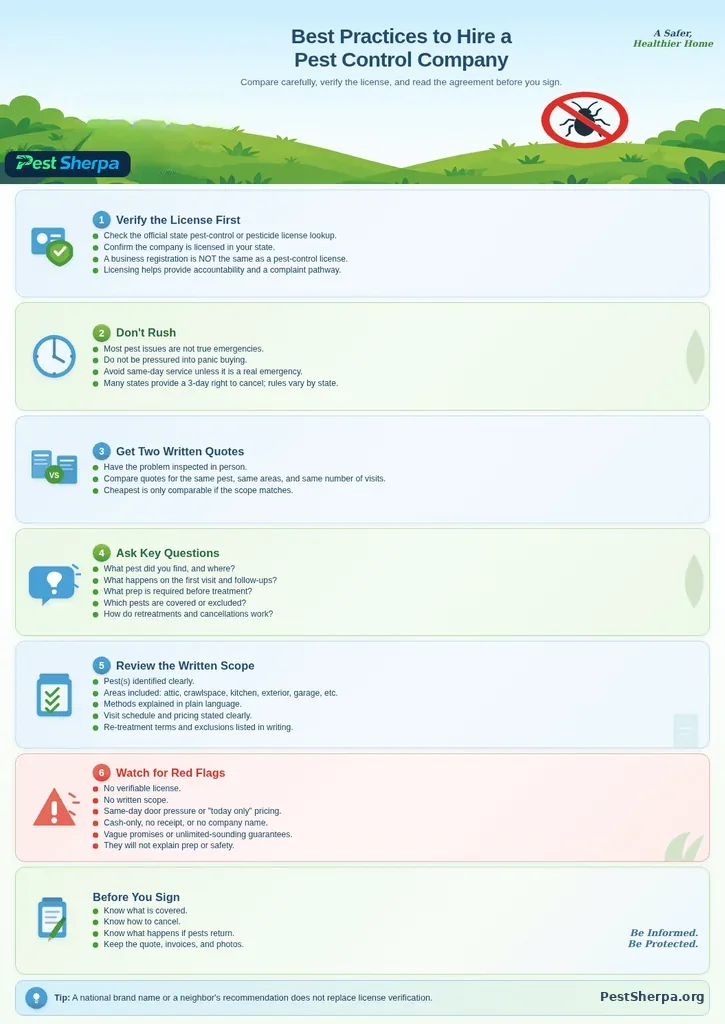
Before you hire, verify the license requirements in your state, ask a few plain questions on the quote, and read what you are signing. That order has saved me more headaches than any “best company” list. At the same time, understand that very few pest issues and certainly services to maintain a pest free environment are generally not emergencies. Do not be pressured into panic buying. Also, most states have a three day right to cancel requirements when a service agreement is signed, so know your rights. Unless a true emergency, do not allow same day service when you engage a pest control company as generally, that eliminates your three day right of remission depending on the state.
Why a licensed company matters
A license is the first filter I use. In most states you cannot legally apply pesticides for hire without one. That protects your family, pets, and house, and it gives you a service records trail if something goes sideways. The license we are referring to here is not just a license to do business in a state, whether pest control, dry cleaning, or tax preparation as examples, but a specific license to perform pest control services in a state. The name used varies and depending on the state might be called license, pest control business license, charter, etc. In many states, the license number to perform pest control work must be posted in the office and listed on service vehicles.
- Usually required by law. Because it is federal law, states require a business license with at least one certified applicator before restricted pesticides are applied for hire. While applying restricted use products is very rare in most cases, states still generally require at least one certified applicator on staff. Also, nearly every person performing service will have met state requirements and may be registered technician or similar designation. All require periodic update training.
- Insurance tends to ride with it. A licensed firm is required by law to self insure or carry insurance coverage that helps if services damage property or injury people or pets.
- Label rules are real. Pest control companies are read, understand, and follow the product labels which accompany pesticides. Any label violation is a violation of federal law.
- There is a documentation as to what was done and how it was done. A license number ties the work to a company and is subject to inspection by state regulatory agencies.
- You have a place to start a complaint. If service fails or a company may have violated state regulations, start by contacting the company for clarification. If the issue is not resolved, the state regulatory agencies, frequently working with consumer services staff, might investigate and can help resolve the issue.
A license is not a quality score. It does not mean every tech is excellent. It means they are allowed to do the work where you live, and that the state oversees compliance with the laws and regulations. That is the main consideration before price.
Use the official pest-control / pesticide license checker below. I’ve seen people stop at a secretary-of-state filing for a generic business license, a city tax receipt, or “bonded and insured” on a truck. Those are not a pesticide license.
National brands vs local companies
I do not rank companies here. Big brands often bring call centers, packaged plans, extensive advertising, and transferable warranties. Local companies and branches of national companies know your soil, housing stock, and which pests show up and when. Either can be fine. Still verify the license, and get the scope in writing before you sign.
A national logo is not a license. A neighbor’s recommendation is not either. Use the official checker, then compare written quotes on the same pest and the same areas.
Check their license
Pick your state, tap Next, and open the official lookup. Search by company name, or by license number if they gave you one. Come back and answer Yes or No.
Keep this tab open. Check the license in the new window, then come back and tap Yes or No.
If that search tool moved, start from the agency page linked above.
Is this company properly licensed?
Yes means you found an active license that matches that company. No means you did not, I’d look elsewhere before spending time on quotes.
Finish the official lookup, then tap Yes or No.
Questions to ask before you hire
Have someone look at the problem in person, then get two written quotes. Keep it short. I ask roughly these:
- What pest did you find, and where is it living or where were the signs?
- What will you do on the first visit, and what happens on follow-ups?
- What do I need to do before you treat, clean up, move items, fix moisture, seal gaps?
- What is included in writing: pests, areas, visit count, and what is left out?
- If I still see activity, how do re-treatments work, and is that written?
- Which pests are covered vs excluded, termites, bed bugs, wildlife?
- If I sign a service agreement (contract), can I cancel? How?
What a good written quote includes
A useful quote is boring on purpose. Hand it to a spouse or roommate, they should understand the plan without another sales call.
- Pest(s) described clearly: not just “pests.” If they are not sure, they should say what they will check next.
- What to do if a pest not covered by the agreement is found? How is that priced?
- Areas and access: kitchen, attic, crawl, exterior, garage, and whether they need keys or cleared storage.
- Method in plain language: sprays, baits, dusts, monitors, exclusion, sanitation. Skip jargon; know what happens on site.
- Visit schedule: one-time, monthly, bi-monthly, seasonal, and how many visits sit in the first price.
- Exclusions: wildlife, wood-destroying insects, bed bugs, or anything that needs a different service.
- Re-treat rules: what they do if activity continues, and what voids it (skipped prep, denied access, unpaid renewals).
- Price with matching scope: compare quotes only when pest, areas, and visit count match. A cheap bid that skips the attic is a different job.
Red flags when hiring pest control
You can walk away. I’ve seen these often enough that they earn a pause:
- No license you can verify: or only a generic business number instead of a pesticide / pest-control license.
- Same-day door pressure: especially “today only” pricing before anyone has looked at the problem.
- No written scope: “we’ll take care of everything” with nothing on paper.
- Unlimited-sounding guarantees: then exclusions buried until after you sign.
- Cash-only, no receipt, no company name, you want a paper trail if something goes wrong.
- They will not name the pest, or invent urgency that does not match what you are seeing.
- They will not explain prep or safety, kids, pets, food surfaces, and re-entry should be plain English.
When professional help matters
Plenty of small problems respond to sanitation, sealing, and store-bought tools. Many people want to know more about pests and options before they call a professional. Many people also want to try to control pests on their own. While a professional industry is in place, frequently people don’t want to deal with pests or have tried unsuccessfully. The professional is trained and must attend period educational courses or retake exams to keep their credential. Call a licensed company when the source looks bigger than a one-afternoon fix:
- Activity keeps returning after you cleaned, sealed, and removed the obvious food or water.
- You suspect a nest or breeding site you cannot reach, wall voids, attic, crawl, drains.
- Health or contamination risk in kitchens or bedrooms, or around kids and pets, and you want a plan, not guesswork.
- You need products or methods that are not over-the-counter, or that need training to use safely.
- A landlord, buyer, inspector, or health department wants documented treatment.
This page does not sell a service. It helps you hire carefully once a pro is the next step.
Before you sign the contract
Before you sign, make sure you can explain these in your own words, if not, ask again.
- What is covered. Which pest, which areas, what they will do, how often they return, and what is left out.
- How you can stop. Cancel rules, notice, and whether you are locked in for months.
- What happens if pests return. Re-treat terms, how long, and what voids the promise.
Common questions
Do I need a license number before I get a quote?
Quotes can come first. Verify the license before anyone treats. I prefer companies that give a number you can check above.
Is the cheapest quote usually fine?
Only if pest, areas, and visit count match. A low bid that skips the attic or follow-ups is a different job.
What if they are licensed in another state?
They need to be licensed where your home is. Use the tool above. Some states allow reciprocal work but this does not mean that license in one state is accepted in another. It usually means that pre-requisites are waived and a credential in one state qualifies for credential in another state.
Should I be home for the visit?
Usually yes for the first look and prep questions. Ask about access (kitchen, attic, crawl) and re-entry time after treatment.
Service agreement vs one-time?
One-time is a defined visit or short series. A service agreement is recurring visits for named pests. General plans often exclude termites, bed bugs, and wildlife, read the list.
Where do I complain?
Start with the same state agency behind the license lookup. Keep invoices, the written scope, and photos.
Is a business registration the same as a pest-control license?
No. A secretary-of-state filing or city tax receipt is not a pesticide license.
Can I hire “natural only” and skip the license check?
Request reduced risk methods if you want them. Still requirements for “natural” or “low impact” still requires compliance with licensing requirements.
Not sure what you have?
Not sure what you have? Start with a guide for ID and next steps, then come back here to hire:

Ant Guide: Identification, Risk, and What to Do
Cockroach Guide: Identification, Risk, and What to Do
Bed Bug Guide: Identification, Prevention, and What to Do

Rodent Guide: Identification, Risk, and What to Do
Fly Guide: Identification, Breeding Sources, and What to Do
Mosquito Guide: Identification, Bite Risk, and Yard Control
General pest plans often exclude termites, bed bugs, and wildlife. Ask what is covered, what needs a separate service, and get that exclusion list in writing. For termite-specific work, the Termite Control hub explains inspection and warranties language buyers often see.
Educational guide only. Not a ranking, not prices, and not legal, insurance, or pesticide advice. License databases change: verify on the official state site. Rules vary by state.
This article was written by Greg Baumann, founder of Pest Sherpa, and reflects more than 40 years of professional pest management experience.
About the Author

Greg Baumann | Pest Control Expert
Greg Baumann is the founder of Pest Sherpa and a Pest Control Expert with more than 40 years of professional pest management experience. His articles combine decades of field experience, technical expertise, and science-based guidance to help homeowners identify pests correctly, understand real-world risks, and make informed pest management decisions.
Mission: Identify the pest. Understand the risk. Stop the problem. Prevent the comeback. Know when it’s time to call a professional.