
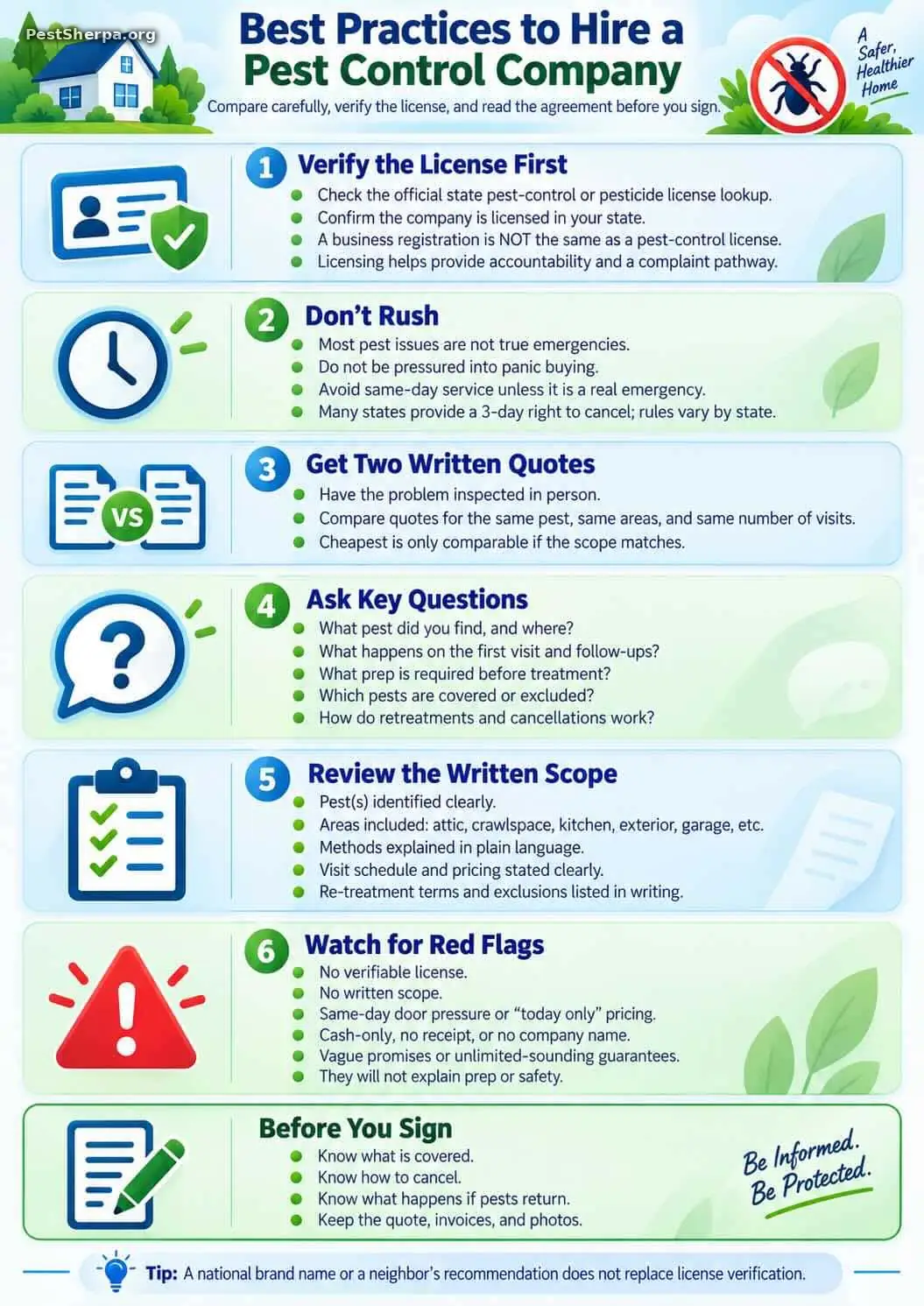
How to Hire a Licensed Termite Company
Field notes on hiring for termites: not a ranking, not a price list, and not legal advice.
Before you hire for termites, confirm they are licensed for termite or wood-destroying organism work in your state, get a real inspection before treatment, and compare method and warranty in plain English. Price comes last.
Why a licensed termite company matters
Termite work is not a quick spray task. Most states require a structural pest and/or wood-destroying insect (WDI) or wood destroying organism (WDO) credential, licensed for that work, not just general household pest control. It is surprising that companies offering termite control services without proper training, licensing, and state required insurance still exist. This is why it is important to check licensing before you agree to purchase any service.
- Termite / WDI/WDO is often its own category. Most states require a structural or WDO credential beyond a basic pest license. Ask for that, then verify it. In some states, just performing a termite or WDI/WDO inspection does not require any special licensing.
- Insurance matters more on structures. Treatment can mean drilling, trenching, opening walls for wood treatment, or bait stations around the foundation. Coverage should match that work in case the company damages property.
- Termiticide (termite control chemical) labels are strict. Licensed firms are expected to follow the label without exception.
- Long warranties need a real company. A license ties multi-year retreat promises to a firm the state can still fine later.
- You have a place to start if things go wrong. Wrong inspection or ignored warranty: the state license file is often step one.
Inspection comes before treatment quotes. I’ve seen companies sell soil treatment or bait without a clear graph, a layout of the structure and where the wood destroying insects/organisms such as fungi, were found. While information is commonly documented electronically, and a “graph” is not required unless the state has that in their regulations, you need a clear picture of findings. That also helps when comparing findings of several companies. Selling a service that is not needed is unethical unless it is sold to you as a preventative treatment.
Verify the right license category. Use the checker below and look for termite / structural / WDO wording where your state uses it. A general pesticide card alone may not be enough. Do not confuse this with a secretary-of-state business filing.
National brands vs local termite companies
I do not rank companies here. National brands may emphasize transferable warranties and multi-state paperwork. Local firms may know your soil, slab vs crawl, and which termites show up in your county. Either way: confirm termite / WDO licensing where required, insist on an inspection graph before price, and read method plus warranty in plain English.
Check their license
Pick your state, tap Next, and open the official lookup. Search the company. If your state shows categories, confirm termite / structural / WDO, not only a general pest listing. Then answer Yes or No.
Keep this tab open. Check the license in the new window, then come back and tap Yes or No.
If that search tool moved, start from the agency page linked above.
Is this company properly licensed?
Yes means you found an active license that fits termite or WDO work for that company. No means you did not, I would not move on to treatment quotes yet.
Finish the official lookup, then tap Yes or No.
Questions to ask before you hire
Ask for an on-site inspection and a simple graph of findings before you compare treatment proposals. I ask roughly these:
- What evidence of termites (or other wood-destroying insects) did you find, and where?
- Do I need treatment now, monitoring, or both, and why?
- Which method (liquid, bait, or both) and why for this house?
- What does the warranty cover, how long does it last, and what voids it?
- If activity continues under warranty, what do you do, and how fast?
Inspection vs treatment proposal
Keep the order straight: inspection graph → method → warranty → then price. A quote without findings is a product pitch.
- Inspection / graph. Where evidence was found (or not found), and whether it looks active or old. Keep a copy.
- Method. Liquid soil treatment, bait system, wood treatment, or a mix, and why that fits this house. For ID and lookalike beetle damage, use the guide cards below.
- Warranty. Years of coverage, annual inspections, transfer rules, and what voids it, in writing.
- Price last. Compare two proposals only when method and areas match. For context, here are typical termite treatment costs by method.
Liquid vs bait (plain English). Liquid soil treatments create a treated zone in the soil around or under the foundation. Bait systems use stations that termites feed on and share in the colony. Neither is “always better.” Ask which fits the species clues, construction, and access on your property, and how the warranty works with that method.
What a good termite proposal includes
A solid proposal starts with an inspection graph, not a same-day pitch. You should see findings and a method that matches them.
- Inspection graph / diagram / map- where evidence was found (or not), and whether damage looks active or old.
- Insect identification or evidence named: subterranean vs drywood clues matter; the treatment path differs.
- Method and why: liquid soil, bait, wood treatment, or a mix, tied to this house, not a package name.
- Areas and access: drilling, trenching, crawl entry, vegetation clearances.
- Warranty in plain English: years, annual inspections, transfer rules if you sell, and what voids it.
- Re-treat process: who you call, what they will do, and whether monitoring visits keep the warranty alive.
- Price tied to the graph: compare proposals only when method and areas match. A cheaper bid that skips the garage slab is a different job.
- Termites in the mulch: that is naturally the habitat for subterranean termites; that does not mean that your structure is infested.
Red flags on termite sales
Termite decisions are structural. I’ve seen these often enough that I slow down:
- Treatment quote before a real inspection, or no graph of findings you can keep.
- Must-sign-today pressure: especially before you can sleep on the warranty language.
- License you cannot verify for termite / WDO, a vague “pest control” card may not cover structural work in your state.
- Fear language without evidence: “your house will collapse” without tubes, damage, or frass.
- One method for every house: with no explanation of why liquid or bait fits what they found.
- Warranty that disappears in fine print, annual fees, denied access, or transfer rules never explained up front.
- Cash deals with no company paperwork, you want a named firm on the invoice and warranty.
- Termites in the mulch: that is naturally the habitat for subterranean termites; that does not mean that your structure is infested.
When a termite professional matters
Helpful homeowner work is moisture control, wood-to-soil separation, and keeping evidence intact for an inspector. Structural treatment is not a weekend spray project:
- You found mud tubes, hollow wood, discarded wings indoors, or drywood frass under kick-out holes in furniture or accessible wood areas.
- A home inspection or WDO report flagged possible termites and you need confirmation.
- You are buying or selling and need an inspection for the buyer to obtain a mortgage; frequently, the buyer orders the inspection and not the seller but in some states, the seller must provide that service. The inspection report in this case must reported on the official state inspection form.
- Activity continues after a prior treatment, or you inherited an old warranty you do not understand.
- The job may need drilling, trenching, bait stations, or products not sold for casual DIY use.
This page does not sell termite work. It helps you hire carefully when an inspection says treatment is next.
Before you sign the contract
Compare proposals on method and warranty, not on same-day sales pressure.
- Method and areas. Liquid, bait, wood treatment, or all; where they will treat; and what is left out.
- Warranty and re-treatment. Years, transfer rules, required inspections, and what they do if termites return.
- No rush. Take time to read the documentation and warranty. Same-day pressure is a red flag.
Common questions
Do I need a license number before I get a quote?
Get the inspection first and find out if the inspector must be and is licensed in the state. Before treatment, verify termite / WDO licensing in your state, not only a general pest card. A general tax business license not specific for pest control is not adequate and in most states, not acceptable for termite work.
Is the cheapest quote usually fine?
Compare method and areas on the graph or documentation first. A cheaper bid that skips part of the foundation is not the same treatment. In some cases, the cheapest might be just fine; but, make sure that the cheapest is also as thorough as the other quotes. All things being equal, you’ll have a feel for the company that you are most comfortable with.
What if they are licensed in another state?
They need the right credentials where your house is located. Use the official checker for your state. If unclear, contact the regulatory agency under the checker for confirmation.
Should I be home for the inspection?
Yes when you can. Walk the findings and keep the graph or documentation. Ask about attic, basement, crawl, and slab access.
Inspection vs treatment proposal?
Inspection documents evidence (active vs old). The proposal names method, areas, warranty, and price. Keep that order: see Inspection vs treatment proposal above.
Where do I complain?
Start with the company. If you are not satisfied, contact the same state agency behind the license lookup. Bring the graph, contract, and warranty.
Is a general pest-control license enough for termites?
Often no. Many states split structural / WDO categories. Ask, then verify.
How do I know if damage is active or old?
That is an inspection question. Ask which evidence looks active. Old damage alone does not always mean that a treatment is needed.
Related guides
Start with ID and damage context, then come back here for licensing, questions, and the proposal. Also see the hire hub When to Hire a Pest Pro vs DIY and What to Look for When Hiring a Pro for Termites.

Termite Guide: Identification, Damage Risk, and What to Do

Wood-Boring Beetle Guide: Identification, Damage Risk, and What to Do
Educational guide only. Not a ranking, not prices, and not legal, insurance, or pesticide advice. License databases change: verify on the official state site. Termite / WDO categories vary by state.
This article was written by Greg Baumann, founder of Pest Sherpa, and reflects more than 40 years of professional pest management experience.
About the Author

Greg Baumann | Pest Control Expert
Greg Baumann is the founder of Pest Sherpa and a Pest Control Expert with more than 40 years of professional pest management experience. His articles combine decades of field experience, technical expertise, and science-based guidance to help homeowners identify pests correctly, understand real-world risks, and make informed pest management decisions.
Mission: Identify the pest. Understand the risk. Stop the problem. Prevent the comeback. Know when it’s time to call a professional.