
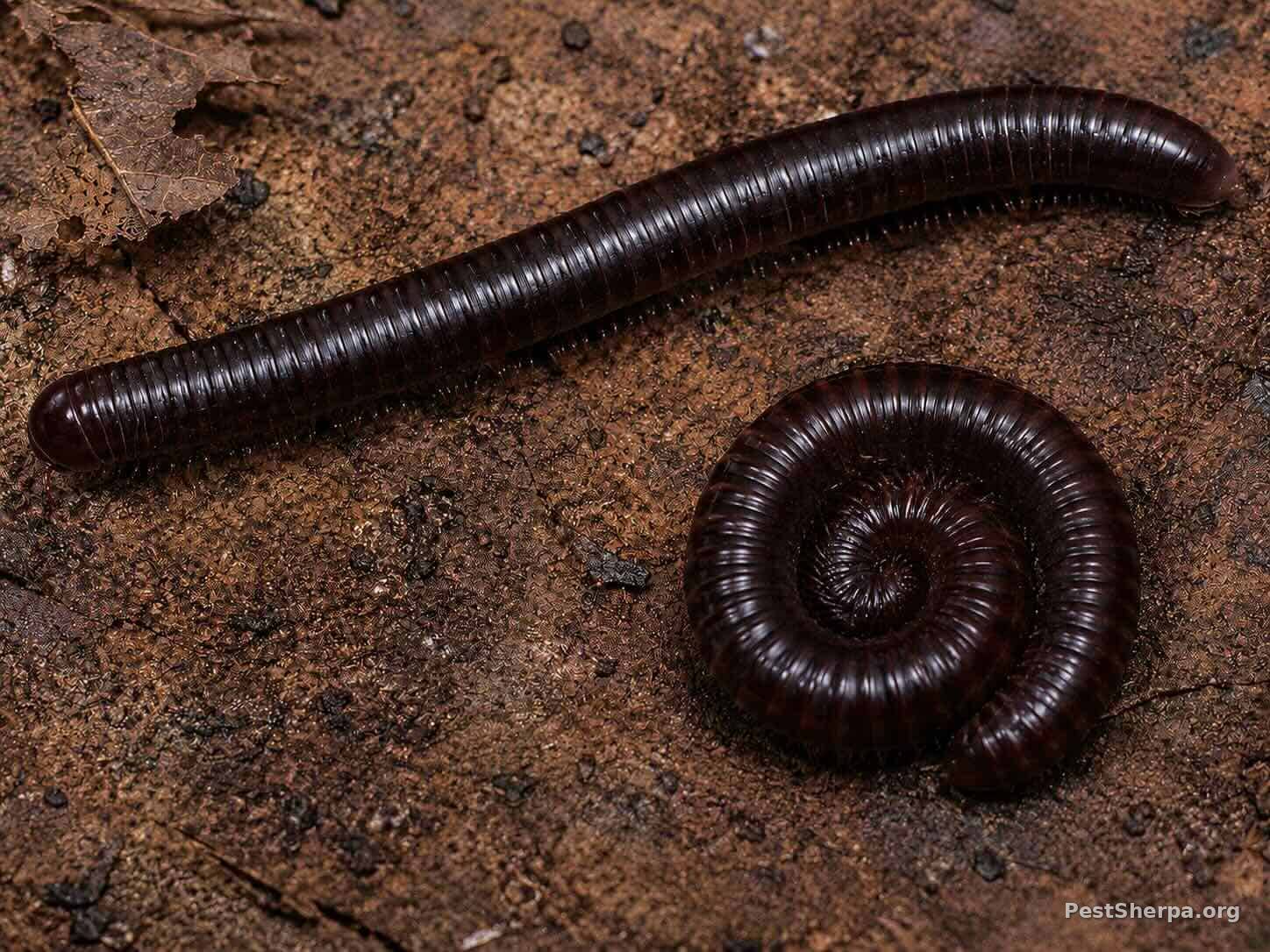
Millipedes keep dying in my kitchen corners and leaving red stains on the linoleum. What cleaner will remove the stains?
Short answer: Start with regular dish detergent in water. If that does not lift the stain, make a paste of a borax-based or oxi-based laundry detergent and water, leave it on the stain for a few minutes, then wipe, rinse, and check your progress. Test anything you use in an inconspicuous spot first, and avoid bleach, which would likely severely discolor your floor. Then work on how the millipedes are getting in.
Which millipedes are leaving the stain?
Without seeing the millipedes, there are a few assumptions that have to be made. It is likely that the small black millipedes are the ones leaving the stain. Red millipedes do occur, including in Virginia, but they are rather large, and it would be very unusual to find them inside the house. For pictures and a full ID, see my millipede identification guide.
Many millipedes release a defensive fluid when they are disturbed, and university extension sources note that crushed millipedes can leave stains. That may be part of why these marks hold on so stubbornly.
How to clean the stain, step by step
- Test first. For anything you put on your floor, test it in an inconspicuous area to make sure it will not discolor the floor.
- Start mild. Try regular dish detergent in water as your first choice.
- Step up to a paste. If that does not work, mix a borax-based or oxi-based laundry detergent with water into a paste and leave it on the stain for a few minutes.
- Wipe, rinse, and check. Look at your progress before you decide on another round.
- Skip the bleach. Bleach would likely severely discolor your floor.
Why they end up dead in the corners
Millipedes live outdoors in mulch, leaf litter, and damp soil, and they need moisture to survive. Indoors, the air is usually too dry for them, so most die within a short time. They wander along walls and baseboards, so the bodies collect in corners. If you keep finding live millipedes instead of dead ones, extension specialists say that can point to extra moisture indoors, so it is worth checking under the sink and along the floor for leaks.
Stop them at the entry point
If these are the large red ones, figure out how they are getting in and eliminate the entry point by sealing or caulking. The same approach helps with the small black ones. A few places to look:
- The door sweep and threshold on the nearest exterior door.
- Gaps around pipes and lines where they come through the wall under the sink.
- Thick mulch and leaf litter piled against the house near the kitchen. Pulling it back and letting the soil dry between waterings makes the area less inviting.
Clean up without making new stains
Sweep or vacuum dead millipedes instead of stepping on them, especially on light-colored floors, and wash your hands if you handle them. Indoor sprays rarely help here because the source is outside.
Related guides
- Millipedes in the House: Identification, Causes, and What to Do
- Moisture Pest Guide
- More Ask the Sherpa Q&A
- Ask the Sherpa: send Greg your question
References
- Clemson HGIC: Millipedes
- University of Minnesota Extension: Sowbugs, millipedes and centipedes
- UC IPM: Centipedes and Millipedes
This article was written by Greg Baumann, founder of Pest Sherpa, and reflects more than 40 years of professional pest management experience.
About the Author

Greg Baumann | Pest Control Expert
Greg Baumann is the founder of Pest Sherpa and a Pest Control Expert with more than 40 years of professional pest management experience. His articles combine decades of field experience, technical expertise, and science-based guidance to help homeowners identify pests correctly, understand real-world risks, and make informed pest management decisions.
Mission: Identify the pest. Understand the risk. Stop the problem. Prevent the comeback. Know when it’s time to call a professional.