
Millipedes in the House: Identification, Causes, and What to Do
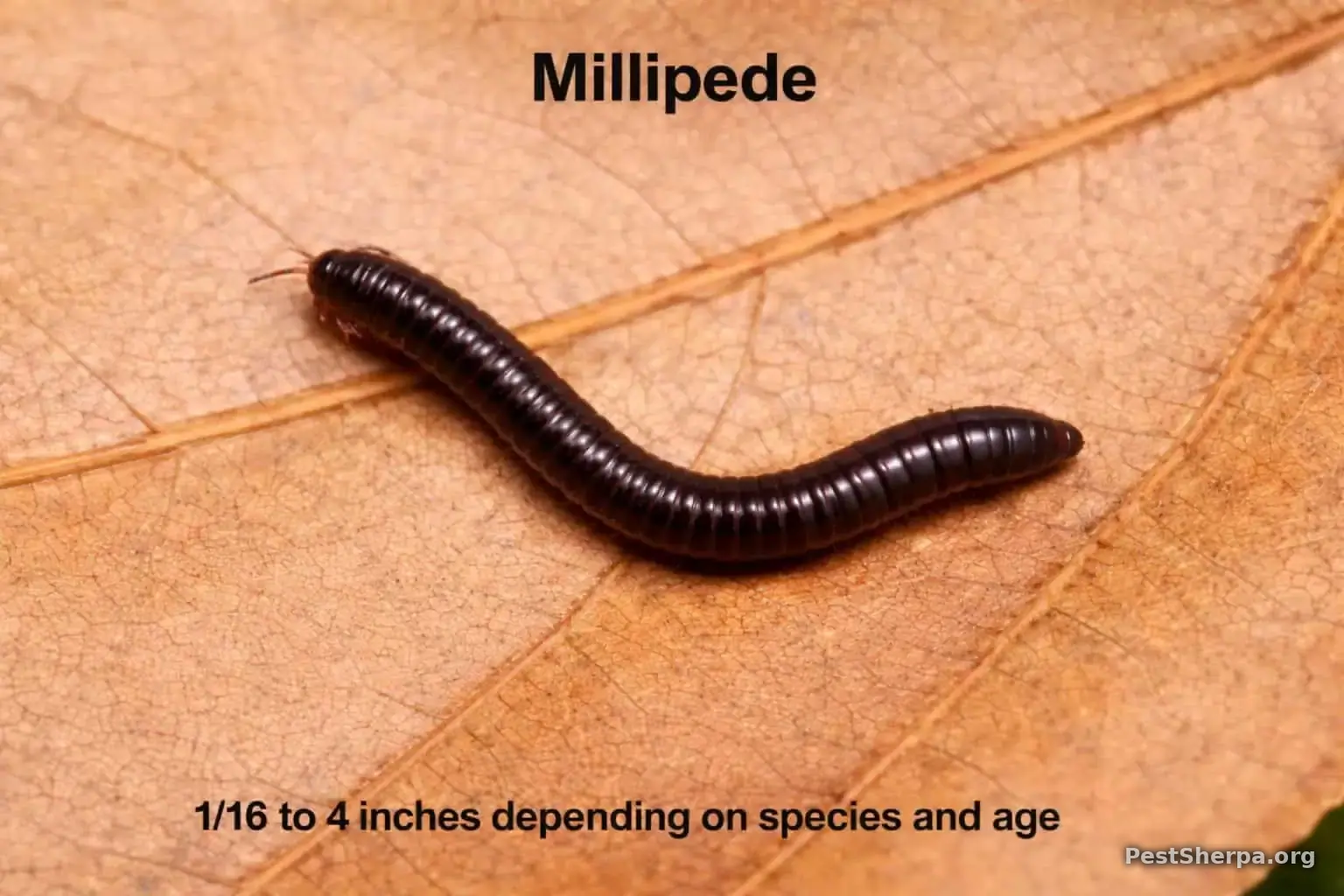
In more than 40 years of pest work, millipede calls almost always started the same way: a homeowner finds dozens of slow, dark brown “worms with legs” curled up on the basement floor or garage slab after a stretch of heavy rain. Here is the short answer I give them. Millipedes are harmless decomposers that live in damp mulch, leaf litter, and soil, and they wander inside when conditions outside change. They do not bite, they do not breed in your living space, and they dry out and die within a day or two indoors.
Quick ID: if it moves slowly, has two pairs of short legs on most body segments, and coils up tight when you touch it, it is a millipede. If it is flat, fast, and has one pair of long legs per segment, it is a centipede. Below I cover how to tell them apart, why they show up all at once, and what actually stops them.
TL;DR
If you are finding millipedes indoors, the main issue is usually moisture and outdoor habitat near the structure, not an indoor breeding infestation. Millipedes normally live outside and often enter homes after heavy rain, prolonged wet soil, drought, seasonal movement, or disturbance of mulch and leaf litter.
Most millipedes do not bite, sting, spread disease, damage sound wood, or survive long indoors. The best next step is to vacuum or sweep up indoor millipedes. Then reduce damp organic material near the foundation, improve drainage, dry damp indoor areas, and seal gaps around doors, windows, vents, and utility openings.
Quick Navigation
- Quick ID
- What Are Millipedes?
- How to Identify Millipedes
- Millipedes vs. Centipedes
- Where Millipedes Live
- Why Millipedes Enter Structures
- Source Investigation Checklist
- Are Millipedes Harmful?
- What To Do
- What Does Not Work
- How Long Millipedes Last Indoors
- When Professional Help May Be Worth Considering
- Lookalikes
- FAQs
- References
Quick ID: Is It a Millipede?
| Feature | Millipede Clue |
|---|---|
| Body shape | Long, rounded, cylindrical, or slightly flattened body with many segments |
| Legs | Two pairs of legs on most body segments; legs are usually short and tucked beneath the body |
| Movement | Slow, steady crawling rather than fast running |
| Defense | Often curls into a tight coil when disturbed |
| Indoor location | Basements, garages, crawlspace entries, door thresholds, patios, foundation edges, and damp lower-level rooms |
| What it usually means | Outdoor moisture, mulch, leaf litter, or foundation entry points are likely involved |
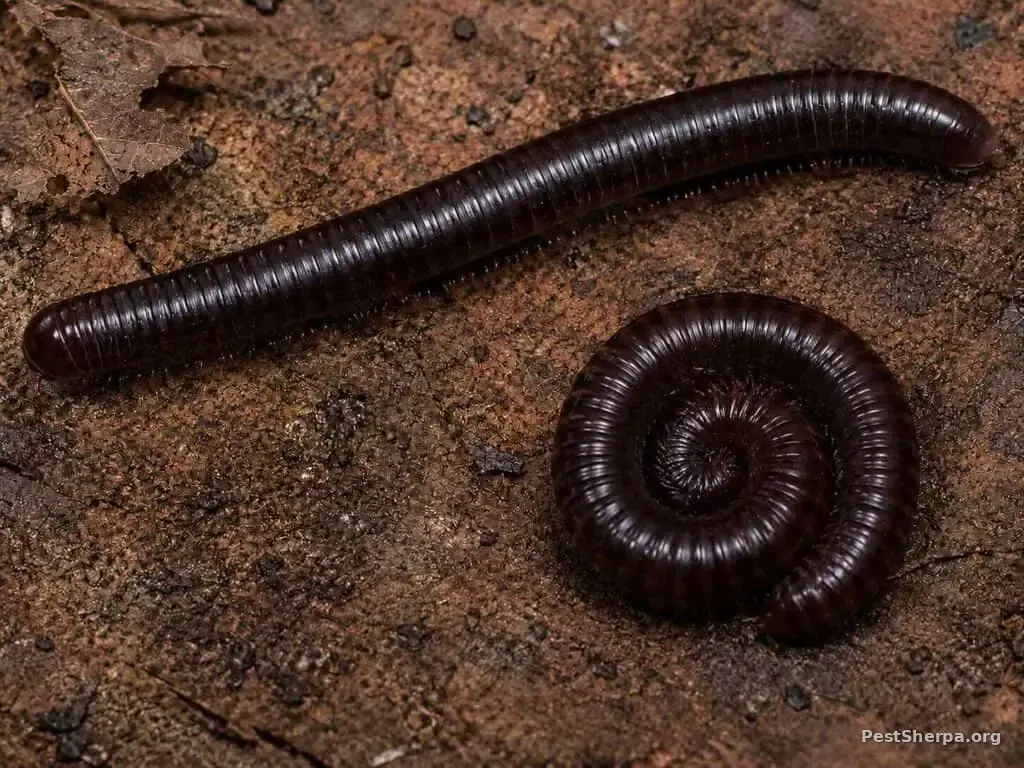
Common millipede showing rounded body, many short legs, and curled defensive posture.
What Are Millipedes?
Millipedes are arthropods in the class Diplopoda. They are not insects, spiders, or worms. Most species live in damp outdoor habitats where they feed mainly on decomposing leaves, rotting wood, grass clippings, fungi, and other organic material.
Outdoors, millipedes are beneficial decomposers. Their feeding activity helps break down dead plant material and return nutrients to the soil. Around homes, however, they can become nuisance invaders when large numbers move out of wet mulch, leaf litter, lawns, or soil near the foundation.
The name “millipede” means “thousand feet,” but most millipedes have far fewer than one thousand legs. The key identification feature is not the exact leg count. It is the pattern: millipedes have two pairs of legs on most body segments, while centipedes have one pair per segment.
How to Identify Millipedes
Millipedes vary by species, but common household-invading millipedes share several practical field marks.
Body Shape
Most millipedes have long, many-segmented bodies that look rounded, cylindrical, or slightly arched from above. Their legs are usually shorter and less obvious than centipede legs.
Size
Many common household millipedes are about 1 to 1 1/2 inches long, but size varies widely. Some species are tiny, while others can exceed 4 inches.
Color
Common colors include dark brown, reddish brown, gray, black, or mottled patterns. Some species have lighter stripes or bands along the body.
Leg Arrangement
Millipedes have two pairs of legs on most visible body segments. The first few body segments are exceptions, so do not rely on a single segment near the head for identification.
Movement
Millipedes move slowly. Their legs may appear to ripple in waves as they crawl. This slow movement helps separate them from fast-running centipedes.
Defensive Behavior
When disturbed, many millipedes curl into a tight spiral or coil. Some species can release defensive fluids that smell unpleasant, stain surfaces, or irritate skin or eyes. Avoid crushing them on light-colored floors, rugs, or walls, and wash your hands after handling them.
Millipedes vs. Centipedes
Millipedes and centipedes are often confused because both have many legs and segmented bodies. Their behavior and risk level are different.
| Feature | Millipede | Centipede |
|---|---|---|
| Body | Rounded or cylindrical | Usually flattened |
| Legs per segment | Two pairs on most segments | One pair per segment |
| Speed | Slow | Fast |
| Food | Mostly decaying organic material | Predator of insects and other arthropods |
| Defense | Curls up; may release defensive fluid | Runs quickly; some can bite if handled or trapped |
| Indoor meaning | Usually moisture and outdoor habitat near the structure | Often moisture plus indoor prey insects |
For a closer comparison, see the Pest Sherpa centipede identification guide. See also: What is the difference between a house centipede and a millipede?
Where Millipedes Live
Millipedes need moisture because they dry out easily. Outdoors, they stay hidden in damp, shaded places during the day and may become more active at night or after rain.
Common millipede habitats include:
- Leaf litter beneath trees and shrubs
- Mulch beds and landscape plantings
- Compost piles
- Rotting logs, bark, stumps, or wood debris
- Under stones, boards, pavers, pots, or landscape timbers
- Thick grass, lawn thatch, and damp soil near foundations
- Clogged gutters, splash zones, and other damp exterior areas
Finding millipedes indoors usually points back to one or more of these outdoor conditions. That is especially true when activity is concentrated along ground-level doors, basement walls, garages, or foundation edges.
Why Millipedes Enter Structures
Millipedes enter homes by accident. They are not looking for people, stored food, clothing, furniture, or sound structural wood. Most indoor sightings happen when outdoor conditions change suddenly or when a large outdoor population is close to the building.
Common triggers include:
Heavy Rain or Saturated Soil
Extended rain can flood mulch, leaf litter, thatch, and soil spaces where millipedes normally hide. They may move to patios, driveways, foundation walls, garages, or lower-level entries while searching for a more suitable place.
Drought or Drying Habitat
Prolonged dry weather can also trigger movement as millipedes search for moisture. This is why activity may follow either very wet or very dry weather.
Seasonal Movement
Millipede migrations are often seasonal. In many areas, activity increases in spring, late summer, or fall, depending on local moisture, temperature, and habitat conditions.
Mulch, Leaves, and Moisture Against the Foundation
Deep mulch, wet leaves, clogged gutters, overwatering, and poor drainage can create ideal millipede habitat directly beside entry points. This makes indoor migration more likely.
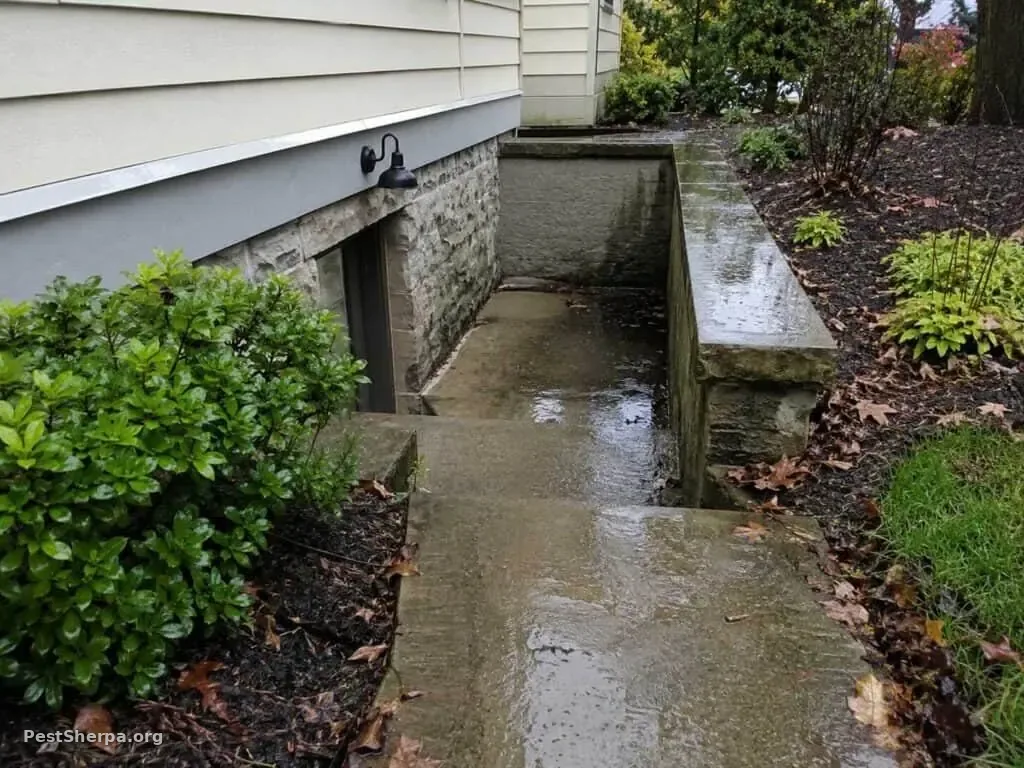
Common millipede habitat conditions which can lead to home entry including wet excessive mulch, leaf litter, foundation cracks, and door gaps.
Millipede Source Investigation Checklist
Use the location of the millipedes to narrow down the source. The window, wall, or floor where they are found is usually not the breeding site. It is often the path they followed after entering.
Step 1: Map Where You See Them
- Are they mostly near one exterior door?
- Are they along basement walls or floor edges?
- Are they appearing near a garage threshold?
- Are they concentrated on one side of the house?
A concentrated pattern often points to a nearby outdoor moisture or entry issue.
Step 2: Check Outdoor Moisture
- Downspouts discharging near the foundation
- Standing water or poor grading
- Leaking outdoor faucets or irrigation
- Wet mulch against siding or foundation walls
- Clogged gutters or roof runoff
Step 3: Check Organic Debris
- Leaf piles
- Grass clippings
- Compost
- Rotting wood
- Landscape timbers
- Dense groundcover touching the structure
Step 4: Check Entry Points
- Gaps under exterior doors
- Garage door gaps
- Cracks in foundation walls
- Loose basement window frames
- Openings around pipes, wires, vents, and utility penetrations
- Damaged screens, thresholds, or weather stripping
Step 5: Check Indoor Damp Areas
Millipedes usually die quickly indoors, but repeated sightings of live millipedes can indicate excess moisture inside. Check basements, crawlspaces, utility rooms, sump areas, laundry rooms, and slab edges for humidity, seepage, condensation, or leaks.
Are Millipedes Harmful to People, Pets, or Homes?
Millipedes are mainly nuisance pests indoors. They do not bite or sting, and they are not known as disease-spreading pests in homes. They also do not damage sound structural wood, clothing, stored food, or furniture.
The main concerns are nuisance numbers, unpleasant odor, possible staining from crushed millipedes, and mild irritation from defensive fluids in some species. Avoid rubbing your eyes after handling millipedes, and wash skin that contacts their secretions. Keep children and pets from playing with large numbers of millipedes or crushed bodies.
In gardens, some millipedes may occasionally feed on tender seedlings, soft plant tissue, or ripe fruit touching the soil. This is more likely when decaying organic material dries out. This is usually a garden issue rather than a structural pest issue.
What To Do About Millipedes
1. Remove Indoor Millipedes
Sweep or vacuum millipedes indoors. Empty the vacuum or dispose of collected bodies promptly, especially if there are many dead millipedes. Avoid crushing them on light-colored surfaces because some species can stain.
2. Reduce Moisture Near the Foundation
- Extend downspouts away from the foundation.
- Repair leaking outdoor faucets and irrigation lines.
- Improve grading where water drains toward the home.
- Allow soil and mulch near the house to dry between watering.
- Use dehumidifiers or ventilation in damp basements and crawlspaces when appropriate.
3. Adjust Mulch and Organic Debris
- Pull thick mulch back from foundation walls, siding, and door thresholds.
- Remove excessive leaf litter and grass clippings near the structure.
- Move compost piles and rotting wood away from the house.
- Store firewood off the ground and away from exterior walls.
- Thin dense groundcover so the soil can dry more quickly.
4. Seal Entry Points
- Install or repair door sweeps.
- Replace worn weather stripping.
- Caulk cracks around basement windows and foundation openings.
- Screen vents and repair damaged screens.
- Seal gaps around pipes, cables, utility lines, and wall penetrations.
5. Use Pesticides Carefully, If They Are Used at All
Pesticides are not always necessary for millipedes. Indoor sprays rarely solve the underlying issue because the source is usually outside. If a pesticide is considered, use only products labeled for the pest and the treatment site. Read and follow the entire label. Keep children and pets away from treated areas until the label says it is safe. Avoid applying products near food, drains, ventilation openings, or water sources unless the label specifically allows that use.
Habitat reduction, moisture correction, and exclusion are usually more important than spraying.
What Does Not Work Well for Millipedes
- Indoor spraying alone: It may kill some visible millipedes, but it does not correct wet mulch, leaf litter, drainage, or entry points outside.
- Bug bombs or foggers: These are a poor match for millipede problems. They can create unnecessary exposure risks when the issue is mostly outdoor moisture and entry.
- Only vacuuming once: Vacuuming helps indoors, but repeated activity usually means exterior habitat or entry points still need attention.
- Treating drains without evidence: Millipedes are not drain flies. Do not treat drains unless you have correctly identified a drain-associated pest.
- Ignoring moisture: Millipede activity often continues when basements, crawlspaces, foundation soil, mulch, or leaf litter remain damp.
How Long Will Millipedes Last Indoors?
Most millipedes do not survive long in dry indoor conditions. A small number may disappear within a few days after the weather changes or after obvious entry points are sealed. Larger migrations may last longer if wet mulch, leaf litter, drainage problems, or gaps around the structure remain uncorrected.
| Situation | What Usually Happens |
|---|---|
| One or two millipedes indoors | May be accidental entry |
| Many dead millipedes along walls | Likely outdoor migration followed by indoor drying |
| Live millipedes keep appearing | Check indoor moisture, exterior habitat, and entry gaps |
| Activity after heavy rain | Often tied to saturated soil, mulch, or leaf litter |
| Activity during drought | May be movement toward moisture |
When Professional Help May Be Worth Considering
Most millipede situations can be improved with moisture correction, habitat reduction, exclusion, and indoor cleanup. Professional help may be worth considering when the activity is heavy, repeated, or hard to trace. It may also help when the activity is tied to a moisture problem that is hard to correct.
Examples include:
- Large numbers of millipedes appearing repeatedly after rain
- Persistent live millipedes in a basement or crawlspace
- Suspected drainage, grading, or crawlspace moisture problems
- Millipedes entering through multiple foundation areas
- Situations where pesticide use is being considered and correct product selection, site restrictions, or label compliance are unclear
- Commercial, multifamily, childcare, food-handling, or sensitive environments where documentation and prevention planning matter
A useful inspection should focus on identification, moisture sources, outdoor habitat, entry points, and practical prevention. It should not stop at the millipedes you can see indoors.
Millipede Lookalikes and Common Misidentifications
Several moisture-associated pests are mistaken for millipedes. Correct identification helps avoid unnecessary or ineffective treatments.
| Lookalike | How It Differs | Why It Matters |
|---|---|---|
| Centipedes | Faster, flatter, one pair of legs per segment, often with longer legs | Predators; indoor sightings may also suggest other prey insects |
| Pillbugs | Gray, oval crustaceans; some roll into a ball | Also moisture-associated, but body shape is shorter and wider |
| Sowbugs | Gray, oval crustaceans with visible overlapping body segments; do not have a long cylindrical body | Often linked to damp exterior conditions near foundations |
| Springtails | Tiny, often jump, commonly found around moisture, plants, bathrooms, or damp slabs | Moisture correction is still important, but identification and source investigation differ |
| Earwigs | Six legs, pincers at the rear, faster movement | Occasional invaders that also use damp outdoor hiding places |
| Camel Crickets | Large jumping insects with long legs and a hump-backed body | Often found in damp basements, garages, and crawlspaces |
| Carpet beetle larvae | Small, fuzzy or bristly larvae; much fewer legs than millipedes | Can indicate stored product, fabric, dead insect, or animal-nest sources rather than outdoor millipede migration |
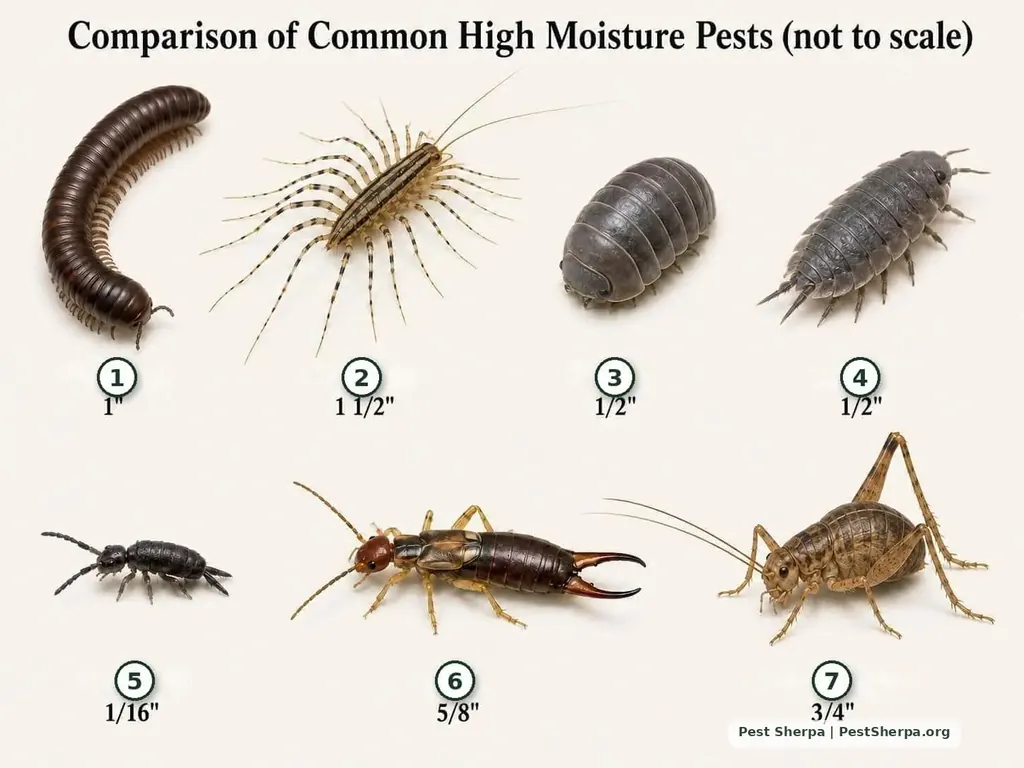
Which one did you find? Match the number:
- Millipede: round, dark brown body with two pairs of legs on most segments. Curls up when disturbed.
- Centipede (house centipede): flattened body with one pair of very long legs per segment. Fast runner.
- Pillbug: gray, armored and rounded. Rolls into a tight ball.
- Sowbug: gray and flatter, with two small tail spines. Cannot roll into a ball.
- Springtail: tiny, about 1/16 inch, and jumps when disturbed.
- Earwig: long brown body with pincers (forceps) on the tail end.
- Camel cricket: humpbacked, wingless and tan with very long hind legs and antennae.
Millipede lookalikes which like high moisture mulch, vegetation and wet concrete including centipede, pillbug, sowbug, springtail, earwig, and camel cricket.
Frequently Asked Questions About Millipedes
Why are millipedes suddenly in my house?
Sudden indoor millipede activity is usually tied to outdoor movement. Common triggers are heavy rain, saturated soil, drought, seasonal migration, or disturbed damp mulch and leaf litter near the building.
Does seeing millipedes mean my house is infested?
Usually no. Millipedes normally live outdoors and often wander indoors by accident. Repeated sightings usually mean the outdoor source, moisture condition, or entry point has not been corrected.
Do millipedes bite?
No. Millipedes do not bite or sting. Some species can release defensive fluids that may irritate skin or eyes, so avoid handling them with bare hands and wash after contact.
Do millipedes damage wood?
Millipedes may be associated with rotting wood and decaying organic material, but they do not attack sound structural wood like termites or wood-boring beetles.
Why are dead millipedes along my basement wall?
Millipedes often dry out after entering homes. Dead millipedes along wall edges usually suggest they entered from outside and could not survive the dry indoor environment.
Should I spray inside for millipedes?
Indoor spraying is rarely the best first step. Vacuuming, moisture reduction, habitat cleanup, and exclusion usually address the real causes more effectively. If any pesticide is used, read and follow the label and use only products labeled for the pest and location.
Are millipedes good for the yard?
Yes, in normal numbers. Millipedes help break down dead plant material and recycle nutrients. The goal around homes is usually prevention and exclusion, not eliminating millipedes from the landscape.
What is the fastest way to reduce millipedes indoors?
Vacuum visible millipedes, dry damp areas, remove wet organic debris near the foundation, and seal entry points. If activity continues, inspect the exterior side of the room or wall where they are appearing.
References
- UC IPM: Centipedes and Millipedes
- Clemson Cooperative Extension Home & Garden Information Center: Millipedes
- University of Missouri Extension: Millipedes and Centipedes
- University of Minnesota Extension: Sowbugs, Millipedes and Centipedes
- Colorado State University Extension: Millipedes, Centipedes, and Sowbugs
- University of Maryland Extension: Identifying Common Household Insect Pests
This article was written by Greg Baumann, founder of Pest Sherpa, and reflects more than 40 years of professional pest management experience.
About the Author

Greg Baumann | Pest Control Expert
Greg Baumann is the founder of Pest Sherpa and a Pest Control Expert with more than 40 years of professional pest management experience. His articles combine decades of field experience, technical expertise, and science-based guidance to help homeowners identify pests correctly, understand real-world risks, and make informed pest management decisions.
Mission: Identify the pest. Understand the risk. Stop the problem. Prevent the comeback. Know when it’s time to call a professional.