
Northern Giant Hornet (Asian Giant Hornet): Identification, Biology, Range, and Control
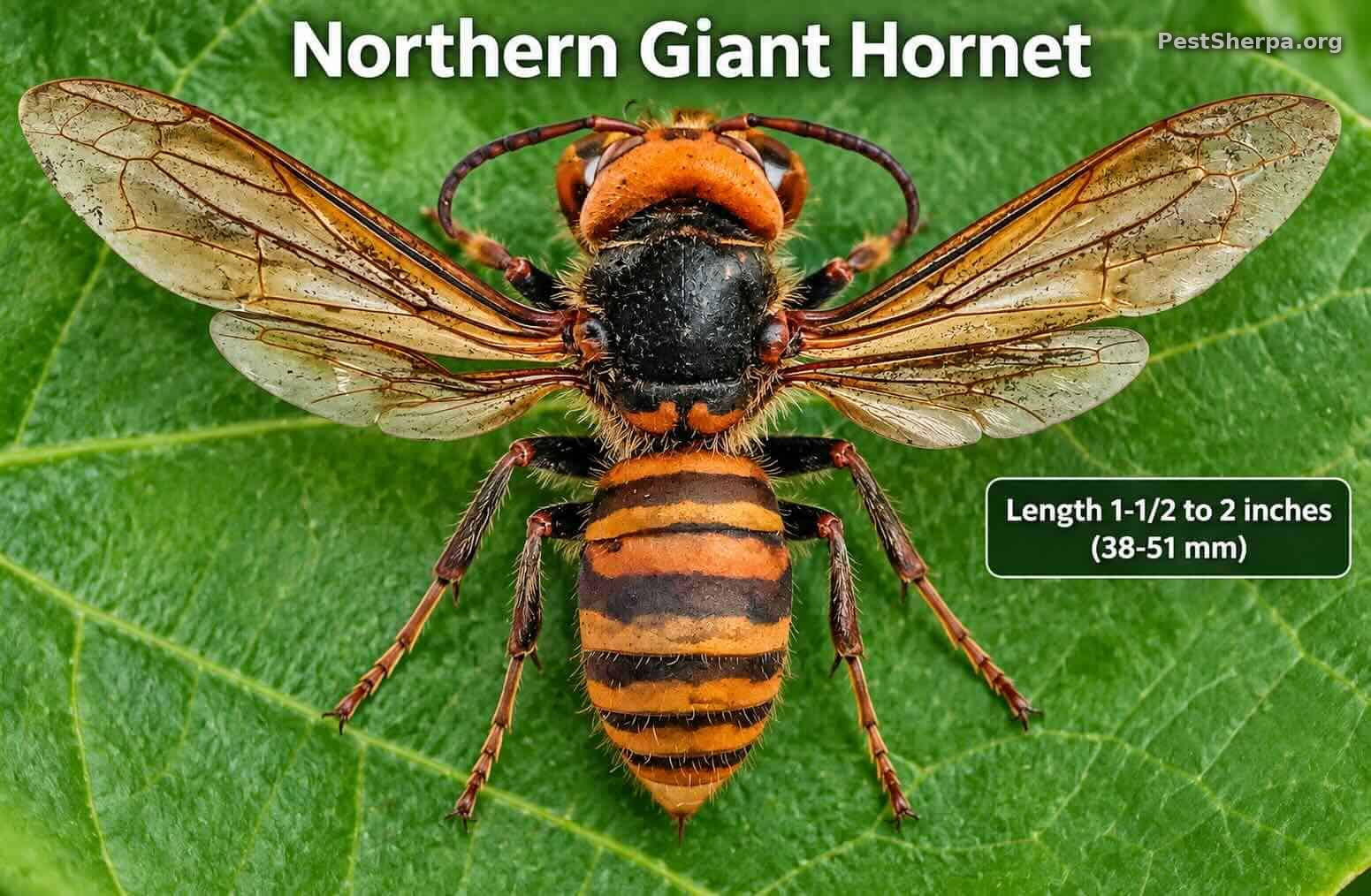
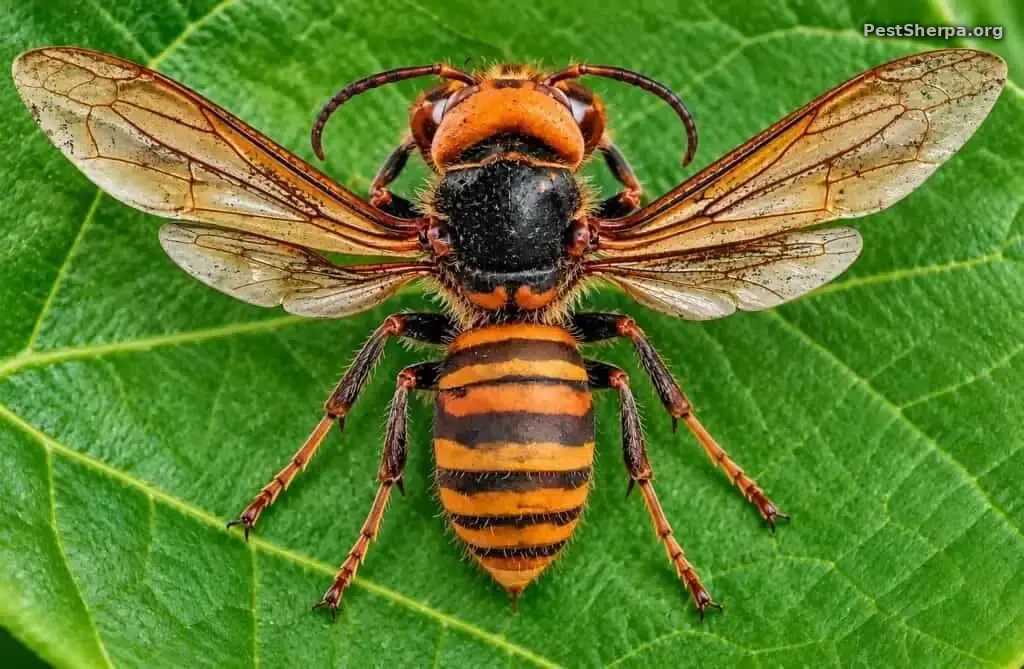
The northern giant hornet (Vespa mandarinia), formerly called the Asian giant hornet, is the largest hornet species in the world. Adults generally measure approximately 1½ to 2 inches (38 to 51 mm) long. Their enormous orange-yellow heads, dark thoraxes, and banded abdomens make them distinctive, although several large wasps native to or established in North America are sometimes mistaken for them.
The discovery of northern giant hornets in Washington State in 2019 raised particular concern among beekeepers. Unlike most hornets found in the United States, this species can organize group attacks against honey bee colonies, killing thousands of bees and removing the developing brood to feed its own larvae.
News reports frequently referred to the species as the “murder hornet,” a name that generated considerable public concern but misrepresented its normal behavior toward people. Northern giant hornets generally avoid human encounters unless threatened or defending their nests.
Northern giant hornets are no longer known to be established in the United States; however, the rumors and fears still are common. Following an extensive surveillance and eradication effort, Washington State and federal agricultural officials declared the species eradicated from the country in December 2024. No subsequent established U.S. population was identified in the official information available as of October 2026.
So why write about a species that appears to be eradicated from the country? Simple. This insect is still talked about and may return to the country on ships or planes, starting the entire process of eradication again. It is related to the invasive yellow-legged hornet, currently found in parts of Georgia, South Carolina, and North Carolina, which is the target of an eradication program very similar to the one for the northern giant hornet.
How to Identify a Northern Giant Hornet
The northern giant hornet is a large, robust wasp with an unusually broad head and powerful mandibles. Its combination of size, coloration, and body proportions separates it from other hornets and wasps.
Adult workers generally measure approximately 1½ to 2 inches (38 to 51 mm) long. Queens are usually larger than workers, and large individuals may exceed 2 inches (51 mm). Their wingspan can approach 3 inches (76 mm).
Important identification features include:
- Head: Broad and conspicuously orange to yellow-orange, with large dark compound eyes.
- Thorax: Predominantly dark brown to black, contrasting with the lighter head.
- Abdomen: Broad, with alternating yellow-orange and dark brown or black bands.
- Mandibles: Large, strong jaws used to capture and dismember prey.
- Wings: Two pairs of smoky brown, membranous wings.
- Stinger: Females possess a substantial stinger capable of delivering a painful sting.
The head is particularly distinctive. Viewed from the front, it appears unusually broad compared with the heads of most familiar North American wasps.
Size alone is not enough to identify a northern giant hornet. Several wasps already found in the United States are nearly as large.
Northern Giant Hornet Lookalikes
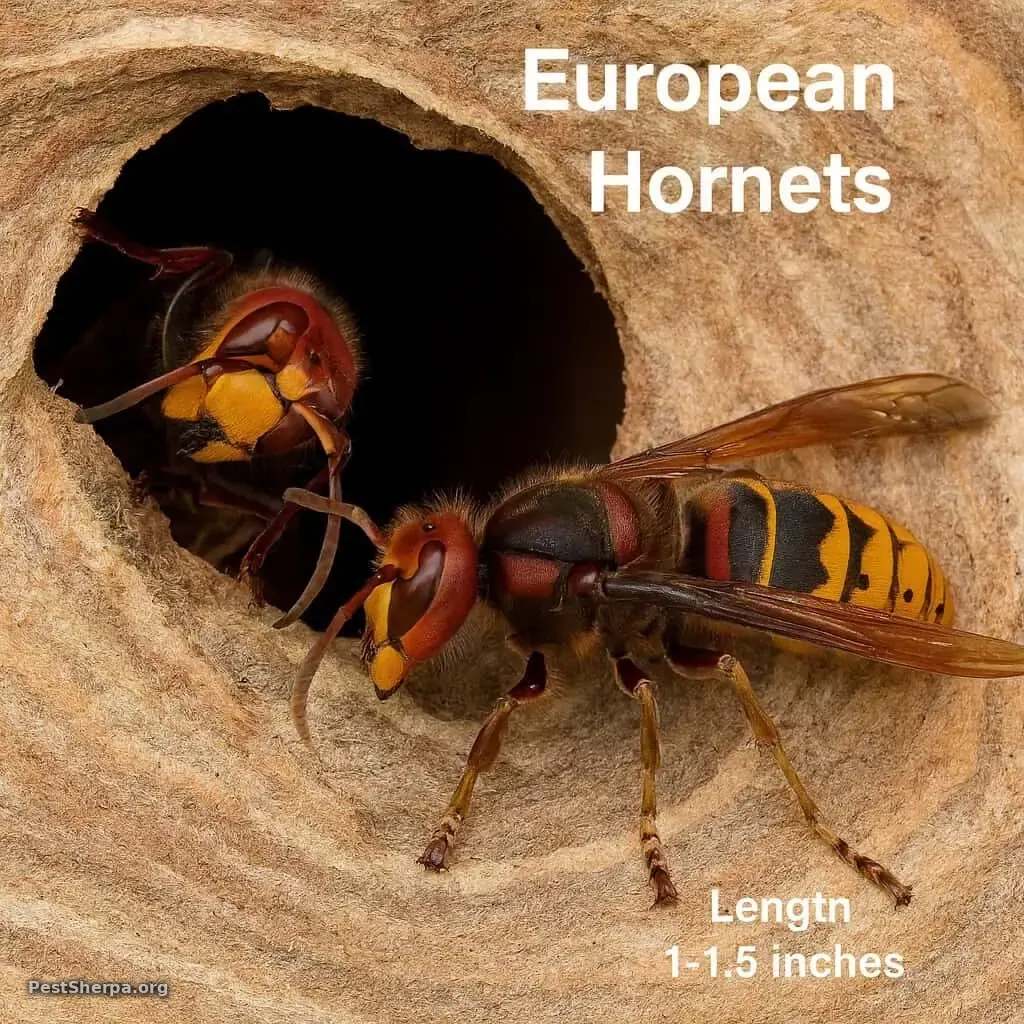
European hornet (Vespa crabro). This introduced species is established throughout much of the eastern United States. It has a reddish-brown head and thorax with yellow and dark markings on the abdomen. European hornets are considerably smaller on average, although queens can appear quite large. Unlike northern giant hornets, European hornets frequently nest in aboveground cavities, including hollow trees and wall voids.
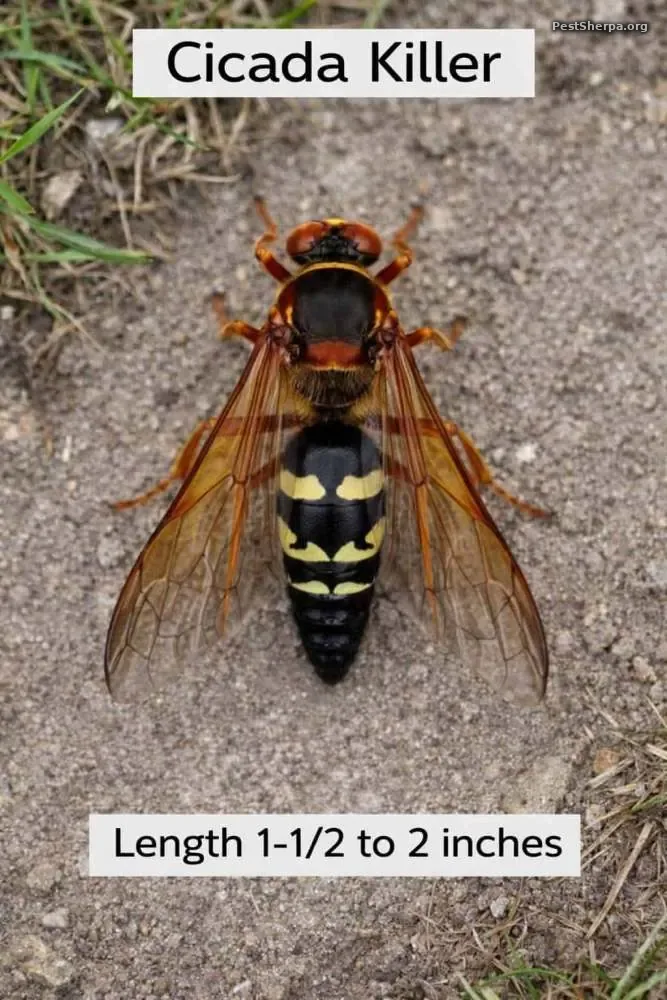
Eastern cicada killer (Sphecius speciosus). Female cicada killers may approach 2 inches (51 mm) in length. They are robust, solitary wasps that excavate burrows in soil and provision them with paralyzed cicadas. Their abdominal markings, head proportions, and solitary behavior distinguish them from northern giant hornets.
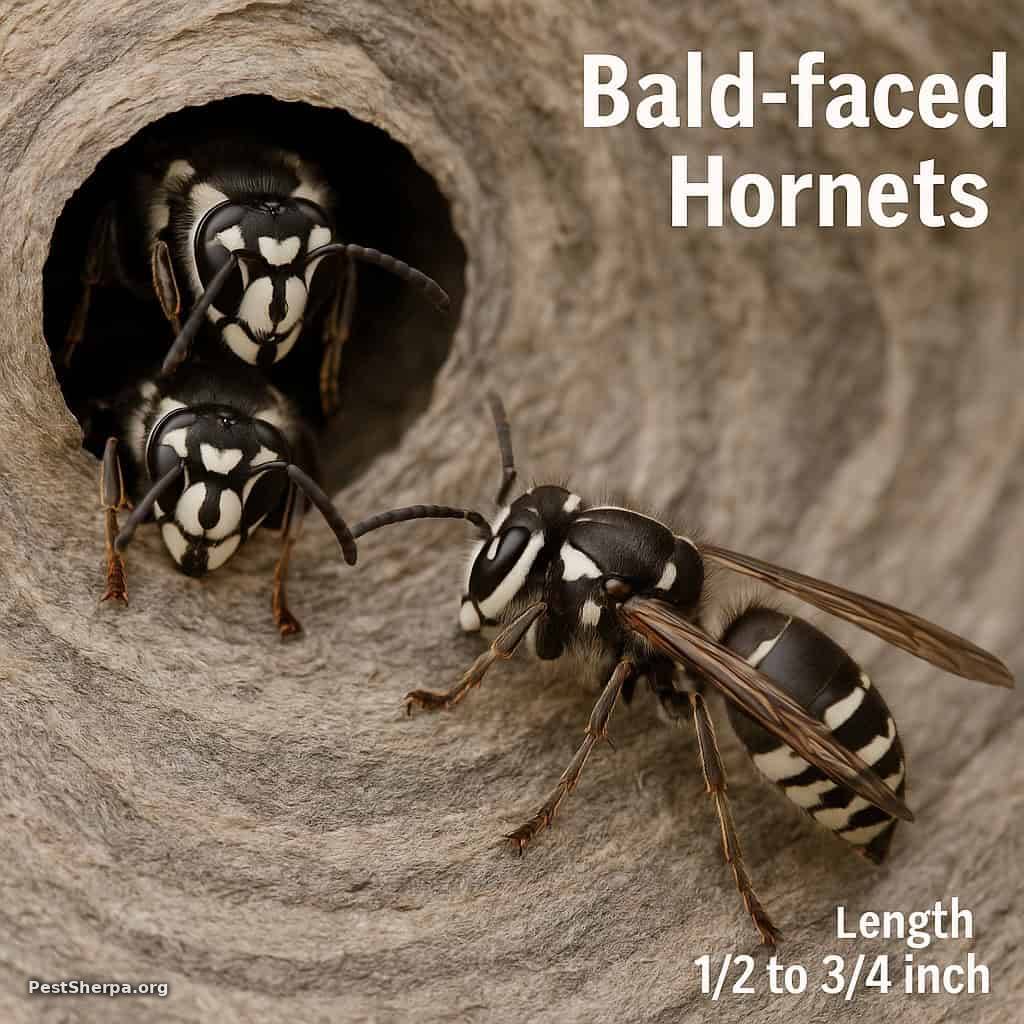
Bald-faced hornet (Dolichovespula maculata). Despite its common name, this species is a yellowjacket rather than a true hornet. It is considerably smaller and has conspicuous black-and-white coloration. Colonies normally construct enclosed paper nests, often in trees or on structures.
Identifying an unfamiliar wasp requires examining several characteristics. Body size, head shape, coloration, and nesting behavior are more reliable when considered together than any single feature. Only a university, county agriculture agent, or a pest control company should identify these insects, especially if the nest is active.
Northern Giant Hornet Biology and Life Cycle
Northern giant hornets are social wasps in the family Vespidae. Their colonies contain a reproductive queen, female workers, and males produced later in the season.
Like other wasps, they develop through complete metamorphosis: egg, larva, pupa, and adult.
Unlike honey bees, northern giant hornets establish new colonies each spring. Only fertilized queens normally survive winter. Males and female workers do not survive.
Overwintering queens shelter in protected locations, often in soil. When temperatures become favorable in spring, surviving queens emerge, feed, and search for suitable nesting locations.
A queen begins a colony by constructing paper brood cells, laying eggs, and feeding the developing larvae. She performs these tasks without workers until the first generation reaches adulthood.
Once workers emerge, they take over nest expansion, foraging, brood care, and colony defense. The queen’s primary role becomes egg production.
Colonies grow through summer as additional workers develop. Their final size depends on food availability, environmental conditions, and the length of the growing season. Mature colonies may contain numerous workers and hundreds of brood cells.
In late summer and autumn, colonies produce reproductive males and new queens. After mating, fertilized queens seek protected overwintering sites.
The original queen, workers, and males eventually die. The colony itself does not survive winter as a functioning social unit.
This annual cycle is important when considering the species as a potential invasive pest. A successful introduction requires reproductive females to survive, establish colonies, and produce another generation of queens.
Where Do Northern Giant Hornets Nest?
In their native range, northern giant hornets typically construct nests underground. Abandoned rodent burrows, cavities among tree roots, and other protected soil spaces provide suitable nesting locations.
The species is associated with wooded environments, where sheltered nesting sites and insect prey are available.
Although nests occasionally occur in hollow trees, elevated nests are uncommon in the native range. The Washington nests were the exception: all four nests found in 2020 and 2021 were in alder trees, three of them in cavities well above the ground. (WSDA; Looney et al. 2023)
A nest contains multiple paper combs made from plant fibers that workers chew and mix with saliva. Each brood cell houses a developing individual.
Northern giant hornets do not build the large, exposed aerial paper nests familiar to people who encounter bald-faced hornets.
This difference is useful when evaluating suspected sightings. A large enclosed paper nest suspended from a tree branch is unlikely to belong to a northern giant hornet colony.
However, finding a large wasp entering a ground cavity does not establish its identity. Cicada killers and several other wasps also nest in soil.
What Do Northern Giant Hornets Eat?
Adult northern giant hornets feed primarily on carbohydrate-rich materials, including tree sap, nectar, and fruit juices. Developing larvae require protein supplied by the workers.
Workers capture a variety of insects and other arthropods. Their powerful mandibles allow them to kill prey, remove unnecessary body parts, and carry pieces back to the colony.
Prey includes beetles, other wasps, honey bees, and numerous additional insects.
Northern giant hornets are particularly well known for their ability to attack honey bee colonies.
Why Northern Giant Hornets Threaten Honey Bees
The most serious agricultural concern involves attacks on managed European honey bees (Apis mellifera).
Workers may initially hunt individual bees near flowers or hive entrances. Later in the season, some hornet colonies engage in coordinated attacks against entire honey bee colonies.
During these attacks, multiple hornets kill defending adult bees. Thousands may be killed within a relatively short period.
Once resistance is eliminated, hornets enter the hive and remove the developing honey bee brood, which provides protein for their larvae.
European honey bees are especially vulnerable because they lack some defensive behaviors developed by Asian honey bee species exposed to these predators over evolutionary time.
Some Asian honey bees can surround an attacking hornet and generate heat within a tightly packed cluster of workers, a defense sometimes called heat balling.
Although European honey bees have defensive behaviors of their own, they are generally less effective against coordinated attacks by northern giant hornets.
If the species became established in a new region, losses to managed colonies could create economic problems for beekeepers and potentially affect agricultural pollination services.
It is important to distinguish this potential threat from current conditions. The northern giant hornet is not known to have an established population in the United States.
Are Northern Giant Hornets Dangerous to People?
Northern giant hornets possess substantial stingers and can sting repeatedly.
A sting is extremely painful and may cause considerable localized redness and swelling. As with other stinging Hymenoptera, the severity of the reaction varies among individuals.
A single sting is not necessarily life-threatening. However, people allergic to wasp venom may experience anaphylaxis, a severe systemic allergic reaction requiring immediate medical attention.
Multiple stings also increase the possibility of serious toxic effects from the venom, even in individuals without a known allergy.
Symptoms including difficulty breathing, swelling of the throat, fainting, or other signs of a severe allergic reaction require immediate emergency medical care.
The greatest danger usually occurs when hornets defend a disturbed nest. Excavating soil, creating vibrations near a colony, or attempting to destroy a nest can provoke defensive behavior.
Northern giant hornets are predators, but they do not ordinarily pursue people without a reason.
The sensational nickname “murder hornet” should not be interpreted as evidence that the insect routinely attacks humans.
Are Northern Giant Hornets Still Found in the United States?
Northern giant hornets are native to parts of eastern and southern Asia, including Japan, China, Korea, and neighboring regions.
North American detections began in 2019, when specimens were confirmed in British Columbia, Canada, and Washington State.
The discovery triggered a coordinated effort to determine whether breeding populations had become established.
Washington State agricultural officials, working with federal agencies and other partners, located and destroyed four nests during 2020 and 2021.
Subsequent monitoring failed to detect additional hornets during the 2022 to 2024 surveillance period.
On December 18, 2024, the Washington State Department of Agriculture and the U.S. Department of Agriculture announced that northern giant hornets had been eradicated from the United States.
As of October 2026, no established northern giant hornet populations are known in the United States.
In North America, the species has been detected only in Washington State and British Columbia. It has never been confirmed in the eastern United States.
Historical North American records from Washington and British Columbia should not be confused with evidence of a current breeding population.
Continued vigilance is reasonable because invasive species can be introduced through international movement of goods and other pathways.
The northern giant hornet should also not be confused with the yellow-legged hornet (Vespa velutina), a separate invasive hornet species that has been detected in the southeastern United States.
Northern Giant Hornet Prevention, Control, and Reporting
Because northern giant hornets are not known to be established in the United States, there is no reason for routine residential pesticide applications directed specifically against this species.
The appropriate response to a suspected sighting is identification and reporting rather than immediate insecticide treatment.
Anyone encountering an unusually large hornet should avoid handling it. A clear photograph, taken without approaching or disturbing the insect, may provide enough detail for an initial identification.
Record the location and date of the sighting. These details help agricultural officials determine whether additional investigation is necessary.
Suspected northern giant hornets should be reported to the state department of agriculture, a state invasive-species reporting program, or an appropriate university diagnostic service.
References
Entomological Society of America. “Northern Giant Hornet Common Name Toolkit.” https://entsoc.org/publications/common-names/northern-giant-hornet.
Looney, Chris, et al. “Detection and Description of Four Vespa mandarinia (Hymenoptera, Vespidae) Nests in Western North America.” Journal of Hymenoptera Research 96 (2023): 1-20. https://doi.org/10.3897/jhr.96.99307.
National Pest Management Association. Field Guide to Structural Pests. “Bees, Hornets, and Wasps.” Fairfax, VA: National Pest Management Association.
Oregon Department of Agriculture. “Hornets.” https://www.oregon.gov/oda/ippm/survey-treatment/pages/hornets.aspx.
Penn State Extension. “European Hornet.” Updated July 19, 2024. https://extension.psu.edu/european-hornet.
Penn State Extension. “Northern Giant Hornets.” Updated May 19, 2025. https://extension.psu.edu/northern-giant-hornets.
Spears, Lori, Carson Wise, and Ryan Davis. “Asian Giant Hornet (a.k.a. Northern Giant Hornet).” Utah State University Extension, May 2020. https://extension.usu.edu/planthealth/research/asian-giant-hornet.
U.S. Department of Agriculture, Animal and Plant Health Inspection Service. “Northern Giant Hornet.” Updated August 31, 2026. https://www.aphis.usda.gov/plantsplant-healthplant-pests-and-diseases/northern-giant-hornet.
U.S. Department of Agriculture, National Invasive Species Information Center. “Northern Giant Hornet.” https://www.invasivespeciesinfo.gov/terrestrial/invertebrates/northern-giant-hornet.
Washington Invasive Species Council. “Northern Giant Hornet.” https://invasivespecies.wa.gov/accomplishment/northern-giant-hornet/.
Washington State Department of Agriculture. “Northern Giant Hornet.” https://agr.wa.gov/departments/insects-pests-and-weeds/insects/hornets/faq-s/northern-giant-hornet.
Washington State Department of Agriculture. “Taking Hornet Nest Removal to New Heights.” WSDA AgBriefs, September 2021. https://wastatedeptag.blogspot.com/2021/09/2021AGHnest3.html.
This article was written by Greg Baumann, founder of Pest Sherpa, and reflects more than 40 years of professional pest management experience.
About the Author

Greg Baumann | Pest Control Expert
Greg Baumann is the founder of Pest Sherpa and a Pest Control Expert with more than 40 years of professional pest management experience. His articles combine decades of field experience, technical expertise, and science-based guidance to help homeowners identify pests correctly, understand real-world risks, and make informed pest management decisions.
Mission: Identify the pest. Understand the risk. Stop the problem. Prevent the comeback. Know when it’s time to call a professional.