
Drywood Termites: Identification, Frass, Damage, and Control
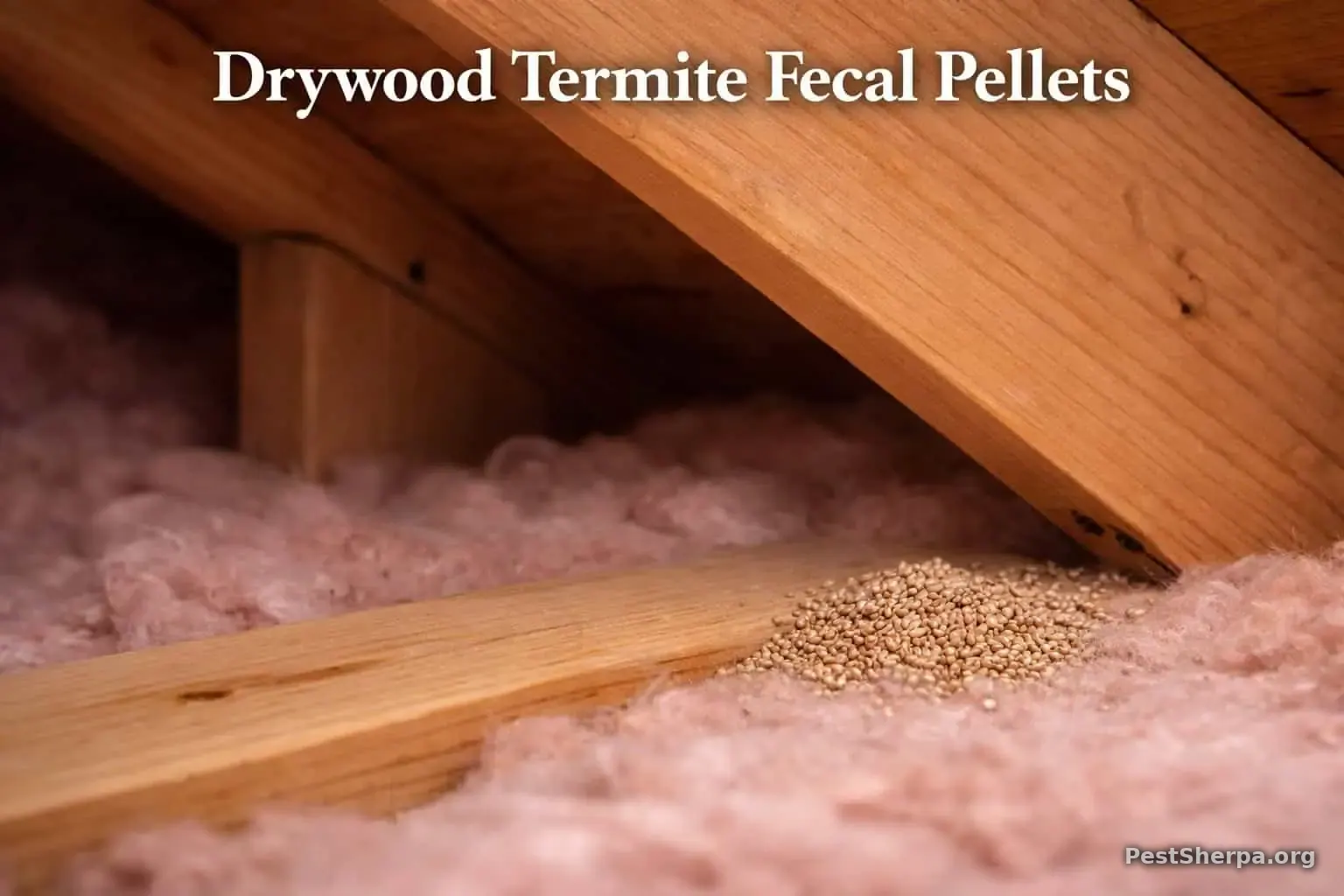
Updated for accuracy: Drywood termites are wood-destroying insects that live directly inside dry wood rather than in soil. Homeowners often first notice them through pellet-like droppings called frass, discarded wings, or hidden damage inside trim, walls, furniture, or structural wood.
Drywood termites live in the wood itself, not the soil. If you are sorting drywood from subterranean species, or deciding what to do next, start with the main termite guide.
Drywood termites are one of the easiest wood-destroying pests to underestimate. Unlike subterranean termites, they do not need soil contact. They can live entirely inside dry, sound wood, stay hidden for long periods, and continue causing damage while the outer surface still looks mostly intact. That is why homeowners often notice the signs late. Those signs include small piles of pellets, blistered wood, a hollow sound, or swarmers and discarded wings that seem to appear out of nowhere.
This guide is built to help you make the right decision in the right order. First, identify the signs correctly. Next, understand what drywood termites are often confused with. Then learn which control options are realistic, and recognize when professional inspection is the only smart next move.
TL;DR
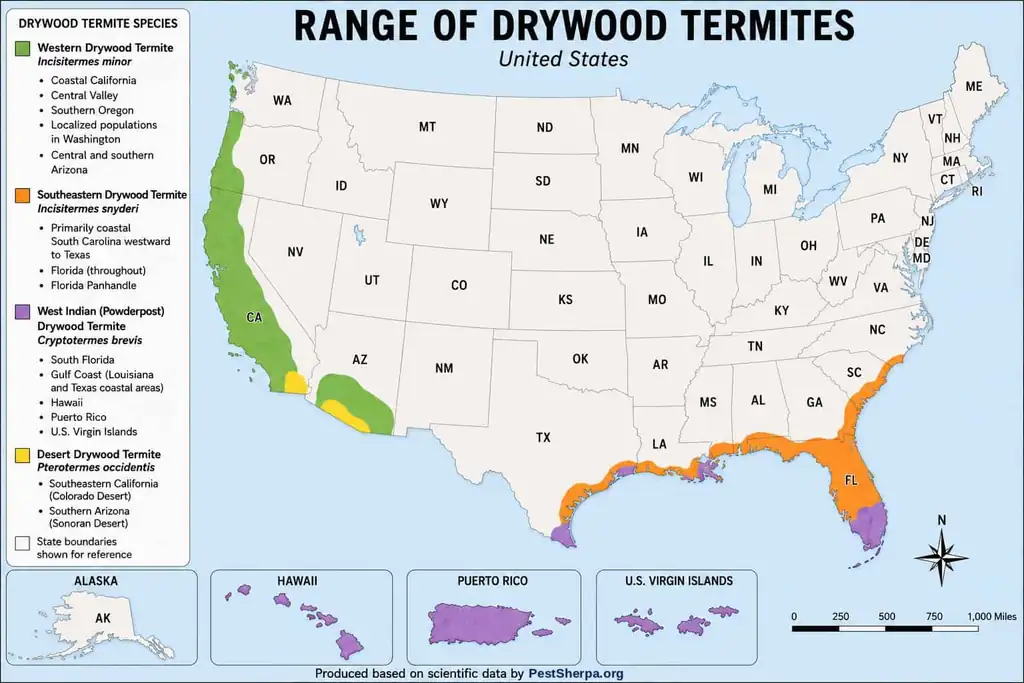
For a sourced look at where drywood pressure shows up in the U.S., see the Pest Lab drywood termite range map.
Drywood termites live inside dry wood and do not require soil contact like subterranean termites. Drywood termites are not found in structures nationwide. However, infested furniture can carry them from infested homes to areas where drywood termites are not usually found. A primary homeowner clue is frass: drywood colonies push out fecal pellets (also called droppings or pellets) through tiny kick-out holes. Those piles often look like coarse sand or salt on windowsills, trim, or floors below the wood. Other warning signs include hollow wood and indoor termite swarmers. Infestations may remain hidden for years. Localized infestations can sometimes be treated directly, but widespread structural infestations often require professional termite treatment or fumigation.
Jump to: Identification | Why It Matters | What To Do | When To Call a Pro | Similar Pests | Common Questions | References
Fast Decision Guide
- One pellet pile, one location, easy access: may be a localized issue
- Pellets in multiple areas or rooms: likely more than one colony
- Attic, roofline, or structural wood involved: higher probability of widespread infestation
- Not sure what you’re seeing: identification comes first, not treatment
Quick Answer
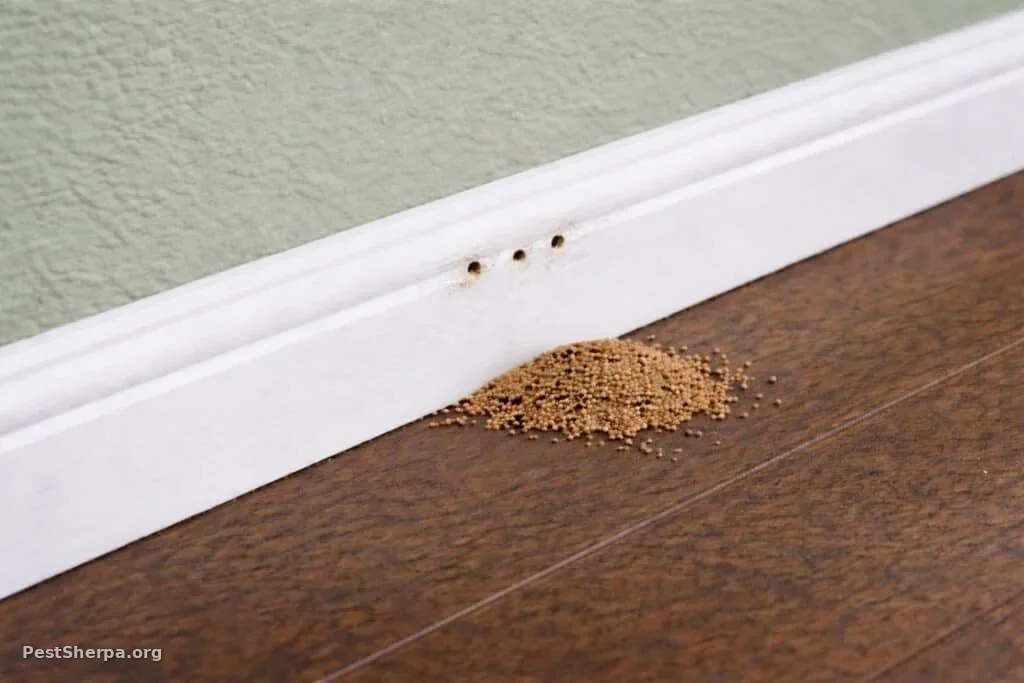
Are you seeing small, hard pellets that look like coarse sand or tiny seed-like grains? If they are falling from trim, framing, furniture, attic wood, or window and door areas, drywood termites should be high on the list. Those piles are fecal pellets (frass), often called drywood termite droppings. You may also see discarded wings, blistered wood, or repeated pellet piles in more than one location. If so, the problem may be larger than it looks from the surface. The key mistake homeowners make is assuming that because the visible evidence is small, the infestation must be small too. With drywood termites, the visible evidence is often only the spillover from hidden activity inside the wood.
Why Drywood Termites Matter
Field insight: In real inspections, drywood termite infestations are often more extensive than the visible evidence suggests.
Drywood termites do not usually announce themselves with obvious mud tubes, wet soil contact, or dramatic surface collapse in the early stages. They work from inside the wood, gradually hollowing galleries while often leaving a thin surface shell intact. That makes them a true hidden-damage pest. Colonies are smaller than subterranean termite colonies, but a single structure can hold multiple colonies. Most homeowners have no reliable way to tell where one colony ends and another begins.
That is why this pest matters so much in real life. A few pellets on a windowsill may point to a localized problem. The same pellets showing up in several rooms, on multiple levels, or below attic framing can point to a very different treatment decision.
How to Identify Drywood Termites
Drywood termites are social insects that live entirely within the wood they infest. In homes, the forms people are most likely to notice are pellet-like fecal material known as frass, swarmers or discarded wings, and the damage itself. Workers and soldiers usually stay hidden unless infested wood is opened.
What Homeowners Often Notice First
- Small piles of dry pellets beneath trim, framing, furniture, or exposed wood
- Tiny kick-out holes where pellets have been expelled from the gallery
- Blistered, puckered, cracked, or hollow-sounding wood
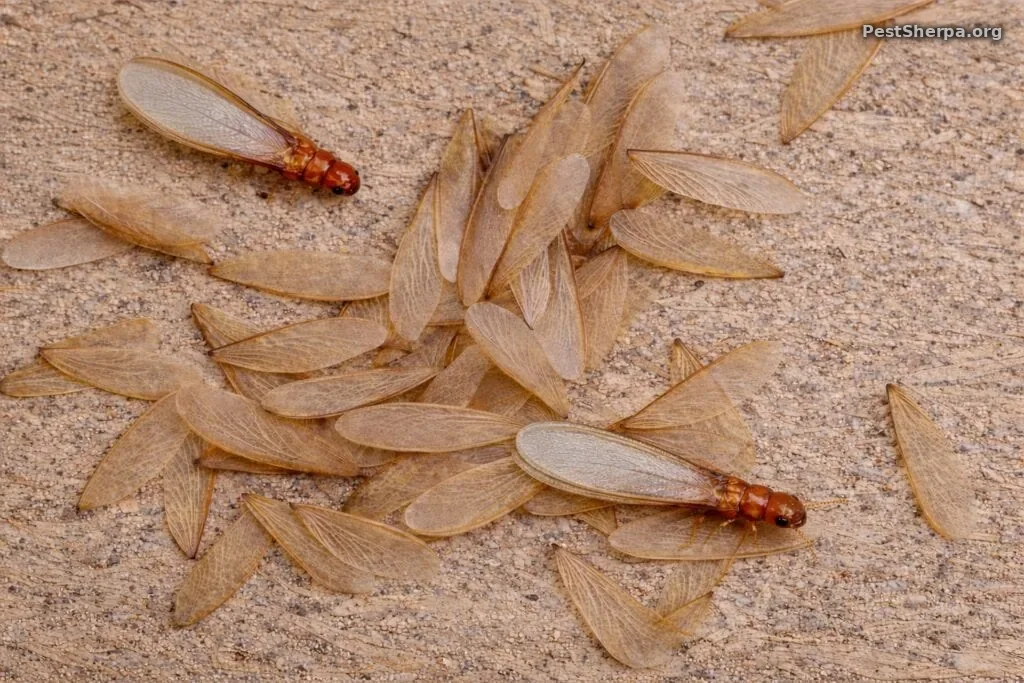
- Discarded wings near windows, sills, attic access points, or light sources
- Swarmers appearing during warm periods, depending on species and region
Fecal Pellets, Frass, and Droppings: How to Recognize Them
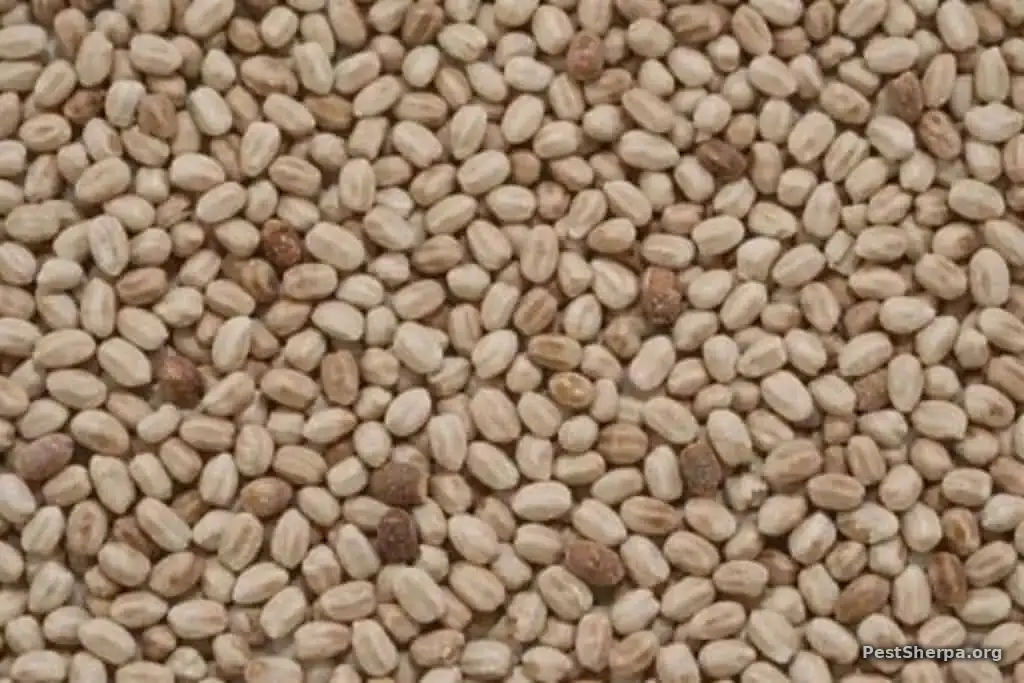
People search for drywood termite fecal pellets, drywood termite droppings, dry wood termite droppings, or drywood termites frass. They are usually describing the same clue. Drywood termites produce hard fecal pellets (frass). They are not wood “shavings” from a saw, and they are not soft dust. Colonies push pellets out of the wood through small kick-out holes so their tunnels (galleries) stay clear. That is why piles often show up on floors, sills, or shelves under the activity.
Up close, drywood fecal pellets are usually oblong with six flattened sides (often described as hexagonal or six-sided). This is a key ID point taught by university extension programs such as UC IPM. Color varies with the wood being eaten, from light tan to darker brown. Fresh or recurring piles under kick-out holes are a strong reason to get a professional inspection. Frass alone does not tell you how far galleries extend, and it is not a DIY treatment plan.
Drywood termite frass is one of the best field clues because it is not random dust. The pellets are hard, dry, and fairly uniform. Once homeowners know what to compare, they can often tell them apart from beetle powder or carpenter ant debris.
Frass Look-Alikes (Quick Compare)
| Material | What it usually looks like | Quick tip |
|---|---|---|
| Drywood termite fecal pellets (frass / droppings) | Hard, gritty pellets; often six-sided under magnification; piles under kick-out holes | Primary drywood homeowner clue; still needs pro confirmation of activity and extent |
| Powderpost beetle frass | Much finer, flour-like or powdery material; round exit holes | Texture is softer and dustier than drywood pellets |
| Carpenter ant debris | Irregular shreds; may include insect parts | Ants excavate wood but do not eat it; debris is not uniform pellets |
| Sawdust from drilling or cutting | Fresh wood particles near recent work | Usually tied to a tool mark or remodel, not kick-out holes |
| Subterranean termites (for contrast) | Mud tubes and soil contact clues more than hard pellet piles | Different biology; start at the termite guide if you are unsure |
What Swarmers Look Like
Drywood termite alates are winged reproductives that leave mature colonies to establish new ones. They usually have two pairs of equal-length wings and shed those wings after landing. Exact color and swarming timing vary by species. Either way, finding swarmers or piles of shed wings indoors is always a strong signal that a closer inspection is needed.
What Drywood Termites Are Commonly Confused With
This is one of the most important sections on the page, because many expensive mistakes start with misidentification. Drywood termite evidence is often confused with the debris or damage caused by other wood-related pests and conditions.
Quick Reality Check
- Dry, hard pellets that look granular or seed-like: drywood termites are more likely.
- Mud tubes or soil-lined galleries: think subterranean termites, not drywood termites.
- Fine, flour-like powder from round exit holes: think powderpost beetles before termites.
- Coarse sawdust-like debris mixed with insect body parts: carpenter ants move higher on the list.
- Soft, decayed wood with moisture problems: wood-decay fungi may be part of the story.
Drywood Termites vs. Subterranean Termites
Subterranean termites depend on moisture and soil contact. Their galleries are associated with mud and shelter tubes. Drywood termites do not need soil contact and leave behind dry pellets instead of mud-lined evidence. If there are clear mud tubes, you should not assume drywood termites are the main culprit.
Drywood Termites vs. Powderpost Beetles
Powderpost beetles often leave much finer, powder-like frass and round emergence holes. Drywood termite pellets are harder, more uniform, and more granular. Beetle damage and termite damage can both stay hidden for a while, which is one reason proper diagnosis matters so much before treatment.
Drywood Termites vs. Carpenter Ants
Carpenter ants excavate wood but do not eat it. Their debris is often more irregular and may include insect parts. Drywood termites are more likely to leave clean pellet piles below the wood where activity is occurring. If you’re unsure, compare see the full Pest Sherpa Guide to Carpenter Ants.
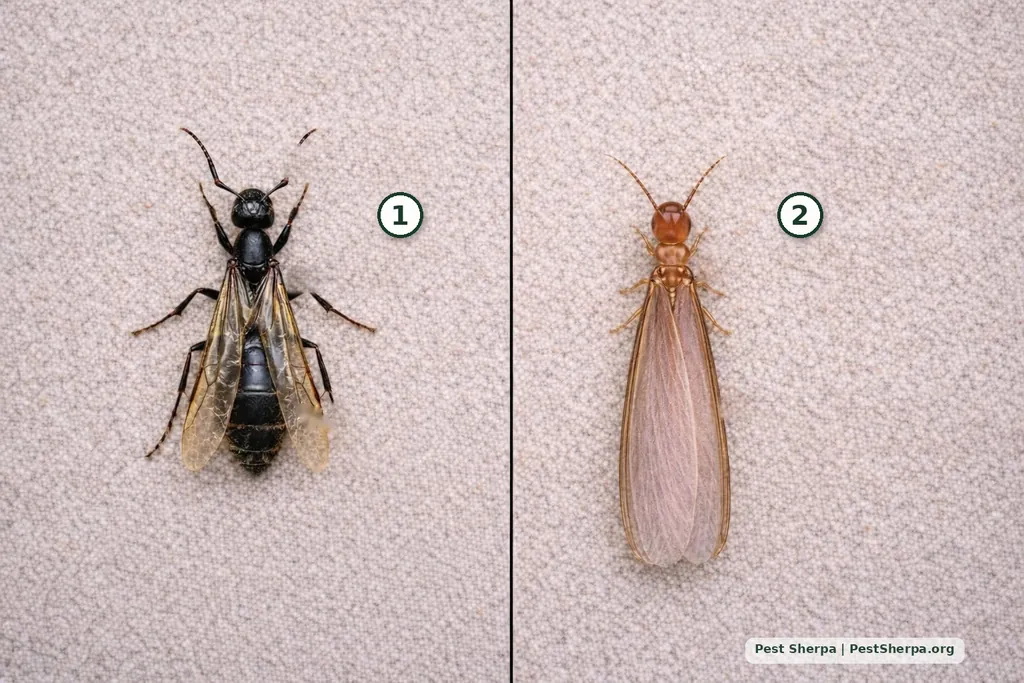
Which one did you find? Match the number:
- Winged ant: pinched, wasp-like waist and bent (elbowed) antennae. Front wings are longer than the back pair.
- Winged termite (swarmer): thick waist with no pinch, straight beaded antennae, and four wings of equal length that run well past the body.
Seeing number 2 indoors, especially near windows or piles of shed wings? Call a licensed termite pro for an inspection.
Drywood Termites vs. Subterranean Termites
Subterranean termites depend on moisture and soil contact. Their galleries are associated with mud and shelter tubes. Drywood termites do not need soil contact and leave behind dry pellets instead of mud-lined evidence. Learn more about subterranean termites.
Biology, Colony Growth, and Why the Damage Can Stay Hidden
Drywood termite colonies are usually smaller than subterranean termite colonies. They often range from several hundred to a few thousand termites, but they can stay active for years. A pair of reproductives enters dry wood through a crack, crevice, joint, or exposed grain, seals the entry point, and begins the colony. Early growth is slow, which is one reason infestations can persist unnoticed for long periods.
Unlike subterranean termites, drywood termites do not need moisture from the soil. They obtain enough moisture from the wood they consume and from metabolic processes. That adaptation lets them occupy attic framing, fascia, eaves, trim, doors, window frames, flooring, furniture, and other seasoned wood without any soil connection.
The practical result is simple. You can have an active infestation well above the ground floor, entirely inside dry wood, with no mud tubes at all.
Signs of a Drywood Termite Infestation
- Pellet piles recurring in the same place: one of the clearest signs of active gallery clean-out
- Kick-out holes: tiny openings in wood where pellets are expelled
- Discarded wings: especially around windows, light sources, attic access, or upper levels
- Blistered or puckered wood: termites often leave a thin outer layer hiding internal galleries
- Hollow-sounding wood: especially around trim, doors, window frames, cabinets, roof framing, or exposed boards
- Evidence in attics or upper areas: drywood termites often begin in eaves, attics, fascia, and exposed wood
Most drywood termite damage is discovered only after wood is already weakened more than the surface suggests. By the time pellets are visible, the termites have usually been active long enough to establish internal galleries. That is part of what makes this pest so deceptive. A small visible clue can sit above a much larger hidden gallery system.
Where Drywood Termites Commonly Live in a Home
Drywood termites infest seasoned, relatively dry wood. Common locations include:
- Attic framing, rafters, and roof sheathing edges
- Fascia boards, soffits, eaves, and exposed trim
- Window frames, door frames, and decorative millwork
- Wood siding, paneling, cabinets, and built-ins
- Hardwood flooring and stair components
- Furniture, stored wood items, and decorative wood brought in from infested regions
They are often introduced in infested furniture, lumber, or other wood products, then slowly expand within the structure. In warmer regions they may also directly infest exterior wood components.
Inspection and Detection: Why This Is Harder Than It Looks
Professional inspection is not just about finding pellets. It is about estimating extent, separating old evidence from likely active evidence, identifying the pest correctly, and deciding whether the infestation appears isolated or widespread. That is harder than it sounds because drywall, paint, insulation, cabinetry, trim, and inaccessible voids can all conceal colony boundaries.
Inspectors may use probing, sounding, moisture meters, borescopes, acoustic devices, or infrared tools depending on the situation. None of that changes the core reality. From a pellet pile alone, most homeowners cannot tell how many colonies are present or whether the infestation is limited to one accessible spot.
Important: most failed drywood termite spot treatments do not fail because the material was wrong. They fail because the full extent of the infestation was never located.
Control Options: What Actually Determines the Right Treatment
Drywood termite control is not a one-size-fits-all decision. The right method depends on infestation extent, accessibility, how confidently the colony locations have been mapped, and whether structural or attic wood is involved. For a broader look at inspection, treatment choices, and warranties, see the Termite Control hub.
How Control Decisions Are Usually Made
- One clearly defined, accessible infestation: localized treatment may be reasonable.
- Several pellet sites or evidence on more than one level: concern rises for multiple colonies or broader spread.
- Attic framing, roofline, or inaccessible structural wood involved: whole-structure treatment becomes much more likely.
- Uncertain boundaries or repeated evidence after limited treatment: fumigation often becomes the more reliable option.
Localized Treatment
Localized treatment involves drilling, injecting, foaming, dusting, or otherwise applying material directly into known galleries. This approach can work well when the infestation is truly limited and accurately located. The weakness is obvious: if one colony is missed, or if the gallery system extends beyond what was identified, the problem continues.
Whole-Structure Fumigation
Fumigation is often recommended when infestations are widespread, hidden, inaccessible, or found in multiple areas of the structure. Its major advantage is reach. It treats hidden infestations that cannot be confidently mapped from the surface. Its limitations are also real: the home must be vacated for the treatment process, and fumigation does not prevent future reinfestation. It solves existing hidden colonies; it does not create residual protection.
Heat and Other Non-Fumigation Options
Heat treatment and some other non-fumigation approaches can be useful in the right setting, but performance depends heavily on complete temperature penetration or precise application. Large beams, layered assemblies, and concealed areas can all reduce reliability. These are not casual DIY substitutes.
What DIY Gets Wrong Most Often
- Assuming the visible pellet pile shows the full extent of the problem
- Trying to treat the surface instead of the hidden gallery system
- Confusing drywood termites with beetles, ants, or moisture-related damage
- Assuming one treated spot means the structure is termite-free
When to Call a Professional
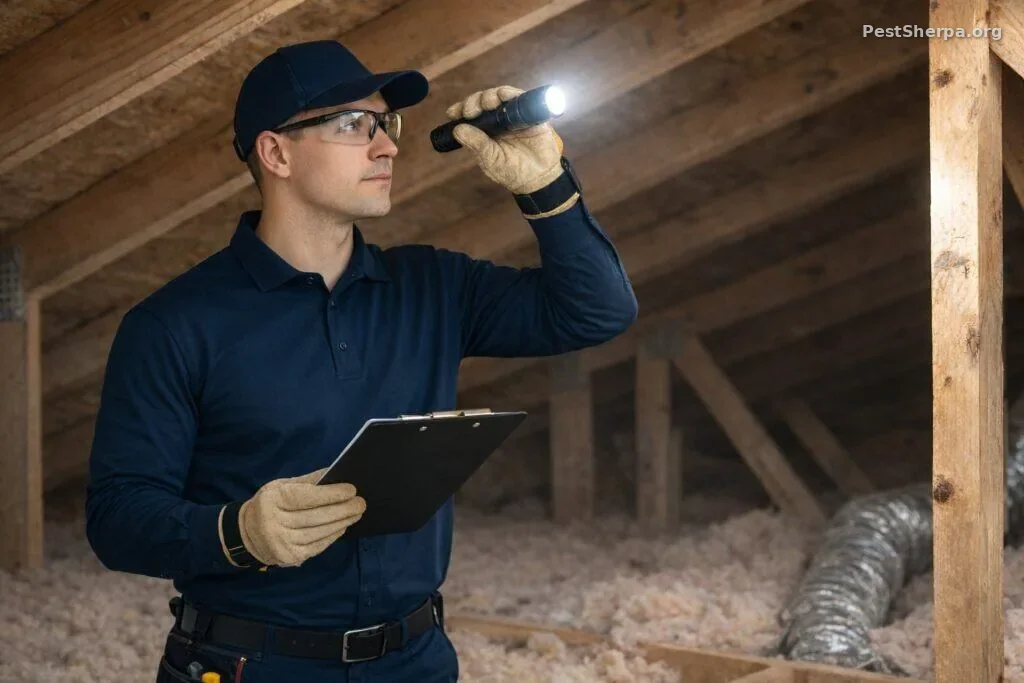
Frass alone is enough reason to schedule an inspection. You should move past guesswork quickly when any of the following are true:
- You are seeing pellet piles repeatedly in the same area
- You are finding pellets in more than one room, wall line, level, or part of the structure
- You have evidence in attic framing, roofline wood, cabinets, stairs, windows, or structural members
- You are seeing swarmers or discarded wings indoors
- You are not completely sure the pest is drywood termites and not beetles or ants
- You are considering drilling or opening finished surfaces without confidence in the exact infestation location
- You already tried a limited treatment and evidence returned
If activity appears isolated to one clearly defined piece of wood, a targeted professional treatment may be enough. Signs may show up across multiple areas or in hidden structural wood. In that case, homeowners usually save money by getting the scope right early. The alternative is paying for incomplete treatment followed by re-treatment.
If you are comparing bids, read the Pest Lab guide on what to look for when hiring a pro for termites. Drywood jobs often turn on inspection quality and whether localized treatment or fumigation fits the evidence you already have.
Prevention and Long-Term Protection
Prevention is about reducing entry opportunities and avoiding accidental introduction. It does not eliminate the need for inspection in risk-prone areas, but it does improve the odds.
- Seal cracks, joints, and exposed end grain where possible
- Maintain paint, sealants, and protective finishes on exposed exterior wood
- Inspect used furniture, decorative wood, and salvaged lumber before bringing them inside
- Pay extra attention to attics, eaves, fascia, trim, and upper exterior wood
- Schedule inspections in regions where drywood termites are established or often introduced
- After treatment, keep monitoring for new pellets, wings, or fresh signs rather than assuming the risk is gone forever
Frequently Asked Questions
Do drywood termites always leave pellets?
Pellets are one of the most common and useful signs, but not every infestation is noticed because of pellets first. Sometimes homeowners notice wings, blistered wood, or hollow-sounding trim before they ever notice frass.
Can drywood termites infest a house without any mud tubes?
Yes. That is one of their defining traits. Drywood termites live entirely inside wood and do not need soil contact, which is why mud tubes are not the expected sign.
Does finding pellets mean the infestation is active right now?
Fresh or recurring pellet piles strongly raise concern for activity, but extent and activity level still need interpretation. Pellets can sometimes be disturbed and fall after earlier activity, which is one reason inspection matters.
Can one spot treatment solve a drywood termite problem?
Sometimes, yes, but only when the infestation is truly localized and accurately identified. The biggest limitation is hidden spread. If colony boundaries are uncertain, a spot treatment may leave active termites behind.
When is fumigation usually the better choice?
Fumigation becomes much more likely when evidence shows up in multiple areas, on multiple levels, or in attics or structural wood. It is also more likely when the infestation cannot be confidently mapped for localized treatment. Finding frass alone does not automatically mean tent fumigation. A pro still has to map activity before choosing localized treatment versus whole-structure options.
Are termite droppings really feces?
Yes. Drywood termite “droppings,” “pellets,” and “frass” are fecal pellets the colony pushes out of the wood. They are a waste product, not chewed wood left as sawdust.
Can frass mean the colony is already gone?
Sometimes old pellets remain after activity slows or stops, and building vibration can knock more pellets loose later. Fresh piles that return after you clean them up raise concern for ongoing activity. Do not treat based on pellets alone. Confirm with a professional inspection.
What is the difference between frass and sawdust?
Sawdust from tools is usually irregular wood particles near recent cutting or drilling. Drywood frass is hard, fairly uniform fecal pellets, often with six sides under magnification. It usually sits under kick-out holes rather than next to a fresh tool mark.
Common Questions
References
- University of California Statewide IPM Program: Drywood Termites
- Texas A&M AgriLife Extension: Drywood Termites
- Texas A&M School IPM: IPM Action Plan for Drywood Termites
- University of Tennessee Urban IPM Lab: Interesting Drywood Termite Structural Infestation
- USDA Forest Service: Drywood Termites
This article was written by Greg Baumann, founder of Pest Sherpa, and reflects more than 40 years of professional pest management experience.
About the Author

Greg Baumann | Pest Control Expert
Greg Baumann is the founder of Pest Sherpa and a Pest Control Expert with more than 40 years of professional pest management experience. His articles combine decades of field experience, technical expertise, and science-based guidance to help homeowners identify pests correctly, understand real-world risks, and make informed pest management decisions.
Mission: Identify the pest. Understand the risk. Stop the problem. Prevent the comeback. Know when it’s time to call a professional.