
Red Flour Beetles: Identification, Pantry Sources, and Control
Introduction
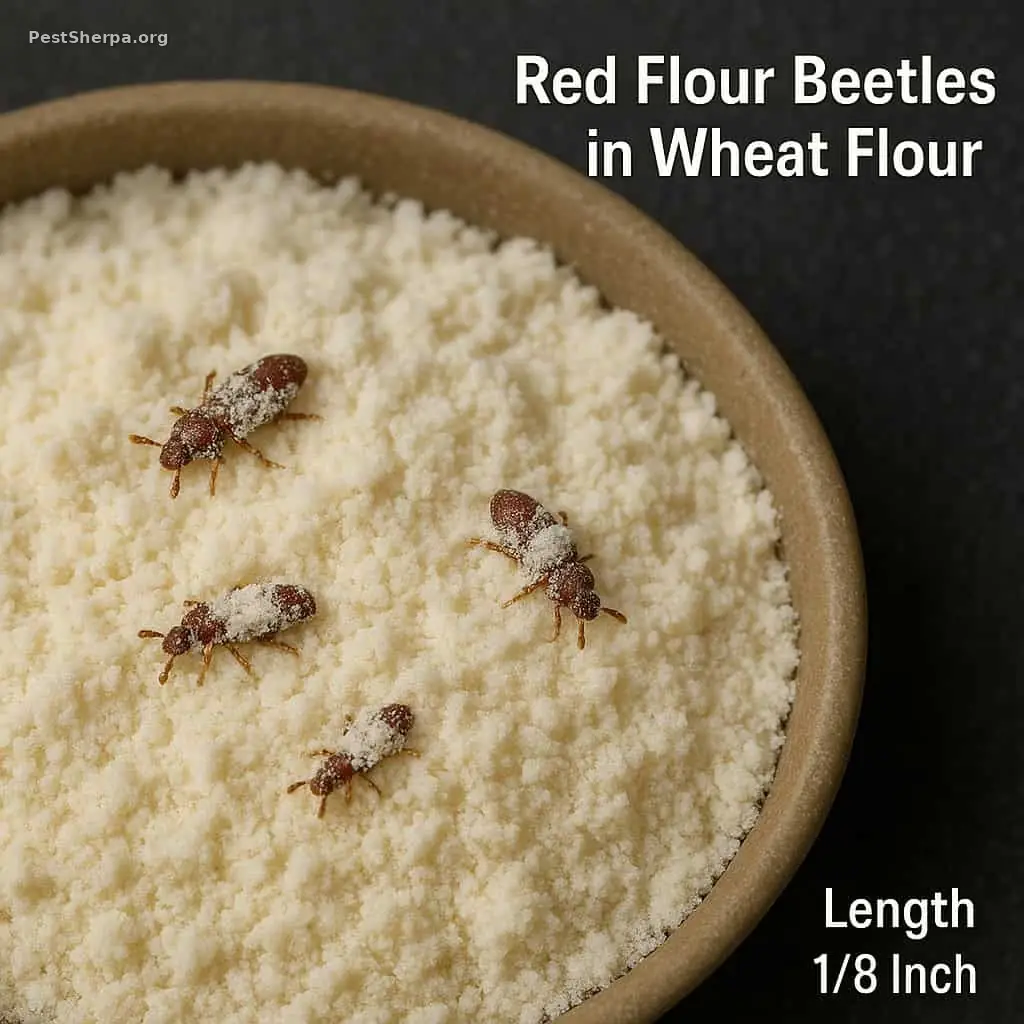
The red flour beetle, Tribolium castaneum, is a common stored-product pest associated with flour, cereal, cake mixes, spices, pet food, bird seed, dried fruit, nuts, chocolate, and other dry foods. In homes, these beetles are usually a pantry-source problem, not a biting or structural pest problem.
Red flour beetles are small reddish-brown beetles that usually infest processed, milled, cracked, or damaged food materials. They do not normally attack whole, intact grain kernels the way some grain weevils do. Instead, they develop in flour dust, broken grain, crumbs, old packages, and food residue caught in seams, shelf corners, cracks, or storage containers.
A few beetles on a counter or pantry shelf usually mean there is a food source nearby that needs to be found. The most effective solution is usually not spraying. It is careful inspection, removal of infested material, vacuuming, cleaning, and better dry-food storage.
TL;DR
If you are seeing small reddish-brown beetles in flour, cereal, baking mixes, spices, pet food, bird seed, nuts, or other dry pantry items, red flour beetles may be the cause. Adults are about 1/8 to 3/16 inch long, flattened, reddish brown, and have antennae that end abruptly in a three-segmented club. They do not normally attack whole, intact grain kernels but rather ground grain products. Note that sometimes whole grains will have broken grains and powder from the broken grains which are suitable food for the beetle.
The most important step is to find the source. Check old, opened, damaged, forgotten, or rarely used dry-food packages first. Also check crumbs, flour dust, pet food storage, bird seed, pantry shelf cracks, and food residue around containers.
Discard infested foods, vacuum and clean the area thoroughly, empty the vacuum afterward, and store dry foods in tightly sealed glass, metal, or heavy plastic containers. Insecticides are usually not needed for household pantry infestations and should not be sprayed on or near food, dishes, utensils, or food-storage surfaces.
Quick Navigation
- What Red Flour Beetles Mean in Your Pantry
- Identification
- Red Flour Beetle vs. Confused Flour Beetle
- Biology and Life Cycle
- Source Investigation Checklist
- Foods and Attractants
- What To Do
- What Doesn’t Work
- How Long Red Flour Beetles Last
- Prevention
- When Professional Help May Be Needed
- Lookalikes and Common Misidentifications
- Frequently Asked Questions
- References
What Red Flour Beetles Mean in Your Pantry
Red flour beetles are usually a sign that a dry food product or food residue has become infested. The beetles you see on shelves, counters, walls, or near windows may have come from a nearby pantry item, but the source is often hidden inside a package or in spilled material behind or under stored foods.
| What You See | What It Usually Means |
|---|---|
| One beetle on a counter | Possible stray adult; inspect nearby dry foods |
| Several beetles in a pantry | Likely infested food package or residue nearby |
| Beetles inside flour, cereal, or pet food | Active source in that product |
| Beetles in multiple packages | Infestation has spread or multiple sources exist |
| Beetles near windows | Adults may be dispersing toward light after emerging indoors |
| Odor, grayish tint, or visible contamination in food | Discard the affected product |
Expert Insight: Red flour beetle control depends on source removal. Adult beetles on shelves are only part of the problem; eggs, larvae, pupae, and adults may all be present in the infested food or nearby residue.
Identification: What Red Flour Beetles Look Like
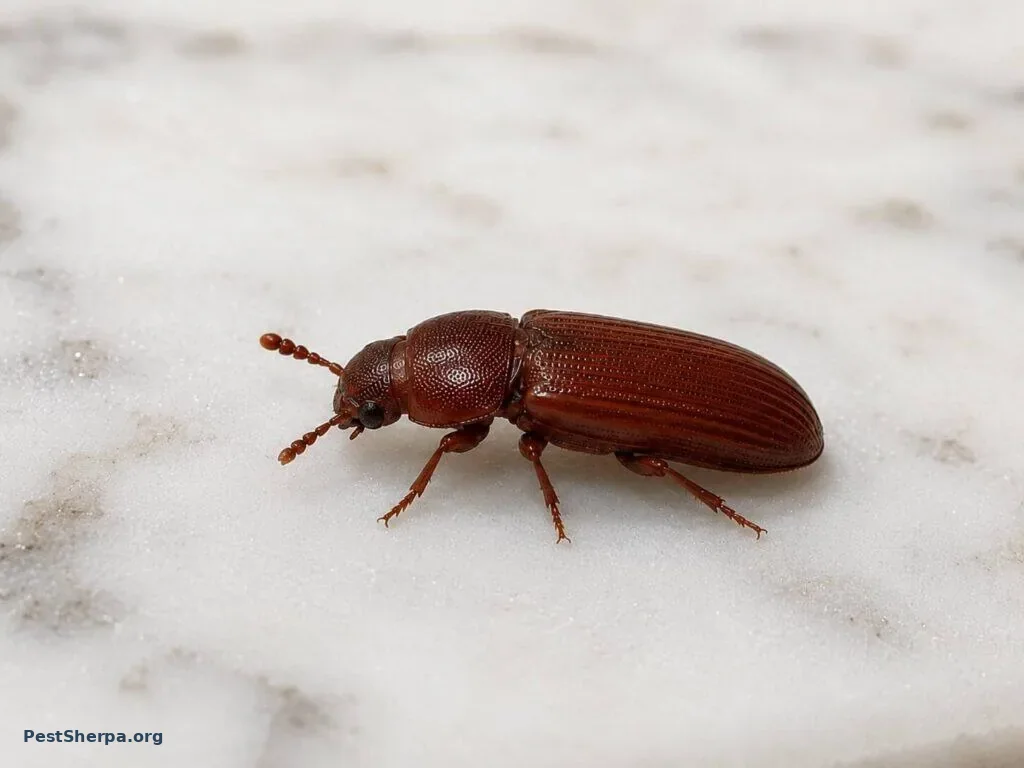
Adult red flour beetles are small, flattened beetles, usually about 1/8 to 3/16 inch long. They are reddish brown, shiny, and somewhat elongated. Because they are small, a hand lens or close-up photo can help with identification.
- Color: Reddish brown to rust brown
- Body shape: Flattened, narrow, and elongated
- Antennae: End abruptly in a three-segmented club
- Thorax: Sides are slightly curved or rounded
- Wings: Adults have wings and may fly, although indoor movement is often short-range
Larvae
- Cream, yellowish, or light honey-colored
- Slender and cylindrical
- Wiry-looking body
- Two small dark projections near the end of the abdomen
- Usually found in or very near the food source
Pupae
- Pale white to yellowish
- Soft-bodied and inactive
- Not enclosed in a cocoon
- Usually found in the food material or nearby shelter
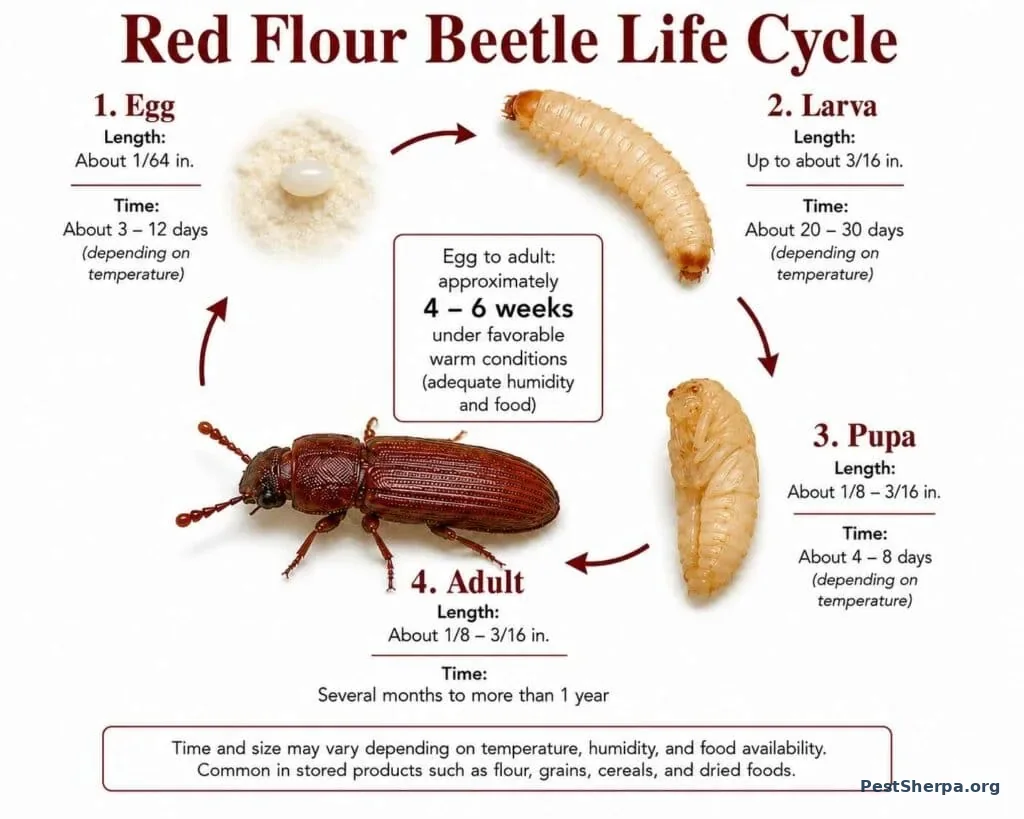
Red flour beetle adult, larva, and pupa life stages for pantry pest identification.
Red Flour Beetle vs. Confused Flour Beetle
The red flour beetle is often confused with the confused flour beetle, Tribolium confusum. The two species look similar, infest similar foods, and are managed in similar ways. The main identification differences are antenna shape, thorax shape, and flight ability.
| Feature | Red Flour Beetle | Confused Flour Beetle |
|---|---|---|
| Scientific name | Tribolium castaneum | Tribolium confusum |
| Antennae | Abrupt three-segmented club | Gradually widened four-segmented club |
| Thorax sides | Slightly curved or rounded | More parallel or straighter |
| Flight | May fly | Generally does not fly |
| Household management | Find source, discard infested food, clean, store food tightly | Same general approach |
For most household situations, exact species confirmation is less important than finding and removing the infested product. In commercial food facilities, species-level identification may be more useful because monitoring, sanitation, and product-flow decisions may depend on the pest complex present.
Biology and Life Cycle
Red flour beetles undergo complete metamorphosis: egg, larva, pupa, and adult. In warm indoor conditions with food available, development can be fast enough for populations to build before the problem is obvious.
- Egg: Females place tiny sticky eggs in flour, meal, food dust, cracks, packaging seams, or other protected areas near food.
- Larva: Larvae feed in the food material and pass through several molts as they grow.
- Pupa: Pupation usually occurs in or near the food source.
- Adult: Adults continue feeding, dispersing, and laying eggs when suitable food remains available.
Development time depends strongly on temperature, humidity, food type, and crowding. Under favorable warm conditions, the life cycle may take only several weeks. In cooler or less favorable conditions, development can take longer. Adults are long-lived compared with many pantry pests, which is one reason infestations may persist if small food residues remain.
All life stages may be present in an infested product at the same time. This is why simply removing visible adult beetles does not solve the problem.
Red Flour Beetle Source Investigation Checklist
Start with the oldest, least-used, damaged, opened, or forgotten dry foods. Red flour beetles can develop in very small amounts of food dust, so the source is not always a full bag of flour.
Step 1: Check Common Pantry Foods
- Flour, cornmeal, bran, and baking mixes
- Cereal, crackers, pasta, and noodles
- Spices and dried herbs
- Dried fruit, nuts, chocolate, and dry baking ingredients
- Pet food, bird seed, and animal treats
- Dried flowers, seed crafts, bean bags, homemade rice heating pads, or decorative plant material
Step 2: Inspect Packaging
Look for beetles, larvae, shed skins, flour dust, holes, damaged seams, clumps, webbing from other pantry pests, or unusual odor. Pour suspicious products onto a light-colored tray or baking sheet so small beetles are easier to see.
Step 3: Check Shelf Cracks and Food Residue
Remove items from the shelf and inspect corners, shelf pin holes, cracks, container lids, shelf liners, cabinet edges, and spilled flour or crumbs. Beetles can survive on small residues that are easy to overlook.
Step 4: Expand Beyond the Kitchen
If no pantry source is found, check pet food storage, bird seed, rodent bait stations, garage shelves, laundry rooms, utility rooms, stored grains, craft supplies, and outdoor bird-feeding areas near the home.
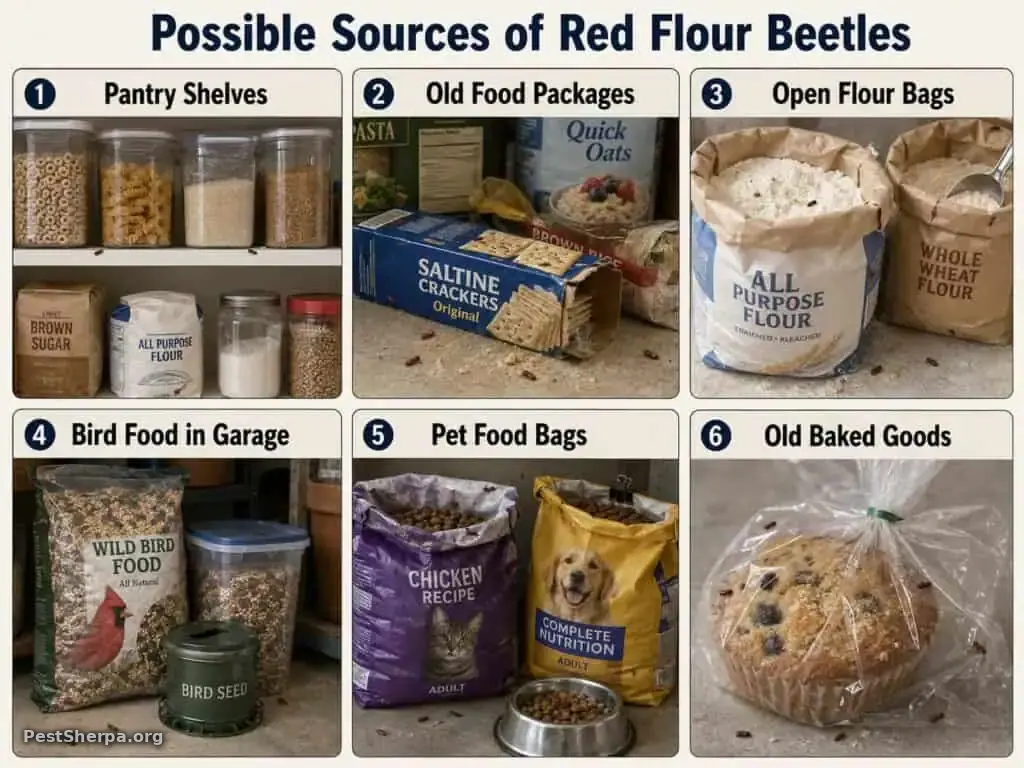
Red flour beetle pantry inspection checklist showing dry food packages, flour, pet food, bird seed (broken grains as food source), and forgotten baked goods.
Foods and Attractants
Red flour beetles are secondary stored-product pests. They usually feed on processed, damaged, milled, cracked, or dusty materials rather than intact kernels. Foods with broken particles, flour dust, or long storage times are especially vulnerable.
Common sources include flour, cornmeal, cereal products, cake mixes, crackers, pasta, spices, dried fruit, nuts, chocolate, dry pet food, bird seed, and spilled food debris. Other stored-product pests may occur in similar places, including sawtoothed grain beetles, merchant grain beetles, warehouse beetles, and Indianmeal moths.
Infestations often begin in one package and spread to nearby items when adults disperse. Thin paper, cardboard, plastic, foil, and cellophane packaging may not be enough to protect food once pantry pests are active nearby.
What To Do About Red Flour Beetles
1. Confirm You Are Dealing With a Pantry Pest
Look for a direct connection to dry stored food. Small beetles found in food packages, on pantry shelves, in cupboards, or near stored pet food are more likely to be pantry pests than beetles that appear only outdoors or around lights.
2. Find and Remove the Source
Discard infested foods promptly. Place infested products in a sealed bag before carrying them through the home. If multiple packages are contaminated, remove all affected items rather than trying to save questionable food.
3. Inspect Nearby Foods
Check all nearby dry goods, even unopened packages. Pantry pests can spread through folds, seams, torn packaging, and small openings. When in doubt, inspect the product on a light tray before returning it to storage.
4. Vacuum and Clean the Area
Vacuum shelves, cracks, corners, shelf pin holes, cabinet edges, floor-wall joints, and areas where flour dust or crumbs may collect. Empty the vacuum canister or discard the vacuum bag afterward so insects are not carried back into the home.
5. Store Dry Foods in Pest-Resistant Containers
Move insect-free dry foods into tightly sealed glass, metal, or heavy plastic containers. Label containers with purchase dates so older foods are used first.
6. Consider Cold or Heat Only for Suitable Items
For dry foods or plant-based decorative items that are not visibly contaminated but may be at risk, freezing or heating may kill hidden insects if the item can tolerate the temperature change. Do not use heat on items that could melt, burn, spoil, release fumes, or create a food-safety risk.
7. Use Traps as Monitoring Tools
Sticky traps or pantry pest monitors can help show whether beetle activity is continuing, but traps do not replace source removal and cleaning.
What Doesn’t Work
- Only killing visible adults: Eggs, larvae, and pupae may still be inside food or residue.
- Spraying shelves without finding the source: Beetles inside packages are protected, and food contamination risks may outweigh benefits.
- Foggers or bug bombs: They do not reliably reach insects hidden inside food packages and can create unnecessary residue concerns.
- Bay leaves, gum, or strong-smelling repellents: These should not be relied on to remove an active stored-food infestation.
- Keeping questionable food: If beetles, larvae, contamination, odor, or off-quality are present, discarding the product is the safer choice.
For most household pantry infestations, insecticides are not recommended inside food-storage cupboards. Never spray pesticides directly on food, food-contact surfaces, dishes, utensils, pet bowls, or food packages. If a pesticide is used in any nearby area, read and follow the label, ventilate as directed, keep children and pets away until the label allows reentry, and discard any food that may have been contaminated. Never spray food directly.
How Long Red Flour Beetles Last
How long activity lasts depends on whether the source is removed. If the infested material is found, discarded, and the area is cleaned thoroughly, beetle sightings should decline as remaining adults are removed or die. If the source remains hidden, beetles may continue appearing.
| Situation | Expected Pattern |
|---|---|
| One stray beetle | May not continue, but inspect nearby foods |
| Source found and removed | Activity usually declines after cleaning and storage correction |
| Source hidden in old food or residue | Beetles may keep appearing |
| Multiple infested packages | Activity may persist until all sources are removed |
| Commercial or bulk storage area | May require monitoring, sanitation review, and facility-level IPM |
Prevention
Prevention is mostly about limiting storage time, reducing food dust, and making dry foods harder for insects to access.
- Buy dry foods in amounts you can use within a reasonable time.
- Use older products before newer products.
- Inspect packages before purchase, especially bulk foods and damaged packaging.
- Store flour, grains, cereals, pet food, and bird seed in tightly sealed containers.
- Clean pantry shelves, corners, cracks, and floor areas regularly.
- Discard old, stale, expired, or forgotten dry foods.
- Do not mix old and new food in the same unwashed container.
- Clean containers before refilling them.
- Check pet food, bird seed, and decorative seed or grain items as part of routine pantry inspections.
When Professional Help May Be Needed
Many household red flour beetle problems can be handled with inspection, disposal, cleaning, and better storage. Professional help may be worth considering when the source cannot be found, beetles continue after repeated cleaning, activity involves large quantities of stored food, or the problem occurs in a commercial kitchen, grocery, warehouse, grain mill, restaurant, or food-processing facility.
In commercial settings, management may require a written IPM plan, sanitation review, incoming-product inspection, stock rotation, structural repairs, monitoring devices, product handling changes, and carefully controlled treatments when needed. Fumigation, heat treatment, or other facility-level measures should be handled by qualified professionals and only where appropriate for the site and product.
Lookalikes and Common Misidentifications
Several pantry pests can be mistaken for red flour beetles. The food source, body shape, size, and whether larvae produce webbing can help narrow the identification.
| Pest | Key Difference | Common Source |
|---|---|---|
| Confused flour beetle | Similar reddish-brown beetle; antennae widen gradually rather than ending abruptly | Flour, grain products, mills, stored foods |
| Sawtoothed grain beetle | Very slender beetle with sawlike projections along the thorax | Cereals, dried fruit, nuts, seeds, stored foods |
| Merchant grain beetle | Similar to sawtoothed grain beetle; often associated with oilier foods such as nuts | Nuts, cereals, dried fruit, pantry foods |
| Warehouse beetle | Oval beetle; larvae are hairy and may infest animal and plant products | Grain products, seeds, pet food, dried animal materials |
| Indianmeal moth | Adult is a small moth; larvae often leave silk webbing in food | Grains, nuts, seeds, dried fruit, pet food |
| Drugstore beetle or cigarette beetle | More rounded or humpbacked appearance; adults may be found near windows | Spices, dried foods, tobacco, dried plant material |
| Grain weevils | Have a snout; larvae develop inside whole kernels | Whole grains and seeds |
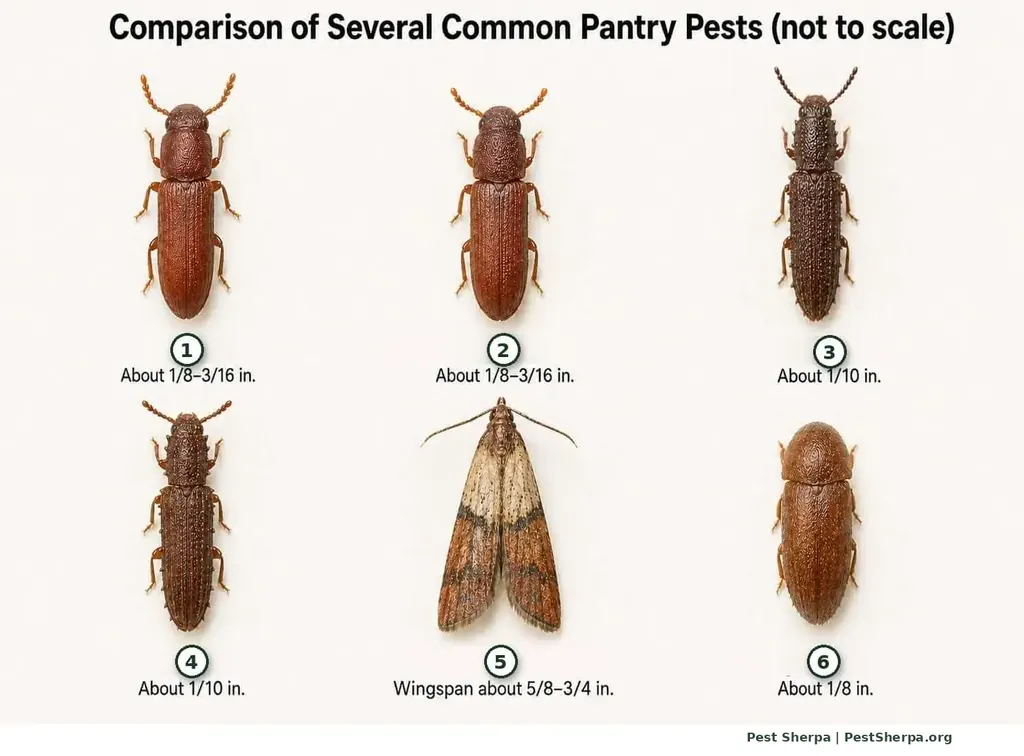
Which one did you find? Match the number:
- Red flour beetle: reddish-brown, about 1/8 to 3/16 inch. The antennae end in a distinct three-segment club.
- Confused flour beetle: looks almost the same as number 1, but the antennae thicken gradually toward the tip.
- Sawtoothed grain beetle: slim and dark brown, about 1/10 inch, with saw-like teeth along each side of the thorax.
- Merchant grain beetle: nearly the same as number 3, but with larger, more noticeable eyes.
- Indianmeal moth: a small moth with pale wing bases and reddish-copper outer wings. Wingspan about 5/8 to 3/4 inch.
- Drugstore beetle: small, oval and reddish-brown, about 1/8 inch, with the head tucked under the body.
Common pantry (also known as stored product) pest comparison including red flour beetle, confused flour beetle, sawtoothed grain beetle, merchant grain beetle, Indianmeal moth, and drugstore beetle.”
Frequently Asked Questions
Do red flour beetles bite?
Red flour beetles are not known as biting pests. Their main importance in homes is contamination of stored foods.
Does one red flour beetle mean I have an infestation?
Not always. One beetle may be a stray adult, but it is still a reason to inspect nearby dry foods, pet food, bird seed, and pantry shelf debris.
Why are red flour beetles in unopened packages?
Some pantry pests enter products before purchase, while others crawl through folds, seams, tears, or small openings after the product is stored. Thin packaging is not always pest-proof.
Can I save flour that has red flour beetles?
Food with beetles, larvae, shed skins, odor, discoloration, or visible contamination should be discarded. Sealing the product in a bag before disposal helps prevent beetles from spreading during cleanup.
Do bay leaves get rid of red flour beetles?
Bay leaves should not be relied on to eliminate red flour beetles. Finding the source, discarding infested food, vacuuming, cleaning, and storing food in tight containers are more reliable steps.
Should I spray my pantry for red flour beetles?
For most household pantry infestations, spraying is not recommended. Pesticides do not solve the problem if insects remain inside food packages, and pesticide residue around food-storage areas can create avoidable risks. Focus on source removal and sanitation first.
Why do beetles keep appearing after I threw away the flour?
There may be another infested package, food residue in cracks, beetles in pet food or bird seed, or adults still emerging from hidden material. Reinspect all nearby dry foods and clean shelf cracks and corners thoroughly.
Can red flour beetles spread from one food to another?
Yes. Adults can move from one package to another, especially when food is stored in thin, damaged, or poorly sealed packaging.
Conclusion
The red flour beetle, Tribolium castaneum, is a persistent pantry and stored-product pest because it can develop in processed dry foods and very small food residues. Its presence usually means there is an infested product, spilled food material, or contaminated storage area nearby.
Successful management depends on accurate identification, careful source investigation, disposal of infested material, thorough vacuuming and cleaning, and storage of dry foods in tightly sealed containers. Insecticides are usually unnecessary in household pantry cupboards and should never be used in a way that contaminates food or food-contact surfaces.
References
- UF/IFAS Extension: Confused Flour Beetle, Tribolium confusum, and Red Flour Beetle, Tribolium castaneum
- UC Statewide IPM Program: Pantry Pests
- NC State Extension: Common Pantry Pests and Their Management
- University of Minnesota Extension: Pantry Pests: Insects Found in Stored Food
- Purdue Extension: Red and Confused Flour Beetles
This article was written by Greg Baumann, founder of Pest Sherpa, and reflects more than 40 years of professional pest management experience.
About the Author

Greg Baumann | Pest Control Expert
Greg Baumann is the founder of Pest Sherpa and a Pest Control Expert with more than 40 years of professional pest management experience. His articles combine decades of field experience, technical expertise, and science-based guidance to help homeowners identify pests correctly, understand real-world risks, and make informed pest management decisions.
Mission: Identify the pest. Understand the risk. Stop the problem. Prevent the comeback. Know when it’s time to call a professional.