
Scorpions: Identification, Sting Risk, Prevention, and What to Do
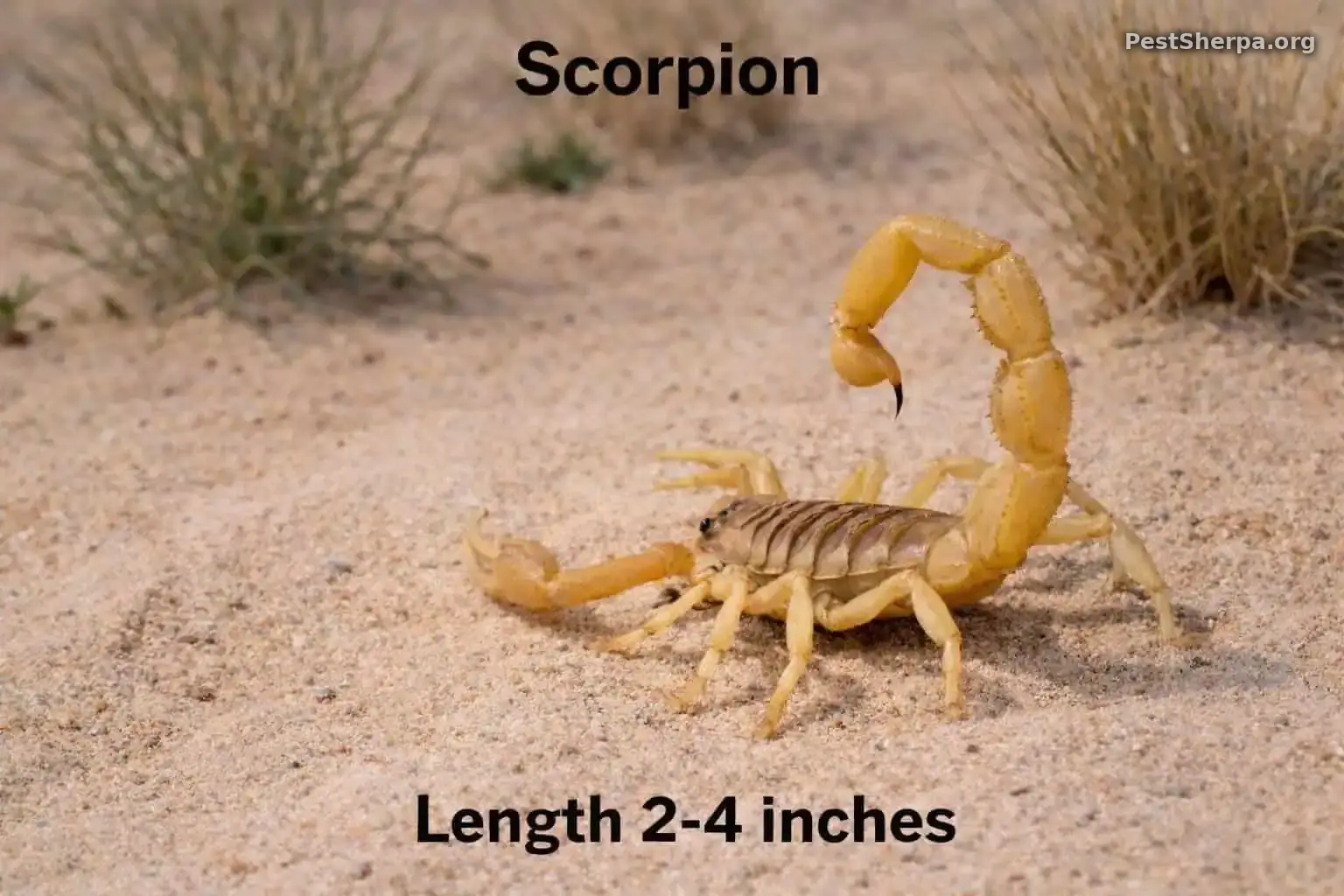
Scorpions are distinctive arachnids with large pincers, eight legs, and a curved, segmented tail ending in a venomous stinger. They are mostly outdoor predators that feed on insects and other small arthropods, but they sometimes enter homes while searching for shelter, moisture, prey, or cooler hiding places. There is a general assumption that scorpions are only found in desert areas. This is not correct. Scorpions can be found in many southern states from the east coast to the west coast. There are at least 100 U.S. species.
Finding one scorpion indoors does not always mean there is an infestation. Repeated sightings, scorpions appearing in living areas, or scorpions found in shoes, bedding, bathrooms, garages, crawl spaces, or attics usually means it is worth looking for entry points, outdoor harborage, and insect prey around the structure.
Quick Answer
If you are seeing scorpions in or around your home, focus first on identification, safe removal, exclusion, outdoor harborage reduction, and reducing insect prey. Pesticides are not always necessary, and adult scorpion sightings often decline when hiding places and entry points are addressed. Seek medical guidance after a sting if the person is a child, symptoms spread beyond the sting site, breathing becomes difficult, or severe symptoms occur.
Quick Navigation
- Identification
- Quick ID Checklist
- Biology and Life Cycle
- Habits and Behavior
- Why Scorpions Enter Homes
- Source and Entry-Point Checklist
- Stings and Medical Importance
- What To Do
- What Does Not Work Well
- How Long Scorpion Activity May Last
- When Professional Help May Be Needed
- Lookalikes and Common Misidentifications
- FAQs
- References
Identification
Scorpions are not insects but belong to the class Arachnida and the order Scorpiones. They are related to spiders, mites, and ticks, but their body shape is easy to recognize: a pair of enlarged pincers at the front and a segmented tail that curves over the body.
Most scorpions found around homes are tan, yellowish, brown, gray, or dark brown. Size varies by species. Many household-invading scorpions are roughly 1 to 3 inches long, while some larger desert species can exceed that size to even up to seven inches.
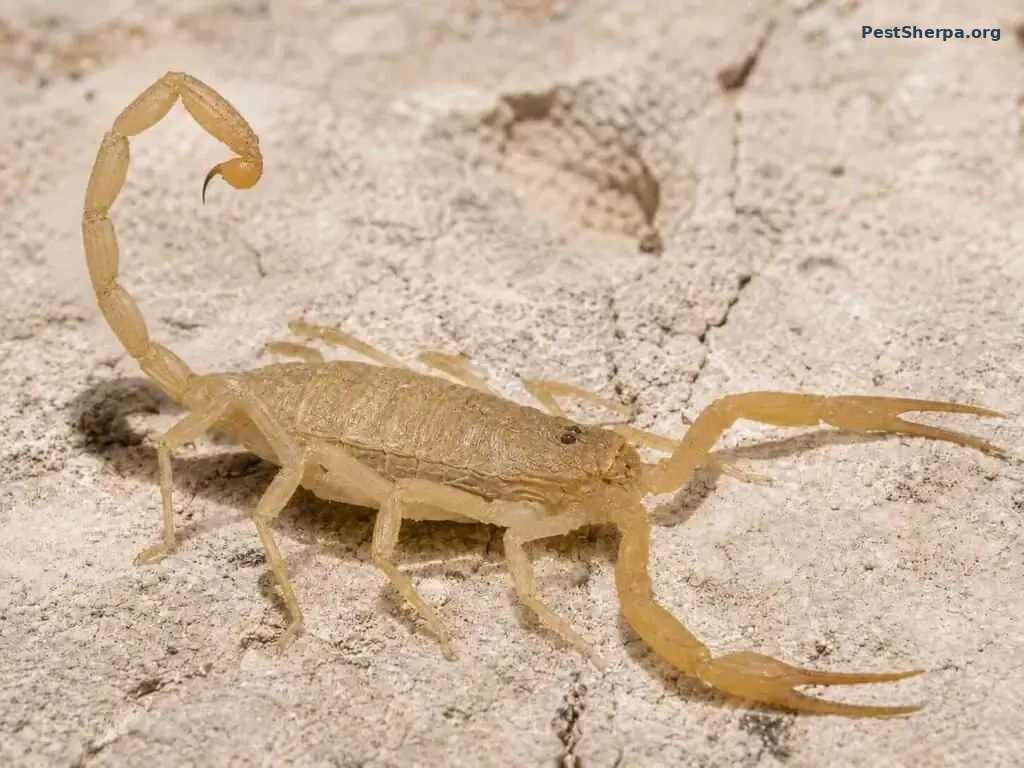
Scorpion anatomy showing pincers, eight legs, segmented tail, and stinger.
Quick ID Checklist
| Feature | What To Look For |
|---|---|
| Legs | Eight walking legs, not six like an insect |
| Pincers | Large front appendages used to grasp prey |
| Tail | Segmented tail, usually curved over the body |
| Stinger | Telson (“tail”) has an enlarged venom-containing bulb (vesicle) ending in a curved, pointed stinger |
| Body shape | Flattened body that can hide under objects and in tight gaps |
| Activity | Mostly active at night and hidden during the day |
Scorpions have two main body regions. The front region, called the prosoma or cephalothorax, carries the eyes, mouthparts, pincers, and walking legs. The rear region, called the opisthosoma, includes the abdomen and the tail-like metasoma. The stinger sits at the tip in a structure called the telson, which contains the venom gland.
Scorpions also have small comb-like sensory structures called pectines on the underside of the body. These help detect vibration and chemical cues, which is important because scorpions do not rely heavily on vision.
Biology and Life Cycle
Scorpions develop by simple metamorphosis. The young resemble miniature adults and grow through a series of molts. Unlike many pests, scorpions do not lay eggs outside the body. Females give birth to live young.
Newborn scorpions are pale and climb onto the mother’s back soon after birth. They remain there until their first molt, then disperse and begin hunting on their own. Development time varies widely by species, temperature, food, and moisture. Some scorpions mature in about a year, while others may take several years.
Scorpions are relatively long-lived compared with many household arthropods. Several species live for multiple years, and some may survive longer under favorable conditions.
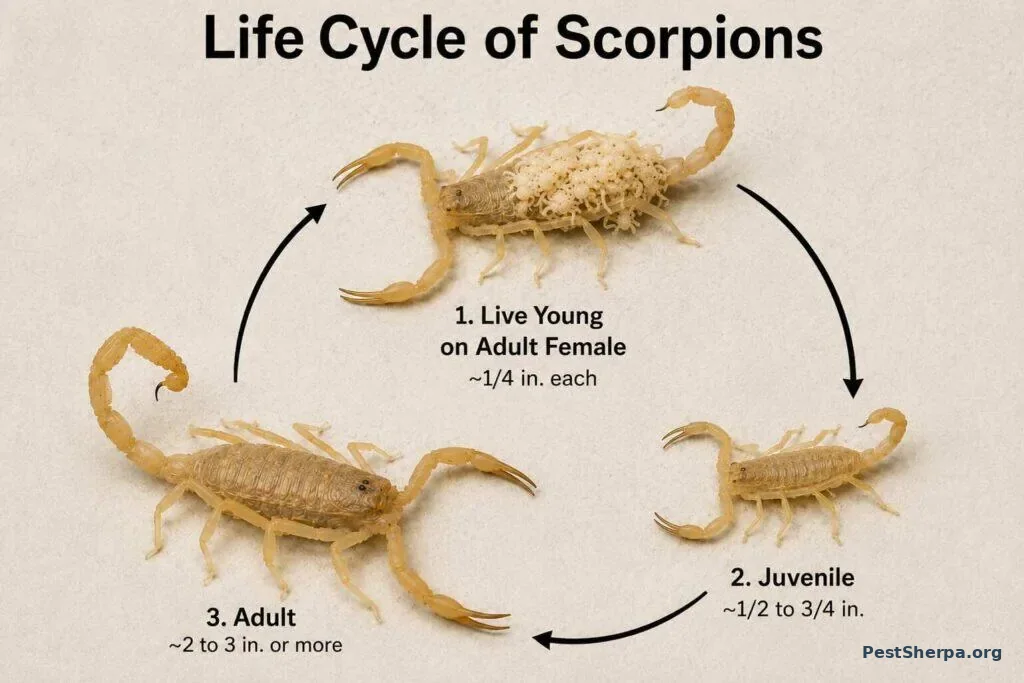
Scorpion life cycle showing live young on the mother’s back and juvenile development.
Habits and Behavior
Scorpions are mainly nocturnal predators. During the day, they hide in protected locations where temperature and moisture conditions are more stable. At night, they leave hiding places to hunt.
Common outdoor hiding places include:
- Under rocks, logs, boards, landscape timbers, and debris
- Inside firewood piles and stored building materials
- Under loose bark, palm skirts, and dense groundcover
- In cracks, crevices, block walls, and retaining walls
- In burrows or protected soil spaces, depending on species
Scorpions feed on insects and other small arthropods. Around structures, their prey may include house crickets, field crickets, beetles, spiders, and cockroaches. Reducing the prey base can make a structure less attractive to scorpions over time.
Many scorpions fluoresce under ultraviolet light. A UV flashlight can help with nighttime inspections outdoors, in garages, and along foundation edges. Use caution when inspecting; avoid reaching into dark spaces with bare hands.
Why Scorpions Enter Homes
Scorpions usually enter homes by accident or while following conditions they need: shelter, moisture, cooler temperatures, or prey. Activity may increase during hot, dry weather, after heavy rains, or when outdoor hiding places are disturbed.
Common indoor locations include:
- Bathrooms, kitchens, laundry rooms, and other moisture-prone areas
- Garages, storage rooms, basements, and crawl spaces
- Attics, especially where ducts, insulation, or gaps provide protected shelter
- Shoes, clothing piles, bedding, towels, and stored boxes
- Wall voids, utility chases, and gaps around plumbing or wiring
Scorpions are sometimes found in sinks or bathtubs because they enter the fixture area and cannot climb back out easily on smooth surfaces.
Source and Entry-Point Checklist
Use this checklist when scorpions are appearing repeatedly indoors.
Step 1: Confirm Where They Are Appearing
Note the rooms and times of day. Scorpions found near exterior doors, garages, bathrooms, kitchens, or utility walls may point to nearby entry points or moisture.
Step 2: Inspect Entry Points
- Gaps under exterior doors
- Loose thresholds and missing door sweeps
- Damaged screens
- Cracks around foundations, siding, stucco, and block walls
- Openings around pipes, cables, vents, and utility penetrations
- Gaps around garage doors and weatherstripping
Step 3: Inspect Outdoor Harborage
- Firewood stacked against the building
- Rock piles, boards, bricks, and stored materials near the foundation
- Dense vegetation touching the structure
- Palm debris, loose bark, leaf litter, and groundcover
- Landscape lights attracting insects near doors and windows
Step 4: Look for Prey Problems
Frequent crickets, cockroaches, beetles, or other crawling insects around the foundation can support scorpion activity. Addressing insect prey is often part of long-term scorpion prevention.
Stings and Medical Importance
All scorpions can sting, but most scorpion stings in the United States cause local pain, tingling, numbness, warmth, or mild swelling. Reactions vary by species, the amount of venom injected, the sting location, and the person’s sensitivity.
The most medically important scorpion in the United States is the Arizona bark scorpion, commonly listed as Centruroides sculpturatus. Some older publications use Centruroides exilicauda for bark scorpions, reflecting earlier taxonomic (classification) identification.
More serious symptoms can include spreading numbness, muscle twitching, unusual eye or head movements, drooling, trouble speaking or swallowing, vomiting, or breathing difficulty. Children especially, older adults, and people with allergies or underlying health conditions may be at higher risk from severe reactions. Young children are particularly vulnerable to serious bark scorpion stings. Children and older adults as well as anyone suffering from any medical condition and anyone developing symptoms or an allergic reaction should receive prompt medical attention.
Safety note: For sting guidance in the United States, contact Poison Help at 1-800-222-1222. Seek urgent medical care for breathing problems, severe symptoms, symptoms that spread beyond the sting site, a sting involving a young child, or any sign of an allergic reaction. Call emergency services immediately if the person has trouble breathing, collapses, has a seizure, or cannot be awakened.
What To Do
1. Avoid Bare-Handed Contact
Do not pick up scorpions with bare hands. For a single indoor scorpion, use a jar, stiff paper, long-handled tool, or vacuum if it can be done safely. Empty vacuums carefully and avoid direct contact with the collected scorpion.
2. Reduce Outdoor Hiding Places
Move firewood, boards, rocks, bricks, and stored materials away from the foundation. Keep vegetation trimmed back from walls, reduce ground clutter, and avoid leaving piles of debris near exterior doors or garage openings.
3. Improve Exclusion
Install tight-fitting door sweeps, repair screens, seal cracks and utility penetrations, and correct gaps around garage doors. Exclusion is especially important because scorpions can flatten their bodies and enter through small openings.
4. Reduce Moisture and Prey
Repair leaks, reduce standing water, improve drainage, and avoid overwatering near the structure. Outdoor lights can attract insects that scorpions hunt, so consider using less-attractive lighting placement or timing where practical.
5. Use Monitoring Carefully
Sticky traps can help show where scorpions are moving indoors, especially along garage walls, storage areas, and baseboards. Keep sticky traps away from children, pets, and non-target wildlife.
6. Use Pesticides Carefully, If Needed
Pesticides are not always necessary for scorpions and rarely solve the problem alone. If a pesticide is used, choose only products labeled for the site and pest, read and follow the label, keep people and pets away from treated areas until label directions allow reentry, and avoid treating food-contact surfaces, toys, bedding, drains, or ventilation pathways. For broader label-reading help, see this Pest Sherpa Q&A on understanding pesticide labels.
What Does Not Work Well
- Relying only on indoor sprays: This may miss outdoor harborage, entry points, and prey insects.
- Using foggers or “bug bombs” as a shortcut: Foggers do not seal entry points and may not reach the protected spaces where scorpions hide.
- Ignoring clutter and firewood: Outdoor hiding places can keep scorpions close to the home.
- Leaving door gaps unsealed: Door sweeps and thresholds are often more useful than repeated interior treatments.
- Counting on repellents alone: Repellents such as essential-oils which have little value in repelling scorpions and ultrasonic devices should not be relied upon as substitutes for exclusion, prey (scorpion food sources) reduction and habitat management.
How Long Scorpion Activity May Last
| Situation | What It May Mean |
|---|---|
| One scorpion indoors | May be a single accidental entry |
| Several scorpions over days or weeks | Likely nearby harborage, entry points, or prey activity |
| Scorpions in bathrooms or sinks | Possible moisture attraction or movement from wall/utility areas |
| Scorpions in garages or storage areas | Often connected to door gaps, clutter, or outdoor harborage |
| Activity after landscape cleanup | Disturbed hiding places may cause temporary movement |
After exclusion and harborage reduction, activity may decline gradually rather than overnight. Continued sightings usually mean there are still entry points, outdoor shelters, or prey insects supporting scorpion movement near the home.
When Professional Help May Be Needed
Professional help may be worth considering when scorpions are found repeatedly inside living spaces, when occupants include young children or medically vulnerable people, when scorpions are appearing in bedrooms or beds, or when inspection suggests activity in attics, crawl spaces, wall voids, or block walls that are difficult to evaluate safely.
A useful scorpion inspection should look beyond the individual scorpion and evaluate exterior harborage, prey insects, moisture, door gaps, utility penetrations, garage seals, attic access, and crawl-space conditions.
Lookalikes and Common Misidentifications
| Lookalike | How It Differs From a Scorpion |
|---|---|
| Windscorpion / camel spider | A fast arachnid with large jaws, but no true scorpion tail or stinger |
| Centipede | Long body with many legs; no pincers and no curved stinging tail |
| Brown recluse spider | Eight legs but no pincers or tail; body shape is spider-like |
| Yellow sac spider | Pale spider sometimes found indoors; no pincers or segmented tail |
| Earwig | Insect with rear forceps; has six legs and no stinger-tipped tail |
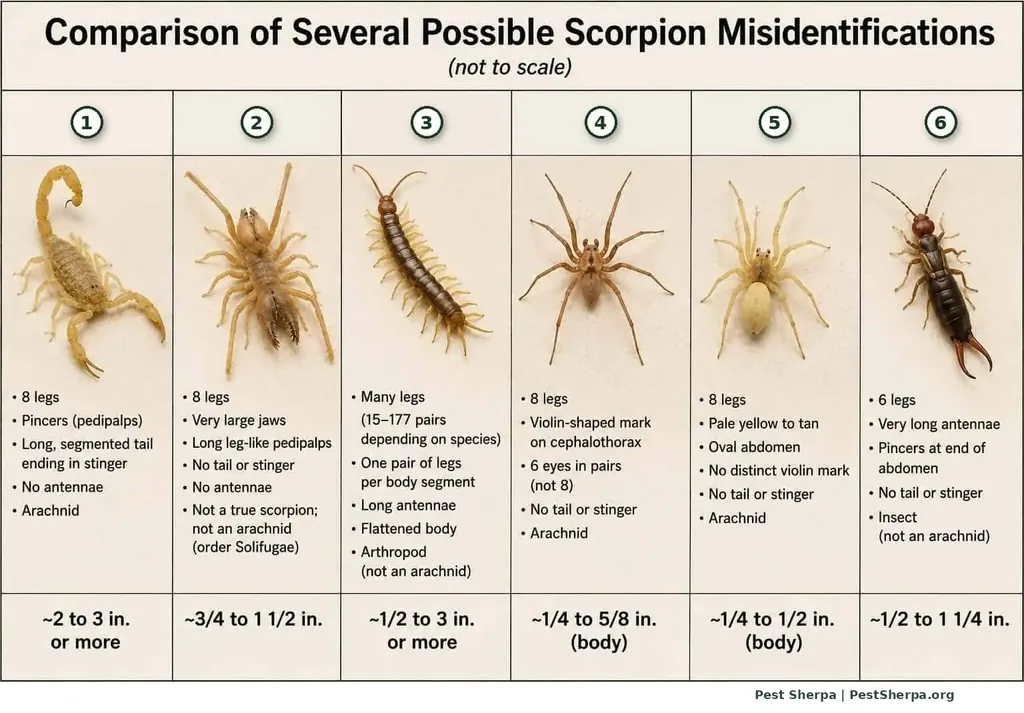
Which one do you see? Match the number:
- Scorpion: about 2 to 3 inches or more, pincers, long segmented tail ending in a stinger, 8 legs.
- Windscorpion (solifuge): about 3/4 to 1 1/2 inches, very large jaws and long leg-like pedipalps, no tail or stinger. Not a true scorpion.
- Centipede: about 1/2 to 3 inches or more, flattened body with one pair of legs per body segment and long antennae.
- Brown recluse spider: about 1/4 to 5/8 inch body, violin-shaped mark on the cephalothorax and 6 eyes in pairs.
- Yellow sac spider: about 1/4 to 1/2 inch body, pale yellow to tan with an oval abdomen and no violin mark.
- Earwig: about 1/2 to 1 1/4 inches, an insect with 6 legs, long antennae and pincers at the end of the abdomen.
Comparison of a scorpion with common household lookalikes including windscorpion, centipede, spiders, and earwig.
Frequently Asked Questions
Does one scorpion mean I have an infestation?
Not always. One scorpion may have entered accidentally. Repeated sightings, scorpions in multiple rooms, or scorpions appearing in bedrooms, bathrooms, or garages suggest that entry points and outdoor harborage should be inspected.
Why are scorpions in my bathroom?
Bathrooms may provide moisture and access through plumbing or wall gaps. Scorpions may also become trapped in sinks or tubs because smooth surfaces are hard for them to climb.
Do scorpions climb walls?
Some species, especially bark scorpions, can climb rough surfaces such as stucco, block, bark, and textured walls. Smooth glass or slick plastic is harder for them to climb.
Are scorpions active during the day?
They are usually hidden during the day and active at night. Daytime sightings can happen when hiding places are disturbed or when a scorpion is trapped indoors.
Do scorpions glow under black light?
Many scorpions fluoresce under ultraviolet light, which can make nighttime inspections easier. A UV flashlight is a monitoring tool, not a control method.
What should I do after a scorpion sting?
Stay calm, avoid handling the scorpion, and contact Poison Help at 1-800-222-1222 for guidance in the United States. Seek urgent care for severe pain, spreading symptoms, breathing difficulty, muscle twitching, unusual eye or head movements, symptoms in a young child, or any sign of an allergic reaction.
Will scorpions go away on their own?
A single scorpion may not be followed by more. Ongoing activity usually continues until entry points, outdoor hiding places, moisture, and prey insects are addressed.
References
- University of Arizona Cooperative Extension: Scorpions of the Desert Southwest United States
- University of California Statewide IPM Program: Scorpions
- Texas A&M AgriLife Extension Service: Scorpions
- Poison Control: Are Scorpions Venomous?
- Mayo Clinic: Scorpion Sting Symptoms and Causes
This article was written by Greg Baumann, founder of Pest Sherpa, and reflects more than 40 years of professional pest management experience.
About the Author

Greg Baumann | Pest Control Expert
Greg Baumann is the founder of Pest Sherpa and a Pest Control Expert with more than 40 years of professional pest management experience. His articles combine decades of field experience, technical expertise, and science-based guidance to help homeowners identify pests correctly, understand real-world risks, and make informed pest management decisions.
Mission: Identify the pest. Understand the risk. Stop the problem. Prevent the comeback. Know when it’s time to call a professional.