
Bald-faced Hornets: Identification, Nest Risk, and What to Do
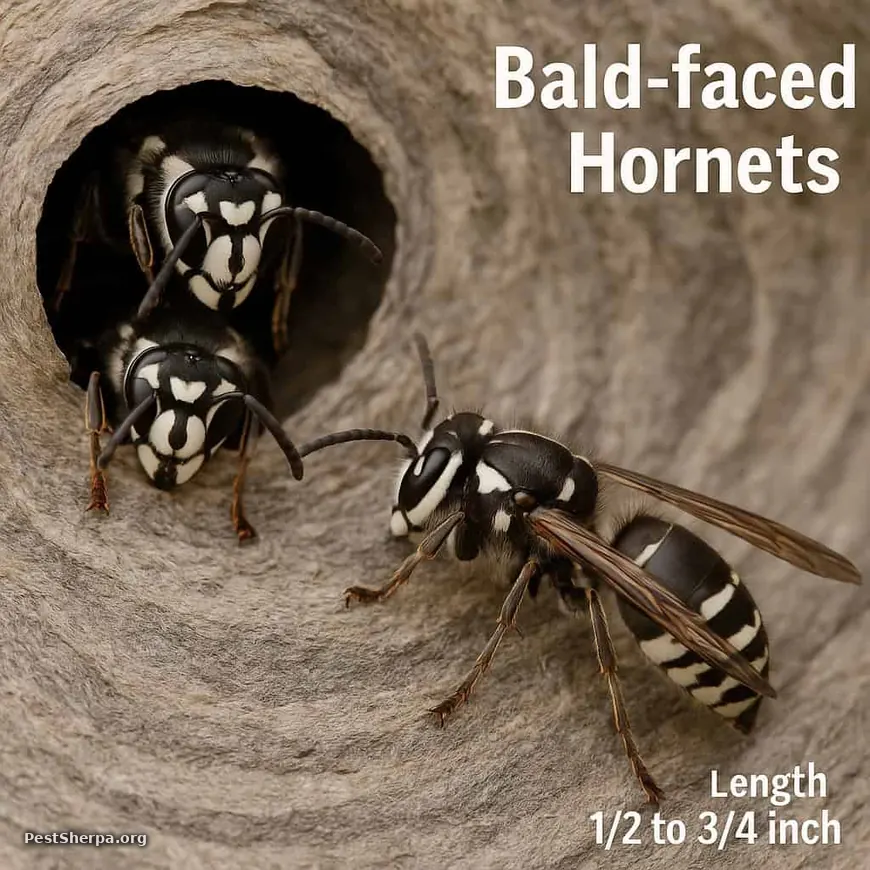
Bald-faced Hornets: Identification, Nest Risk, Safety, and What To Do
Finding a bald-faced hornet nest can be unsettling, especially if it is near a doorway, patio, playset, driveway, mailbox, deck, or shrub you regularly walk past. These large black-and-white wasps can be beneficial predators of flies, caterpillars, spiders, and other insects, but an active nest in a high-traffic area deserves careful attention. This guide explains how to identify bald-faced hornets, what their nest usually means, how to assess the risk, where to inspect safely, what not to do, and when professional help may be worth considering.
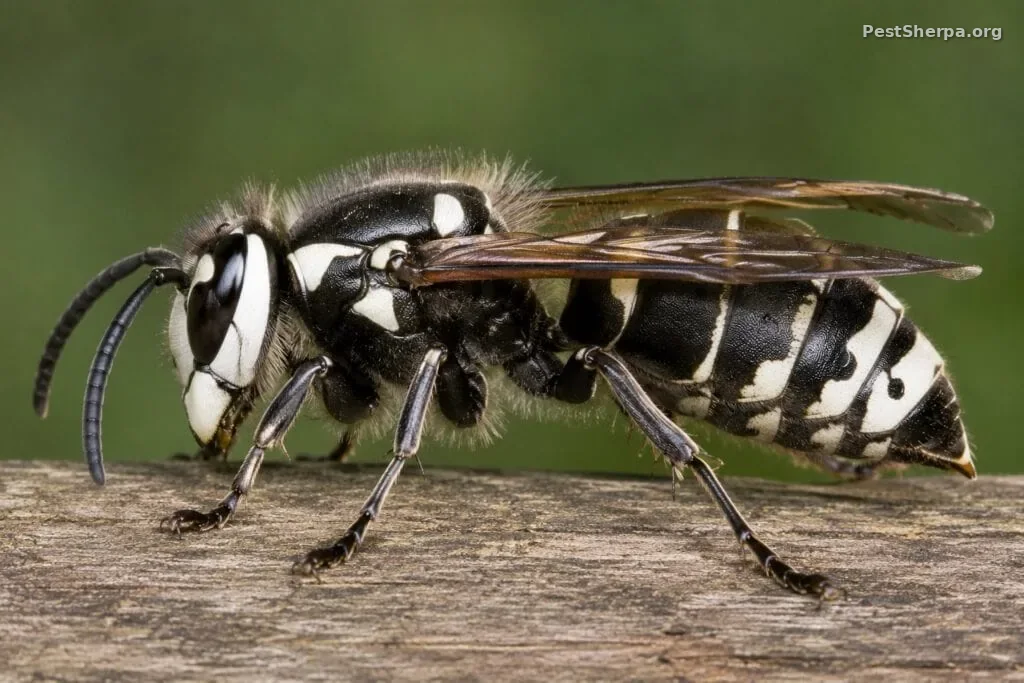
Adult bald-faced hornet showing black body and white facial markings.
TL;DR
Bald-faced hornets are not true hornets. They are large aerial yellowjackets, scientifically known as Dolichovespula maculata. They build gray, papery, football-shaped nests above ground in trees, shrubs, under eaves, on buildings, and sometimes on other outdoor structures.
A single hornet on flowers, fruit, or around lights does not always mean there is a nest on your home. Repeated traffic to the same spot, a visible gray paper nest, or workers becoming defensive when you approach an area usually means an active colony is nearby.
Do not hit, shake, spray randomly, burn, hose down, seal, or knock down an active nest. Keep children, pets, and bystanders away. A nest high in a tree and away from people may not require immediate action, but nests near doors, patios, play areas, walkways, or structures can create a sting risk and may justify professional evaluation.
Quick Navigation
- What Bald-faced Hornets Mean Around Your Home
- Quick Identification
- Quick Assessment: How Serious Is It?
- Where To Inspect Safely
- Seasonal Activity and Life Cycle
- Why Bald-faced Hornets Suddenly Appear
- Common Nest Locations, Attractants, and Entry Points
- What To Do
- What Does Not Work
- How Long Will It Last?
- Health, Sting, Pet, and Pesticide Safety
- When Professional Help May Be Needed
- Lookalikes and Common Misidentifications
- Frequently Asked Questions
- References
What Bald-faced Hornets Mean Around Your Home
Bald-faced hornets are social wasps. The adults you see are usually workers foraging for insect prey, sugary foods, fruit juices, nectar, honeydew, or nest-building material. If you see several workers flying in and out of one location, that location may be the nest entrance.
The main question is not simply “Are bald-faced hornets present?” The more useful question is: Is there an active nest close enough to people, pets, or routine activity to create a realistic sting risk?
| What You See | What It Usually Means |
|---|---|
| One bald-faced hornet on flowers, fruit, or a deck rail | May be a forager passing through |
| Several hornets repeatedly flying to the same shrub, eave, tree, or structure | Possible active nest nearby |
| Gray football-shaped paper nest | Likely bald-faced hornet or aerial yellowjacket nest |
| Hornets emerging from a soffit, wall gap, attic vent, or void | Possible nest in or against the structure |
| Increased defensive activity when mowing, pruning, or walking past one area | Nest may be close to the disturbed area |
| Old gray nest after hard freeze with no activity | Likely abandoned seasonal nest, but confirm there is no flight activity before approaching |
Consumer note: Bald-faced hornets can be beneficial when their nest is far from human activity. A high nest at the edge of a property may be less urgent than a smaller nest beside a doorway, school entrance, patio, or play area.
Quick Identification: What Bald-faced Hornets Look Like
Bald-faced hornets are large black-and-white social wasps. The scientific name is Dolichovespula maculata. Despite the common name, they are not true hornets in the genus Vespa; they are usually described as aerial yellowjackets.
- Color: Mostly black with white to cream markings on the face and near the end of the abdomen
- Size: Large for a yellowjacket-type wasp, commonly described around 5/8 to 7/8 inch, with queens larger than workers
- Body shape: Smooth, shiny, wasp-like body with a narrow waist
- Wings: Clear to smoky wings that fold over the back when resting
- Nest: Gray, papery, enclosed, football-shaped or pear-shaped nest with layered combs inside
- Nest placement: Usually above ground in trees, shrubs, under eaves, on buildings, or on outdoor structures
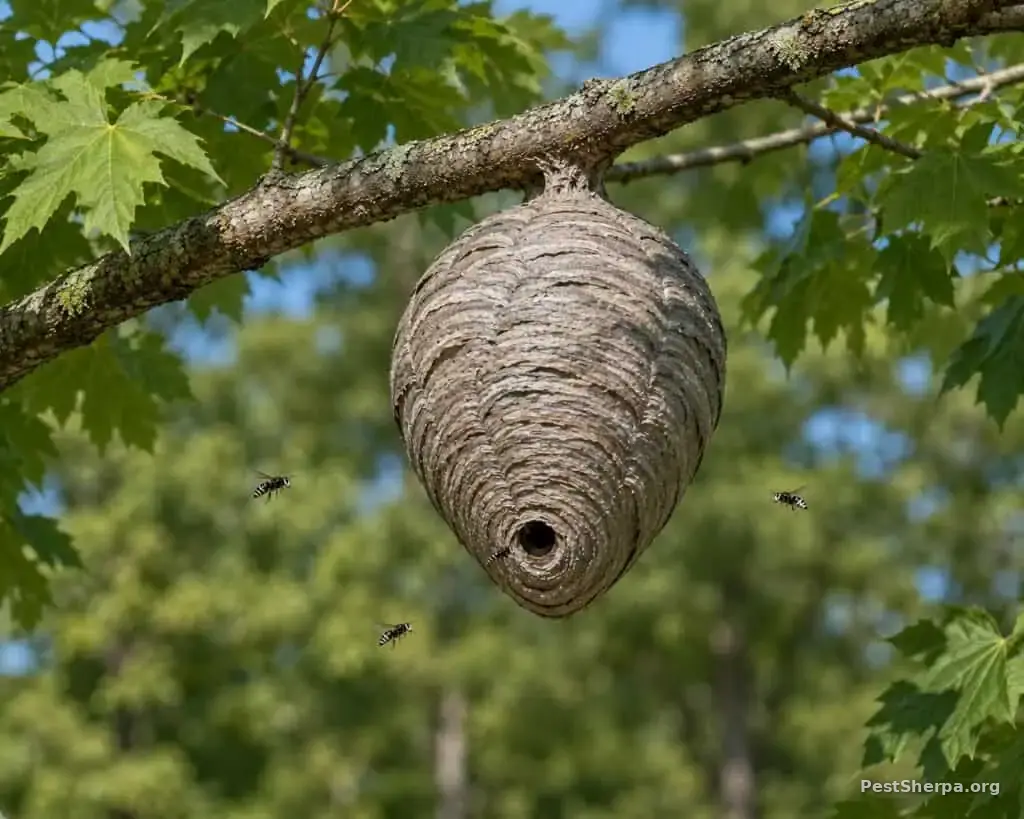
IGray football-shaped bald-faced hornet nest hanging from a tree branch.
| Feature | Bald-faced Hornet Clue |
|---|---|
| Face | White or cream markings on the front of the head |
| Abdomen | Mostly black with white markings near the tip |
| Nest covering | Fully enclosed gray paper envelope |
| Nest shape | Oval, football-shaped, or pear-shaped |
| Common flight pattern | Workers travel directly to and from one entrance |
| Main confusion | Often mistaken for true hornets, yellowjackets, or paper wasps |
Quick Assessment: How Serious Is It?
Use the location and activity level to decide how cautious to be. The same species can be low concern in a remote tree and high concern beside a front door.
| Situation | Likely Risk Level | Practical Next Step |
|---|---|---|
| One hornet foraging on flowers or fruit | Low | Observe from a distance; remove obvious food attractants if needed |
| Nest high in a tree far from people, pets, and paths | Low to moderate | Mark the area mentally and avoid disturbance; monitoring may be enough |
| Nest near a walkway, porch, driveway, patio, deck, mailbox, pool, or garden work area | Moderate to high | Keep people and pets away; evaluate whether the nest can be safely left alone |
| Nest near a playset, school area, daycare, pet run, or busy entrance | High | Restrict access and consider professional evaluation |
| Hornets entering a wall, attic vent, soffit, or roofline gap | High | Do not seal the opening while active; identify the nest location safely |
| Known sting allergy in the household or frequent visitors | High | Avoid the area and consider professional help even if the nest seems small |
| Someone has already sprayed, knocked, cut, or disturbed the nest | High | Leave the area and give the colony space; do not continue disturbing it |
Important: Do not use a ladder, stand under the nest, prune the branch holding the nest, or place your face near a suspected entrance to “get a better look.” Defensive activity can escalate quickly when the nest is disturbed.
Where To Inspect Safely
Inspection should be done from a safe distance. The goal is to observe flight patterns, not to disturb the nest. Stand well away, watch where workers are traveling, and avoid blocking the flight path.
Outdoor Areas To Check
- Tree branches, especially 6 feet or higher
- Dense shrubs and hedges
- Under eaves, soffits, fascia, porch ceilings, and roof overhangs
- Deck framing, pergolas, gazebos, and outdoor structures
- Playsets, fences, sheds, garages, and outbuildings
- Areas around fruit trees, fallen fruit, outdoor trash, compost, and sugary drink spills
- Roofline gaps, attic vents, utility penetrations, and exterior wall openings where workers are entering and leaving
How To Watch the Flight Path
- Choose a safe vantage point away from the suspected nest.
- Watch for repeated straight-line flights to and from one spot.
- Look for workers disappearing into leaves, eaves, a soffit gap, or the side/lower entrance of a paper nest.
- Keep children, pets, and bystanders out of the area during inspection.
- Stop inspecting if hornets begin circling you, bumping into you, or acting more defensive.
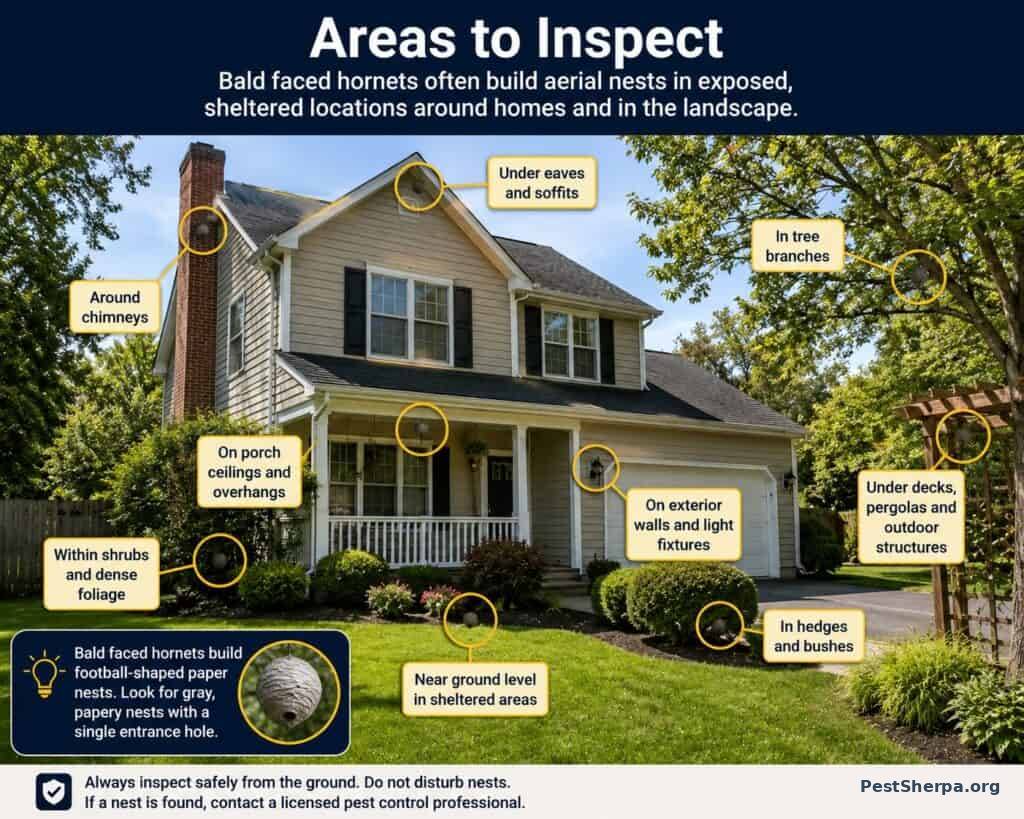
Diagram showing common bald-faced hornet nest inspection areas around a home.
Seasonal Activity and Life Cycle
Bald-faced hornet colonies are seasonal in most temperate regions. A mated queen survives winter in a protected place and begins a new nest in spring. Early in the season, the nest may be small and easy to miss. Once the first workers emerge, they expand the nest, forage for prey, feed larvae, and defend the colony.
By mid- to late summer, the colony is often much larger and easier to notice. In late summer and fall, the colony produces males and new queens. After mating, the new queens seek protected overwintering sites. Workers, males, and the old colony decline as cold weather arrives. Old nests are generally not reused the next year.
| Season | What Is Happening | What Homeowners Notice |
|---|---|---|
| Spring | Overwintered queen starts a new nest | Small nest may be hidden and easy to miss |
| Early summer | First workers emerge and begin expanding the nest | Light activity near shrubs, eaves, or trees |
| Mid to late summer | Colony grows quickly | Visible nest and steady worker traffic |
| Late summer to fall | New queens and males are produced | More noticeable activity around fruit, sugary foods, and outdoor spaces |
| After hard freezes | Old colony dies out; mated queens overwinter elsewhere | Old nest may remain but is usually inactive |
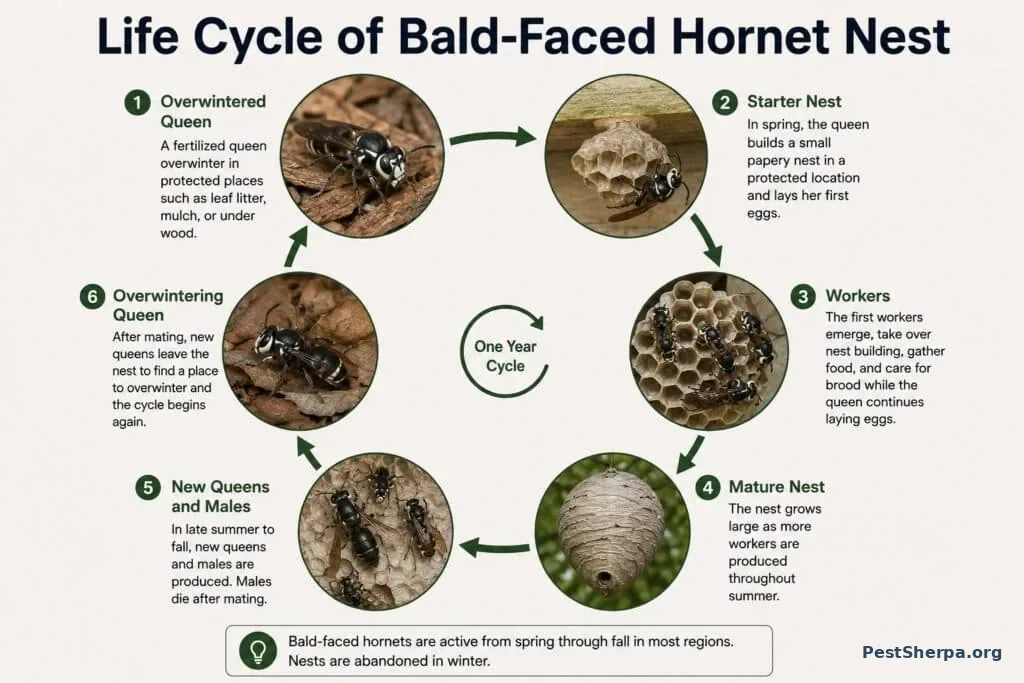
Bald-faced hornet seasonal life cycle from spring queen to late-season colony decline.
Why Bald-faced Hornets Suddenly Appear
Bald-faced hornets often seem to appear suddenly because the nest grows quietly for weeks before people notice it. Leaves, shrubs, rooflines, and high branches can hide the nest until worker traffic increases or the nest becomes large enough to see.
- Colony growth: A small spring nest can become a much larger summer nest as workers expand it.
- Seasonal population peak: More workers are active in mid- to late summer.
- Pruning or yard work: Trimming shrubs, mowing, or moving outdoor items can disturb a hidden nest.
- Food sources: Fallen fruit, sugary drinks, garbage, and protein scraps can attract foragers.
- Weather and leaf drop: Wind, storms, thinning foliage, or autumn leaf drop can reveal a nest that was already present.
- Structure gaps: Repeated hornets near a soffit, attic vent, or wall gap may indicate activity in a void or an attached nest near the opening.
Sudden sightings do not always mean the nest is new. In many cases, the colony has been developing out of sight and has only become noticeable as activity increases.
Common Nest Locations, Attractants, and Entry Points
Common Nest Locations
- Tree branches and tree forks
- Dense shrubs, hedges, and ornamental plantings
- Under eaves, porch roofs, soffits, fascia, and roof overhangs
- Outbuildings, sheds, barns, garages, and pergolas
- Deck framing, fences, playsets, and outdoor furniture
- Occasionally near rock overhangs or other sheltered exterior surfaces
Common Attractants
- Ripening or fallen fruit
- Sugary drinks, juice spills, and outdoor food residues
- Garbage, recycling residue, and picnic scraps
- Protein foods at outdoor meals
- Honeydew from aphids or other plant-feeding insects
- Weathered wood fibers and thin bark used for nest paper
Possible Structural Clues
Bald-faced hornets usually build visible aerial nests, but repeated traffic into a soffit, attic vent, siding gap, fascia opening, or wall void should be treated cautiously. Do not seal the opening while insects are active. Sealing an active entrance can trap workers and may push them into living areas or create new exit points.
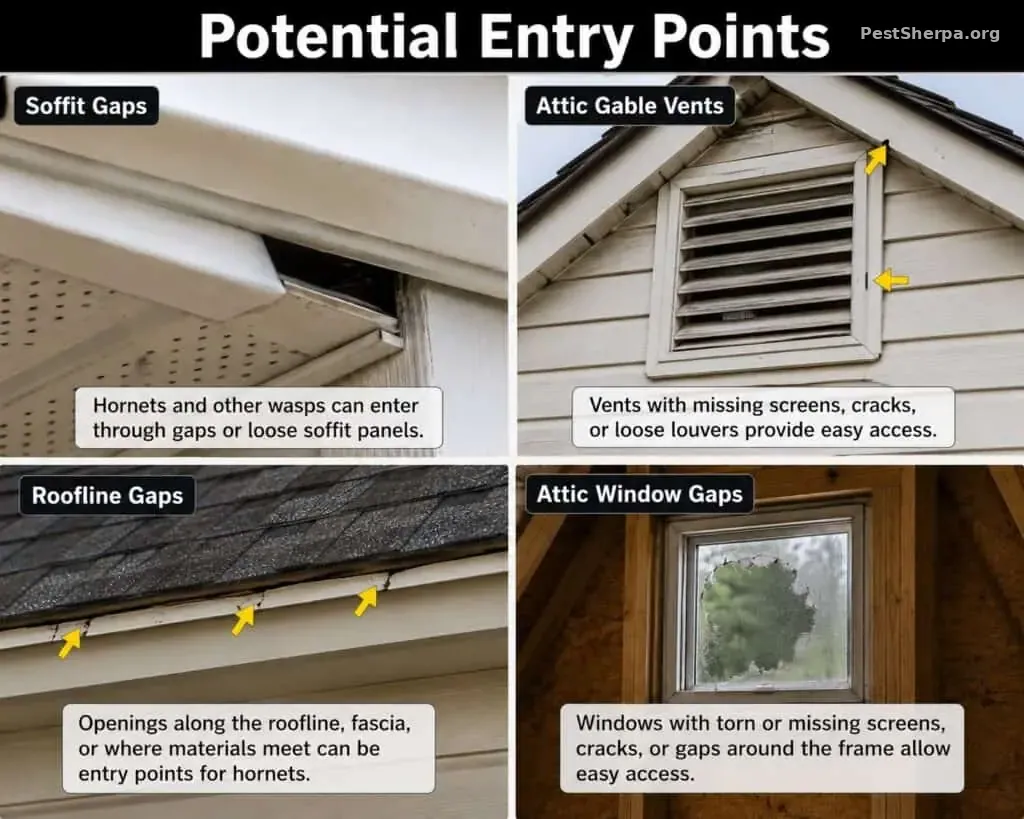
Common roofline and soffit gaps where bald-faced hornets may enter or nest nearby.
What To Do
1. Confirm the Insect and Nest Type
Before taking action, confirm whether you are dealing with bald-faced hornets, yellowjackets, paper wasps, European hornets, cicada killers, honey bees, or another insect. Management decisions are different for social wasps, solitary wasps, and bees.
Related guide: Bee & Wasps Insect Guide: Identification, Risk, and What to Do
2. Keep People and Pets Away
Use a visible reminder, temporary barrier, or alternate route if the nest is near a common path. Keep children, pets, guests, landscapers, delivery workers, and anyone with a known sting allergy away from the area.
3. Observe From a Safe Distance
Watch the flight path without standing under the nest or blocking the entrance. Do not shake branches, open soffits, move outdoor furniture, prune shrubs, or mow directly beside the suspected nest.
4. Reduce Food Attractants
- Keep garbage and recycling containers closed.
- Clean sugary drink spills and outdoor food residue.
- Pick up fallen fruit when practical.
- Cover food and drinks during outdoor meals.
- Rinse sticky bottles, cans, and bins before storage.
5. Decide Whether the Nest Can Be Left Alone
If the nest is high, remote, and away from people and pets, monitoring and avoidance may be enough until the colony naturally declines after freezing weather. If the nest is near daily activity, leaving it alone may not be realistic.
6. Use Pesticides Only With Label-Based Safety
If any pesticide is considered, read and follow the product label completely. Use only products labeled for the intended pest and site. Do not apply pesticides in a way that conflicts with the label, and do not improvise with fuels, solvents, household cleaners, or unmarked products. Keep children, pets, and nonessential people away from treated areas according to label directions.
7. Remove Old Nests Only After Confirming Inactivity
After hard freezes and no visible activity, old nests can often be left to weather away. If removal is desired, confirm there is no traffic for several days and avoid removal if you are allergic, uncertain, or the nest is high or difficult to reach.
What Does Not Work
Many common nest “tricks” increase risk or fail to address the colony.
| Approach | Why It Is a Problem |
|---|---|
| Knocking down an active nest | Can trigger a defensive swarm and may not eliminate the colony |
| Throwing rocks, spraying with a hose, or shaking branches | Disturbs the colony and puts the person directly in the danger zone |
| Burning or smoking the nest | Creates fire, smoke, burn, and sting hazards |
| Sealing an active wall, soffit, or attic entrance | Can drive workers into living areas or force new exits |
| Using indoor bug bombs for an outdoor or wall nest | Usually does not reach the colony and can create pesticide exposure risks |
| Spraying random foragers on flowers | Does not address the nest and may affect beneficial insects |
| Using a ladder close to the nest | Increases fall risk if hornets defend the nest |
| Trying to remove the nest without identifying it | May lead to the wrong approach, especially if the insects are bees or another wasp species |
Key point: The nest is the source of the risk. Randomly treating flying adults rarely solves an active colony problem.
How Long Will It Last?
The answer depends on whether you are seeing foragers or an active nest.
- One or two foragers: Activity may stop when the food source is gone or weather changes.
- Active spring nest: The nest may continue growing through summer if undisturbed.
- Active summer nest: Activity often increases as the colony grows.
- Late-season nest: The colony usually declines after freezing weather, although timing varies by climate.
- Old inactive nest: The paper nest may remain visible for months but is generally not reused the following year.
- Nest in or near a structure: Activity can continue until the colony naturally declines or is properly managed.
A nest that is far from people may be tolerated until the seasonal colony dies out. A nest near daily activity may need a faster risk-based decision.
Health, Sting, Pet, and Pesticide Safety
Sting Risk
Bald-faced hornets can sting more than once. They are most likely to sting when their nest is threatened, disturbed, bumped, cut into, sprayed, or approached too closely. Most stings cause local pain, redness, itching, and swelling, but some people can have severe allergic reactions.
Seek emergency medical care immediately if a sting is followed by trouble breathing, swelling of the throat or tongue, widespread hives, dizziness, fainting, vomiting, chest tightness, or other signs of a severe reaction. Anyone with a known insect-sting allergy should follow their medical plan and carry prescribed emergency medication as directed by their clinician.
Children and Pets
Children and pets may not recognize warning signs or may accidentally throw objects, run near the nest, bump shrubs, or investigate buzzing insects. Keep them away from active nest areas, and alert visitors, yard workers, and neighbors if a nest is close to shared spaces.
Pesticide Safety
If pesticides are used, the label is the law and the safety guide. Read the label before buying, applying, storing, or disposing of any product. Follow all site restrictions, protective-equipment directions, ventilation instructions, re-entry statements, storage instructions, and first-aid directions. Do not use unlabeled products or combine products.
When Professional Help May Be Needed
Professional help may be worth considering when the nest location, height, structure involvement, allergy risk, or traffic level makes safe avoidance difficult. This is not about panic; it is about matching the response to the real risk.
- The nest is near a doorway, sidewalk, patio, deck, pool, mailbox, driveway, or play area.
- The nest is high enough that a ladder would be needed.
- Hornets are entering a soffit, wall, attic, vent, roofline gap, or other structural void.
- Someone on the property has a known sting allergy or history of severe reactions.
- The nest is at a school, daycare, multifamily property, workplace, restaurant patio, or other shared high-traffic site.
- Previous attempts disturbed the nest or made activity worse.
- You cannot identify the insect confidently.
- You cannot keep children, pets, guests, or workers away from the nest area.
A qualified pest management professional can identify the insect, locate the nest entrance, evaluate whether the nest can be left alone, and explain appropriate management options. If pesticides are used, they should be selected and applied according to the label and applicable regulations.
Lookalikes and Common Misidentifications
Correct identification matters because hornets, yellowjackets, paper wasps, solitary wasps, honey bees, and bumblebees do not create the same risk or require the same response.
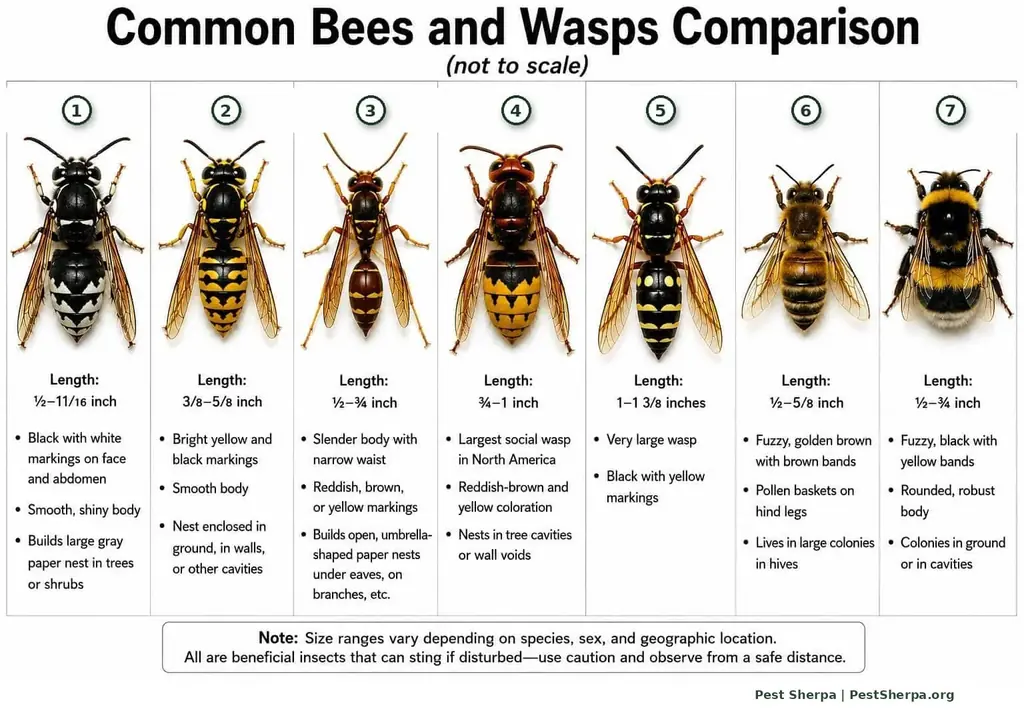
Which one do you see? Match the number:
- Bald-faced hornet: 1/2 to 11/16 inch, black with white markings on the face and abdomen. Builds large gray paper nests in trees or shrubs.
- Yellowjacket: 3/8 to 5/8 inch, bright yellow and black, smooth body. Nests enclosed in the ground, in walls or other cavities.
- Paper wasp: 1/2 to 3/4 inch, slender with a narrow waist, reddish-brown or yellow markings. Builds open, umbrella-shaped paper nests.
- European hornet: 3/4 to 1 inch, the largest social wasp in North America, reddish-brown and yellow. Nests in tree cavities or wall voids.
- Cicada killer: 1 to 1 3/8 inches, very large black wasp with yellow markings. Solitary, digs burrows in soil and hunts cicadas.
- Honey bee: 1/2 to 5/8 inch, fuzzy, golden brown with brown bands and pollen baskets on the hind legs. Lives in large colonies in hives.
- Bumblebee: 1/2 to 3/4 inch, fuzzy and robust, black with yellow bands. Nests in the ground or in cavities.
IComparison of bald-faced hornet, yellowjacket, paper wasp, European hornet, cicada killer, honey bee, and bumblebee.
| Lookalike | How It Differs | Related Guide |
|---|---|---|
| Yellowjackets | Usually black and yellow rather than black and white; many species nest underground or in cavities, although bald-faced hornets are also yellowjacket relatives | Yellowjackets |
| Paper Wasps | Slender body, long legs that often hang during flight, and open umbrella-like comb nests rather than enclosed football-shaped nests | Bee & Wasps Guide |
| European Hornets | Larger true hornets with reddish-brown and yellow markings; often use tree cavities, wall voids, or protected spaces | European Hornets |
| Cicada Killer Wasps | Very large solitary wasps that usually nest in soil burrows and hunt cicadas; not social nest defenders like bald-faced hornets | Cicada Killer Wasps |
| Honey Bees | Fuzzier, tan to golden-brown, important pollinators; may form swarms or wax-comb colonies rather than gray paper nests | Honey Bees |
| Bumblebees | Rounder and fuzzier, often with pollen baskets; many species nest in soil cavities or protected spaces | Bumblebees |
If you are unsure whether the insects are bees, wasps, yellowjackets, or hornets, avoid disturbing the nest until identification is clearer.
Frequently Asked Questions
Are bald-faced hornets really hornets?
No. Despite the name, bald-faced hornets are not true hornets. They are large black-and-white aerial yellowjackets in the genus Dolichovespula.
What does a bald-faced hornet nest look like?
The nest is usually gray, papery, enclosed, and shaped like a football, pear, or oval. It often hangs from a tree branch, shrub, eave, porch ceiling, or other above-ground location.
Will bald-faced hornets reuse the same nest next year?
Old nests are generally not reused. The seasonal colony dies out in cold weather, while mated queens overwinter separately and start new nests the following spring.
Should I remove a high nest in a tree?
Not always. If the nest is high, remote, and away from people, pets, and routine activity, it may be reasonable to avoid the area and let the seasonal colony decline naturally. A high nest near a deck, sidewalk, school area, or work zone is a different situation.
Why are bald-faced hornets around my fruit tree or garbage cans?
Adults use sugary foods for energy and also collect protein sources. Fallen fruit, juice spills, outdoor meals, garbage residue, and other food sources can attract foragers even if the nest is elsewhere.
Can bald-faced hornets sting more than once?
Yes. Bald-faced hornets can sting repeatedly, especially when defending the nest.
What should I do if I accidentally disturb a nest?
Move away quickly and calmly toward shelter. Do not swat at the insects, stand still next to the nest, or jump into water. Once away from the area, check for stings and watch for symptoms of a severe allergic reaction.
Can I just seal the hole where they are entering?
Do not seal an active entrance. If hornets are entering a soffit, wall, attic vent, or other opening, sealing it can trap workers and may force them into living spaces or new exit points.
Do bald-faced hornets damage houses?
They are not wood-destroying insects like termites. They chew weathered wood fibers and sometimes thin bark to make paper nest material, but the larger concern around homes is usually sting risk from an active nest in a high-traffic location.
When is professional help most reasonable?
Professional help is most reasonable when the nest is close to people or pets, located high off the ground, connected to a structure, difficult to access, near a person with a sting allergy, or in a public or shared space.
Bottom Line
Bald-faced hornets are beneficial predators when their nests are out of the way, but active nests near people can create a real sting risk. Identify the insect, keep a safe distance, avoid disturbing the nest, reduce food attractants, and make a risk-based decision based on location, activity, allergies, and access. When the nest is high, hidden, structural, or close to daily activity, professional evaluation may be the safer next step.
References
Species-Specific References
- University of Minnesota Extension: Wasps and Bees
- NC State Extension: Baldfaced Hornets in Landscapes
- LSU AgCenter: Dolichovespula maculata, Bald-faced Hornet
- Cornell Integrated Pest Management: Yellowjackets and Baldfaced Hornets
- GBIF: Dolichovespula maculata (Linnaeus, 1763)
This article was written by Greg Baumann, founder of Pest Sherpa, and reflects more than 40 years of professional pest management experience.
About the Author

Greg Baumann | Pest Control Expert
Greg Baumann is the founder of Pest Sherpa and a Pest Control Expert with more than 40 years of professional pest management experience. His articles combine decades of field experience, technical expertise, and science-based guidance to help homeowners identify pests correctly, understand real-world risks, and make informed pest management decisions.
Mission: Identify the pest. Understand the risk. Stop the problem. Prevent the comeback. Know when it’s time to call a professional.