
Fire Ants: Identification, Species, Range, and Control
TL;DR
| Common Name | Fire Ants |
|---|---|
| Primary Genus | Solenopsis |
| Other Stinging Ant Included | Myrmica rubra (European Fire Ant) |
| Main Concern | Painful stings, aggressive colony defense, nuisance, public health, agriculture |
| Structural Pest? | No |
| Nest Type | Soil nests and earthen mounds (varies by species) |
| Best Management | Species identification followed by integrated baiting and mound treatment |
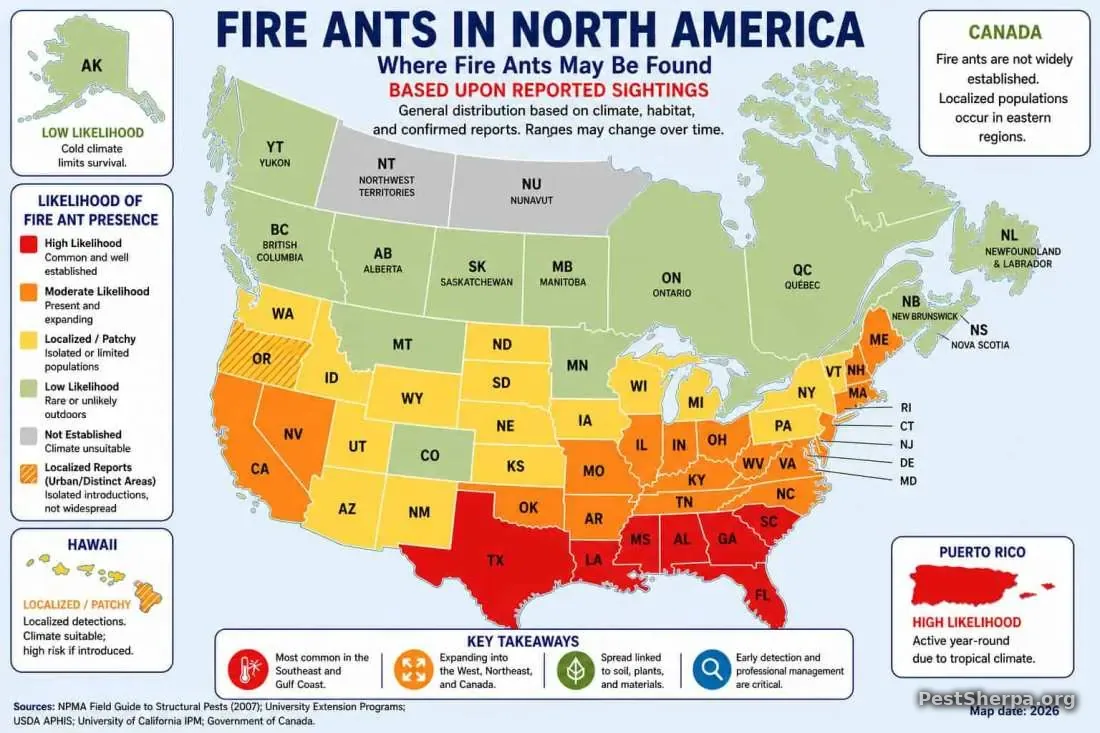
Fire ants are not a single species. North America is home to multiple native and introduced fire ants. These include Red Imported Fire Ants, Black Imported Fire Ants, Southern Fire Ants, Tropical Fire Ants, Desert Fire Ants, and European Fire Ants. Imported fire ants remain most common in the Southeast. Still, fire ant problems now extend into western states, the Northeast, and parts of eastern Canada.
Understanding which species you are dealing with is important because identification, sting risk, nesting habits, geographic distribution, and control strategies vary considerably.
Most homeowners should know:
- Not every red ant is a fire ant.
- Not every fire ant is the Red Imported Fire Ant.
- Different species require different management approaches.
- Imported fire ants remain the most serious fire ant pest in much of the southern United States.
- Correct identification is the first step toward successful control.
Jump to:
- Fire Ant Identification Guides
- What Are Fire Ants?
- Key Fire Ant Species in North America
- Distribution Map of US
- Signs You Have Fire Ants
- Why Fire Ants Matter
- What Fire Ants Do NOT Damage
- Lookalikes
- Species Comparison
- Control
- FAQ
- References
Other Fire Ant Identification Guides
Fire ants differ substantially in appearance, range, aggressiveness, mound construction, and preferred habitat. Use the following species guides to identify the fire ants found in your area.
For broader comparisons, visit the Pest Sherpa Ant Guide Hub.
What Are Fire Ants?
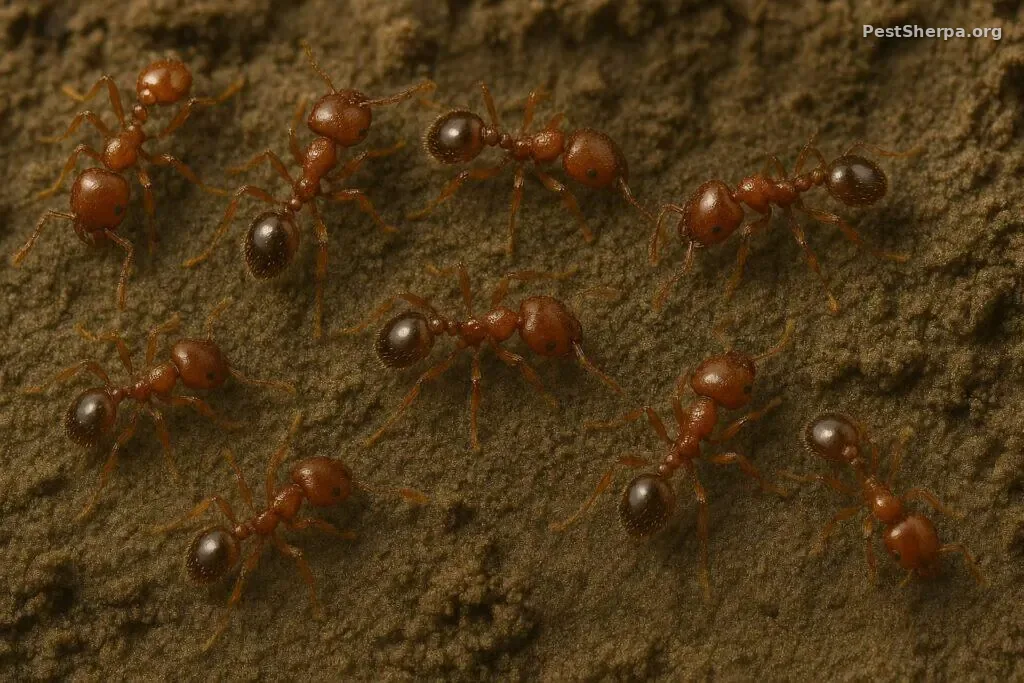
Fire ants belong mainly to the genus Solenopsis, a group of social ants within the family Formicidae. Colonies consist of workers, reproductive males, queens, and developing brood. Many species defend their nests aggressively using a combination of biting and repeated venomous stings.
The common name “fire ant” is also used for the unrelated European Fire Ant (Myrmica rubra) because of its painful sting. It belongs to a different ant genus (a genus is a group of closely related species).
Several different ants are called fire ants. So base your ID on worker size, body color, mound construction, nesting location, geographic range, and behavior, not the common name alone.
Key Fire Ant Species in North America
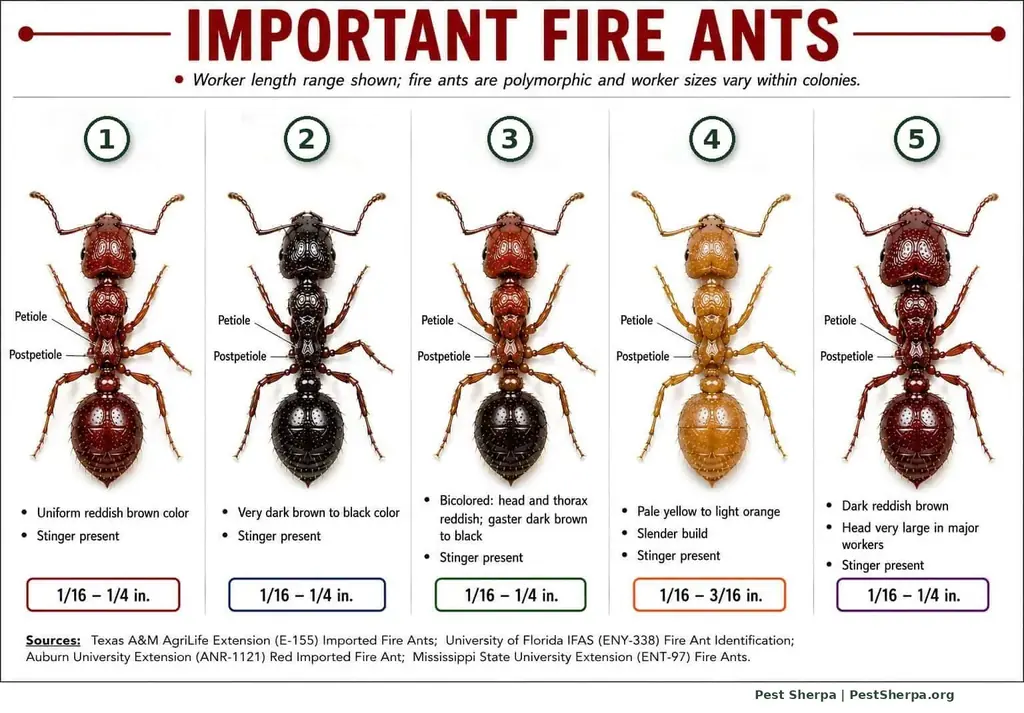
Which one did you find? Match the number:
- Red imported fire ant: uniform reddish brown.
- Black imported fire ant: very dark brown to black.
- Southern fire ant: bicolored: reddish head and thorax with a dark brown to black rear (gaster).
- Desert fire ant: pale yellow to light orange with a slender build.
- Tropical fire ant: dark reddish brown. Major workers have a very large head.
Several different species are often called fire ants, but they differ in appearance, distribution, and behavior.
Red Imported Fire Ant (Solenopsis invicta)
The Red Imported Fire Ant is the most widespread and economically significant imported fire ant in the United States. Native to South America, it arrived in the United States in the early 1900s. It is now established across much of the southeastern United States, with more populations in parts of the Southwest and California.12
Workers vary in size from about 1/16 to 1/4 inch and are reddish brown with darker abdomens. Colonies often build visible mounds in sunny, open locations and respond aggressively when disturbed.
Black Imported Fire Ant (Solenopsis richteri)
The Black Imported Fire Ant is another introduced South American fire ant. It is less widespread than the Red Imported Fire Ant and has been displaced or hybridized in some areas where the two species overlap. It remains important in portions of the southeastern United States and can still produce painful stings and nuisance infestations.
Southern Fire Ant (Solenopsis xyloni)
The Southern Fire Ant is a native fire ant species found in parts of the southern and western United States. It may nest under stones, boards, pavers, logs, or debris rather than always producing the obvious dome-like mounds associated with imported fire ants.
Desert Fire Ant (Solenopsis aurea)
The Desert Fire Ant is a smaller yellowish to reddish species associated with arid regions of the southwestern United States. It is not usually the large-scale yard and public-health problem that Red Imported Fire Ants are. It can still sting, though, and may be confused with other reddish ants.
Tropical Fire Ant (Solenopsis geminata)
The Tropical Fire Ant is common in tropical and subtropical regions, including Puerto Rico and other warm areas. It may occur in disturbed habitats, fields, lawns, and around structures. In tropical climates, fire ants may remain active for much of the year.
European Fire Ant (Myrmica rubra)
The European Fire Ant is not a true Solenopsis fire ant. It is often grouped with fire ants because of its painful sting and aggressive nest defense. This invasive ant has become established in parts of the northeastern United States and eastern Canada.56
Unlike imported fire ants, European fire ants often prefer moist, shaded spots. Look in mulch beds, landscaped edges, leaf litter, lawns near woods, gardens, and forest edges.
Expanding Distribution Across North America
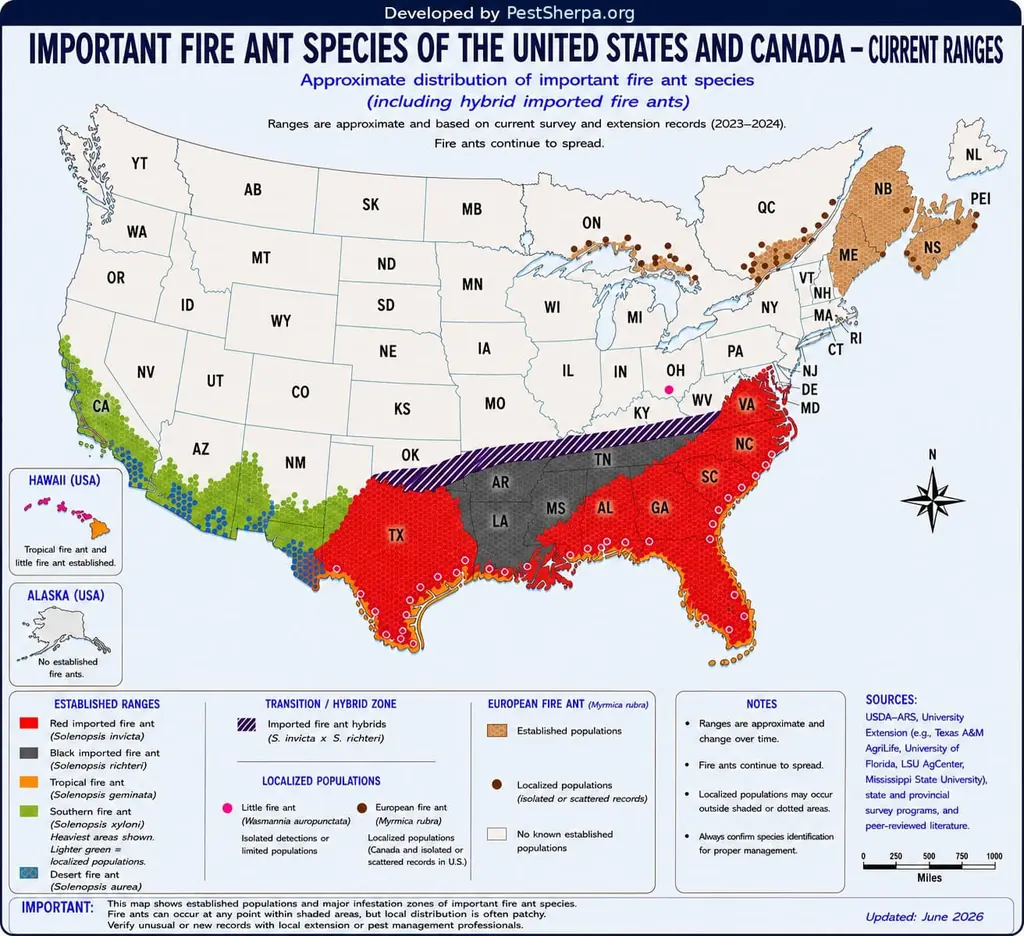
Fire ant distribution varies by species. Imported fire ants remain concentrated in warm southern and western areas. European fire ants matter more in parts of the Northeast and eastern Canada.
Southeastern United States
Imported fire ants remain most concentrated across the southeastern United States. There, warm temperatures, suitable soils, and year-round or nearly year-round foraging support large populations. Red Imported Fire Ants are especially important in lawns, pastures, parks, roadsides, athletic fields, farms, and landscaped areas.
Southwest and California
Fire ant issues also occur in parts of the Southwest and California. The University of California IPM (integrated pest management) program lists Red Imported Fire Ants as an important regulated pest in California. There, moving infested soil, nursery stock, sod, and other materials can help them spread.2
Northeastern United States
Imported fire ants are limited by cold climates, but European Fire Ants have become a serious stinging ant problem in parts of the Northeast. They are especially associated with moist, shaded habitats that are very different from the sunny mounds typical of imported fire ants.
Eastern Canada
European Fire Ants have also become established in parts of eastern Canada, where they may create problems in lawns, gardens, parks, and landscaped areas. Their presence is one reason the statement “fire ants are only a southern U.S. pest” is no longer accurate.
Puerto Rico and Tropical Regions
In tropical and subtropical environments, fire ants can remain active for extended periods and may reproduce continuously when conditions are favorable. Tropical Fire Ants and other warm-climate species may be more relevant in these regions than cold-limited imported fire ant populations.
Signs You Have Fire Ants
Fire ant identification should be based on several clues together rather than color alone. Many harmless or less aggressive ants are reddish or brownish and can be mistaken for fire ants.
- Visible soil mounds: Imported fire ants often build irregular soil mounds in lawns, fields, and open sunny areas.
- Aggressive colony response: Workers may quickly rush out when a mound or nest area is disturbed.
- Painful stings: Fire ants can bite to anchor themselves and then sting, often multiple times.
- Variable worker sizes: Imported fire ant colonies often contain workers of noticeably different sizes.
- Activity after rain or irrigation: Mounds may become more visible after wet weather or watering.
- Moist shaded nests: European Fire Ants may nest in mulch, leaf litter, garden beds, and shaded lawns rather than large sunny mounds.
For a deeper visual comparison, use the Pest Sherpa ant mound identification guide.
Why Fire Ants Matter
Fire ants are mainly nuisance and public-health pests rather than structural pests. Unlike termites or carpenter ants, they do not destroy framing lumber or excavate structural wood. Their importance comes from painful stings, aggressive colony defense, expanding invasive populations, impacts on outdoor activities, agriculture, pets, wildlife, and occasionally electrical equipment.
Public Health
Fire ant stings usually produce immediate burning pain followed by itchy pustules that may remain for several days. Most people recover without complications, but sensitive individuals can develop severe allergic reactions requiring emergency medical attention. Large numbers of stings can also be medically significant, especially for children, older adults, or people unable to escape an attacking colony.8
Pets and Wildlife
Fire ants readily sting pets, livestock, ground-nesting wildlife, and young animals. Colonies around kennels, dog runs, barns, feed storage, gardens, and livestock facilities can become recurring problems if left unmanaged.
Agriculture and Landscapes
Large fire ant populations interfere with mowing, harvesting, irrigation maintenance, gardening, landscaping, recreational activities, and outdoor work. Imported fire ants are considered economically important agricultural pests across much of the southern United States.1
Electrical Equipment
Imported fire ants occasionally nest around electrical equipment, utility boxes, irrigation controllers, HVAC equipment, and similar protected locations. Although not every colony causes equipment problems, their presence around electrical infrastructure has been well documented.
What Fire Ants Do NOT Damage
Fire ants are often blamed for damage actually caused by termites or carpenter ants. Understanding what they do not do helps avoid unnecessary or incorrect treatment.
- Fire ants do not consume structural lumber like termites.
- They do not tunnel through framing members to feed on cellulose.
- They do not excavate galleries inside structural wood like carpenter ants.
- They are not wood-destroying insects.
- They rarely indicate structural damage to a building.
Found damaged wood, hollow framing, mud tubes, or sawdust-like frass (insect droppings and wood debris)? Compare your findings with our guides on termites and carpenter ants before assuming fire ants are responsible.
Not Every Stinging Ant Is a Fire Ant
Painful stings alone do not confirm a fire ant infestation. Several other ants sting or bite, and many reddish ants are routinely misidentified as fire ants.
- Asian needle ants: painful sting, often found in shaded wooded habitats. Compare with the Asian needle ant guide before assuming fire ants.
- Harvester Ants: larger ants that build distinctive nests and can deliver painful stings.
- Field Ants: may build soil mounds but generally behave much less aggressively.
- Pavement Ants: often nest beneath sidewalks and slabs but rarely produce the intense sting response associated with imported fire ants.
- European Fire Ants, not true Solenopsis fire ants but often confused because of their painful sting.
- Allegheny mound ants: build large dome-shaped soil mounds and bite rather than sting. Often confused with fire ants because of the mounds.
Correct identification should consider worker size variation, body color, mound construction, nesting location, colony behavior, and geographic distribution, not simply whether an ant stings.
Fire Ant Species Comparison
| Species | Range | Mound | Sting | Typical Habitat |
|---|---|---|---|---|
| Red Imported Fire Ant | Southeast, Southwest, California | Large soil mounds | Very painful | Sunny lawns, fields, landscapes |
| Black Imported Fire Ant | Localized Southeast | Soil mounds | Painful | Open landscapes |
| Southern Fire Ant | Southern & Western U.S. | Often beneath objects | Painful | Natural and disturbed habitats |
| Tropical Fire Ant | Tropical & subtropical regions | Variable | Painful | Warm humid environments |
| European Fire Ant | Northeast & Eastern Canada | Usually no large mound | Painful | Moist shaded mulch, gardens, woods |
Control and Management Strategies
Effective fire ant management begins with correct identification. Because different species occupy different habitats and respond somewhat differently to treatment, identifying the ant first prevents wasted time and unnecessary pesticide applications.
1. Treat the Entire Colony
Killing only the visible workers rarely eliminates the colony. Fire ant colonies continue to function as long as queens and developing brood survive.
2. Broadcast Baits for Larger Infestations
University extension programs generally recommend bait products as the foundation of area-wide fire ant management. Workers collect bait and distribute it throughout the colony, providing much broader control than contact insecticides alone.34
3. Treat Individual Mounds When Needed
Direct mound treatments may be appropriate when individual colonies pose immediate risks around homes, playgrounds, patios, sidewalks, mailboxes, or high-use outdoor areas.
4. Reduce Favorable Conditions
- Reduce unnecessary irrigation where practical.
- Remove food sources around outdoor eating areas.
- Maintain lawns and landscapes.
- Monitor disturbed soil after landscaping projects.
- Inspect nursery stock, sod, and soil brought onto the property.
5. Know When Professional Help Is Worthwhile
Professional treatment often makes sense when multiple colonies are present or infestations keep coming back despite homeowner efforts. It also makes sense when fire ants create health or safety concerns for children, pets, livestock, or sensitive people.
Frequently Asked Questions
Are all fire ants aggressive?
No. Aggressiveness varies considerably among species. Imported fire ants generally respond more aggressively to disturbance than many native ants.
Do all fire ants build mounds?
No. Large exposed soil mounds are most often associated with imported fire ants. Other species may nest beneath rocks, logs, landscape timbers, mulch, pavers, or other protected locations.
Are fire ants only found in the southern United States?
No. Imported fire ants remain concentrated in warmer southern regions. Other fire ant species, including European Fire Ants, now occur in parts of the Northeast and eastern Canada.
Can fire ants damage my house?
Generally no. Fire ants are not wood-destroying insects. Their primary concerns are painful stings, nuisance infestations, interference with outdoor activities, agriculture, pets, and occasionally electrical equipment.
What is the best fire ant treatment?
The best treatment depends on the species, infestation size, and property. For widespread infestations, extension recommendations generally favor a combination of broadcast baiting and targeted mound treatments rather than relying on mound treatments alone.3
Conclusion
The idea that fire ants are limited to the southern United States is outdated. Today, multiple native and invasive fire ant species occur across North America, each with different biology, distributions, habitats, and management requirements.
Correct identification is the foundation of effective fire ant management. Knowing which species you are dealing with helps you make better treatment decisions and cut unnecessary pesticide use. It also helps you better protect people, pets, landscapes, and property.
References
- USDA APHIS. Imported Fire Ant Program.
- University of California IPM. Red Imported Fire Ant.
- Texas A&M AgriLife Extension. Fire Ant Biology and Control.
- University of Florida IFAS Extension. Fire Ant Management in Florida.
- University of Maine Extension. European Fire Ant.
- Maine Department of Agriculture. European Fire Ant Fact Sheet.
- Tschinkel WR. The Fire Ants. Harvard University Press.
- World Health Organization. Public Health Significance of Urban Pests.
This article was written by Greg Baumann, founder of Pest Sherpa, and reflects more than 40 years of professional pest management experience.
About the Author

Greg Baumann | Pest Control Expert
Greg Baumann is the founder of Pest Sherpa and a Pest Control Expert with more than 40 years of professional pest management experience. His articles combine decades of field experience, technical expertise, and science-based guidance to help homeowners identify pests correctly, understand real-world risks, and make informed pest management decisions.
Mission: Identify the pest. Understand the risk. Stop the problem. Prevent the comeback. Know when it’s time to call a professional.