
Deer Mice: Identification, Health Risks, Cleanup, and Control
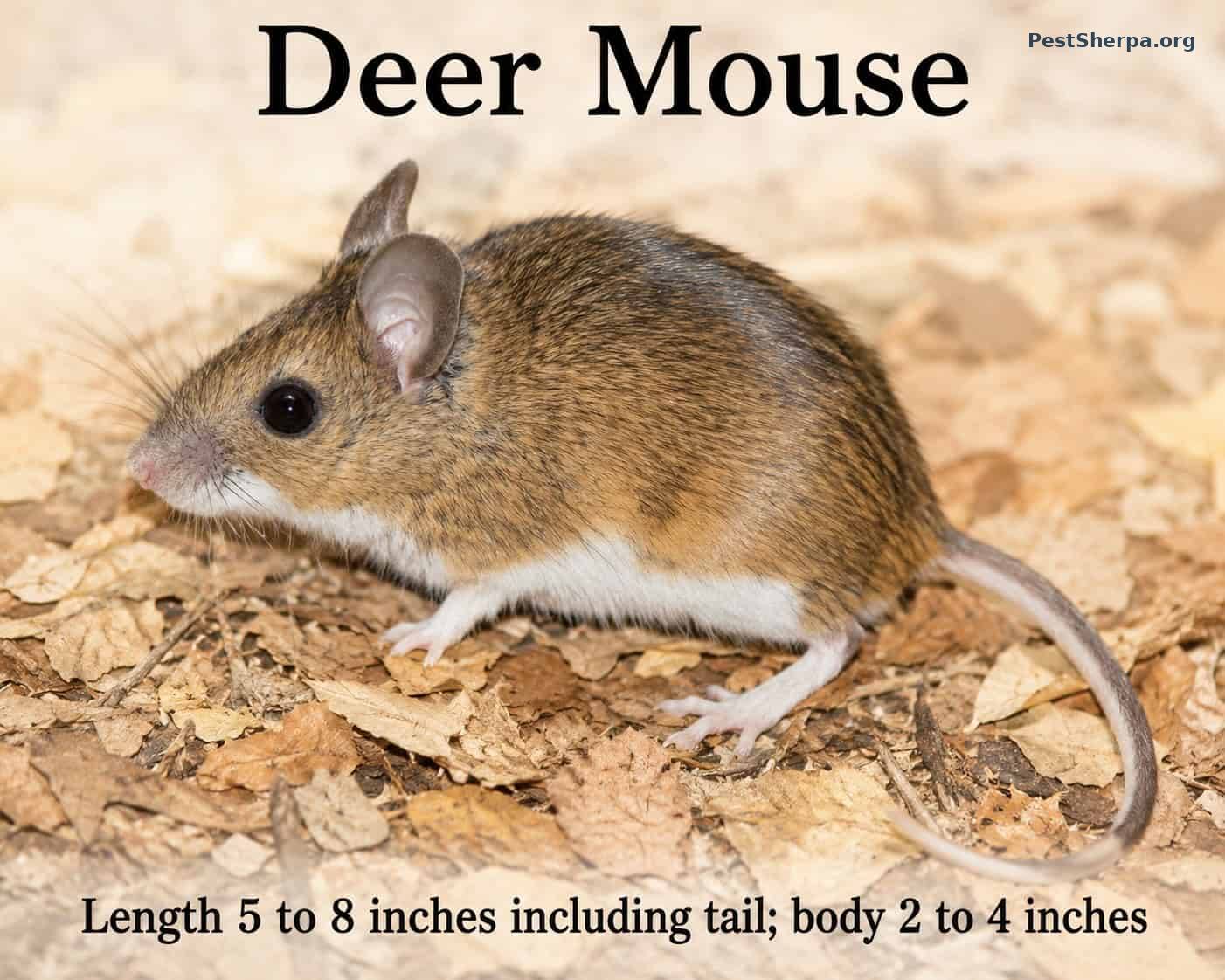
Deer mice are small native rodents in the genus Peromyscus. The name is most often applied to the North American deer mouse, Peromyscus maniculatus, but several closely related Peromyscus mice can look similar. Around homes, cabins, barns, sheds, and storage buildings, correct identification matters because deer mice differ from house mice in appearance, habitat, behavior, and public-health importance.
Unlike the house mouse, which is strongly associated with human structures, deer mice usually live outdoors in forests, fields, grasslands, agricultural edges, brushy areas, and semi-rural settings. They may enter buildings when they find food, nesting materials, shelter, or protected winter harborage. This guide explains how to identify deer mice, what their presence may mean, how to investigate the source, how to clean up rodent evidence more safely, and when professional help may be worth considering.
TL;DR
Deer mice are small, brown-to-gray native mice with white underparts, large eyes, large ears, and a distinctly two-toned tail. They are more common around fields, woods, cabins, garages, sheds, barns, crawl spaces, and rural or semi-rural homes than in dense urban settings.
A single mouse sighting does not prove a large infestation, but repeated sightings, droppings, nesting material, gnawing, nighttime sounds, or contaminated storage areas should be investigated. Deer mice are important because they can be associated with hantavirus risk in some areas. Do not sweep or vacuum rodent droppings, urine, nests, or carcasses. Use wet disinfecting methods and follow public-health guidance before cleanup.
The most effective long-term approach is to identify the rodent, remove food and nesting sources, seal entry points, use traps carefully when appropriate, and clean contaminated areas safely.
Quick Navigation
- How to Identify Deer Mice
- Deer Mouse vs. House Mouse
- What Deer Mice Mean in a Home
- Habitat and Distribution
- Behavior and Reproduction
- Health and Cleanup Concerns
- Common Signs of Deer Mouse Activity
- Source Investigation Checklist
- Prevention and Exclusion
- What To Do
- What Not To Do
- When Professional Help May Be Needed
- Lookalikes and Common Misidentifications
- Frequently Asked Questions
- References
How to Identify Deer Mice
Adult deer mice are small rodents, usually only a few inches long before the tail is included. Total adult length is commonly about 5 to 8 inches including tail, with the tail making up a large part of that measurement, although size can vary among species and populations. Most adults are lightweight, usually around a fraction of an ounce to about an ounce depending on life stage and populations.
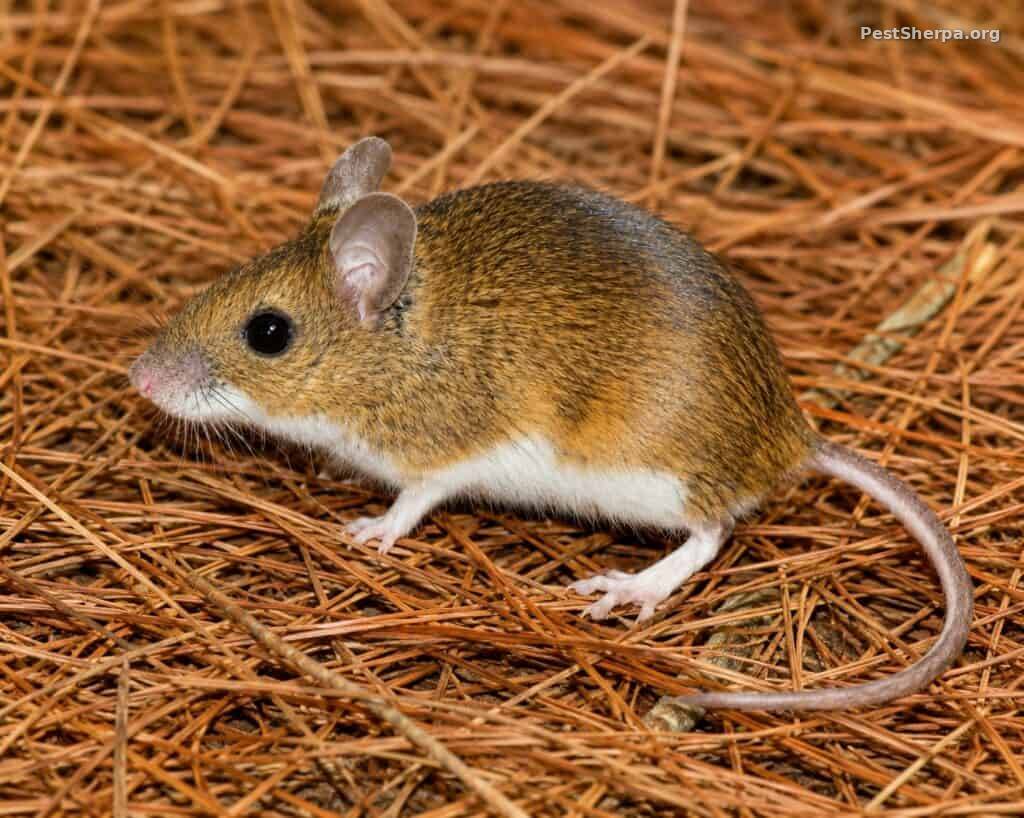
The most useful field marks are the sharp color contrast and the tail. Deer mice usually have brown, reddish-brown, or grayish-brown upperparts with white feet, a white belly, and a white underside. The tail is typically bicolored: darker on top and lighter underneath.
- Brown, reddish-brown, or grayish-brown back
- White belly, feet, and underside
- Distinctly two-toned tail
- Prominent dark eyes and relatively conspicuous ears compared with a house mouse
- Quick, agile movement and good climbing ability
- Small dark droppings, generally mouse-sized and often pointed at one or both ends
Because deer mice can resemble white-footed mice and other native Peromyscus species, exact species-level identification can be difficult from a quick indoor sighting. Color pattern, tail appearance, habitat, droppings, nesting location, and where the mouse was found all help narrow the identification.
Deer Mouse vs. House Mouse
Deer mice and house mice are similar in size, but they usually differ in color, tail appearance, and habitat association.
| Feature | Deer Mouse | House Mouse |
|---|---|---|
| Body color | Brown to grayish-brown above, white below | More uniformly gray or brownish-gray |
| Tail | Often clearly bicolored, dark above and pale below | Usually more uniformly colored and less distinctly two-toned |
| Eyes and ears | Relatively large | Usually less prominent |
| Common setting | Rural, semi-rural, wooded, field-edge, cabin, barn, shed, garage, crawl space | Homes, apartments, warehouses, kitchens, stored-food areas, wall voids |
| Public-health note | Important to evaluate because deer mice can be associated with hantavirus risk | Still a sanitation pest, but not the main U.S. deer-mouse hantavirus reservoir |
Identification tip: A white belly and bicolored tail point toward deer mouse or another Peromyscus mouse. A more uniformly gray-brown mouse living deep inside a structure may be a house mouse. When droppings, nests, or carcasses are present, treat the area cautiously regardless of which rodent you suspect.
What Deer Mice Mean in a Home
Finding a deer mouse indoors usually means the building has at least one access point and at least one attractive condition nearby. The mouse may have entered for warmth, food, nesting material, or protection from weather and predators.
| What You Notice | What It May Mean |
|---|---|
| One mouse sighting | Possible recent entry from outdoors |
| Repeated nighttime sightings | Likely active indoor movement |
| Droppings in cabinets, boxes, or drawers | Food or shelter is being used |
| Nesting material in storage | Possible established nesting site |
| Activity in a cabin, shed, barn, or garage | Common deer mouse setting, especially near fields or woods |
| Rodent evidence in an unused building | Cleanup should be approached carefully before sweeping, vacuuming, or moving stored items |
Deer mice are often a building-condition clue. The long-term solution is usually not just removing the mouse you see, but also correcting the food, clutter, access, and nesting conditions that allowed activity to develop.
Habitat and Distribution
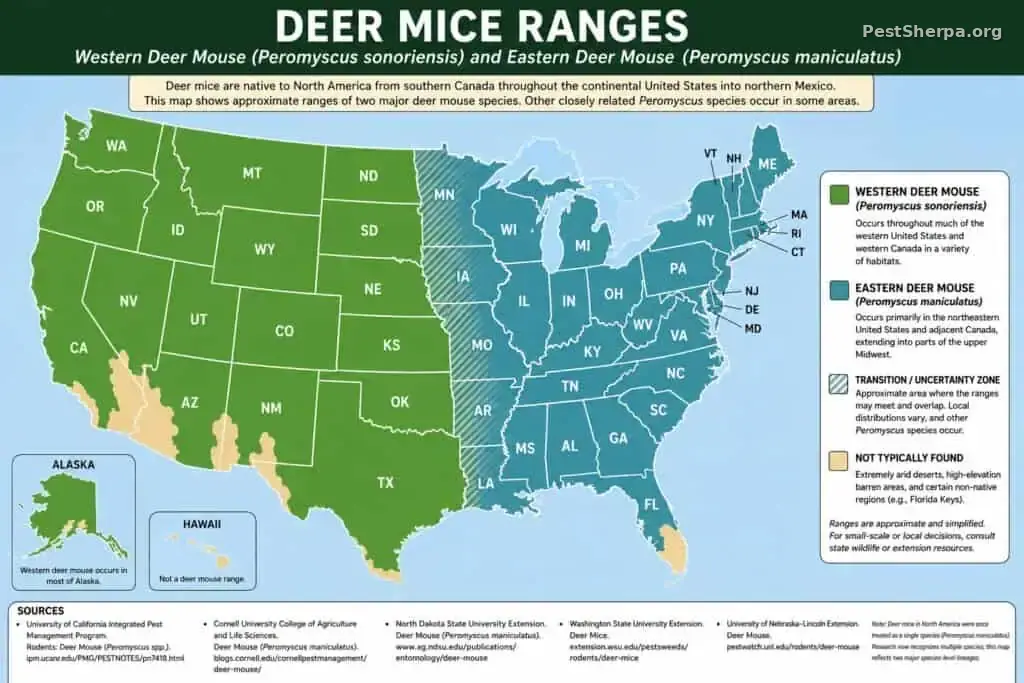
Deer mice occur across much of North America and are especially associated with outdoor habitats such as forests, grasslands, brush, agricultural land, field edges, and mountain or rural landscapes. Around people, they are often found where buildings meet natural habitat.
Common indoor and near-structure locations include:
- Cabins and vacation homes
- Barns, sheds, and outbuildings
- Garages and crawl spaces
- Attics and wall voids
- Grain, seed, livestock feed, birdseed, or pet-food storage areas
- Woodpiles, brush piles, and cluttered storage zones
- Recreational buildings that sit unused for long periods
Deer mice build nests from soft, fibrous material such as grasses, leaves, shredded paper, insulation, cloth, feathers, and other available nesting material. Indoors, nests may be hidden in stored boxes, furniture, wall voids, unused equipment, insulation, or quiet corners of outbuildings. Outdoors, they may nest under rocks, logs, brush, roots, and abandoned burrows.
Deer Mouse Behavior and Reproduction
Deer mice are mostly nocturnal. They usually stay hidden during the day and forage at night for seeds, grains, nuts, fruits, fungi, insects, and other available foods. Around buildings, they may use birdseed, pet food, livestock feed, pantry items, stored seed, and spilled grain.
When food and shelter are available, deer mice can reproduce quickly, up to four litters per year of 1-9 young per litter. Outdoor breeding is often tied to season, climate, and food availability, while sheltered indoor or outbuilding conditions may allow activity to continue longer. Young mice can mature quickly under favorable conditions.
Populations may fluctuate with weather and food supply. Years with abundant vegetation, seed production, or mild conditions can support more mice outdoors, which may increase the chance of mice entering nearby structures later.
Health and Cleanup Concerns Associated With Deer Mice
Deer mice are medically important because they are the primary U.S. reservoir associated with Sin Nombre virus, the hantavirus most often linked with hantavirus pulmonary syndrome in the United States. Hantavirus disease is rare, but it can be severe. Not every deer mouse carries hantavirus, and risk varies by region, habitat, exposure level, and cleanup situation.
People can be exposed when fresh rodent urine, droppings, saliva, nesting material, or contaminated dust is disturbed and inhaled. Risk is often highest when cleaning enclosed or poorly ventilated spaces such as cabins, sheds, barns, crawl spaces, garages, storage rooms, and outbuildings that have had rodent activity.
Hantavirus pulmonary syndrome symptoms may begin with fever, fatigue, and muscle aches and may later progress to coughing or shortness of breath. Anyone who becomes ill after significant rodent exposure should promptly contact a healthcare professional and mention the exposure.
Safer Cleanup Basics
Do not sweep or vacuum dry rodent contamination. Wear rubber or plastic gloves, thoroughly wet urine and droppings with an EPA-registered disinfectant or appropriately prepared bleach solution, allow the required contact time, and wipe up with disposable towels. Follow current CDC instructions for nests, carcasses, heavy infestations, and contaminated enclosed spaces.
For more detailed public-health context, see the Pest Sherpa hantavirus disease and prevention guide. If you are wondering about person-to-person spread, the Q&A page Is hantavirus contagious from person to person? addresses that specific next question.
Safety note: Heavy infestations, extensive contamination, dead rodents, contaminated insulation, or activity in confined spaces may require additional precautions. When in doubt, pause cleanup and consult local public-health guidance or a qualified professional familiar with rodent contamination cleanup.
Common Signs of Deer Mouse Activity
Because deer mice are active mostly at night, signs are often noticed before the mouse itself is seen.
- Small dark droppings in drawers, cabinets, boxes, corners, shelves, or storage areas.
- Gnaw marks on food packaging, seed bags, cardboard, wood, or insulation
- Scratching or rustling sounds at night
- Nesting material made from shredded paper, cloth, insulation, grass, leaves, or feathers
- Damaged or contaminated stored food, birdseed, pet food, or livestock feed
- Tracks in dusty areas
- Rodent odor in enclosed storage spaces
- Small entry gaps near doors, siding, vents, pipes, utility lines, roof edges, or foundation openings
Mouse droppings alone may not identify the species with certainty, but they do confirm rodent activity. Treat droppings as potentially contaminated until the situation is evaluated and cleaned safely.
Deer Mouse Source Investigation Checklist
Use this checklist to narrow down why deer mice are present and where they may be moving.
Step 1: Identify the Main Activity Area
Look for where droppings, gnaw marks, tracks, or nesting material are most concentrated. Common areas include garages, sheds, attics, crawl spaces, cabinets, stored boxes, and feed-storage areas.
Step 2: Check Food Sources
Inspect birdseed, grass seed, livestock feed, pet food, pantry products, nuts, grains, and food waste. Replace damaged packaging with sealed rodent-resistant containers.
Step 3: Look for Nesting Conditions
Check insulation, stored fabric, paper, cardboard, unused equipment, outdoor clutter, woodpiles, brush, and undisturbed storage areas.
Step 4: Inspect Entry Points
Look for openings around doors, garage-door edges, foundation gaps, siding transitions, vents, utility lines, pipe penetrations, soffits, roof returns, and damaged screens. Mice can use very small openings, so even minor gaps deserve attention.
Step 5: Consider the Surrounding Habitat
Nearby fields, woods, brush, tall grass, grain storage, compost, livestock feed, and bird-feeding areas can support outdoor mouse populations that occasionally move indoors.
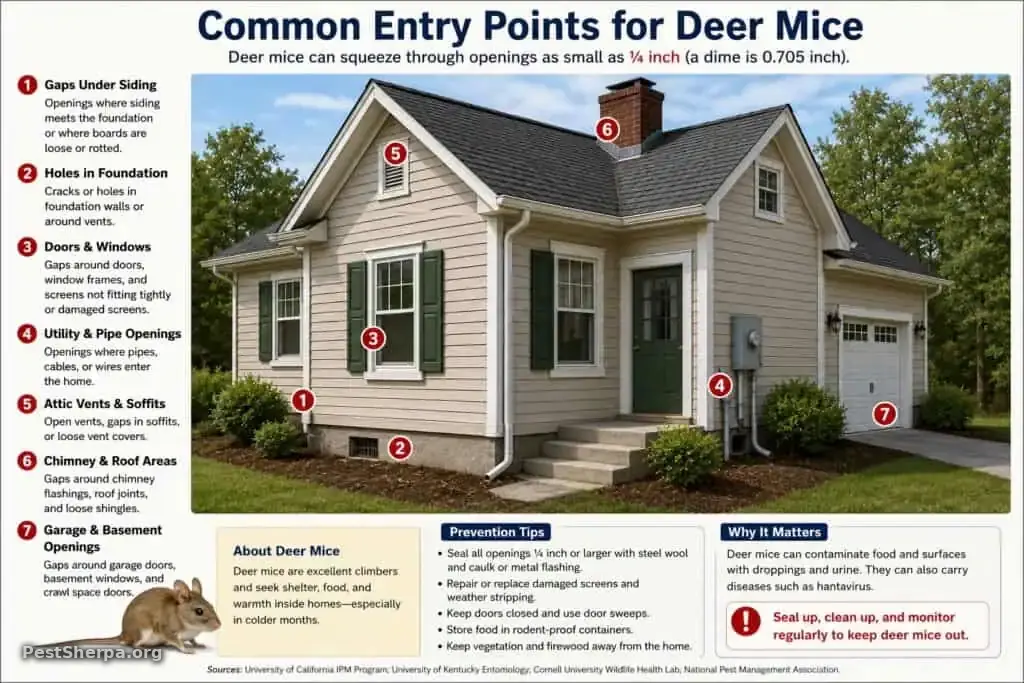
Common deer mouse entry points and nesting areas around a home, garage, attic, and crawl space.
Deer Mouse Prevention and Exclusion
Prevention works best when sanitation, storage, habitat reduction, and exclusion are used together. The goal is to remove the conditions that make the building useful to mice.
- Store food, birdseed, grass seed, livestock feed, and pet food in rodent-resistant containers
- Clean spilled seed, grain, pet food, and pantry debris promptly
- Reduce clutter in garages, sheds, basements, and storage rooms
- Keep firewood, brush, and stored materials away from exterior walls when practical
- Trim dense vegetation near buildings
- Repair torn screens, damaged vents, and missing door sweeps
- Seal gaps around pipes, utility lines, siding, foundations, and roof edges with durable rodent-resistant materials
- Check cabins, barns, sheds, and vacation homes before seasonal use
Because deer mice climb well, exclusion should include high and low openings. Do not limit inspection to the foundation. Roof edges, vents, soffits, siding gaps, chimney areas, and utility chases can also matter.
What To Do If You Find Deer Mice or Rodent Evidence
1. Confirm You Are Dealing With a Mouse
Use appearance, droppings, location, and habitat clues. If the animal is larger, has larger droppings, or is associated with burrows, roof travel, or heavy gnawing, compare it with Norway rats, roof rats, or pack rats and woodrats.
2. Pause Before Cleaning
If droppings, urine, nests, or dead rodents are present, do not sweep or vacuum. Ventilate enclosed spaces when appropriate, wear gloves, use wet disinfecting methods, and follow public-health cleanup guidance.
3. Remove Food and Nesting Sources
Secure food, seed, feed, and pet food. Reduce clutter, discard heavily contaminated cardboard when appropriate, and move stored items into durable containers where possible.
4. Seal Entry Points
Exclusion is one of the most important long-term steps. Seal openings with materials mice cannot easily chew through, and pay attention to both ground-level and elevated openings.
5. Use Traps Carefully When Appropriate
Snap traps can be useful when placed along active travel routes and handled safely. Avoid placing traps where children, pets, or non-target wildlife may contact them. Wear gloves when handling traps or rodent-contaminated materials, and disinfect traps and surrounding areas according to public-health guidance if rodents are captured.
Pesticides are not always necessary for mouse problems. If any pesticide or rodenticide is considered, read and follow the label exactly, use only products allowed for the site and pest, and protect children, pets, food, feed, wildlife, and water sources. Avoid casual indoor bait placement where a rodent could die in an inaccessible wall void or where non-target exposure is possible.
What Not To Do
- Do not dry sweep or vacuum rodent droppings, urine, nests, or dead rodents
- Do not handle dead rodents or contaminated nesting material with bare hands
- Do not rely on repellents, ultrasonic devices, or scent products as the main solution
- Do not leave birdseed, pet food, livestock feed, or pantry foods in chewable packaging
- Do not complete final exclusion until you have addressed rodents that may already be inside.
- Do not use foggers or broad indoor sprays for a rodent problem
- Do not place rodenticides casually in areas accessible to children, pets, livestock, or wildlife
For a related seasonal question, see Now that the weather is warmer, will mice leave my basement?. Mice may move differently by season, but food, shelter, and entry points still determine whether activity continues.
When Professional Help May Be Needed
Many minor mouse problems can be improved with careful sanitation, exclusion, monitoring, and safe cleanup. Professional help may be worth considering when the situation is larger, recurring, difficult to access, or involves contamination concerns.
- Rodent evidence is widespread or recurring
- Droppings, urine, nests, or dead rodents are present in an attic, crawl space, wall void, shed, barn, or cabin
- There is heavy contamination or contaminated insulation
- You cannot find or seal entry points
- Children, pets, vulnerable occupants, or food/feed areas are involved
- You are unsure whether the rodent is a deer mouse, house mouse, rat, or another species
- You need help designing a safe trapping, exclusion, and cleanup plan
A careful plan should focus on identification, entry-point correction, sanitation, trapping or removal where appropriate, and safe cleanup rather than relying on one product or one tactic.
Lookalikes and Common Misidentifications
Several rodents can be confused with deer mice. Use multiple clues rather than relying on color alone.
| Possible Lookalike | How It Differs | Helpful Comparison |
|---|---|---|
| House mouse | Usually more uniformly gray-brown, strongly associated with indoor human environments | House mouse guide |
| White-footed mouse | Very similar; often difficult to separate from deer mice without close examination and regional context | Keep unlinked unless a verified Pest Sherpa page is available |
| Pack rat or woodrat | Larger, often associated with bulky nests or collected objects | Pack rats and woodrats guide |
| Roof rat | Larger than mice, long tail, often uses elevated routes | Roof rat guide |
| Norway rat | Larger, heavier-bodied, often associated with burrows, foundations, sewers, and ground-level activity | Norway rat guide |
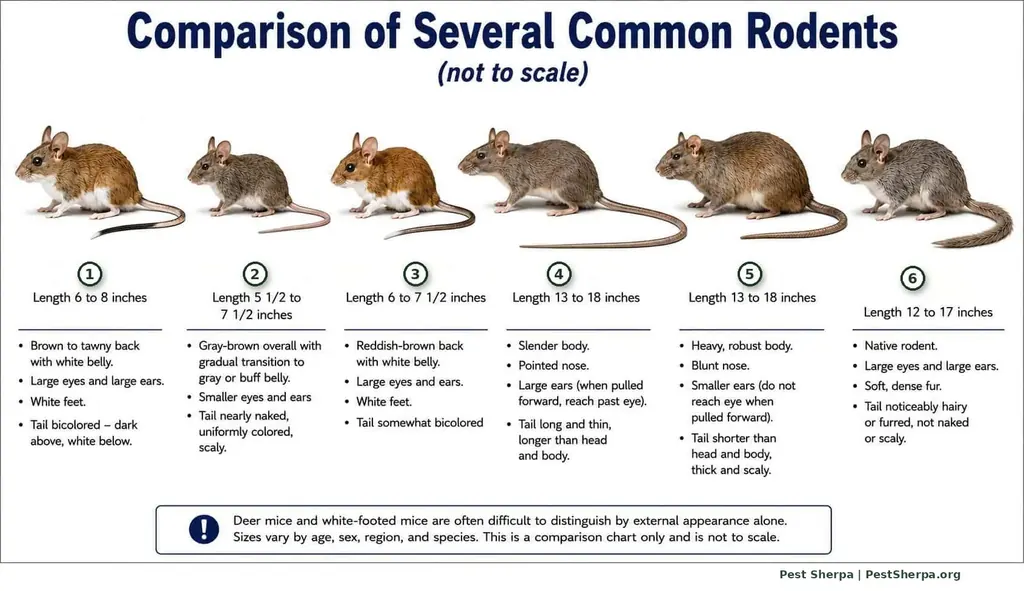
Which one do you see? Match the number:
- Deer mouse: 6 to 8 inches with tail, brown to tawny back, white belly and white feet, and a sharply two-toned tail.
- House mouse: 5 1/2 to 7 1/2 inches with tail, gray-brown overall, with a nearly naked, one-color tail.
- White-footed mouse: 6 to 7 1/2 inches with tail, reddish-brown back, white belly and feet. Very hard to tell from number 1 without an expert.
- Roof rat: 13 to 18 inches with tail, slender, with a pointed nose, large ears and a tail longer than the head and body.
- Norway rat: 13 to 18 inches with tail, heavy and robust, with a blunt nose, small ears and a tail shorter than the head and body.
- Pack rat (woodrat): 12 to 17 inches with tail, large eyes and ears, soft dense fur and a hairy tail.
Comparison of deer mouse, house mouse, white-footed mouse, roof rat, Norway rat, and pack rat.
Frequently Asked Questions
Does one deer mouse mean I have an infestation?
Not always. One mouse may have entered recently from outdoors. Repeated sightings, droppings in several areas, nesting material, gnawing, or contaminated food storage suggest a more established problem.
Are deer mice dangerous?
Deer mice should be taken seriously because they can contaminate food and surfaces, and in some areas they may be associated with hantavirus risk. The risk from any single mouse cannot be judged by appearance, so rodent evidence should be handled cautiously.
Can I vacuum deer mouse droppings?
No. Do not vacuum or dry sweep rodent droppings, urine, nests, or dead rodents. These actions can stir contaminated particles into the air. Use wet disinfecting methods and follow public-health cleanup guidance.
Where do deer mice hide indoors?
They may hide in garages, sheds, cabins, attics, crawl spaces, wall voids, stored boxes, insulation, furniture, unused equipment, and feed-storage areas. They prefer quiet, protected areas with nearby food or nesting material.
Will deer mice leave when the weather warms up?
Sometimes outdoor movement changes seasonally, but mice may remain if a building provides food, shelter, nesting material, or easy access. Warm weather alone is not a reliable control method.
What is the best way to prevent deer mice?
Use a combined approach: seal entry points, reduce clutter, store food and seed securely, manage vegetation and outdoor harborage, monitor for new signs, and clean any rodent evidence safely.
References
- University of California Statewide IPM Program: Deer Mouse
- Centers for Disease Control and Prevention: About Hantavirus
- Centers for Disease Control and Prevention: Hantavirus Prevention
- Centers for Disease Control and Prevention: How to Clean Up After Rodents
- Cornell Integrated Pest Management: Mouse and Rat Biology and Behavior
- Utah State University Extension: Deer Mouse
- Integrated Taxonomic Information System: Peromyscus maniculatus
This article was written by Greg Baumann, founder of Pest Sherpa, and reflects more than 40 years of professional pest management experience.
About the Author

Greg Baumann | Pest Control Expert
Greg Baumann is the founder of Pest Sherpa and a Pest Control Expert with more than 40 years of professional pest management experience. His articles combine decades of field experience, technical expertise, and science-based guidance to help homeowners identify pests correctly, understand real-world risks, and make informed pest management decisions.
Mission: Identify the pest. Understand the risk. Stop the problem. Prevent the comeback. Know when it’s time to call a professional.